Short synopsis of UAlbany Master’s thesis:“Web 2.0 Tool Use as a Learning Activity among Adult Higher Education Faculty”Mike Fortune
Learning Activity?The use of a Web 2.0 tool in a blended or fully online environment.  Not as a content or resource tool, but to engage students with pedagogical content.Inspired by use of Web 2.0 tools in Alex Pickett’s ETAP 687 course at UAlbany.
Participating Institutions“adult-friendly institutions”Empire State College, New York State (approx. 60 count)Granite State College, New Hampshire (approx. 20 count)SurveyMonkey survey (anonymous)IRB approval at UAlbany and ESC
Literature ReviewDetail of Web 2.0 use as a learning activity in higher education. Began with short descriptions of the C.o.I. Model, Andragogy, Social Constructivism and Connectivism.Citing of empirical evidence of use as a learning activity. Included text based tools (Twitter, Facebook, blogging, wikis), video (VoiceThread), audio podcasting,SL, etc.
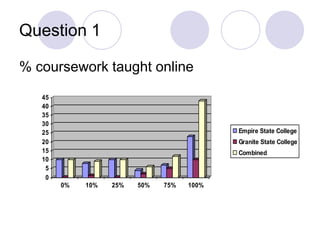
Question 1 % coursework taught online
Question 2“What is your area of study?”Many identified as cross-discipline!Majority taught “Cultural Studies,” B, M & E (Business, Management and Economics) or Education (was the most fully-online)Smallest number included History and Science, Math & Technology instructors
Question 3 “What, to you, makes a successful online learning experience?”More online teaching=deeper perspectiveSix answered “I don’t know” or “N/A.”Most popular terms used were “presence,”“clarity,” and  “feedback.”Large number referred to meaningful discussion board interaction.
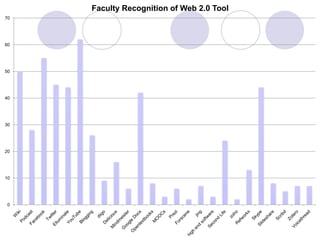
Question 4Faculty were given a list of 25 popular Web 2.0 tools in higher education and asked to identify those they were familiar with.
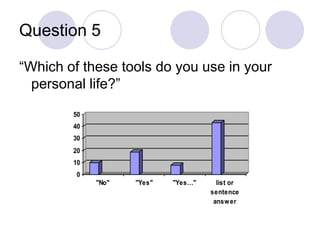
Question 5 “Which of these tools do you use in your personal life?”
Question 5Most stated using YouTube and/or Facebook.Next most popular was Skype.
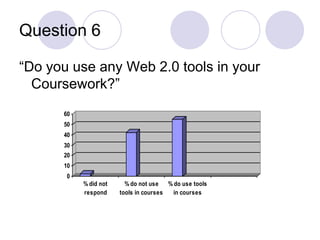
Question 6“Do you use any Web 2.0 tools in your Coursework?”
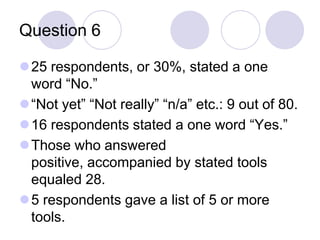
Question 625 respondents, or 30%, stated a one word “No.”“Not yet”“Not really”“n/a” etc.: 9 out of 80.16 respondents stated a one word “Yes.”Those who answered positive, accompanied by stated tools equaled 28.5 respondents gave a list of 5 or more tools.
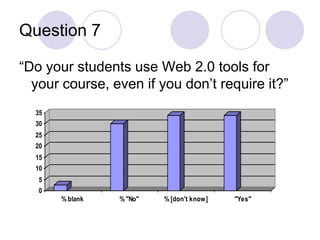
Question 7“Do your students use Web 2.0 tools for your course, even if you don’t require it?”
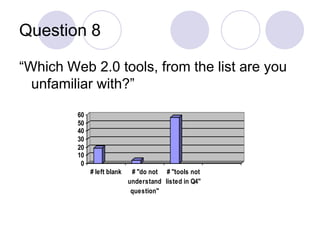
Question 8“Which Web 2.0 tools, from the list are you unfamiliar with?”
Question 9“Have you considered (but not yet) integrating Web 2.0 tools in online learning for adult learners?  Also, what might  be some deterrents or drawbacks to you?”
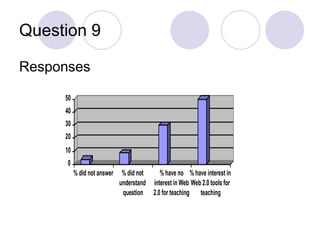
Question 9Responses
Response to Q9Those that don’t already indicated that they would if the following situations were address:Ability to personally install any tools on institution computers. Time to research the tools. Perceived lack of technology capability on the part of students. Time for faculty to experiment with any tool to determine how it could be usefully integrated for learning purposes in their study area.
Other findingsFaculty that made tool use mandatory for students reported no student adaptation problems.Many confused students referencing Wikipedia and viewing YouTube videos as a learning activity.
There is hope!Most stated that they wanted to learn more about various Web 2.0 tools.The vast majority of faculty surveyed showed in Q3 to already have a seasoned perspective of online learning.

Cit presentation

  • 1.
    Short synopsis ofUAlbany Master’s thesis:“Web 2.0 Tool Use as a Learning Activity among Adult Higher Education Faculty”Mike Fortune
  • 2.
    Learning Activity?The useof a Web 2.0 tool in a blended or fully online environment. Not as a content or resource tool, but to engage students with pedagogical content.Inspired by use of Web 2.0 tools in Alex Pickett’s ETAP 687 course at UAlbany.
  • 3.
    Participating Institutions“adult-friendly institutions”EmpireState College, New York State (approx. 60 count)Granite State College, New Hampshire (approx. 20 count)SurveyMonkey survey (anonymous)IRB approval at UAlbany and ESC
  • 4.
    Literature ReviewDetail ofWeb 2.0 use as a learning activity in higher education. Began with short descriptions of the C.o.I. Model, Andragogy, Social Constructivism and Connectivism.Citing of empirical evidence of use as a learning activity. Included text based tools (Twitter, Facebook, blogging, wikis), video (VoiceThread), audio podcasting,SL, etc.
  • 5.
    Question 1 %coursework taught online
  • 6.
    Question 2“What isyour area of study?”Many identified as cross-discipline!Majority taught “Cultural Studies,” B, M & E (Business, Management and Economics) or Education (was the most fully-online)Smallest number included History and Science, Math & Technology instructors
  • 7.
    Question 3 “What,to you, makes a successful online learning experience?”More online teaching=deeper perspectiveSix answered “I don’t know” or “N/A.”Most popular terms used were “presence,”“clarity,” and “feedback.”Large number referred to meaningful discussion board interaction.
  • 8.
    Question 4Faculty weregiven a list of 25 popular Web 2.0 tools in higher education and asked to identify those they were familiar with.
  • 10.
    Question 5 “Whichof these tools do you use in your personal life?”
  • 11.
    Question 5Most statedusing YouTube and/or Facebook.Next most popular was Skype.
  • 12.
    Question 6“Do youuse any Web 2.0 tools in your Coursework?”
  • 13.
    Question 625 respondents,or 30%, stated a one word “No.”“Not yet”“Not really”“n/a” etc.: 9 out of 80.16 respondents stated a one word “Yes.”Those who answered positive, accompanied by stated tools equaled 28.5 respondents gave a list of 5 or more tools.
  • 14.
    Question 7“Do yourstudents use Web 2.0 tools for your course, even if you don’t require it?”
  • 15.
    Question 8“Which Web2.0 tools, from the list are you unfamiliar with?”
  • 16.
    Question 9“Have youconsidered (but not yet) integrating Web 2.0 tools in online learning for adult learners? Also, what might be some deterrents or drawbacks to you?”
  • 17.
  • 18.
    Response to Q9Thosethat don’t already indicated that they would if the following situations were address:Ability to personally install any tools on institution computers. Time to research the tools. Perceived lack of technology capability on the part of students. Time for faculty to experiment with any tool to determine how it could be usefully integrated for learning purposes in their study area.
  • 19.
    Other findingsFaculty thatmade tool use mandatory for students reported no student adaptation problems.Many confused students referencing Wikipedia and viewing YouTube videos as a learning activity.
  • 20.
    There is hope!Moststated that they wanted to learn more about various Web 2.0 tools.The vast majority of faculty surveyed showed in Q3 to already have a seasoned perspective of online learning.