Welcome!
Investigation of Basement Flooding and Stormwater
Runoff Quality Control Study Area 38
Master Plan Class EA
Public Information Centre #1
View displays and discuss the study with project staff
Feel free to ask questions and fill out a comment sheet
1
Purpose of Tonight’s Meeting
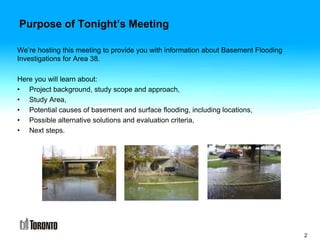
We’re hosting this meeting to provide you with information about Basement Flooding
Investigations for Area 38.
Here you will learn about:
• Project background, study scope and approach,
• Study Area,
• Potential causes of basement and surface flooding, including locations,
• Possible alternative solutions and evaluation criteria,
• Next steps.
2
Background
• Large storm events in 2000, 2002,
2005 and 2006 caused basement
and surface flooding across the
City.
• Through the Basement Flooding
Protection Program, the City is
developing plans to reduce flooding
risk in certain areas.
Maintenance hole lid damage
from Black Creek flooding Example of flooded basement
Example of ponding
Example of storm sewer surcharging
3
Background
• Study Area 38, located in the Etobicoke Creek
area, has experienced basement and surface
flooding during past extreme storms in 2005,
2012 and 2013.
• The study area is based on local sewer
system and generally bounded by:
• Rathburn Road – North
• Highway 407 – East
• Lakeshore Boulevard – South
• Etobicoke Creek – West
• The most recent flooding event was in July
2013 where 140 properties or 5% of all
properties in this study area reported flooding.
• Reports of flooding were predominantly
concentrated in residential neighbourhoods
north and south of Rathburn Road and Bloor
Street.
4
Purpose of Study
• Determine the contributing factors for surface and basement flooding in Area 38.
• Address flooding by improving infrastructure and where feasible, improve the
quality of stormwater runoff before it goes to Etobicoke Creek and Renforth
Creek.
• Recommend solutions to improve the City’s storm and sanitary sewer systems
including overland drainage routes.
5
What This Study Will and Will Not Cover
Will Cover: Public Lands - Any improvements to the sewer and drainage system to be
made within the City’s property such as parks, roads and sewer infrastructure.
Will Not Cover: Private Property Improvements - Each homeowner is responsible for
the operation and maintenance of drainage systems on private property which
includes:
• Lot grading
• Front and rear-yard or driveway
drainage catchbasins
• Foundation drains
• Sump pumps and backwater valves
• Private tree roots and what you put
down the drains (fats, oils, grease, etc)
• Disconnecting downspouts
6
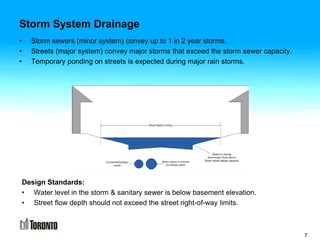
• Storm sewers (minor system) convey up to 1 in 2 year storms.
• Streets (major system) convey major storms that exceed the storm sewer capacity.
• Temporary ponding on streets is expected during major rain storms.
Design Standards:
• Water level in the storm & sanitary sewer is below basement elevation.
• Street flow depth should not exceed the street right-of-way limits.
Storm System Drainage
7
Investigating Basement Flooding: Steps Involved
8
Data Collection and Inventory
of Existing Conditions
Preliminary Assessment
Report
Identify Causes of Flooding
and Potential Solutions
Identify & Recommended
Solutions/Overall Strategy
Develop Conceptual Design
for Preferred Solutions
Prepare & File EA Report
WE ARE HERE
PIC #2
PIC #1
Municipal Class EA Process
• The City must meet the
requirements of Ontario’s
Environmental Assessment (EA)
Act for infrastructure projects.
• The EA process is an opportunity
for the public and agencies to
provide input.
• This project requires completion of
Phases 1 and 2 of the Class EA
process. We are in the early stages
of Phase 2.
9
PHASE 1
Identify and Describe the
Problem or Opportunity
PHASE 2A
Complete Study Area
Inventory, Identify
Alternative Solutions
Mandatory Review
Agency/Public
Notification
30 Day Review Period
Notice of Study
Commencement
Late in the Fall 2015
PHASE 5
Complete Drawings &
Documents, Proceed to
Construct, Operate and
Monitor Project
PHASE 2B
Evaluate Alternative
Solutions & Establish the
Preferred Solutions
Strategies
Mandatory Review
Agency/Public Consultation
PIC #2
Fall 2016
Mandatory Review
Agency/Public Consultation
PIC #1
May 18, 2016
Existing & Future Land Use / Natural Environment
10
“The study area is
highly urbanized
with vegetation
communities
clustered around
Etobicoke Creek.”
Existing Land Use Future Land Use Natural Environment
Natural environment
features include Etobicoke
Creek, Renforth Creek and
vegetation communities
clustered around these
water courses. Natural
environment features
including species at risk
will be further defined
based on desk top and
field investigations
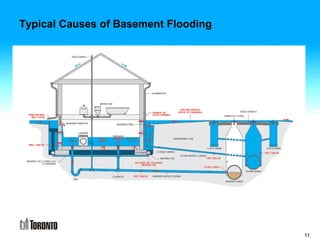
Typical Causes of Basement Flooding
11
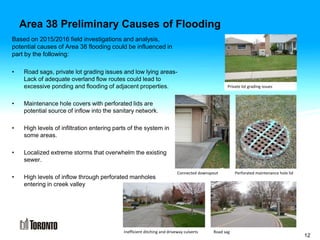
Area 38 Preliminary Causes of Flooding
Based on 2015/2016 field investigations and analysis,
potential causes of Area 38 flooding could be influenced in
part by the following:
• Road sags, private lot grading issues and low lying areas-
Lack of adequate overland flow routes could lead to
excessive ponding and flooding of adjacent properties.
• Maintenance hole covers with perforated lids are
potential source of inflow into the sanitary network.
• High levels of infiltration entering parts of the system in
some areas.
• Localized extreme storms that overwhelm the existing
sewer.
• High levels of inflow through perforated manholes
entering in creek valley
12
Perforated maintenance hole lid
Road sag
Connected downspout
Inefficient ditching and driveway culverts
Private lot grading issues
Basement Flooding
by Cluster
13
• Area 38 flooding problems are
generally confined to five
cluster areas.
• The study will also review non-
cluster areas to confirm if
adequate design standards are
in place.
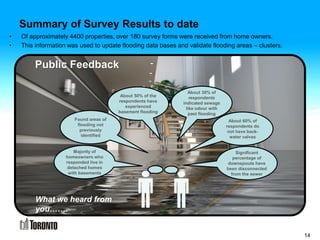
Summary of Survey Results to date
14
Majority of
homeowners who
responded live in
detached homes
with basements
Found areas of
flooding not
previously
identified
About 30% of
respondents
indicated sewage
like odour with
past flooding
About 60% of
respondents do
not have back-
water valves
Significant
percentage of
downspouts have
been disconnected
from the sewer
Public Feedback
What we heard from
you…….
About 50% of the
respondents have
experienced
basement flooding
• Of approximately 4400 properties, over 180 survey forms were received from home owners.
• This information was used to update flooding data bases and validate flooding areas – clusters.
15
Homeowner Measures to Control Flooding - Isolating your
home’s plumbing from the City’s sewer systems
16
Methods for Reducing Basement Flooding & Improving
Stormwater Runoff Quality
Source Controls:
• Source control measures involve managing stormwater
where it originates (roofs, roads, driveways), before it
enters the City’s sewer pipes.
Conveyance Controls:
• Conveyance control measures help to control stormwater
as it travels along the drainage system (in pipes or along
the road).
End of Pipe Controls:
• End-of-pipe control measures control stormwater just
before it is discharged to a watercourse (stream, river, or
lake).
17
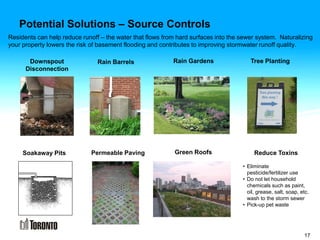
Potential Solutions – Source Controls
Residents can help reduce runoff – the water that flows from hard surfaces into the sewer system. Naturalizing
your property lowers the risk of basement flooding and contributes to improving stormwater runoff quality.
Rain Barrels Tree PlantingDownspout
Disconnection
Reduce ToxinsPermeable Paving
• Eliminate
pesticide/fertilizer use
• Do not let household
chemicals such as paint,
oil, grease, salt, soap, etc.
wash to the storm sewer
• Pick-up pet waste
Soakaway Pits Green Roofs
Rain Gardens
18
Potential Solutions – Source Controls
Sealing
Maintenance
Hole Covers
Additional source control options:
• Sewer Maintenance and Rehabilitation
Involves:
• Sanitary Sewer: CCTV, smoke/dye tests, sewer cleaning, relining, and repair
• Storm System: Street sweeping, seasonal leaf pick-up, catchbasin vacuum
cleanouts
Surface Flow Path
Diversion
Pervious Pavement
These measures can also help reduce the amount of runoff entering the sewer system.
19
Potential Solutions – Conveyance Controls
Description
• A vegetated depression and underground
trench designed to filter stormwater runoff
to remove pollutants and promote
infiltration/evapotranspiration
What Does it Involve?
• Diversion of small overland or piped
drainage areas for small storm events
• Excavation of a trench with specific soil
mixture, surface plantings and underdrain
within an open area such as a boulevard
or park
Description
• Maintain/enhance existing ditches
and culverts which slow down
surface water and encourage
infiltration/filtration
• Retrofit existing concrete curb and
gutter streets with grassed
ditches/swales if opportunity exists
What Does it Involve?
• Excavation of ditches and installation
of shallow culvert pipes where
appropriate
Road Cross-Section Retrofits (Ditches)
(Improve Stormwater Runoff Quality)
Local Bioretention Filters
(Improve Stormwater Runoff Quality)
20
Potential Solutions – Conveyance Controls
Increase Number of Catchbasins
(Controls Basement Flooding)
Overland (Major System)
Control
(Controls Basement Flooding)
What Does it Involve?
• Addition of “speed bump” or “curb cut” to
redirect overland flow to strategic locations
• Interception of road or boulevard flows to
dedicated major system sewer with large inlet
grate or “curb drain”
What Does it Involve?
• Minor street excavation for installation of
new catchbasin(s) and connection to
storm sewer
• Curb replacement and road restoration
Description
• The diversion of surface
drainage away from low
lying areas that have no
direct outlet to reduce
surface ponding depths
Description
• Where the storm
sewer has existing
capacity, add more
catchbasins to
capture more flow
from the surface
21
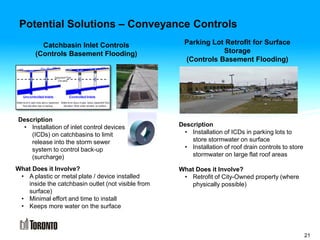
Potential Solutions – Conveyance Controls
Parking Lot Retrofit for Surface
Storage
(Controls Basement Flooding)
Catchbasin Inlet Controls
(Controls Basement Flooding)
What Does it Involve?
• A plastic or metal plate / device installed
inside the catchbasin outlet (not visible from
surface)
• Minimal effort and time to install
• Keeps more water on the surface
Description
• Installation of ICDs in parking lots to
store stormwater on surface
• Installation of roof drain controls to store
stormwater on large flat roof areas
What Does it Involve?
• Retrofit of City-Owned property (where
physically possible)
Description
• Installation of inlet control devices
(ICDs) on catchbasins to limit
release into the storm sewer
system to control back-up
(surcharge)
22
Potential Solutions – Conveyance Controls
Adding New Sewers (Twinning)
(Controls Basement Flooding)
Replacement of Existing Storm
and/or Sanitary Sewers
(Controls Basement Flooding)
Description
• Increase the size of the sewer pipe by
replacing the old sewer with a larger pipe
What Does it Involve?
• Road excavation within City limits
• Removal of old sewer and structures
(manholes & catchbasins) and disconnection
of sewer service line(s)
• Placement of new sewer, reconnection of
sewer service line(s) and restoration of road
and boulevard
Description
• Increase the capacity of the sewer system by
adding another sewer pipe in addition to the
existing pipe
What Does it Involve?
• Road excavation within City limits
• Replacement of old structures (manholes &
catchbasins) and reconnection of sewer
service line(s), if necessary
• Placement of new sewer, reconnection of
sewer service line(s) and restoration of road
and boulevard
23
Potential Solutions – End of Pipe Controls
Wet Pond/Wetland
(Controls Basement Flooding and
Can Improve Runoff Quality)
Dry Pond
(Controls Basement Flooding)
Description
• An engineered surface depression that controls
the quantity of inflowing stormwater through
storage and slow release to the receiving
system
• Typically fills with water during extreme storm
events and drains within 24 to 48 hours or less
What Does it Involve?
• Excavation and shaping of a suitable open
space
• Addition of inlet/outlet structures
• Restoration and landscaping; signage
Description
• An engineered pond or wetland with a
permanent water surface that controls the
quantity and quality of inflowing stormwater
through storage and slow release to the
receiving system
What Does it Involve?
• Excavation and shaping of a suitable open
space
• Addition of inlet/outlet structures
• Restoration and landscaping (aquatic and
side-slope)
• Infrequent maintenance (sediment removal)
24
Potential Solutions – End of Pipe Controls
Oil & Grit Separator
(Improves Stormwater Runoff
Quality)
Underground Storage Tank
(Controls Basement Flooding & Can
Improve Stormwater Runoff Quality)
Description
• An underground tank or pipe that controls the
rate of inflowing sanitary or stormwater
through temporary detention and slow release
to the receiving sewer, reducing the potential
for flooding
What Does it Involve?
• Excavation and construction of tank or pipe,
including inlet and outlet structures
• Infrequent maintenance (monitoring, clean-
out)
What Does it Involve?
• Similar to a manhole, minor street
excavation for installation of structure
• Road restoration
• Annual maintenance (vacuum clean-
out)
Description
• An underground
separation tank that
takes the place of a
conventional manhole
and provides a measure
of treatment for small
drainage areas
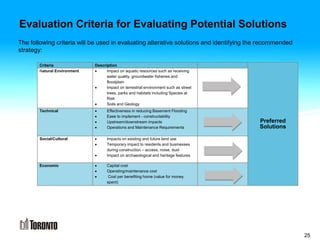
Evaluation Criteria for Evaluating Potential Solutions
The following criteria will be used in evaluating alterative solutions and identifying the recommended
strategy:
25
Criteria Description
Preferred
Solutions
Natural Environment  Impact on aquatic resources such as receiving
water quality, groundwater fisheries and
floodplain
 Impact on terrestrial environment such as street
trees, parks and habitats including Species at
Risk
 Soils and Geology
Technical  Effectiveness in reducing Basement Flooding
 Ease to implement - constructability
 Upstream/downstream impacts
 Operations and Maintenance Requirements
Social/Cultural  Impacts on existing and future land use
 Temporary impact to residents and businesses
during construction – access, noise, dust
 Impact on archaeological and heritage features
Economic  Capital cost
 Operating/maintenance cost
 Cost per benefiting home (value for money
spent)
Existing Storm Sewer and Sanitary Sewer System
Existing Storm Sewer System Existing Sanitary Sewer System
26
What Happens Next
For more information on this study, or to provide your comments, please contact:
Josie Franch, Senior Public Consultation Coordinator (Public Consultation Unit)
55 John Street, Metro Hall, 19th Floor
Toronto, ON M5V 3C6
Phone: 416-338-2859
Email: jfranch@toronto.ca
Website: www.toronto.ca/bfea
27
Spring 2016
•See project website for a copy of the display materials
•Receive public comments by June 1, 2016
•Following this PIC Project Team will review and consider your comments in the
evaluation of alternative solutions
Fall/Winter
2016
•PIC #2 will present the recommended solutions
•Prepare EA Report
2017
•File EA Report for 30-day public review period.
•Conceptual Design
•Detailed Design including approvals

Area 38 pic 1 final presentation

  • 1.
    Welcome! Investigation of BasementFlooding and Stormwater Runoff Quality Control Study Area 38 Master Plan Class EA Public Information Centre #1 View displays and discuss the study with project staff Feel free to ask questions and fill out a comment sheet 1
  • 2.
    Purpose of Tonight’sMeeting We’re hosting this meeting to provide you with information about Basement Flooding Investigations for Area 38. Here you will learn about: • Project background, study scope and approach, • Study Area, • Potential causes of basement and surface flooding, including locations, • Possible alternative solutions and evaluation criteria, • Next steps. 2
  • 3.
    Background • Large stormevents in 2000, 2002, 2005 and 2006 caused basement and surface flooding across the City. • Through the Basement Flooding Protection Program, the City is developing plans to reduce flooding risk in certain areas. Maintenance hole lid damage from Black Creek flooding Example of flooded basement Example of ponding Example of storm sewer surcharging 3
  • 4.
    Background • Study Area38, located in the Etobicoke Creek area, has experienced basement and surface flooding during past extreme storms in 2005, 2012 and 2013. • The study area is based on local sewer system and generally bounded by: • Rathburn Road – North • Highway 407 – East • Lakeshore Boulevard – South • Etobicoke Creek – West • The most recent flooding event was in July 2013 where 140 properties or 5% of all properties in this study area reported flooding. • Reports of flooding were predominantly concentrated in residential neighbourhoods north and south of Rathburn Road and Bloor Street. 4
  • 5.
    Purpose of Study •Determine the contributing factors for surface and basement flooding in Area 38. • Address flooding by improving infrastructure and where feasible, improve the quality of stormwater runoff before it goes to Etobicoke Creek and Renforth Creek. • Recommend solutions to improve the City’s storm and sanitary sewer systems including overland drainage routes. 5
  • 6.
    What This StudyWill and Will Not Cover Will Cover: Public Lands - Any improvements to the sewer and drainage system to be made within the City’s property such as parks, roads and sewer infrastructure. Will Not Cover: Private Property Improvements - Each homeowner is responsible for the operation and maintenance of drainage systems on private property which includes: • Lot grading • Front and rear-yard or driveway drainage catchbasins • Foundation drains • Sump pumps and backwater valves • Private tree roots and what you put down the drains (fats, oils, grease, etc) • Disconnecting downspouts 6
  • 7.
    • Storm sewers(minor system) convey up to 1 in 2 year storms. • Streets (major system) convey major storms that exceed the storm sewer capacity. • Temporary ponding on streets is expected during major rain storms. Design Standards: • Water level in the storm & sanitary sewer is below basement elevation. • Street flow depth should not exceed the street right-of-way limits. Storm System Drainage 7
  • 8.
    Investigating Basement Flooding:Steps Involved 8 Data Collection and Inventory of Existing Conditions Preliminary Assessment Report Identify Causes of Flooding and Potential Solutions Identify & Recommended Solutions/Overall Strategy Develop Conceptual Design for Preferred Solutions Prepare & File EA Report WE ARE HERE PIC #2 PIC #1
  • 9.
    Municipal Class EAProcess • The City must meet the requirements of Ontario’s Environmental Assessment (EA) Act for infrastructure projects. • The EA process is an opportunity for the public and agencies to provide input. • This project requires completion of Phases 1 and 2 of the Class EA process. We are in the early stages of Phase 2. 9 PHASE 1 Identify and Describe the Problem or Opportunity PHASE 2A Complete Study Area Inventory, Identify Alternative Solutions Mandatory Review Agency/Public Notification 30 Day Review Period Notice of Study Commencement Late in the Fall 2015 PHASE 5 Complete Drawings & Documents, Proceed to Construct, Operate and Monitor Project PHASE 2B Evaluate Alternative Solutions & Establish the Preferred Solutions Strategies Mandatory Review Agency/Public Consultation PIC #2 Fall 2016 Mandatory Review Agency/Public Consultation PIC #1 May 18, 2016
  • 10.
    Existing & FutureLand Use / Natural Environment 10 “The study area is highly urbanized with vegetation communities clustered around Etobicoke Creek.” Existing Land Use Future Land Use Natural Environment Natural environment features include Etobicoke Creek, Renforth Creek and vegetation communities clustered around these water courses. Natural environment features including species at risk will be further defined based on desk top and field investigations
  • 11.
    Typical Causes ofBasement Flooding 11
  • 12.
    Area 38 PreliminaryCauses of Flooding Based on 2015/2016 field investigations and analysis, potential causes of Area 38 flooding could be influenced in part by the following: • Road sags, private lot grading issues and low lying areas- Lack of adequate overland flow routes could lead to excessive ponding and flooding of adjacent properties. • Maintenance hole covers with perforated lids are potential source of inflow into the sanitary network. • High levels of infiltration entering parts of the system in some areas. • Localized extreme storms that overwhelm the existing sewer. • High levels of inflow through perforated manholes entering in creek valley 12 Perforated maintenance hole lid Road sag Connected downspout Inefficient ditching and driveway culverts Private lot grading issues
  • 13.
    Basement Flooding by Cluster 13 •Area 38 flooding problems are generally confined to five cluster areas. • The study will also review non- cluster areas to confirm if adequate design standards are in place.
  • 14.
    Summary of SurveyResults to date 14 Majority of homeowners who responded live in detached homes with basements Found areas of flooding not previously identified About 30% of respondents indicated sewage like odour with past flooding About 60% of respondents do not have back- water valves Significant percentage of downspouts have been disconnected from the sewer Public Feedback What we heard from you……. About 50% of the respondents have experienced basement flooding • Of approximately 4400 properties, over 180 survey forms were received from home owners. • This information was used to update flooding data bases and validate flooding areas – clusters.
  • 15.
    15 Homeowner Measures toControl Flooding - Isolating your home’s plumbing from the City’s sewer systems
  • 16.
    16 Methods for ReducingBasement Flooding & Improving Stormwater Runoff Quality Source Controls: • Source control measures involve managing stormwater where it originates (roofs, roads, driveways), before it enters the City’s sewer pipes. Conveyance Controls: • Conveyance control measures help to control stormwater as it travels along the drainage system (in pipes or along the road). End of Pipe Controls: • End-of-pipe control measures control stormwater just before it is discharged to a watercourse (stream, river, or lake).
  • 17.
    17 Potential Solutions –Source Controls Residents can help reduce runoff – the water that flows from hard surfaces into the sewer system. Naturalizing your property lowers the risk of basement flooding and contributes to improving stormwater runoff quality. Rain Barrels Tree PlantingDownspout Disconnection Reduce ToxinsPermeable Paving • Eliminate pesticide/fertilizer use • Do not let household chemicals such as paint, oil, grease, salt, soap, etc. wash to the storm sewer • Pick-up pet waste Soakaway Pits Green Roofs Rain Gardens
  • 18.
    18 Potential Solutions –Source Controls Sealing Maintenance Hole Covers Additional source control options: • Sewer Maintenance and Rehabilitation Involves: • Sanitary Sewer: CCTV, smoke/dye tests, sewer cleaning, relining, and repair • Storm System: Street sweeping, seasonal leaf pick-up, catchbasin vacuum cleanouts Surface Flow Path Diversion Pervious Pavement These measures can also help reduce the amount of runoff entering the sewer system.
  • 19.
    19 Potential Solutions –Conveyance Controls Description • A vegetated depression and underground trench designed to filter stormwater runoff to remove pollutants and promote infiltration/evapotranspiration What Does it Involve? • Diversion of small overland or piped drainage areas for small storm events • Excavation of a trench with specific soil mixture, surface plantings and underdrain within an open area such as a boulevard or park Description • Maintain/enhance existing ditches and culverts which slow down surface water and encourage infiltration/filtration • Retrofit existing concrete curb and gutter streets with grassed ditches/swales if opportunity exists What Does it Involve? • Excavation of ditches and installation of shallow culvert pipes where appropriate Road Cross-Section Retrofits (Ditches) (Improve Stormwater Runoff Quality) Local Bioretention Filters (Improve Stormwater Runoff Quality)
  • 20.
    20 Potential Solutions –Conveyance Controls Increase Number of Catchbasins (Controls Basement Flooding) Overland (Major System) Control (Controls Basement Flooding) What Does it Involve? • Addition of “speed bump” or “curb cut” to redirect overland flow to strategic locations • Interception of road or boulevard flows to dedicated major system sewer with large inlet grate or “curb drain” What Does it Involve? • Minor street excavation for installation of new catchbasin(s) and connection to storm sewer • Curb replacement and road restoration Description • The diversion of surface drainage away from low lying areas that have no direct outlet to reduce surface ponding depths Description • Where the storm sewer has existing capacity, add more catchbasins to capture more flow from the surface
  • 21.
    21 Potential Solutions –Conveyance Controls Parking Lot Retrofit for Surface Storage (Controls Basement Flooding) Catchbasin Inlet Controls (Controls Basement Flooding) What Does it Involve? • A plastic or metal plate / device installed inside the catchbasin outlet (not visible from surface) • Minimal effort and time to install • Keeps more water on the surface Description • Installation of ICDs in parking lots to store stormwater on surface • Installation of roof drain controls to store stormwater on large flat roof areas What Does it Involve? • Retrofit of City-Owned property (where physically possible) Description • Installation of inlet control devices (ICDs) on catchbasins to limit release into the storm sewer system to control back-up (surcharge)
  • 22.
    22 Potential Solutions –Conveyance Controls Adding New Sewers (Twinning) (Controls Basement Flooding) Replacement of Existing Storm and/or Sanitary Sewers (Controls Basement Flooding) Description • Increase the size of the sewer pipe by replacing the old sewer with a larger pipe What Does it Involve? • Road excavation within City limits • Removal of old sewer and structures (manholes & catchbasins) and disconnection of sewer service line(s) • Placement of new sewer, reconnection of sewer service line(s) and restoration of road and boulevard Description • Increase the capacity of the sewer system by adding another sewer pipe in addition to the existing pipe What Does it Involve? • Road excavation within City limits • Replacement of old structures (manholes & catchbasins) and reconnection of sewer service line(s), if necessary • Placement of new sewer, reconnection of sewer service line(s) and restoration of road and boulevard
  • 23.
    23 Potential Solutions –End of Pipe Controls Wet Pond/Wetland (Controls Basement Flooding and Can Improve Runoff Quality) Dry Pond (Controls Basement Flooding) Description • An engineered surface depression that controls the quantity of inflowing stormwater through storage and slow release to the receiving system • Typically fills with water during extreme storm events and drains within 24 to 48 hours or less What Does it Involve? • Excavation and shaping of a suitable open space • Addition of inlet/outlet structures • Restoration and landscaping; signage Description • An engineered pond or wetland with a permanent water surface that controls the quantity and quality of inflowing stormwater through storage and slow release to the receiving system What Does it Involve? • Excavation and shaping of a suitable open space • Addition of inlet/outlet structures • Restoration and landscaping (aquatic and side-slope) • Infrequent maintenance (sediment removal)
  • 24.
    24 Potential Solutions –End of Pipe Controls Oil & Grit Separator (Improves Stormwater Runoff Quality) Underground Storage Tank (Controls Basement Flooding & Can Improve Stormwater Runoff Quality) Description • An underground tank or pipe that controls the rate of inflowing sanitary or stormwater through temporary detention and slow release to the receiving sewer, reducing the potential for flooding What Does it Involve? • Excavation and construction of tank or pipe, including inlet and outlet structures • Infrequent maintenance (monitoring, clean- out) What Does it Involve? • Similar to a manhole, minor street excavation for installation of structure • Road restoration • Annual maintenance (vacuum clean- out) Description • An underground separation tank that takes the place of a conventional manhole and provides a measure of treatment for small drainage areas
  • 25.
    Evaluation Criteria forEvaluating Potential Solutions The following criteria will be used in evaluating alterative solutions and identifying the recommended strategy: 25 Criteria Description Preferred Solutions Natural Environment  Impact on aquatic resources such as receiving water quality, groundwater fisheries and floodplain  Impact on terrestrial environment such as street trees, parks and habitats including Species at Risk  Soils and Geology Technical  Effectiveness in reducing Basement Flooding  Ease to implement - constructability  Upstream/downstream impacts  Operations and Maintenance Requirements Social/Cultural  Impacts on existing and future land use  Temporary impact to residents and businesses during construction – access, noise, dust  Impact on archaeological and heritage features Economic  Capital cost  Operating/maintenance cost  Cost per benefiting home (value for money spent)
  • 26.
    Existing Storm Sewerand Sanitary Sewer System Existing Storm Sewer System Existing Sanitary Sewer System 26
  • 27.
    What Happens Next Formore information on this study, or to provide your comments, please contact: Josie Franch, Senior Public Consultation Coordinator (Public Consultation Unit) 55 John Street, Metro Hall, 19th Floor Toronto, ON M5V 3C6 Phone: 416-338-2859 Email: jfranch@toronto.ca Website: www.toronto.ca/bfea 27 Spring 2016 •See project website for a copy of the display materials •Receive public comments by June 1, 2016 •Following this PIC Project Team will review and consider your comments in the evaluation of alternative solutions Fall/Winter 2016 •PIC #2 will present the recommended solutions •Prepare EA Report 2017 •File EA Report for 30-day public review period. •Conceptual Design •Detailed Design including approvals