ARE YOUR GAS DETECTORS
ACTUALLY WORKING?
EESS 2017
TIM WYLIE
CHIEF TECHNOLOGY OFFICER
AMPCONTROL
Copyright Ampcontrol 2017
1. Essential attributes of a gas sensor.
2. Common gas sensing technologies applied in mining.
3. Response time:
– A blocked sensor will be slow, but for some types there is a link to
absolute accuracy as well …. blocked sensors can also under
report or read incorrectly.
4. Time to alarm or T90 – which one counts?
5. Practical response time testing – it’s a mine not a lab …
6. Summary observations.
PRESENTATION OVERVIEW
Copyright Ampcontrol 2017
• Whether it is monitoring for explosive risk or toxicity a gas
detector must:
1. Accurately sense the gas concentration,
2. Transmit (and sometimes locally display) the concentration,
and/or;
3. Signal a warning or alarm to initiate an action in a timely
manner.
• … so there are three fundamental attributes:
1. Accuracy;
2. Telemetry; and,
3. Time response.
ATTRIBUTES OF A GAS SENSOR
… its all about absolute accuracy isn’t it?
Copyright Ampcontrol 2017
• All new gas detectors used in Australian mining
undergo performance testing to validate all three
attributes:
1. Accuracy;
2. Telemetry; and,
3. Time response.
• Flammables: AS/NZS 60079.29.1
• Toxics and Oxygen: AS/NZS 4641
PERFORMANCE REQUIREMENTS
… defined for new gas detectors
Copyright Ampcontrol 2017
• Until recently Standards and Industry practice for
maintenance of gas detectors focussed almost
exclusively on absolute accuracy.
– Regular bump tests and NATA calibration.
• Testing telemetry and time response were
largely ignored …AS 2290.3 will now require
telemetry and response testing.
– … so why the change after so many years?
MAINTENNANCE OF GAS DETECTORS
New revision of AS2290.3 includes accuracy, telemetry and response testing
Copyright Ampcontrol 2017
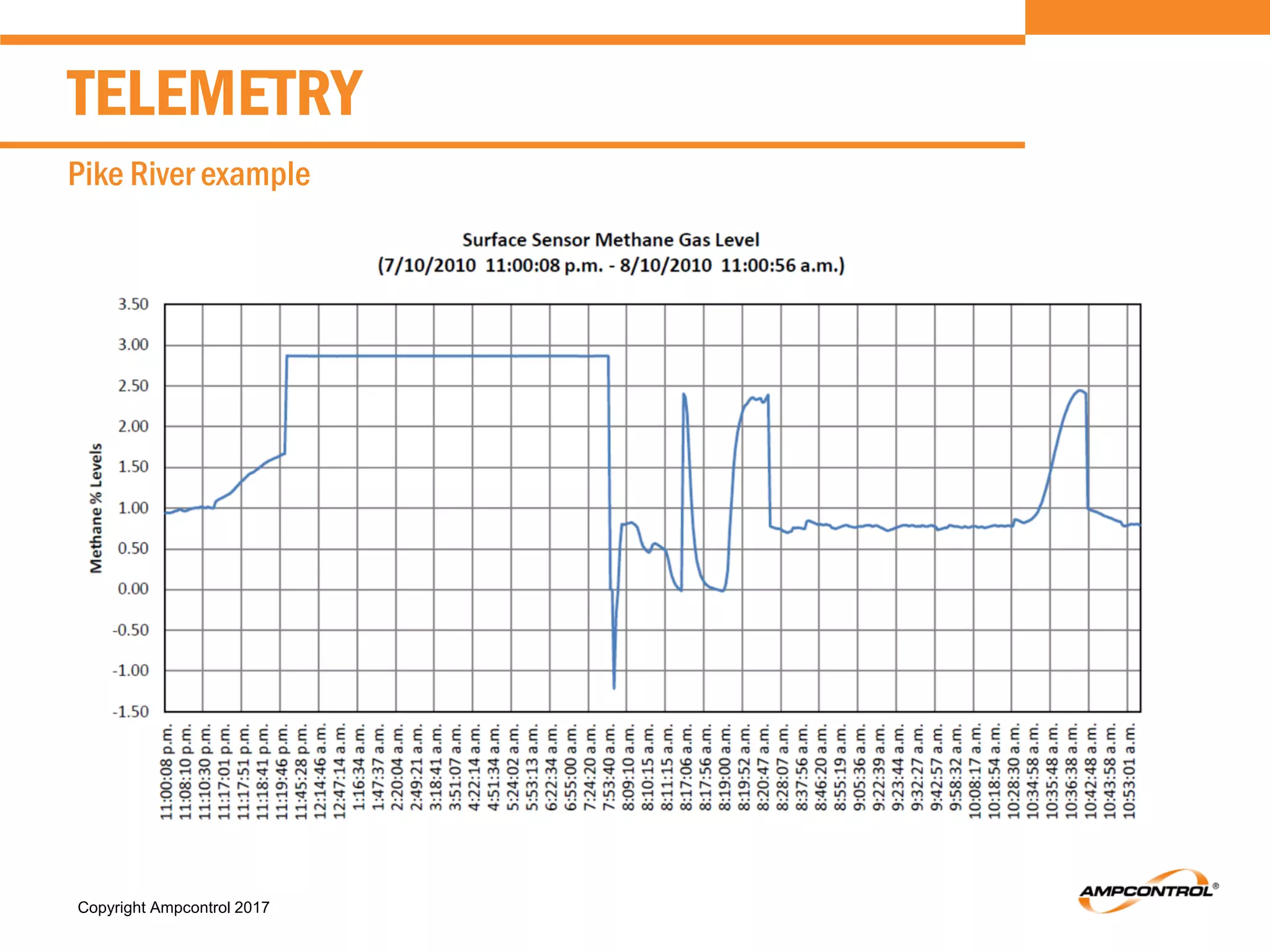
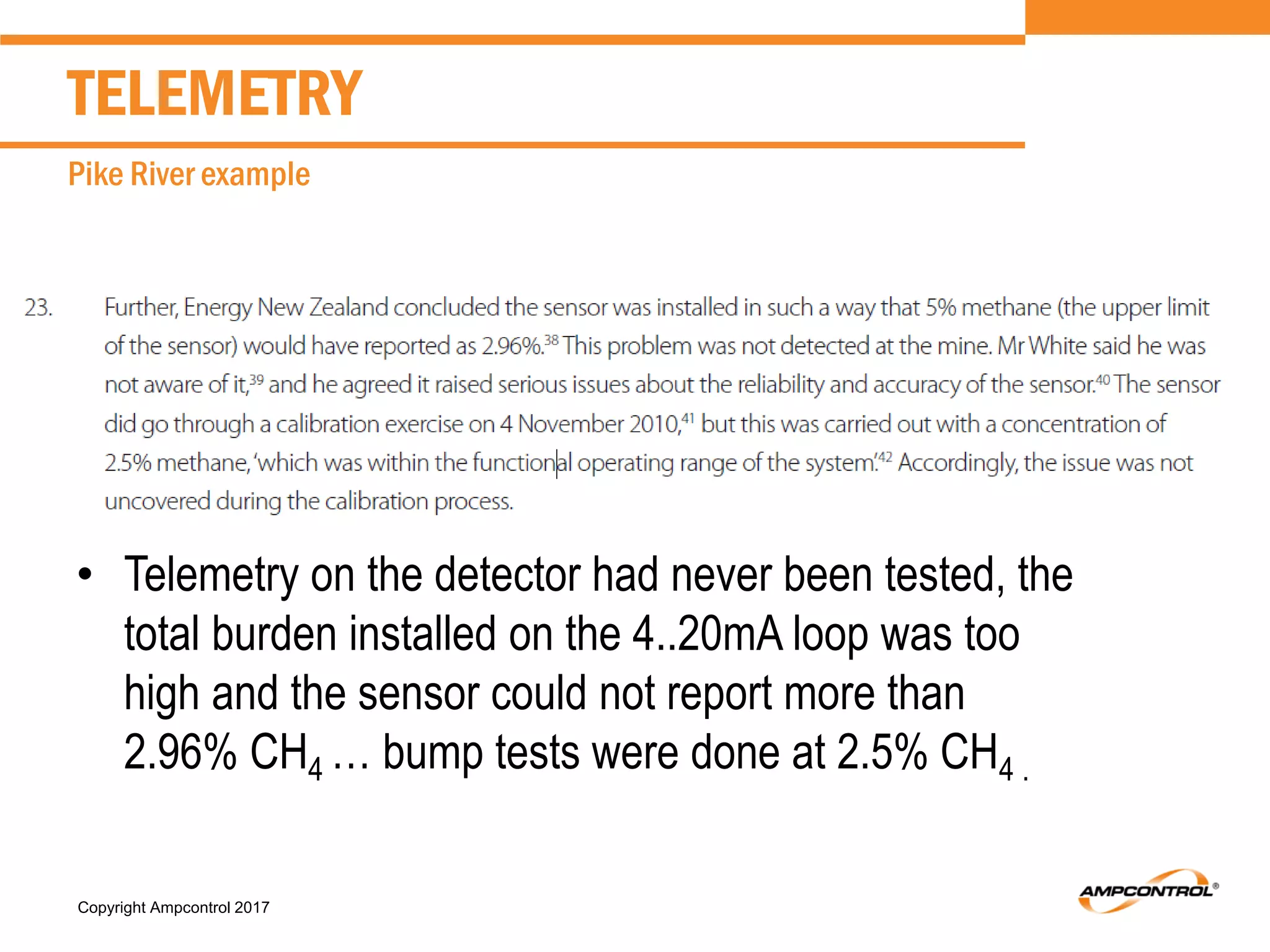
TELEMETRY
Pike River example
Copyright Ampcontrol 2017
• Telemetry on the detector had never been tested, the
total burden installed on the 4..20mA loop was too
high and the sensor could not report more than
2.96% CH4 … bump tests were done at 2.5% CH4 .
TELEMETRY
Pike River example
Copyright Ampcontrol 2017
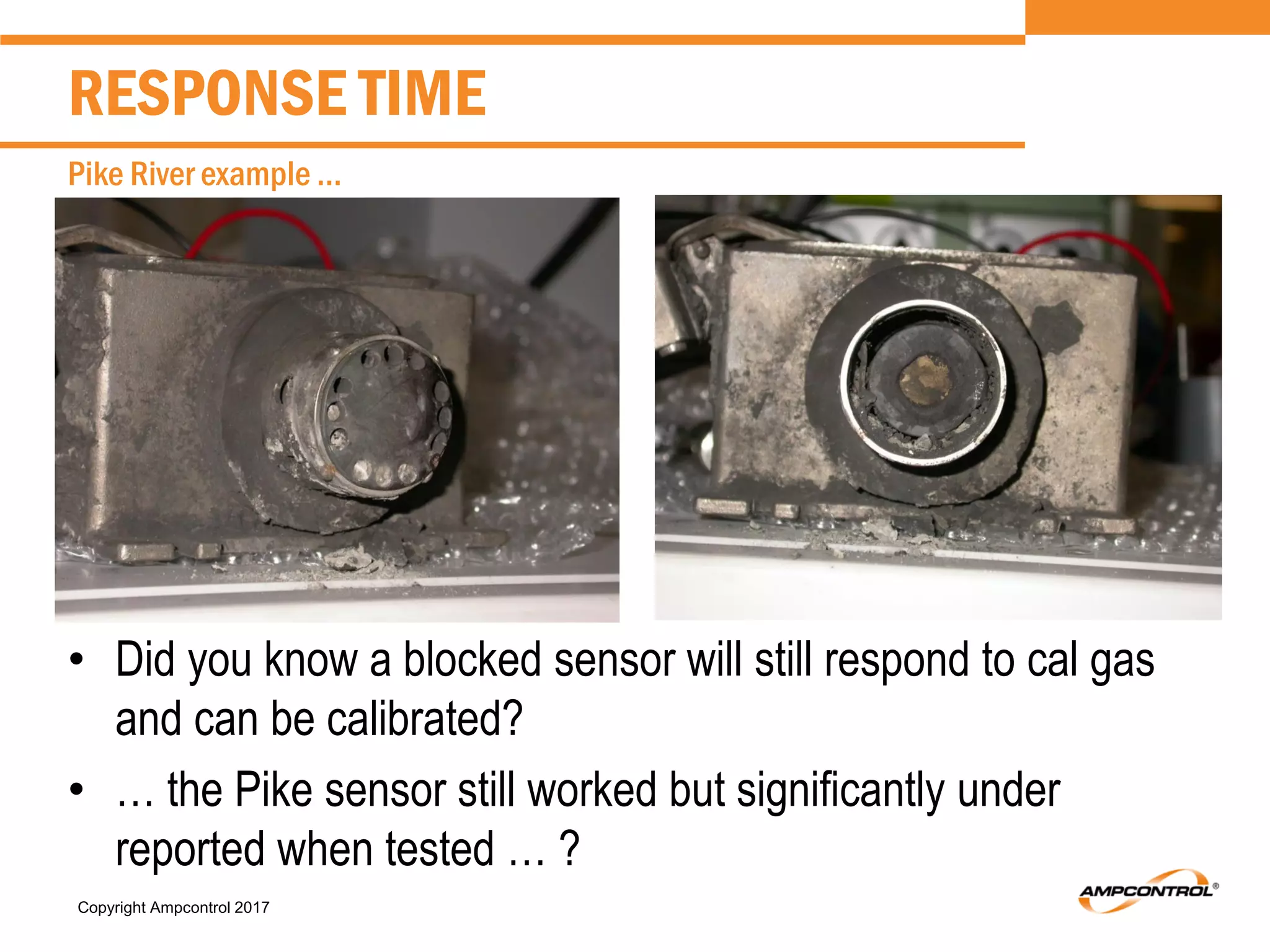
RESPONSE TIME
Pike River example …
• Did you know a blocked sensor will still respond to cal gas
and can be calibrated?
• … the Pike sensor still worked but significantly under
reported when tested … ?
Copyright Ampcontrol 2017
• The interaction between time response and absolute
accuracy for some sensor types in widespread use is
poorly understood.
• Even though a blocked sensor will calibrate correctly:
– It can under report concentration in still air.
– Read incorrectly in moving air.
– Fail to identify transient gas concentrations.
• … we will come back to this …
RESPONSE TIME & ACCURACY ??
… Response time is not independent of accuracy for some sensor types
Copyright Ampcontrol 2017
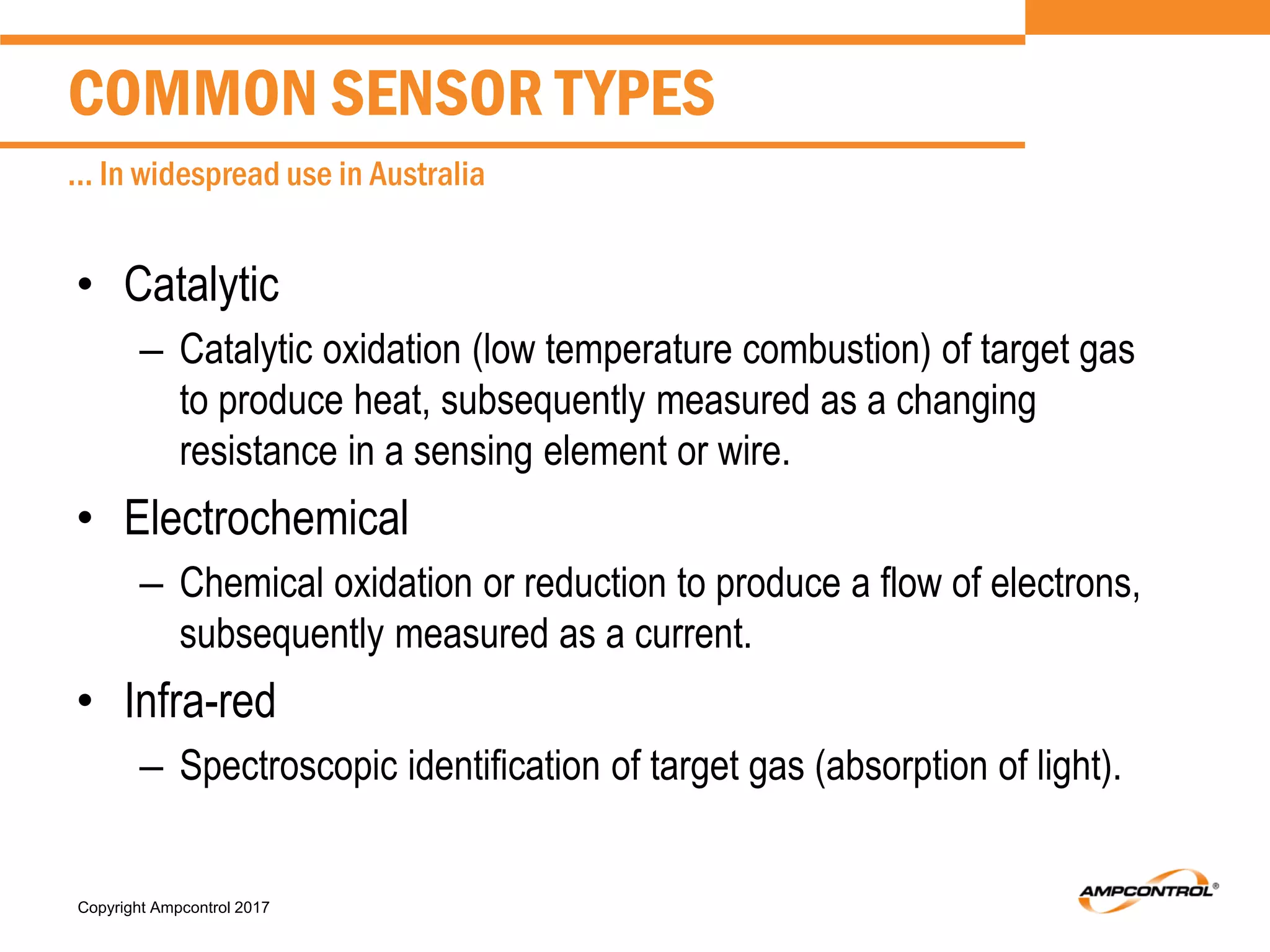
• Catalytic
– Catalytic oxidation (low temperature combustion) of target gas
to produce heat, subsequently measured as a changing
resistance in a sensing element or wire.
• Electrochemical
– Chemical oxidation or reduction to produce a flow of electrons,
subsequently measured as a current.
• Infra-red
– Spectroscopic identification of target gas (absorption of light).
COMMON SENSOR TYPES
... In widespread use in Australia
Copyright Ampcontrol 2017
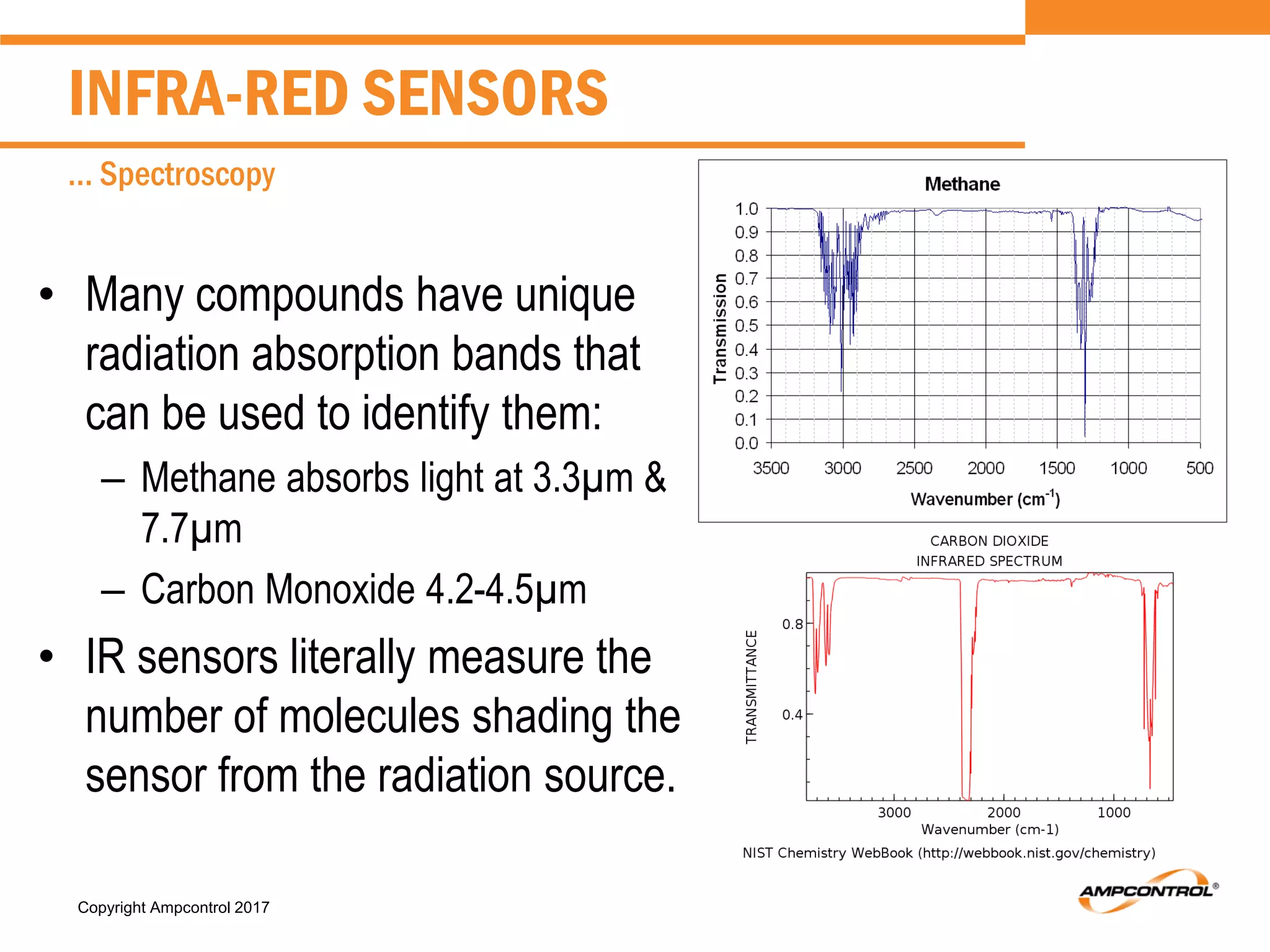
• Many compounds have unique
radiation absorption bands that
can be used to identify them:
– Methane absorbs light at 3.3µm &
7.7µm
– Carbon Monoxide 4.2-4.5µm
• IR sensors literally measure the
number of molecules shading the
sensor from the radiation source.
INFRA-RED SENSORS
… Spectroscopy
Copyright Ampcontrol 2017
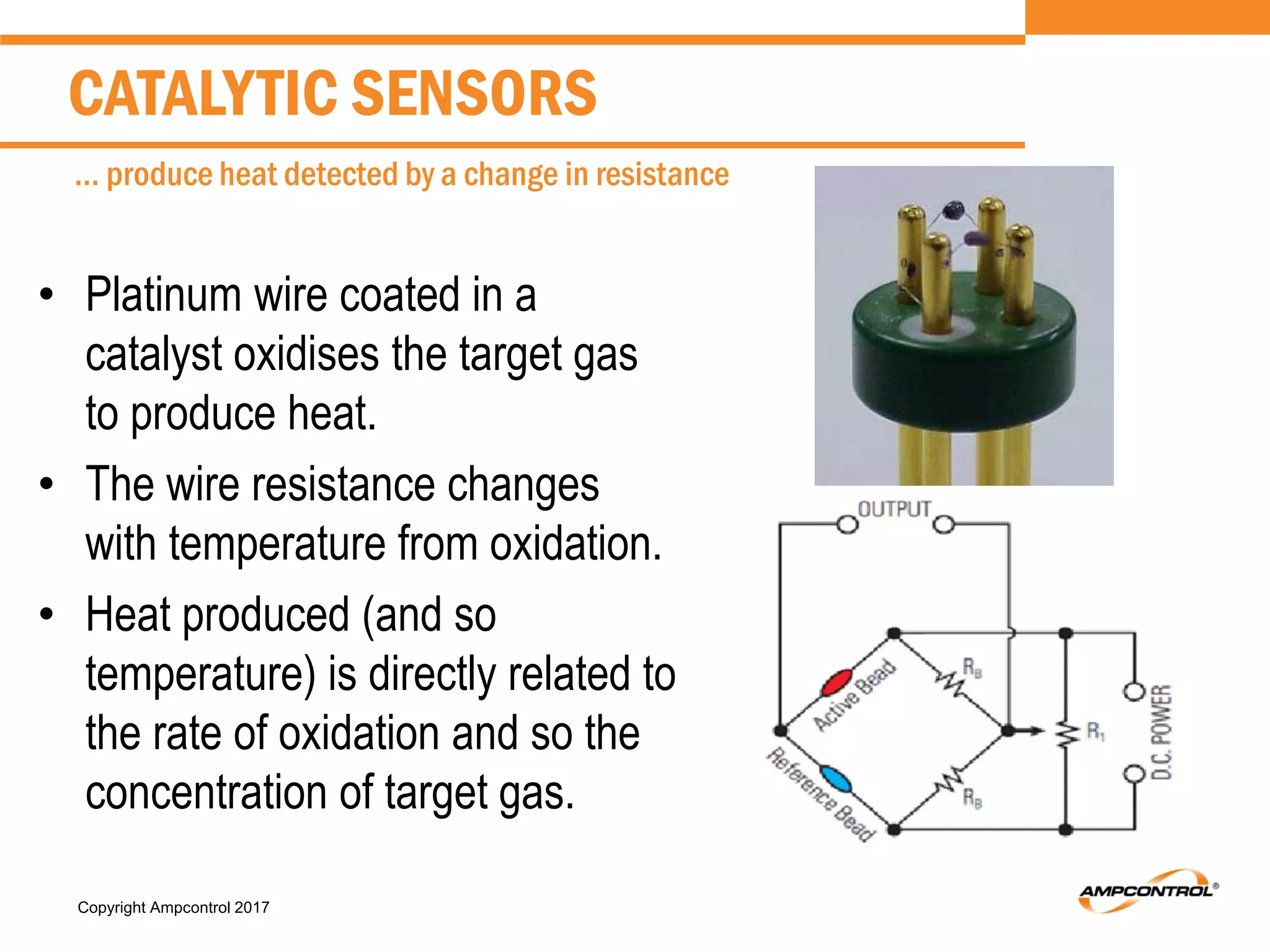
CATALYTIC SENSORS
… produce heat detected by a change in resistance
• Platinum wire coated in a
catalyst oxidises the target gas
to produce heat.
• The wire resistance changes
with temperature from oxidation.
• Heat produced (and so
temperature) is directly related to
the rate of oxidation and so the
concentration of target gas.
Copyright Ampcontrol 2017
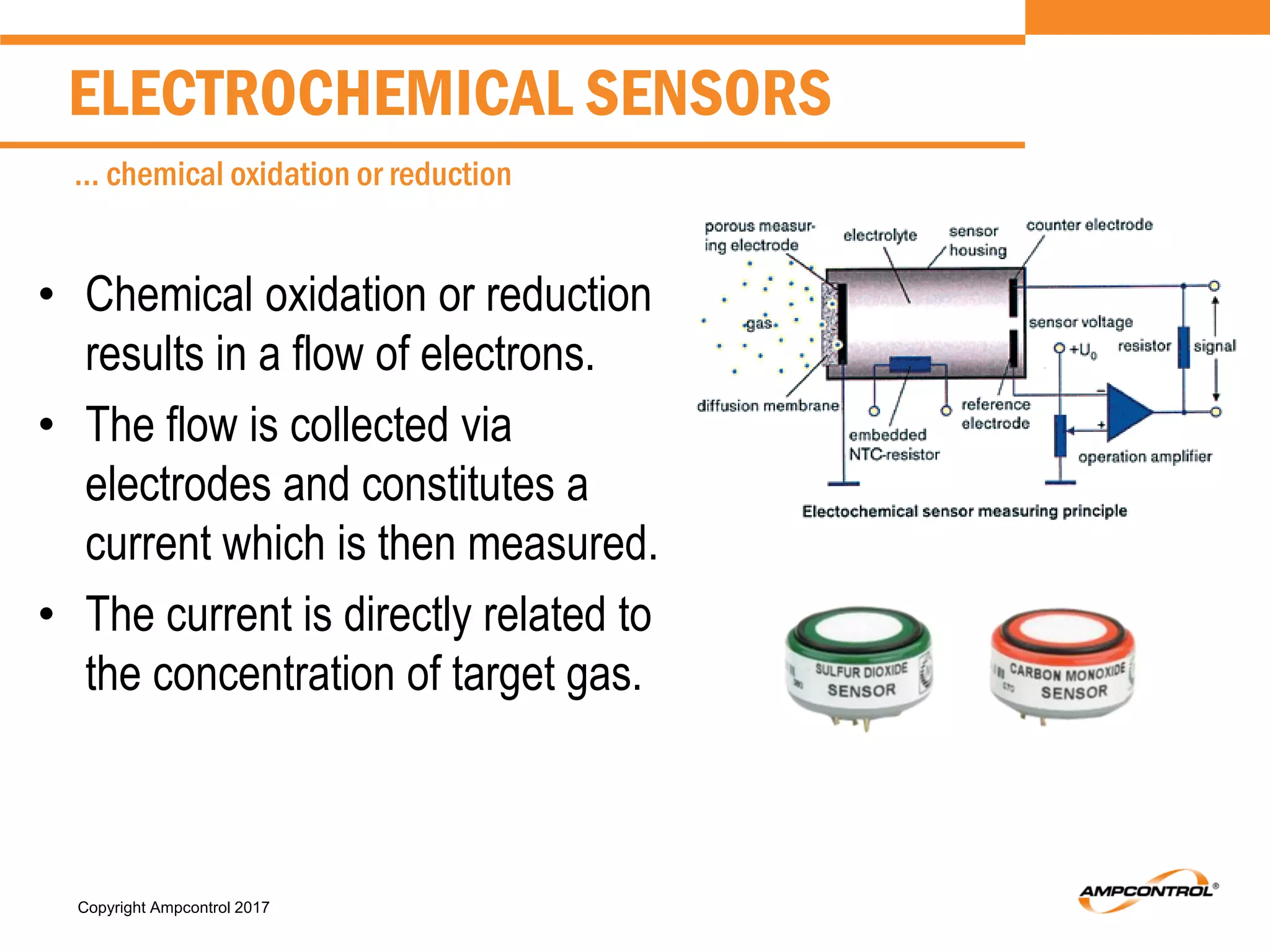
ELECTROCHEMICAL SENSORS
… chemical oxidation or reduction
• Chemical oxidation or reduction
results in a flow of electrons.
• The flow is collected via
electrodes and constitutes a
current which is then measured.
• The current is directly related to
the concentration of target gas.
Copyright Ampcontrol 2017
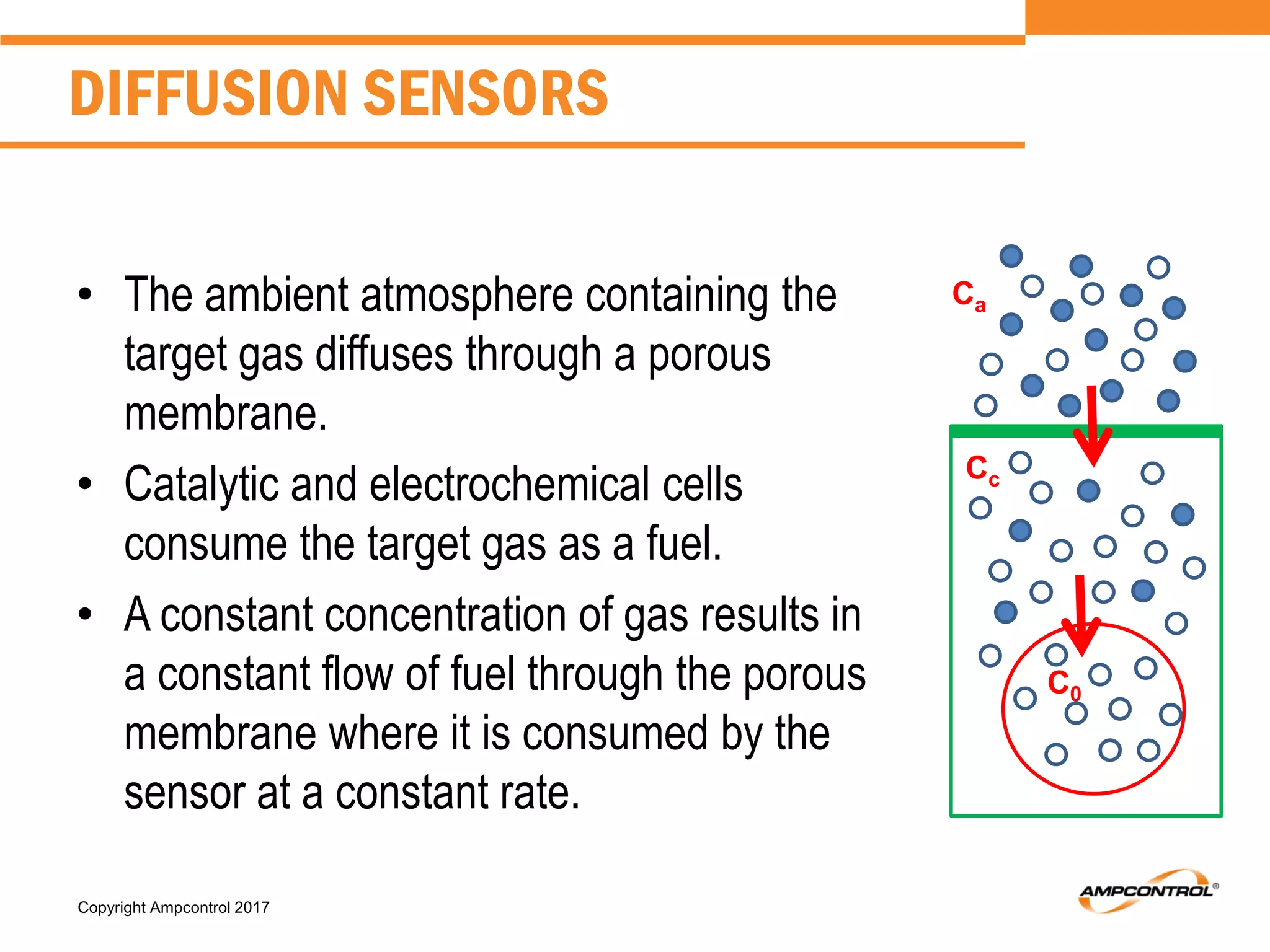
• The ambient atmosphere containing the
target gas diffuses through a porous
membrane.
• Catalytic and electrochemical cells
consume the target gas as a fuel.
• A constant concentration of gas results in
a constant flow of fuel through the porous
membrane where it is consumed by the
sensor at a constant rate.
DIFFUSION SENSORS
Ca
Cc
C0
Copyright Ampcontrol 2017
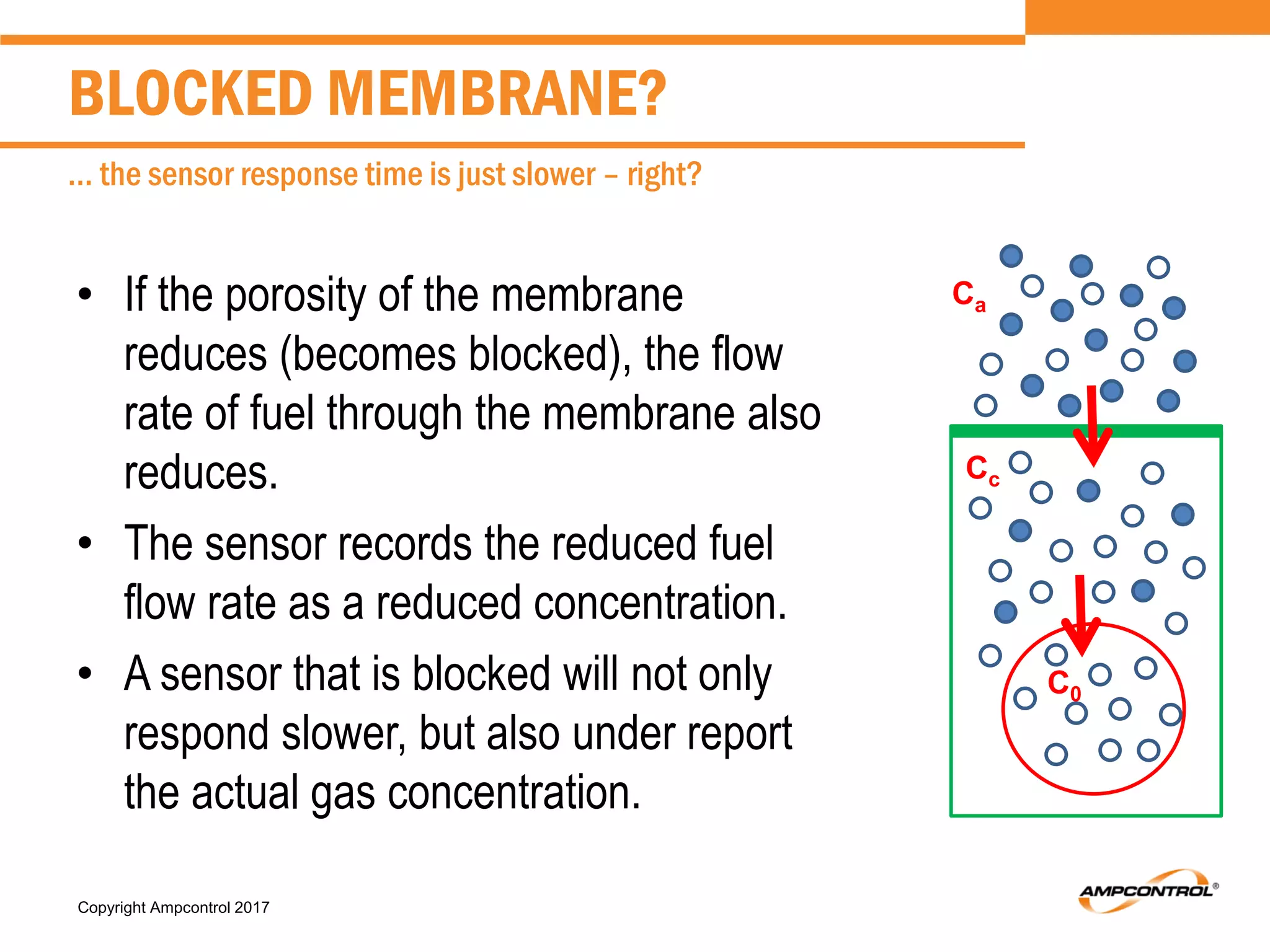
• If the porosity of the membrane
reduces (becomes blocked), the flow
rate of fuel through the membrane also
reduces.
• The sensor records the reduced fuel
flow rate as a reduced concentration.
• A sensor that is blocked will not only
respond slower, but also under report
the actual gas concentration.
BLOCKED MEMBRANE?
… the sensor response time is just slower – right?
Ca
Cc
C0
Copyright Ampcontrol 2017
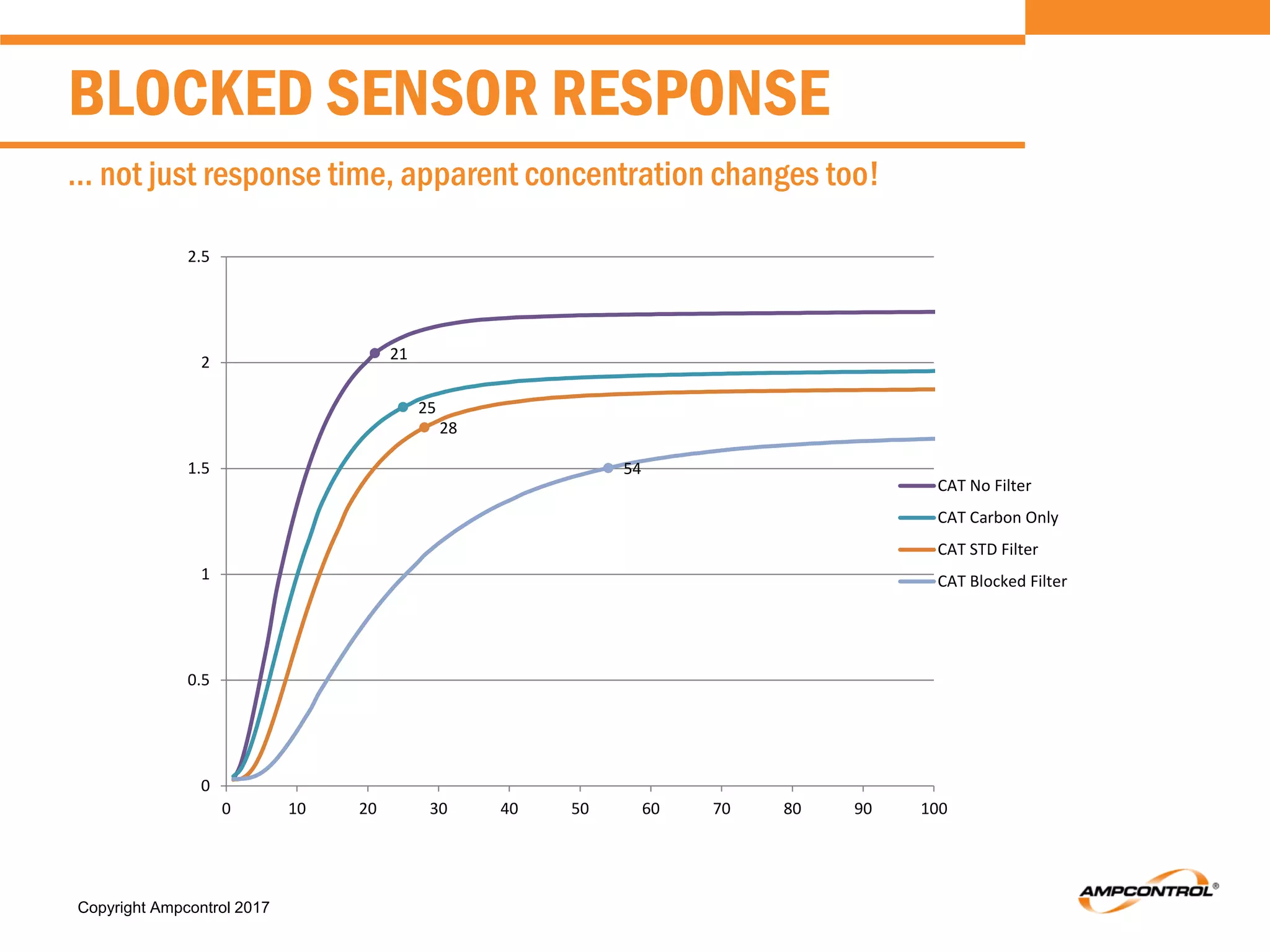
BLOCKED SENSOR RESPONSE
… not just response time, apparent concentration changes too!
21
25
28
54
0
0.5
1
1.5
2
2.5
0 10 20 30 40 50 60 70 80 90 100
CAT No Filter
CAT Carbon Only
CAT STD Filter
CAT Blocked Filter
Copyright Ampcontrol 2017
• The error is corrected so the sensor accurately
displays the test gas concentration, but:
– Does it correctly display a different test gas
concentration? and,
– Now it responds more slowly and will fail to identify
transient gas concentrations.
• We cannot detect these deficiencies with a
conventional bump test looking at final accuracy
of displayed value at one concentration only.
RECALIBRATION
… we correct the reading error as a result of the bump test
Copyright Ampcontrol 2017
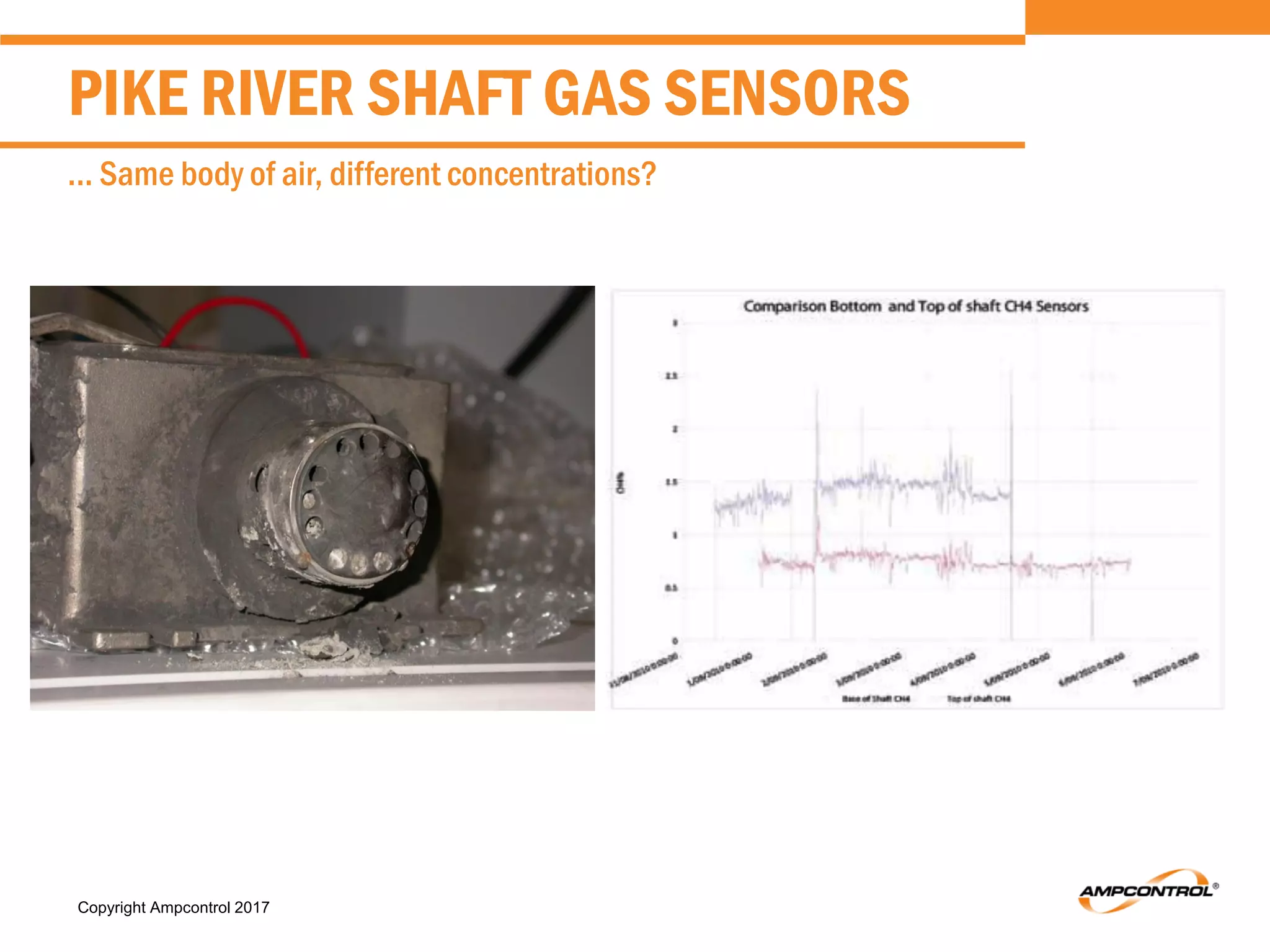
PIKE RIVER SHAFT GAS SENSORS
... Same body of air, different concentrations?
Copyright Ampcontrol 2017
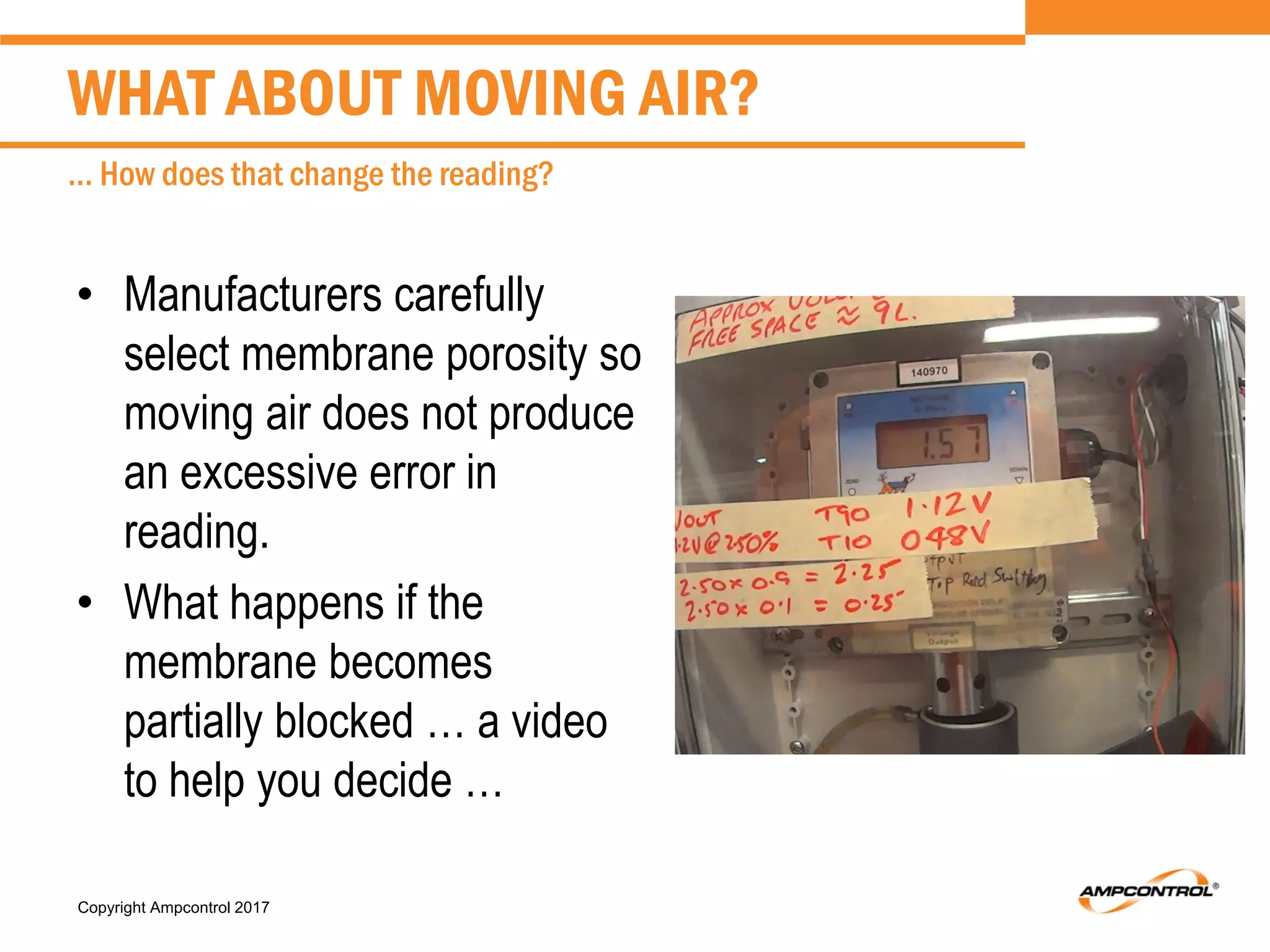
• Manufacturers carefully
select membrane porosity so
moving air does not produce
an excessive error in
reading.
• What happens if the
membrane becomes
partially blocked … a video
to help you decide …
WHAT ABOUT MOVING AIR?
… How does that change the reading?
Copyright Ampcontrol 2017
• Moving air outside is at a lower pressure than the still air
inside the sensing chamber.
• The increased partial pressure across the membrane,
increases the flow of fuel to the sensor, so the apparent
concentration seen by the sensor increases.
• Maybe a good thing? The error is towards safety … or is it?
• If we calibrate in moving air, we may under-report
concentration in slower or still air.
A NEW PATENT?
… the methane producing fan.
Copyright Ampcontrol 2017
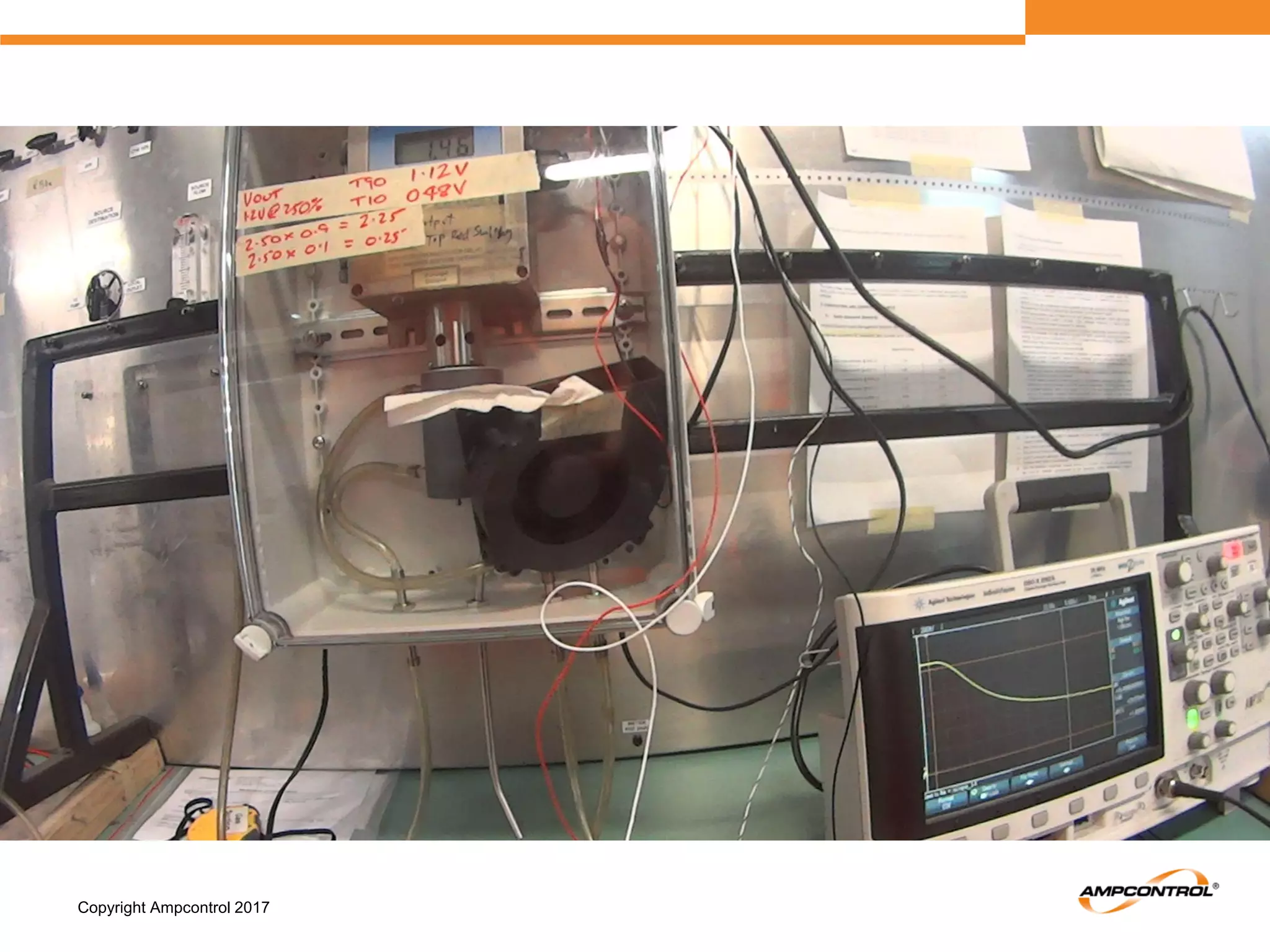
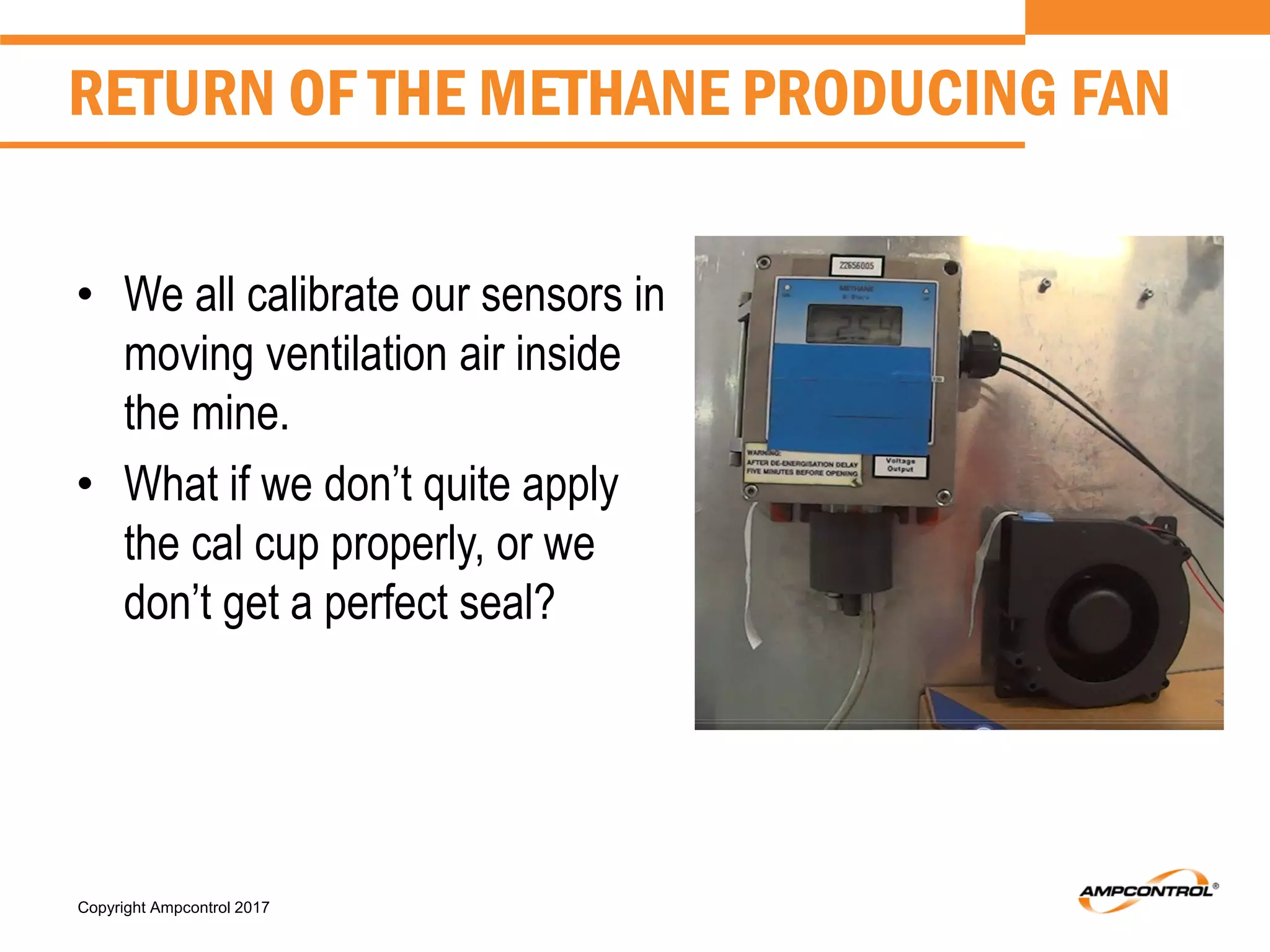
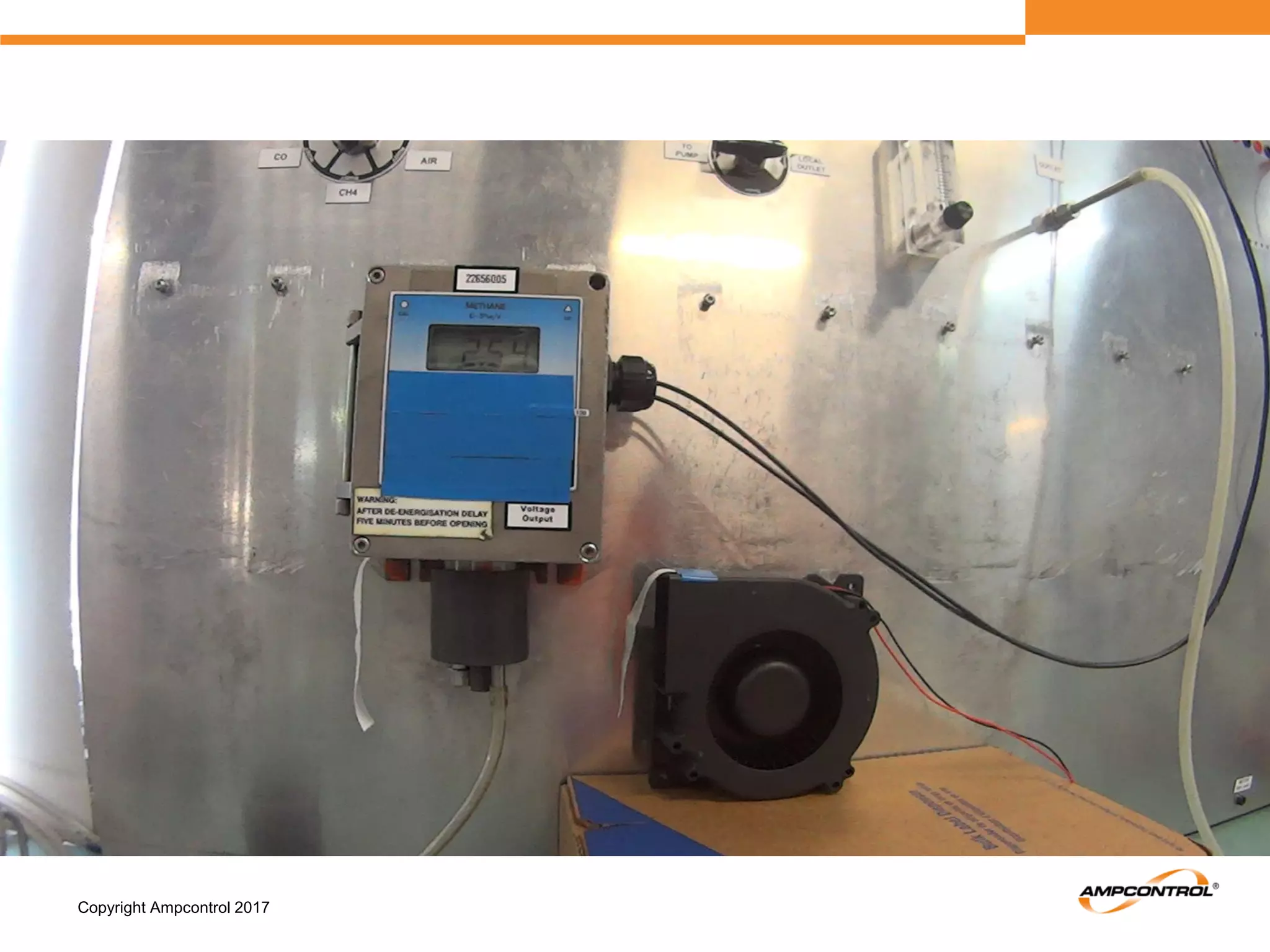
• We all calibrate our sensors in
moving ventilation air inside
the mine.
• What if we don’t quite apply
the cal cup properly, or we
don’t get a perfect seal?
RETURN OF THE METHANE PRODUCING FAN
Copyright Ampcontrol 2017
• A sensor that is compromised in terms of time
response:
– Will still calibrate correctly and to sufficient accuracy when
bump tested.
– Can under report the actual ambient gas concentration in
still air.
– Can read incorrectly in the presence of moving air.
– Will increase operating risk, unable to respond to transient
gas bursts.
• So how do you practically measure time response in
an operating environment?
RESPONSE TIME IS IMPORTANT
… more than previously appreciated!
Copyright Ampcontrol 2017
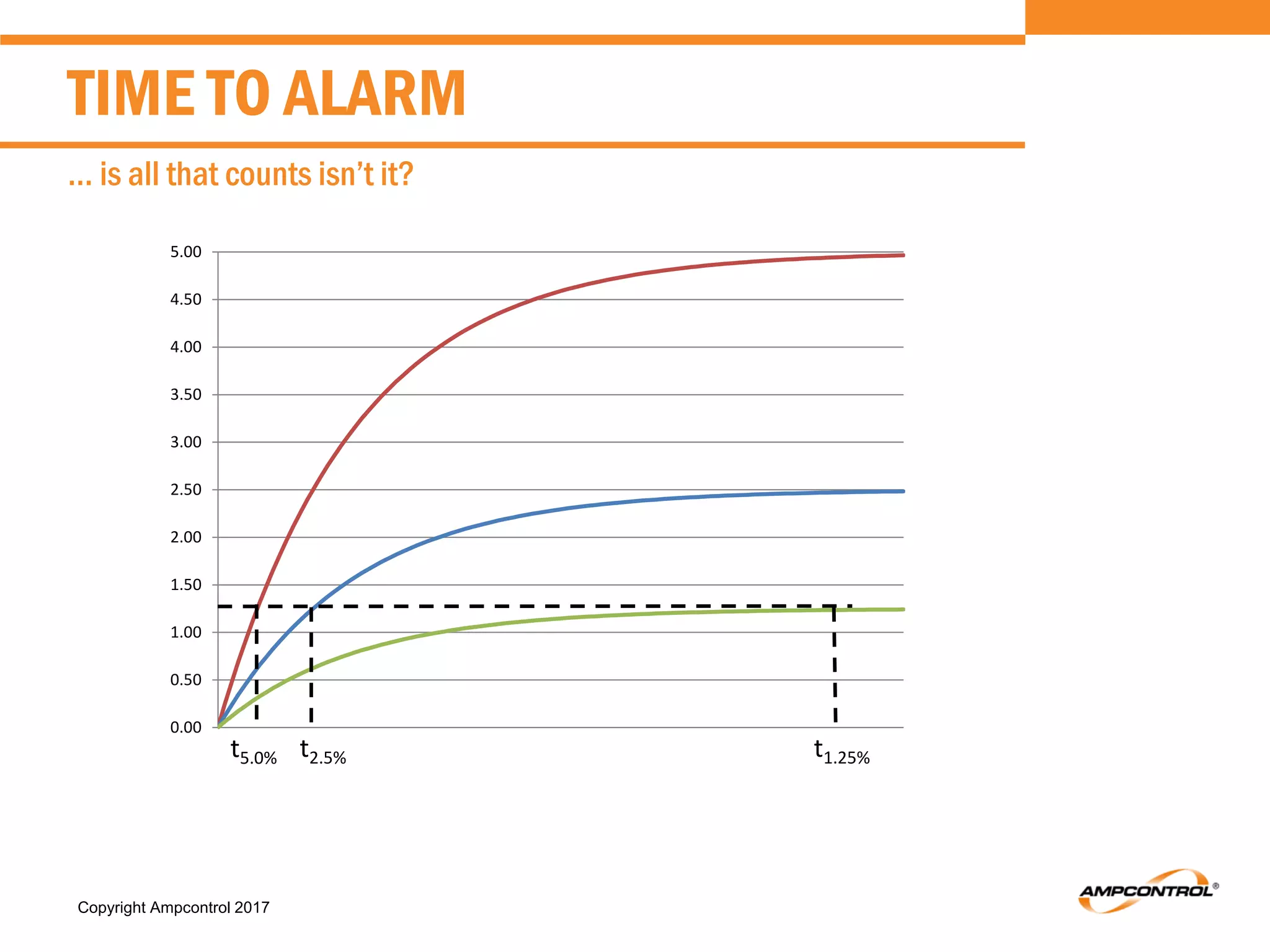
TIME TO ALARM
… is all that counts isn’t it?
0.00
0.50
1.00
1.50
2.00
2.50
3.00
3.50
4.00
4.50
5.00
t2.5% t1.25%t5.0%
Copyright Ampcontrol 2017
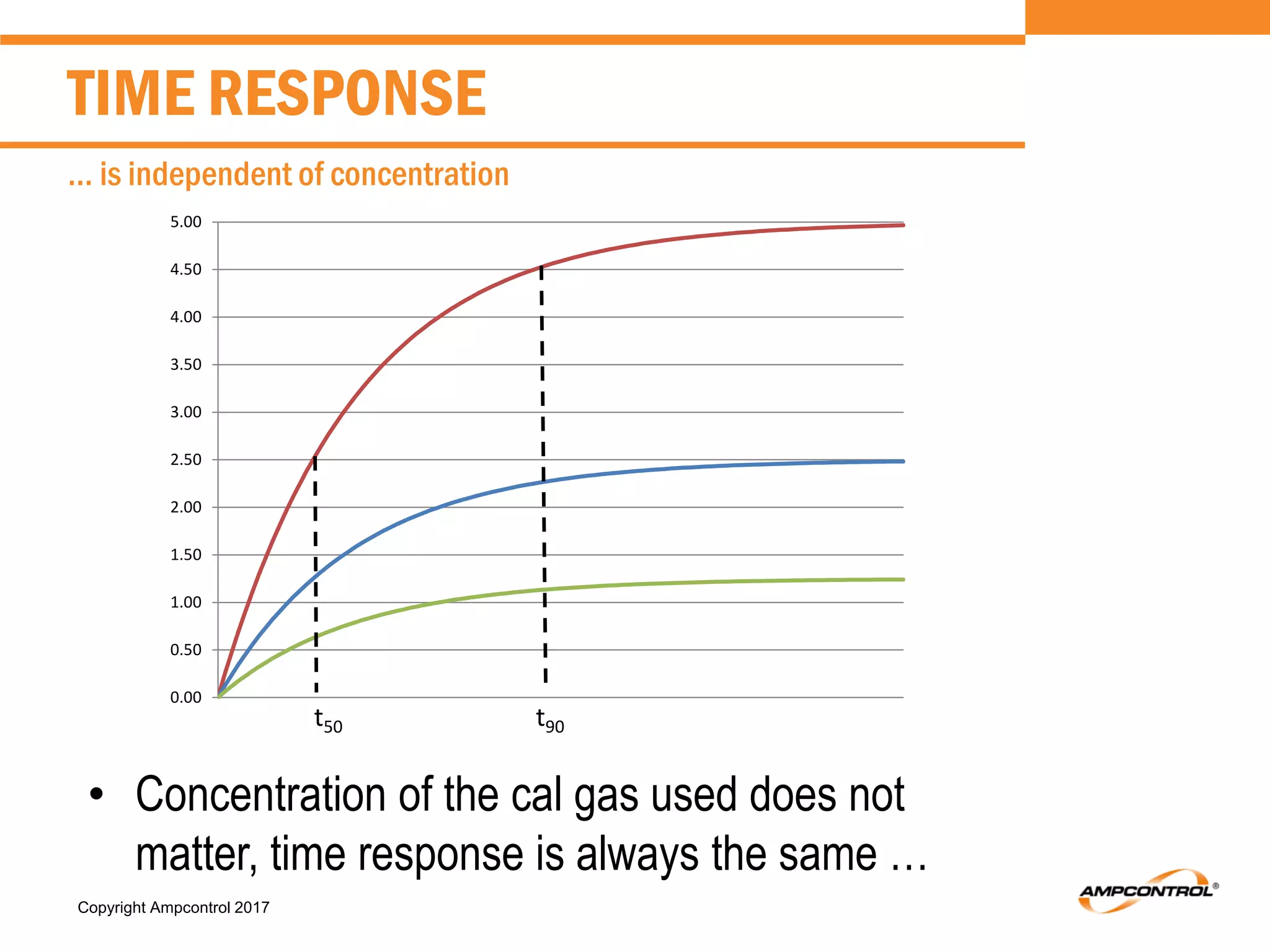
• Concentration of the cal gas used does not
matter, time response is always the same …
TIME RESPONSE
… is independent of concentration
0.00
0.50
1.00
1.50
2.00
2.50
3.00
3.50
4.00
4.50
5.00
t50 t90
Copyright Ampcontrol 2017
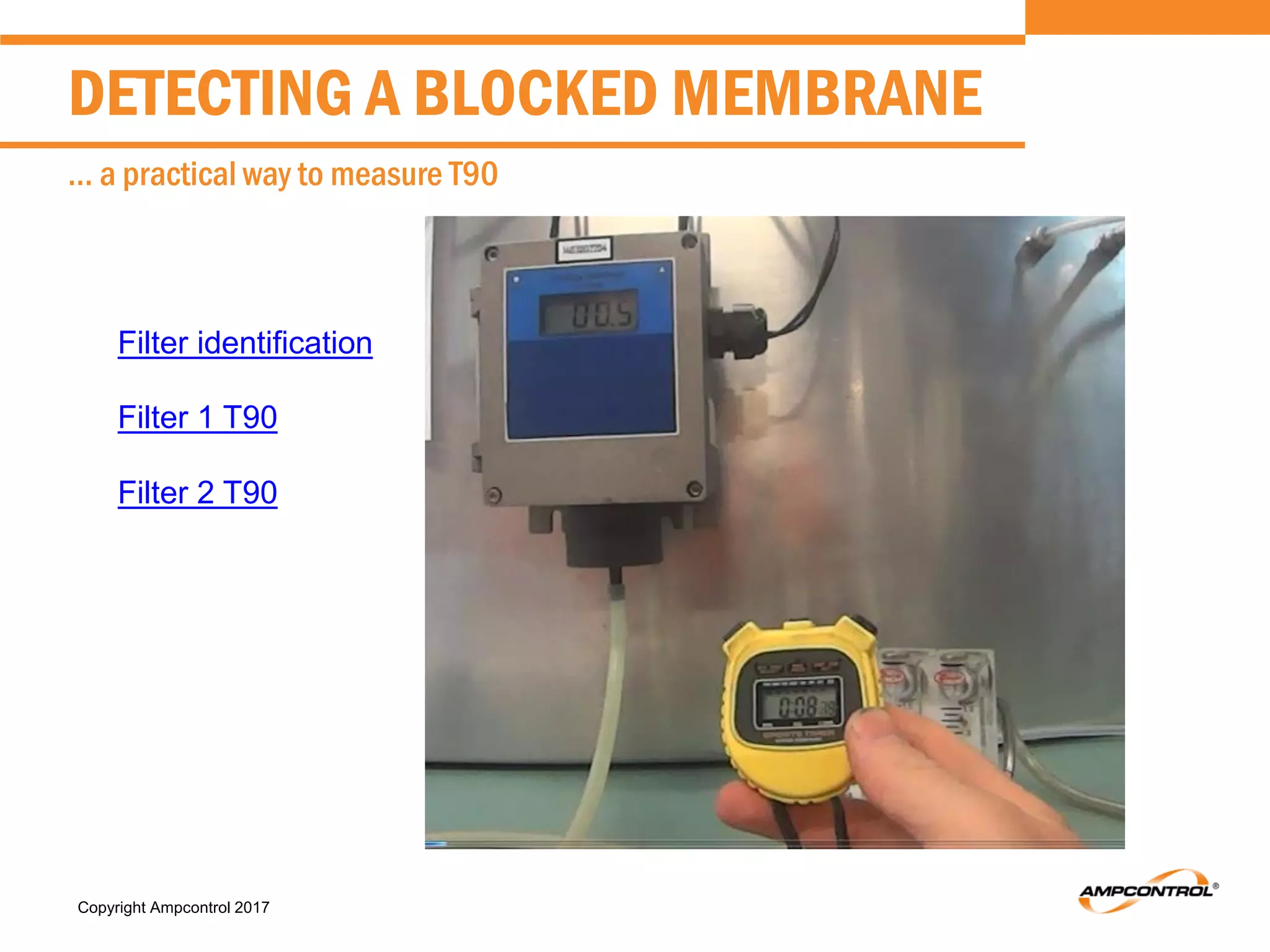
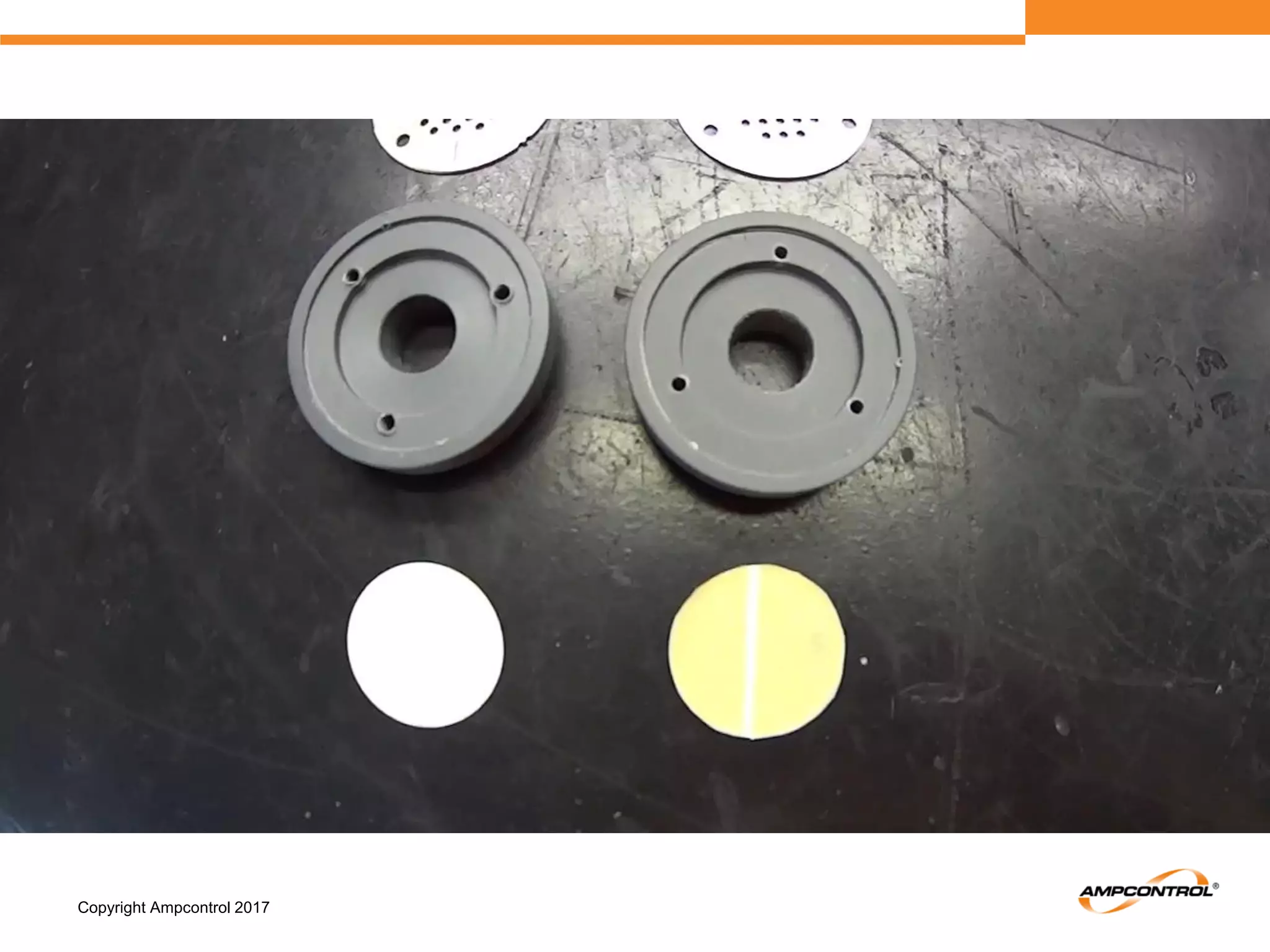
DETECTING A BLOCKED MEMBRANE
… a practical way to measure T90
Filter identification
Filter 1 T90
Filter 2 T90
Copyright Ampcontrol 2017
SUMMARY OBSERVATIONS
Copyright Ampcontrol 2017
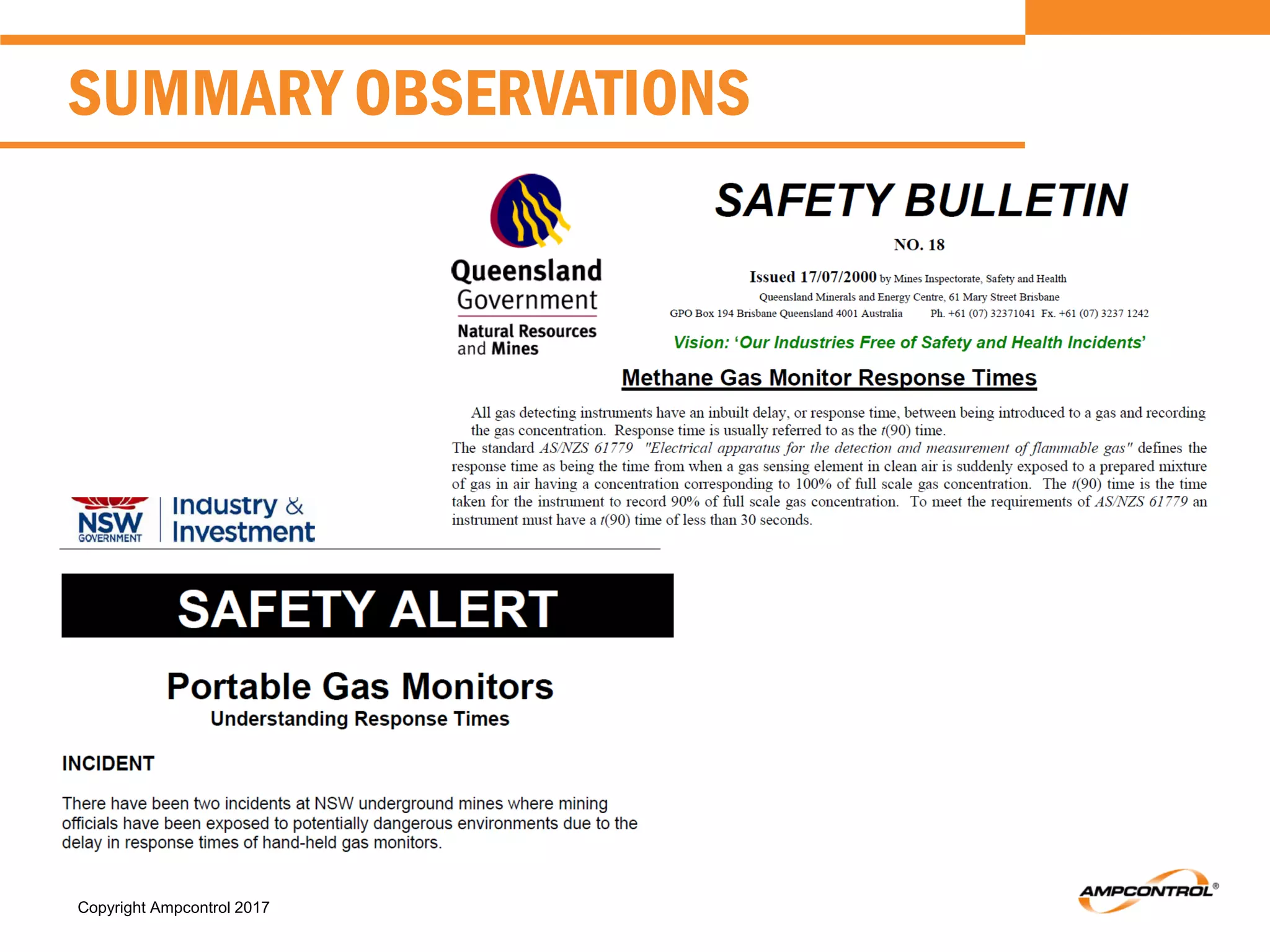
• Recent changes to AS2290.3 are more significant than
generally appreciated.
• Maintenance of gas detectors requires testing to
ensure key parameters are ‘as new’, namely:
– Accuracy;
– Telemetry; and,
– Time response.
• These requirements are not new:
– Both QLD and NSW Inspectorates have released safety
bulletins in regard to response times of gas detectors
SUMMARY OBSERVATIONS
Copyright Ampcontrol 2017
SUMMARY OBSERVATIONS
Copyright Ampcontrol 2017
SUMMARY OBSERVATIONS
• A sensor that is compromised in terms of time
response:
– Will still calibrate correctly and to sufficient accuracy when
bump tested.
– Can under report the actual ambient gas concentration in
still air.
– Can read incorrectly in the presence of moving air.
– Will increase operating risk, unable to respond to transient
gas bursts.
Copyright Ampcontrol 2017
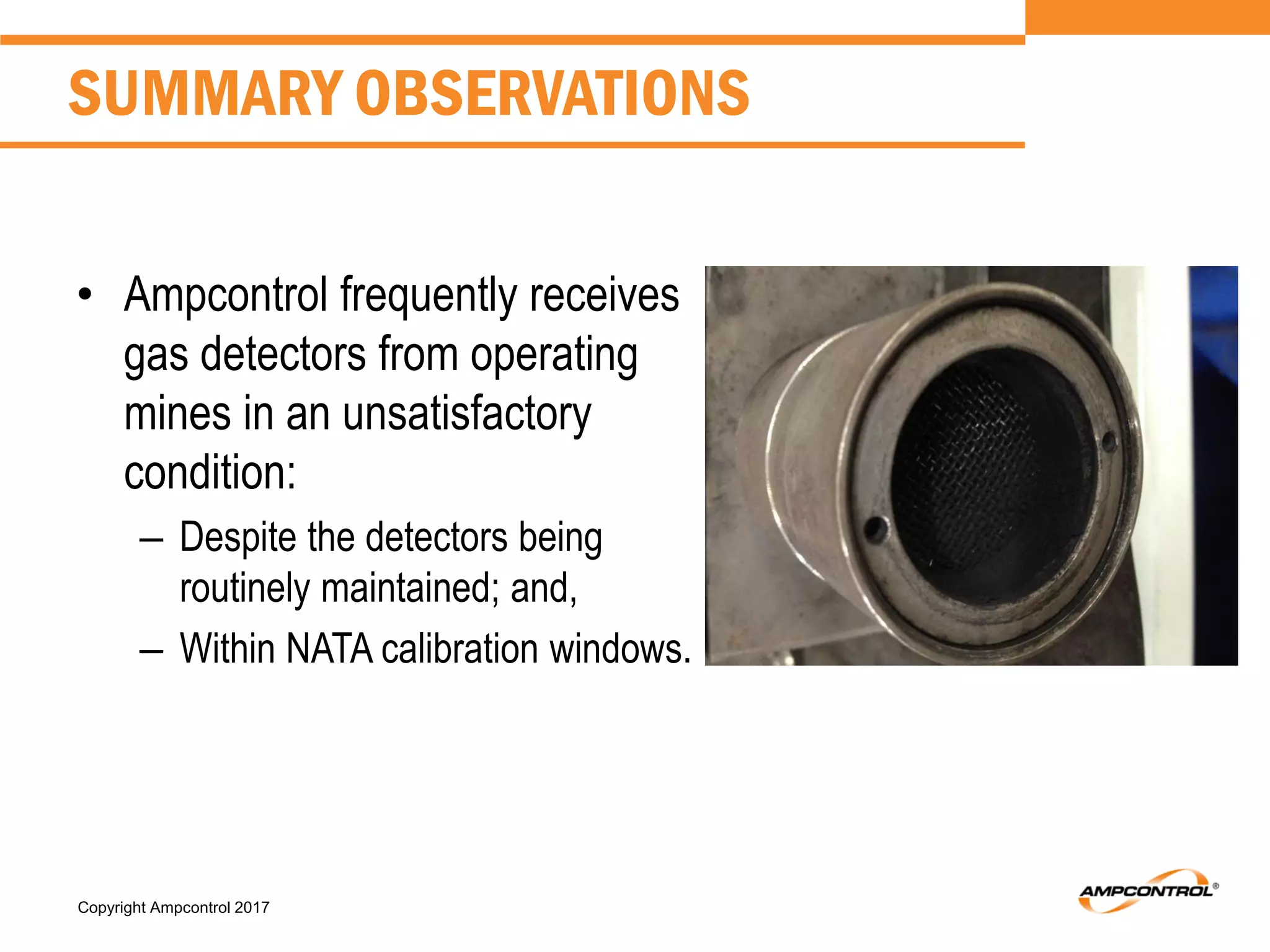
• Ampcontrol frequently receives
gas detectors from operating
mines in an unsatisfactory
condition:
– Despite the detectors being
routinely maintained; and,
– Within NATA calibration windows.
SUMMARY OBSERVATIONS
Copyright Ampcontrol 2017
• If your mine does not do response time or telemetry
testing in addition to a bump test …
How do you know your gas detectors
are actually working?
RESPONSE TIME TESTING?
QUESTIONS?

Are your gas detectors actually working Tim Wylie

  • 1.
    ARE YOUR GASDETECTORS ACTUALLY WORKING? EESS 2017 TIM WYLIE CHIEF TECHNOLOGY OFFICER AMPCONTROL
  • 2.
    Copyright Ampcontrol 2017 1.Essential attributes of a gas sensor. 2. Common gas sensing technologies applied in mining. 3. Response time: – A blocked sensor will be slow, but for some types there is a link to absolute accuracy as well …. blocked sensors can also under report or read incorrectly. 4. Time to alarm or T90 – which one counts? 5. Practical response time testing – it’s a mine not a lab … 6. Summary observations. PRESENTATION OVERVIEW
  • 3.
    Copyright Ampcontrol 2017 •Whether it is monitoring for explosive risk or toxicity a gas detector must: 1. Accurately sense the gas concentration, 2. Transmit (and sometimes locally display) the concentration, and/or; 3. Signal a warning or alarm to initiate an action in a timely manner. • … so there are three fundamental attributes: 1. Accuracy; 2. Telemetry; and, 3. Time response. ATTRIBUTES OF A GAS SENSOR … its all about absolute accuracy isn’t it?
  • 4.
    Copyright Ampcontrol 2017 •All new gas detectors used in Australian mining undergo performance testing to validate all three attributes: 1. Accuracy; 2. Telemetry; and, 3. Time response. • Flammables: AS/NZS 60079.29.1 • Toxics and Oxygen: AS/NZS 4641 PERFORMANCE REQUIREMENTS … defined for new gas detectors
  • 5.
    Copyright Ampcontrol 2017 •Until recently Standards and Industry practice for maintenance of gas detectors focussed almost exclusively on absolute accuracy. – Regular bump tests and NATA calibration. • Testing telemetry and time response were largely ignored …AS 2290.3 will now require telemetry and response testing. – … so why the change after so many years? MAINTENNANCE OF GAS DETECTORS New revision of AS2290.3 includes accuracy, telemetry and response testing
  • 6.
  • 7.
    Copyright Ampcontrol 2017 •Telemetry on the detector had never been tested, the total burden installed on the 4..20mA loop was too high and the sensor could not report more than 2.96% CH4 … bump tests were done at 2.5% CH4 . TELEMETRY Pike River example
  • 8.
    Copyright Ampcontrol 2017 RESPONSETIME Pike River example … • Did you know a blocked sensor will still respond to cal gas and can be calibrated? • … the Pike sensor still worked but significantly under reported when tested … ?
  • 9.
    Copyright Ampcontrol 2017 •The interaction between time response and absolute accuracy for some sensor types in widespread use is poorly understood. • Even though a blocked sensor will calibrate correctly: – It can under report concentration in still air. – Read incorrectly in moving air. – Fail to identify transient gas concentrations. • … we will come back to this … RESPONSE TIME & ACCURACY ?? … Response time is not independent of accuracy for some sensor types
  • 10.
    Copyright Ampcontrol 2017 •Catalytic – Catalytic oxidation (low temperature combustion) of target gas to produce heat, subsequently measured as a changing resistance in a sensing element or wire. • Electrochemical – Chemical oxidation or reduction to produce a flow of electrons, subsequently measured as a current. • Infra-red – Spectroscopic identification of target gas (absorption of light). COMMON SENSOR TYPES ... In widespread use in Australia
  • 11.
    Copyright Ampcontrol 2017 •Many compounds have unique radiation absorption bands that can be used to identify them: – Methane absorbs light at 3.3µm & 7.7µm – Carbon Monoxide 4.2-4.5µm • IR sensors literally measure the number of molecules shading the sensor from the radiation source. INFRA-RED SENSORS … Spectroscopy
  • 12.
    Copyright Ampcontrol 2017 CATALYTICSENSORS … produce heat detected by a change in resistance • Platinum wire coated in a catalyst oxidises the target gas to produce heat. • The wire resistance changes with temperature from oxidation. • Heat produced (and so temperature) is directly related to the rate of oxidation and so the concentration of target gas.
  • 13.
    Copyright Ampcontrol 2017 ELECTROCHEMICALSENSORS … chemical oxidation or reduction • Chemical oxidation or reduction results in a flow of electrons. • The flow is collected via electrodes and constitutes a current which is then measured. • The current is directly related to the concentration of target gas.
  • 14.
    Copyright Ampcontrol 2017 •The ambient atmosphere containing the target gas diffuses through a porous membrane. • Catalytic and electrochemical cells consume the target gas as a fuel. • A constant concentration of gas results in a constant flow of fuel through the porous membrane where it is consumed by the sensor at a constant rate. DIFFUSION SENSORS Ca Cc C0
  • 15.
    Copyright Ampcontrol 2017 •If the porosity of the membrane reduces (becomes blocked), the flow rate of fuel through the membrane also reduces. • The sensor records the reduced fuel flow rate as a reduced concentration. • A sensor that is blocked will not only respond slower, but also under report the actual gas concentration. BLOCKED MEMBRANE? … the sensor response time is just slower – right? Ca Cc C0
  • 16.
    Copyright Ampcontrol 2017 BLOCKEDSENSOR RESPONSE … not just response time, apparent concentration changes too! 21 25 28 54 0 0.5 1 1.5 2 2.5 0 10 20 30 40 50 60 70 80 90 100 CAT No Filter CAT Carbon Only CAT STD Filter CAT Blocked Filter
  • 17.
    Copyright Ampcontrol 2017 •The error is corrected so the sensor accurately displays the test gas concentration, but: – Does it correctly display a different test gas concentration? and, – Now it responds more slowly and will fail to identify transient gas concentrations. • We cannot detect these deficiencies with a conventional bump test looking at final accuracy of displayed value at one concentration only. RECALIBRATION … we correct the reading error as a result of the bump test
  • 18.
    Copyright Ampcontrol 2017 PIKERIVER SHAFT GAS SENSORS ... Same body of air, different concentrations?
  • 19.
    Copyright Ampcontrol 2017 •Manufacturers carefully select membrane porosity so moving air does not produce an excessive error in reading. • What happens if the membrane becomes partially blocked … a video to help you decide … WHAT ABOUT MOVING AIR? … How does that change the reading?
  • 20.
  • 21.
    Copyright Ampcontrol 2017 •Moving air outside is at a lower pressure than the still air inside the sensing chamber. • The increased partial pressure across the membrane, increases the flow of fuel to the sensor, so the apparent concentration seen by the sensor increases. • Maybe a good thing? The error is towards safety … or is it? • If we calibrate in moving air, we may under-report concentration in slower or still air. A NEW PATENT? … the methane producing fan.
  • 22.
    Copyright Ampcontrol 2017 •We all calibrate our sensors in moving ventilation air inside the mine. • What if we don’t quite apply the cal cup properly, or we don’t get a perfect seal? RETURN OF THE METHANE PRODUCING FAN
  • 23.
  • 24.
    Copyright Ampcontrol 2017 •A sensor that is compromised in terms of time response: – Will still calibrate correctly and to sufficient accuracy when bump tested. – Can under report the actual ambient gas concentration in still air. – Can read incorrectly in the presence of moving air. – Will increase operating risk, unable to respond to transient gas bursts. • So how do you practically measure time response in an operating environment? RESPONSE TIME IS IMPORTANT … more than previously appreciated!
  • 25.
    Copyright Ampcontrol 2017 TIMETO ALARM … is all that counts isn’t it? 0.00 0.50 1.00 1.50 2.00 2.50 3.00 3.50 4.00 4.50 5.00 t2.5% t1.25%t5.0%
  • 26.
    Copyright Ampcontrol 2017 •Concentration of the cal gas used does not matter, time response is always the same … TIME RESPONSE … is independent of concentration 0.00 0.50 1.00 1.50 2.00 2.50 3.00 3.50 4.00 4.50 5.00 t50 t90
  • 27.
    Copyright Ampcontrol 2017 DETECTINGA BLOCKED MEMBRANE … a practical way to measure T90 Filter identification Filter 1 T90 Filter 2 T90
  • 28.
  • 29.
  • 30.
    Copyright Ampcontrol 2017 •Recent changes to AS2290.3 are more significant than generally appreciated. • Maintenance of gas detectors requires testing to ensure key parameters are ‘as new’, namely: – Accuracy; – Telemetry; and, – Time response. • These requirements are not new: – Both QLD and NSW Inspectorates have released safety bulletins in regard to response times of gas detectors SUMMARY OBSERVATIONS
  • 31.
  • 32.
    Copyright Ampcontrol 2017 SUMMARYOBSERVATIONS • A sensor that is compromised in terms of time response: – Will still calibrate correctly and to sufficient accuracy when bump tested. – Can under report the actual ambient gas concentration in still air. – Can read incorrectly in the presence of moving air. – Will increase operating risk, unable to respond to transient gas bursts.
  • 33.
    Copyright Ampcontrol 2017 •Ampcontrol frequently receives gas detectors from operating mines in an unsatisfactory condition: – Despite the detectors being routinely maintained; and, – Within NATA calibration windows. SUMMARY OBSERVATIONS
  • 34.
    Copyright Ampcontrol 2017 •If your mine does not do response time or telemetry testing in addition to a bump test … How do you know your gas detectors are actually working? RESPONSE TIME TESTING?
  • 35.