ACADEMIC LECTURE
BRAND & BRAND MANAGEMENT
CONTEMPORARY PERSPECTIVE
CHAPTER 1
L e c t . N G Ô B Ì N H
3
Brand Equity
Concept
2
Why do Brands
matter?
1
What is brand?
Discussion
6
5
SBM Process
Branding
Challenges
Opportunities
4
OU TLIN ES & LEA R N IN G OBJ EC TIV ES
Define “brand,” state
how brand differs from
a product, and explain
what brand equity is
Summarize the
importance of brand
today’s brand-focused
world
Explain how branding
applies to virtually
everything.
Describe
the main branding
challenges and
opportunities.
Identify the steps in
the strategic brand
management
process
In – class debate
Best practice & Application
N
G
O
B
I
N
H
[ BRAND ]
No/Pro Logo
Concept
holistically
[4]
Image
(Consumers’ Perception)
Personality
(Customer/Firm
Perception)
[2]
[1]
Identity
(Company’s Desired
Perception)
N
G
O
B
I
N
H
B
Perceived Values
(functional > emotional
associations)
[3]
[ BRAND ]
AMA *
Definition
(Physical Perspective
Concept)
BR A N D , WHAT IS A LL A BOU T…?
Towards
Firms/Org
Towards
Consumer s
To be
branded
WHY D O BR A N D S M ATTER ?
 Identification of the source
of the product
 Assignment of responsibility
to product maker
 Risk reducer
 Promise, bond
 Symbolic device
 Signal of quality
 Identification to simplify handling or tracing
 Unique features protecting legally
 Signal of quality level
 Endowing products with unique associations
 Source of SCA
 Source of financial returns
 Physical goods & Services
 Retailers and distributors
 People and organizations
 Sports, arts, & entertainment
 Geographic locations
 Ideas and causes
N
G
O
B
I
N
H
WHAT BR A N D IN G M ATTER S
N
G
O
B
I
N
H
Media
fragmentation
Brand
Proliferation
Savvy
Customers
Greater
accountability
Increased
costs
Increased
competition
 Brilliant consumers
 World-class inspiration
 Consumers more demanding
 Customer more sophisticated
 Others
 More new brands &
products,
 Degrees of similarity.
 Many brand battles
 Traditional media erosion
 Non-traditional media emergence
 Other promotion, communication
alternatives
 Globalization
 Low-priced competitors
 Brand extensions:
 Deregulation
 More complicated
competition
 NPD expenses
 Current product
supporting
 A new product failure
 Ambitious profit targets
 Short-term benefits but long-
term costs decisions
 ROMI /P&L & etc
BR A N D V S . PR OD U C T
N
G
O
B
I
N
H
[ 1 ]
[ 2 ]
[ 3 ]
 Designing Packaging
 Services provided
 Delivery arrangements
 Basic Offerings
 Core benefit level
 Generic benefit level
 True product
 Expected product level
 Augmented product level
 Potential product level
 Financing
 Most value added
Brand Equity
 Customer advice
 Other things valued by the
customers
B R A N D
P R O D U C T
has dimensions
that differentiate it
in some way
Any offerings
can be categorized,
for use or consumption,
[ a ]
[ b ]
[ c ]
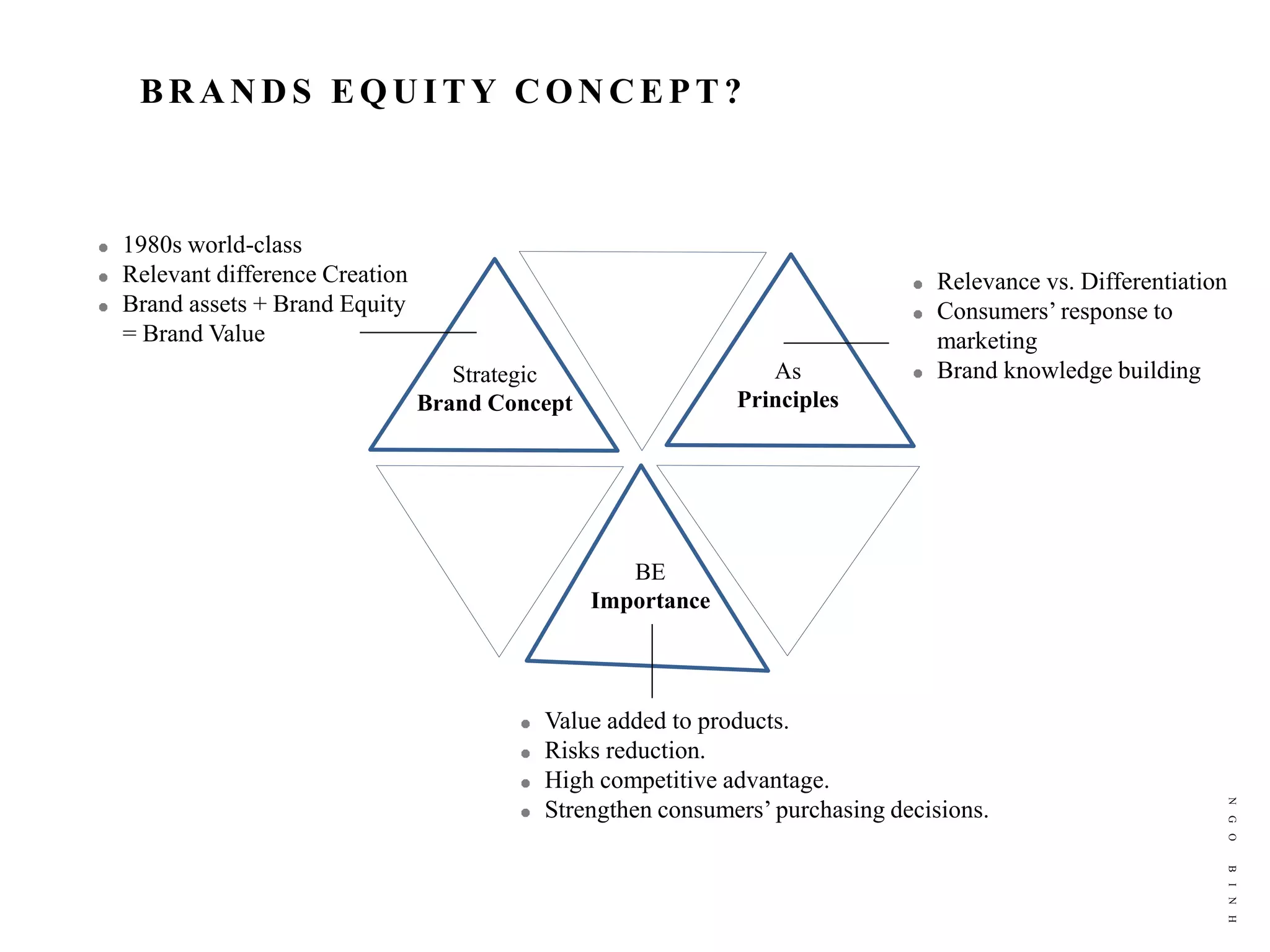
BE
Importance
Strategic
Brand Concept
As
Principles
BR A N D S EQU ITY C ON C EPT?
 1980s world-class
 Relevant difference Creation
 Brand assets + Brand Equity
= Brand Value
 Value added to products.
 Risks reduction.
 High competitive advantage.
 Strengthen consumers’ purchasing decisions.
 Relevance vs. Differentiation
 Consumers’ response to
marketing
 Brand knowledge building
N
G
O
B
I
N
H
Strong & Beloved
BRAND
Plan & Implement
Brand Marketing Programs
[2]
[1]
Identify & Establish
Brand Positioning & Values
N
G
O
B
I
N
H
SBM
Strategic
Brand Management
Process
[ K.L.Keller 1993 ]
STR ATEGIC BR A N D M A N GEM EN T PR OC ESS
[3]
Measure & Interpret
Brand Performance
Grow & Sustain
Brand Equity
[4]
Brand
Resonance
Model
Brand
Positioning
Model
Brand Value
Chain
ID EN TIFY & ESTA BLISH
BRAND POSITIONING & VALUE
STP & D in customer mindset
Mental map
Point of Difference /POD.
Frame of Reference / FOR
Point of Parity/POP.
Four steps of a strong brand building
 Salience
 Performance & Imagery
 Feelings & Judgement
 Resonance
Value creation w. program multipliers
 Marketing Program Investment
 Customer minset
 Market Performance
 Shareholder value
N
G
O
B
I
N
H
Brand
Marketing
Activities
Brand
Elements
Secondary
Associations
PLA N & D ESIGN
BRAND MARKETING PROGRAMS
Brand components -
Brand Identifications System
People, places, things, & -
abstract images
 Identify some new perspectives of marketing
 Enhancing product experience, value pricing,
channel options
 Conducting IMC to build BE
 Creation of new brand associations
 COO Effects conduct
 Co-branding
 Celebrity Endorsement
N
G
O
B
I
N
H
Brand
Audit & Tracking
Studies
Brand
Value Chain
BE
Measurement
System
M EA SU R E & IN TER PR ET
BRAND PERFORMANCE
 Creating & Managing
BVC Profitably
 Internal BE System
 CMI networks & Agency Partners
 Brand Health Emtrics
 Brand Tracking Surveys
N
G
O
B
I
N
H
 Brand Perfomance
 Conducting Survey
Customer Insights
 Customer’s BAR/PAR…
 Brand Health Checking
 Brand Vision Scan
Brand
Expansion
Strategies
Define
Brand
Architecture
Brand
Reinforcement &
Revitalization
PLA N & D ESIGN
BRAND MARKETING PROGRAMS
 Define Brand Portfolios &
Hierachies
 Brand & CAT matrix
 Confirm Brand Priorities
(Core/Extensiion/Stretch)
 Brand Platform of Prepare- Defense-Attack,
etc
 Managing Brand Equity over Time
 Managing Brand Equity over
Geographic Boundaries, Cultures,
and Market Segments
N
G
O
B
I
N
H
[ 3 ]
Articles
[ 2 ]
[ 1 ]
In Brief
Next steps
6
[ 5 ]
……..
[ 4 ]
D ISC U SSION
Starbucks Case study
Individual homework
Excersise
SBM 1
Pair work
Reading & Briefing
Articles 1
In Class Debate
Best practice
Role - play
Brand Battle in VN
Initial Group Project’s
Brainstoming
N
G
O
B
I
N
H
THANK YOU
FOR YOUR PARTICIPATION
N
G
O
B
I
N
H

Brand Management

  • 1.
    ACADEMIC LECTURE BRAND &BRAND MANAGEMENT CONTEMPORARY PERSPECTIVE CHAPTER 1 L e c t . N G Ô B Ì N H
  • 2.
    3 Brand Equity Concept 2 Why doBrands matter? 1 What is brand? Discussion 6 5 SBM Process Branding Challenges Opportunities 4 OU TLIN ES & LEA R N IN G OBJ EC TIV ES Define “brand,” state how brand differs from a product, and explain what brand equity is Summarize the importance of brand today’s brand-focused world Explain how branding applies to virtually everything. Describe the main branding challenges and opportunities. Identify the steps in the strategic brand management process In – class debate Best practice & Application N G O B I N H
  • 3.
    [ BRAND ] No/ProLogo Concept holistically [4] Image (Consumers’ Perception) Personality (Customer/Firm Perception) [2] [1] Identity (Company’s Desired Perception) N G O B I N H B Perceived Values (functional > emotional associations) [3] [ BRAND ] AMA * Definition (Physical Perspective Concept) BR A N D , WHAT IS A LL A BOU T…?
  • 4.
    Towards Firms/Org Towards Consumer s To be branded WHYD O BR A N D S M ATTER ?  Identification of the source of the product  Assignment of responsibility to product maker  Risk reducer  Promise, bond  Symbolic device  Signal of quality  Identification to simplify handling or tracing  Unique features protecting legally  Signal of quality level  Endowing products with unique associations  Source of SCA  Source of financial returns  Physical goods & Services  Retailers and distributors  People and organizations  Sports, arts, & entertainment  Geographic locations  Ideas and causes N G O B I N H
  • 5.
    WHAT BR AN D IN G M ATTER S N G O B I N H Media fragmentation Brand Proliferation Savvy Customers Greater accountability Increased costs Increased competition  Brilliant consumers  World-class inspiration  Consumers more demanding  Customer more sophisticated  Others  More new brands & products,  Degrees of similarity.  Many brand battles  Traditional media erosion  Non-traditional media emergence  Other promotion, communication alternatives  Globalization  Low-priced competitors  Brand extensions:  Deregulation  More complicated competition  NPD expenses  Current product supporting  A new product failure  Ambitious profit targets  Short-term benefits but long- term costs decisions  ROMI /P&L & etc
  • 6.
    BR A ND V S . PR OD U C T N G O B I N H [ 1 ] [ 2 ] [ 3 ]  Designing Packaging  Services provided  Delivery arrangements  Basic Offerings  Core benefit level  Generic benefit level  True product  Expected product level  Augmented product level  Potential product level  Financing  Most value added Brand Equity  Customer advice  Other things valued by the customers B R A N D P R O D U C T has dimensions that differentiate it in some way Any offerings can be categorized, for use or consumption, [ a ] [ b ] [ c ]
  • 7.
    BE Importance Strategic Brand Concept As Principles BR AN D S EQU ITY C ON C EPT?  1980s world-class  Relevant difference Creation  Brand assets + Brand Equity = Brand Value  Value added to products.  Risks reduction.  High competitive advantage.  Strengthen consumers’ purchasing decisions.  Relevance vs. Differentiation  Consumers’ response to marketing  Brand knowledge building N G O B I N H
  • 8.
    Strong & Beloved BRAND Plan& Implement Brand Marketing Programs [2] [1] Identify & Establish Brand Positioning & Values N G O B I N H SBM Strategic Brand Management Process [ K.L.Keller 1993 ] STR ATEGIC BR A N D M A N GEM EN T PR OC ESS [3] Measure & Interpret Brand Performance Grow & Sustain Brand Equity [4]
  • 9.
    Brand Resonance Model Brand Positioning Model Brand Value Chain ID ENTIFY & ESTA BLISH BRAND POSITIONING & VALUE STP & D in customer mindset Mental map Point of Difference /POD. Frame of Reference / FOR Point of Parity/POP. Four steps of a strong brand building  Salience  Performance & Imagery  Feelings & Judgement  Resonance Value creation w. program multipliers  Marketing Program Investment  Customer minset  Market Performance  Shareholder value N G O B I N H
  • 10.
    Brand Marketing Activities Brand Elements Secondary Associations PLA N &D ESIGN BRAND MARKETING PROGRAMS Brand components - Brand Identifications System People, places, things, & - abstract images  Identify some new perspectives of marketing  Enhancing product experience, value pricing, channel options  Conducting IMC to build BE  Creation of new brand associations  COO Effects conduct  Co-branding  Celebrity Endorsement N G O B I N H
  • 11.
    Brand Audit & Tracking Studies Brand ValueChain BE Measurement System M EA SU R E & IN TER PR ET BRAND PERFORMANCE  Creating & Managing BVC Profitably  Internal BE System  CMI networks & Agency Partners  Brand Health Emtrics  Brand Tracking Surveys N G O B I N H  Brand Perfomance  Conducting Survey Customer Insights  Customer’s BAR/PAR…  Brand Health Checking  Brand Vision Scan
  • 12.
    Brand Expansion Strategies Define Brand Architecture Brand Reinforcement & Revitalization PLA N& D ESIGN BRAND MARKETING PROGRAMS  Define Brand Portfolios & Hierachies  Brand & CAT matrix  Confirm Brand Priorities (Core/Extensiion/Stretch)  Brand Platform of Prepare- Defense-Attack, etc  Managing Brand Equity over Time  Managing Brand Equity over Geographic Boundaries, Cultures, and Market Segments N G O B I N H
  • 13.
    [ 3 ] Articles [2 ] [ 1 ] In Brief Next steps 6 [ 5 ] …….. [ 4 ] D ISC U SSION Starbucks Case study Individual homework Excersise SBM 1 Pair work Reading & Briefing Articles 1 In Class Debate Best practice Role - play Brand Battle in VN Initial Group Project’s Brainstoming N G O B I N H
  • 14.
    THANK YOU FOR YOURPARTICIPATION N G O B I N H