AGC / CFMA Conference Self Insurance with Sophistication Are You Ready for a Captive?  October 23, 2008 Mark Ouimette, ARM [email_address]
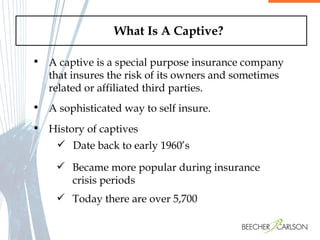
What Is A Captive? A captive is a special purpose insurance company that insures the risk of its owners and sometimes related or affiliated third parties. A sophisticated way to self insure.  Date back to early 1960’s History of captives Became more popular during insurance crisis periods Today there are over 5,700
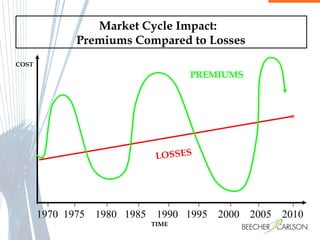
COST TIME PREMIUMS 1970  1975  1980  1985  1990  1995  2000  2005  2010 LOSSES Market Cycle Impact:  Premiums Compared to Losses
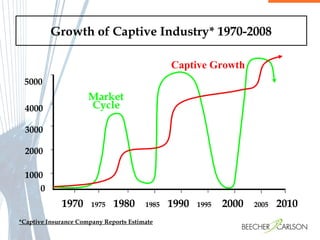
Growth of Captive Industry* 1970-2008  *Captive Insurance Company Reports Estimate 1970  1975   1980  1985   1990  1995   2000  2005   2010 0 1000 2000 3000 4000 5000 Captive   Growth Market Cycle
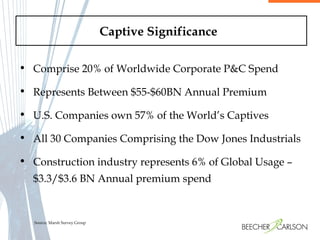
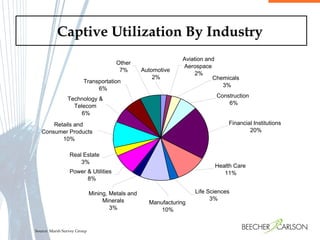
Captive Significance   Comprise 20% of Worldwide Corporate P&C Spend  Represents Between $55-$60BN Annual Premium U.S. Companies own 57% of the World’s Captives All 30 Companies Comprising the Dow Jones Industrials  Construction industry represents 6% of Global Usage –  $3.3/$3.6 BN Annual premium spend Source: Marsh Survey Group
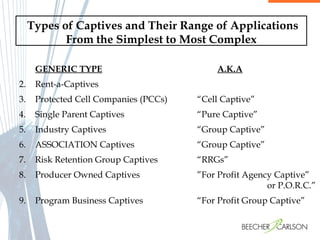
GENERIC TYPE   A.K.A Rent-a-Captives Protected Cell Companies (PCCs)   “Cell Captive” Single Parent Captives   “Pure Captive” Industry Captives   “Group Captive” ASSOCIATION Captives   “Group Captive” Risk Retention Group Captives    “RRGs” Producer Owned Captives     ”For Profit Agency Captive”    or P.O.R.C.” Program Business Captives   “For Profit Group Captive”   Types of Captives and Their Range of Applications From the Simplest to Most Complex
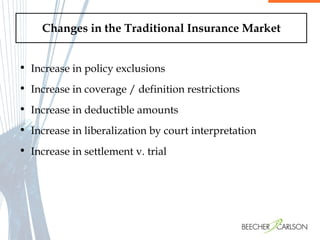
Changes in the Traditional Insurance Market Increase in policy exclusions Increase in coverage / definition restrictions Increase in deductible amounts Increase in liberalization by court interpretation Increase in settlement v. trial
Why an Alternative to Commercial Insurance? You want to control your destiny You know your risks better than any insurance company underwriter You do not want to be rated based on others and industry losses Certain aspects of “Off the shelf” insurance programs do not suit contractor specific circumstances
Captive Ownership The owners of the captive are its policyholders, but also can be 3 rd  parties The policyholders have control over management, underwriting, claims, investments, etc.  Overall decisions regarding captive operation rests in the hands of the Board of Directors elected by the captive owners.
Group Captives Owned by multiple, non-related organizations Designed to insure the risk of these owners Homogeneous – insuring only similar types of business risks Heterogeneous – insuring a wide range of risks Involves risk sharing with others – known and unknown Results in Dividends or Assessments
Can be owned by members of a common trade or industry association Can be owned by the Association – Or in combination with members Shares the risks of that industry among its members Possibility of adverse selection Association Captive
Why Captives Are Sophisticated? Coverage can be tailored to meet the specific needs of the policyholder(s) Underwriting flexibility to provide coverage where it is unavailable or overpriced in the commercial marketplace Premiums are based on the loss experience of the captive, not on the income and expense needs of an insurance company Premium funding flexibility based on actuarial loss projections via confidence intervals
Captive Sophistication  continued Accumulated surplus can be used to reduce future premiums or be returned to the policyholders as dividends More incentives for safety programs & loss control Greater control over claim handling Opportunity for premium/loss reserve tax deductibility  Insurance company accounting treatment - IBNR Underwriting profit & investment income belongs to the captive, not the insurance company
Potential for lower overhead costs so a larger percentage of premium can be used for claim payments or dividends Direct access to the reinsurance marketplace Independence from the conventional insurance marketplace Flexibility – endorsements, cancellations, premiums Potential for tax advantages Access to U.S. Government’s coverage via TRIA  Captive Sophistication  continued
Uses Of A Captive General Liability  - Completed Ops / Construction  Defect Workers’ Compensation  OCIP / CCIP Subcontractor Default (Surety / Performance Bond) Warranty To Fund a Retained Working Loss Layer From $ 0  $ X Builders Risk Earthquake / Windstorm
TRIA Excess or Buffer Layer  - GL Specialty coverage (Mold etc.) EPLI  Professional Liability Difference of Conditions  Employee Benefits Uses Of A Captive  Continued
Captive Utilization By Industry Source: Marsh Survey Group Manufacturing 10% Financial Institutions 20% Construction 6% Chemicals 3% Aviation and  Aerospace 2% Other 7% Automotive 2% Health Care 11% Life Sciences 3% Mining, Metals and  Minerals 3% Power & Utilities 8% Real Estate 3% Retails and  Consumer Products 10% Technology &  Telecom 6% Transportation 6%
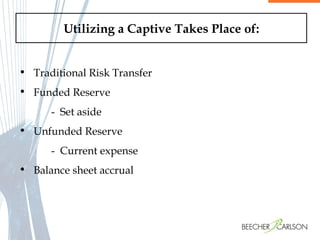
Utilizing a Captive Takes Place of: Traditional Risk Transfer Funded Reserve -  Set aside Unfunded Reserve  -  Current expense  Balance sheet accrual
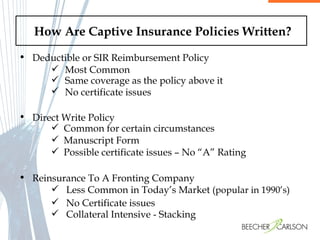
How Are Captive Insurance Policies Written? Deductible or SIR Reimbursement Policy Most Common Same coverage as the policy above it No certificate issues     Direct Write Policy Common for certain circumstances Manuscript Form Possible certificate issues – No “A” Rating Reinsurance To A Fronting Company Less Common in Today’s Market  (popular in 1990’s) No Certificate issues Collateral Intensive - Stacking
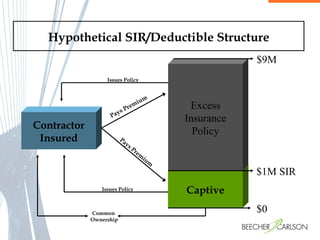
Hypothetical SIR/Deductible Structure Captive Contractor Insured Excess Insurance  Policy $0 $1M SIR $9M Pays Premium Issues Policy  Issues Policy  Common  Ownership Pays Premium
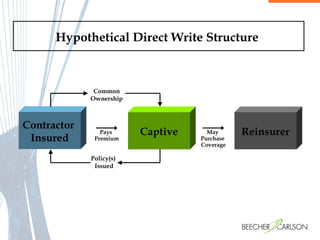
Contractor  Insured Captive Reinsurer Common Ownership Policy(s)  Issued May  Purchase  Coverage Hypothetical Direct Write Structure  Pays  Premium
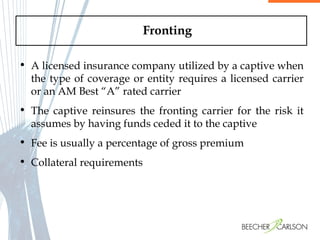
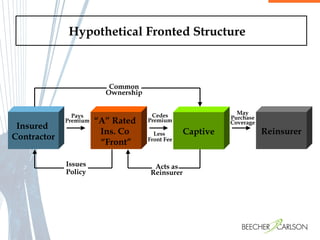
Fronting A licensed insurance company utilized by a captive when the type of coverage or entity requires a licensed carrier or an AM Best “A” rated carrier The captive reinsures the fronting carrier for the risk it assumes by having funds ceded it to the captive Fee is usually a percentage of gross premium Collateral requirements
Insured  Contractor “ A” Rated  Ins. Co  “ Front” Captive Reinsurer Issues Policy Acts as Reinsurer Common Ownership Hypothetical Fronted Structure  Pays Premium Cedes Premium Less  Front Fee May Purchase Coverage
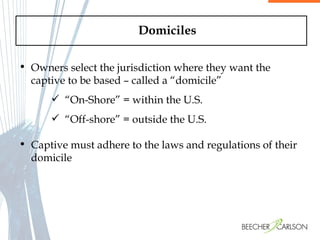
Domiciles Owners select the jurisdiction where they want the captive to be based – called a “domicile”  “ On-Shore” = within the U.S. “ Off-shore” = outside the U.S.  Captive must adhere to the laws and regulations of their domicile
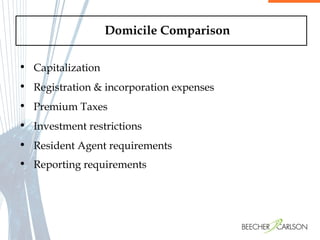
Domicile Comparison Capitalization Registration & incorporation expenses Premium Taxes Investment restrictions  Resident Agent requirements  Reporting requirements
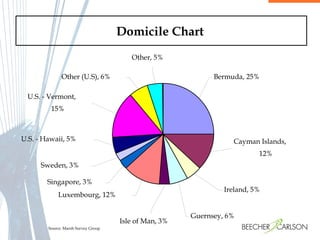
Domicile Chart Source: Marsh Survey Group Bermuda, 25% Cayman Islands,  12% Guernsey, 6% Ireland, 5% Isle of Man, 3% Luxembourg, 12% Singapore, 3% U.S. - Hawaii, 5% Sweden, 3% U.S. - Vermont,  15% Other (U.S), 6% Other, 5%
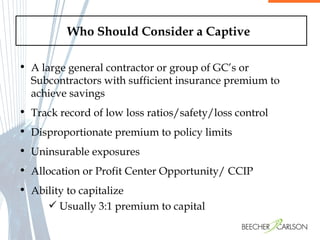
Who Should Consider a Captive   A large general contractor or group of GC’s or Subcontractors with sufficient insurance premium to achieve savings  Track record of low loss ratios/safety/loss control  Disproportionate premium to policy limits Uninsurable exposures Allocation or Profit Center Opportunity/ CCIP Ability to capitalize Usually 3:1 premium to capital
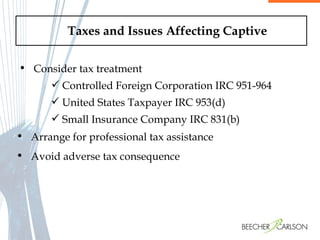
Taxes and Issues Affecting Captive Consider tax treatment Controlled Foreign Corporation IRC 951-964 United States Taxpayer IRC 953(d) Small Insurance Company IRC 831(b) Arrange for professional tax assistance  Avoid adverse tax consequence
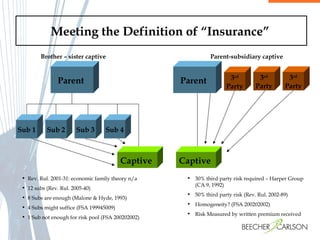
Meeting the Definition of “Insurance” Rev. Rul. 2001-31: economic family theory n/a 12 subs (Rev. Rul. 2005-40) 8 Subs are enough (Malone & Hyde, 1993) 4 Subs might suffice (FSA 199945009) 1 Sub not enough for risk pool (FSA 200202002) 30% third party risk required – Harper Group (CA 9, 1992) 50% third party risk (Rev. Rul. 2002-89) Homogeneity? (FSA 200202002) Risk Measured by written premium received  Brother – sister captive Parent  Sub 1 Sub 2 Sub 3 Sub 4 Captive  Captive  Parent  Parent-subsidiary captive 3 rd Party 3 rd Party 3 rd Party
Who Will Run the Captive? Independent captive management companies International brokers/agencies – captive management arm Reinsurers captive management arms
Captive Management Captive Managers have sufficient resources to perform insurance, accounting, underwriting, and claims functions.  This can involve the following: Annual reports and filings for regulators Bind coverage and issue insurance or reinsurance contracts Perform banking and investment functions Rate and underwrite risk exposure Issue Policies
Captive Management  continued Captive Managers have sufficient resources to perform insurance, accounting, underwriting, and claims functions.  This can involve the following:  Allocate premiums, losses and dividends as needed Adjust claims
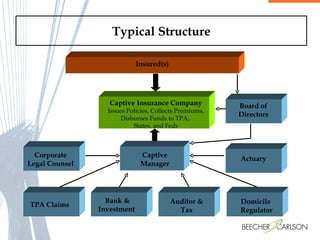
Typical Structure Captive Insurance Company Issues Policies, Collects Premiums, Disburses Funds to TPA,  States, and Feds Insured(s) Domicile   Regulator Captive Manager Corporate Legal Counsel Auditor & Tax Bank & Investment  TPA Claims Board of Directors Actuary

Are You Ready For A Captive?

  • 1.
    AGC / CFMAConference Self Insurance with Sophistication Are You Ready for a Captive? October 23, 2008 Mark Ouimette, ARM [email_address]
  • 2.
    What Is ACaptive? A captive is a special purpose insurance company that insures the risk of its owners and sometimes related or affiliated third parties. A sophisticated way to self insure. Date back to early 1960’s History of captives Became more popular during insurance crisis periods Today there are over 5,700
  • 3.
    COST TIME PREMIUMS1970 1975 1980 1985 1990 1995 2000 2005 2010 LOSSES Market Cycle Impact: Premiums Compared to Losses
  • 4.
    Growth of CaptiveIndustry* 1970-2008 *Captive Insurance Company Reports Estimate 1970 1975 1980 1985 1990 1995 2000 2005 2010 0 1000 2000 3000 4000 5000 Captive Growth Market Cycle
  • 5.
    Captive Significance Comprise 20% of Worldwide Corporate P&C Spend Represents Between $55-$60BN Annual Premium U.S. Companies own 57% of the World’s Captives All 30 Companies Comprising the Dow Jones Industrials Construction industry represents 6% of Global Usage – $3.3/$3.6 BN Annual premium spend Source: Marsh Survey Group
  • 6.
    GENERIC TYPE A.K.A Rent-a-Captives Protected Cell Companies (PCCs) “Cell Captive” Single Parent Captives “Pure Captive” Industry Captives “Group Captive” ASSOCIATION Captives “Group Captive” Risk Retention Group Captives “RRGs” Producer Owned Captives ”For Profit Agency Captive” or P.O.R.C.” Program Business Captives “For Profit Group Captive” Types of Captives and Their Range of Applications From the Simplest to Most Complex
  • 7.
    Changes in theTraditional Insurance Market Increase in policy exclusions Increase in coverage / definition restrictions Increase in deductible amounts Increase in liberalization by court interpretation Increase in settlement v. trial
  • 8.
    Why an Alternativeto Commercial Insurance? You want to control your destiny You know your risks better than any insurance company underwriter You do not want to be rated based on others and industry losses Certain aspects of “Off the shelf” insurance programs do not suit contractor specific circumstances
  • 9.
    Captive Ownership Theowners of the captive are its policyholders, but also can be 3 rd parties The policyholders have control over management, underwriting, claims, investments, etc. Overall decisions regarding captive operation rests in the hands of the Board of Directors elected by the captive owners.
  • 10.
    Group Captives Ownedby multiple, non-related organizations Designed to insure the risk of these owners Homogeneous – insuring only similar types of business risks Heterogeneous – insuring a wide range of risks Involves risk sharing with others – known and unknown Results in Dividends or Assessments
  • 11.
    Can be ownedby members of a common trade or industry association Can be owned by the Association – Or in combination with members Shares the risks of that industry among its members Possibility of adverse selection Association Captive
  • 12.
    Why Captives AreSophisticated? Coverage can be tailored to meet the specific needs of the policyholder(s) Underwriting flexibility to provide coverage where it is unavailable or overpriced in the commercial marketplace Premiums are based on the loss experience of the captive, not on the income and expense needs of an insurance company Premium funding flexibility based on actuarial loss projections via confidence intervals
  • 13.
    Captive Sophistication continued Accumulated surplus can be used to reduce future premiums or be returned to the policyholders as dividends More incentives for safety programs & loss control Greater control over claim handling Opportunity for premium/loss reserve tax deductibility Insurance company accounting treatment - IBNR Underwriting profit & investment income belongs to the captive, not the insurance company
  • 14.
    Potential for loweroverhead costs so a larger percentage of premium can be used for claim payments or dividends Direct access to the reinsurance marketplace Independence from the conventional insurance marketplace Flexibility – endorsements, cancellations, premiums Potential for tax advantages Access to U.S. Government’s coverage via TRIA Captive Sophistication continued
  • 15.
    Uses Of ACaptive General Liability - Completed Ops / Construction Defect Workers’ Compensation OCIP / CCIP Subcontractor Default (Surety / Performance Bond) Warranty To Fund a Retained Working Loss Layer From $ 0 $ X Builders Risk Earthquake / Windstorm
  • 16.
    TRIA Excess orBuffer Layer - GL Specialty coverage (Mold etc.) EPLI Professional Liability Difference of Conditions Employee Benefits Uses Of A Captive Continued
  • 17.
    Captive Utilization ByIndustry Source: Marsh Survey Group Manufacturing 10% Financial Institutions 20% Construction 6% Chemicals 3% Aviation and Aerospace 2% Other 7% Automotive 2% Health Care 11% Life Sciences 3% Mining, Metals and Minerals 3% Power & Utilities 8% Real Estate 3% Retails and Consumer Products 10% Technology & Telecom 6% Transportation 6%
  • 18.
    Utilizing a CaptiveTakes Place of: Traditional Risk Transfer Funded Reserve - Set aside Unfunded Reserve - Current expense Balance sheet accrual
  • 19.
    How Are CaptiveInsurance Policies Written? Deductible or SIR Reimbursement Policy Most Common Same coverage as the policy above it No certificate issues Direct Write Policy Common for certain circumstances Manuscript Form Possible certificate issues – No “A” Rating Reinsurance To A Fronting Company Less Common in Today’s Market (popular in 1990’s) No Certificate issues Collateral Intensive - Stacking
  • 20.
    Hypothetical SIR/Deductible StructureCaptive Contractor Insured Excess Insurance Policy $0 $1M SIR $9M Pays Premium Issues Policy Issues Policy Common Ownership Pays Premium
  • 21.
    Contractor InsuredCaptive Reinsurer Common Ownership Policy(s) Issued May Purchase Coverage Hypothetical Direct Write Structure Pays Premium
  • 22.
    Fronting A licensedinsurance company utilized by a captive when the type of coverage or entity requires a licensed carrier or an AM Best “A” rated carrier The captive reinsures the fronting carrier for the risk it assumes by having funds ceded it to the captive Fee is usually a percentage of gross premium Collateral requirements
  • 23.
    Insured Contractor“ A” Rated Ins. Co “ Front” Captive Reinsurer Issues Policy Acts as Reinsurer Common Ownership Hypothetical Fronted Structure Pays Premium Cedes Premium Less Front Fee May Purchase Coverage
  • 24.
    Domiciles Owners selectthe jurisdiction where they want the captive to be based – called a “domicile” “ On-Shore” = within the U.S. “ Off-shore” = outside the U.S. Captive must adhere to the laws and regulations of their domicile
  • 25.
    Domicile Comparison CapitalizationRegistration & incorporation expenses Premium Taxes Investment restrictions Resident Agent requirements Reporting requirements
  • 26.
    Domicile Chart Source:Marsh Survey Group Bermuda, 25% Cayman Islands, 12% Guernsey, 6% Ireland, 5% Isle of Man, 3% Luxembourg, 12% Singapore, 3% U.S. - Hawaii, 5% Sweden, 3% U.S. - Vermont, 15% Other (U.S), 6% Other, 5%
  • 27.
    Who Should Considera Captive A large general contractor or group of GC’s or Subcontractors with sufficient insurance premium to achieve savings Track record of low loss ratios/safety/loss control Disproportionate premium to policy limits Uninsurable exposures Allocation or Profit Center Opportunity/ CCIP Ability to capitalize Usually 3:1 premium to capital
  • 28.
    Taxes and IssuesAffecting Captive Consider tax treatment Controlled Foreign Corporation IRC 951-964 United States Taxpayer IRC 953(d) Small Insurance Company IRC 831(b) Arrange for professional tax assistance Avoid adverse tax consequence
  • 29.
    Meeting the Definitionof “Insurance” Rev. Rul. 2001-31: economic family theory n/a 12 subs (Rev. Rul. 2005-40) 8 Subs are enough (Malone & Hyde, 1993) 4 Subs might suffice (FSA 199945009) 1 Sub not enough for risk pool (FSA 200202002) 30% third party risk required – Harper Group (CA 9, 1992) 50% third party risk (Rev. Rul. 2002-89) Homogeneity? (FSA 200202002) Risk Measured by written premium received Brother – sister captive Parent Sub 1 Sub 2 Sub 3 Sub 4 Captive Captive Parent Parent-subsidiary captive 3 rd Party 3 rd Party 3 rd Party
  • 30.
    Who Will Runthe Captive? Independent captive management companies International brokers/agencies – captive management arm Reinsurers captive management arms
  • 31.
    Captive Management CaptiveManagers have sufficient resources to perform insurance, accounting, underwriting, and claims functions. This can involve the following: Annual reports and filings for regulators Bind coverage and issue insurance or reinsurance contracts Perform banking and investment functions Rate and underwrite risk exposure Issue Policies
  • 32.
    Captive Management continued Captive Managers have sufficient resources to perform insurance, accounting, underwriting, and claims functions. This can involve the following: Allocate premiums, losses and dividends as needed Adjust claims
  • 33.
    Typical Structure CaptiveInsurance Company Issues Policies, Collects Premiums, Disburses Funds to TPA, States, and Feds Insured(s) Domicile Regulator Captive Manager Corporate Legal Counsel Auditor & Tax Bank & Investment TPA Claims Board of Directors Actuary