Introduction to
Captive Insurance
  Companies


A Risk Management Strategy
What is a captive insurance company?

   • A captive insurance company insures the “other risks” of a business.
   •   Current casualty insurance coverage for:
           Buildings
           Contents
           Inventory
           Business liability
           Other coverage
   • Other risks that are not insured can include:
           Deductibles on current coverage
           Exclusions on current coverage
           Loss of key vendor
           Loss of key employee
           Loss of key customer
           Dispute resolution
           Employment practices
Business Insurance Coverage

   • Insured risks include a portion of a businesses risks:
          Umbrella
          Retention
          Workers Compensation
          General Liability
          Excess


   • Other exposed risks that are not currently insured:
          Deductibles and exclusions on current coverage
          Operating risks regarding key employees and vendors
          Cyber risk
          Credit default
          Dispute resolution
          Litigation defense
Insuring “Other” Business Risks

   • Forming a captive insurance company (CIC) offers solutions for covering
     uninsured risks for many companies.
          Actuarially determines insurable risks and prices the risk.
          A CIC is formed in a state or territorial domicile that is favorable for the
           business operation.
          A CIC provides additional coverage and is not intended to replace current
           property and casualty coverage.
          A CIC is eligible for up to $1.2 million in annual insurance premium [IRC
           831(b)].
          A CIC is required to be professionally managed to ensure regulatory and IRS
           compliance.
          Captive Insurance Group, LLC provide professional services for ongoing
           management of captive insurance companies.
Forms of Coverage

   •   Comprehensive Dispute Resolution Insurance Policy

   •   Cyber Risk Commercial Insurance Policy
          Facilities
          Technology
          Corporate Activities Regarding Cyberspace

   •   Comprehensive Business Interruption Insurance Policy
          Business Income Loss Due to Changes in the Physical Environment

   •   Comprehensive Business Interruption Insurance
          Business Income Loss Due to Loss of Key Personnel
          Loss of Key Corporate Relationships
          Regulatory Change
Tax Treatment

   •   History of IRC 831 (b)

   •   Issuance of revenue rulings providing safe harbors in 2002:
           Revenue Ruling 2002-89
           Revenue Ruling 2002-90
           Revenue Ruling 2002-91

   •   Multiple captives is possible when sufficient risks exist and
       control group rules can be met.
Tax Treatment of Distributions

    • Tax effects on the distribution of money out of a captive can be tax
      favorable.

    • In most cases dividends paid out of a captive insurance company will
      be taxable at a 20% rate under the current American Taxpayer Relief
      Act of 2012.

    • A long-term exit strategy may involve a tax liquidation of the captive
      insurance company, creating a long-term gain treatment on the stock
      of the insurance company if the holding period for LTCG treatment is
      met.
Revenue Ruling 2002-89

   •   More than 50% of exposure is derived from unrelated parties.

   •   Accomplished through the use of a risk pooling arrangement.

   •   Client exposure to the risk pooling arrangement is limited through
       stop loss agreements within the pool and through underlying
       reinsurance arrangements.
Revenue Ruling 2002-90

   • Risk shifting and risk distribution requirements are satisfied if:
         Twelve Brother/Sister subsidiaries are in the corporate structure.

         There is no single Brother/Sister subsidiary than has more than 15% nor
          less than 5% or the risk.
Estate Planning with a Captive

   • A captive insurance company can provide estate planning strategies
     for:
          Principals
          Businesses
          Family
          Shareholders
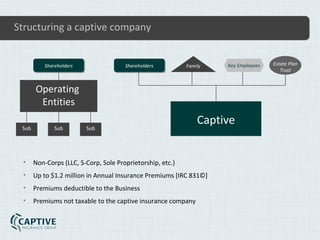
   • A captive insurance company can be owned by:
          Shareholders
          Estate Plan Trusts
          Key Employees
          Family
Captive Ownership Qualification

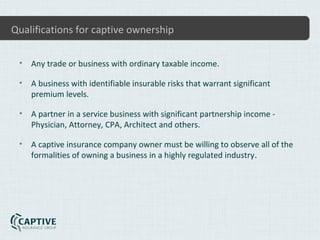
    • Any trade or business with ordinary taxable income can have a
      captive.

    • Businesses with identifiable and insurable risks that warrant
      significant premium levels should consider a captive.

    • Businesses with consistent cash flows can benefit with a captive
      insurance company.

    • Ownership of a captive insurance company requires the basic
      understanding that it will operate in a highly regulated industry.
Establishing a Captive

    •   A copy of the last two years of the corporation(s) federal income tax
        returns is required.

    •   The corporation will provide an organizational chart showing entities
        and ownership.

    •   A declaration page of current insurance coverage purchased from
        commercial insurance carrier is provided by client.

    •   A discovery meeting with client and actuarial firm will identify
        uninsured risks in the business operation.
Captive Insurance Group, LLC

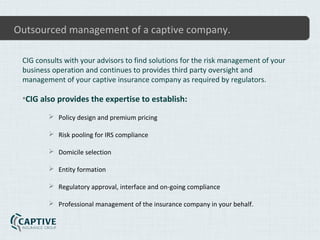
    •   Work with the clients professional advisors to determine the right solution
        for risk management of their business operation.
    •   Engage independent actuaries to determine the policy design and
        premium pricing.
    •   Arrange the risk pooling arrangement for IRS compliance.
    •   Advise client on domicile selection.
    •   Establish the captive insurance company.
    •   Manage the regulatory interface and approval ensuring on-going
        compliance.
    •   Manage the captive insurance company for the client.
    •   The management of the money within the captive is handled by the
        client’s wealth advisors.
Legal Disclosure

  The information contained herein is for educational use and is not a substitute for competent
  legal, tax and business advice as it relates to the formation and ongoing operations of a captive
  insurance company.
  IRS Circular 230 Required Notice—IRS regulations require that we inform you as follows:
  Any U.S. federal tax advice contained in this communication is not intended to be used
  and cannot be used, for the purpose of (i) avoiding penalties under the Internal Revenue
  Code or (ii) promoting, marketing or recommending to another party any transaction or
  tax-related matters.
  Financial examples included in this information are generic and are not specific to a particular
  clients risk management profile or financial situation.
Contact Information

  Captive Insurance Group, LLC provides Domestic and U.S. Territory captive
  management services.

      Charles H. Spitzer, CPA
      President
      817.793.6522
      Cspitzer@captiveinsuranceusa.com


      www.captiveinsuranceusa.com

Captive Insurance Group - A Risk Management Strategy

  • 1.
    Introduction to Captive Insurance Companies A Risk Management Strategy
  • 2.
    What is acaptive insurance company? • A captive insurance company insures the “other risks” of a business. • Current casualty insurance coverage for:  Buildings  Contents  Inventory  Business liability  Other coverage • Other risks that are not insured can include:  Deductibles on current coverage  Exclusions on current coverage  Loss of key vendor  Loss of key employee  Loss of key customer  Dispute resolution  Employment practices
  • 3.
    Business Insurance Coverage • Insured risks include a portion of a businesses risks:  Umbrella  Retention  Workers Compensation  General Liability  Excess • Other exposed risks that are not currently insured:  Deductibles and exclusions on current coverage  Operating risks regarding key employees and vendors  Cyber risk  Credit default  Dispute resolution  Litigation defense
  • 4.
    Insuring “Other” BusinessRisks • Forming a captive insurance company (CIC) offers solutions for covering uninsured risks for many companies.  Actuarially determines insurable risks and prices the risk.  A CIC is formed in a state or territorial domicile that is favorable for the business operation.  A CIC provides additional coverage and is not intended to replace current property and casualty coverage.  A CIC is eligible for up to $1.2 million in annual insurance premium [IRC 831(b)].  A CIC is required to be professionally managed to ensure regulatory and IRS compliance.  Captive Insurance Group, LLC provide professional services for ongoing management of captive insurance companies.
  • 5.
    Forms of Coverage • Comprehensive Dispute Resolution Insurance Policy • Cyber Risk Commercial Insurance Policy  Facilities  Technology  Corporate Activities Regarding Cyberspace • Comprehensive Business Interruption Insurance Policy  Business Income Loss Due to Changes in the Physical Environment • Comprehensive Business Interruption Insurance  Business Income Loss Due to Loss of Key Personnel  Loss of Key Corporate Relationships  Regulatory Change
  • 6.
    Tax Treatment • History of IRC 831 (b) • Issuance of revenue rulings providing safe harbors in 2002:  Revenue Ruling 2002-89  Revenue Ruling 2002-90  Revenue Ruling 2002-91 • Multiple captives is possible when sufficient risks exist and control group rules can be met.
  • 7.
    Tax Treatment ofDistributions • Tax effects on the distribution of money out of a captive can be tax favorable. • In most cases dividends paid out of a captive insurance company will be taxable at a 20% rate under the current American Taxpayer Relief Act of 2012. • A long-term exit strategy may involve a tax liquidation of the captive insurance company, creating a long-term gain treatment on the stock of the insurance company if the holding period for LTCG treatment is met.
  • 8.
    Revenue Ruling 2002-89 • More than 50% of exposure is derived from unrelated parties. • Accomplished through the use of a risk pooling arrangement. • Client exposure to the risk pooling arrangement is limited through stop loss agreements within the pool and through underlying reinsurance arrangements.
  • 9.
    Revenue Ruling 2002-90 • Risk shifting and risk distribution requirements are satisfied if:  Twelve Brother/Sister subsidiaries are in the corporate structure.  There is no single Brother/Sister subsidiary than has more than 15% nor less than 5% or the risk.
  • 10.
    Estate Planning witha Captive • A captive insurance company can provide estate planning strategies for:  Principals  Businesses  Family  Shareholders • A captive insurance company can be owned by:  Shareholders  Estate Plan Trusts  Key Employees  Family
  • 11.
    Captive Ownership Qualification • Any trade or business with ordinary taxable income can have a captive. • Businesses with identifiable and insurable risks that warrant significant premium levels should consider a captive. • Businesses with consistent cash flows can benefit with a captive insurance company. • Ownership of a captive insurance company requires the basic understanding that it will operate in a highly regulated industry.
  • 12.
    Establishing a Captive • A copy of the last two years of the corporation(s) federal income tax returns is required. • The corporation will provide an organizational chart showing entities and ownership. • A declaration page of current insurance coverage purchased from commercial insurance carrier is provided by client. • A discovery meeting with client and actuarial firm will identify uninsured risks in the business operation.
  • 13.
    Captive Insurance Group,LLC • Work with the clients professional advisors to determine the right solution for risk management of their business operation. • Engage independent actuaries to determine the policy design and premium pricing. • Arrange the risk pooling arrangement for IRS compliance. • Advise client on domicile selection. • Establish the captive insurance company. • Manage the regulatory interface and approval ensuring on-going compliance. • Manage the captive insurance company for the client. • The management of the money within the captive is handled by the client’s wealth advisors.
  • 14.
    Legal Disclosure The information contained herein is for educational use and is not a substitute for competent legal, tax and business advice as it relates to the formation and ongoing operations of a captive insurance company. IRS Circular 230 Required Notice—IRS regulations require that we inform you as follows: Any U.S. federal tax advice contained in this communication is not intended to be used and cannot be used, for the purpose of (i) avoiding penalties under the Internal Revenue Code or (ii) promoting, marketing or recommending to another party any transaction or tax-related matters. Financial examples included in this information are generic and are not specific to a particular clients risk management profile or financial situation.
  • 15.
    Contact Information Captive Insurance Group, LLC provides Domestic and U.S. Territory captive management services. Charles H. Spitzer, CPA President 817.793.6522 Cspitzer@captiveinsuranceusa.com www.captiveinsuranceusa.com