What brokers need to know about CaptivesBIBA 2011, fringe session, Wednesday 11th MayMike JohnsAlternative Risk Management Limitedmjohns@arm.co.ggPaul EatonHeritagePaul.Eaton@heritage.co.gg
Guernsey
Guernsey’s finance industry•  Insurance, Banking, Funds and Trust•  No.1 European Captive Domicile•  675 insurance entities•  £3.4bn of GWP•  40% of the FTSE100 captives•  Pioneer of Protected Cell legislation
Presentation agenda•  What is a Captive?•  The different types•  How and why are Captives used?•  Pure Captives: Case Study•  Broker Captives: Case Study•  Why Guernsey?
What is a Captive?•  An insurance company•  Usually formed for a specific purpose, primarily self insurance•  Called ‘Captives’ as often only provides insurance to its owner•  Often formed in a offshore domicile•  Captures both premium and risk
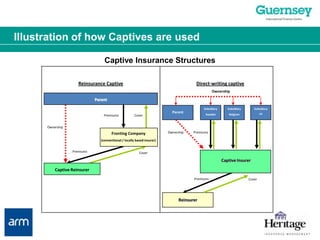
Captive Insurance StructuresReinsurance CaptiveDirect-writing captiveOwnershipParentSubsidiarySwedenSubsidiaryBelgiumSubsidiaryUKParentCoverPremiumsOwnershipPremiumsOwnershipFronting Company(conventional / locally based insurer)PremiumsCaptive InsurerCoverCaptive ReinsurerPremiumsCoverReinsurerIllustration of how Captives are used
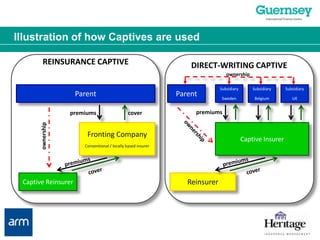
Illustration of how Captives are usedownershipREINSURANCE CAPTIVEDIRECT-WRITING CAPTIVEownershipParentParentSubsidiarySwedenSubsidiaryBelgiumSubsidiaryUKpremiumspremiumscoverFronting CompanyConventional / locally based insurerCaptive InsurerownershipownershippremiumspremiumscovercoverCaptive ReinsurerReinsurer
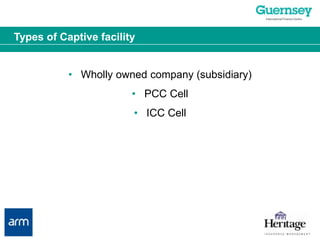
Types of Captive facility•   Wholly owned company (subsidiary)•   PCC Cell•   ICC Cell
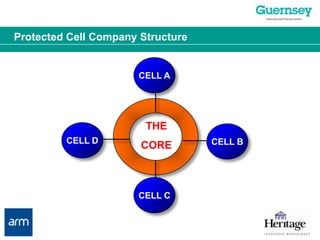
Protected Cell Company StructureCELL ATHECORECELL DCELL BCELL C
How and why are Captives used?PURE Captives•  Used by your clients as a mechanism to manage self insurance•  Can underwrite various risks of the owner•  Control over the unpredictable market cycle•  Optimise the insurance purchase•  Cost of risk based upon actual performance•  Leverage with the insurance market•  Focal point for awareness of risk management•  Flexibility in cover and innovative approach possible
How and why are Captives used?THIRD PARTY Captives•  Can be used by brokers, MGAs or clients •  A way of creating more value from existing profitable business•  Earn additional revenue•  Maximise control•  Flexibility and Bespoke coverage
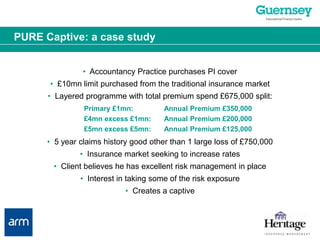
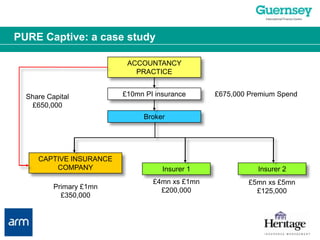
PURE Captive: a case study•  Accountancy Practice purchases PI cover•  £10mn limit purchased from the traditional insurance market•  Layered programme with total premium spend £675,000 split:Primary £1mn:	Annual Premium £350,000£4mn excess £1mn:	Annual Premium £200,000£5mn excess £5mn:	Annual Premium £125,000•  5 year claims history good other than 1 large loss of £750,000•  Insurance market seeking to increase rates•  Client believes he has excellent risk management in place•  Interest in taking some of the risk exposure•  Creates a captive
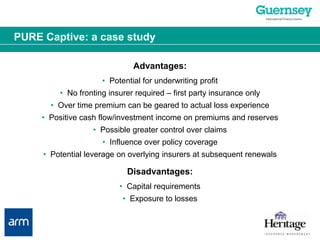
PURE Captive: a case studyAdvantages:•  Potential for underwriting profit•  No fronting insurer required – first party insurance only•  Over time premium can be geared to actual loss experience•  Positive cash flow/investment income on premiums and reserves•  Possible greater control over claims•  Influence over policy coverage•  Potential leverage on overlying insurers at subsequent renewalsDisadvantages:•  Capital requirements•  Exposure to losses
PURE Captive: a case studyACCOUNTANCY PRACTICE£10mn PI insurance£675,000 Premium SpendShare Capital£650,000BrokerCAPTIVE INSURANCECOMPANYInsurer 1Insurer 2£4mn xs £1mn£200,000£5mn xs £5mn£125,000Primary £1mn£350,000
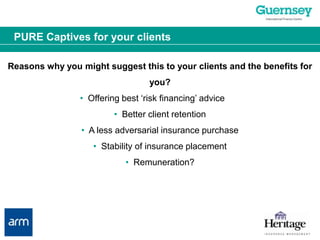
PURE Captives for your clientsReasons why you might suggest this to your clients and the benefits for you?•  Offering best ‘risk financing’ advice	•  Better client retention•  A less adversarial insurance purchase•  Stability of insurance placement•  Remuneration?
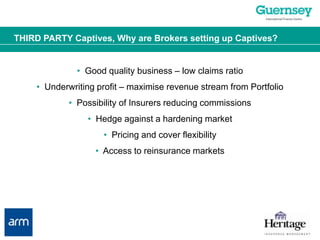
THIRD PARTY Captives, Why are Brokers setting up Captives?•  Good quality business – low claims ratio•  Underwriting profit – maximise revenue stream from Portfolio•  Possibility of Insurers reducing commissions•  Hedge against a hardening market•  Pricing and cover flexibility•  Access to reinsurance markets
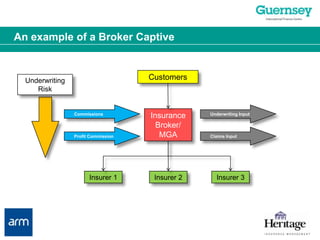
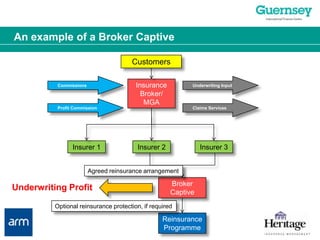
An example of a Broker CaptiveCustomersUnderwriting RiskCommissionsUnderwriting InputInsuranceBroker/MGAProfit CommissionClaims InputInsurer 1Insurer 2Insurer 3
CommissionsUnderwriting InputProfit CommissionClaims ServicesAn example of a Broker CaptiveCustomersInsuranceBroker/MGAInsurer 1Insurer 2Insurer 3Agreed reinsurance arrangementBrokerCaptiveUnderwriting ProfitOptional reinsurance protection, if requiredReinsurance Programme
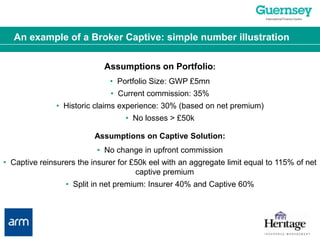
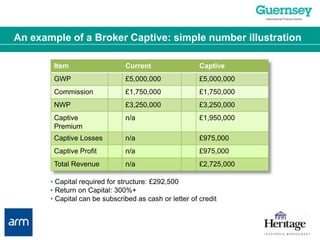
An example of a Broker Captive: simple number illustrationAssumptions on Portfolio:•  Portfolio Size: GWP £5mn•  Current commission: 35%•  Historic claims experience: 30% (based on net premium)•  No losses > £50kAssumptions on Captive Solution:•  No change in upfront commission•  Captive reinsurers the insurer for £50k eel with an aggregate limit equal to 115% of net captive premium•  Split in net premium: Insurer 40% and Captive 60%
An example of a Broker Captive: simple number illustration• Capital required for structure: £292,500• Return on Capital: 300%+• Capital can be subscribed as cash or letter of credit
Why Guernsey?•  Europe’s No.1 captive domicile•  Mature financial infrastucture•  Excellent reputation•  Highly skilled workforce•  Convenient location and good travel links•  Capitalisation requirements: No solvency II equivalence

Biba fringe session 2011

  • 1.
    What brokers needto know about CaptivesBIBA 2011, fringe session, Wednesday 11th MayMike JohnsAlternative Risk Management Limitedmjohns@arm.co.ggPaul EatonHeritagePaul.Eaton@heritage.co.gg
  • 2.
  • 3.
    Guernsey’s finance industry• Insurance, Banking, Funds and Trust• No.1 European Captive Domicile• 675 insurance entities• £3.4bn of GWP• 40% of the FTSE100 captives• Pioneer of Protected Cell legislation
  • 4.
    Presentation agenda• What is a Captive?• The different types• How and why are Captives used?• Pure Captives: Case Study• Broker Captives: Case Study• Why Guernsey?
  • 5.
    What is aCaptive?• An insurance company• Usually formed for a specific purpose, primarily self insurance• Called ‘Captives’ as often only provides insurance to its owner• Often formed in a offshore domicile• Captures both premium and risk
  • 6.
    Captive Insurance StructuresReinsuranceCaptiveDirect-writing captiveOwnershipParentSubsidiarySwedenSubsidiaryBelgiumSubsidiaryUKParentCoverPremiumsOwnershipPremiumsOwnershipFronting Company(conventional / locally based insurer)PremiumsCaptive InsurerCoverCaptive ReinsurerPremiumsCoverReinsurerIllustration of how Captives are used
  • 7.
    Illustration of howCaptives are usedownershipREINSURANCE CAPTIVEDIRECT-WRITING CAPTIVEownershipParentParentSubsidiarySwedenSubsidiaryBelgiumSubsidiaryUKpremiumspremiumscoverFronting CompanyConventional / locally based insurerCaptive InsurerownershipownershippremiumspremiumscovercoverCaptive ReinsurerReinsurer
  • 8.
    Types of Captivefacility• Wholly owned company (subsidiary)• PCC Cell• ICC Cell
  • 9.
    Protected Cell CompanyStructureCELL ATHECORECELL DCELL BCELL C
  • 10.
    How and whyare Captives used?PURE Captives• Used by your clients as a mechanism to manage self insurance• Can underwrite various risks of the owner• Control over the unpredictable market cycle• Optimise the insurance purchase• Cost of risk based upon actual performance• Leverage with the insurance market• Focal point for awareness of risk management• Flexibility in cover and innovative approach possible
  • 11.
    How and whyare Captives used?THIRD PARTY Captives• Can be used by brokers, MGAs or clients • A way of creating more value from existing profitable business• Earn additional revenue• Maximise control• Flexibility and Bespoke coverage
  • 12.
    PURE Captive: acase study• Accountancy Practice purchases PI cover• £10mn limit purchased from the traditional insurance market• Layered programme with total premium spend £675,000 split:Primary £1mn: Annual Premium £350,000£4mn excess £1mn: Annual Premium £200,000£5mn excess £5mn: Annual Premium £125,000• 5 year claims history good other than 1 large loss of £750,000• Insurance market seeking to increase rates• Client believes he has excellent risk management in place• Interest in taking some of the risk exposure• Creates a captive
  • 13.
    PURE Captive: acase studyAdvantages:• Potential for underwriting profit• No fronting insurer required – first party insurance only• Over time premium can be geared to actual loss experience• Positive cash flow/investment income on premiums and reserves• Possible greater control over claims• Influence over policy coverage• Potential leverage on overlying insurers at subsequent renewalsDisadvantages:• Capital requirements• Exposure to losses
  • 14.
    PURE Captive: acase studyACCOUNTANCY PRACTICE£10mn PI insurance£675,000 Premium SpendShare Capital£650,000BrokerCAPTIVE INSURANCECOMPANYInsurer 1Insurer 2£4mn xs £1mn£200,000£5mn xs £5mn£125,000Primary £1mn£350,000
  • 15.
    PURE Captives foryour clientsReasons why you might suggest this to your clients and the benefits for you?• Offering best ‘risk financing’ advice • Better client retention• A less adversarial insurance purchase• Stability of insurance placement• Remuneration?
  • 16.
    THIRD PARTY Captives,Why are Brokers setting up Captives?• Good quality business – low claims ratio• Underwriting profit – maximise revenue stream from Portfolio• Possibility of Insurers reducing commissions• Hedge against a hardening market• Pricing and cover flexibility• Access to reinsurance markets
  • 17.
    An example ofa Broker CaptiveCustomersUnderwriting RiskCommissionsUnderwriting InputInsuranceBroker/MGAProfit CommissionClaims InputInsurer 1Insurer 2Insurer 3
  • 18.
    CommissionsUnderwriting InputProfit CommissionClaimsServicesAn example of a Broker CaptiveCustomersInsuranceBroker/MGAInsurer 1Insurer 2Insurer 3Agreed reinsurance arrangementBrokerCaptiveUnderwriting ProfitOptional reinsurance protection, if requiredReinsurance Programme
  • 19.
    An example ofa Broker Captive: simple number illustrationAssumptions on Portfolio:• Portfolio Size: GWP £5mn• Current commission: 35%• Historic claims experience: 30% (based on net premium)• No losses > £50kAssumptions on Captive Solution:• No change in upfront commission• Captive reinsurers the insurer for £50k eel with an aggregate limit equal to 115% of net captive premium• Split in net premium: Insurer 40% and Captive 60%
  • 20.
    An example ofa Broker Captive: simple number illustration• Capital required for structure: £292,500• Return on Capital: 300%+• Capital can be subscribed as cash or letter of credit
  • 21.
    Why Guernsey?• Europe’s No.1 captive domicile• Mature financial infrastucture• Excellent reputation• Highly skilled workforce• Convenient location and good travel links• Capitalisation requirements: No solvency II equivalence