Mark Hopkins, Client Services Director, ORM

30 June 2015


#DigitisePS
Content with your content?
Why content?
Need or marketing idea >
Internal approval >
Brief >
IT implementation or agency >
Design/build >
Content load >
Test >
Deploy
But…
What about mobile?
What about search?
Who is you audience?
What is your data telling you?
Is your content working?
Is it frequent enough?
Of value?
We’ve got to get away from this…
No personalisation, bad UX Old-style marketing… no value to me.
Lengthy article templates, not mobileNo hierarchy of content; hard to find valuable content
And get to this…
Content merchandising; consumable Brilliant narrative; instructive; persuasion architecture
Brilliant, UX, content that breathes and is succinctPoor UI, but valuable content distributed well
So what is Content Strategy 

and why is it important?
Content is…
Email
WebVideo
Social
Mobile
Tablet
DM
“The strategic planning and management of
content creation for maximum effectiveness.
“It involves elements of UX: designing content that
is user friendly and meets user needs”
@contentchampion
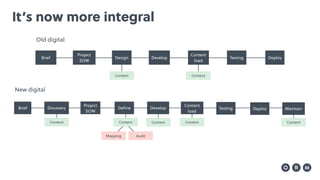
It’s now more integral
Old digital
Brief
Project
SOW
Design Develop
Content
load
Testing Deploy
Content Content
New digital
ContentContent
Brief Discovery
Content
load
Testing DeployDevelop
Project
SOW
Define Maintain
Content ContentContent
AuditMapping
It is also now a discipline
So why is this relevant to me 

in my professional services role?
Case study:
• In 2013 I worked on a global template for a large Professional Services firm.
• The brief was innovation focused: to push the boundaries of UX 

and browsing behaviour.
• The result was a set of wireframes and designs that did that…
There were, however, problems:
• Content wasn’t part of the planning
• Each member firm had to load and prepare their own content
• The site had multiple breakpoints, which made hyphenation a common problem
• They had under-estimated the state of their content and its lack of preparedness
• In short, they had a site – with no content
The result…
• In short, content wasn’t part of the planning… and it cost US$$$ 

to fix and maintain
• Meanwhile, the current site sat untouched and continued in its 

place for another 9 months
The key is to make a content the focus 

of your marketing activity
Digital consumers are losing patience:
• Since 2000, attention has dropped to eight seconds
• 40% leave sites that don’t load in 3 seconds
• 43% of us abandon emails if they take > 30 seconds to read
• 32% tune out if you don’t make the point in 15 seconds
• And, most worryingly, 74% lose interest in presentations if the key point 

is not made in 60 seconds
Customer expectations are higher than ever before:
• They want analysis – so consider time to market
• They want content that engages AND inspires – so think about relevancy
• They want it distributed to them, when they want it – so think about channel and time
• The want it where they frequent and on device they prefer – so consider off-siting
• They want it in a format that makes it digestible, memorable and useful
• Lastly, tone of voice. Pick a consistent narrative that explains you
• Importantly, set your standards and stick to them
Heard about the Marshmallow test?
How do you make your business 

focus on content?
ZMOT
As this amazing book by Google demonstrates, digital content done well will
win the battleground for micro moments in our daily lives
“Don’t make decisions related to 

content based upon assumptions. 

There are no mandates. Best practice 

may not apply to you.”
@halvorson
Create rules…
• If you don’t know your audience, I.D. them
• If you don’t have content you’re proud of – pull it
• If I.T. are driving digital change, make sure they don’t have the keys
• Metrics: if you’re not set up to monitor behaviour – start now
• Place content and data people in your marketing function
• Consult a specialist… content strategies, done well pay for themselves
• Audit
• Personas
• Make story-telling a focus
• Tone of voice
• Take ownership – process
• Create rules for your comms
• Personalisation
• Comms architecture
• Content mapping
• Content calendar
• Contact strategy
• Search
10 differences a content strategist can make
A few last words…
“If the holy grail is a customised and
personalised experience at every touch point,
then you are only going to achieve this with the
help of a content strategist.”
– Digital marketing magazine
“No one’s going to care about the
implementation, it’s the content 

we’ll be judged on.”
> Marketing Director in this room
“No-one remembers the facts, 

they only every remember the story”
Thank you
Mark Hopkins, Client Services Director, ORM
mark.hopkins@ormlondon.com
ormlondon.com

@ormlondon
Case study:
• McKinsey’s Insights app.
• It has been downloaded 500k times.
• It serves me content to my preference during 

my commute times.
• It is served in a consumable format and is 

extremely well written with takeaways,

infographics and video.

Are You Content With Your Content?

  • 1.
    Mark Hopkins, ClientServices Director, ORM
 30 June 2015
 
 #DigitisePS Content with your content?
  • 2.
  • 3.
    Need or marketingidea > Internal approval > Brief > IT implementation or agency > Design/build > Content load > Test > Deploy
  • 4.
    But… What about mobile? Whatabout search? Who is you audience? What is your data telling you? Is your content working? Is it frequent enough? Of value?
  • 5.
    We’ve got toget away from this… No personalisation, bad UX Old-style marketing… no value to me. Lengthy article templates, not mobileNo hierarchy of content; hard to find valuable content
  • 6.
    And get tothis… Content merchandising; consumable Brilliant narrative; instructive; persuasion architecture Brilliant, UX, content that breathes and is succinctPoor UI, but valuable content distributed well
  • 7.
    So what isContent Strategy 
 and why is it important?
  • 8.
  • 9.
    “The strategic planningand management of content creation for maximum effectiveness. “It involves elements of UX: designing content that is user friendly and meets user needs” @contentchampion
  • 10.
    It’s now moreintegral Old digital Brief Project SOW Design Develop Content load Testing Deploy Content Content New digital ContentContent Brief Discovery Content load Testing DeployDevelop Project SOW Define Maintain Content ContentContent AuditMapping
  • 11.
    It is alsonow a discipline
  • 12.
    So why isthis relevant to me 
 in my professional services role?
  • 13.
    Case study: • In2013 I worked on a global template for a large Professional Services firm. • The brief was innovation focused: to push the boundaries of UX 
 and browsing behaviour. • The result was a set of wireframes and designs that did that…
  • 14.
    There were, however,problems: • Content wasn’t part of the planning • Each member firm had to load and prepare their own content • The site had multiple breakpoints, which made hyphenation a common problem • They had under-estimated the state of their content and its lack of preparedness • In short, they had a site – with no content
  • 15.
    The result… • Inshort, content wasn’t part of the planning… and it cost US$$$ 
 to fix and maintain • Meanwhile, the current site sat untouched and continued in its 
 place for another 9 months
  • 16.
    The key isto make a content the focus 
 of your marketing activity
  • 17.
    Digital consumers arelosing patience: • Since 2000, attention has dropped to eight seconds • 40% leave sites that don’t load in 3 seconds • 43% of us abandon emails if they take > 30 seconds to read • 32% tune out if you don’t make the point in 15 seconds • And, most worryingly, 74% lose interest in presentations if the key point 
 is not made in 60 seconds
  • 18.
    Customer expectations arehigher than ever before: • They want analysis – so consider time to market • They want content that engages AND inspires – so think about relevancy • They want it distributed to them, when they want it – so think about channel and time • The want it where they frequent and on device they prefer – so consider off-siting • They want it in a format that makes it digestible, memorable and useful • Lastly, tone of voice. Pick a consistent narrative that explains you • Importantly, set your standards and stick to them
  • 19.
    Heard about theMarshmallow test?
  • 20.
    How do youmake your business 
 focus on content?
  • 21.
    ZMOT As this amazingbook by Google demonstrates, digital content done well will win the battleground for micro moments in our daily lives
  • 22.
    “Don’t make decisionsrelated to 
 content based upon assumptions. 
 There are no mandates. Best practice 
 may not apply to you.” @halvorson
  • 23.
    Create rules… • Ifyou don’t know your audience, I.D. them • If you don’t have content you’re proud of – pull it • If I.T. are driving digital change, make sure they don’t have the keys • Metrics: if you’re not set up to monitor behaviour – start now • Place content and data people in your marketing function • Consult a specialist… content strategies, done well pay for themselves
  • 24.
    • Audit • Personas •Make story-telling a focus • Tone of voice • Take ownership – process • Create rules for your comms • Personalisation • Comms architecture • Content mapping • Content calendar • Contact strategy • Search 10 differences a content strategist can make
  • 25.
    A few lastwords…
  • 26.
    “If the holygrail is a customised and personalised experience at every touch point, then you are only going to achieve this with the help of a content strategist.” – Digital marketing magazine
  • 27.
    “No one’s goingto care about the implementation, it’s the content 
 we’ll be judged on.” > Marketing Director in this room
  • 28.
    “No-one remembers thefacts, 
 they only every remember the story”
  • 29.
    Thank you Mark Hopkins,Client Services Director, ORM mark.hopkins@ormlondon.com ormlondon.com
 @ormlondon
  • 30.
    Case study: • McKinsey’sInsights app. • It has been downloaded 500k times. • It serves me content to my preference during 
 my commute times. • It is served in a consumable format and is 
 extremely well written with takeaways,
 infographics and video.