

Creating a
Business-Driven
Content Strategy
October 14, 2015
Carla Johnson
Michael Brenner
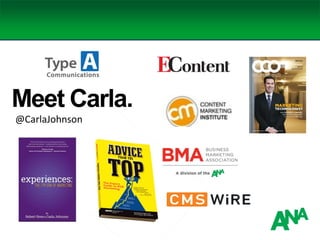
Meet Carla.
@CarlaJohnson
Meet Michael.
@BrennerMichael
Agenda
• How To Build Your Content Marketing Strategy
• Sourcing Content and Editorial Planning
• Content Distribution And Amplification
• Measuring with Meaning
• Reflection and Action Plan
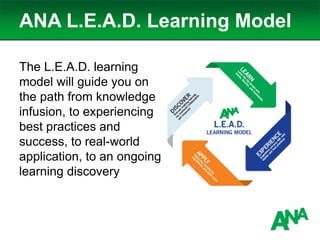
ANA L.E.A.D. Learning Model
The L.E.A.D. learning
model will guide you on
the path from knowledge
infusion, to experiencing
best practices and
success, to real-world
application, to an ongoing
learning discovery
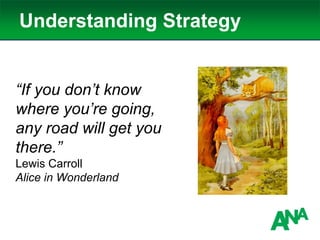
Understanding Strategy
“If you don’t know
where you’re going,
any road will get you
there.”
Lewis Carroll
Alice in Wonderland
Learning Objectives
• Why telling your company’s story in a compelling
way connects prospects with your brand and can
make a powerful emotional connection.
• Learn how to fill the gap between what your
audience wants and what your business
produces so you can properly position your
product or service in an entertaining and
educational way to engage decision makers at
every point in the decision journey.
“Content today must compete with pictures of
babies and kittens.”
@BrennerMichael
What Is A Strategy?
“Astrategy describes how the ends (goals) will
be achieved by the means (resources).”
Wikipedia
The Outside / In Approach
• Not, “We need content for this line of business
or product.”
• But, “This prospect has these information
needs. How can we fill them?”
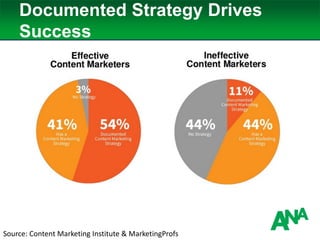
Documented Strategy Drives
Success
Source: Content Marketing Institute & MarketingProfs
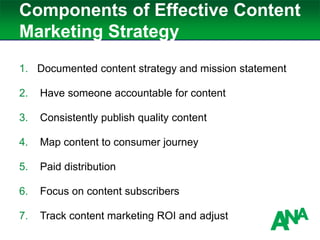
Components of Effective Content
Marketing Strategy
1. Documented content strategy and mission statement
2. Have someone accountable for content
3. Consistently publish quality content
4. Map content to consumer journey
5. Paid distribution
6. Focus on content subscribers
7. Track content marketing ROI and adjust
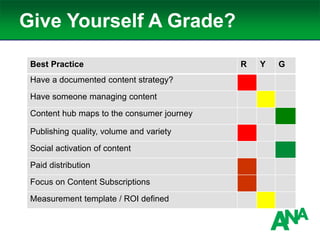
Give Yourself A Grade?
Best Practice R Y G
Have a documented content strategy?
Have someone managing content
Content hub maps to the consumer journey
Publishing quality, volume and variety
Social activation of content
Paid distribution
Focus on Content Subscriptions
Measurement template / ROI defined
The Promise of Content Marketing:
To earn your audience . . .
. . . versus buying it!
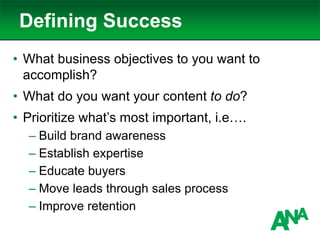
Defining Success
• What business objectives to you want to
accomplish?
• What do you want your content to do?
• Prioritize what’s most important, i.e….
– Build brand awareness
– Establish expertise
– Educate buyers
– Move leads through sales process
– Improve retention
Recognizing “Success”
• Drives business objectives
• Creates value in and of itself
• Educates, informs, changes perceptions,
sells, upsells, retains, entertains
• Multiple channels, multiple formats
• Meaningful measurement
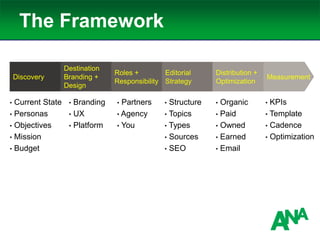
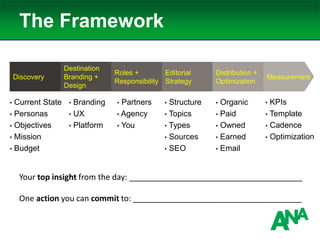
The Framework
Discovery
Destination
Branding +
Design
Roles +
Responsibility
Editorial
Strategy
Distribution +
Optimization
Measurement
• Current State
• Personas
• Objectives
• Mission
• Budget
• Branding
• UX
• Platform
• Partners
• Agency
• You
• Structure
• Topics
• Types
• Sources
• SEO
• Organic
• Paid
• Owned
• Earned
• Email
• KPIs
• Template
• Cadence
• Optimization
Ex: SAP Business Innovation
• In 2011, SAP’s new CEO asked why the
company’s thought leadership was not
reflected on their website.
• It took 12 months to deliver a solution
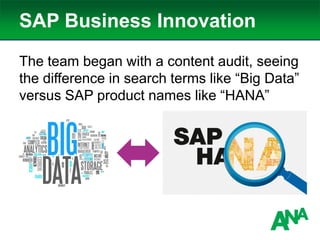
SAP Business Innovation
The team began with a content audit, seeing
the difference in search terms like “Big Data”
versus SAP product names like “HANA”
SAP Business Innovation
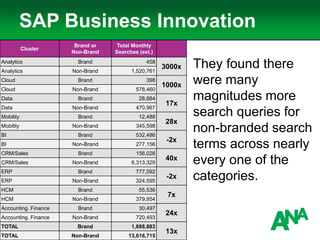
They found there
were many
magnitudes more
search queries for
non-branded search
terms across nearly
every one of the
categories.
Cluster
Brand or
Non-Brand
Total Monthly
Searches (est.)
Analytics Brand 458
3000x
Analytics Non-Brand 1,520,761
Cloud Brand 398
1000x
Cloud Non-Brand 578,460
Data Brand 28,884
17x
Data Non-Brand 470,967
Mobility Brand 12,488
28x
Mobility Non-Brand 345,598
BI Brand 532,486
-2x
BI Non-Brand 277,156
CRM/Sales Brand 156,028
40x
CRM/Sales Non-Brand 6,313,329
ERP Brand 777,092
-2x
ERP Non-Brand 324,595
HCM Brand 55,536
7x
HCM Non-Brand 379,954
Accounting. Finance Brand 30,497
24x
Accounting. Finance Non-Brand 720,493
TOTAL Brand 1,688,883
13x
TOTAL Non-Brand 13,616,715
SAP Business Innovation
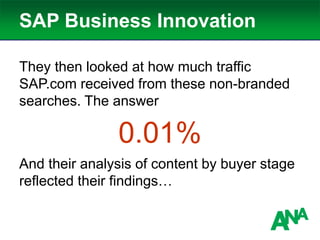
They then looked at how much traffic
SAP.com received from these non-branded
searches. The answer
0.01%
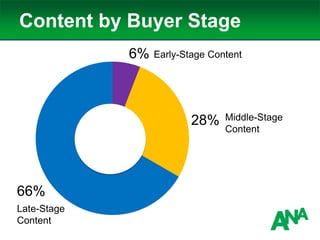
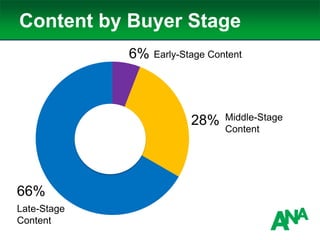
And their analysis of content by buyer stage
reflected their findings…
Content by Buyer Stage
Early-Stage Content
Middle-Stage Content
Late-Stage Content66%
6%
28%
Early-Stage Content
Late-Stage
Content
Middle-Stage
Content
SAP Business Innovation
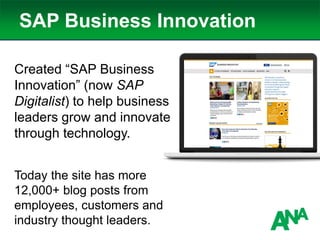
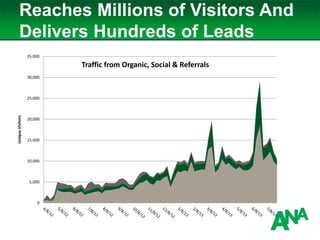
Created “SAP Business
Innovation” (now SAP
Digitalist) to help business
leaders grow and innovate
through technology.
Today the site has more
12,000+ blog posts from
employees, customers and
industry thought leaders.
Reaches Millions of Visitors And
Delivers Hundreds of Leads
0
5,000
10,000
15,000
20,000
25,000
30,000
35,000
UniqueVisitors
Traffic from Organic, Social & Referrals
Exercise: Content + Objectives
1. What’s your content
mission?
Become a destination for [target
audience] interested in [topics]. To
help them [describe customer
value].
2. Who’s your target
audience?
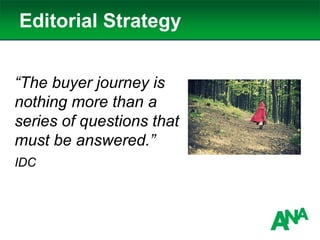
Editorial Strategy
“The buyer journey is
nothing more than a
series of questions that
must be answered.”
IDC
Learning Objectives
• How to create an editorial strategy that meets the
needs of your buyer and drives conversions for
your business
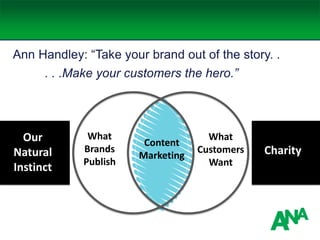
Ann Handley: “Take your brand out of the story. .
. . .Make your customers the hero.”
Content
Marketing
What
Brands
Publish
What
Customers
Want
Charity
Our
Natural
Instinct
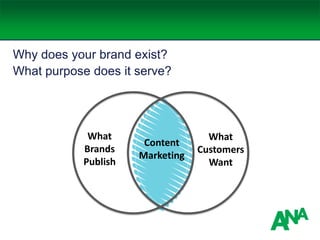
Why does your brand exist?
What purpose does it serve?
Content
Marketing
What
Brands
Publish
What
Customers
Want
Example: Marriott
Become the world’s
destination for travel
lifestyle content.
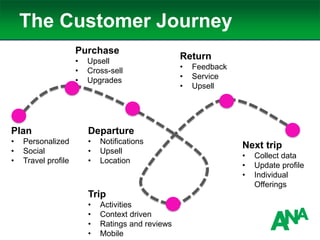
The Customer Journey
Plan
• Personalized
• Social
• Travel profile
Departure
• Notifications
• Upsell
• Location
Return
• Feedback
• Service
• Upsell
Trip
• Activities
• Context driven
• Ratings and reviews
• Mobile
Purchase
• Upsell
• Cross-sell
• Upgrades
Next trip
• Collect data
• Update profile
• Individual
Offerings
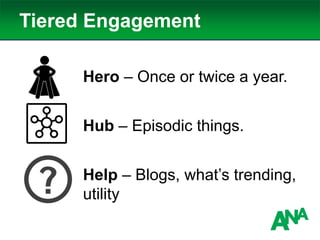
Hero – Once or twice a year.
Hub – Episodic things.
Help – Blogs, what’s trending,
utility
Tiered Engagement
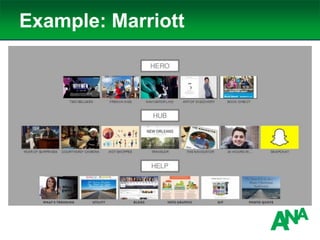
Example: Marriott
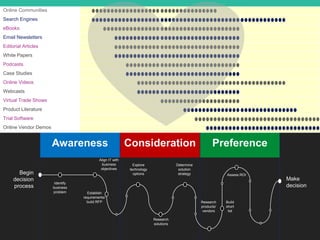
Awareness Consideration Preference
Online Communities
Search Engines
eBooks
Email Newsletters
Editorial Articles
White Papers
Podcasts
Case Studies
Online Videos
Webcasts
Virtual Trade Shows
Product Literature
Trial Software
Online Vendor Demos
Begin
decision
process
Make
decision
Identify
business
problem Establish
requirements/
build RFP
Align IT with
business
objectives
Explore
technology
options
Research
solutions
Determine
solution
strategy Assess ROI
Research
products/
vendors
Build
short
list
Content by Buyer Stage
Early-Stage Content
Middle-Stage Content
Late-Stage Content66%
6%
28%
Early-Stage Content
Late-Stage
Content
Middle-Stage
Content
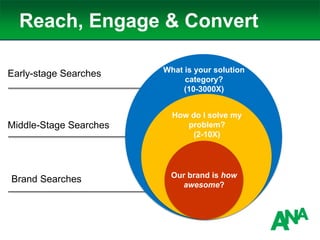
Reach, Engage & Convert
Early-stage Searches
Brand Searches
Middle-Stage Searches
What is your solution
category?
(10-3000X)
How do I solve my
problem?
(2-10X)
Our brand is how
awesome?
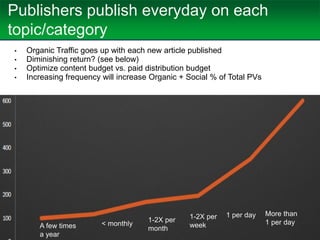
Publishers publish everyday on each
topic/category
• Organic Traffic goes up with each new article published
• Diminishing return? (see below)
• Optimize content budget vs. paid distribution budget
• Increasing frequency will increase Organic + Social % of Total PVs
A few times
a year
1-2X per
month
< monthly
1-2X per
week
1 per day More than
1 per day
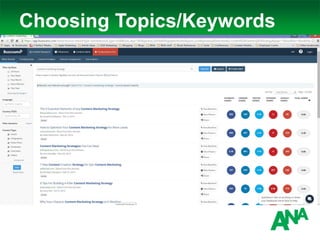
Choosing Topics/Keywords
Putting it Together
3 questions to ask when building the
editorial calendar
1. What do I want to achieve?
2. What gaps do I have?
3. What are my resources?
The underlying question is ALWAYS…how do I
create value for my audience?
Take Stock Of Your Assets
• Create an inventory of what you already
have
– Sales sheets − Blogs
– Slide decks − Whitepapers
– Website − Videos
• Who are subject matter experts who can
contribute?
• Who has incentive to contribute?
Identify Topics
• Different personas will have different topic
needs. Brainstorm a list for each of them.
• What are the top 20 questions that your
audience has?
• What current topics are performing well?
• What questions do your sales and
customer service teams hear?
Sample Editorial Calendar
Exercise: Editorial Strategy
• What are 4-6 steps that your customer
goes through to make a decision?
• What are questions do they have at
each stage?
• In what format do they want
information?
Key Take Aways
• An editorial strategy ensures that relevant
content is delivered to the right person at the
right time and place and in the right format
• Content mapping requires understanding what
content already exists
• Content must be balanced by buyer stage based
on persona needs
Content Amplification and
Distribution
“Even great content needs a push!”
• The average Hollywood movie spends 50-
60% of production budget on distribution.
Learning Objectives
• See how a “converged media” approach
drives success in brand-owned content
marketing.
• Learn how to maximize the reach,
engagement and conversion of your content
with amplification and distribution
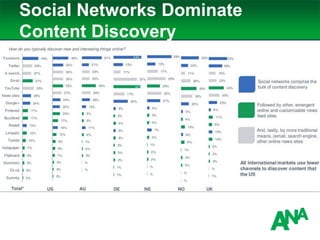
• Determine the channels your customers use
most for content discovery.
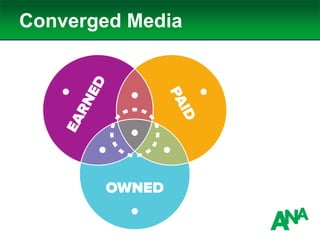
Converged Media
Social Networks Dominate
Content Discovery
Tactics For Distribution
• Ad networks (example: Google AdWords)
• Organic Social (example: Twitter, Facebook)
• Paid Social (example: LinkedIn Sponsored Updates)
• Native advertising (example: Sharethrough)
• Organic Search / SEO
• Email (example: subscriber newsletter)
Don’t Forget Email
• Keep your audience engaged
• Free distribution channel
• Provides instantaneous trackable
results
• Nurture and convert leads
45%
of NewsCred’s
traffic came from
email
Example: Intel IQ
• Doubled their traffic in less than a year on the
same paid distribution budget.
• Content Focus: “Winning the internet everyday.”
• Engagement: Measure organic social shares /
frequency
• Paid media: put budget behind the winners
– When you concentrate on what’s doing well, finding a
new reader is five times more efficient on a cost per
reader basis.” ~ Luke Kintigh, Intel
Source: http://digiday.com/brands/intel-doubled-blog-traffic-less-year/
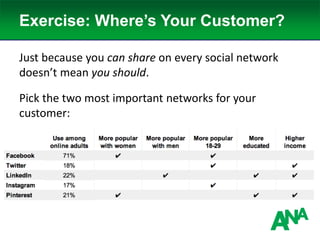
Exercise: Where’s Your Customer?
Just because you can share on every social network
doesn’t mean you should.
Pick the two most important networks for your
customer:
Key Takeaways
• Content marketing is an important element in
the new approach to buying media.
• Creating content is just half the battle.
• Email is still an important channel across
every demographic.
• Paid distribution can dramatically increase
your results.
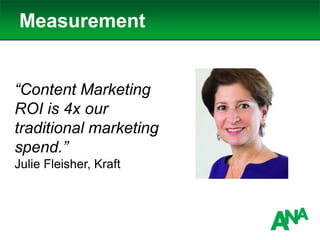
Measurement
“Content Marketing
ROI is 4x our
traditional marketing
spend.”
Julie Fleisher, Kraft
Learning Objectives
• Understand why measurement needs to
connect back to business objectives
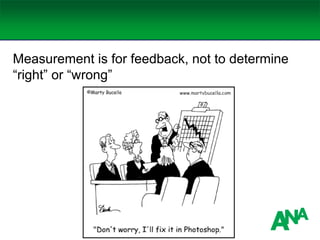
Measurement is for feedback, not to determine
“right” or “wrong”
Measurement
• Lots of marketers will measure what they can
• Fewer will measure what has meaning
• Fewer still will ties those to business
objectives
Content Marketing ROI
1. Reach early stage buyers
• Fair “Share of Conversation”
• % Unbranded Search traffic on your website
• Banner effectiveness at driving brand visits
• Cost of advertising / search landing pages with low organic and social traffic
• Cost of organic and social website traffic vs. paid
2. Engage new buyers with your brand
• Time spent, Bounce rate on content vs. advertising landing pages
• Cost / Repeat visits, Time engaged with your brand
• Subscribers, value per subscriber
3. Conversions you would have never reached
• Cost per lead, Pipeline touched, Cost per registration (content or events), Cost
per sale
• Content % source of leads
• ROI vs. Avg. Marketing ROI
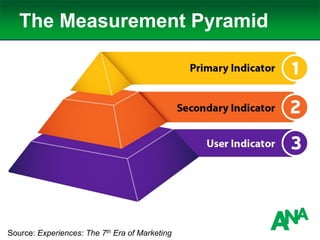
The Measurement Pyramid
Source: Experiences: The 7th Era of Marketing
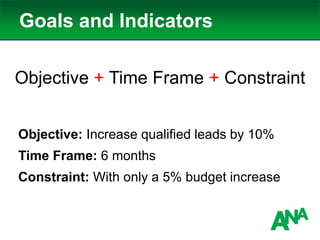
Goals and Indicators
Objective + Time Frame + Constraint
Objective: Increase qualified leads by 10%
Time Frame: 6 months
Constraint: With only a 5% budget increase
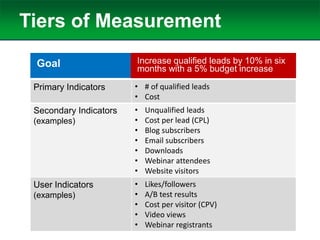
Tiers of Measurement
Goal Increase qualified leads by 10% in six
months with a 5% budget increase
Primary Indicators • # of qualified leads
• Cost
Secondary Indicators
(examples)
• Unqualified leads
• Cost per lead (CPL)
• Blog subscribers
• Email subscribers
• Downloads
• Webinar attendees
• Website visitors
User Indicators
(examples)
• Likes/followers
• A/B test results
• Cost per visitor (CPV)
• Video views
• Webinar registrants
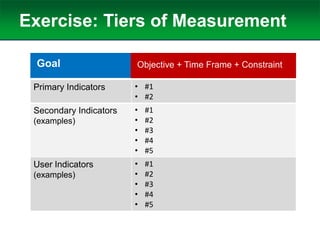
Exercise: Tiers of Measurement
Goal Objective + Time Frame + Constraint
Primary Indicators • #1
• #2
Secondary Indicators
(examples)
• #1
• #2
• #3
• #4
• #5
User Indicators
(examples)
• #1
• #2
• #3
• #4
• #5
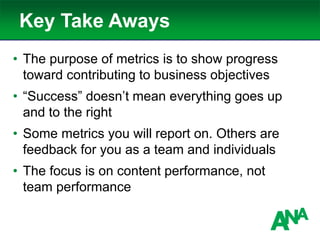
Key Take Aways
• The purpose of metrics is to show progress
toward contributing to business objectives
• “Success” doesn’t mean everything goes up
and to the right
• Some metrics you will report on. Others are
feedback for you as a team and individuals
• The focus is on content performance, not
team performance
The Framework
Discovery
Destination
Branding +
Design
Roles +
Responsibility
Editorial
Strategy
Distribution +
Optimization
Measurement
• Current State
• Personas
• Objectives
• Mission
• Budget
• Branding
• UX
• Platform
• Partners
• Agency
• You
• Structure
• Topics
• Types
• Sources
• SEO
• Organic
• Paid
• Owned
• Earned
• Email
• KPIs
• Template
• Cadence
• Optimization
Your top insight from the day: _______________________________________
One action you can commit to: ______________________________________
My L.E.A.D. Action Plan
Actionable goal name:
Desired state (90 days from now): By [ _ /_ / _ ], I/we will:
Current state:
Key milestones to reach goal:
How will it be measured:
Who are you accountable to:
After the 90 days, assess your progress:
1. Did you accomplish your goal?
2. How were you supported in achieving your goals?
3. Did anything prevent you from achieving your goals?
4. What ongoing goals are you now driving to achieve?
Carla Johnson
Speaker. Storyteller. Strategist.
Type A Communications
Carla@TypeACommunications.com
Michael Brenner
Head of Strategy
NewsCred
Michael.Brenner@NewsCred.com

Creating a Business-Driven Content Marketing Strategy

  • 1.
    Creating a Business-Driven Content Strategy October14, 2015 Carla Johnson Michael Brenner
  • 2.
  • 3.
  • 4.
    Agenda • How ToBuild Your Content Marketing Strategy • Sourcing Content and Editorial Planning • Content Distribution And Amplification • Measuring with Meaning • Reflection and Action Plan
  • 5.
    ANA L.E.A.D. LearningModel The L.E.A.D. learning model will guide you on the path from knowledge infusion, to experiencing best practices and success, to real-world application, to an ongoing learning discovery
  • 6.
    Understanding Strategy “If youdon’t know where you’re going, any road will get you there.” Lewis Carroll Alice in Wonderland
  • 7.
    Learning Objectives • Whytelling your company’s story in a compelling way connects prospects with your brand and can make a powerful emotional connection. • Learn how to fill the gap between what your audience wants and what your business produces so you can properly position your product or service in an entertaining and educational way to engage decision makers at every point in the decision journey.
  • 8.
    “Content today mustcompete with pictures of babies and kittens.”
  • 9.
  • 10.
    What Is AStrategy? “Astrategy describes how the ends (goals) will be achieved by the means (resources).” Wikipedia
  • 11.
    The Outside /In Approach • Not, “We need content for this line of business or product.” • But, “This prospect has these information needs. How can we fill them?”
  • 12.
    Documented Strategy Drives Success Source:Content Marketing Institute & MarketingProfs
  • 13.
    Components of EffectiveContent Marketing Strategy 1. Documented content strategy and mission statement 2. Have someone accountable for content 3. Consistently publish quality content 4. Map content to consumer journey 5. Paid distribution 6. Focus on content subscribers 7. Track content marketing ROI and adjust
  • 14.
    Give Yourself AGrade? Best Practice R Y G Have a documented content strategy? Have someone managing content Content hub maps to the consumer journey Publishing quality, volume and variety Social activation of content Paid distribution Focus on Content Subscriptions Measurement template / ROI defined
  • 15.
    The Promise ofContent Marketing: To earn your audience . . . . . . versus buying it!
  • 16.
    Defining Success • Whatbusiness objectives to you want to accomplish? • What do you want your content to do? • Prioritize what’s most important, i.e…. – Build brand awareness – Establish expertise – Educate buyers – Move leads through sales process – Improve retention
  • 17.
    Recognizing “Success” • Drivesbusiness objectives • Creates value in and of itself • Educates, informs, changes perceptions, sells, upsells, retains, entertains • Multiple channels, multiple formats • Meaningful measurement
  • 18.
    The Framework Discovery Destination Branding + Design Roles+ Responsibility Editorial Strategy Distribution + Optimization Measurement • Current State • Personas • Objectives • Mission • Budget • Branding • UX • Platform • Partners • Agency • You • Structure • Topics • Types • Sources • SEO • Organic • Paid • Owned • Earned • Email • KPIs • Template • Cadence • Optimization
  • 19.
    Ex: SAP BusinessInnovation • In 2011, SAP’s new CEO asked why the company’s thought leadership was not reflected on their website. • It took 12 months to deliver a solution
  • 20.
    SAP Business Innovation Theteam began with a content audit, seeing the difference in search terms like “Big Data” versus SAP product names like “HANA”
  • 21.
    SAP Business Innovation Theyfound there were many magnitudes more search queries for non-branded search terms across nearly every one of the categories. Cluster Brand or Non-Brand Total Monthly Searches (est.) Analytics Brand 458 3000x Analytics Non-Brand 1,520,761 Cloud Brand 398 1000x Cloud Non-Brand 578,460 Data Brand 28,884 17x Data Non-Brand 470,967 Mobility Brand 12,488 28x Mobility Non-Brand 345,598 BI Brand 532,486 -2x BI Non-Brand 277,156 CRM/Sales Brand 156,028 40x CRM/Sales Non-Brand 6,313,329 ERP Brand 777,092 -2x ERP Non-Brand 324,595 HCM Brand 55,536 7x HCM Non-Brand 379,954 Accounting. Finance Brand 30,497 24x Accounting. Finance Non-Brand 720,493 TOTAL Brand 1,688,883 13x TOTAL Non-Brand 13,616,715
  • 22.
    SAP Business Innovation Theythen looked at how much traffic SAP.com received from these non-branded searches. The answer 0.01% And their analysis of content by buyer stage reflected their findings…
  • 23.
    Content by BuyerStage Early-Stage Content Middle-Stage Content Late-Stage Content66% 6% 28% Early-Stage Content Late-Stage Content Middle-Stage Content
  • 24.
    SAP Business Innovation Created“SAP Business Innovation” (now SAP Digitalist) to help business leaders grow and innovate through technology. Today the site has more 12,000+ blog posts from employees, customers and industry thought leaders.
  • 25.
    Reaches Millions ofVisitors And Delivers Hundreds of Leads 0 5,000 10,000 15,000 20,000 25,000 30,000 35,000 UniqueVisitors Traffic from Organic, Social & Referrals
  • 26.
    Exercise: Content +Objectives 1. What’s your content mission? Become a destination for [target audience] interested in [topics]. To help them [describe customer value]. 2. Who’s your target audience?
  • 27.
    Editorial Strategy “The buyerjourney is nothing more than a series of questions that must be answered.” IDC
  • 28.
    Learning Objectives • Howto create an editorial strategy that meets the needs of your buyer and drives conversions for your business
  • 29.
    Ann Handley: “Takeyour brand out of the story. . . . .Make your customers the hero.” Content Marketing What Brands Publish What Customers Want Charity Our Natural Instinct
  • 30.
    Why does yourbrand exist? What purpose does it serve? Content Marketing What Brands Publish What Customers Want
  • 31.
    Example: Marriott Become theworld’s destination for travel lifestyle content.
  • 32.
    The Customer Journey Plan •Personalized • Social • Travel profile Departure • Notifications • Upsell • Location Return • Feedback • Service • Upsell Trip • Activities • Context driven • Ratings and reviews • Mobile Purchase • Upsell • Cross-sell • Upgrades Next trip • Collect data • Update profile • Individual Offerings
  • 33.
    Hero – Onceor twice a year. Hub – Episodic things. Help – Blogs, what’s trending, utility Tiered Engagement
  • 34.
  • 35.
    Awareness Consideration Preference OnlineCommunities Search Engines eBooks Email Newsletters Editorial Articles White Papers Podcasts Case Studies Online Videos Webcasts Virtual Trade Shows Product Literature Trial Software Online Vendor Demos Begin decision process Make decision Identify business problem Establish requirements/ build RFP Align IT with business objectives Explore technology options Research solutions Determine solution strategy Assess ROI Research products/ vendors Build short list
  • 36.
    Content by BuyerStage Early-Stage Content Middle-Stage Content Late-Stage Content66% 6% 28% Early-Stage Content Late-Stage Content Middle-Stage Content
  • 37.
    Reach, Engage &Convert Early-stage Searches Brand Searches Middle-Stage Searches What is your solution category? (10-3000X) How do I solve my problem? (2-10X) Our brand is how awesome?
  • 38.
    Publishers publish everydayon each topic/category • Organic Traffic goes up with each new article published • Diminishing return? (see below) • Optimize content budget vs. paid distribution budget • Increasing frequency will increase Organic + Social % of Total PVs A few times a year 1-2X per month < monthly 1-2X per week 1 per day More than 1 per day
  • 39.
  • 40.
    Putting it Together 3questions to ask when building the editorial calendar 1. What do I want to achieve? 2. What gaps do I have? 3. What are my resources? The underlying question is ALWAYS…how do I create value for my audience?
  • 41.
    Take Stock OfYour Assets • Create an inventory of what you already have – Sales sheets − Blogs – Slide decks − Whitepapers – Website − Videos • Who are subject matter experts who can contribute? • Who has incentive to contribute?
  • 42.
    Identify Topics • Differentpersonas will have different topic needs. Brainstorm a list for each of them. • What are the top 20 questions that your audience has? • What current topics are performing well? • What questions do your sales and customer service teams hear?
  • 43.
  • 44.
    Exercise: Editorial Strategy •What are 4-6 steps that your customer goes through to make a decision? • What are questions do they have at each stage? • In what format do they want information?
  • 45.
    Key Take Aways •An editorial strategy ensures that relevant content is delivered to the right person at the right time and place and in the right format • Content mapping requires understanding what content already exists • Content must be balanced by buyer stage based on persona needs
  • 46.
    Content Amplification and Distribution “Evengreat content needs a push!” • The average Hollywood movie spends 50- 60% of production budget on distribution.
  • 47.
    Learning Objectives • Seehow a “converged media” approach drives success in brand-owned content marketing. • Learn how to maximize the reach, engagement and conversion of your content with amplification and distribution • Determine the channels your customers use most for content discovery.
  • 48.
  • 49.
  • 50.
    Tactics For Distribution •Ad networks (example: Google AdWords) • Organic Social (example: Twitter, Facebook) • Paid Social (example: LinkedIn Sponsored Updates) • Native advertising (example: Sharethrough) • Organic Search / SEO • Email (example: subscriber newsletter)
  • 51.
    Don’t Forget Email •Keep your audience engaged • Free distribution channel • Provides instantaneous trackable results • Nurture and convert leads 45% of NewsCred’s traffic came from email
  • 52.
    Example: Intel IQ •Doubled their traffic in less than a year on the same paid distribution budget. • Content Focus: “Winning the internet everyday.” • Engagement: Measure organic social shares / frequency • Paid media: put budget behind the winners – When you concentrate on what’s doing well, finding a new reader is five times more efficient on a cost per reader basis.” ~ Luke Kintigh, Intel Source: http://digiday.com/brands/intel-doubled-blog-traffic-less-year/
  • 53.
    Exercise: Where’s YourCustomer? Just because you can share on every social network doesn’t mean you should. Pick the two most important networks for your customer:
  • 54.
    Key Takeaways • Contentmarketing is an important element in the new approach to buying media. • Creating content is just half the battle. • Email is still an important channel across every demographic. • Paid distribution can dramatically increase your results.
  • 55.
    Measurement “Content Marketing ROI is4x our traditional marketing spend.” Julie Fleisher, Kraft
  • 56.
    Learning Objectives • Understandwhy measurement needs to connect back to business objectives
  • 57.
    Measurement is forfeedback, not to determine “right” or “wrong”
  • 58.
    Measurement • Lots ofmarketers will measure what they can • Fewer will measure what has meaning • Fewer still will ties those to business objectives
  • 59.
    Content Marketing ROI 1.Reach early stage buyers • Fair “Share of Conversation” • % Unbranded Search traffic on your website • Banner effectiveness at driving brand visits • Cost of advertising / search landing pages with low organic and social traffic • Cost of organic and social website traffic vs. paid 2. Engage new buyers with your brand • Time spent, Bounce rate on content vs. advertising landing pages • Cost / Repeat visits, Time engaged with your brand • Subscribers, value per subscriber 3. Conversions you would have never reached • Cost per lead, Pipeline touched, Cost per registration (content or events), Cost per sale • Content % source of leads • ROI vs. Avg. Marketing ROI
  • 60.
    The Measurement Pyramid Source:Experiences: The 7th Era of Marketing
  • 61.
    Goals and Indicators Objective+ Time Frame + Constraint Objective: Increase qualified leads by 10% Time Frame: 6 months Constraint: With only a 5% budget increase
  • 62.
    Tiers of Measurement GoalIncrease qualified leads by 10% in six months with a 5% budget increase Primary Indicators • # of qualified leads • Cost Secondary Indicators (examples) • Unqualified leads • Cost per lead (CPL) • Blog subscribers • Email subscribers • Downloads • Webinar attendees • Website visitors User Indicators (examples) • Likes/followers • A/B test results • Cost per visitor (CPV) • Video views • Webinar registrants
  • 63.
    Exercise: Tiers ofMeasurement Goal Objective + Time Frame + Constraint Primary Indicators • #1 • #2 Secondary Indicators (examples) • #1 • #2 • #3 • #4 • #5 User Indicators (examples) • #1 • #2 • #3 • #4 • #5
  • 64.
    Key Take Aways •The purpose of metrics is to show progress toward contributing to business objectives • “Success” doesn’t mean everything goes up and to the right • Some metrics you will report on. Others are feedback for you as a team and individuals • The focus is on content performance, not team performance
  • 65.
    The Framework Discovery Destination Branding + Design Roles+ Responsibility Editorial Strategy Distribution + Optimization Measurement • Current State • Personas • Objectives • Mission • Budget • Branding • UX • Platform • Partners • Agency • You • Structure • Topics • Types • Sources • SEO • Organic • Paid • Owned • Earned • Email • KPIs • Template • Cadence • Optimization Your top insight from the day: _______________________________________ One action you can commit to: ______________________________________
  • 66.
    My L.E.A.D. ActionPlan Actionable goal name: Desired state (90 days from now): By [ _ /_ / _ ], I/we will: Current state: Key milestones to reach goal: How will it be measured: Who are you accountable to: After the 90 days, assess your progress: 1. Did you accomplish your goal? 2. How were you supported in achieving your goals? 3. Did anything prevent you from achieving your goals? 4. What ongoing goals are you now driving to achieve?
  • 67.
    Carla Johnson Speaker. Storyteller.Strategist. Type A Communications Carla@TypeACommunications.com Michael Brenner Head of Strategy NewsCred Michael.Brenner@NewsCred.com