IPv6: Are we really ready to
turn off IPv4?
Geoff Huston
APNIC
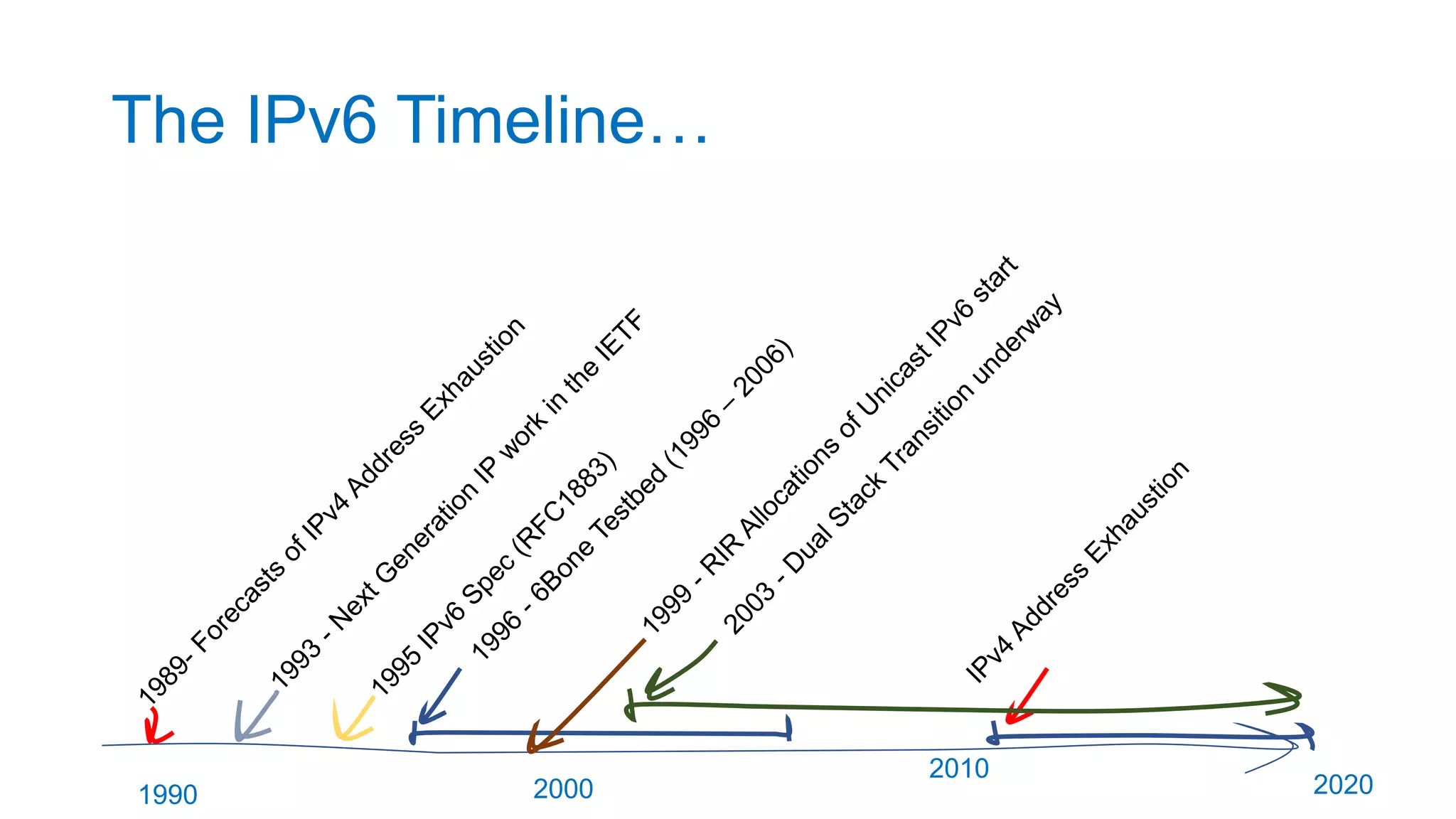
The IPv6 Timeline…
1990 2000
2010
2020
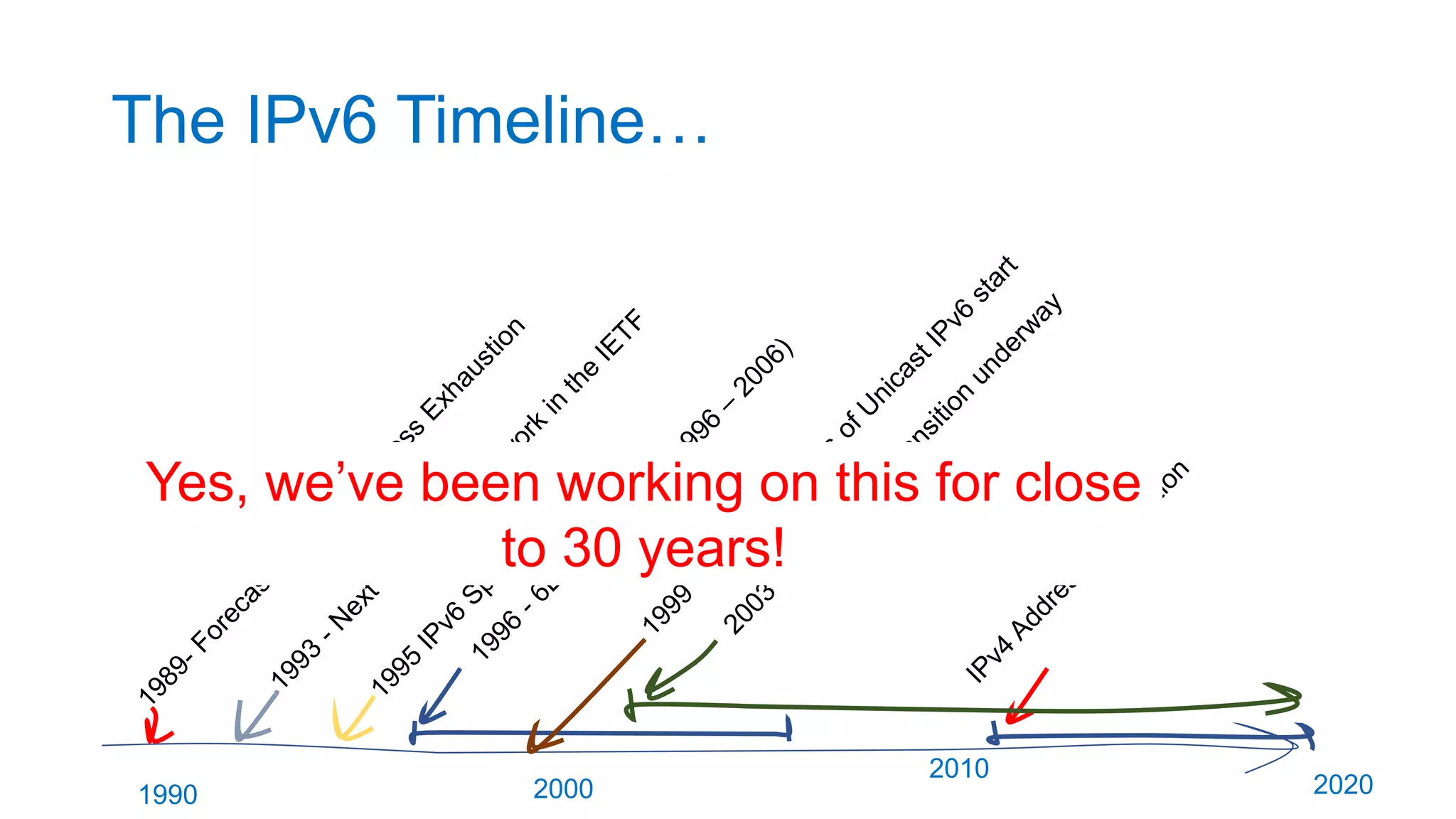
The IPv6 Timeline…
1990 2000
2010
2020
Yes, we’ve been working on this for close
to 30 years!
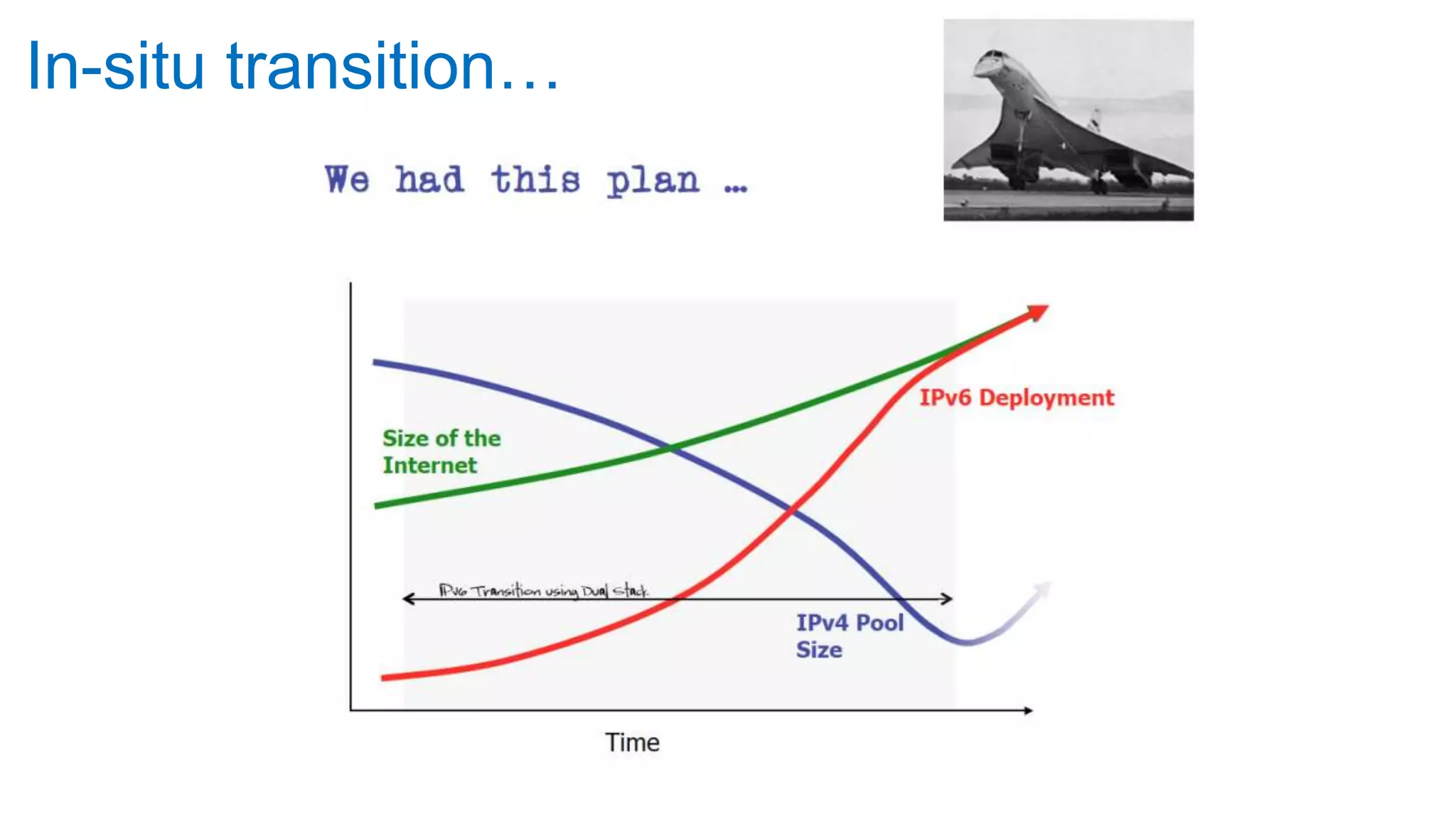
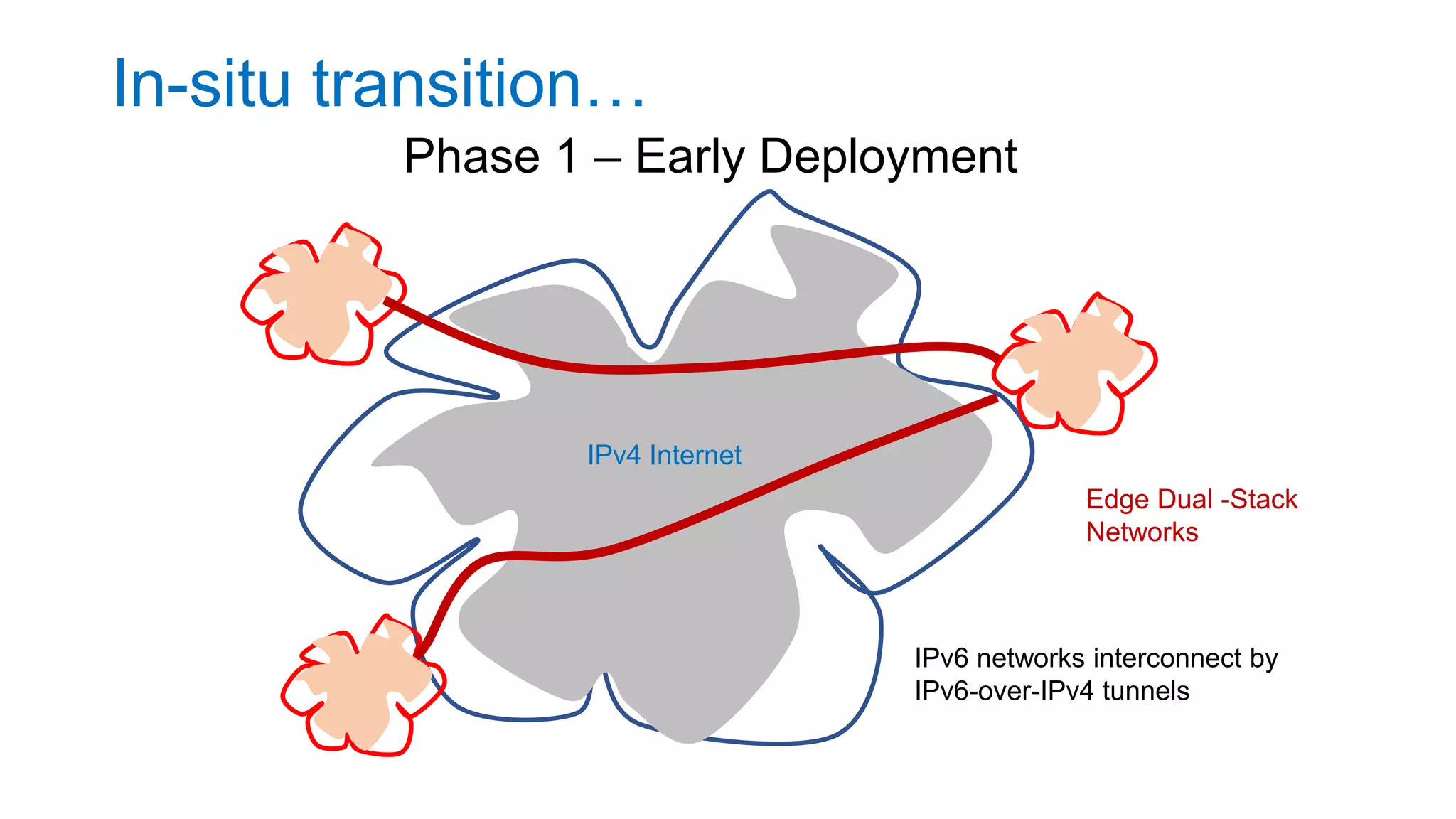
In-situ transition…
In-situ transition…
IPv4 Internet
Phase 1 – Early Deployment
Edge Dual -Stack
Networks
IPv6 networks interconnect by
IPv6-over-IPv4 tunnels
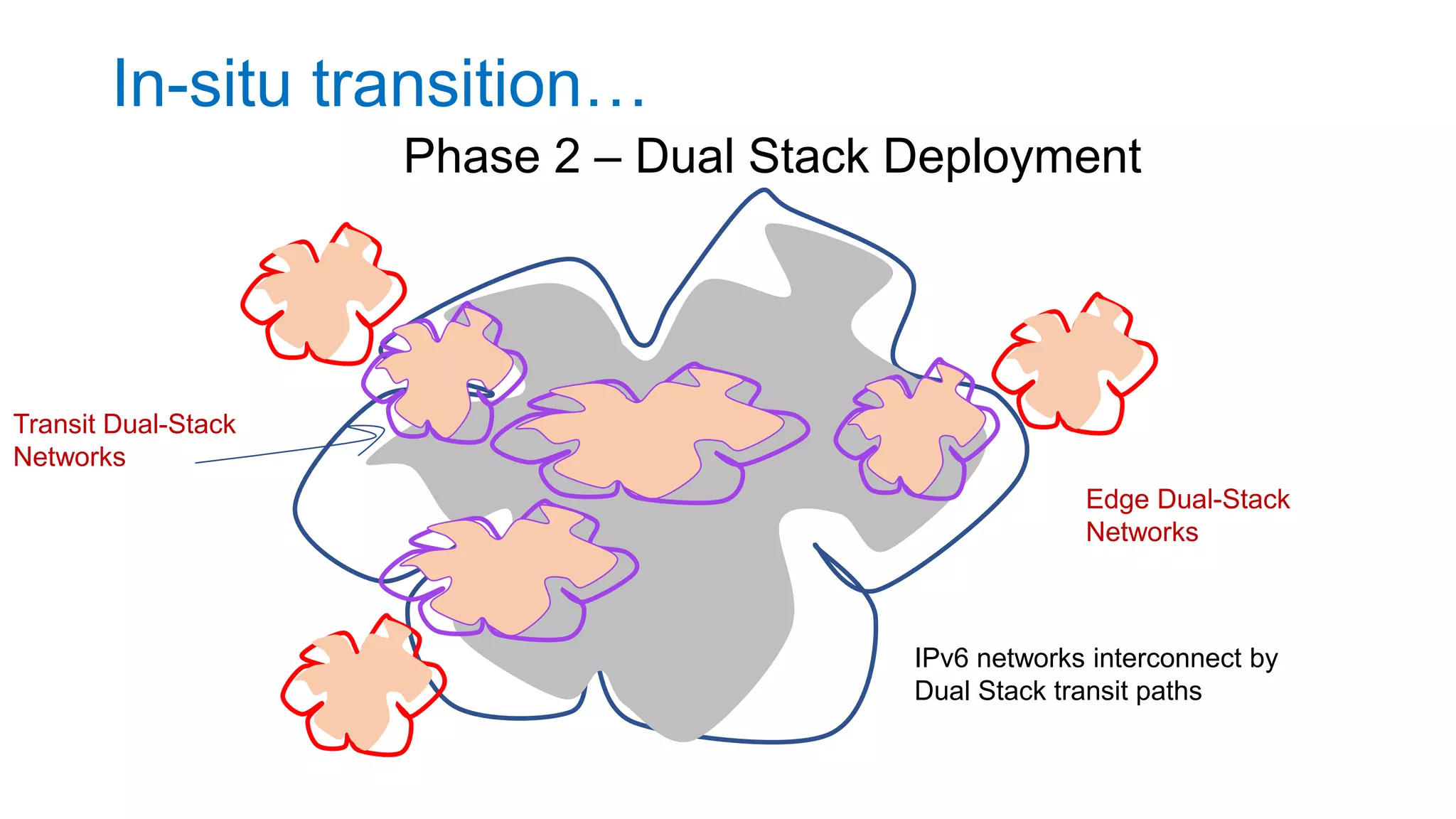
In-situ transition…
Phase 2 – Dual Stack Deployment
Edge Dual-Stack
Networks
IPv6 networks interconnect by
Dual Stack transit paths
Transit Dual-Stack
Networks
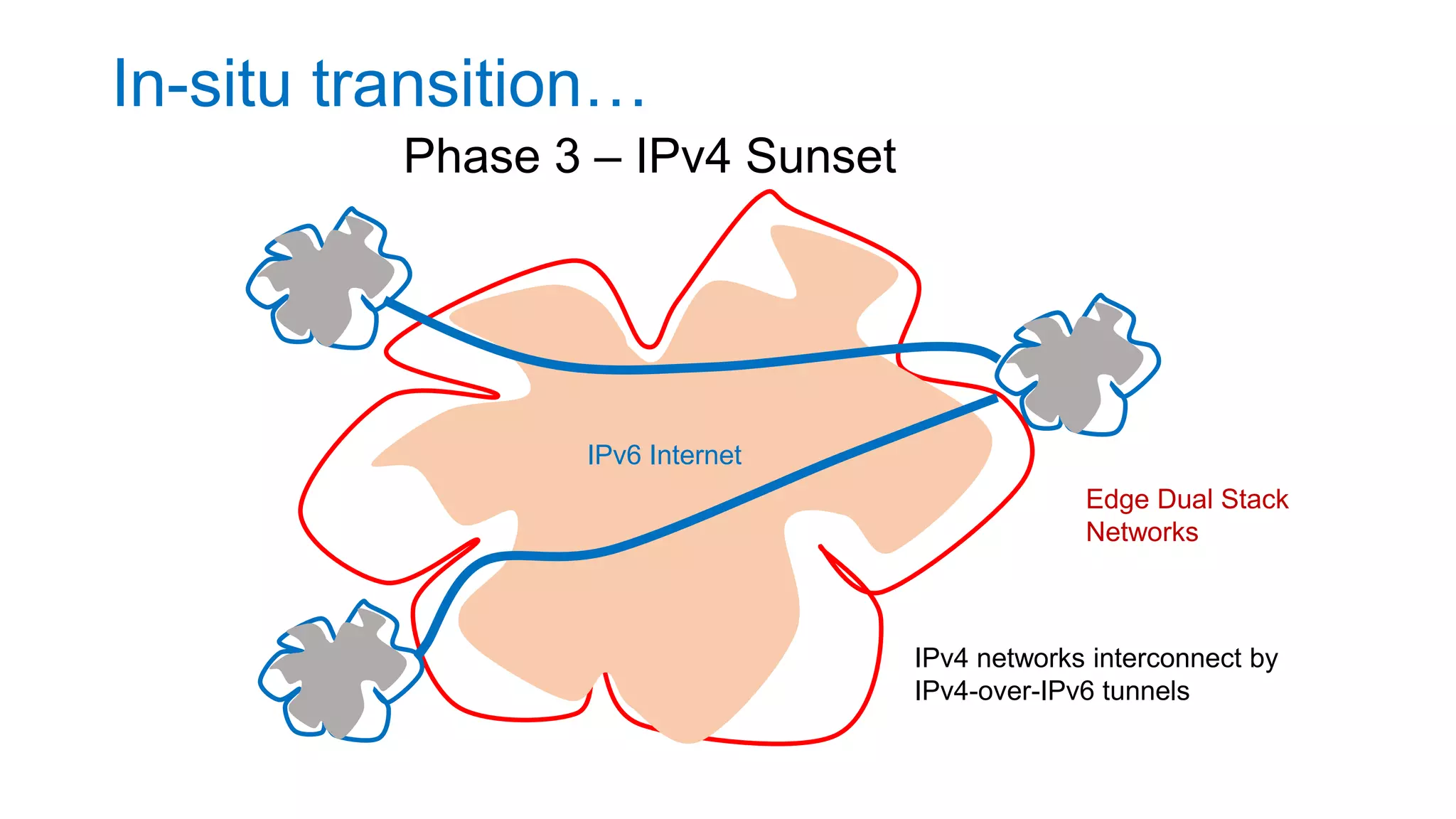
In-situ transition…
IPv6 Internet
Phase 3 – IPv4 Sunset
Edge Dual Stack
Networks
IPv4 networks interconnect by
IPv4-over-IPv6 tunnels
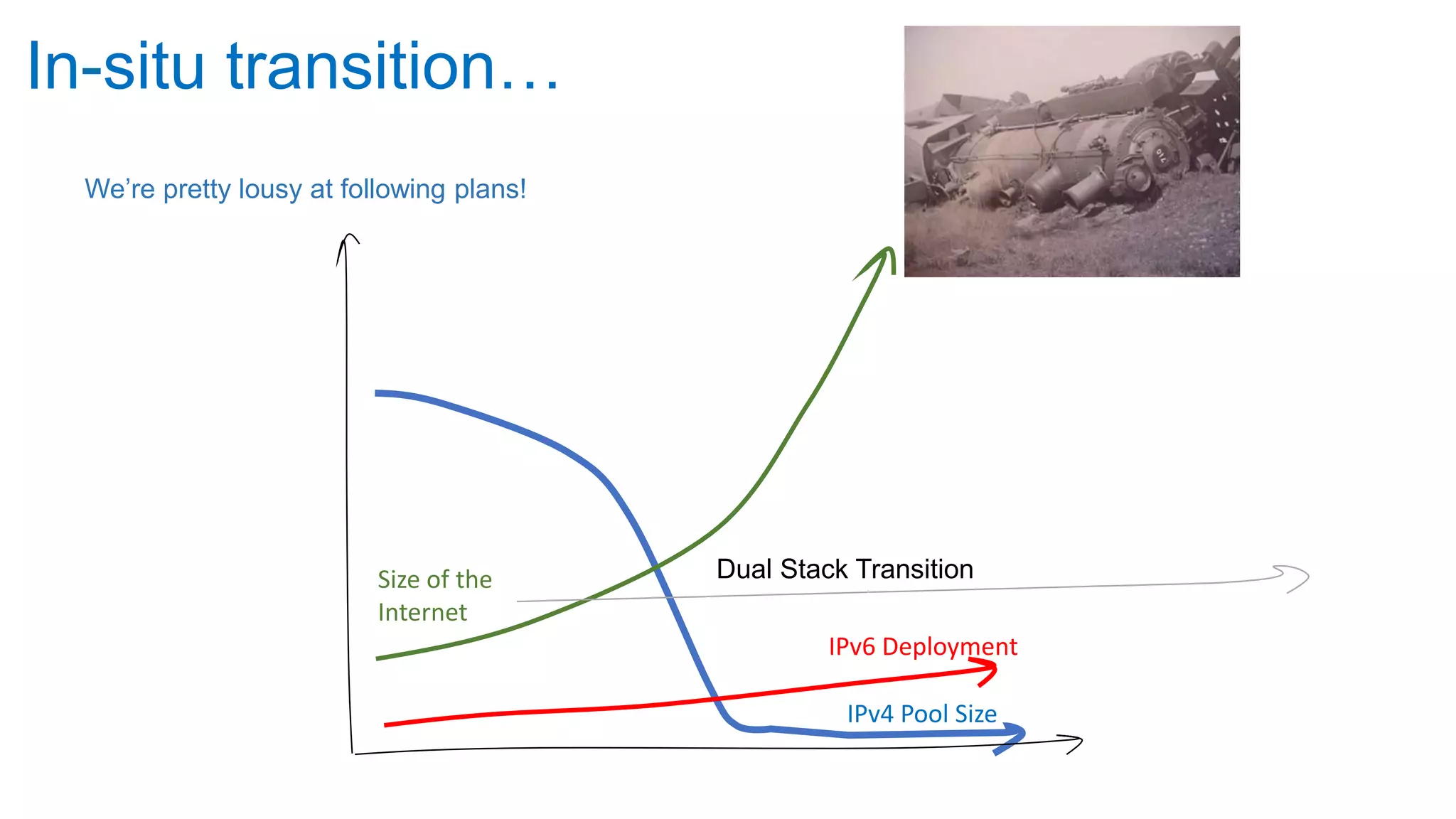
In-situ transition…
IPv4 Pool Size
IPv6 Deployment
Size of the
Internet
Dual Stack Transition
We’re pretty lousy at following plans!
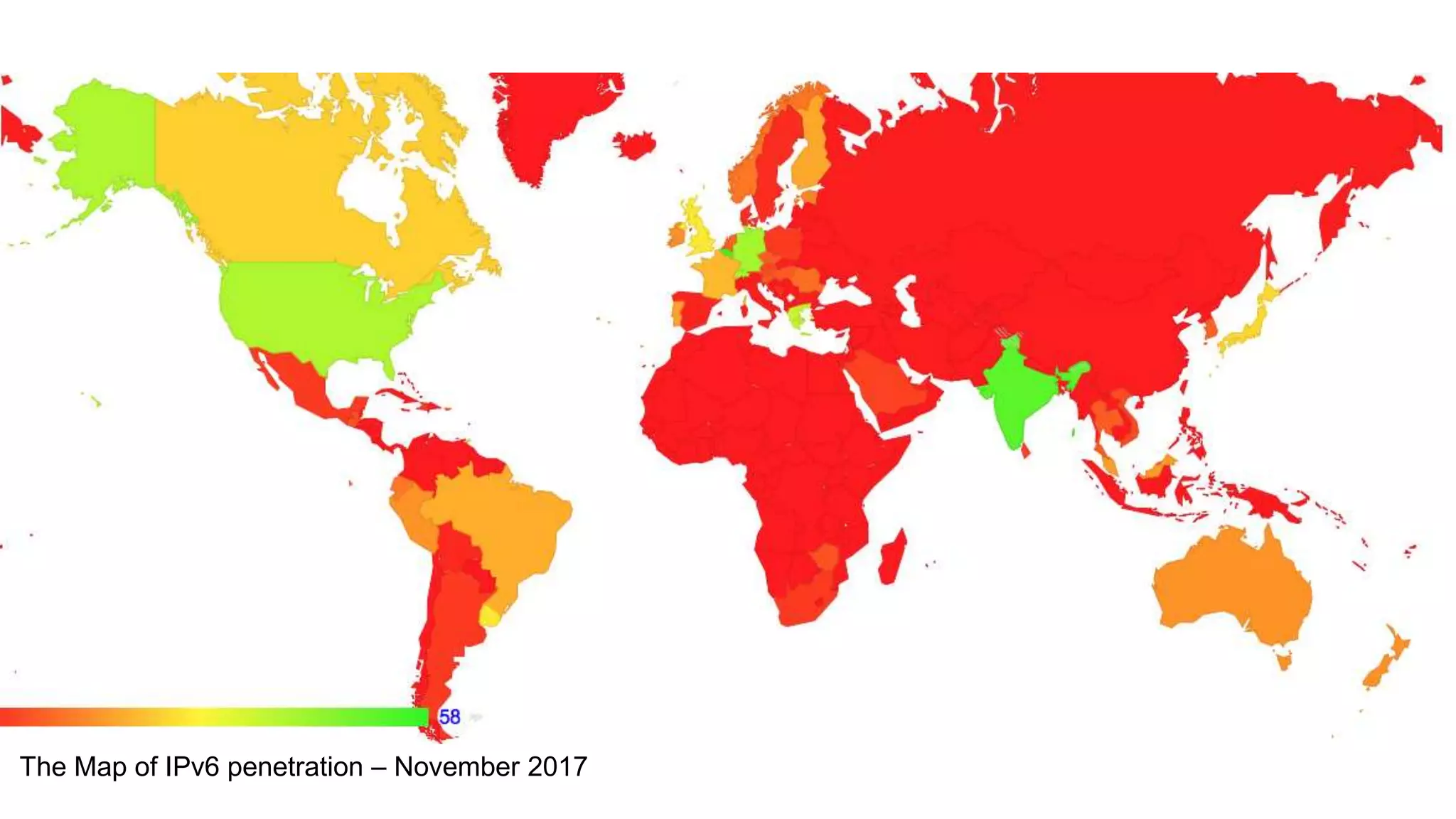
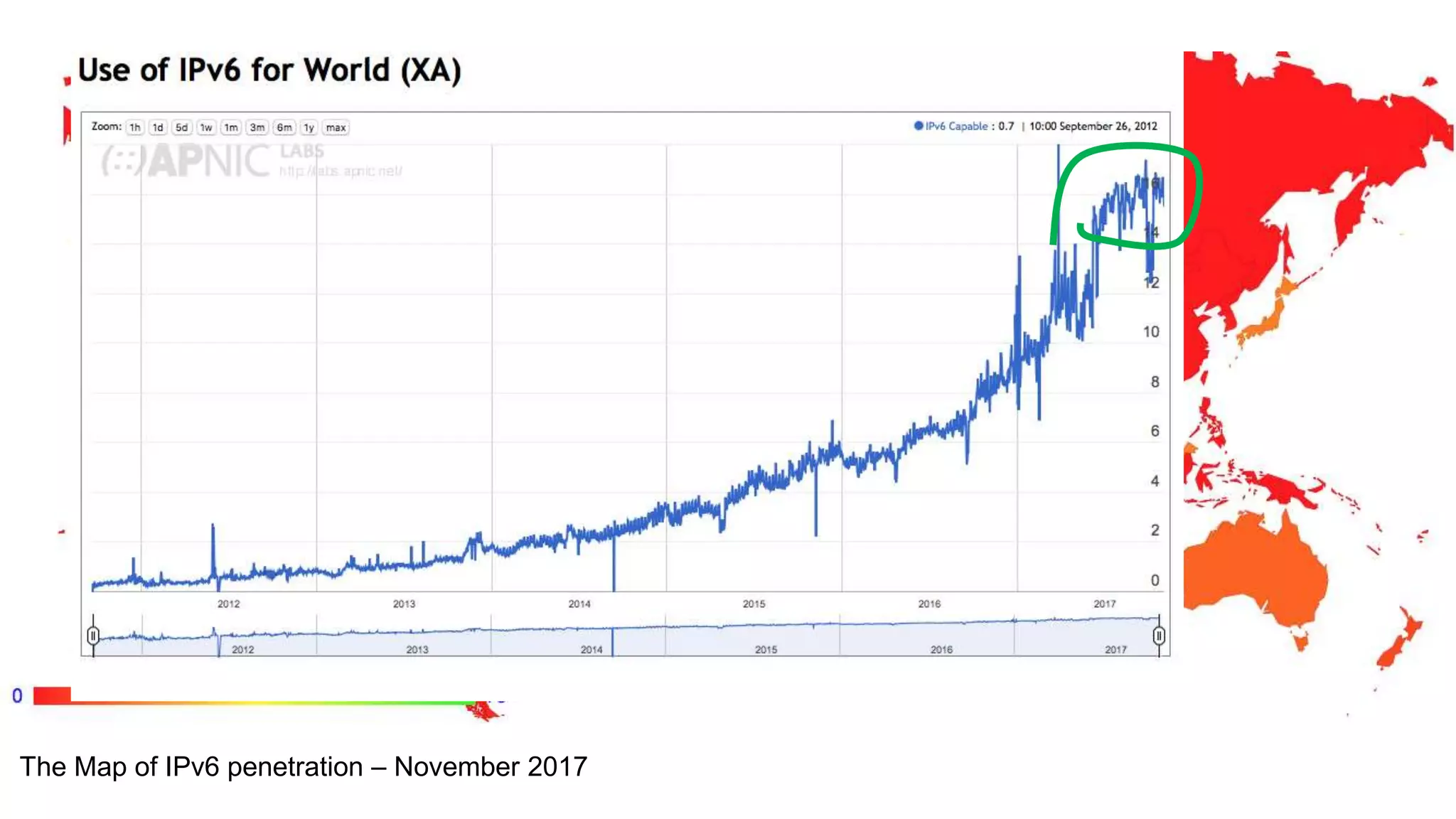
The Map of IPv6 penetration – November 2017
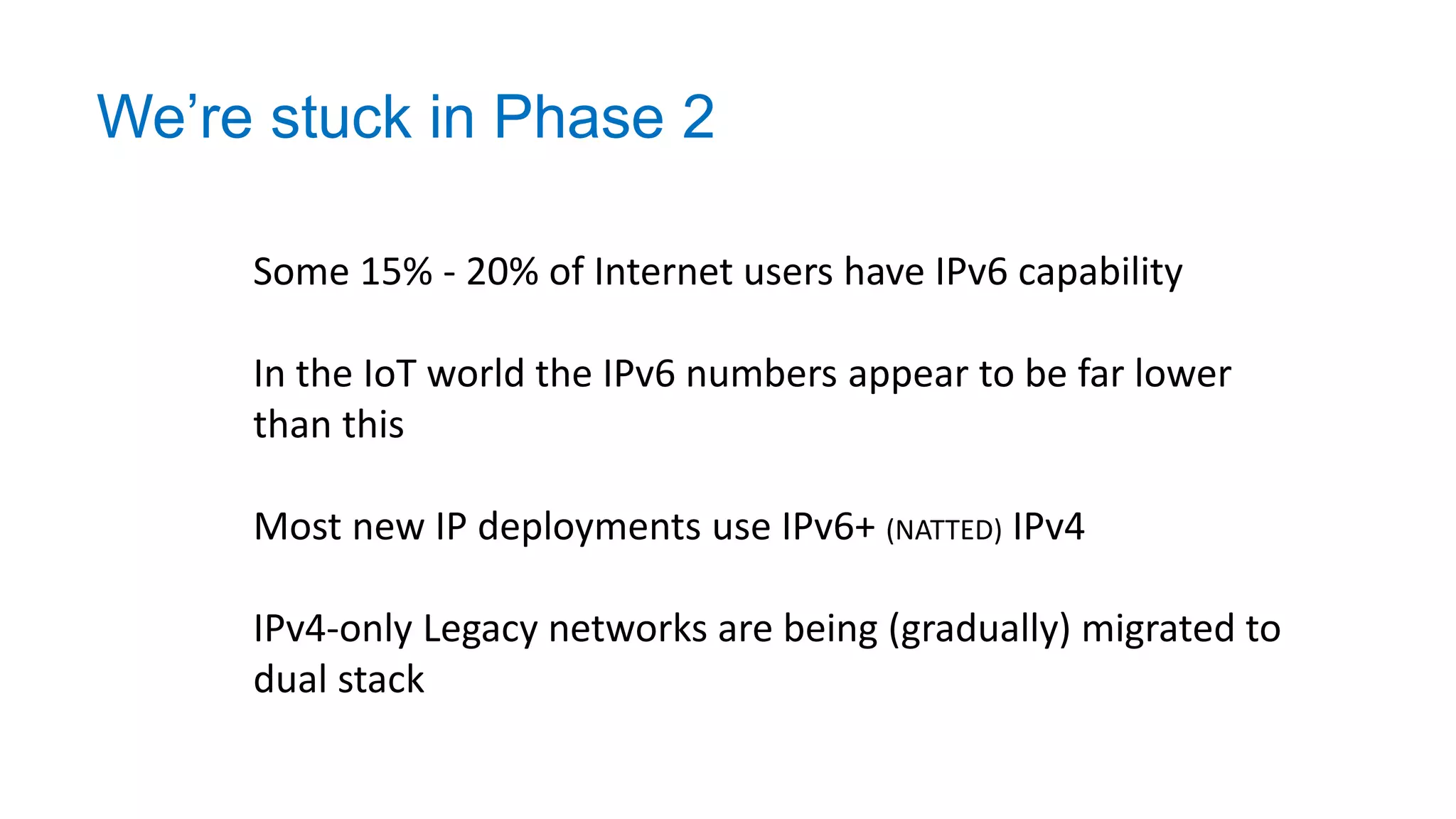
We’re stuck in Phase 2
Some 15% - 20% of Internet users have IPv6 capability
In the IoT world the IPv6 numbers appear to be far lower
than this
Most new IP deployments use IPv6+ (NATTED) IPv4
IPv4-only Legacy networks are being (gradually) migrated to
dual stack
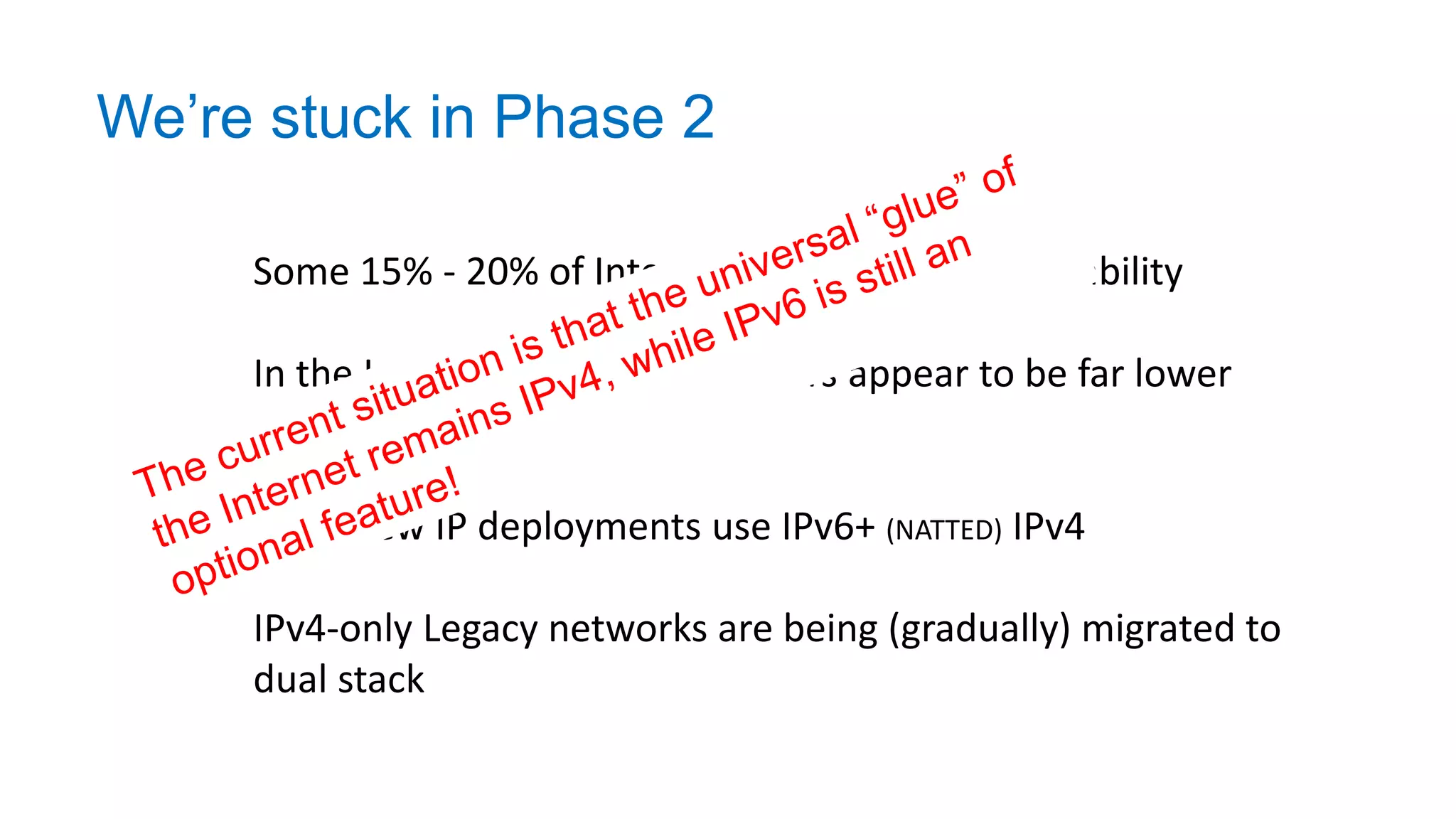
We’re stuck in Phase 2
Some 15% - 20% of Internet users have IPv6 capability
In the IoT world the IPv6 numbers appear to be far lower
than this
Most new IP deployments use IPv6+ (NATTED) IPv4
IPv4-only Legacy networks are being (gradually) migrated to
dual stack
Today
We appear to be in the middle of the transition!
Dual Stack networks cannot drop support for IPv4 as long as
significant services and user populations do not support IPv6
Today
We appear to be in the middle of the transition!
Dual Stack networks cannot drop support for IPv4 as long as
significant services and user populations do not support IPv6
– and we can’t tell when that may change
Nobody is really in a position to deploy a robust at-scale ipv6-
only network service today, even if they wanted to!
And we are not even sure if we can!
Today
We appear to be in the middle of the transition!
Dual Stack networks cannot drop support for IPv4 as long as
significant services and user populations do not support IPv6
– and we can’t tell when that may change
Nobody is really in a position to deploy a robust at-scale ipv6-
only network service today, even if they wanted to!
And we are not even sure if we can!
The Issue
We cannot run Dual-Stack services indefinitely
At some point we need to support networks that only have IPv6
Is that viable?
In other words…
What do we rely on today in IPv4 that does not appear to have a clear
working counterpart in IPv6?
In other words…
What do we rely on today in IPv4 that does not appear to have a clear
working counterpart in IPv6?
If the answer is “nothing” then we are done!
But if there is an issue here, then we should be working on it!
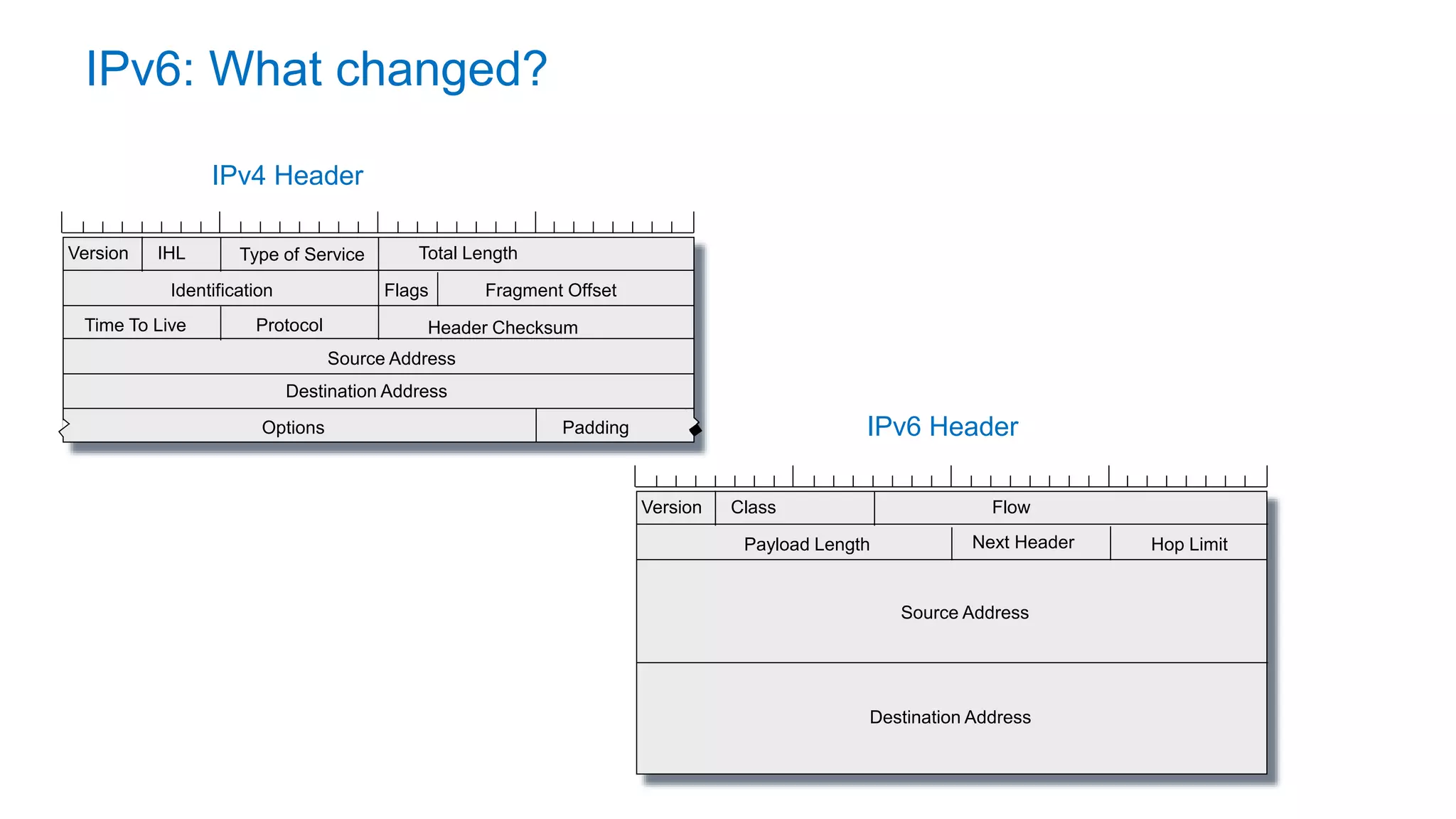
Version IHL Total Length
FlagsIdentification Fragment Offset
Time To Live
Source Address
Destination Address
Options Padding
Protocol Header Checksum
Type of Service
Version Class Flow
Payload Length Hop Limit
Source Address
Destination Address
Next Header
IPv4 Header
IPv6 Header
IPv6: What changed?
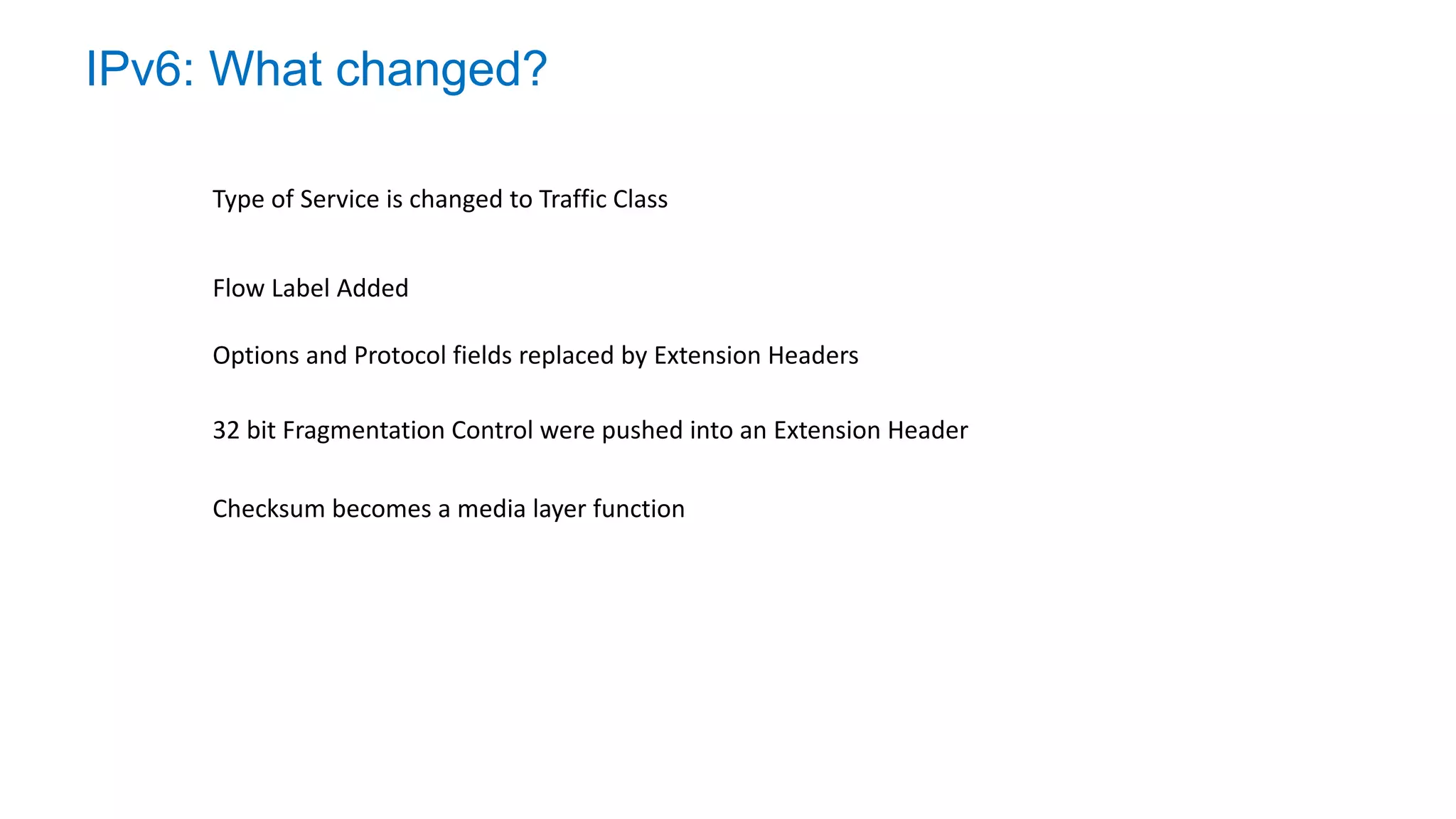
IPv6: What changed?
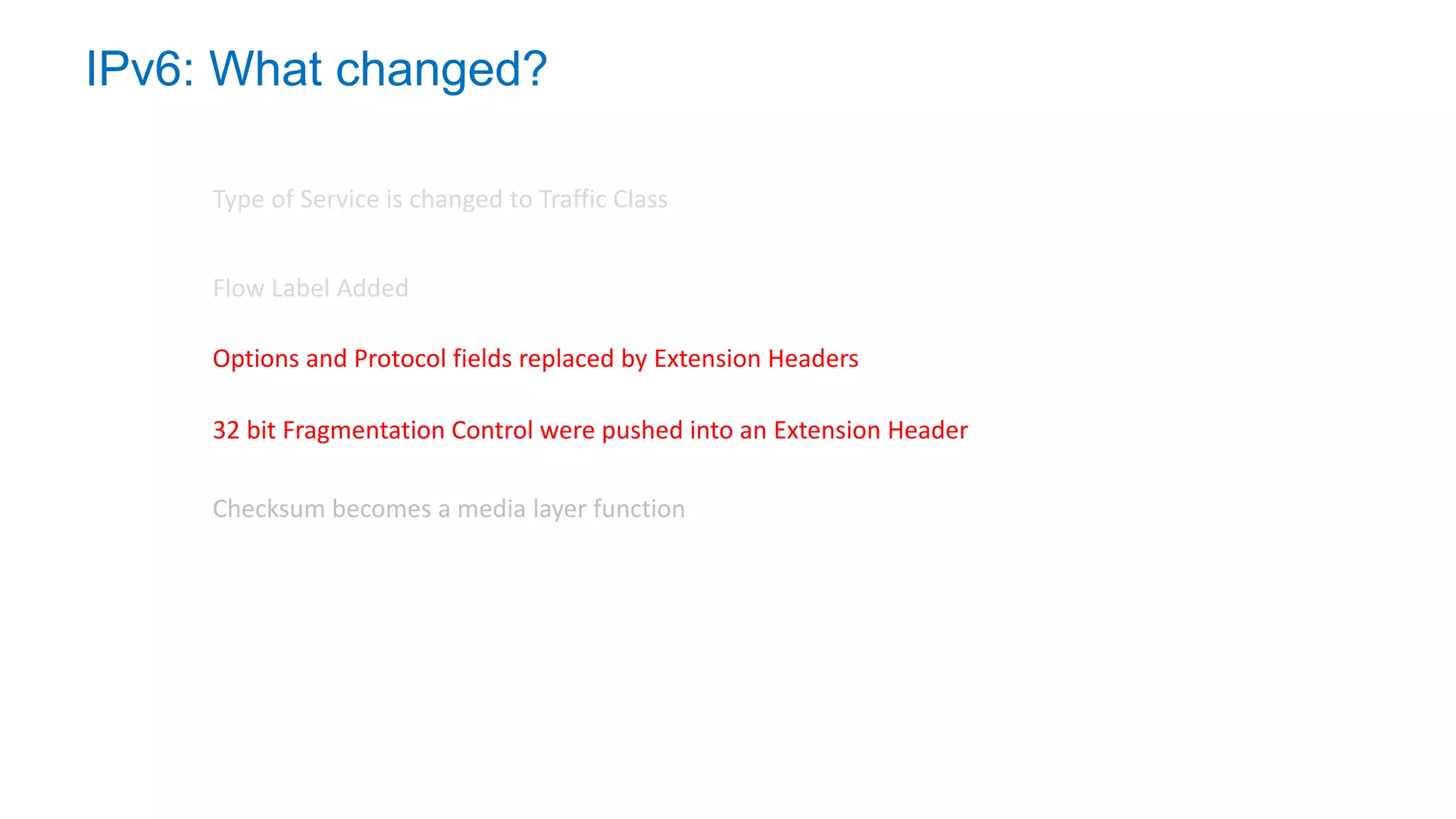
Type of Service is changed to Traffic Class
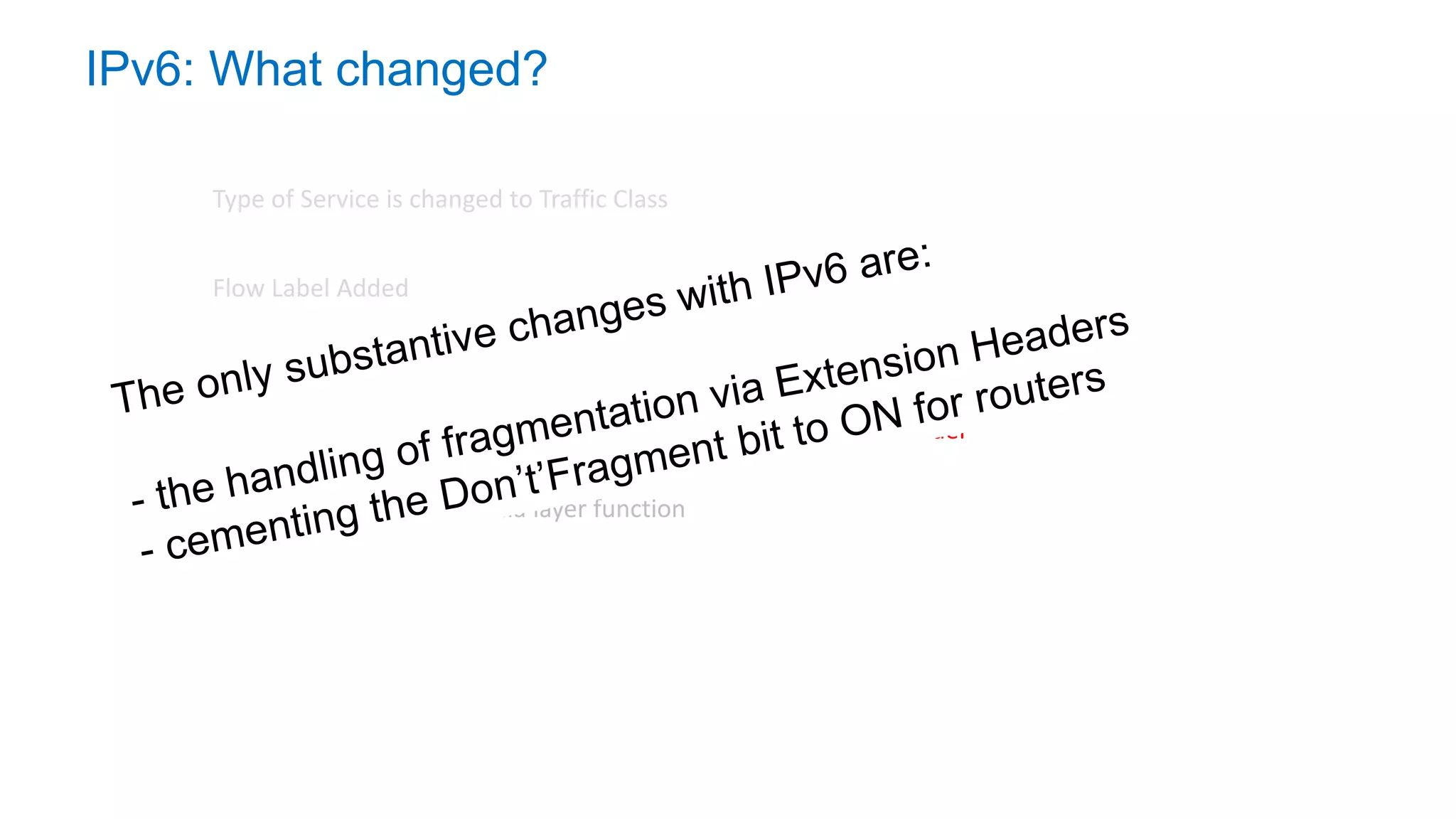
32 bit Fragmentation Control were pushed into an Extension Header
Flow Label Added
Options and Protocol fields replaced by Extension Headers
Checksum becomes a media layer function
IPv6: What changed?
Type of Service is changed to Traffic Class
32 bit Fragmentation Control were pushed into an Extension Header
Flow Label Added
Options and Protocol fields replaced by Extension Headers
Checksum becomes a media layer function
IPv6: What changed?
Type of Service is changed to Traffic Class
32 bit Fragmentation Control were pushed into an Extension Header
Flow Label Added
Options and Protocol fields replaced by Extension Headers
Checksum becomes a media layer function
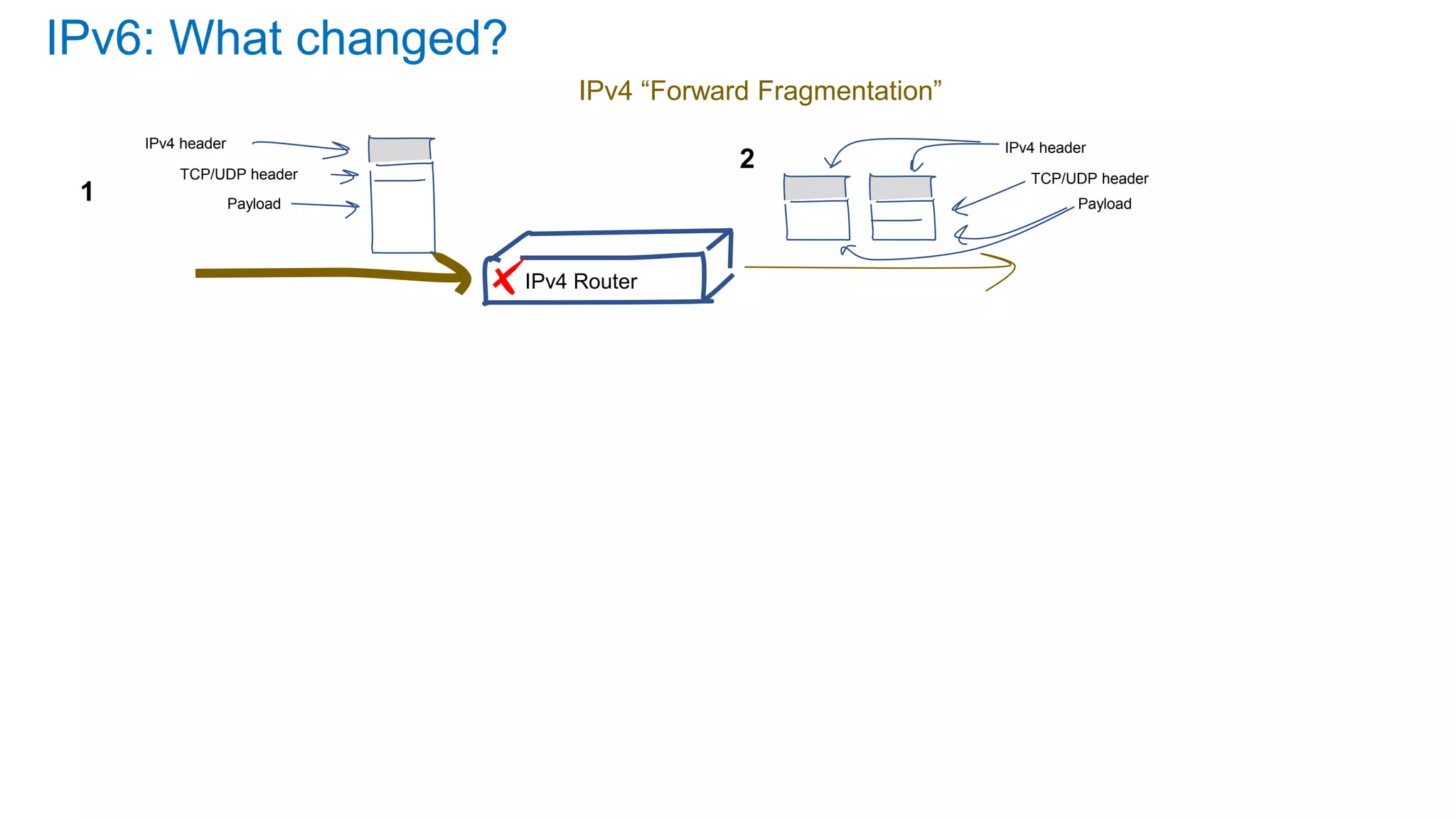
IPv4 Router
IPv4 header
Payload
TCP/UDP header
IPv4 header
Payload
TCP/UDP header
1
2
IPv6: What changed?
IPv4 “Forward Fragmentation”
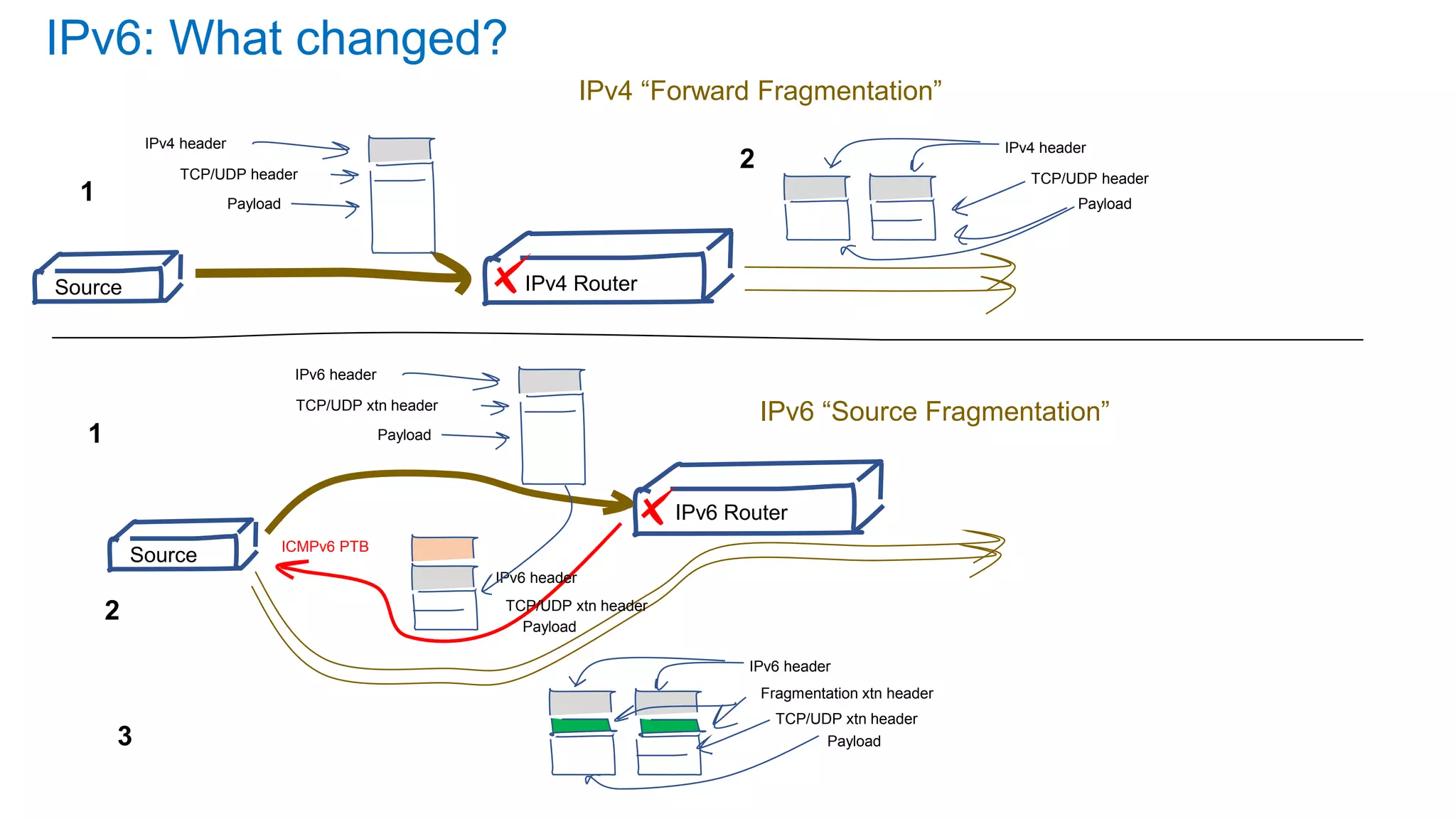
IPv4 Router
IPv4 header
Payload
TCP/UDP header
IPv4 header
Payload
TCP/UDP header
IPv6 Router
IPv6 header
Payload
TCP/UDP xtn header
Payload
TCP/UDP xtn header
ICMPv6 PTB
IPv6 header
IPv6 header
Payload
TCP/UDP xtn header
Fragmentation xtn header
1
2
3
1
2
IPv6: What changed?
IPv4 “Forward Fragmentation”
IPv6 “Source Fragmentation”
Source
Source
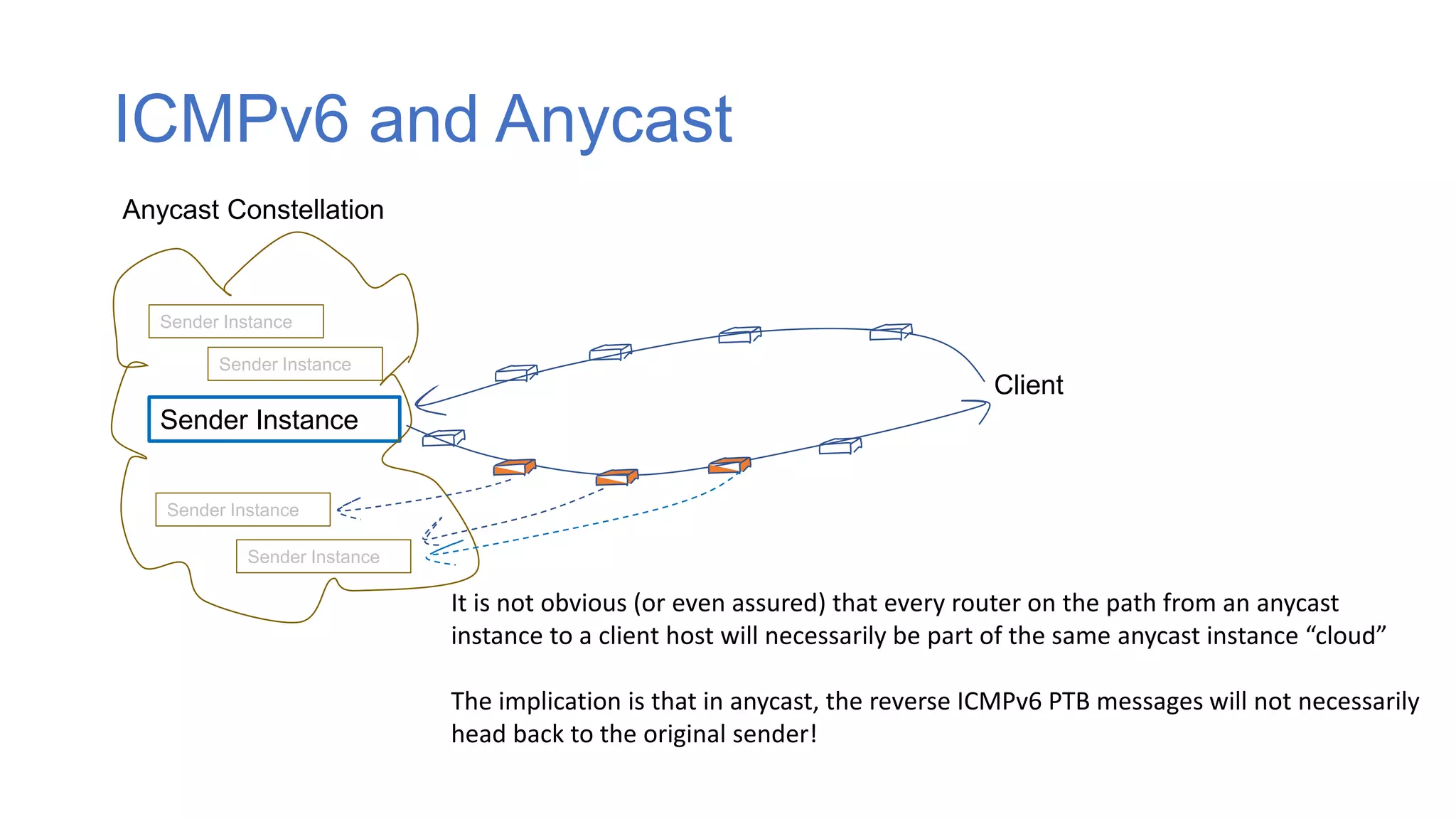
ICMPv6 and Anycast
Sender Instance
Client
Sender Instance
Sender Instance
Anycast Constellation
Sender Instance
Sender Instance
It is not obvious (or even assured) that every router on the path from an anycast
instance to a client host will necessarily be part of the same anycast instance “cloud”
The implication is that in anycast, the reverse ICMPv6 PTB messages will not necessarily
head back to the original sender!
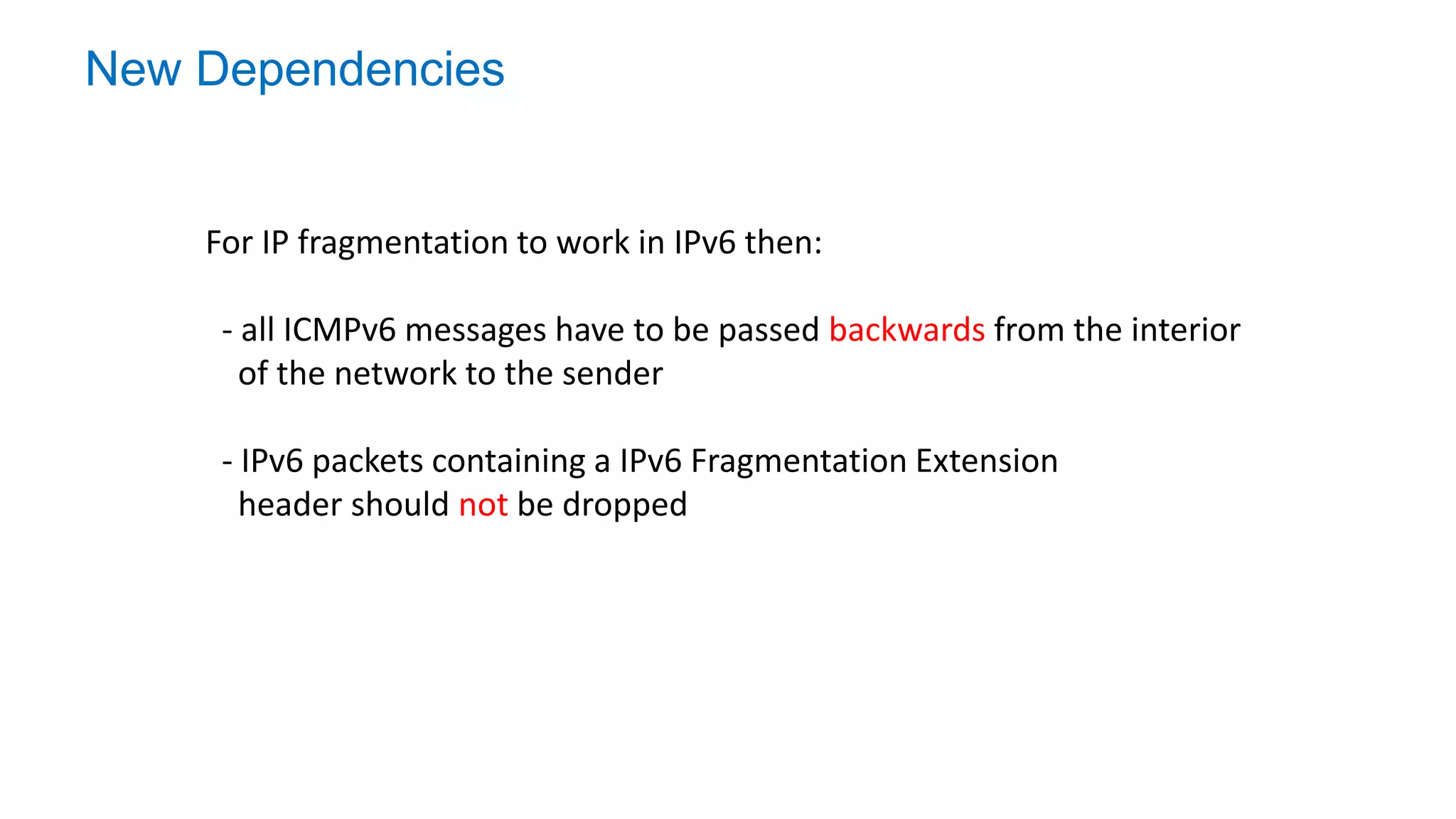
New Dependencies
For IP fragmentation to work in IPv6 then:
- all ICMPv6 messages have to be passed backwards from the interior
of the network to the sender
- IPv6 packets containing a IPv6 Fragmentation Extension
header should not be dropped
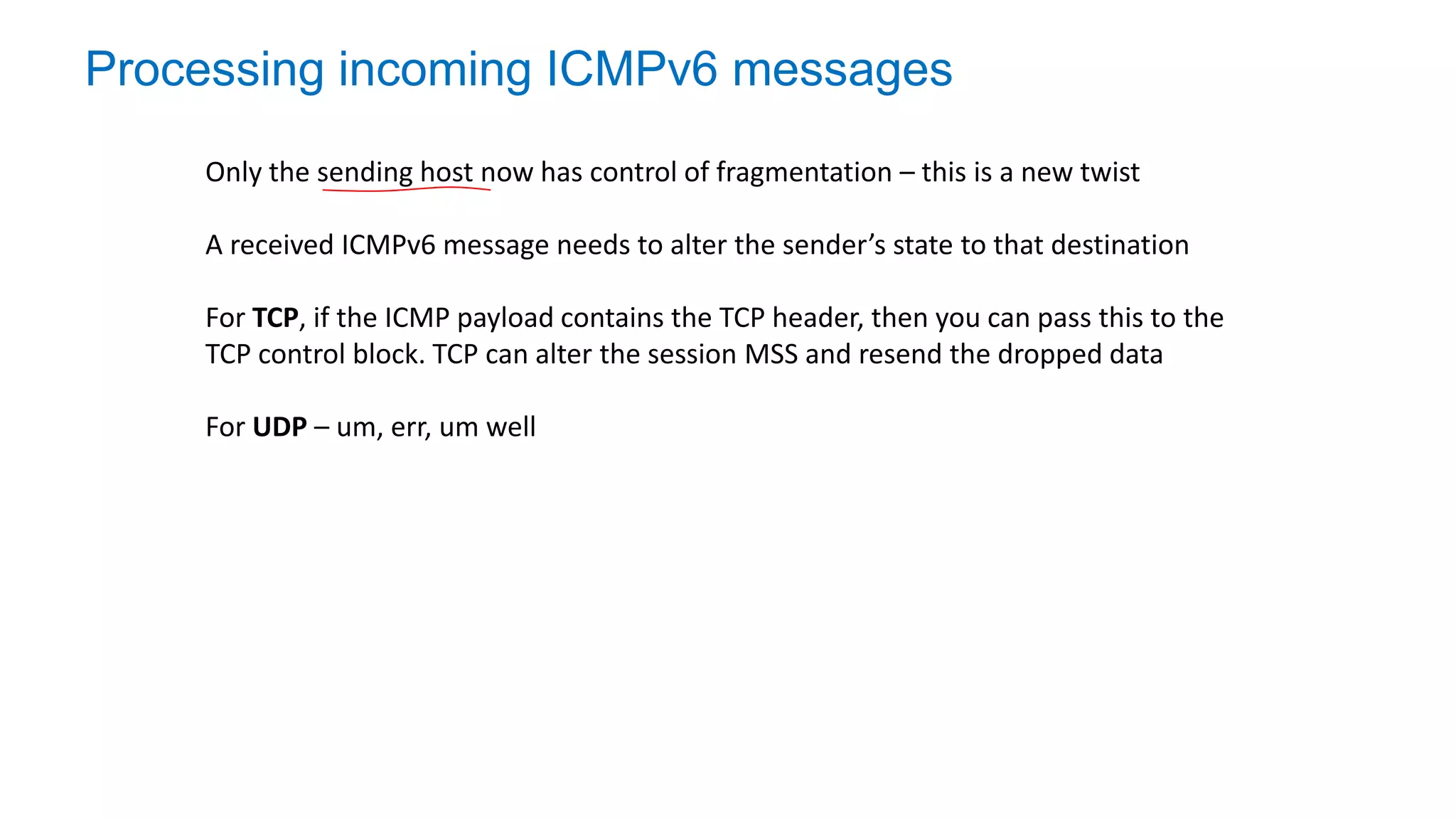
Processing incoming ICMPv6 messages
Only the sending host now has control of fragmentation – this is a new twist
A received ICMPv6 message needs to alter the sender’s state to that destination
For TCP, if the ICMP payload contains the TCP header, then you can pass this to the
TCP control block. TCP can alter the session MSS and resend the dropped data
For UDP – um, err, um well
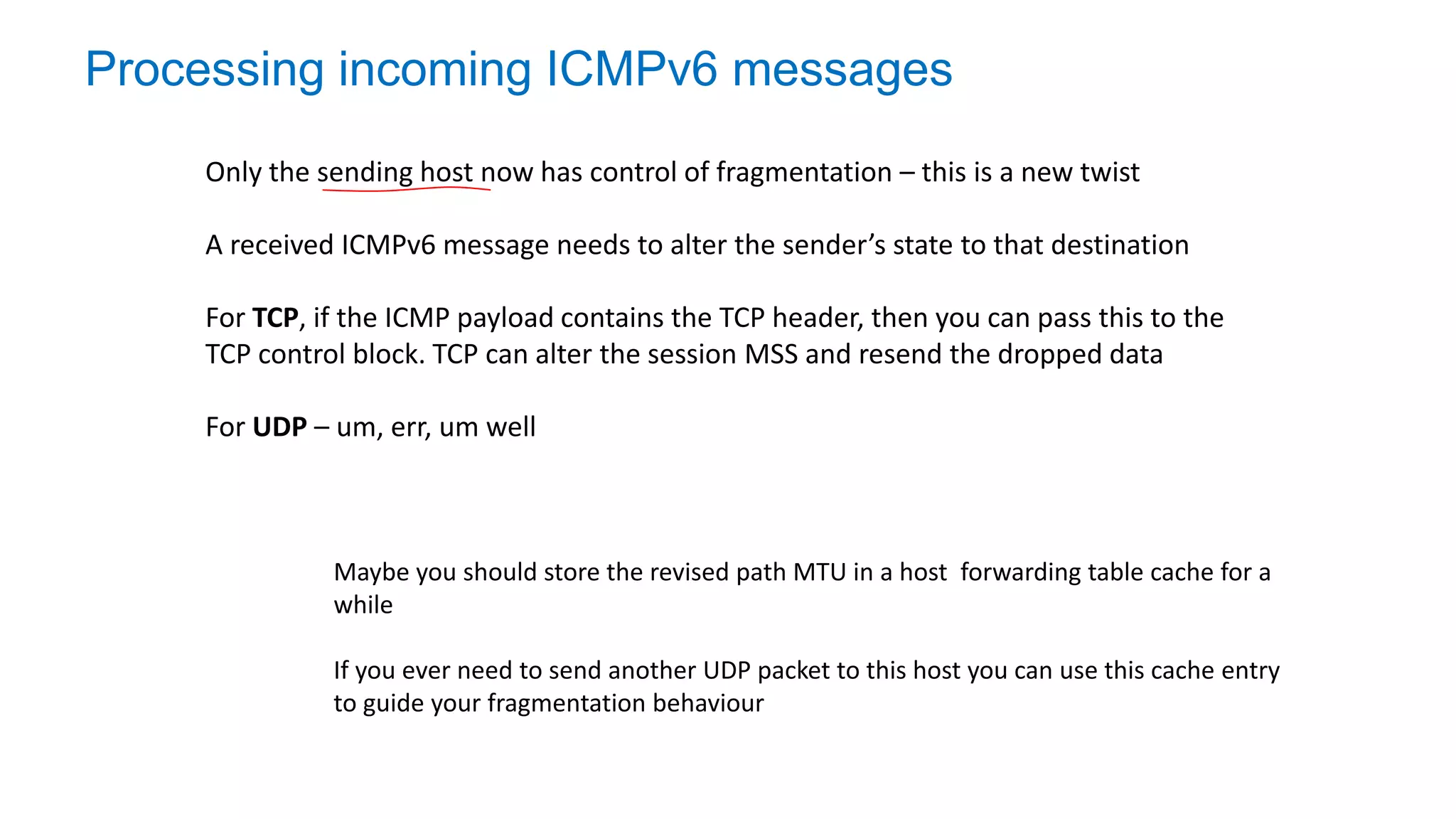
Processing incoming ICMPv6 messages
Only the sending host now has control of fragmentation – this is a new twist
A received ICMPv6 message needs to alter the sender’s state to that destination
For TCP, if the ICMP payload contains the TCP header, then you can pass this to the
TCP control block. TCP can alter the session MSS and resend the dropped data
For UDP – um, err, um well
Maybe you should store the revised path MTU in a host forwarding table cache for a
while
If you ever need to send another UDP packet to this host you can use this cache entry
to guide your fragmentation behaviour
IPv6 and Fragmentation
The theory is that TCP in IPv6 should never send a fragmented packet - TCP should use the session MSS as a
guide to packet sizes and segment the stream according to the session MSS
However, UDP cannot avoid fragmentation - large payloads in UDP simply need to be fragmented to fit
within the path MTU
Fragmentation in IPv6 uses the same control fields as IPv4 – a packet identifier, a fragmentation
offset and a More Frags flag
BUT they are located in an inserted “shim” that sits between the IPv6 packet header and the UDP
transport header - this is an instance of the IPv6 “Extension Header”
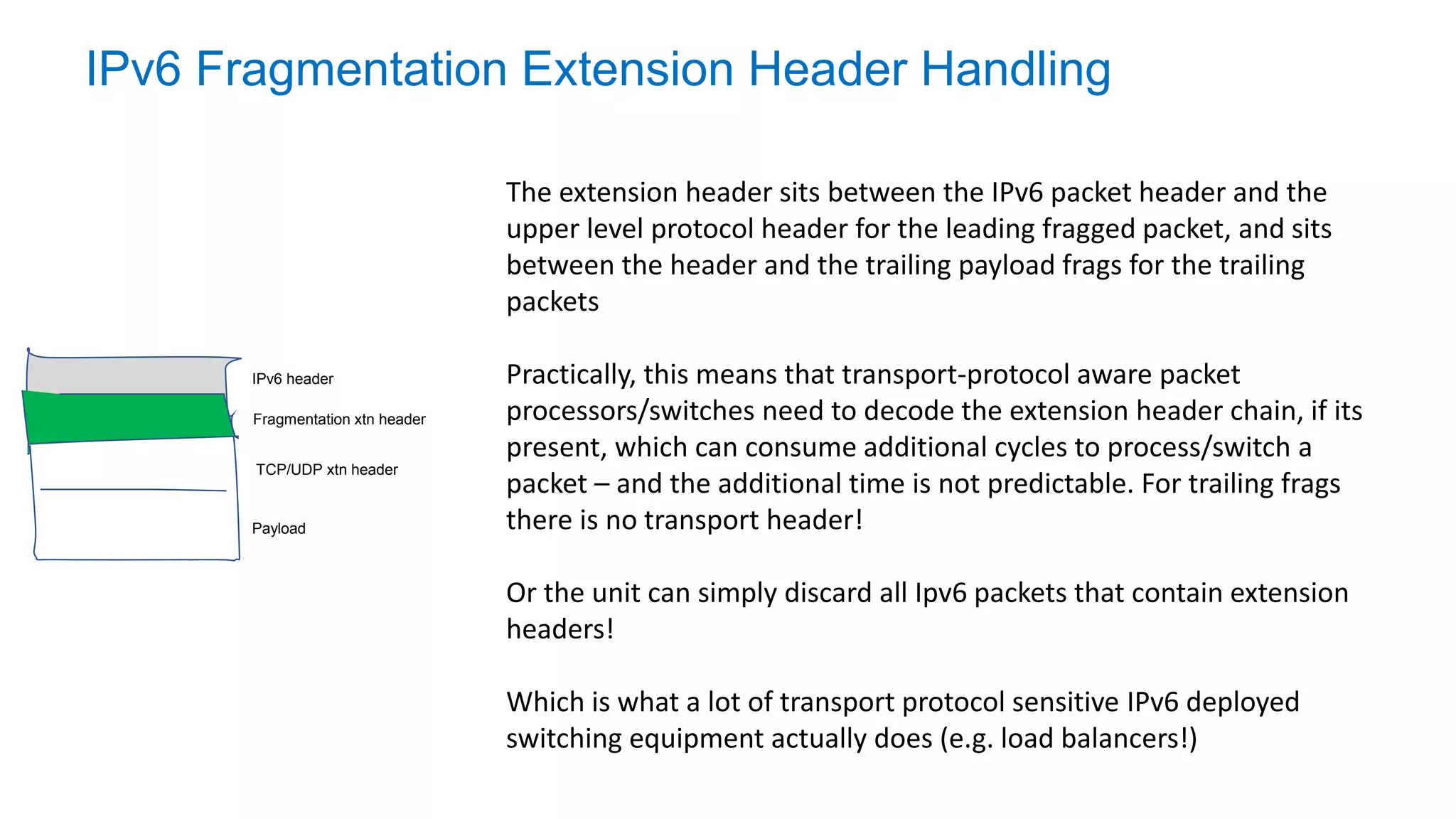
IPv6 Fragmentation Extension Header Handling
The extension header sits between the IPv6 packet header and the
upper level protocol header for the leading fragged packet, and sits
between the header and the trailing payload frags for the trailing
packets
Practically, this means that transport-protocol aware packet
processors/switches need to decode the extension header chain, if its
present, which can consume additional cycles to process/switch a
packet – and the additional time is not predictable. For trailing frags
there is no transport header!
Or the unit can simply discard all Ipv6 packets that contain extension
headers!
Which is what a lot of transport protocol sensitive IPv6 deployed
switching equipment actually does (e.g. load balancers!)
IPv6 header
Payload
TCP/UDP xtn header
Fragmentation xtn header
IPv6 Fragmentation Extension Header Handling
There is a lot of “drop” behaviour in the IPv6 Internet for Fragmentation Extension
headers
RFC7872 – recorded drop rates of 30% - 40%
This experiment sent fragmented packets towards well-known servers and observed
whether the server received and reconstructed the fragmented packet
But sending fragmented queries to servers is not all that common – the reverse
situation of big responses is more common
So what about sending fragmented packets BACK from servers – what’s the drop
rate of the reverse case?
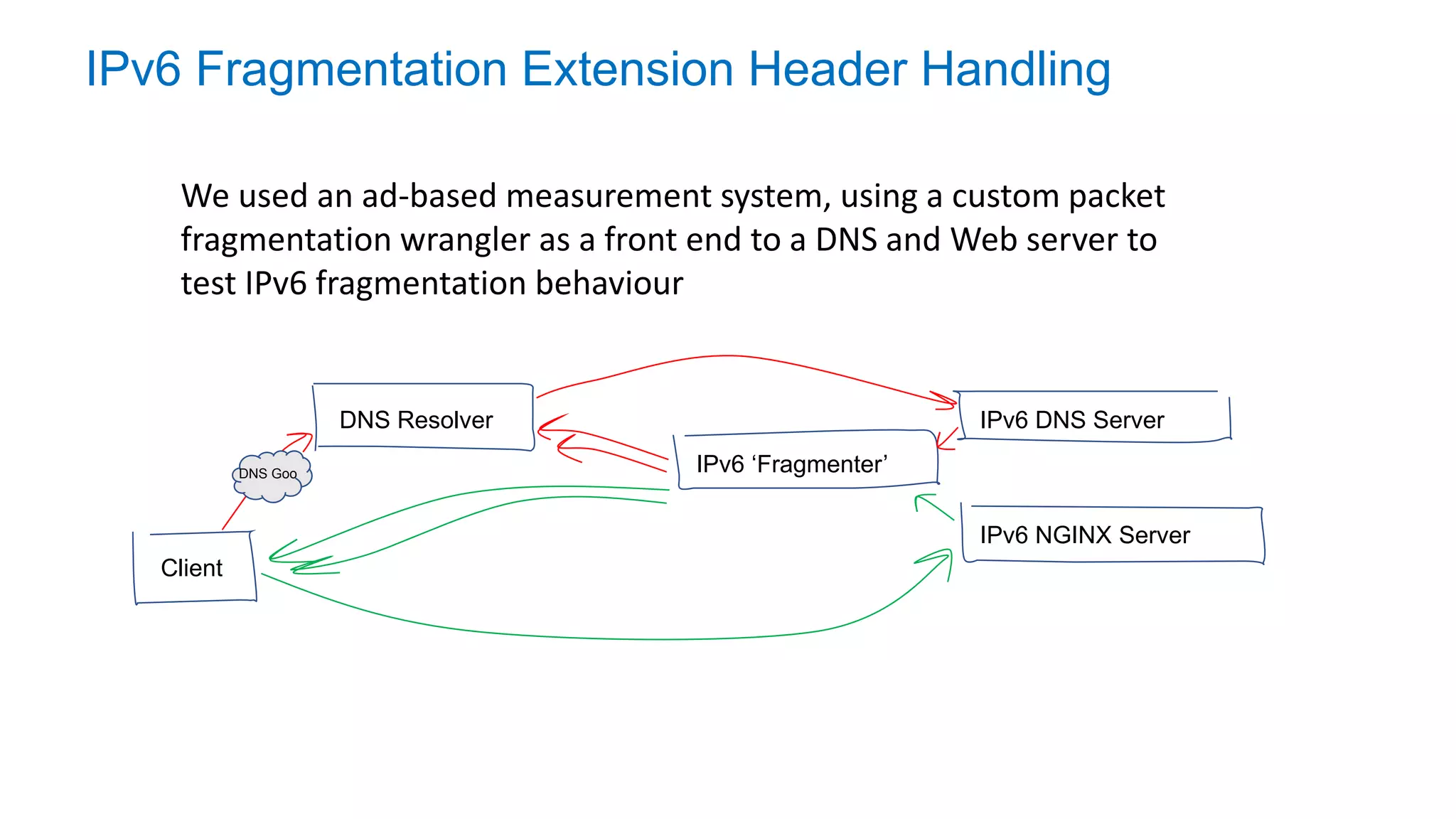
IPv6 Fragmentation Extension Header Handling
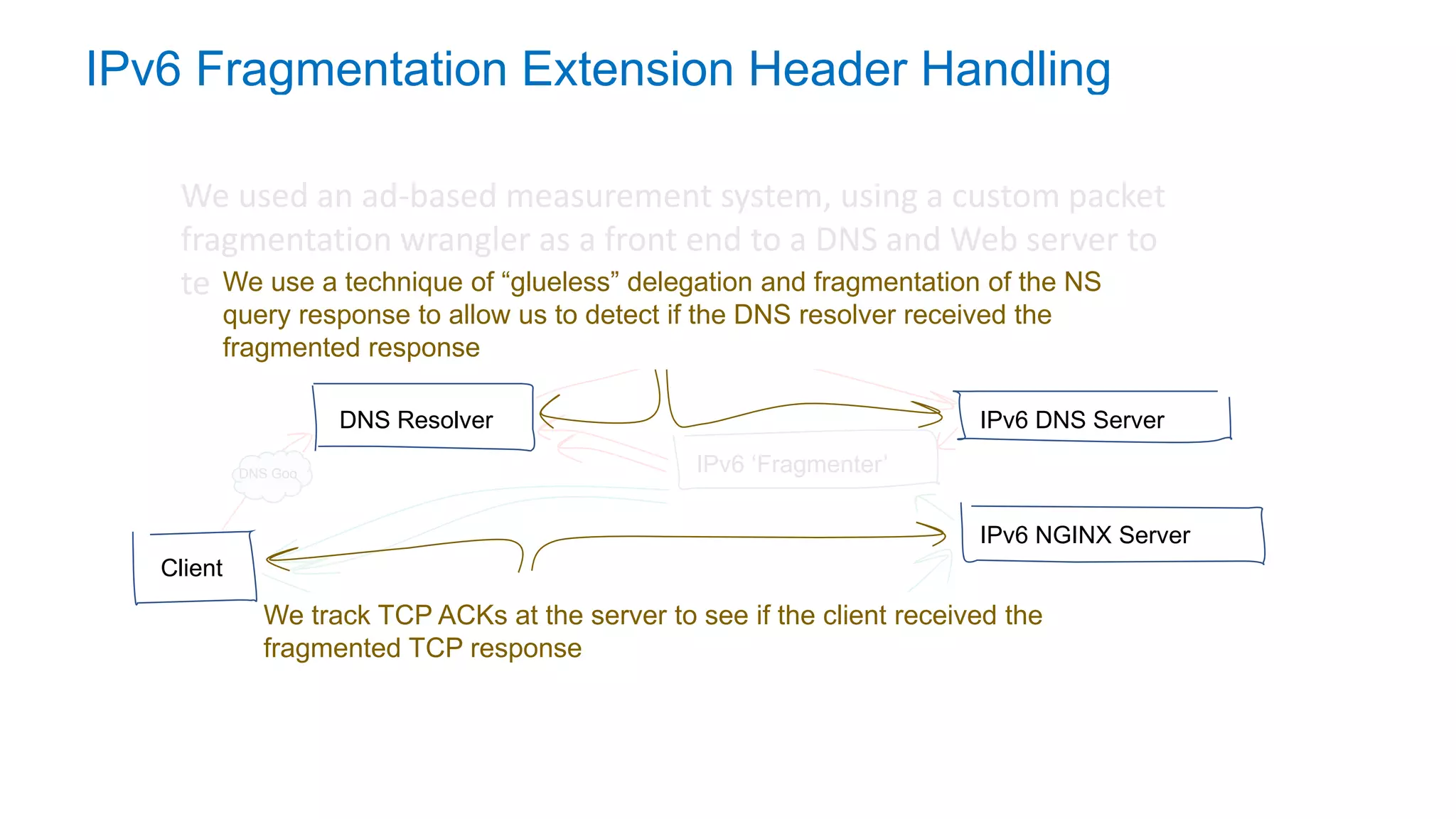
We used an ad-based measurement system, using a custom packet
fragmentation wrangler as a front end to a DNS and Web server to
test IPv6 fragmentation behaviour
Client
DNS Resolver IPv6 DNS Server
IPv6 NGINX Server
IPv6 ‘Fragmenter’DNS Goo
We used an ad-based measurement system, using a custom packet
fragmentation wrangler as a front end to a DNS and Web server to
test IPv6 fragmentation behaviour
IPv6 Fragmentation Extension Header Handling
Client
DNS Resolver
IPv6 ‘Fragmenter’DNS Goo
We use a technique of “glueless” delegation and fragmentation of the NS
query response to allow us to detect if the DNS resolver received the
fragmented response
We track TCP ACKs at the server to see if the client received the
fragmented TCP response
Client
DNS Resolver IPv6 DNS Server
IPv6 NGINX Server
IPv6 Fragmentation Extension Header Handling
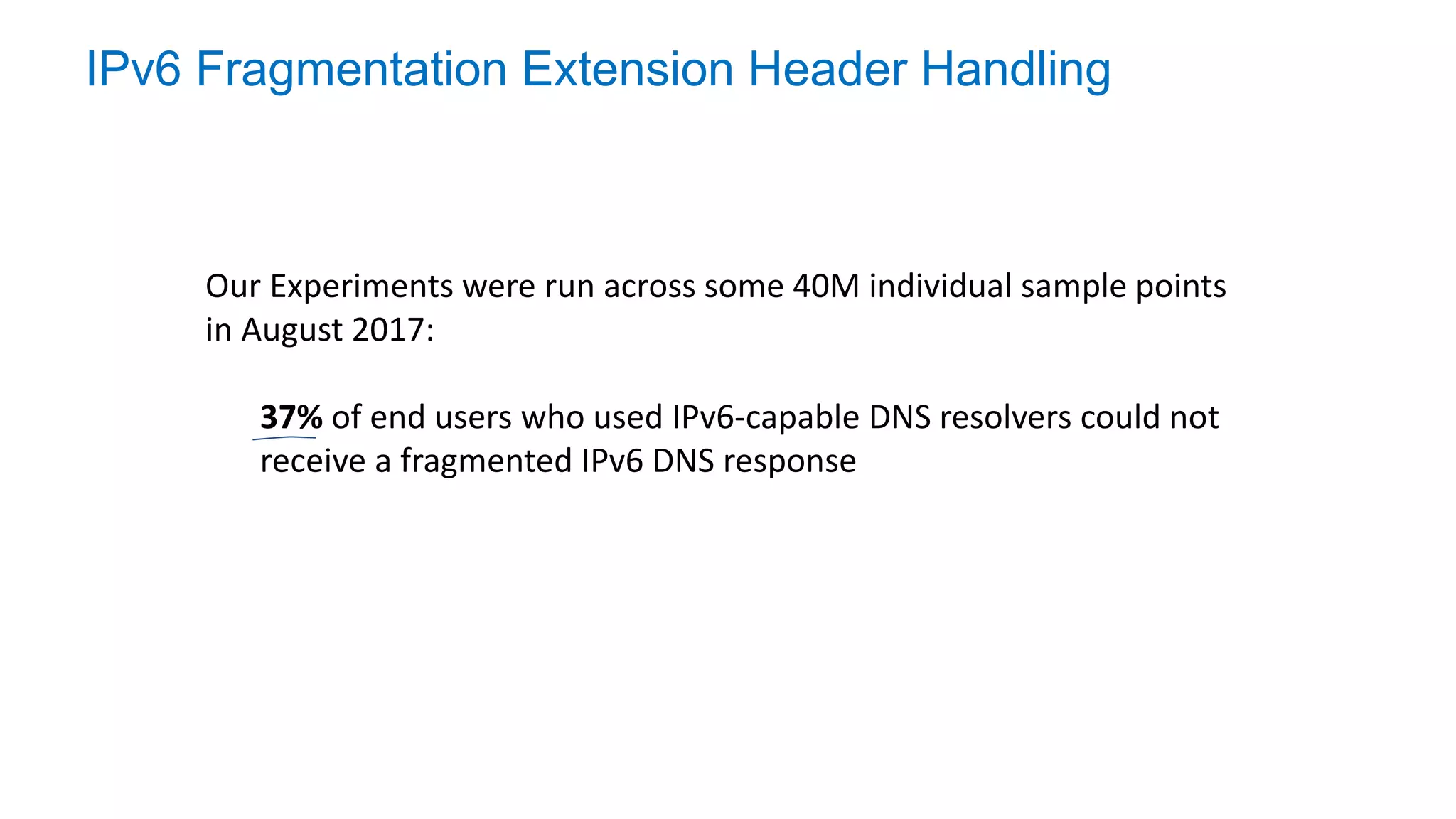
Our Experiments were run across some 40M individual sample points
in August 2017:
37% of end users who used IPv6-capable DNS resolvers could not
receive a fragmented IPv6 DNS response
IPv6 Fragmentation Extension Header Handling
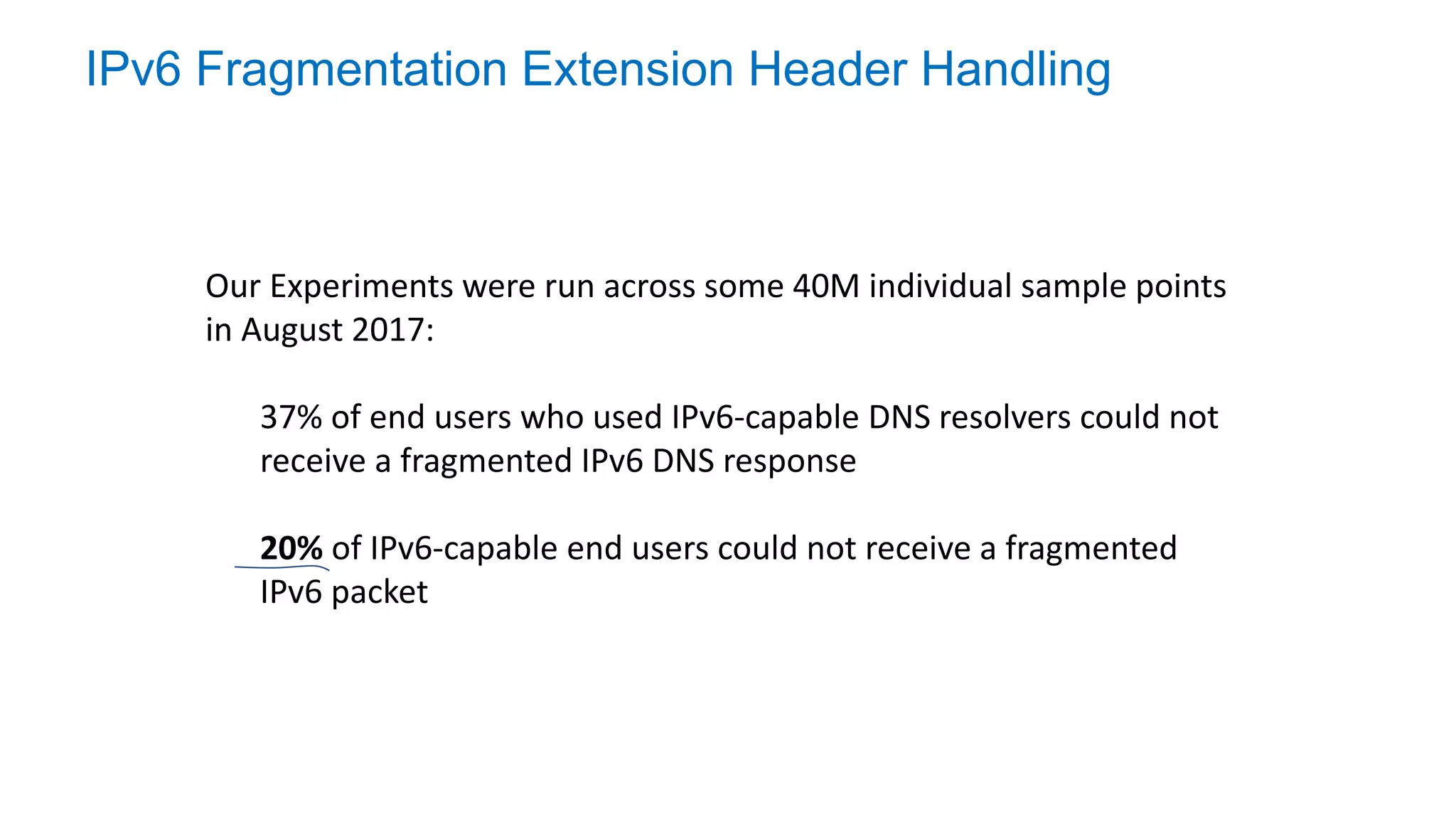
Our Experiments were run across some 40M individual sample points
in August 2017:
37% of end users who used IPv6-capable DNS resolvers could not
receive a fragmented IPv6 DNS response
20% of IPv6-capable end users could not receive a fragmented
IPv6 packet
IPv6 Fragmentation is very unreliable
Why don’t we see this unreliability in today’s IPv6 networks
affecting user transactions?
IPv6 Fragmentation is very unreliable
Why don’t we see this unreliability in today’s IPv6 networks
affecting user transactions?
Because IPv4 papers over the problem!
IPv6 Fragmentation is very unreliable
Why don’t we see this unreliability in today’s IPv6 networks
affecting user transactions?
Because IPv4 papers over the problem!
In a Dual-Stack environment there is always the option to flip to
use IPv4 if you are stuck with Ipv6.
The DNS does this, and Happy Eyeballs does this
So there are few user-visible problems in a dual stack
environment
This means that there is no urgent imperative to correct these
underlying problems in deployed IPv6 networks
IPv6 Fragmentation is very unreliable
Why don’t we see this unreliability in today’s IPv6 networks
affecting user transactions?
Because IPv4 papers over the problem!
In a Dual-Stack environment there is always the option to flip to
use IPv4 if you are stuck with Ipv6.
The DNS does this, and Happy Eyeballs does this
So there are few user-visible problems in a dual stack
environment
This means that there is no urgent imperative to correct these
underlying problems in deployed IPv6 networks
Living without IPv6 Fragmentation
If we apparently don’t want to fix this, can we live with it?
We are living with it in a Dual Stack world, because IPv4 just makes it
all better!
But what happens when there is no IPv4 left?
Living without IPv6 Fragmentation
If we apparently don’t want to fix this, can we live with it?
We are living with it in a Dual Stack world, because IPv4 just makes it
all better!
But what happens when there is no IPv4 left?
TCP can work as long as IPv6 sessions use conservative MSS sizes
UDP can work as long as UDP packet sizes are capped so as to avoid
fragmentation
We have to avoid IPv6 Fragmentation!
Living without IPv6 Fragmentation
TCP can work as long as IPv6 sessions use conservative MSS sizes
UDP can work as long as UDP packet sizes are capped so as to avoid
fragmentation
We have to avoid IPv6 Fragmentation!
Living without IPv6 Fragmentation
TCP can work as long as IPv6 sessions use conservative MSS sizes
UDP can work as long as UDP packet sizes are capped so as to avoid
fragmentation
We have to avoid IPv6 Fragmentation!
DNSSEC!
What can we do about it?
A. Get all the deployed routers and switches to deliver
ICMPv6 packets and accept packets with IPv6
Fragmentation Headers
What can we do about it?
B. Get all the deployed routers and switches to alter the way
IPv6 manages packet fragmentation
What can we do about it?
C. Move the DNS off UDP
Pick one?
All of these options have a certain level of pain, cost and potential
inconvenience
Its hard to work out what is the best course of action, but it seems like
a lot of extra effort if we take on all three at once!
For TCP …
Working around this issue in TCP can be as simple as a very careful
selection of a default IPv6 TCP MSS
• Large enough enough to offer a tolerable data carriage efficiency
• Small enough to avoid Path MTU issues
And perhaps you might want to to support TCP path MTU discovery
(RFC 4281)
For TCP …
But you have to take into account the observation that Path MTU
discovery without reliable ICMPv6 signaling takes a number of Round
Trip Times (delay)
And time is something no application designer has enough of to waste
on probing path characteristics
So choose your TCP MSS very carefully
Hint: Smaller TCP MSS sizes are Better in IPv6!
For UDP …
• Working around this issue can be challenging with UDP
• ICMPv6 Packet Too Big filtering causes silence
• Fragment drop is silent drop
• Which means that protocols need to understand timeouts
• An effort to work around this necessarily involves application-level
adaptation to pass large responses without relying on UDP packet
fragmentation
If we can’t fix IPv6
• And we can’t fix end-to-end transport
• Then all that’s left is to look at the application protocol and see if we
can re-define the protocol behaviour in a way eliminates
fragmentation behaviour
“Old Style” DNS
• The original DNS protocol had this behaviour
• If the DNS payload was <= 512 bytes send the answer over UDP
• Otherwise send as much as will fit in 512 bytes set the truncate bit
• The receiver is meant to re-query using TCP upon receipt of a truncated response
• Why did we change this behaviour?
• Because we thought that fragmentation was “safe” and TCP was too costly
• So we added Extension options for DNS to signal it was OK to send large
fragmented UDP responses
• But its not OK
Large DNS Responses and IPv6
Change the protocol behaviour?
• Shift Additional Records into additional explicit UDP query/response transactions
rather than bloating the original DNS response
• Perform UDP MTU discovery using EDNS(0) UDP Buffer Size variations as a probe
• Add a truncated minimal UDP response to trail a fragmented response (ATR)
Change the transport?
• DNS over TCP by default
• DNS over TLS over TCP by default
• DNS over QUIC
• Devise some new DNS framing protocol that uses multiple packets instead of
fragmentation
Where now?
• We have a decent idea of the problem space we need to resolve
• We’d prefer a plan that allows each of us to work independently
rather than a large scale orchestrated common change
• We’re not sure we can clean up all the ICMPv6 filters and EH packet
droppers in the IPv6 network
• And it sure seems a bit late in the day to contemplate IPv6 protocol
changes
• Which means that we are probably looking at working around the
problem by changing the behaviour of applications
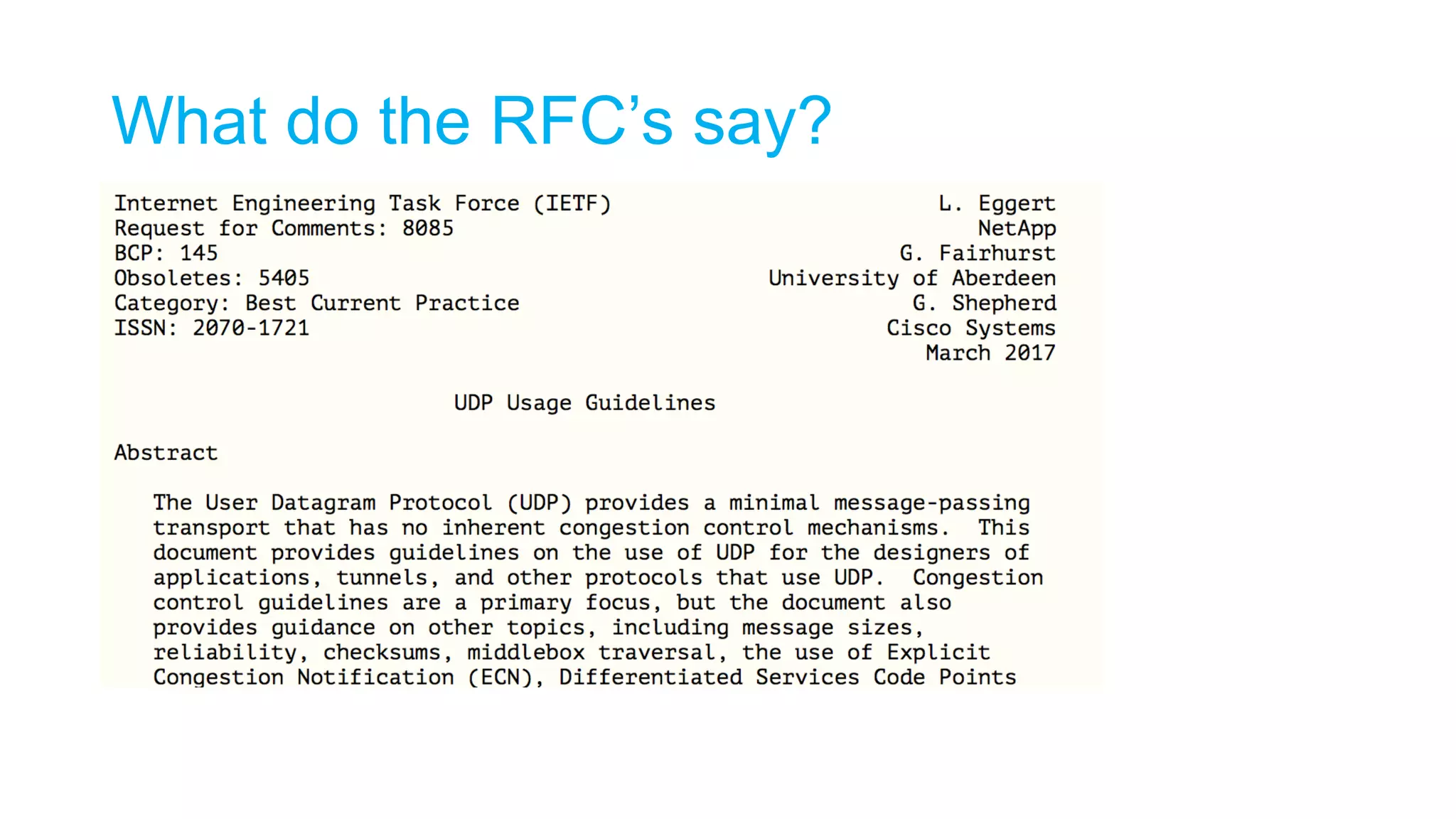
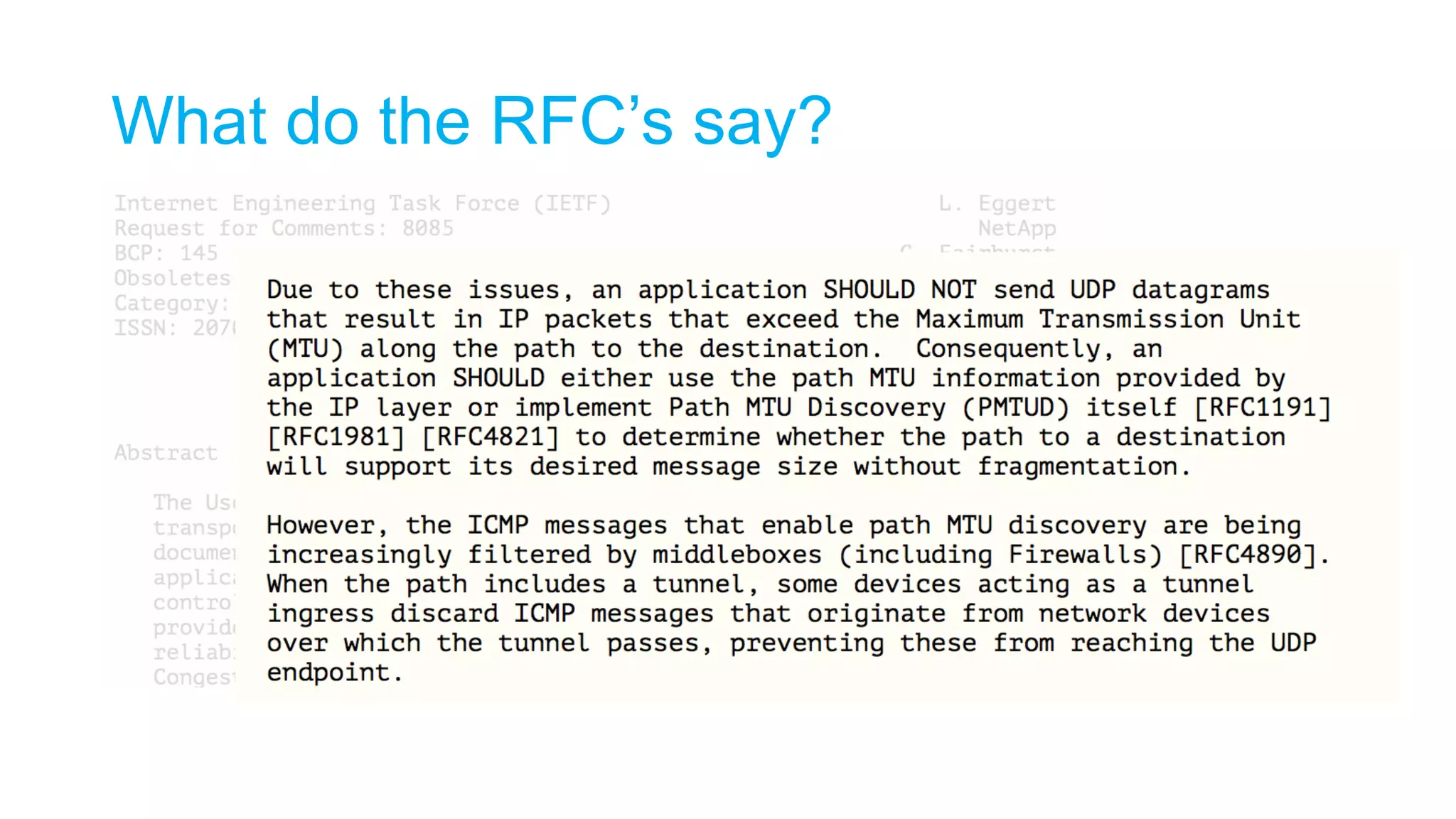
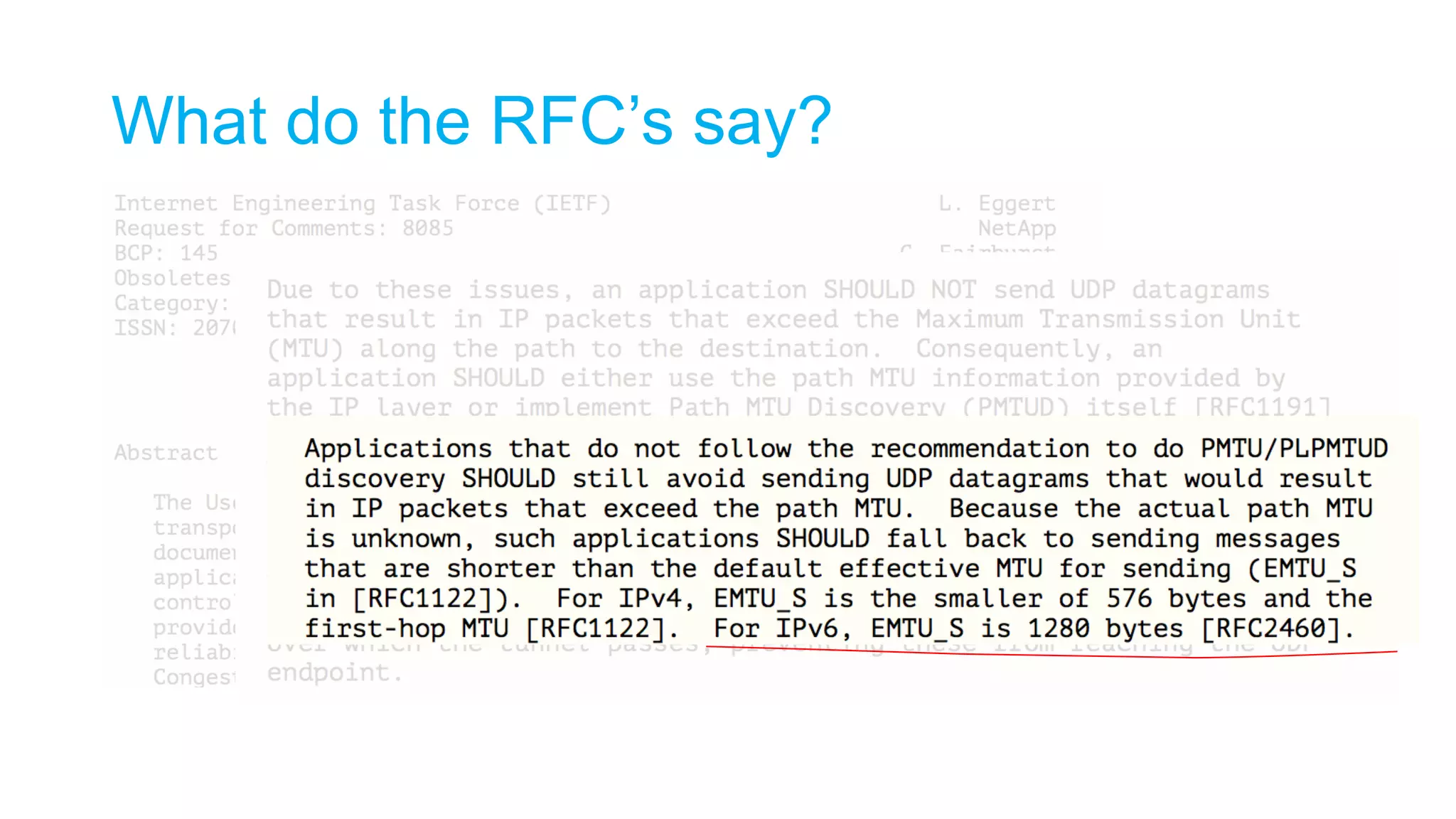
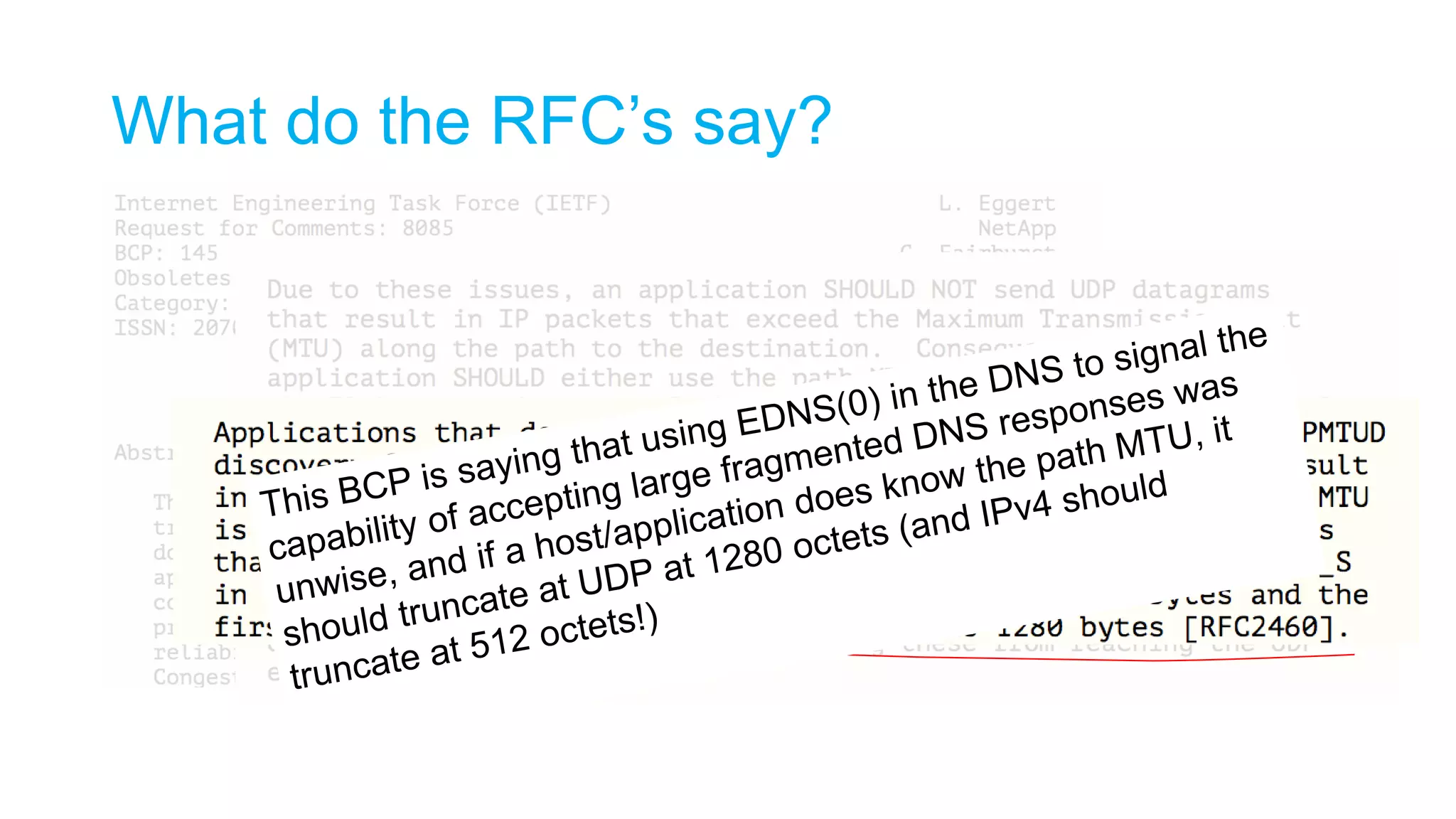
What do the RFC’s say?
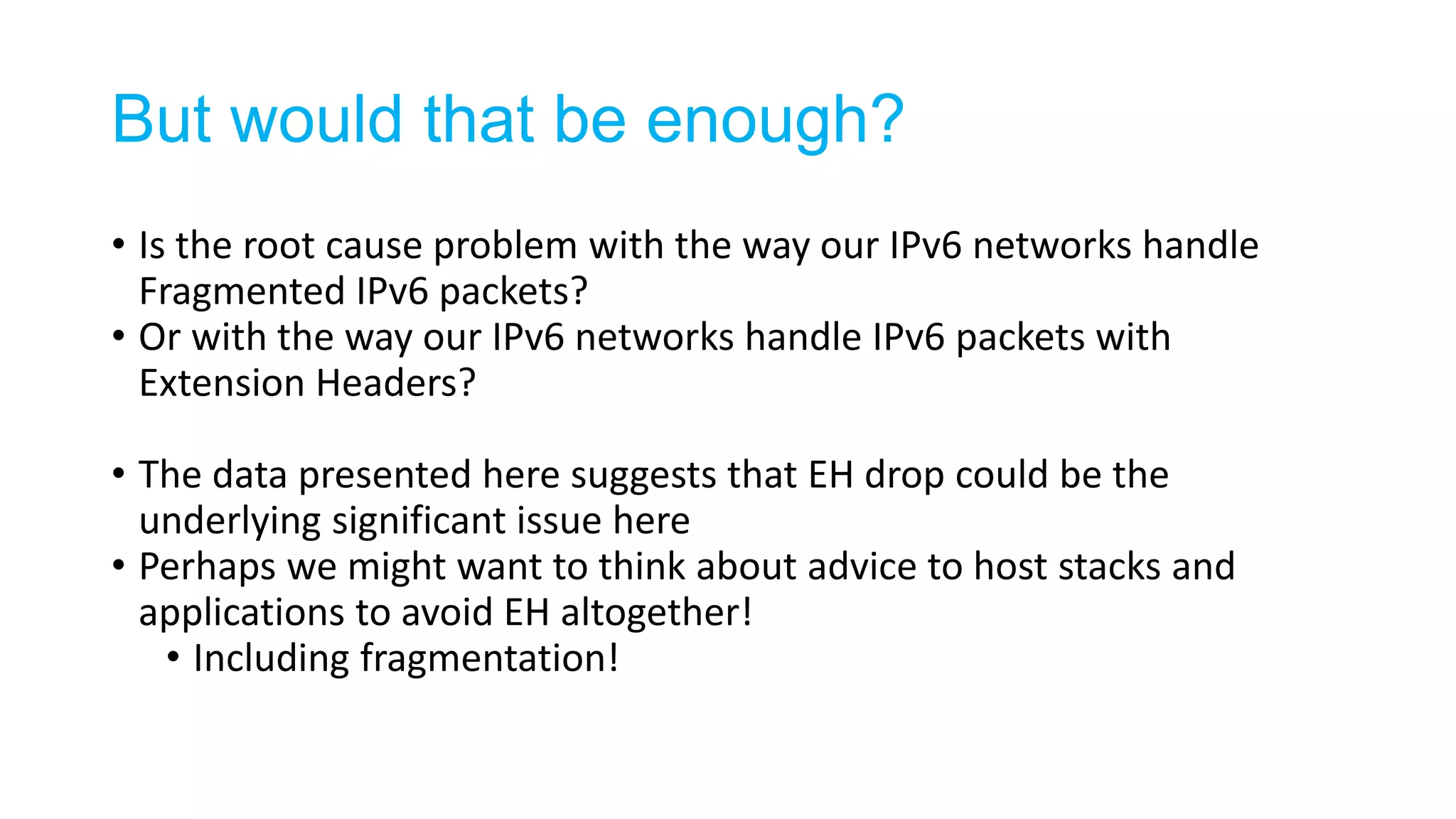
But would that be enough?
• Is the root cause problem with the way our IPv6 networks handle
Fragmented IPv6 packets?
• Or with the way our IPv6 networks handle IPv6 packets with
Extension Headers?
• The data presented here suggests that EH drop could be the
underlying significant issue here
• Perhaps we might want to think about advice to host stacks and
applications to avoid EH altogether!
• Including fragmentation!
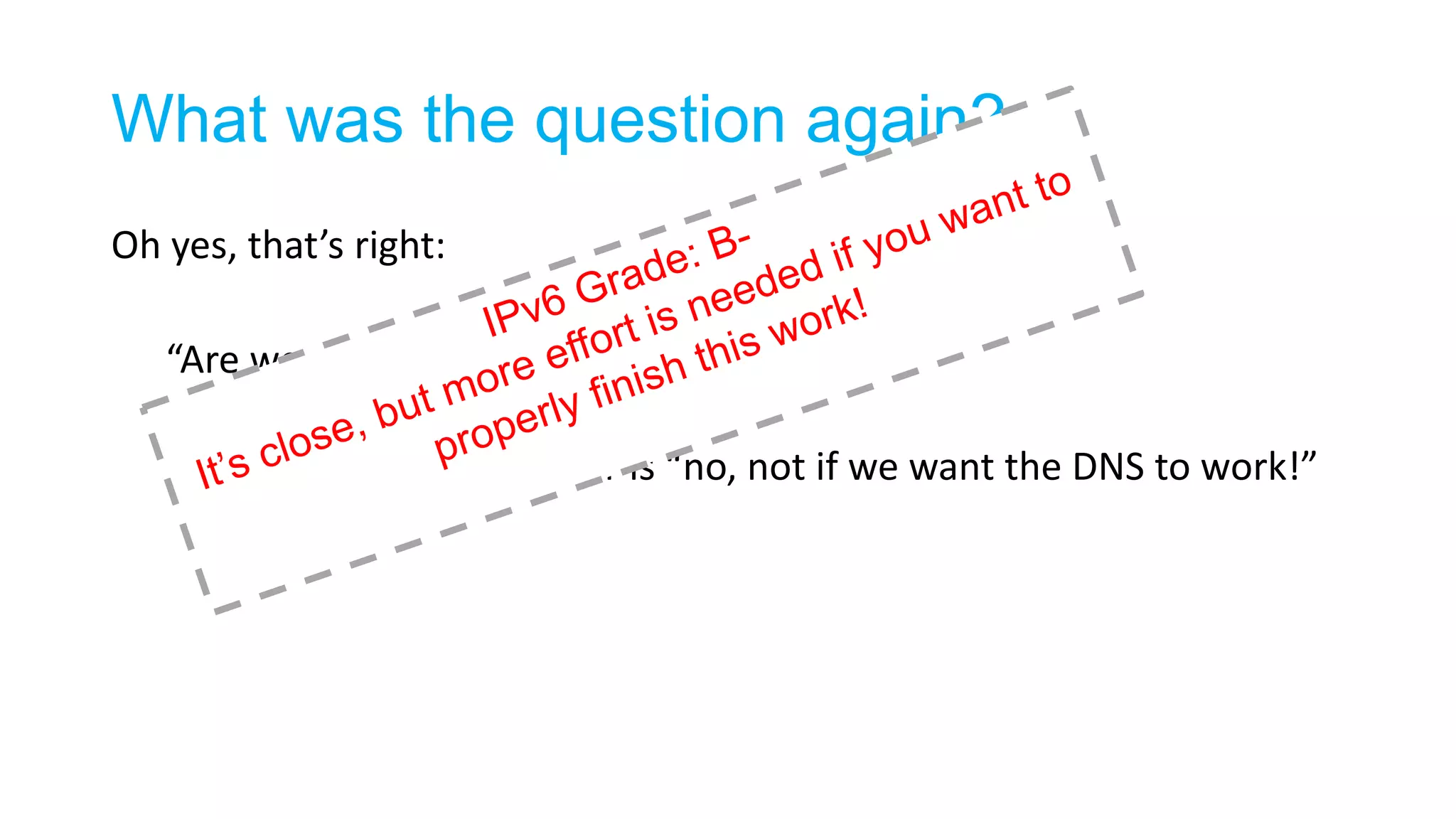
What was the question again?
Oh yes, that’s right:
“Are we ready for an IPv6-only Internet?”
It appears that the answer is “no, not if we want the DNS to work!”
What was the question again?
Oh yes, that’s right:
“Are we ready for an IPv6-only Internet?”
It appears that the answer is “no, not if we want the DNS to work!”
Thanks!

Are we really ready to turn off IPv4?

  • 1.
    IPv6: Are wereally ready to turn off IPv4? Geoff Huston APNIC
  • 2.
  • 3.
    The IPv6 Timeline… 19902000 2010 2020 Yes, we’ve been working on this for close to 30 years!
  • 4.
  • 5.
    In-situ transition… IPv4 Internet Phase1 – Early Deployment Edge Dual -Stack Networks IPv6 networks interconnect by IPv6-over-IPv4 tunnels
  • 6.
    In-situ transition… Phase 2– Dual Stack Deployment Edge Dual-Stack Networks IPv6 networks interconnect by Dual Stack transit paths Transit Dual-Stack Networks
  • 7.
    In-situ transition… IPv6 Internet Phase3 – IPv4 Sunset Edge Dual Stack Networks IPv4 networks interconnect by IPv4-over-IPv6 tunnels
  • 8.
    In-situ transition… IPv4 PoolSize IPv6 Deployment Size of the Internet Dual Stack Transition We’re pretty lousy at following plans!
  • 9.
    The Map ofIPv6 penetration – November 2017
  • 10.
    The Map ofIPv6 penetration – November 2017
  • 11.
    We’re stuck inPhase 2 Some 15% - 20% of Internet users have IPv6 capability In the IoT world the IPv6 numbers appear to be far lower than this Most new IP deployments use IPv6+ (NATTED) IPv4 IPv4-only Legacy networks are being (gradually) migrated to dual stack
  • 12.
    We’re stuck inPhase 2 Some 15% - 20% of Internet users have IPv6 capability In the IoT world the IPv6 numbers appear to be far lower than this Most new IP deployments use IPv6+ (NATTED) IPv4 IPv4-only Legacy networks are being (gradually) migrated to dual stack
  • 13.
    Today We appear tobe in the middle of the transition! Dual Stack networks cannot drop support for IPv4 as long as significant services and user populations do not support IPv6
  • 14.
    Today We appear tobe in the middle of the transition! Dual Stack networks cannot drop support for IPv4 as long as significant services and user populations do not support IPv6 – and we can’t tell when that may change Nobody is really in a position to deploy a robust at-scale ipv6- only network service today, even if they wanted to! And we are not even sure if we can!
  • 15.
    Today We appear tobe in the middle of the transition! Dual Stack networks cannot drop support for IPv4 as long as significant services and user populations do not support IPv6 – and we can’t tell when that may change Nobody is really in a position to deploy a robust at-scale ipv6- only network service today, even if they wanted to! And we are not even sure if we can!
  • 16.
    The Issue We cannotrun Dual-Stack services indefinitely At some point we need to support networks that only have IPv6 Is that viable?
  • 17.
    In other words… Whatdo we rely on today in IPv4 that does not appear to have a clear working counterpart in IPv6?
  • 18.
    In other words… Whatdo we rely on today in IPv4 that does not appear to have a clear working counterpart in IPv6? If the answer is “nothing” then we are done! But if there is an issue here, then we should be working on it!
  • 19.
    Version IHL TotalLength FlagsIdentification Fragment Offset Time To Live Source Address Destination Address Options Padding Protocol Header Checksum Type of Service Version Class Flow Payload Length Hop Limit Source Address Destination Address Next Header IPv4 Header IPv6 Header IPv6: What changed?
  • 20.
    IPv6: What changed? Typeof Service is changed to Traffic Class 32 bit Fragmentation Control were pushed into an Extension Header Flow Label Added Options and Protocol fields replaced by Extension Headers Checksum becomes a media layer function
  • 21.
    IPv6: What changed? Typeof Service is changed to Traffic Class 32 bit Fragmentation Control were pushed into an Extension Header Flow Label Added Options and Protocol fields replaced by Extension Headers Checksum becomes a media layer function
  • 22.
    IPv6: What changed? Typeof Service is changed to Traffic Class 32 bit Fragmentation Control were pushed into an Extension Header Flow Label Added Options and Protocol fields replaced by Extension Headers Checksum becomes a media layer function
  • 23.
    IPv4 Router IPv4 header Payload TCP/UDPheader IPv4 header Payload TCP/UDP header 1 2 IPv6: What changed? IPv4 “Forward Fragmentation”
  • 24.
    IPv4 Router IPv4 header Payload TCP/UDPheader IPv4 header Payload TCP/UDP header IPv6 Router IPv6 header Payload TCP/UDP xtn header Payload TCP/UDP xtn header ICMPv6 PTB IPv6 header IPv6 header Payload TCP/UDP xtn header Fragmentation xtn header 1 2 3 1 2 IPv6: What changed? IPv4 “Forward Fragmentation” IPv6 “Source Fragmentation” Source Source
  • 25.
    ICMPv6 and Anycast SenderInstance Client Sender Instance Sender Instance Anycast Constellation Sender Instance Sender Instance It is not obvious (or even assured) that every router on the path from an anycast instance to a client host will necessarily be part of the same anycast instance “cloud” The implication is that in anycast, the reverse ICMPv6 PTB messages will not necessarily head back to the original sender!
  • 26.
    New Dependencies For IPfragmentation to work in IPv6 then: - all ICMPv6 messages have to be passed backwards from the interior of the network to the sender - IPv6 packets containing a IPv6 Fragmentation Extension header should not be dropped
  • 27.
    Processing incoming ICMPv6messages Only the sending host now has control of fragmentation – this is a new twist A received ICMPv6 message needs to alter the sender’s state to that destination For TCP, if the ICMP payload contains the TCP header, then you can pass this to the TCP control block. TCP can alter the session MSS and resend the dropped data For UDP – um, err, um well
  • 28.
    Processing incoming ICMPv6messages Only the sending host now has control of fragmentation – this is a new twist A received ICMPv6 message needs to alter the sender’s state to that destination For TCP, if the ICMP payload contains the TCP header, then you can pass this to the TCP control block. TCP can alter the session MSS and resend the dropped data For UDP – um, err, um well Maybe you should store the revised path MTU in a host forwarding table cache for a while If you ever need to send another UDP packet to this host you can use this cache entry to guide your fragmentation behaviour
  • 29.
    IPv6 and Fragmentation Thetheory is that TCP in IPv6 should never send a fragmented packet - TCP should use the session MSS as a guide to packet sizes and segment the stream according to the session MSS However, UDP cannot avoid fragmentation - large payloads in UDP simply need to be fragmented to fit within the path MTU Fragmentation in IPv6 uses the same control fields as IPv4 – a packet identifier, a fragmentation offset and a More Frags flag BUT they are located in an inserted “shim” that sits between the IPv6 packet header and the UDP transport header - this is an instance of the IPv6 “Extension Header”
  • 30.
    IPv6 Fragmentation ExtensionHeader Handling The extension header sits between the IPv6 packet header and the upper level protocol header for the leading fragged packet, and sits between the header and the trailing payload frags for the trailing packets Practically, this means that transport-protocol aware packet processors/switches need to decode the extension header chain, if its present, which can consume additional cycles to process/switch a packet – and the additional time is not predictable. For trailing frags there is no transport header! Or the unit can simply discard all Ipv6 packets that contain extension headers! Which is what a lot of transport protocol sensitive IPv6 deployed switching equipment actually does (e.g. load balancers!) IPv6 header Payload TCP/UDP xtn header Fragmentation xtn header
  • 31.
    IPv6 Fragmentation ExtensionHeader Handling There is a lot of “drop” behaviour in the IPv6 Internet for Fragmentation Extension headers RFC7872 – recorded drop rates of 30% - 40% This experiment sent fragmented packets towards well-known servers and observed whether the server received and reconstructed the fragmented packet But sending fragmented queries to servers is not all that common – the reverse situation of big responses is more common So what about sending fragmented packets BACK from servers – what’s the drop rate of the reverse case?
  • 32.
    IPv6 Fragmentation ExtensionHeader Handling We used an ad-based measurement system, using a custom packet fragmentation wrangler as a front end to a DNS and Web server to test IPv6 fragmentation behaviour Client DNS Resolver IPv6 DNS Server IPv6 NGINX Server IPv6 ‘Fragmenter’DNS Goo
  • 33.
    We used anad-based measurement system, using a custom packet fragmentation wrangler as a front end to a DNS and Web server to test IPv6 fragmentation behaviour IPv6 Fragmentation Extension Header Handling Client DNS Resolver IPv6 ‘Fragmenter’DNS Goo We use a technique of “glueless” delegation and fragmentation of the NS query response to allow us to detect if the DNS resolver received the fragmented response We track TCP ACKs at the server to see if the client received the fragmented TCP response Client DNS Resolver IPv6 DNS Server IPv6 NGINX Server
  • 34.
    IPv6 Fragmentation ExtensionHeader Handling Our Experiments were run across some 40M individual sample points in August 2017: 37% of end users who used IPv6-capable DNS resolvers could not receive a fragmented IPv6 DNS response
  • 35.
    IPv6 Fragmentation ExtensionHeader Handling Our Experiments were run across some 40M individual sample points in August 2017: 37% of end users who used IPv6-capable DNS resolvers could not receive a fragmented IPv6 DNS response 20% of IPv6-capable end users could not receive a fragmented IPv6 packet
  • 36.
    IPv6 Fragmentation isvery unreliable Why don’t we see this unreliability in today’s IPv6 networks affecting user transactions?
  • 37.
    IPv6 Fragmentation isvery unreliable Why don’t we see this unreliability in today’s IPv6 networks affecting user transactions? Because IPv4 papers over the problem!
  • 38.
    IPv6 Fragmentation isvery unreliable Why don’t we see this unreliability in today’s IPv6 networks affecting user transactions? Because IPv4 papers over the problem! In a Dual-Stack environment there is always the option to flip to use IPv4 if you are stuck with Ipv6. The DNS does this, and Happy Eyeballs does this So there are few user-visible problems in a dual stack environment This means that there is no urgent imperative to correct these underlying problems in deployed IPv6 networks
  • 39.
    IPv6 Fragmentation isvery unreliable Why don’t we see this unreliability in today’s IPv6 networks affecting user transactions? Because IPv4 papers over the problem! In a Dual-Stack environment there is always the option to flip to use IPv4 if you are stuck with Ipv6. The DNS does this, and Happy Eyeballs does this So there are few user-visible problems in a dual stack environment This means that there is no urgent imperative to correct these underlying problems in deployed IPv6 networks
  • 40.
    Living without IPv6Fragmentation If we apparently don’t want to fix this, can we live with it? We are living with it in a Dual Stack world, because IPv4 just makes it all better! But what happens when there is no IPv4 left?
  • 41.
    Living without IPv6Fragmentation If we apparently don’t want to fix this, can we live with it? We are living with it in a Dual Stack world, because IPv4 just makes it all better! But what happens when there is no IPv4 left? TCP can work as long as IPv6 sessions use conservative MSS sizes UDP can work as long as UDP packet sizes are capped so as to avoid fragmentation We have to avoid IPv6 Fragmentation!
  • 42.
    Living without IPv6Fragmentation TCP can work as long as IPv6 sessions use conservative MSS sizes UDP can work as long as UDP packet sizes are capped so as to avoid fragmentation We have to avoid IPv6 Fragmentation!
  • 43.
    Living without IPv6Fragmentation TCP can work as long as IPv6 sessions use conservative MSS sizes UDP can work as long as UDP packet sizes are capped so as to avoid fragmentation We have to avoid IPv6 Fragmentation! DNSSEC!
  • 44.
    What can wedo about it? A. Get all the deployed routers and switches to deliver ICMPv6 packets and accept packets with IPv6 Fragmentation Headers
  • 45.
    What can wedo about it? B. Get all the deployed routers and switches to alter the way IPv6 manages packet fragmentation
  • 46.
    What can wedo about it? C. Move the DNS off UDP
  • 47.
    Pick one? All ofthese options have a certain level of pain, cost and potential inconvenience Its hard to work out what is the best course of action, but it seems like a lot of extra effort if we take on all three at once!
  • 48.
    For TCP … Workingaround this issue in TCP can be as simple as a very careful selection of a default IPv6 TCP MSS • Large enough enough to offer a tolerable data carriage efficiency • Small enough to avoid Path MTU issues And perhaps you might want to to support TCP path MTU discovery (RFC 4281)
  • 49.
    For TCP … Butyou have to take into account the observation that Path MTU discovery without reliable ICMPv6 signaling takes a number of Round Trip Times (delay) And time is something no application designer has enough of to waste on probing path characteristics So choose your TCP MSS very carefully Hint: Smaller TCP MSS sizes are Better in IPv6!
  • 50.
    For UDP … •Working around this issue can be challenging with UDP • ICMPv6 Packet Too Big filtering causes silence • Fragment drop is silent drop • Which means that protocols need to understand timeouts • An effort to work around this necessarily involves application-level adaptation to pass large responses without relying on UDP packet fragmentation
  • 51.
    If we can’tfix IPv6 • And we can’t fix end-to-end transport • Then all that’s left is to look at the application protocol and see if we can re-define the protocol behaviour in a way eliminates fragmentation behaviour
  • 52.
    “Old Style” DNS •The original DNS protocol had this behaviour • If the DNS payload was <= 512 bytes send the answer over UDP • Otherwise send as much as will fit in 512 bytes set the truncate bit • The receiver is meant to re-query using TCP upon receipt of a truncated response • Why did we change this behaviour? • Because we thought that fragmentation was “safe” and TCP was too costly • So we added Extension options for DNS to signal it was OK to send large fragmented UDP responses • But its not OK
  • 53.
    Large DNS Responsesand IPv6 Change the protocol behaviour? • Shift Additional Records into additional explicit UDP query/response transactions rather than bloating the original DNS response • Perform UDP MTU discovery using EDNS(0) UDP Buffer Size variations as a probe • Add a truncated minimal UDP response to trail a fragmented response (ATR) Change the transport? • DNS over TCP by default • DNS over TLS over TCP by default • DNS over QUIC • Devise some new DNS framing protocol that uses multiple packets instead of fragmentation
  • 54.
    Where now? • Wehave a decent idea of the problem space we need to resolve • We’d prefer a plan that allows each of us to work independently rather than a large scale orchestrated common change • We’re not sure we can clean up all the ICMPv6 filters and EH packet droppers in the IPv6 network • And it sure seems a bit late in the day to contemplate IPv6 protocol changes • Which means that we are probably looking at working around the problem by changing the behaviour of applications
  • 55.
    What do theRFC’s say?
  • 56.
    What do theRFC’s say?
  • 57.
    What do theRFC’s say?
  • 58.
    What do theRFC’s say?
  • 59.
    What do theRFC’s say?
  • 60.
    But would thatbe enough? • Is the root cause problem with the way our IPv6 networks handle Fragmented IPv6 packets? • Or with the way our IPv6 networks handle IPv6 packets with Extension Headers? • The data presented here suggests that EH drop could be the underlying significant issue here • Perhaps we might want to think about advice to host stacks and applications to avoid EH altogether! • Including fragmentation!
  • 61.
    What was thequestion again? Oh yes, that’s right: “Are we ready for an IPv6-only Internet?” It appears that the answer is “no, not if we want the DNS to work!”
  • 62.
    What was thequestion again? Oh yes, that’s right: “Are we ready for an IPv6-only Internet?” It appears that the answer is “no, not if we want the DNS to work!”
  • 63.