Arctic
Alexandra M and Veronica F
What is the Arctic like?
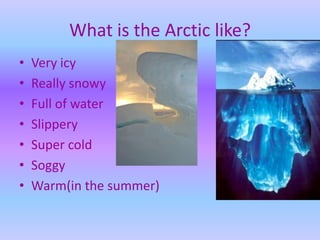
• Very icy
• Really snowy
• Full of water
• Slippery
• Super cold
• Soggy
• Warm(in the summer)
What animals are in the arctic?
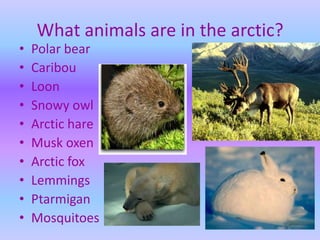
• Polar bear
• Caribou
• Loon
• Snowy owl
• Arctic hare
• Musk oxen
• Arctic fox
• Lemmings
• Ptarmigan
• Mosquitoes
What plants grow in the arctic?
• Shrub
• Saxifrage
• Wildflowers
Interesting facts about the Arctic
• Frozen bodies of extinct animals such as the
wooly mammoth are buried and found in the
Arctic.
• Arctic foxes have fur on the bottom of their
paws.
• Some animals change color by season like
brown in fall and white in winter
• Degrees in the Arctic in summer can go up to
50 but frost is still possible in July.
What are some adaptations in the
Arctic?
• Polar bears eat seal, fish, and walrus.
• Arctic hare must learn to keep warm.
• Musk oxen have are strong hooves to dig
trough snow to find food.
• Polar bears have thick fur to keep warm .
• Seals and whales need blubber to keep warm.

Arctic2

  • 1.
  • 2.
    What is theArctic like? • Very icy • Really snowy • Full of water • Slippery • Super cold • Soggy • Warm(in the summer)
  • 3.
    What animals arein the arctic? • Polar bear • Caribou • Loon • Snowy owl • Arctic hare • Musk oxen • Arctic fox • Lemmings • Ptarmigan • Mosquitoes
  • 4.
    What plants growin the arctic? • Shrub • Saxifrage • Wildflowers
  • 5.
    Interesting facts aboutthe Arctic • Frozen bodies of extinct animals such as the wooly mammoth are buried and found in the Arctic. • Arctic foxes have fur on the bottom of their paws. • Some animals change color by season like brown in fall and white in winter • Degrees in the Arctic in summer can go up to 50 but frost is still possible in July.
  • 6.
    What are someadaptations in the Arctic? • Polar bears eat seal, fish, and walrus. • Arctic hare must learn to keep warm. • Musk oxen have are strong hooves to dig trough snow to find food. • Polar bears have thick fur to keep warm . • Seals and whales need blubber to keep warm.