Antarctica
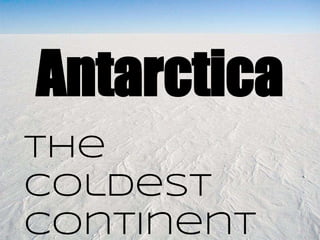
The
Coldest
Continent
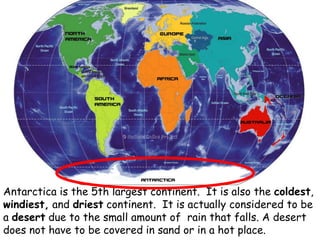
Antarctica is a continent at the southern most part of the
earth. It contains the south pole and is surrounded by the
southern ocean. The Atlantic, Pacific, and Indian oceans all
touch Antarctica.
Antarctica is the 5th largest continent. It is also the coldest,
windiest, and driest continent. It is actually considered to be
a desert due to the small amount of rain that falls. A desert
does not have to be covered in sand or in a hot place.
The temperature in Antarctica has reached -129
degrees farenheit. There are no people who live there
permanently. Antarctica is so cold that people could
not live there.
People in Antarctica live on research stations. These
people are scientists. This is a photograph of the
Neumayer Research Station. The Neumayer station can
sleep up to 40 people.
The coldest months are
June, July, August and
September. The
temperature is around -
22F.
The warmest months are
December and January
(the summer months).
The temperature is around
30 F although it can get
warmer.
Usually they only have
about 2 days of rain in the
whole year.
There are no schools in Antarctica as it is too cold for
children to live there year round. However, some children
live at the stations with their families and go to school at
the station.
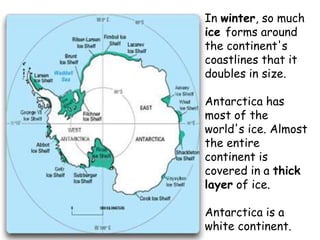
In winter, so much
ice forms around
the continent's
coastlines that it
doubles in size.
Antarctica has
most of the
world's ice. Almost
the entire
continent is
covered in a thick
layer of ice.
Antarctica is a
white continent.
Not many animals can live in Antarctica because it
is so cold. In fact, the only animals that live on
Antarctica are insects, spiders and small
creatures. However, the sea is filled with life. Can
you guess which sea animal is in this photograph?
Some types of
penguins live in
Antarctica.
Penguins do not fly
but swim instead.
They love to eat
krill and fish.
Penguins spend half
their life in the
water and half
their life on land.
Gentoo Penguin
Emperor penguins are the only penguins to lay their eggs
on the ice. All other penguins lay their eggs on land or in
nests. After the female lays the egg, the male keeps it
warm for 2 months. He doesn't even eat during that time.
Emperor penguins huddle together to stay warm. The
penguins in the middle are the warmest. When they are warm
enough, they move to the outside to let other penguins take a
turn in the middle.
Leopard seals have black-spotted coats. They spend most
of their time in the cold water looking for penguins to eat.
Seals have a thick layer of fat, called blubber which
protects them from the cold.
Whales are the world's largest mammals, found in
Antarctica.There are up to 8 whale species to encounter
in Antarctica. Humpbacks are the most sighted, followed
Killer whales also known as Orca whales can also be found in
Antarctica.
Krill are very important sea animals because they are
eaten by whales, seals, penguins and squid.
The Snow Petrel is one of only three birds that lives in
Antarctica.
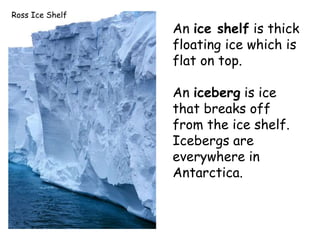
An ice shelf is thick
floating ice which is
flat on top.
An iceberg is ice
that breaks off
from the ice shelf.
Icebergs are
everywhere in
Antarctica.
Ross Ice Shelf
Here you can see the flat top of the Ross ice shelf.
Did you know that underneath some ice shelves
there are subglacial volcanoes? These volcanoes
are contributing to the ice melt that is occurring in
West Antarctica.
The orange areas mean the temperature is getting warmer
in parts of Antarctica. Warmer temperatures mean the ice
is melting and the sea level is getting higher. No one really
knows how this will affect the rest of the world in the
future.
We must reduce global warming to protect
the habitat of animals in Antarctica.
Ice melting from a glacier
Protect the animals'
habitats. They need
the ice to survive.
Protect our earth for
the future.
Reduce global warming by
turning off the lights when
you leave the room.
You can make a difference!
the end

Antarctica.pptx

  • 1.
  • 2.
    Antarctica is acontinent at the southern most part of the earth. It contains the south pole and is surrounded by the southern ocean. The Atlantic, Pacific, and Indian oceans all touch Antarctica.
  • 3.
    Antarctica is the5th largest continent. It is also the coldest, windiest, and driest continent. It is actually considered to be a desert due to the small amount of rain that falls. A desert does not have to be covered in sand or in a hot place.
  • 4.
    The temperature inAntarctica has reached -129 degrees farenheit. There are no people who live there permanently. Antarctica is so cold that people could not live there.
  • 5.
    People in Antarcticalive on research stations. These people are scientists. This is a photograph of the Neumayer Research Station. The Neumayer station can sleep up to 40 people.
  • 6.
    The coldest monthsare June, July, August and September. The temperature is around - 22F. The warmest months are December and January (the summer months). The temperature is around 30 F although it can get warmer. Usually they only have about 2 days of rain in the whole year.
  • 7.
    There are noschools in Antarctica as it is too cold for children to live there year round. However, some children live at the stations with their families and go to school at the station.
  • 8.
    In winter, somuch ice forms around the continent's coastlines that it doubles in size. Antarctica has most of the world's ice. Almost the entire continent is covered in a thick layer of ice. Antarctica is a white continent.
  • 9.
    Not many animalscan live in Antarctica because it is so cold. In fact, the only animals that live on Antarctica are insects, spiders and small creatures. However, the sea is filled with life. Can you guess which sea animal is in this photograph?
  • 10.
    Some types of penguinslive in Antarctica. Penguins do not fly but swim instead. They love to eat krill and fish. Penguins spend half their life in the water and half their life on land. Gentoo Penguin
  • 11.
    Emperor penguins arethe only penguins to lay their eggs on the ice. All other penguins lay their eggs on land or in nests. After the female lays the egg, the male keeps it warm for 2 months. He doesn't even eat during that time.
  • 12.
    Emperor penguins huddletogether to stay warm. The penguins in the middle are the warmest. When they are warm enough, they move to the outside to let other penguins take a turn in the middle.
  • 13.
    Leopard seals haveblack-spotted coats. They spend most of their time in the cold water looking for penguins to eat. Seals have a thick layer of fat, called blubber which protects them from the cold.
  • 14.
    Whales are theworld's largest mammals, found in Antarctica.There are up to 8 whale species to encounter in Antarctica. Humpbacks are the most sighted, followed
  • 15.
    Killer whales alsoknown as Orca whales can also be found in Antarctica.
  • 16.
    Krill are veryimportant sea animals because they are eaten by whales, seals, penguins and squid.
  • 17.
    The Snow Petrelis one of only three birds that lives in Antarctica.
  • 18.
    An ice shelfis thick floating ice which is flat on top. An iceberg is ice that breaks off from the ice shelf. Icebergs are everywhere in Antarctica. Ross Ice Shelf
  • 19.
    Here you cansee the flat top of the Ross ice shelf.
  • 20.
    Did you knowthat underneath some ice shelves there are subglacial volcanoes? These volcanoes are contributing to the ice melt that is occurring in West Antarctica.
  • 21.
    The orange areasmean the temperature is getting warmer in parts of Antarctica. Warmer temperatures mean the ice is melting and the sea level is getting higher. No one really knows how this will affect the rest of the world in the future.
  • 22.
    We must reduceglobal warming to protect the habitat of animals in Antarctica. Ice melting from a glacier
  • 23.
    Protect the animals' habitats.They need the ice to survive. Protect our earth for the future. Reduce global warming by turning off the lights when you leave the room. You can make a difference!
  • 24.