Architecture as Activism
Site Visit Recap
Architecture as Activism
The 9th Grade
Experience at
the City
Planner and
Botanical
Gardens
Morrisville
City Planner
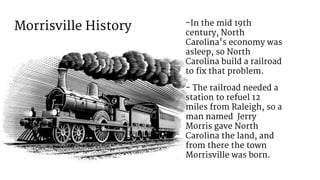
Morrisville History -In the mid 19th
century, North
Carolina's economy was
asleep, so North
Carolina build a railroad
to fix that problem.
- The railroad needed a
station to refuel 12
miles from Raleigh, so a
man named Jerry
Morris gave North
Carolina the land, and
from there the town
Morrisville was born.
Morrisville City Planner Environmental Requirements
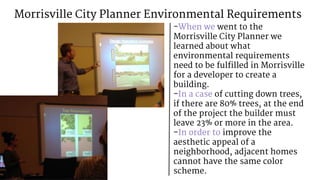
-When we went to the
Morrisville City Planner we
learned about what
environmental requirements
need to be fulfilled in Morrisville
for a developer to create a
building.
-In a case of cutting down trees,
if there are 80% trees, at the end
of the project the builder must
leave 23% or more in the area.
-In order to improve the
aesthetic appeal of a
neighborhood, adjacent homes
cannot have the same color
scheme.
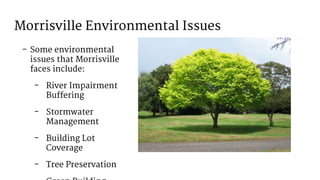
Morrisville Environmental Issues
- Some environmental
issues that Morrisville
faces include:
- River Impairment
Buffering
- Stormwater
Management
- Building Lot
Coverage
- Tree Preservation
Morrisville Growth
- Morrisville has grown as a town from 251 people in 1980 to 23,699
people in 2015. This is 94 times more than the population of 251.
- The city planners have to plan for growth.
- One thing that the planners have to keep in mind what longtime
residents want their community to be like and what new developers
who see Morrisville as an opportunity to build a bigger community
want the town to be like.
Steps for Regulations
- Step 1: A community decides what it wants to look and feel like.
Public input is then received and bound together into a community
vision.
- Step 2: City planners draft a plan for a community based on the
community vision. These plans typically take the community vision
and break it down into measurable goals, objectives, and policy
actions.
- Step 3: City planners present the draft plan to the Council. The
Council then decides to either adopt or deny the plan.
- Step 4: City planners then create regulations based on the goals,
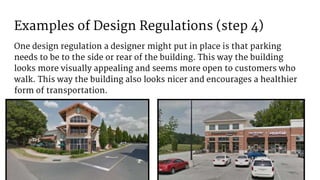
Examples of Design Regulations (step 4)
One design regulation a designer might put in place is that parking
needs to be to the side or rear of the building. This way the building
looks more visually appealing and seems more open to customers who
walk. This way the building also looks nicer and encourages a healthier
form of transportation.
Examples of Design Regulations (step 4)
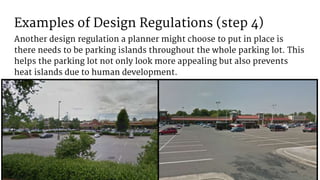
Another design regulation a planner might choose to put in place is
there needs to be parking islands throughout the whole parking lot. This
helps the parking lot not only look more appealing but also prevents
heat islands due to human development.
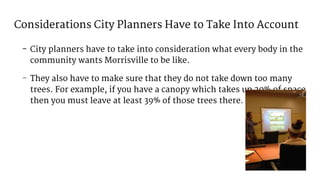
Considerations City Planners Have to Take Into Account
- City planners have to take into consideration what every body in the
community wants Morrisville to be like.
- They also have to make sure that they do not take down too many
trees. For example, if you have a canopy which takes up 20% of space
then you must leave at least 39% of those trees there.
Challenges
- Some different challenges that city planners face are balancing all
the different social goals, economic goals, environmental goals,
stakeholder goals, and long and short term goals.
- A stakeholder goal is a goal of anybody who is impacted by a
decision. For example, if a development company wants to turn a
forest into a shopping center, local people may want the forest to
stay. This is a stakeholder goal.
UNC
Botanical
Gardens
NC Botanical Gardens
-The NC Botanical gardens is a Platinum LEED
certified building.
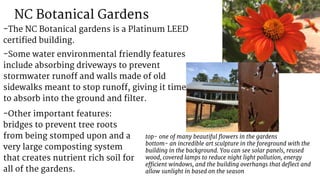
top- one of many beautiful flowers in the gardens
bottom- an incredible art sculpture in the foreground with the
building in the background. You can see solar panels, reused
wood, covered lamps to reduce night light pollution, energy
efficient windows, and the building overhangs that deflect and
allow sunlight in based on the season
-Other important features:
bridges to prevent tree roots
from being stomped upon and a
very large composting system
that creates nutrient rich soil for
all of the gardens.
-Some water environmental friendly features
include absorbing driveways to prevent
stormwater runoff and walls made of old
sidewalks meant to stop runoff, giving it time
to absorb into the ground and filter.
How We Can Go Green
- There are many different ways that people like you and I can go green.
- For example, you can install solar panels to get you energy for
your house. (About 8% of the energy used at the gardens comes
from their solar panels)
- You can use greywater to flush your toilets.
- Greywater is water that is filtered but not potable.
- You could use recycled materials for your building.
- Shading from sunlight in the winter vs summer.
More Ways to Go Green Inside the Building
As well as using recycled materials on the
outside, the classrooms, offices, and
learning spaces all have the following
features:
- motion sensored lighting
- divider panels to combine classrooms
- sound panels
- recycled chairs
- elevators using electric traction motors
- the wall paint has low VOC
Ways That the Botanical Gardens Preserve Nature
- The Botanical Gardens is careful to only use wood from trees that
have already fallen and no trees were killed to build either of the
buildings. All of the doorframes and other features made out of
wood inside the buildings are made of reused wood as well.
- There is a program in place called
Saving our Pollinators to protect
bees that talks about how to
preserve what they need to live.
Water Storage
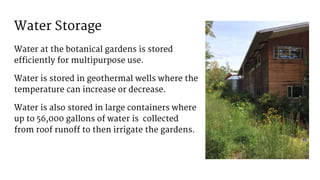
Water at the botanical gardens is stored
efficiently for multipurpose use.
Water is stored in geothermal wells where the
temperature can increase or decrease.
Water is also stored in large containers where
up to 56,000 gallons of water is collected
from roof runoff to then irrigate the gardens.
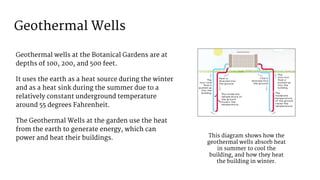
Geothermal Wells
Geothermal wells at the Botanical Gardens are at
depths of 100, 200, and 500 feet.
It uses the earth as a heat source during the winter
and as a heat sink during the summer due to a
relatively constant underground temperature
around 55 degrees Fahrenheit.
The Geothermal Wells at the garden use the heat
from the earth to generate energy, which can
power and heat their buildings. This diagram shows how the
geothermal wells absorb heat
in summer to cool the
building, and how they heat
the building in winter.
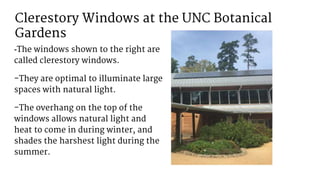
Clerestory Windows at the UNC Botanical
Gardens
-The windows shown to the right are
called clerestory windows.
-They are optimal to illuminate large
spaces with natural light.
-The overhang on the top of the
windows allows natural light and
heat to come in during winter, and
shades the harshest light during the
summer.
Other Photos!

Architecture as Activism Site Visit

  • 1.
    Architecture as Activism SiteVisit Recap Architecture as Activism The 9th Grade Experience at the City Planner and Botanical Gardens
  • 2.
  • 3.
    Morrisville History -Inthe mid 19th century, North Carolina's economy was asleep, so North Carolina build a railroad to fix that problem. - The railroad needed a station to refuel 12 miles from Raleigh, so a man named Jerry Morris gave North Carolina the land, and from there the town Morrisville was born.
  • 4.
    Morrisville City PlannerEnvironmental Requirements -When we went to the Morrisville City Planner we learned about what environmental requirements need to be fulfilled in Morrisville for a developer to create a building. -In a case of cutting down trees, if there are 80% trees, at the end of the project the builder must leave 23% or more in the area. -In order to improve the aesthetic appeal of a neighborhood, adjacent homes cannot have the same color scheme.
  • 5.
    Morrisville Environmental Issues -Some environmental issues that Morrisville faces include: - River Impairment Buffering - Stormwater Management - Building Lot Coverage - Tree Preservation
  • 6.
    Morrisville Growth - Morrisvillehas grown as a town from 251 people in 1980 to 23,699 people in 2015. This is 94 times more than the population of 251. - The city planners have to plan for growth. - One thing that the planners have to keep in mind what longtime residents want their community to be like and what new developers who see Morrisville as an opportunity to build a bigger community want the town to be like.
  • 7.
    Steps for Regulations -Step 1: A community decides what it wants to look and feel like. Public input is then received and bound together into a community vision. - Step 2: City planners draft a plan for a community based on the community vision. These plans typically take the community vision and break it down into measurable goals, objectives, and policy actions. - Step 3: City planners present the draft plan to the Council. The Council then decides to either adopt or deny the plan. - Step 4: City planners then create regulations based on the goals,
  • 8.
    Examples of DesignRegulations (step 4) One design regulation a designer might put in place is that parking needs to be to the side or rear of the building. This way the building looks more visually appealing and seems more open to customers who walk. This way the building also looks nicer and encourages a healthier form of transportation.
  • 9.
    Examples of DesignRegulations (step 4) Another design regulation a planner might choose to put in place is there needs to be parking islands throughout the whole parking lot. This helps the parking lot not only look more appealing but also prevents heat islands due to human development.
  • 10.
    Considerations City PlannersHave to Take Into Account - City planners have to take into consideration what every body in the community wants Morrisville to be like. - They also have to make sure that they do not take down too many trees. For example, if you have a canopy which takes up 20% of space then you must leave at least 39% of those trees there.
  • 11.
    Challenges - Some differentchallenges that city planners face are balancing all the different social goals, economic goals, environmental goals, stakeholder goals, and long and short term goals. - A stakeholder goal is a goal of anybody who is impacted by a decision. For example, if a development company wants to turn a forest into a shopping center, local people may want the forest to stay. This is a stakeholder goal.
  • 12.
  • 13.
    NC Botanical Gardens -TheNC Botanical gardens is a Platinum LEED certified building. top- one of many beautiful flowers in the gardens bottom- an incredible art sculpture in the foreground with the building in the background. You can see solar panels, reused wood, covered lamps to reduce night light pollution, energy efficient windows, and the building overhangs that deflect and allow sunlight in based on the season -Other important features: bridges to prevent tree roots from being stomped upon and a very large composting system that creates nutrient rich soil for all of the gardens. -Some water environmental friendly features include absorbing driveways to prevent stormwater runoff and walls made of old sidewalks meant to stop runoff, giving it time to absorb into the ground and filter.
  • 14.
    How We CanGo Green - There are many different ways that people like you and I can go green. - For example, you can install solar panels to get you energy for your house. (About 8% of the energy used at the gardens comes from their solar panels) - You can use greywater to flush your toilets. - Greywater is water that is filtered but not potable. - You could use recycled materials for your building. - Shading from sunlight in the winter vs summer.
  • 15.
    More Ways toGo Green Inside the Building As well as using recycled materials on the outside, the classrooms, offices, and learning spaces all have the following features: - motion sensored lighting - divider panels to combine classrooms - sound panels - recycled chairs - elevators using electric traction motors - the wall paint has low VOC
  • 16.
    Ways That theBotanical Gardens Preserve Nature - The Botanical Gardens is careful to only use wood from trees that have already fallen and no trees were killed to build either of the buildings. All of the doorframes and other features made out of wood inside the buildings are made of reused wood as well. - There is a program in place called Saving our Pollinators to protect bees that talks about how to preserve what they need to live.
  • 17.
    Water Storage Water atthe botanical gardens is stored efficiently for multipurpose use. Water is stored in geothermal wells where the temperature can increase or decrease. Water is also stored in large containers where up to 56,000 gallons of water is collected from roof runoff to then irrigate the gardens.
  • 18.
    Geothermal Wells Geothermal wellsat the Botanical Gardens are at depths of 100, 200, and 500 feet. It uses the earth as a heat source during the winter and as a heat sink during the summer due to a relatively constant underground temperature around 55 degrees Fahrenheit. The Geothermal Wells at the garden use the heat from the earth to generate energy, which can power and heat their buildings. This diagram shows how the geothermal wells absorb heat in summer to cool the building, and how they heat the building in winter.
  • 19.
    Clerestory Windows atthe UNC Botanical Gardens -The windows shown to the right are called clerestory windows. -They are optimal to illuminate large spaces with natural light. -The overhang on the top of the windows allows natural light and heat to come in during winter, and shades the harshest light during the summer.
  • 20.