Over one billion people with disability face physical, social,
economic and attitudinal barriers that exclude them to
participate as equal to other members of society.
People with disabilities lack equal access to basic resources,
such as education, employment, healthcare, social and legal
support systems.
Disability in poor countries has remained invisible in the
mainstream development agenda.
Besides lack of awareness, understanding of accessibility and
accommodations remain an obstacle to the achievement of
progress.
Dr. Y. P. Gupta, Consultant, Allahabad
In physical terms, the problems of disabled children are much the
same the world over. But while problems may coincide, the ways by
which they ought to be resolved may differ.
Appropriate solutions are governed by the way that services are
organized, along with social, economic and cultural influences.
For architects, there may be some circumstances where similar
design solutions will be proper and others where they will not be.
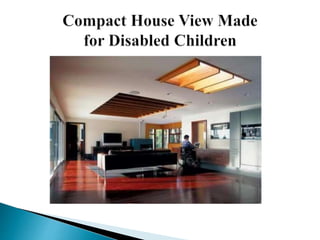
The houses, schools and other public places need to be designed to
cater for children in wheel chairs & walking aid.
Dr. Y. P. Gupta, Consultant, Allahabad
• Design for disability includes:
• Mobility
• Vision
• Hearing
• Speech
• Cognitive
• Within the public and private sectors
1.
2. Oblique walls should be avoided as they give a
wrong direction impression
3. Big areas should preferably have a clear
conceptual layout, like a rectangular or square
area
4. Pillars, etc. should not be of same color as
background
5. Living room, toilet/shower, and bed-space should
be on ground floor in 2 story buildings or more.
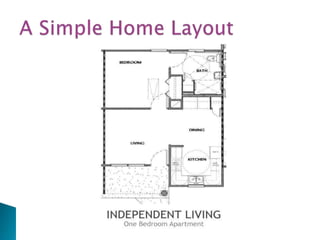
6. Bedroom should preferably be next to a bathroom.
7. When there are indented areas, the straight,
imagined continuation of the wall should be free
for walking.
8. Walking can be supported by clear contrast of the
floor material to the surrounding walls
 An adaptable home is one which is built or renovated to allow
low cost and easy adaptation to the changing needs of the
residents.
 For disabled people and elderly, this means that devices
assisting the activities of daily living can easily be installed.
 A prerequisite in order to achieve the benefits of a smarthome
is a barrier-free physical environment that supports the
residents.
Building must be adjacent to street
Car park must be level or ramped in compliance with codes
Principal entrances to the building must be accessible to chair-
bound children.
A loading bay should be provided for children going to the
school by special buses
The platform should be at approximately 0.620 m above
ground level
Access to and from the building may be under cover.
Internal Planning of house should accommodate wheel chair
bound Children
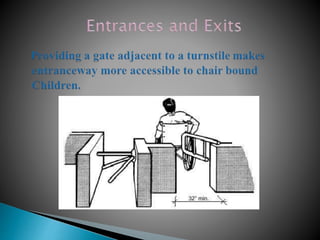
Where revolving doors or turnstiles are installed an
auxiliary side hung door or gate must be provided
giving clear opening width not less than 0.760 as
shown.
Threshold must not be raised more than 0.015m above
the level of floor to either side of door
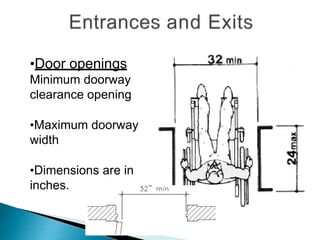
•Door openings
Minimum doorway
clearance opening
•Maximum doorway
width
•Dimensions are in
inches.
Door ironmongery should be simple for handicapped
children to handle;
Doors should be protected from damage by wheelchairs
on trailing faces.
Some windows should have sills at or near floor level,
allowing children lying or sitting on the floor to see
outside.
Doors can be of the sliding or swinging type. In general sliding
doors are preferable to swinging doors .
Automatic doors are useful when traffic is heavy.
Automatic doors should have an adequate opening interval.
Guard rails can be installed near double- swinging doors to indicate
a door opening area and to prevent people from being hit by the
door.
Revolving doors: - Revolving doors are not suitable for the use of
disabled people or people with prams.
Wherever there are revolving doors, an adjacent accessible
swinging or sliding door should be provided .
Auxiliary gates should be provided next turnstiles.
Pivoted doors: - Pivoted doors should swing away from the
direction of travel wherever possible.
Sliding and folding doors: - Manual sliding and folding doors
are recommended for narrow spaces not heavily used by the
public .
For exterior doors, the minimum opening is 0.90 m when the door is
open.
For interior doors, the minimum opening is 0.80 m when the door is
open.
The minimum door opening can be 0.75 m if the access is straight or
if the door can stay open by itself.
The minimum door width of rest rooms should be 0.75 m.
For doors installed in an opening more than 0.60 m in depth, the clear
door opening should be at least 0.90 m.
For double-leaf doors, at least one leaf should have a minimum clear
width of 0.80 m.
32" minimum clear width
½" maximum threshold height
48" plus width of door swinging into space clear
width for two doors in a series
48" maximum height for door handles, pulls, latches,
locks, and other operating devices - operable with
closed fist
3 seconds minimum sweep (closing) period
5 lbs maximum opening force for interior hinged,
sliding, or folding doors
8.5 lbs maximum opening force for exterior doors
Operational devices on doors, such as handles, pulls, latches and locks, should
be easy to grasp with one hand.
Handles: - Lever-type handles, push plates or pull handles are
recommended for swinging doors because they are easy to open.
Door handles should be located at a comfortable height between
0.90 m and 1.00 m from the floor surface.
Locks: Locks on entrance doors should be mounted at a comfortable height
between 0.90 m and 1.00 m from the floor.
Extra pull handle: To facilitate closing, a door fitted with spring
closers should be equipped with an extra pull handle approximately
0.30 m in length, located between 0.20 m and 0.30 m from the hinged side of
the door and mounted between 0.90 m and 1.20 m from the floor.
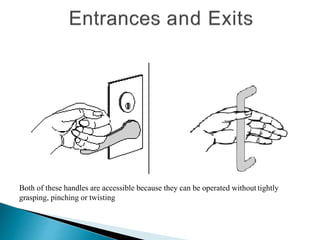
Both of these handles are accessible because they can be operated without tightly
grasping, pinching or twisting
Outward swinging doors and doors in public corridors should
have low windows to enable users to see oncoming traffic.
The bottom edge of the window should not be higher than
1.00 m from the finished floor level.
Completely glazed doors should be avoided in buildings
frequented by people with visual impairments.
Glazed doors should be clearly marked with a coloured band
or mark placed for the benefit of all users at a height between
1.40 m and 1.60 m
(if the Child can climb the stairs)
• 275mm/11" minimum wide treads, uniform riser heights and
tread widths
• 35mm / 1½" maximum nosing projection, undersides to be
sloped with a minimum angle of 60° from the horizontal
• Complying handrails on both sides
• 300/12" mm horizontal projection of handrail at top;
handrail to continue to slope width of one tread plus have
300mm/12" horizontal extension at bottom
• A riser height difference of only 3mm/⅛” is enough to
cause someone to trip
Platform at head of ramp:
Where the gradient of the ramp exceeds 1:12 platform having a width and
depth of not less than 1-200 must be provided at the head of the ramp
Foot of ramp:
At the foot of any ramp whose gradient exceeds 1:12 the surface should
be leveled for a distance of not less than1.800m
Kerbs:
A kerb not less than 0-050 high must be provided to any exposed side of a
ramp or platform.
This is required to prevent wheelchair cast or wheels dropping over the
edge.
Handrails:
A handrail at approx 1-000 above ramp level should be
provided to any exposed side of a ramp.
Grab bars make maneuvering easier for the individual in a
wheelchair
Towel bars will not support the weight of a person so use
grab bars as an alternative
Sinks with an opening underneath
Bathroom mirrors and medicine cabinets should be installed
for a seated user
Adjustable-height shower head is adjusted to suit different
users
Single lever faucet handles are universal for all individuals
In-tub showers are inaccessible to wheelchair users. Provide
a tub transfer seat and properly located grab bars
Stall shower allows wheelchair users easy access
• Clear floor space varies by configuration
• It should be 17" - 19" high to top of toilet seat.
• Grab bars required : 36" rear grab bar, 42" side grab
bar
• Flush controls must be at a maximum 44", mounted on
the wide side of toilet areas
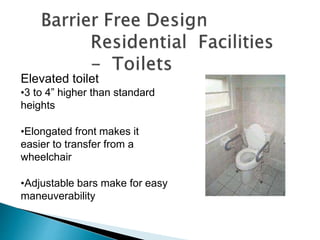
Elevated toilet
•3 to 4” higher than standard
heights
•Elongated front makes it
easier to transfer from a
wheelchair
•Adjustable bars make for easy
maneuverability
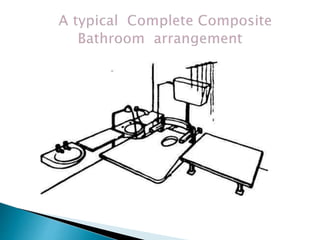
Hand rinse basin
A hand rinse basin must be provided inside the WC
compartment, located where it can be reached by a person
seated on the WC
The basin rim should be at approx 0-750mm above floor
level
A single mixer valve with lever handle is suggested, located
on the side nearer the WC
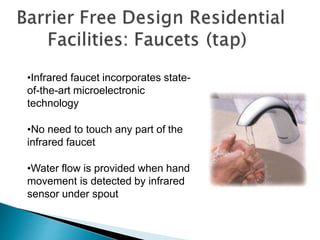
•Infrared faucet incorporates state-
of-the-art microelectronic
technology
•No need to touch any part of the
infrared faucet
•Water flow is provided when hand
movement is detected by infrared
sensor under spout
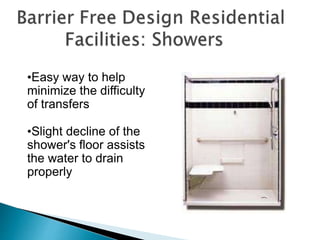
•Easy way to help
minimize the difficulty
of transfers
•Slight decline of the
shower's floor assists
the water to drain
properly
Horizontal Rails:
A hinged support rail should be installed to the exposed tide
of the WC
Horizontal rails should be fixed at a level approx 0.220
Meter above the WC seat
Vertical rails:
A vertical rail should be fixed approx 0.300 Mt in front of
the WC and approx 0.280 to 0.330 Mt from the centre line
of the WC
A second vertical rail should be fixed on the rear wall at a
point approx 0.400 Mt from the centre line of the WC
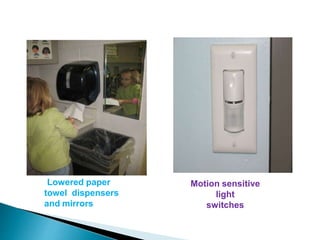
Lowered paper
towel dispensers
and mirrors
Motion sensitive
light
switches
• Raised dishwasher to provide toe space for wheelchairs,
less bending during loading, as well as a raised counter
top for working while standing.
• Pullout cabinets under sinks and cook tops
• Drawers for storing bulk items
• Tambour cabinets for lowered storage and easy access
to items
• Full height pantry units with lazy suspans and door
storage
• Lowered upper cabinets with glass fronts
• Open storage racks for often used items
• Larger toe-kick for wheelchair access
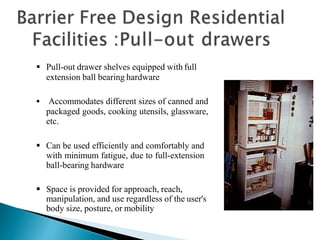
 Pull-out drawer shelves equipped with full
extension ball bearing hardware
 Accommodates different sizes of canned and
packaged goods, cooking utensils, glassware,
etc.
 Can be used efficiently and comfortably and
with minimum fatigue, due to full-extension
ball-bearing hardware
 Space is provided for approach, reach,
manipulation, and use regardless of the user's
body size, posture, or mobility
Light switches should be aligned with door handles, in
positions where they can be reached by children in
wheelchair.
The door or the door frame can be painted in a color
that contrasts with the adjoining wall to facilitate its
identification by children with visual impairments
The Elevators Must operate automatically
Must have self-leveling feature
Hall call buttons have a specific height
Lanterns have visual and audio signals
Door reopening device
Specific chimes for hall and car calls
Specific floor area
Interior control dimensions
Emergency communications
Wall finishes should be washable. The use of exposed brickwork should be avoided
as it can cause injury to the hands of children with problems of co- ordination
Compared with normal children, handicapped children may spend more of their
time at or near floor level.
Therefore: Floor finishes must not be very smooth like smooth marble
Floor finishes should be comfortable to walk, play on, easily cleaned and pleasant
to touch.
Handrails should be fixed to walls only along main circulation routes; they ought
not to be fixed indiscriminately
Some protection may be needed to wall surfaces in particular locations but the
general provision of buffer rails is not recommended.*
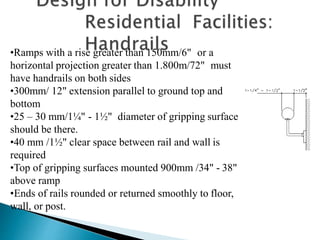
•Ramps with a rise greater than 150mm/6" or a
horizontal projection greater than 1.800m/72" must
have handrails on both sides
•300mm/ 12" extension parallel to ground top and
bottom
•25 – 30 mm/1¼" - 1½" diameter of gripping surface
should be there.
•40 mm /1½" clear space between rail and wall is
required
•Top of gripping surfaces mounted 900mm /34" - 38"
above ramp
•Ends of rails rounded or returned smoothly to floor,
wall, or post.
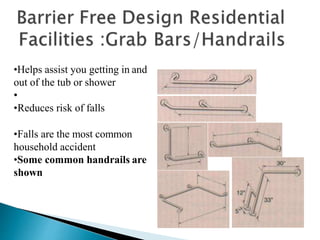
•Helps assist you getting in and
out of the tub or shower
•
•Reduces risk of falls
•Falls are the most common
household accident
•Some common handrails are
shown
When designing a new public facility, there are several areas
in and around the facility to apply design for disabilities. The
following are some examples:
Parking Lots
Entrances and Exits
Travel Routes
Public Restrooms
Restaurants
Emergency Notifications
 Accessible doors should be so designed as to permit
operation by one person in a single motion with little
effort.
Power-operated doors are the best for children with
disabilities
The activator system should be automatic or placed
within easy reach
An accessible door should have the following features: a
sign, a door handle, an extra pull handle, glazing and a
kick plate.
Rooms designated for wheelchair children should, where
possible, be placed at ground level so as to have a direct
means of escape in case of fire
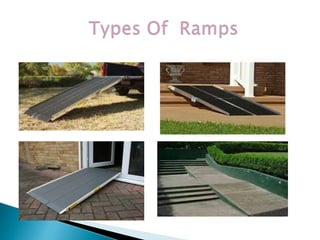
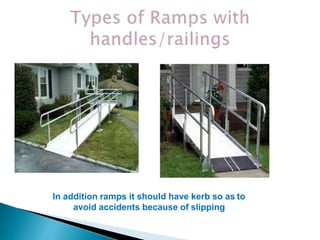
In addition ramps it should have kerb so as to
avoid accidents because of slipping
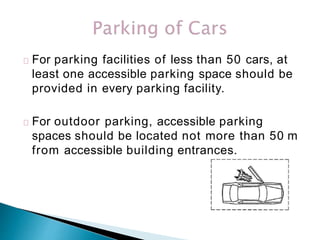
For parking facilities of less than 50 cars, at
least one accessible parking space should be
provided in every parking facility.
For outdoor parking, accessible parking
spaces should be located not more than 50 m
from accessible building entrances.
For indoor parking, accessible parking
spaces should be located right next to
accessible elevators, or as close as possible
to exits.
The ends of rows are preferable for vans
with lifts for wheelchair users.
 Dimensions:
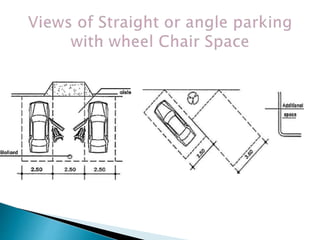
The minimum width of an accessible parking
space is 3.60
 m. The recommended width is 3.90 m as
shown.
An access aisle 1.20 m wide can be located
between two ordinary parking spaces.
For indoor parking, the minimum height
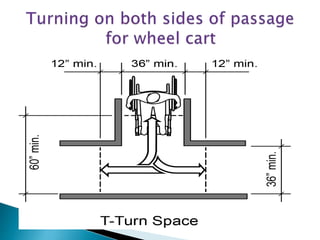
•Passageways serving accessible areas must not be less than 1-
200 wide, preferred minimum 1-600
•Where lobbies are incorporated between doors, there must be
space for wheelchair maneuvers
Lifts
•Vertical circulation between floors must be by means of a
lift. At entrance level the floor of the lift must be at the same
level as the entrance door
• The clear space in front of the lift doors must be not less
than 600 upto 1600 mm
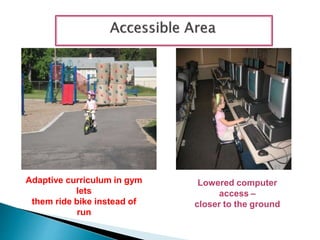
Adaptive curriculum in gym
lets
them ride bike instead of
run
Lowered computer
access –
closer to the ground
Curb ramps are used wherever there is a difference in level on
pedestrian paths or cross paths.
To avoid confusing sightless pedestrians, curb ramps should be
positioned out of the usual line of pedestrian flow. The
unobstructed width of the pathway should be not less than
0.90 m .
Curb ramps should be located away from places where water
accumulates.
Standard curb ramps: Cut back into the pavement with flared
sides providing
Room numbers should be placed on door frames and not on
doors themselves so that the room number is visible even
when the door is open.
Colour:
The door or the door frame can be painted in a colour that
contrasts with the adjoining wall to facilitate its identification
by people with visual impairments.
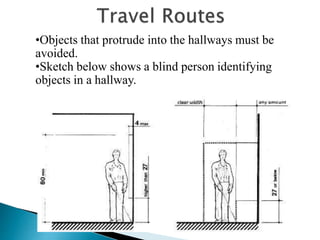
•Objects that protrude into the hallways must be
avoided.
•Sketch below shows a blind person identifying
objects in a hallway.
Platform Lift - requires either two side doors, or one sliding
door on a van and is stored either on the side, the rear or
under the floor of the van.
Rotary (Swing) Lift - beneficial because of the parking
conveniences, due to less room needed to enter and to exit
the van. This device swings into the van, and the lift
platform sits on the floor in the middle of the van.
Trunk Lift - puts the scooter into the trunk, provided the
scooter measures less than the trunk.
Under-the-Floor Lift - only pump and motor are located
inside.
Door Openers:
Chain Door Opener - slide door that travels in a track located at the top ofthe
van.
Pivot Arm and Push/Pull Gear Door Opener - used to open
double-outdoors outward.
Parking Brake Extensions:
Electric Parking Brake - motorized and can be set and released by a switch
located within easy reach of the driver. This is ideal for those with limitedfoot
and leg strength. The use of electric parking brakes have been used for
customers without disabilities as a upgrade to the manual parking brake and
also for weight reduction..
Manual Parking Brake - for those with limited foot and leg strength. It isa
handle attached to the parking brake and is long enough to operate by hand.
An assistive device may make a person stand out
more than a conventional device, causing the user to:
-Look Different
-Become Embarrassed
-Become Self Conscious
-Do that particular activity less
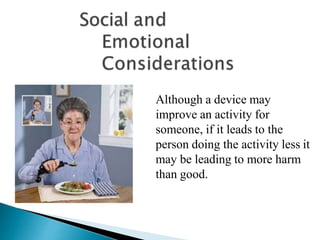
Although a device may
improve an activity for
someone, if it leads to the
person doing the activity less it
may be leading to more harm
than good.
In this way if we provide some of these basic aids in the
homes for our disabled children who are our very own but not so
fortunate children, at least we can try
make their lives more independent, emotionally stronger, little
more enjoyable & develop more confidence in themselves &
build up more confidence
Architectural barrier for Disabled people

Architectural barrier for Disabled people

  • 2.
    Over one billionpeople with disability face physical, social, economic and attitudinal barriers that exclude them to participate as equal to other members of society. People with disabilities lack equal access to basic resources, such as education, employment, healthcare, social and legal support systems. Disability in poor countries has remained invisible in the mainstream development agenda. Besides lack of awareness, understanding of accessibility and accommodations remain an obstacle to the achievement of progress. Dr. Y. P. Gupta, Consultant, Allahabad
  • 3.
    In physical terms,the problems of disabled children are much the same the world over. But while problems may coincide, the ways by which they ought to be resolved may differ. Appropriate solutions are governed by the way that services are organized, along with social, economic and cultural influences. For architects, there may be some circumstances where similar design solutions will be proper and others where they will not be. The houses, schools and other public places need to be designed to cater for children in wheel chairs & walking aid. Dr. Y. P. Gupta, Consultant, Allahabad
  • 4.
    • Design fordisability includes: • Mobility • Vision • Hearing • Speech • Cognitive • Within the public and private sectors
  • 5.
    1. 2. Oblique wallsshould be avoided as they give a wrong direction impression 3. Big areas should preferably have a clear conceptual layout, like a rectangular or square area 4. Pillars, etc. should not be of same color as background 5. Living room, toilet/shower, and bed-space should be on ground floor in 2 story buildings or more.
  • 6.
    6. Bedroom shouldpreferably be next to a bathroom. 7. When there are indented areas, the straight, imagined continuation of the wall should be free for walking. 8. Walking can be supported by clear contrast of the floor material to the surrounding walls
  • 8.
     An adaptablehome is one which is built or renovated to allow low cost and easy adaptation to the changing needs of the residents.  For disabled people and elderly, this means that devices assisting the activities of daily living can easily be installed.  A prerequisite in order to achieve the benefits of a smarthome is a barrier-free physical environment that supports the residents.
  • 10.
    Building must beadjacent to street Car park must be level or ramped in compliance with codes Principal entrances to the building must be accessible to chair- bound children. A loading bay should be provided for children going to the school by special buses The platform should be at approximately 0.620 m above ground level Access to and from the building may be under cover. Internal Planning of house should accommodate wheel chair bound Children
  • 11.
    Where revolving doorsor turnstiles are installed an auxiliary side hung door or gate must be provided giving clear opening width not less than 0.760 as shown. Threshold must not be raised more than 0.015m above the level of floor to either side of door
  • 12.
    •Door openings Minimum doorway clearanceopening •Maximum doorway width •Dimensions are in inches.
  • 14.
    Door ironmongery shouldbe simple for handicapped children to handle; Doors should be protected from damage by wheelchairs on trailing faces. Some windows should have sills at or near floor level, allowing children lying or sitting on the floor to see outside.
  • 15.
    Doors can beof the sliding or swinging type. In general sliding doors are preferable to swinging doors . Automatic doors are useful when traffic is heavy. Automatic doors should have an adequate opening interval. Guard rails can be installed near double- swinging doors to indicate a door opening area and to prevent people from being hit by the door. Revolving doors: - Revolving doors are not suitable for the use of disabled people or people with prams.
  • 16.
    Wherever there arerevolving doors, an adjacent accessible swinging or sliding door should be provided . Auxiliary gates should be provided next turnstiles. Pivoted doors: - Pivoted doors should swing away from the direction of travel wherever possible. Sliding and folding doors: - Manual sliding and folding doors are recommended for narrow spaces not heavily used by the public .
  • 17.
    For exterior doors,the minimum opening is 0.90 m when the door is open. For interior doors, the minimum opening is 0.80 m when the door is open. The minimum door opening can be 0.75 m if the access is straight or if the door can stay open by itself. The minimum door width of rest rooms should be 0.75 m. For doors installed in an opening more than 0.60 m in depth, the clear door opening should be at least 0.90 m. For double-leaf doors, at least one leaf should have a minimum clear width of 0.80 m.
  • 18.
    32" minimum clearwidth ½" maximum threshold height 48" plus width of door swinging into space clear width for two doors in a series 48" maximum height for door handles, pulls, latches, locks, and other operating devices - operable with closed fist 3 seconds minimum sweep (closing) period 5 lbs maximum opening force for interior hinged, sliding, or folding doors 8.5 lbs maximum opening force for exterior doors
  • 19.
    Operational devices ondoors, such as handles, pulls, latches and locks, should be easy to grasp with one hand. Handles: - Lever-type handles, push plates or pull handles are recommended for swinging doors because they are easy to open. Door handles should be located at a comfortable height between 0.90 m and 1.00 m from the floor surface. Locks: Locks on entrance doors should be mounted at a comfortable height between 0.90 m and 1.00 m from the floor. Extra pull handle: To facilitate closing, a door fitted with spring closers should be equipped with an extra pull handle approximately 0.30 m in length, located between 0.20 m and 0.30 m from the hinged side of the door and mounted between 0.90 m and 1.20 m from the floor.
  • 20.
    Both of thesehandles are accessible because they can be operated without tightly grasping, pinching or twisting
  • 21.
    Outward swinging doorsand doors in public corridors should have low windows to enable users to see oncoming traffic. The bottom edge of the window should not be higher than 1.00 m from the finished floor level. Completely glazed doors should be avoided in buildings frequented by people with visual impairments. Glazed doors should be clearly marked with a coloured band or mark placed for the benefit of all users at a height between 1.40 m and 1.60 m
  • 22.
    (if the Childcan climb the stairs) • 275mm/11" minimum wide treads, uniform riser heights and tread widths • 35mm / 1½" maximum nosing projection, undersides to be sloped with a minimum angle of 60° from the horizontal • Complying handrails on both sides • 300/12" mm horizontal projection of handrail at top; handrail to continue to slope width of one tread plus have 300mm/12" horizontal extension at bottom • A riser height difference of only 3mm/⅛” is enough to cause someone to trip
  • 23.
    Platform at headof ramp: Where the gradient of the ramp exceeds 1:12 platform having a width and depth of not less than 1-200 must be provided at the head of the ramp Foot of ramp: At the foot of any ramp whose gradient exceeds 1:12 the surface should be leveled for a distance of not less than1.800m Kerbs: A kerb not less than 0-050 high must be provided to any exposed side of a ramp or platform. This is required to prevent wheelchair cast or wheels dropping over the edge. Handrails: A handrail at approx 1-000 above ramp level should be provided to any exposed side of a ramp.
  • 24.
    Grab bars makemaneuvering easier for the individual in a wheelchair Towel bars will not support the weight of a person so use grab bars as an alternative Sinks with an opening underneath Bathroom mirrors and medicine cabinets should be installed for a seated user Adjustable-height shower head is adjusted to suit different users Single lever faucet handles are universal for all individuals In-tub showers are inaccessible to wheelchair users. Provide a tub transfer seat and properly located grab bars Stall shower allows wheelchair users easy access
  • 25.
    • Clear floorspace varies by configuration • It should be 17" - 19" high to top of toilet seat. • Grab bars required : 36" rear grab bar, 42" side grab bar • Flush controls must be at a maximum 44", mounted on the wide side of toilet areas
  • 26.
    Elevated toilet •3 to4” higher than standard heights •Elongated front makes it easier to transfer from a wheelchair •Adjustable bars make for easy maneuverability
  • 27.
    Hand rinse basin Ahand rinse basin must be provided inside the WC compartment, located where it can be reached by a person seated on the WC The basin rim should be at approx 0-750mm above floor level A single mixer valve with lever handle is suggested, located on the side nearer the WC
  • 29.
    •Infrared faucet incorporatesstate- of-the-art microelectronic technology •No need to touch any part of the infrared faucet •Water flow is provided when hand movement is detected by infrared sensor under spout
  • 30.
    •Easy way tohelp minimize the difficulty of transfers •Slight decline of the shower's floor assists the water to drain properly
  • 31.
    Horizontal Rails: A hingedsupport rail should be installed to the exposed tide of the WC Horizontal rails should be fixed at a level approx 0.220 Meter above the WC seat Vertical rails: A vertical rail should be fixed approx 0.300 Mt in front of the WC and approx 0.280 to 0.330 Mt from the centre line of the WC A second vertical rail should be fixed on the rear wall at a point approx 0.400 Mt from the centre line of the WC
  • 34.
    Lowered paper towel dispensers andmirrors Motion sensitive light switches
  • 35.
    • Raised dishwasherto provide toe space for wheelchairs, less bending during loading, as well as a raised counter top for working while standing. • Pullout cabinets under sinks and cook tops • Drawers for storing bulk items • Tambour cabinets for lowered storage and easy access to items • Full height pantry units with lazy suspans and door storage • Lowered upper cabinets with glass fronts • Open storage racks for often used items • Larger toe-kick for wheelchair access
  • 36.
     Pull-out drawershelves equipped with full extension ball bearing hardware  Accommodates different sizes of canned and packaged goods, cooking utensils, glassware, etc.  Can be used efficiently and comfortably and with minimum fatigue, due to full-extension ball-bearing hardware  Space is provided for approach, reach, manipulation, and use regardless of the user's body size, posture, or mobility
  • 37.
    Light switches shouldbe aligned with door handles, in positions where they can be reached by children in wheelchair. The door or the door frame can be painted in a color that contrasts with the adjoining wall to facilitate its identification by children with visual impairments
  • 38.
    The Elevators Mustoperate automatically Must have self-leveling feature Hall call buttons have a specific height Lanterns have visual and audio signals Door reopening device Specific chimes for hall and car calls Specific floor area Interior control dimensions Emergency communications
  • 39.
    Wall finishes shouldbe washable. The use of exposed brickwork should be avoided as it can cause injury to the hands of children with problems of co- ordination Compared with normal children, handicapped children may spend more of their time at or near floor level. Therefore: Floor finishes must not be very smooth like smooth marble Floor finishes should be comfortable to walk, play on, easily cleaned and pleasant to touch. Handrails should be fixed to walls only along main circulation routes; they ought not to be fixed indiscriminately Some protection may be needed to wall surfaces in particular locations but the general provision of buffer rails is not recommended.*
  • 40.
    •Ramps with arise greater than 150mm/6" or a horizontal projection greater than 1.800m/72" must have handrails on both sides •300mm/ 12" extension parallel to ground top and bottom •25 – 30 mm/1¼" - 1½" diameter of gripping surface should be there. •40 mm /1½" clear space between rail and wall is required •Top of gripping surfaces mounted 900mm /34" - 38" above ramp •Ends of rails rounded or returned smoothly to floor, wall, or post.
  • 41.
    •Helps assist yougetting in and out of the tub or shower • •Reduces risk of falls •Falls are the most common household accident •Some common handrails are shown
  • 42.
    When designing anew public facility, there are several areas in and around the facility to apply design for disabilities. The following are some examples: Parking Lots Entrances and Exits Travel Routes Public Restrooms Restaurants Emergency Notifications
  • 43.
     Accessible doorsshould be so designed as to permit operation by one person in a single motion with little effort. Power-operated doors are the best for children with disabilities The activator system should be automatic or placed within easy reach An accessible door should have the following features: a sign, a door handle, an extra pull handle, glazing and a kick plate. Rooms designated for wheelchair children should, where possible, be placed at ground level so as to have a direct means of escape in case of fire
  • 46.
    In addition rampsit should have kerb so as to avoid accidents because of slipping
  • 48.
    For parking facilitiesof less than 50 cars, at least one accessible parking space should be provided in every parking facility. For outdoor parking, accessible parking spaces should be located not more than 50 m from accessible building entrances.
  • 49.
    For indoor parking,accessible parking spaces should be located right next to accessible elevators, or as close as possible to exits. The ends of rows are preferable for vans with lifts for wheelchair users.  Dimensions: The minimum width of an accessible parking space is 3.60  m. The recommended width is 3.90 m as shown. An access aisle 1.20 m wide can be located between two ordinary parking spaces. For indoor parking, the minimum height
  • 51.
    •Passageways serving accessibleareas must not be less than 1- 200 wide, preferred minimum 1-600 •Where lobbies are incorporated between doors, there must be space for wheelchair maneuvers Lifts •Vertical circulation between floors must be by means of a lift. At entrance level the floor of the lift must be at the same level as the entrance door • The clear space in front of the lift doors must be not less than 600 upto 1600 mm
  • 53.
    Adaptive curriculum ingym lets them ride bike instead of run Lowered computer access – closer to the ground
  • 54.
    Curb ramps areused wherever there is a difference in level on pedestrian paths or cross paths. To avoid confusing sightless pedestrians, curb ramps should be positioned out of the usual line of pedestrian flow. The unobstructed width of the pathway should be not less than 0.90 m . Curb ramps should be located away from places where water accumulates. Standard curb ramps: Cut back into the pavement with flared sides providing
  • 55.
    Room numbers shouldbe placed on door frames and not on doors themselves so that the room number is visible even when the door is open. Colour: The door or the door frame can be painted in a colour that contrasts with the adjoining wall to facilitate its identification by people with visual impairments.
  • 56.
    •Objects that protrudeinto the hallways must be avoided. •Sketch below shows a blind person identifying objects in a hallway.
  • 57.
    Platform Lift -requires either two side doors, or one sliding door on a van and is stored either on the side, the rear or under the floor of the van. Rotary (Swing) Lift - beneficial because of the parking conveniences, due to less room needed to enter and to exit the van. This device swings into the van, and the lift platform sits on the floor in the middle of the van. Trunk Lift - puts the scooter into the trunk, provided the scooter measures less than the trunk. Under-the-Floor Lift - only pump and motor are located inside.
  • 58.
    Door Openers: Chain DoorOpener - slide door that travels in a track located at the top ofthe van. Pivot Arm and Push/Pull Gear Door Opener - used to open double-outdoors outward. Parking Brake Extensions: Electric Parking Brake - motorized and can be set and released by a switch located within easy reach of the driver. This is ideal for those with limitedfoot and leg strength. The use of electric parking brakes have been used for customers without disabilities as a upgrade to the manual parking brake and also for weight reduction.. Manual Parking Brake - for those with limited foot and leg strength. It isa handle attached to the parking brake and is long enough to operate by hand.
  • 59.
    An assistive devicemay make a person stand out more than a conventional device, causing the user to: -Look Different -Become Embarrassed -Become Self Conscious -Do that particular activity less
  • 60.
    Although a devicemay improve an activity for someone, if it leads to the person doing the activity less it may be leading to more harm than good.
  • 61.
    In this wayif we provide some of these basic aids in the homes for our disabled children who are our very own but not so fortunate children, at least we can try make their lives more independent, emotionally stronger, little more enjoyable & develop more confidence in themselves & build up more confidence