Part 5: Advanced Topics
Applied Statistics for Finance
Professor Asmerilda Hitaj
asmerilda.hitaj1@unimib.it
April 10, 2018
A. Hitaj ASFF - Part 5 Spring 2018 1 / 27
ARCH Processes
Applied Statistics for Finance
Francesco Bianchi
francesco.bianchi04@icatt.it
April 10, 2018
F. Bianchi ASFF - Part 5 Spring 2018 2 / 27
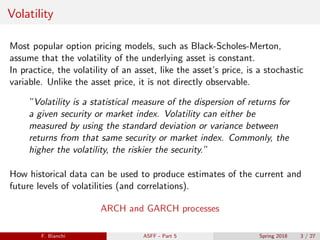
Volatility
Most popular option pricing models, such as Black-Scholes-Merton,
assume that the volatility of the underlying asset is constant.
In practice, the volatility of an asset, like the asset’s price, is a stochastic
variable. Unlike the asset price, it is not directly observable.
”Volatility is a statistical measure of the dispersion of returns for
a given security or market index. Volatility can either be
measured by using the standard deviation or variance between
returns from that same security or market index. Commonly, the
higher the volatility, the riskier the security.”
How historical data can be used to produce estimates of the current and
future levels of volatilities (and correlations).
ARCH and GARCH processes
F. Bianchi ASFF - Part 5 Spring 2018 3 / 27
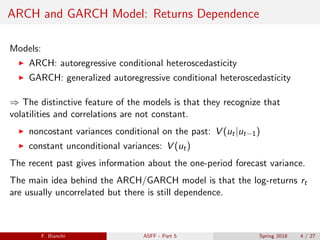
ARCH and GARCH Model: Returns Dependence
Models:
ARCH: autoregressive conditional heteroscedasticity
GARCH: generalized autoregressive conditional heteroscedasticity
⇒ The distinctive feature of the models is that they recognize that
volatilities and correlations are not constant.
noncostant variances conditional on the past: V (ut|ut−1)
constant unconditional variances: V (ut)
The recent past gives information about the one-period forecast variance.
The main idea behind the ARCH/GARCH model is that the log-returns rt
are usually uncorrelated but there is still dependence.
F. Bianchi ASFF - Part 5 Spring 2018 4 / 27
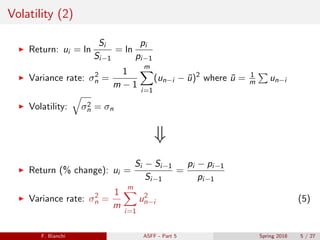
Volatility (2)
Return: ui = ln
Si
Si−1
= ln
pi
pi−1
Variance rate: σ2
n =
1
m − 1
m
i=1
(un−i − ¯u)2
where ¯u = 1
m un−i
Volatility: σ2
n = σn
⇓
Return (% change): ui =
Si − Si−1
Si−1
=
pi − pi−1
pi−1
Variance rate: σ2
n =
1
m
m
i=1
u2
n−i (5)
F. Bianchi ASFF - Part 5 Spring 2018 5 / 27
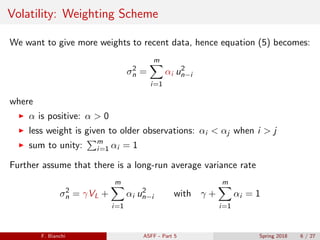
Volatility: Weighting Scheme
We want to give more weights to recent data, hence equation (5) becomes:
σ2
n =
m
i=1
αi u2
n−i
where
α is positive: α > 0
less weight is given to older observations: αi < αj when i > j
sum to unity: m
i=1 αi = 1
Further assume that there is a long-run average variance rate
σ2
n = γVL +
m
i=1
αi u2
n−i with γ +
m
i=1
αi = 1
F. Bianchi ASFF - Part 5 Spring 2018 6 / 27
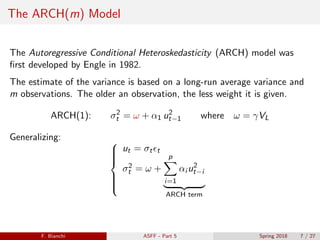
The ARCH(m) Model
The Autoregressive Conditional Heteroskedasticity (ARCH) model was
first developed by Engle in 1982.
The estimate of the variance is based on a long-run average variance and
m observations. The older an observation, the less weight it is given.
ARCH(1): σ2
t = ω + α1 u2
t−1 where ω = γVL
Generalizing: 


ut = σt t
σ2
t = ω +
p
i=1
αi u2
t−i
ARCH term
F. Bianchi ASFF - Part 5 Spring 2018 7 / 27
The GARCH(p, q) Model
The Generalized Autoregressive Conditional Heteroskedasticity (GARCH)
model was first introduced by Bollerslev in 1986.
The simplest version of the model is the GARCH(1,1) one, where the
variance rate is calculated from a long-run average variance rate, VL, as
well as from σn−1 and un−1. Defined as:
σ2
t = γVL + α1u2
t−1 + β1σ2
t−1 = ω + α1u2
t−1 + β1σ2
t−1
where α1 + β1 < 1 in order to ensure stability of the process.
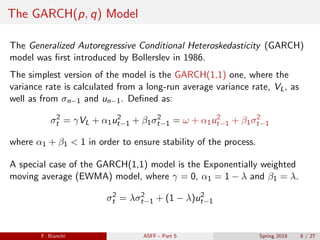
A special case of the GARCH(1,1) model is the Exponentially weighted
moving average (EWMA) model, where γ = 0, α1 = 1 − λ and β1 = λ.
σ2
t = λσ2
t−1 + (1 − λ)u2
t−1
F. Bianchi ASFF - Part 5 Spring 2018 8 / 27
The GARCH(p, q) Model (Cont.)
The Generalized Autoregressive Conditional Heteroscedasticity
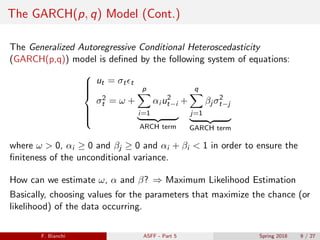
(GARCH(p,q)) model is defined by the following system of equations:



ut = σt t
σ2
t = ω +
p
i=1
αi u2
t−i
ARCH term
+
q
j=1
βj σ2
t−j
GARCH term
where ω > 0, αi ≥ 0 and βj ≥ 0 and αi + βi < 1 in order to ensure the
finiteness of the unconditional variance.
How can we estimate ω, α and β? ⇒ Maximum Likelihood Estimation
Basically, choosing values for the parameters that maximize the chance (or
likelihood) of the data occurring.
F. Bianchi ASFF - Part 5 Spring 2018 9 / 27
The GARCH(p, q) Model (Cont.)
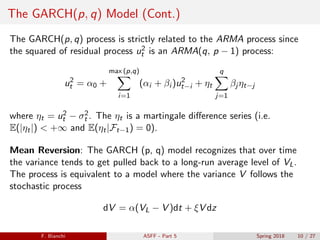
The GARCH(p, q) process is strictly related to the ARMA process since
the squared of residual process u2
t is an ARMA(q, p − 1) process:
u2
t = α0 +
max (p,q)
i=1
(αi + βi )u2
t−i + ηt
q
j=1
βj ηt−j
where ηt = u2
t − σ2
t . The ηt is a martingale difference series (i.e.
E(|ηt|) < +∞ and E(ηt|Ft−1) = 0).
Mean Reversion: The GARCH (p, q) model recognizes that over time
the variance tends to get pulled back to a long-run average level of VL.
The process is equivalent to a model where the variance V follows the
stochastic process
dV = α(VL − V )dt + ξV dz
F. Bianchi ASFF - Part 5 Spring 2018 10 / 27
Exercises
Exercise 1
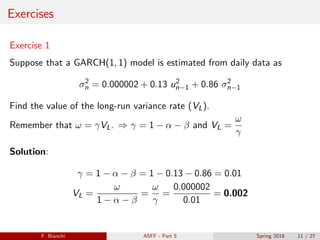
Suppose that a GARCH(1, 1) model is estimated from daily data as
σ2
n = 0.000002 + 0.13 u2
n−1 + 0.86 σ2
n−1
Find the value of the long-run variance rate (VL).
Remember that ω = γVL. ⇒ γ = 1 − α − β and VL =
ω
γ
Solution:
γ = 1 − α − β = 1 − 0.13 − 0.86 = 0.01
VL =
ω
1 − α − β
=
ω
γ
=
0.000002
0.01
= 0.002
F. Bianchi ASFF - Part 5 Spring 2018 11 / 27
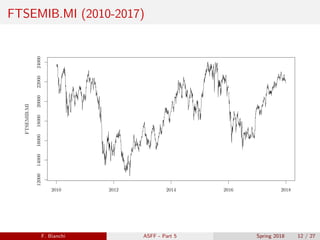
FTSEMIB.MI (2010-2017)
2010 2012 2014 2016 2018
12000140001600018000200002200024000
FTSEMIB.MI
F. Bianchi ASFF - Part 5 Spring 2018 12 / 27
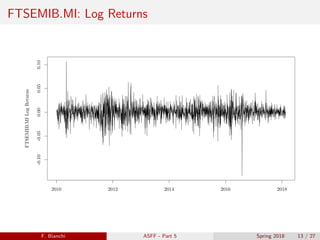
FTSEMIB.MI: Log Returns
2010 2012 2014 2016 2018
-0.10-0.050.000.050.10
FTSEMIB.MILogReturns
F. Bianchi ASFF - Part 5 Spring 2018 13 / 27
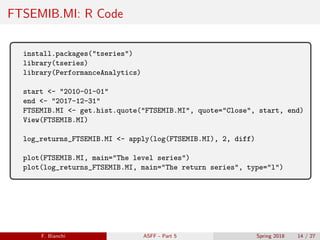
FTSEMIB.MI: R Code
install.packages("tseries")
library(tseries)
library(PerformanceAnalytics)
start <- "2010-01-01"
end <- "2017-12-31"
FTSEMIB.MI <- get.hist.quote("FTSEMIB.MI", quote="Close", start, end)
View(FTSEMIB.MI)
log_returns_FTSEMIB.MI <- apply(log(FTSEMIB.MI), 2, diff)
plot(FTSEMIB.MI, main="The level series")
plot(log_returns_FTSEMIB.MI, main="The return series", type="l")
F. Bianchi ASFF - Part 5 Spring 2018 14 / 27
Autocorrelation in Returns
There is usually a certain form of heteroskedasticity in a series of
returns.
High volatility today can lead to high volatility tomorrow.
Variances today and tomorrow are somehow related.
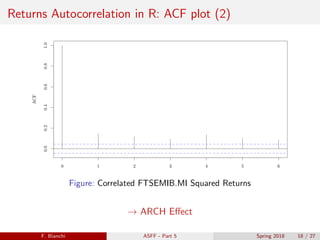
This form of heteroskedasticity implies that there will be
autocorrelation in squared returns. → ARCH Effect
To check the ARCH effect we use the R package FinTS. Two tests are
available in the package: Ljung-Box test and Lagrange Multiplier test.
Further packages can be used to implement this tests: stats and fGarch.
F. Bianchi ASFF - Part 5 Spring 2018 15 / 27
Returns Autocorrelation in R
We study the autocorrelation between log returns
start <- "2010-01-01"
end <- "2017-12-31"
FTSEMIB.MI <- get.hist.quote("FTSEMIB.MI", quote="Close", start, end)
log_returns_FTSEMIB.MI <- apply(log(FTSEMIB.MI), 2, diff)
log_returns_FTSEMIB.MI <- na.omit(log_returns_FTSEMIB.MI)
num_log_returns_FTSEMIB.MI <- as.numeric(log_returns_FTSEMIB.MI)
acf(num_log_returns_FTSEMIB.MI, lag.max = 6)
acf(num_log_returns_FTSEMIB.MI^2, lag.max = 6)
F. Bianchi ASFF - Part 5 Spring 2018 16 / 27
Returns Autocorrelation in R: ACF plot
0 1 2 3 4 5 6
0.00.20.40.60.81.0
ACF
Figure: Uncorrelated FTSEMIB.MI Returns
F. Bianchi ASFF - Part 5 Spring 2018 17 / 27
Returns Autocorrelation in R: ACF plot (2)
0 1 2 3 4 5 6
0.00.20.40.60.81.0
ACF
Figure: Correlated FTSEMIB.MI Squared Returns
→ ARCH Effect
F. Bianchi ASFF - Part 5 Spring 2018 18 / 27
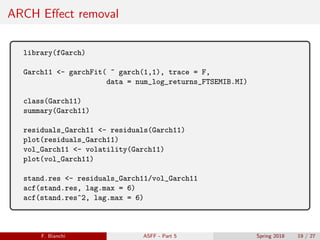
ARCH Effect removal
library(fGarch)
Garch11 <- garchFit( ~ garch(1,1), trace = F,
data = num_log_returns_FTSEMIB.MI)
class(Garch11)
summary(Garch11)
residuals_Garch11 <- residuals(Garch11)
plot(residuals_Garch11)
vol_Garch11 <- volatility(Garch11)
plot(vol_Garch11)
stand.res <- residuals_Garch11/vol_Garch11
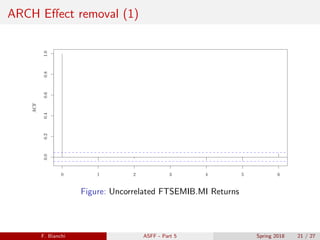
acf(stand.res, lag.max = 6)
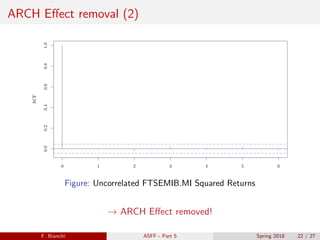
acf(stand.res^2, lag.max = 6)
F. Bianchi ASFF - Part 5 Spring 2018 19 / 27
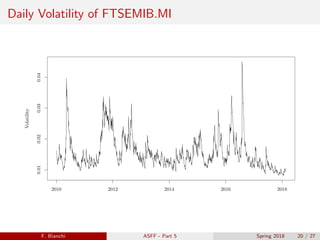
Daily Volatility of FTSEMIB.MI
2010 2012 2014 2016 2018
0.010.020.030.04
Volatility
F. Bianchi ASFF - Part 5 Spring 2018 20 / 27
ARCH Effect removal (1)
0 1 2 3 4 5 6
0.00.20.40.60.81.0
ACF
Figure: Uncorrelated FTSEMIB.MI Returns
F. Bianchi ASFF - Part 5 Spring 2018 21 / 27
ARCH Effect removal (2)
0 1 2 3 4 5 6
0.00.20.40.60.81.0
ACF
Figure: Uncorrelated FTSEMIB.MI Squared Returns
→ ARCH Effect removed!
F. Bianchi ASFF - Part 5 Spring 2018 22 / 27
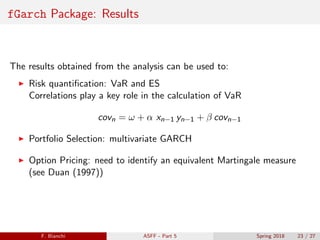
fGarch Package: Results
The results obtained from the analysis can be used to:
Risk quantification: VaR and ES
Correlations play a key role in the calculation of VaR
covn = ω + α xn−1 yn−1 + β covn−1
Portfolio Selection: multivariate GARCH
Option Pricing: need to identify an equivalent Martingale measure
(see Duan (1997))
F. Bianchi ASFF - Part 5 Spring 2018 23 / 27
The COGARCH Model
A further implementation of the GARCH Model is the Continuos GARCH
Model (COGARCH) firstly introduced by Kl¨uppelberg in 2004.
Let Lt be a pure jump L´evy process with finite variation. We define Gt as
a COGARCH(p, q) process with q ≥ p if it satisfies the following system
of stochastic differential equations:



dGt =
√
VtdLt withG0 = 0
Vt = a0 + a Yt−
dYt = BYt−dt + a0 + a Yt− d [L, L]
(d)
t
Where (Vt)t≥0 is a CARMA(q, p − 1) process driven by the discrete part
of the quadratic variation of the L´evy process (Lt)t≥0.
F. Bianchi ASFF - Part 5 Spring 2018 24 / 27
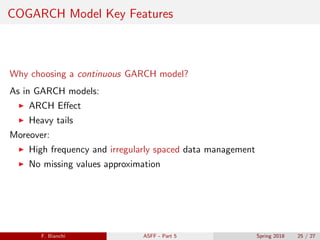
COGARCH Model Key Features
Why choosing a continuous GARCH model?
As in GARCH models:
ARCH Effect
Heavy tails
Moreover:
High frequency and irregularly spaced data management
No missing values approximation
F. Bianchi ASFF - Part 5 Spring 2018 25 / 27
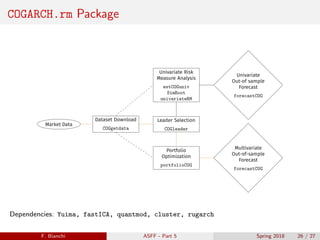
COGARCH.rm Package
Dataset Download
COGgetdata
Market Data
Leader Selection
COGleader
Univariate Risk
Measure Analysis
estCOGuniv
SimBoot
univariateRM
Portfolio
Optimization
portfolioCOG
Univariate
Out-of sample
Forecast
forecastCOG
Multivariate
Out-of-sample
Forecast
forecastCOG
Dependencies: Yuima, fastICA, quantmod, cluster, rugarch
F. Bianchi ASFF - Part 5 Spring 2018 26 / 27
References
[1] Engle R. (1982) ”Autoregressive Conditional Heteroskedasticity with
Estimates of the Variance of UK Inflation”. Econometrica, 50: 987:1008.
[2] Bollerslev T. (1986). ”Generalized Autoregressive Condtional
Heteroskedasticity”. Journal of Econometrics, 31: 307:327.
[3] Duan, J. (1997). ”Augmented GARCH (p,q) process and its diffusion limit”.
Journal of Econometrics, 79, issue 1, p. 97-127.
[4] Kl¨uppelberg C., Maller R. and Lindner A. (2004). ”A continuous time garch
process driven by a L´evy process: stationarity and second-order behaviour.
Journal of Applied Probability.”
[5] Bianchi F., Mercuri L. and Rroji E. (2016). ”Measuring Risk with
Continuous Time Generalized Autoregressive Conditional Heteroscedasticity
models”. SSRN.
[6] Bianchi F., Mercuri L. and Rroji, E. (2017). COGARCH.rm: Portfolio
selection with Multivariate COGARCH(p,q) models. R package version 0.1.0.
F. Bianchi ASFF - Part 5 Spring 2018 27 / 27

Arch & Garch Processes

  • 1.
    Part 5: AdvancedTopics Applied Statistics for Finance Professor Asmerilda Hitaj asmerilda.hitaj1@unimib.it April 10, 2018 A. Hitaj ASFF - Part 5 Spring 2018 1 / 27
  • 2.
    ARCH Processes Applied Statisticsfor Finance Francesco Bianchi francesco.bianchi04@icatt.it April 10, 2018 F. Bianchi ASFF - Part 5 Spring 2018 2 / 27
  • 3.
    Volatility Most popular optionpricing models, such as Black-Scholes-Merton, assume that the volatility of the underlying asset is constant. In practice, the volatility of an asset, like the asset’s price, is a stochastic variable. Unlike the asset price, it is not directly observable. ”Volatility is a statistical measure of the dispersion of returns for a given security or market index. Volatility can either be measured by using the standard deviation or variance between returns from that same security or market index. Commonly, the higher the volatility, the riskier the security.” How historical data can be used to produce estimates of the current and future levels of volatilities (and correlations). ARCH and GARCH processes F. Bianchi ASFF - Part 5 Spring 2018 3 / 27
  • 4.
    ARCH and GARCHModel: Returns Dependence Models: ARCH: autoregressive conditional heteroscedasticity GARCH: generalized autoregressive conditional heteroscedasticity ⇒ The distinctive feature of the models is that they recognize that volatilities and correlations are not constant. noncostant variances conditional on the past: V (ut|ut−1) constant unconditional variances: V (ut) The recent past gives information about the one-period forecast variance. The main idea behind the ARCH/GARCH model is that the log-returns rt are usually uncorrelated but there is still dependence. F. Bianchi ASFF - Part 5 Spring 2018 4 / 27
  • 5.
    Volatility (2) Return: ui= ln Si Si−1 = ln pi pi−1 Variance rate: σ2 n = 1 m − 1 m i=1 (un−i − ¯u)2 where ¯u = 1 m un−i Volatility: σ2 n = σn ⇓ Return (% change): ui = Si − Si−1 Si−1 = pi − pi−1 pi−1 Variance rate: σ2 n = 1 m m i=1 u2 n−i (5) F. Bianchi ASFF - Part 5 Spring 2018 5 / 27
  • 6.
    Volatility: Weighting Scheme Wewant to give more weights to recent data, hence equation (5) becomes: σ2 n = m i=1 αi u2 n−i where α is positive: α > 0 less weight is given to older observations: αi < αj when i > j sum to unity: m i=1 αi = 1 Further assume that there is a long-run average variance rate σ2 n = γVL + m i=1 αi u2 n−i with γ + m i=1 αi = 1 F. Bianchi ASFF - Part 5 Spring 2018 6 / 27
  • 7.
    The ARCH(m) Model TheAutoregressive Conditional Heteroskedasticity (ARCH) model was first developed by Engle in 1982. The estimate of the variance is based on a long-run average variance and m observations. The older an observation, the less weight it is given. ARCH(1): σ2 t = ω + α1 u2 t−1 where ω = γVL Generalizing:    ut = σt t σ2 t = ω + p i=1 αi u2 t−i ARCH term F. Bianchi ASFF - Part 5 Spring 2018 7 / 27
  • 8.
    The GARCH(p, q)Model The Generalized Autoregressive Conditional Heteroskedasticity (GARCH) model was first introduced by Bollerslev in 1986. The simplest version of the model is the GARCH(1,1) one, where the variance rate is calculated from a long-run average variance rate, VL, as well as from σn−1 and un−1. Defined as: σ2 t = γVL + α1u2 t−1 + β1σ2 t−1 = ω + α1u2 t−1 + β1σ2 t−1 where α1 + β1 < 1 in order to ensure stability of the process. A special case of the GARCH(1,1) model is the Exponentially weighted moving average (EWMA) model, where γ = 0, α1 = 1 − λ and β1 = λ. σ2 t = λσ2 t−1 + (1 − λ)u2 t−1 F. Bianchi ASFF - Part 5 Spring 2018 8 / 27
  • 9.
    The GARCH(p, q)Model (Cont.) The Generalized Autoregressive Conditional Heteroscedasticity (GARCH(p,q)) model is defined by the following system of equations:    ut = σt t σ2 t = ω + p i=1 αi u2 t−i ARCH term + q j=1 βj σ2 t−j GARCH term where ω > 0, αi ≥ 0 and βj ≥ 0 and αi + βi < 1 in order to ensure the finiteness of the unconditional variance. How can we estimate ω, α and β? ⇒ Maximum Likelihood Estimation Basically, choosing values for the parameters that maximize the chance (or likelihood) of the data occurring. F. Bianchi ASFF - Part 5 Spring 2018 9 / 27
  • 10.
    The GARCH(p, q)Model (Cont.) The GARCH(p, q) process is strictly related to the ARMA process since the squared of residual process u2 t is an ARMA(q, p − 1) process: u2 t = α0 + max (p,q) i=1 (αi + βi )u2 t−i + ηt q j=1 βj ηt−j where ηt = u2 t − σ2 t . The ηt is a martingale difference series (i.e. E(|ηt|) < +∞ and E(ηt|Ft−1) = 0). Mean Reversion: The GARCH (p, q) model recognizes that over time the variance tends to get pulled back to a long-run average level of VL. The process is equivalent to a model where the variance V follows the stochastic process dV = α(VL − V )dt + ξV dz F. Bianchi ASFF - Part 5 Spring 2018 10 / 27
  • 11.
    Exercises Exercise 1 Suppose thata GARCH(1, 1) model is estimated from daily data as σ2 n = 0.000002 + 0.13 u2 n−1 + 0.86 σ2 n−1 Find the value of the long-run variance rate (VL). Remember that ω = γVL. ⇒ γ = 1 − α − β and VL = ω γ Solution: γ = 1 − α − β = 1 − 0.13 − 0.86 = 0.01 VL = ω 1 − α − β = ω γ = 0.000002 0.01 = 0.002 F. Bianchi ASFF - Part 5 Spring 2018 11 / 27
  • 12.
    FTSEMIB.MI (2010-2017) 2010 20122014 2016 2018 12000140001600018000200002200024000 FTSEMIB.MI F. Bianchi ASFF - Part 5 Spring 2018 12 / 27
  • 13.
    FTSEMIB.MI: Log Returns 20102012 2014 2016 2018 -0.10-0.050.000.050.10 FTSEMIB.MILogReturns F. Bianchi ASFF - Part 5 Spring 2018 13 / 27
  • 14.
    FTSEMIB.MI: R Code install.packages("tseries") library(tseries) library(PerformanceAnalytics) start<- "2010-01-01" end <- "2017-12-31" FTSEMIB.MI <- get.hist.quote("FTSEMIB.MI", quote="Close", start, end) View(FTSEMIB.MI) log_returns_FTSEMIB.MI <- apply(log(FTSEMIB.MI), 2, diff) plot(FTSEMIB.MI, main="The level series") plot(log_returns_FTSEMIB.MI, main="The return series", type="l") F. Bianchi ASFF - Part 5 Spring 2018 14 / 27
  • 15.
    Autocorrelation in Returns Thereis usually a certain form of heteroskedasticity in a series of returns. High volatility today can lead to high volatility tomorrow. Variances today and tomorrow are somehow related. This form of heteroskedasticity implies that there will be autocorrelation in squared returns. → ARCH Effect To check the ARCH effect we use the R package FinTS. Two tests are available in the package: Ljung-Box test and Lagrange Multiplier test. Further packages can be used to implement this tests: stats and fGarch. F. Bianchi ASFF - Part 5 Spring 2018 15 / 27
  • 16.
    Returns Autocorrelation inR We study the autocorrelation between log returns start <- "2010-01-01" end <- "2017-12-31" FTSEMIB.MI <- get.hist.quote("FTSEMIB.MI", quote="Close", start, end) log_returns_FTSEMIB.MI <- apply(log(FTSEMIB.MI), 2, diff) log_returns_FTSEMIB.MI <- na.omit(log_returns_FTSEMIB.MI) num_log_returns_FTSEMIB.MI <- as.numeric(log_returns_FTSEMIB.MI) acf(num_log_returns_FTSEMIB.MI, lag.max = 6) acf(num_log_returns_FTSEMIB.MI^2, lag.max = 6) F. Bianchi ASFF - Part 5 Spring 2018 16 / 27
  • 17.
    Returns Autocorrelation inR: ACF plot 0 1 2 3 4 5 6 0.00.20.40.60.81.0 ACF Figure: Uncorrelated FTSEMIB.MI Returns F. Bianchi ASFF - Part 5 Spring 2018 17 / 27
  • 18.
    Returns Autocorrelation inR: ACF plot (2) 0 1 2 3 4 5 6 0.00.20.40.60.81.0 ACF Figure: Correlated FTSEMIB.MI Squared Returns → ARCH Effect F. Bianchi ASFF - Part 5 Spring 2018 18 / 27
  • 19.
    ARCH Effect removal library(fGarch) Garch11<- garchFit( ~ garch(1,1), trace = F, data = num_log_returns_FTSEMIB.MI) class(Garch11) summary(Garch11) residuals_Garch11 <- residuals(Garch11) plot(residuals_Garch11) vol_Garch11 <- volatility(Garch11) plot(vol_Garch11) stand.res <- residuals_Garch11/vol_Garch11 acf(stand.res, lag.max = 6) acf(stand.res^2, lag.max = 6) F. Bianchi ASFF - Part 5 Spring 2018 19 / 27
  • 20.
    Daily Volatility ofFTSEMIB.MI 2010 2012 2014 2016 2018 0.010.020.030.04 Volatility F. Bianchi ASFF - Part 5 Spring 2018 20 / 27
  • 21.
    ARCH Effect removal(1) 0 1 2 3 4 5 6 0.00.20.40.60.81.0 ACF Figure: Uncorrelated FTSEMIB.MI Returns F. Bianchi ASFF - Part 5 Spring 2018 21 / 27
  • 22.
    ARCH Effect removal(2) 0 1 2 3 4 5 6 0.00.20.40.60.81.0 ACF Figure: Uncorrelated FTSEMIB.MI Squared Returns → ARCH Effect removed! F. Bianchi ASFF - Part 5 Spring 2018 22 / 27
  • 23.
    fGarch Package: Results Theresults obtained from the analysis can be used to: Risk quantification: VaR and ES Correlations play a key role in the calculation of VaR covn = ω + α xn−1 yn−1 + β covn−1 Portfolio Selection: multivariate GARCH Option Pricing: need to identify an equivalent Martingale measure (see Duan (1997)) F. Bianchi ASFF - Part 5 Spring 2018 23 / 27
  • 24.
    The COGARCH Model Afurther implementation of the GARCH Model is the Continuos GARCH Model (COGARCH) firstly introduced by Kl¨uppelberg in 2004. Let Lt be a pure jump L´evy process with finite variation. We define Gt as a COGARCH(p, q) process with q ≥ p if it satisfies the following system of stochastic differential equations:    dGt = √ VtdLt withG0 = 0 Vt = a0 + a Yt− dYt = BYt−dt + a0 + a Yt− d [L, L] (d) t Where (Vt)t≥0 is a CARMA(q, p − 1) process driven by the discrete part of the quadratic variation of the L´evy process (Lt)t≥0. F. Bianchi ASFF - Part 5 Spring 2018 24 / 27
  • 25.
    COGARCH Model KeyFeatures Why choosing a continuous GARCH model? As in GARCH models: ARCH Effect Heavy tails Moreover: High frequency and irregularly spaced data management No missing values approximation F. Bianchi ASFF - Part 5 Spring 2018 25 / 27
  • 26.
    COGARCH.rm Package Dataset Download COGgetdata MarketData Leader Selection COGleader Univariate Risk Measure Analysis estCOGuniv SimBoot univariateRM Portfolio Optimization portfolioCOG Univariate Out-of sample Forecast forecastCOG Multivariate Out-of-sample Forecast forecastCOG Dependencies: Yuima, fastICA, quantmod, cluster, rugarch F. Bianchi ASFF - Part 5 Spring 2018 26 / 27
  • 27.
    References [1] Engle R.(1982) ”Autoregressive Conditional Heteroskedasticity with Estimates of the Variance of UK Inflation”. Econometrica, 50: 987:1008. [2] Bollerslev T. (1986). ”Generalized Autoregressive Condtional Heteroskedasticity”. Journal of Econometrics, 31: 307:327. [3] Duan, J. (1997). ”Augmented GARCH (p,q) process and its diffusion limit”. Journal of Econometrics, 79, issue 1, p. 97-127. [4] Kl¨uppelberg C., Maller R. and Lindner A. (2004). ”A continuous time garch process driven by a L´evy process: stationarity and second-order behaviour. Journal of Applied Probability.” [5] Bianchi F., Mercuri L. and Rroji E. (2016). ”Measuring Risk with Continuous Time Generalized Autoregressive Conditional Heteroscedasticity models”. SSRN. [6] Bianchi F., Mercuri L. and Rroji, E. (2017). COGARCH.rm: Portfolio selection with Multivariate COGARCH(p,q) models. R package version 0.1.0. F. Bianchi ASFF - Part 5 Spring 2018 27 / 27