Post Graduate Diploma in Management
Future Managers Group Programme
Term: III (Jan-Mar 2018)
Operations Management
Case 09
Aravind Eye Care System
IDID NameName
11 261110 Soham Roy
22 261111 Sonik Garg
33 261112 Sourav Sarkar
44 261113 Srihari Sujeev
55 261114 Subodh Jain
66 261115 Vaibhav Agarwal
OM
Group
Case Presentation
Presentation Date: 03/03/2018Presentation Date: 03/03/2018
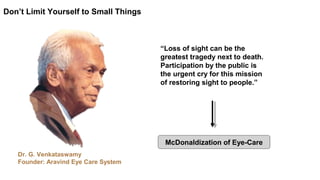
Dr. G. Venkataswamy
Founder: Aravind Eye Care System
Don’t Limit Yourself to Small Things
“Loss of sight can be the
greatest tragedy next to death.
Participation by the public is
the urgent cry for this mission
of restoring sight to people.”
McDonaldization of Eye-Care
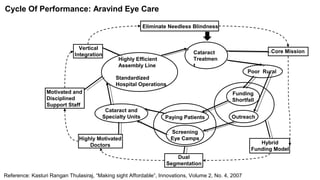
Cataract
Treatmen
t
Screening
Eye Camps
Paying Patients
Funding
Shortfall
Outreach
Highly Efficient
Assembly Line
Standardized
Hospital Operations
Core Mission
Dual
Segmentation
Highly Motivated
Doctors
Motivated and
Disciplined
Support Staff
Hybrid
Funding Model
Vertical
Integration
Eliminate Needless Blindness
Poor Rural
Cataract and
Specialty Units
Reference: Kasturi Rangan Thulasiraj, “Making sight Affordable”, Innovations, Volume 2, No. 4, 2007
Cycle Of Performance: Aravind Eye Care
Business or Charity Service?
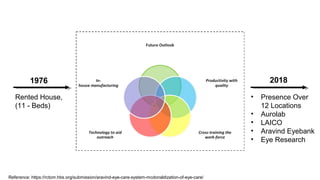
1976
Rented House,
(11 - Beds)
• Presence Over
12 Locations
• Aurolab
• LAICO
• Aravind Eyebank
• Eye Research
2018
Reference: https://rctom.hbs.org/submission/aravind-eye-care-system-mcdonaldization-of-eye-care/
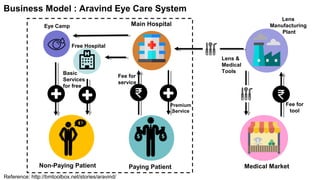
Main Hospital
Paying PatientNon-Paying Patient
Eye Camp
Free Hospital
Lens
Manufacturing
Plant
Premium
Service
Fee for
tool
Fee for
service
Lens &
Medical
ToolsBasic
Services
for free
Business Model : Aravind Eye Care System
Medical Market
Reference: http://bmtoolbox.net/stories/aravind/
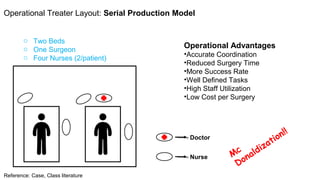
Doctor
Nurse
Operational Treater Layout: Serial Production Model
o Two Beds
o One Surgeon
o Four Nurses (2/patient)
Operational Advantages
•Accurate Coordination
•Reduced Surgery Time
•More Success Rate
•Well Defined Tasks
•High Staff Utilization
•Low Cost per Surgery
Reference: Case, Class literature
Mc
Donaldization!!
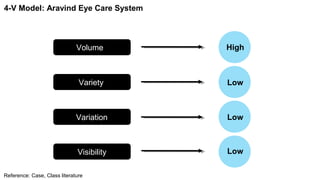
4-V Model: Aravind Eye Care System
Volume
Variety
Variation
Visibility
High
Low
Low
Low
Reference: Case, Class literature
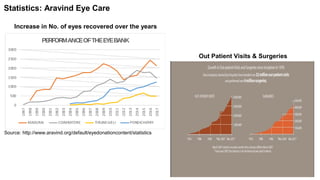
0
500
1000
1500
2000
2500
3000
1997
1998
1999
2000
2001
2002
2003
2004
2005
2006
2007
2008
2009
2010
2011
2012
2013
2014
2015
2016
2017
PERFORMANCEOFTHEEYEBANK
MADURAI COIMBATORE TIRUNELVELI PONDICHERRY
Source: http://www.aravind.org/default/eyedonationcontent/statistics
Increase in No. of eyes recovered over the years
Out Patient Visits & Surgeries
Statistics: Aravind Eye Care
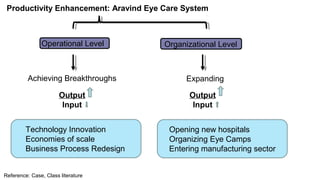
Productivity Enhancement: Aravind Eye Care System
Organizational LevelOperational Level
ExpandingAchieving Breakthroughs
Technology Innovation
Economies of scale
Business Process Redesign
Opening new hospitals
Organizing Eye Camps
Entering manufacturing sector
Output
Input
Output
Input
Reference: Case, Class literature
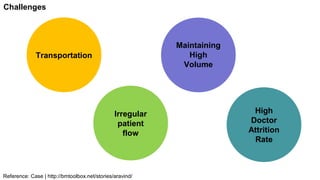
Maintaining
High
Volume
Transportation
Irregular
patient
flow
Reference: Case | http://bmtoolbox.net/stories/aravind/
Challenges
High
Doctor
Attrition
Rate
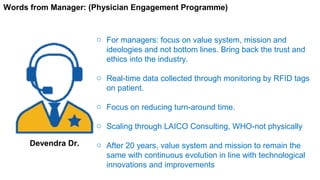
o For managers: focus on value system, mission and
ideologies and not bottom lines. Bring back the trust and
ethics into the industry.
o Real-time data collected through monitoring by RFID tags
on patient.
o Focus on reducing turn-around time.
o Scaling through LAICO Consulting, WHO-not physically
o After 20 years, value system and mission to remain the
same with continuous evolution in line with technological
innovations and improvements
Words from Manager: (Physician Engagement Programme)
Devendra Dr.
Thank You …

Aravind Eye Care System Case Study Operation Management

  • 1.
    Post Graduate Diplomain Management Future Managers Group Programme Term: III (Jan-Mar 2018) Operations Management Case 09 Aravind Eye Care System IDID NameName 11 261110 Soham Roy 22 261111 Sonik Garg 33 261112 Sourav Sarkar 44 261113 Srihari Sujeev 55 261114 Subodh Jain 66 261115 Vaibhav Agarwal OM Group Case Presentation Presentation Date: 03/03/2018Presentation Date: 03/03/2018
  • 2.
    Dr. G. Venkataswamy Founder:Aravind Eye Care System Don’t Limit Yourself to Small Things “Loss of sight can be the greatest tragedy next to death. Participation by the public is the urgent cry for this mission of restoring sight to people.” McDonaldization of Eye-Care
  • 3.
    Cataract Treatmen t Screening Eye Camps Paying Patients Funding Shortfall Outreach HighlyEfficient Assembly Line Standardized Hospital Operations Core Mission Dual Segmentation Highly Motivated Doctors Motivated and Disciplined Support Staff Hybrid Funding Model Vertical Integration Eliminate Needless Blindness Poor Rural Cataract and Specialty Units Reference: Kasturi Rangan Thulasiraj, “Making sight Affordable”, Innovations, Volume 2, No. 4, 2007 Cycle Of Performance: Aravind Eye Care
  • 4.
  • 5.
    1976 Rented House, (11 -Beds) • Presence Over 12 Locations • Aurolab • LAICO • Aravind Eyebank • Eye Research 2018 Reference: https://rctom.hbs.org/submission/aravind-eye-care-system-mcdonaldization-of-eye-care/
  • 6.
    Main Hospital Paying PatientNon-PayingPatient Eye Camp Free Hospital Lens Manufacturing Plant Premium Service Fee for tool Fee for service Lens & Medical ToolsBasic Services for free Business Model : Aravind Eye Care System Medical Market Reference: http://bmtoolbox.net/stories/aravind/
  • 7.
    Doctor Nurse Operational Treater Layout:Serial Production Model o Two Beds o One Surgeon o Four Nurses (2/patient) Operational Advantages •Accurate Coordination •Reduced Surgery Time •More Success Rate •Well Defined Tasks •High Staff Utilization •Low Cost per Surgery Reference: Case, Class literature Mc Donaldization!!
  • 8.
    4-V Model: AravindEye Care System Volume Variety Variation Visibility High Low Low Low Reference: Case, Class literature
  • 9.
    0 500 1000 1500 2000 2500 3000 1997 1998 1999 2000 2001 2002 2003 2004 2005 2006 2007 2008 2009 2010 2011 2012 2013 2014 2015 2016 2017 PERFORMANCEOFTHEEYEBANK MADURAI COIMBATORE TIRUNELVELIPONDICHERRY Source: http://www.aravind.org/default/eyedonationcontent/statistics Increase in No. of eyes recovered over the years Out Patient Visits & Surgeries Statistics: Aravind Eye Care
  • 10.
    Productivity Enhancement: AravindEye Care System Organizational LevelOperational Level ExpandingAchieving Breakthroughs Technology Innovation Economies of scale Business Process Redesign Opening new hospitals Organizing Eye Camps Entering manufacturing sector Output Input Output Input Reference: Case, Class literature
  • 11.
    Maintaining High Volume Transportation Irregular patient flow Reference: Case |http://bmtoolbox.net/stories/aravind/ Challenges High Doctor Attrition Rate
  • 12.
    o For managers:focus on value system, mission and ideologies and not bottom lines. Bring back the trust and ethics into the industry. o Real-time data collected through monitoring by RFID tags on patient. o Focus on reducing turn-around time. o Scaling through LAICO Consulting, WHO-not physically o After 20 years, value system and mission to remain the same with continuous evolution in line with technological innovations and improvements Words from Manager: (Physician Engagement Programme) Devendra Dr.
  • 13.

Editor's Notes

  • #3 India is home to one-third of the world’s blind population with close to 200 million Indians needing eye-care. In 80% of the cases, blindness is caused by factors which can be corrected. Dr. V set out to address this problem of curable blindness and created an institution which performs 400,000 eye surgeries a year. “If Coca-Cola can sell billions of sodas and McDonald’s can sell billions of burger, why can’t Aravind sell millions of sight-restoring operations, and, eventually, the belief in human perfection?” – quipped Dr. Venkatawamy (endearingly known as Dr. V) in an interview to Fast Company. Dr. V had a vision – to restore the gift of sight to millions of poor blind people through the Aravind Eye-Care system (“Aravind”). Aravind’s business model is based on his vision to solve the blindness problem regardless of the patient’s ability to pay. Aravind has been able to successfully execute this business model over the last forty years to become the largest provider of eye-care services in the world.
  • #4 Aravind has been able to develop a self-funding healthcare delivery model where it creates value for its entire customer base but captures the value only from a part of it. Aravind is able to provide free-of-cost or at cost, high-quality service for 50-60% of its patients who are poor or ‘non-paying’ by using the profits generated from the 40-50% of the paying patients. The hospital provides the same quality of service across both paying and non-paying patients and has consistently provided high-quality care for the last 39 years. The organization has been able to achieve this by focusing on the following strategic imperatives – Singular Vision – Dr. V chose a specific vision for the company to focus on – eliminating blindness through cataract surgery Hybrid Business Model – The hybrid model helps Aravind use the cash-flows from paying patients to cross-subsidize services for the needy. This model helped Aravind develop specialty services along with basic cataract surgery and care. The ability to develop high-end ophthalmic care also helped Aravind attract and retain qualified doctors. High volume, high quality and low cost business model –  To provide perspective, the cost of cataract surgery at Aravind could be as low as US$50 while in the US, it is in the range of US$3,000. Reaching out to the under-served – Given the highly fragmented nature of its customer base and due to the need for scale, Aravind has to generate demand through customer outreach programs.
  • #5 This model makes very sound business sense because it‘s fundamentally built on a few core principles. The first one is in terms of market development and through that demand generation. This is a process of converting a need in to a demand and in the process we get a significant percentage of this to our own facilities. The second core principle is excellence in execution of ensuring a high level of efficiency in providing the treatment, including outpatient services and surgeries. The third core principle is one of quality. The aim is to ensure that the patient regardless of whether he is a free or a private patient gets value for his investment in money or time. The fourth principle is of sustainability wherein they set the prices not so much based onwhat it costs us but on how much the various economic strata of the community can afford to pay. It then work backwards to contain the costs within these estimates. This leads to not just financial viability but a higher order of management, as well as inculcating a certain culture in the organisation. The combination of these four principles builds a sustainable programme as they have demonstrated over the last three decades and replicated with similar results in over 200 other eye hospitals.
  • #6 Productivity with quality – Aravind has developed standardized processes for key operations, so as to ensure consistent and efficient delivery. OPD: Aravind serves 6,000 outpatients in the hospital and 1,500 patients in outreach camps every day. The process flow involves registration, vision test, preliminary exam, refraction, final exam, counseling and recommendation for surgery. The Aravind doctor performs>2,000 surgeries in a year compared to the Indian average of 400 and 150-200 for most Asian economies. This significantly higher productivity is obtained by adopting an assembly line approach to surgery. Each operating room has one surgeon in each room, but a minimum of two operating tables, multiple sets of equipment and multiple nursing teams to carry out key non-surgical tasks, such as preparing the patient and administering the anesthetic. This unique layout enables the surgeon to complete a surgery, turn around and start the surgery on the next patient who has been pre-prepared. This procedure enables the doctor to perform six to eight procedures per hour as opposed to usual norm of one surgery per hour. More pertinently, the high productivity does not come at the cost of quality and in fact the clinical outcomes are superior to the average in UK hospitals Cross-training the work-force – To allow the doctors to focus on the most critical tasks of diagnosis and surgery, Aravind has a large staff of nurses and technicians. To further reduce costs, Aravind recruits and trains women from local communities and certifies them as technicians (these women make up 60% of Aravind’s workforce). The nurses and technicians are cross-trained so that they can perform multiple routine tasks. In-house manufacturing – The intra-ocular lens used in the surgery used to make up a significant part of the fixed cost of the surgery at c.US$100. Aravind set up a manufacturing facility which makes intraocular lens called Aurolab in 1992. The price of the lens has been driven down to less than US$10 (90% reduction!). Technology to aid outreach – To facilitate its community outreach programs, Aravind uses both eye camps and telemedicine driven vision centers to source patients for surgery in the main hospital. The vision centers are mobile diagnosis centers which employ tele-medicine so that doctors from the main hospital can evaluate and diagnose millions of patients at scale.   Future Outlook The Aravind model has been partially replicated in more than 300 hospitals globally. However, Aravind believes that it has only covered the tip of the iceberg and that the impact that it can potentially have is much larger. Aravind plans to expand its reach to other parts of India and globally to other developing markets which have large impoverished population. The key source of differentiation for Aravind as compared to other low-cost healthcare players is that it has a strong Research division and it is constantly innovating – on product, process and eye-care delivery.
  • #12 TransportationTransportation is a problem for some of the selected patients from eye camps. They may not be able to travel to the hospital for surgery or to stay away from home for long periods, hence lead to a drop in the number of patients accepting surgery. Irregular patient flowThe flow of patients would be much larger immediately after an eye camp and being much less at other times. The hospital was overcrowded while it operated much below is capacity at other times. ScalabilityPatients are required to come to the hospital for treatment. The camp could not be conducted at a location that was very far from the hospitals.