SEZs in India :A Quantitative
Assessment of Costs and
Benefits
Aradhna Aggarwal
Associate Professor
Department of Business Economics
University of Delhi
Consultant : ICRIER
aradhna.aggarwal@gmail.com
Contents
• The Rationale
• Benefits and costs: Theoretical approaches
• Net Benefits: A quantitative assessment
• Benefits and costs : Qualitative analysis
• Conclusion
Why SEZs?
Two approaches
Orthodox Approach ( neo classical)
Heterodox approach
(New institutional theories)
Earning
foreign exchange
Promotion of EOI
SEZs offer relaxed tax and custom
regime and offset anti-export bias in
import substituting regime
Offer good I climate in export oriented regime
tax incentives :
Modern Infrastructure
Good Governance
Location-specific advantages
EOI is promoted through…
Domestic producers:
1. Independent producers
2. Insertion into GVCs
(Small firms)
Seller driven
Buyer driven
MNCs
Intra-firm trade Clustering
Three channels
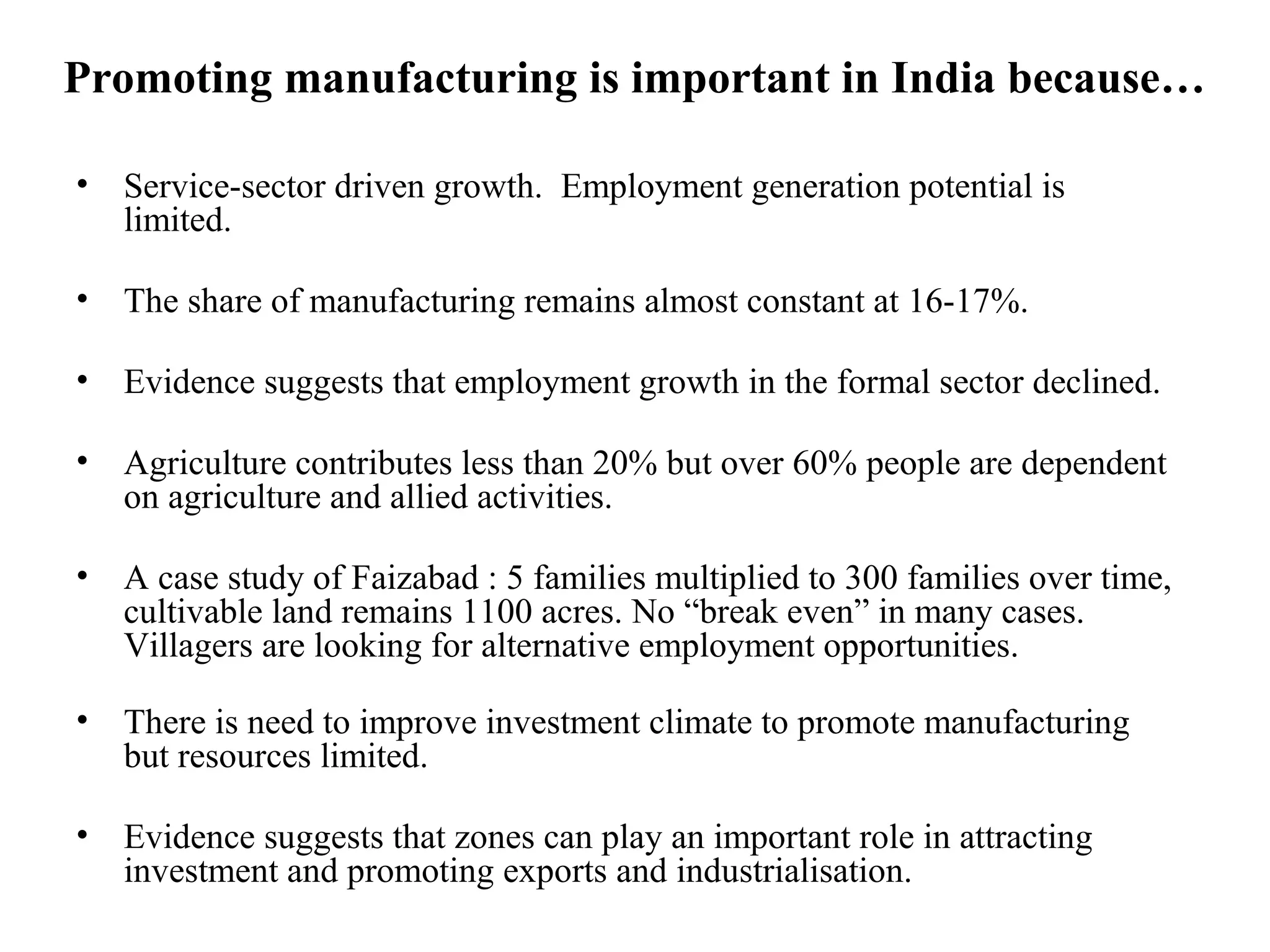
Promoting manufacturing is important in India because…
• Service-sector driven growth. Employment generation potential is
limited.
• The share of manufacturing remains almost constant at 16-17%.
• Evidence suggests that employment growth in the formal sector declined.
• Agriculture contributes less than 20% but over 60% people are dependent
on agriculture and allied activities.
• A case study of Faizabad : 5 families multiplied to 300 families over time,
cultivable land remains 1100 acres. No “break even” in many cases.
Villagers are looking for alternative employment opportunities.
• There is need to improve investment climate to promote manufacturing
but resources limited.
• Evidence suggests that zones can play an important role in attracting
investment and promoting exports and industrialisation.
Benefits to the economy: Theoretical approaches
• 1. Orthodox Approach (Neo classical):
• to offset anti-export bias in a heavily regulated economy :
• always welfare reducing
• 2. Cost benefit approach (accounting method) :Warr, 1989
• SEZs have both costs and benefits.
• Their contribution depends on whether measurable costs are less than measurable
benefits.
• Recognised indirect benefits in terms of income generated
• These arise from backward and forward linkages but argued that they are limited.
• 3. Heterodox approach (Johansson 1994)
• Underscored the importance of indirect effects through spillovers and
demonstrations.
• Overall effects are difficult to measure
• Aggarwal (2007) : Spillovers also take place when
• Zones’ entrepreneurs interact with the rest of the economy entrepreneurs in
various forums.
• Zone entrepreneurs set up production units outside the zones.
Benefits : The Eclectic approach
Direct Indirect
1. Foreign exchange
2. Employment generation
3. Employment for Females
4. Skill Upgradation
5. FDI
6. Tech. transfers and creation
1. Indirect employment
2. Investment
3. Skill spillovers
4. Technology spillovers
1. Ind. growth
2. Productive Diversification
3. Human development
4. Revenue generation for govt.
Quantifiable : static :Foreign Ex
earnings, Net value addition, I, employ,
Dynamic : Income generation
Non quantifiable : other direct and
indirect effects
Costs
• Quantifiable:
• 1. SEZ development cost : Not incurred by the government
• 2. Revenue loss (Tax and other investment incentives)
• 3. Operational costs
Other welfare costs : Non quantifiable
• Resource transfer from the domestic sector to SEZs with no net
addition to economic activities ( relocation and substitution effect)
• Land Acquisition without adequate compensation
• Impoverishment of farmers
• Loss of agricultural land
• Misuse of land for real estate
• Regional disparities
• Unequal treatment
Net benefits
• NNB = (EXP+DTA+TAXGAIN)-IMP-RM-ELEC-ADMIN-TAX LOSS
• Where
• NNB: Net benefits from SEZs
• EXP : foreign exchange earnings and
• DTA : Domestic Tariff area Sales
• TAXGAIN: Taxes collected on DTA sales
• EXP+DTA+TAXGAIN: Total benefits
• IMP : imports
• ELEC : the cost of public utilities (electricity, power and fuel)
• RM : the cost of locally purchased inputs
• TAX Direct and indirect ( only for SEZ developers) tax foregone
• ADMIN: Administrative costs
• IMP+ELEC+RM+TAX+ADMIN : total cost
Fundamental assumptions:
• The proposed SEZ investment in each of the three years will be Rs. 100,000 cr.
• The actual investment in each year will follow a three years’ time frame. In other
words, realized investment in the first year will be 50% of the proposed investment in
that year say, t. In the second (t+1) year, 30% and in the third (t+2) year , 20% of the
investment proposed in the year “t” will be realized.
• Of the total investment, 7% is projected to occur in the FTWZ /power SEZs in each
year. The remaining will be invested in other zones.
• The infrastructure development expenditure in new SEZs will be 60% of the total
investment in the first year. In the second and the third year it will be 30% and 10%.
• The remaining investment termed “productive investment” is divided between the IT
sector and other sectors in the proportion of 44% in the first year, 42% in the second
year and 40% in the third year.
• We required several other conduct and performance related ratios which are based on
the CMIE database of the export oriented sector. Data was extracted for the relevant
industries.
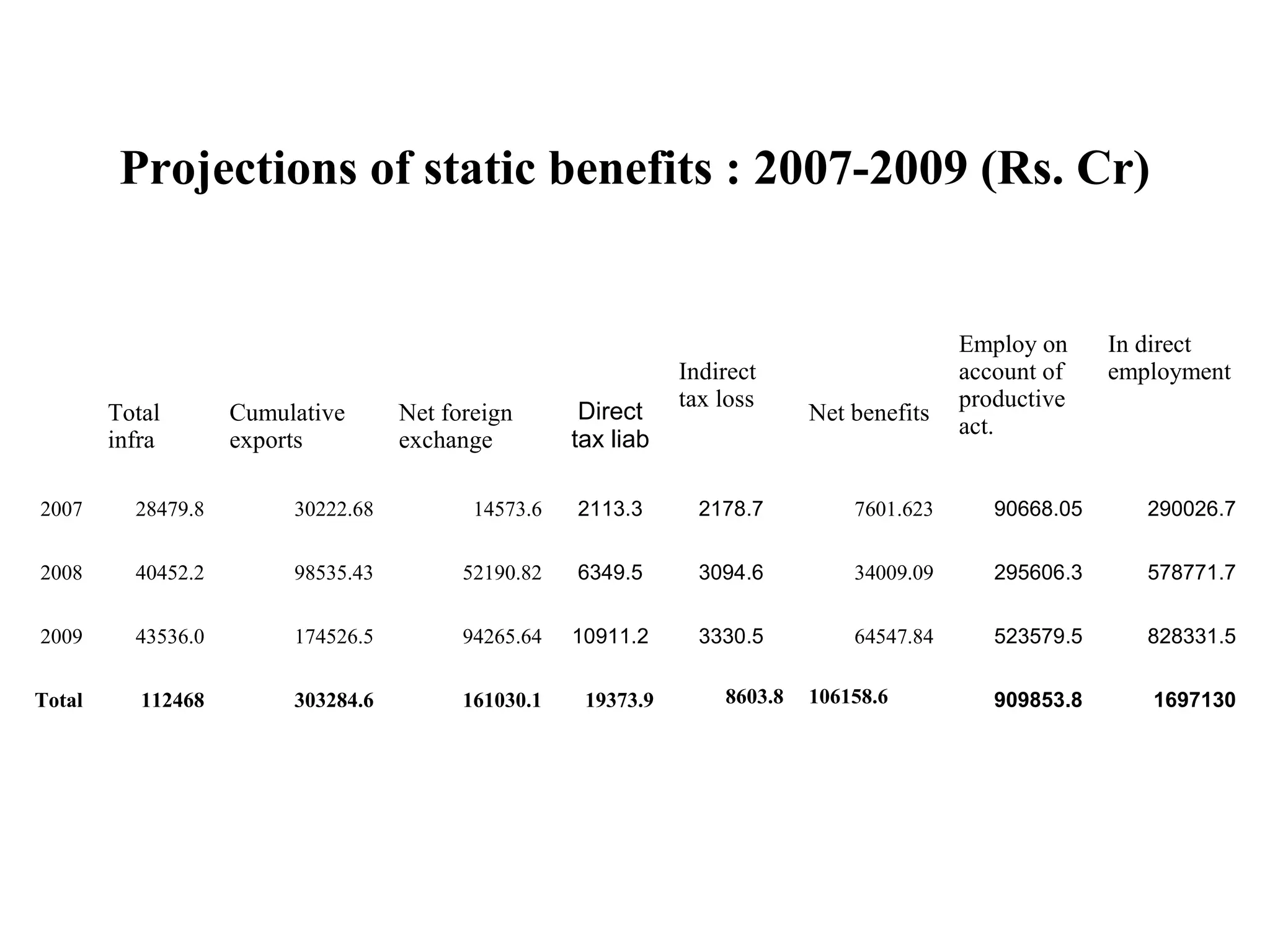
Projections of static benefits : 2007-2009 (Rs. Cr)
Total
infra
Cumulative
exports
Net foreign
exchange
Direct
tax liab
Indirect
tax loss
Net benefits
Employ on
account of
productive
act.
In direct
employment
2007 28479.8 30222.68 14573.6 2113.3 2178.7 7601.623 90668.05 290026.7
2008 40452.2 98535.43 52190.82 6349.5 3094.6 34009.09 295606.3 578771.7
2009 43536.0 174526.5 94265.64 10911.2 3330.5 64547.84 523579.5 828331.5
Total 112468 303284.6 161030.1 19373.9 8603.8 106158.6 909853.8 1697130
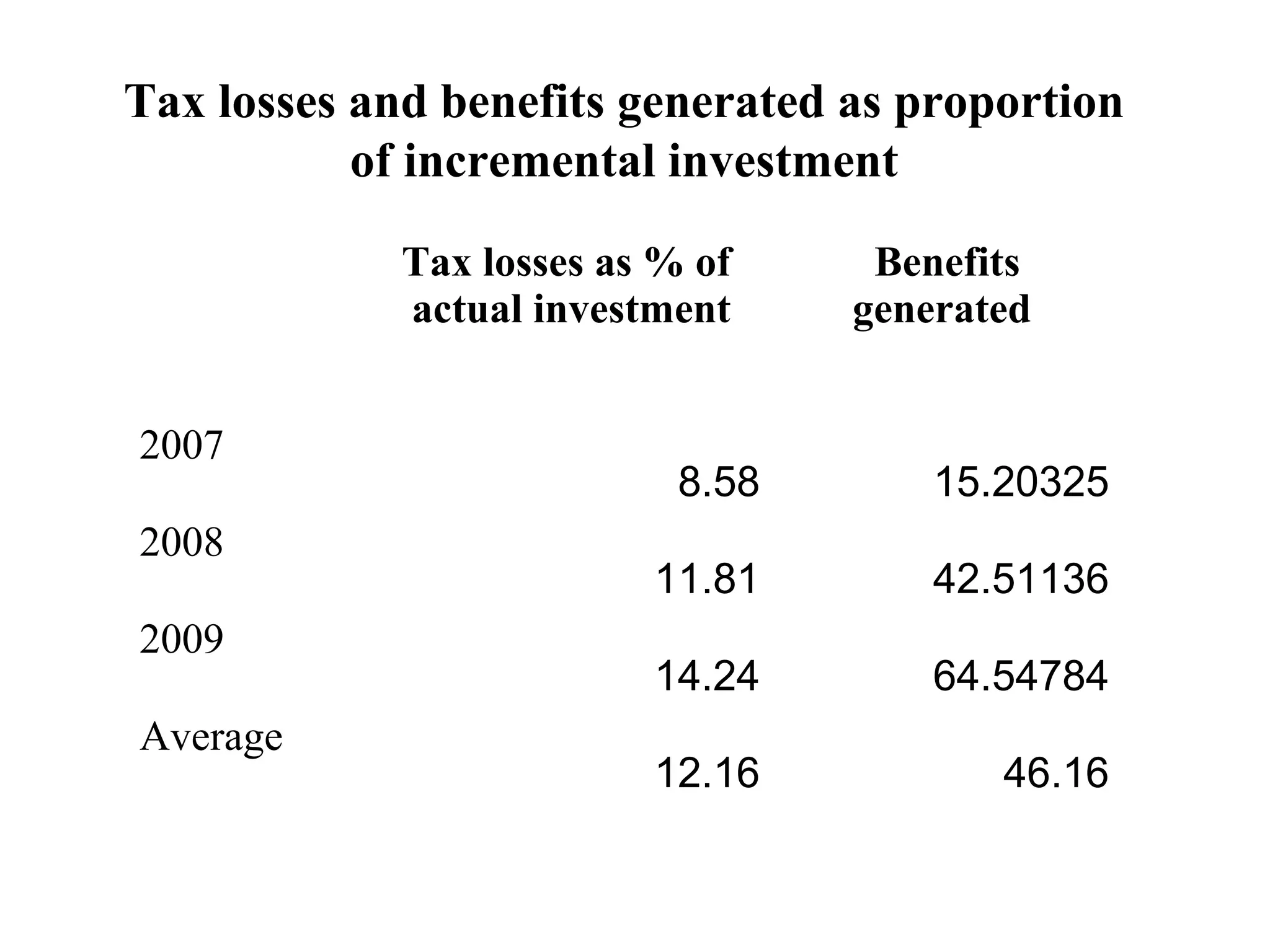
Tax losses and benefits generated as proportion
of incremental investment
Tax losses as % of
actual investment
Benefits
generated
2007
8.58 15.20325
2008
11.81 42.51136
2009
14.24 64.54784
Average
12.16 46.16
Net benefits if no additional investment after 2009
Direct tax loss
(Rs. Cr)
Indirect tax
loss (Rs.Cr)
Net
benefits
2007
2113.3 2178.7047 7601.623
2008
6349.5 3094.5933 34009.09
2009
10911.1 3330.504 64547.84
2010
8034.4 763.2405 48899.05
2011
5911.6 138.771 39294.63
Total
33320.0 9505.8 194352.23
Benefits under the diversion hypothesis (Rs. Crore)
Benefits net of the
IT sector benefits
Total Tax
loss
including
the notional
IT sector
taxes
Benefits as %
to actual I
Tax loss as
% to actual I
(which is the
same as in
Table 7)
2007 5703.198 4291.977 11.41 8.58
2008 21707.13 9444.098 27.13 11.81
2009 40934.7 14241.67 40.93 14.24
Total 68345.03 27977.75 29.7 12.16
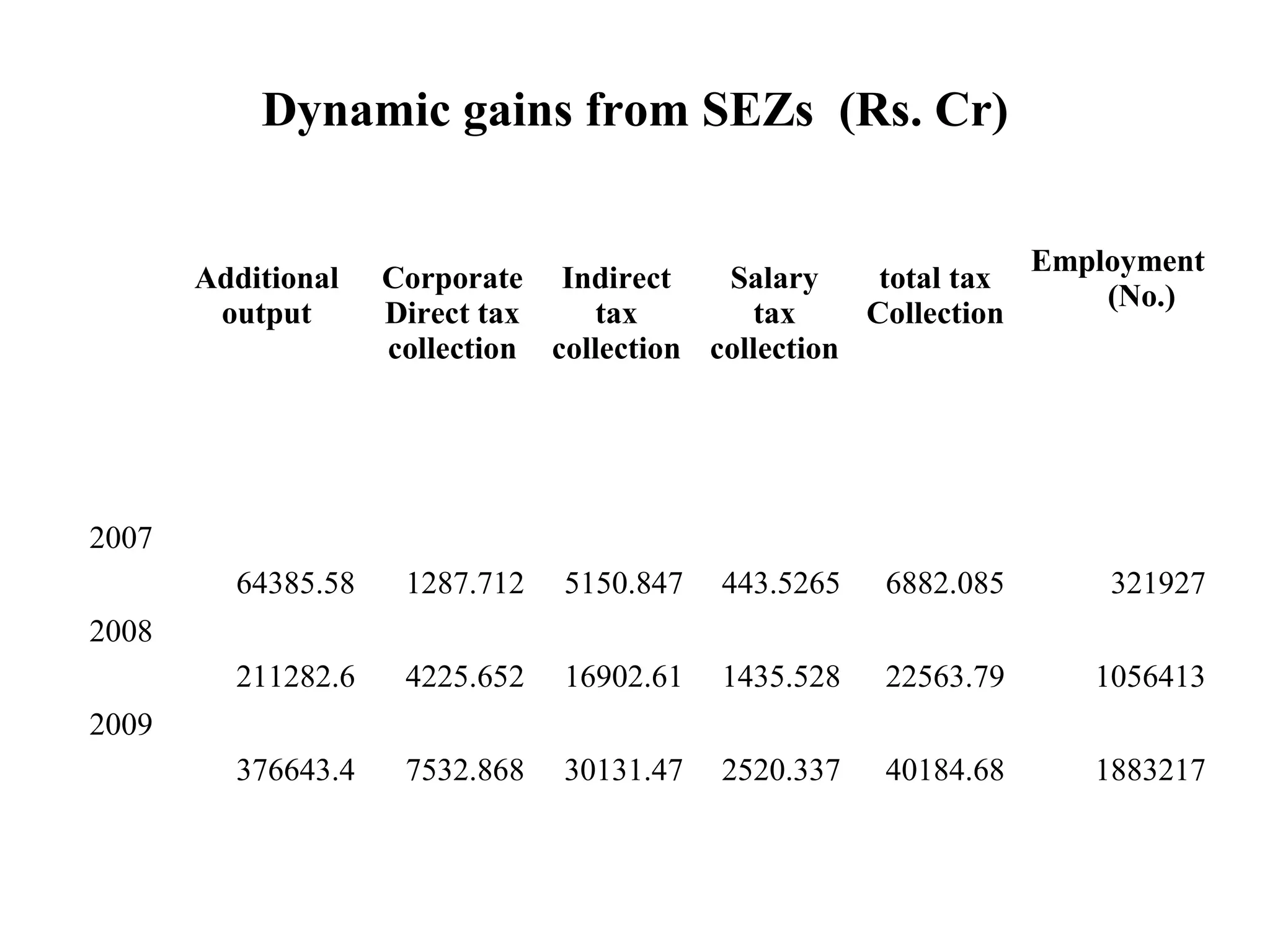
Dynamic gains from SEZs (Rs. Cr)
Additional
output
Corporate
Direct tax
collection
Indirect
tax
collection
Salary
tax
collection
total tax
Collection
Employment
(No.)
2007
64385.58 1287.712 5150.847 443.5265 6882.085 321927
2008
211282.6 4225.652 16902.61 1435.528 22563.79 1056413
2009
376643.4 7532.868 30131.47 2520.337 40184.68 1883217
Contribution of EPZs to Industrial growth/
diversification : A qualitative analysis
At the sector level significant contribution to technology transfer,
spill overs and development of Local entrepreneureship : Gems
and Jewellery, Electronics, SW, rubber gloves
Regional development
Contribution to employment,
Income generation
Ancilliary industrial activities
Most notable : SEEPZ, CSEZ, Kandla, Noida
National
Contribution
to exports,
employment
Human development and Poverty
Remunerative employment for people with low Education
level: : comparable wages and Better working conditions,
satisfaction levels are higher Living conditions improved
after joining the EPZs
Skill formation : Industrial
Training, improvement in skill,
Better prospects outside.
Technology
Transfers,
creation. And
Spillovers limited
SEZ Act provides a major thrust
• 1. A well balanced package of incentives, infrastructure, governance is
offered.
• Should tax incentives be offered:
• Yes, Our survey-based study shows that
• The most important ingredient in any SEZ policy is :Tax incentives
• Three reasons:
• Export obligations, attachment with GVC, no location choice.
• Second most important factor: good governance : custom rules and single
window clearance.
• Third: infrastructure : within zones: electricity and water; outside zones:
transport, roads, ports and airports
• Fourth : location. If good external infrastructure, this is not important. The
argument that they should be set up only near the ports is not sustainable.
Current status
SEZ Status Investment Employment (No.)
Nokia, Tamil Nadu: commenced commercial
production
US$ 100 Million Direct : 2800
Indirect : 10000
Quark City, Chandigarh: Inaugurated by the PM $ 0.5 billion FDI* 35000* by May 2007
Flextronix in Tamilnadu Commences operation
in November 2006
$100 million 3000* (2500 under
training)
Motorola and Foxconn,
Tamilnadu
Units being set up $200 million* 5000* by Dec. 2007
Apache SEZ (Adidas
Group), Andhra Pradesh
Construction started $50 million* 25,000*
Divvy’s Labs, Andhra
Pradesh
 
Commenced operations NA 8000* by April 2007
Rajiv Gandhi
Technology Park,
Chandigarh
Construction started NA 5000* by June 2007
(500 under training)
Brandix Apparel SEZ,
Andhra Pradesh
Advanced stage of
construction
$100 million* 26000* by March 2007
*Expected
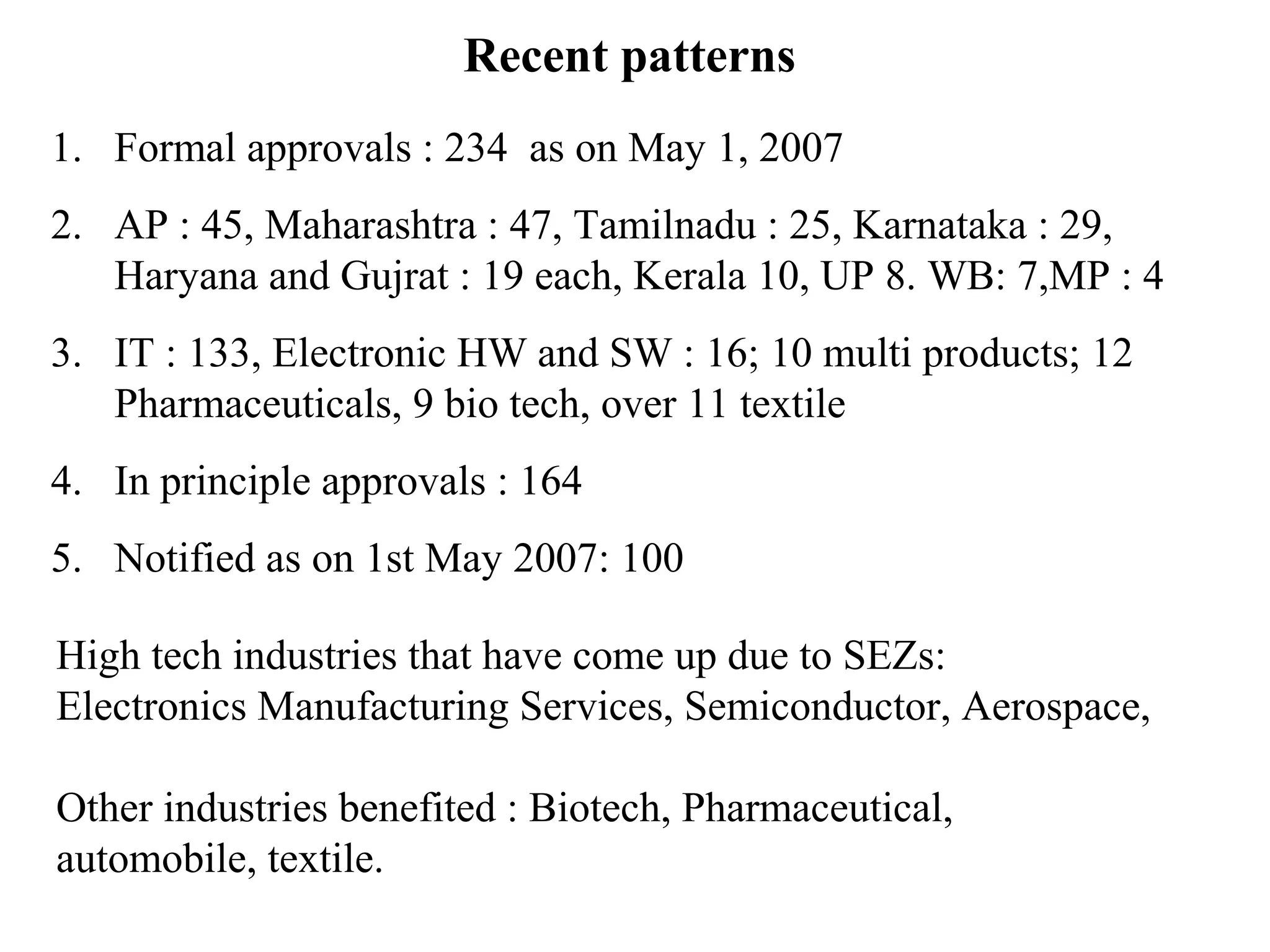
Recent patterns
1. Formal approvals : 234 as on May 1, 2007
2. AP : 45, Maharashtra : 47, Tamilnadu : 25, Karnataka : 29,
Haryana and Gujrat : 19 each, Kerala 10, UP 8. WB: 7,MP : 4
3. IT : 133, Electronic HW and SW : 16; 10 multi products; 12
Pharmaceuticals, 9 bio tech, over 11 textile
4. In principle approvals : 164
5. Notified as on 1st May 2007: 100
High tech industries that have come up due to SEZs:
Electronics Manufacturing Services, Semiconductor, Aerospace,
Other industries benefited : Biotech, Pharmaceutical,
automobile, textile.
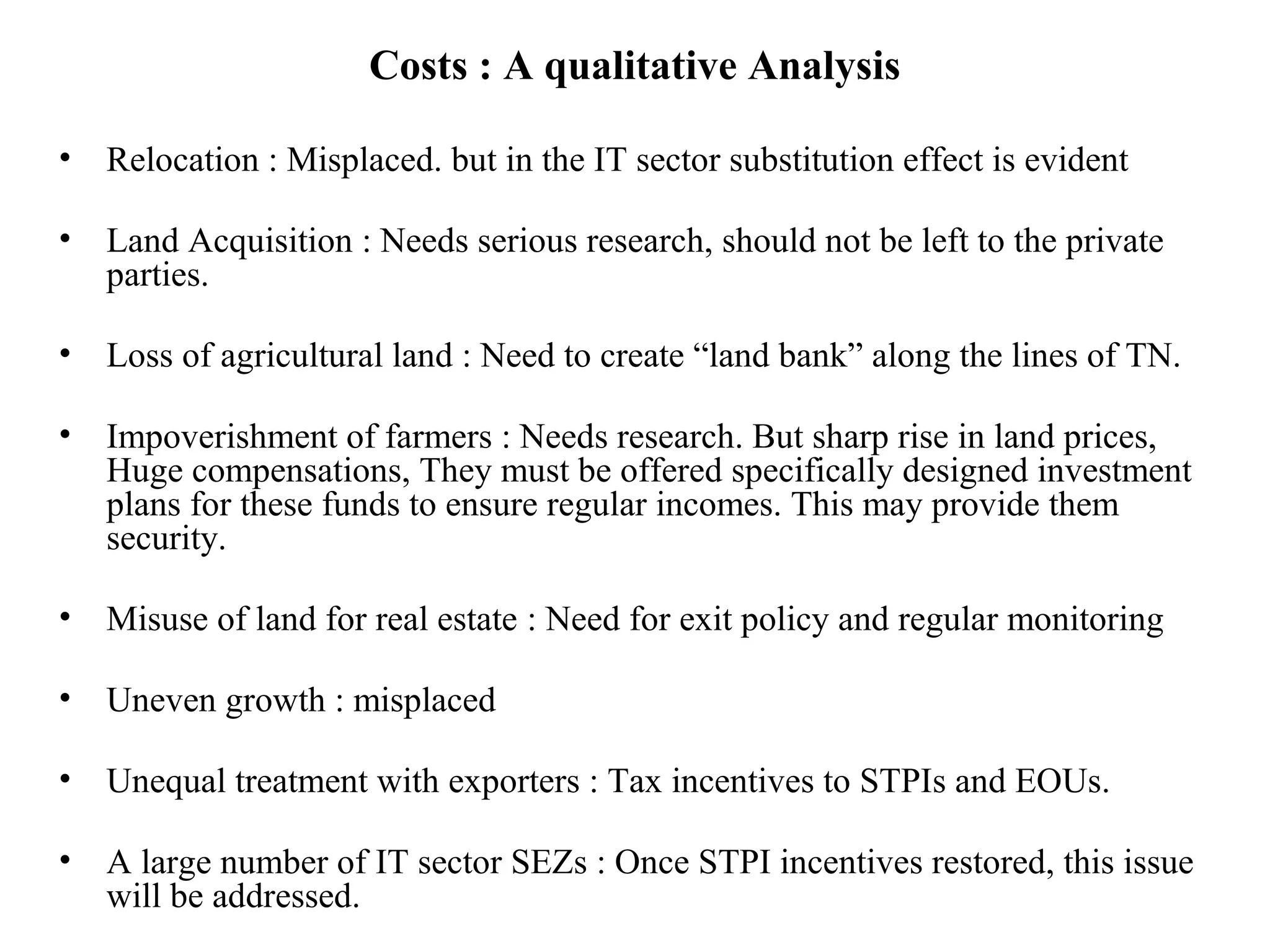
Costs : A qualitative Analysis
• Relocation : Misplaced. but in the IT sector substitution effect is evident
• Land Acquisition : Needs serious research, should not be left to the private
parties.
• Loss of agricultural land : Need to create “land bank” along the lines of TN.
• Impoverishment of farmers : Needs research. But sharp rise in land prices,
Huge compensations, They must be offered specifically designed investment
plans for these funds to ensure regular incomes. This may provide them
security.
• Misuse of land for real estate : Need for exit policy and regular monitoring
• Uneven growth : misplaced
• Unequal treatment with exporters : Tax incentives to STPIs and EOUs.
• A large number of IT sector SEZs : Once STPI incentives restored, this issue
will be addressed.
Conclusion
• SEZs can act as catalyst to industrial growth provided they are implemented
effectively.
• Effective implementation of a policy that aims at giving shock to the economy
requires mobilization of public opinion. People often approach such an issue
initially with strong, emotionally laden feelings and opinions. It must be
shaped and formed so that important decisions are taken without creating
instability in the society.
• Four things are important :
• The government must slow down the process of giving approvals. This is
important not only for social or political reasons but also due to economic
realities.
• Legal institutions related to land acquisition ( including land acquisition
modalities, compensation package and rehabilitation package) must be
addressed.
• Introduce a performance based exit policy for SEZ developers
• Restore STPI and EOUs benefits
• Finally, the policy should be treated as transitory.

Aradhana agarwal

  • 1.
    SEZs in India:A Quantitative Assessment of Costs and Benefits Aradhna Aggarwal Associate Professor Department of Business Economics University of Delhi Consultant : ICRIER aradhna.aggarwal@gmail.com
  • 2.
    Contents • The Rationale •Benefits and costs: Theoretical approaches • Net Benefits: A quantitative assessment • Benefits and costs : Qualitative analysis • Conclusion
  • 3.
    Why SEZs? Two approaches OrthodoxApproach ( neo classical) Heterodox approach (New institutional theories) Earning foreign exchange Promotion of EOI SEZs offer relaxed tax and custom regime and offset anti-export bias in import substituting regime Offer good I climate in export oriented regime tax incentives : Modern Infrastructure Good Governance Location-specific advantages
  • 4.
    EOI is promotedthrough… Domestic producers: 1. Independent producers 2. Insertion into GVCs (Small firms) Seller driven Buyer driven MNCs Intra-firm trade Clustering Three channels
  • 5.
    Promoting manufacturing isimportant in India because… • Service-sector driven growth. Employment generation potential is limited. • The share of manufacturing remains almost constant at 16-17%. • Evidence suggests that employment growth in the formal sector declined. • Agriculture contributes less than 20% but over 60% people are dependent on agriculture and allied activities. • A case study of Faizabad : 5 families multiplied to 300 families over time, cultivable land remains 1100 acres. No “break even” in many cases. Villagers are looking for alternative employment opportunities. • There is need to improve investment climate to promote manufacturing but resources limited. • Evidence suggests that zones can play an important role in attracting investment and promoting exports and industrialisation.
  • 6.
    Benefits to theeconomy: Theoretical approaches • 1. Orthodox Approach (Neo classical): • to offset anti-export bias in a heavily regulated economy : • always welfare reducing • 2. Cost benefit approach (accounting method) :Warr, 1989 • SEZs have both costs and benefits. • Their contribution depends on whether measurable costs are less than measurable benefits. • Recognised indirect benefits in terms of income generated • These arise from backward and forward linkages but argued that they are limited. • 3. Heterodox approach (Johansson 1994) • Underscored the importance of indirect effects through spillovers and demonstrations. • Overall effects are difficult to measure • Aggarwal (2007) : Spillovers also take place when • Zones’ entrepreneurs interact with the rest of the economy entrepreneurs in various forums. • Zone entrepreneurs set up production units outside the zones.
  • 7.
    Benefits : TheEclectic approach Direct Indirect 1. Foreign exchange 2. Employment generation 3. Employment for Females 4. Skill Upgradation 5. FDI 6. Tech. transfers and creation 1. Indirect employment 2. Investment 3. Skill spillovers 4. Technology spillovers 1. Ind. growth 2. Productive Diversification 3. Human development 4. Revenue generation for govt. Quantifiable : static :Foreign Ex earnings, Net value addition, I, employ, Dynamic : Income generation Non quantifiable : other direct and indirect effects
  • 8.
    Costs • Quantifiable: • 1.SEZ development cost : Not incurred by the government • 2. Revenue loss (Tax and other investment incentives) • 3. Operational costs Other welfare costs : Non quantifiable • Resource transfer from the domestic sector to SEZs with no net addition to economic activities ( relocation and substitution effect) • Land Acquisition without adequate compensation • Impoverishment of farmers • Loss of agricultural land • Misuse of land for real estate • Regional disparities • Unequal treatment
  • 9.
    Net benefits • NNB= (EXP+DTA+TAXGAIN)-IMP-RM-ELEC-ADMIN-TAX LOSS • Where • NNB: Net benefits from SEZs • EXP : foreign exchange earnings and • DTA : Domestic Tariff area Sales • TAXGAIN: Taxes collected on DTA sales • EXP+DTA+TAXGAIN: Total benefits • IMP : imports • ELEC : the cost of public utilities (electricity, power and fuel) • RM : the cost of locally purchased inputs • TAX Direct and indirect ( only for SEZ developers) tax foregone • ADMIN: Administrative costs • IMP+ELEC+RM+TAX+ADMIN : total cost
  • 10.
    Fundamental assumptions: • Theproposed SEZ investment in each of the three years will be Rs. 100,000 cr. • The actual investment in each year will follow a three years’ time frame. In other words, realized investment in the first year will be 50% of the proposed investment in that year say, t. In the second (t+1) year, 30% and in the third (t+2) year , 20% of the investment proposed in the year “t” will be realized. • Of the total investment, 7% is projected to occur in the FTWZ /power SEZs in each year. The remaining will be invested in other zones. • The infrastructure development expenditure in new SEZs will be 60% of the total investment in the first year. In the second and the third year it will be 30% and 10%. • The remaining investment termed “productive investment” is divided between the IT sector and other sectors in the proportion of 44% in the first year, 42% in the second year and 40% in the third year. • We required several other conduct and performance related ratios which are based on the CMIE database of the export oriented sector. Data was extracted for the relevant industries.
  • 11.
    Projections of staticbenefits : 2007-2009 (Rs. Cr) Total infra Cumulative exports Net foreign exchange Direct tax liab Indirect tax loss Net benefits Employ on account of productive act. In direct employment 2007 28479.8 30222.68 14573.6 2113.3 2178.7 7601.623 90668.05 290026.7 2008 40452.2 98535.43 52190.82 6349.5 3094.6 34009.09 295606.3 578771.7 2009 43536.0 174526.5 94265.64 10911.2 3330.5 64547.84 523579.5 828331.5 Total 112468 303284.6 161030.1 19373.9 8603.8 106158.6 909853.8 1697130
  • 12.
    Tax losses andbenefits generated as proportion of incremental investment Tax losses as % of actual investment Benefits generated 2007 8.58 15.20325 2008 11.81 42.51136 2009 14.24 64.54784 Average 12.16 46.16
  • 13.
    Net benefits ifno additional investment after 2009 Direct tax loss (Rs. Cr) Indirect tax loss (Rs.Cr) Net benefits 2007 2113.3 2178.7047 7601.623 2008 6349.5 3094.5933 34009.09 2009 10911.1 3330.504 64547.84 2010 8034.4 763.2405 48899.05 2011 5911.6 138.771 39294.63 Total 33320.0 9505.8 194352.23
  • 14.
    Benefits under thediversion hypothesis (Rs. Crore) Benefits net of the IT sector benefits Total Tax loss including the notional IT sector taxes Benefits as % to actual I Tax loss as % to actual I (which is the same as in Table 7) 2007 5703.198 4291.977 11.41 8.58 2008 21707.13 9444.098 27.13 11.81 2009 40934.7 14241.67 40.93 14.24 Total 68345.03 27977.75 29.7 12.16
  • 15.
    Dynamic gains fromSEZs (Rs. Cr) Additional output Corporate Direct tax collection Indirect tax collection Salary tax collection total tax Collection Employment (No.) 2007 64385.58 1287.712 5150.847 443.5265 6882.085 321927 2008 211282.6 4225.652 16902.61 1435.528 22563.79 1056413 2009 376643.4 7532.868 30131.47 2520.337 40184.68 1883217
  • 16.
    Contribution of EPZsto Industrial growth/ diversification : A qualitative analysis At the sector level significant contribution to technology transfer, spill overs and development of Local entrepreneureship : Gems and Jewellery, Electronics, SW, rubber gloves Regional development Contribution to employment, Income generation Ancilliary industrial activities Most notable : SEEPZ, CSEZ, Kandla, Noida National Contribution to exports, employment
  • 17.
    Human development andPoverty Remunerative employment for people with low Education level: : comparable wages and Better working conditions, satisfaction levels are higher Living conditions improved after joining the EPZs Skill formation : Industrial Training, improvement in skill, Better prospects outside. Technology Transfers, creation. And Spillovers limited
  • 18.
    SEZ Act providesa major thrust • 1. A well balanced package of incentives, infrastructure, governance is offered. • Should tax incentives be offered: • Yes, Our survey-based study shows that • The most important ingredient in any SEZ policy is :Tax incentives • Three reasons: • Export obligations, attachment with GVC, no location choice. • Second most important factor: good governance : custom rules and single window clearance. • Third: infrastructure : within zones: electricity and water; outside zones: transport, roads, ports and airports • Fourth : location. If good external infrastructure, this is not important. The argument that they should be set up only near the ports is not sustainable.
  • 19.
    Current status SEZ StatusInvestment Employment (No.) Nokia, Tamil Nadu: commenced commercial production US$ 100 Million Direct : 2800 Indirect : 10000 Quark City, Chandigarh: Inaugurated by the PM $ 0.5 billion FDI* 35000* by May 2007 Flextronix in Tamilnadu Commences operation in November 2006 $100 million 3000* (2500 under training) Motorola and Foxconn, Tamilnadu Units being set up $200 million* 5000* by Dec. 2007 Apache SEZ (Adidas Group), Andhra Pradesh Construction started $50 million* 25,000* Divvy’s Labs, Andhra Pradesh   Commenced operations NA 8000* by April 2007 Rajiv Gandhi Technology Park, Chandigarh Construction started NA 5000* by June 2007 (500 under training) Brandix Apparel SEZ, Andhra Pradesh Advanced stage of construction $100 million* 26000* by March 2007 *Expected
  • 20.
    Recent patterns 1. Formalapprovals : 234 as on May 1, 2007 2. AP : 45, Maharashtra : 47, Tamilnadu : 25, Karnataka : 29, Haryana and Gujrat : 19 each, Kerala 10, UP 8. WB: 7,MP : 4 3. IT : 133, Electronic HW and SW : 16; 10 multi products; 12 Pharmaceuticals, 9 bio tech, over 11 textile 4. In principle approvals : 164 5. Notified as on 1st May 2007: 100 High tech industries that have come up due to SEZs: Electronics Manufacturing Services, Semiconductor, Aerospace, Other industries benefited : Biotech, Pharmaceutical, automobile, textile.
  • 21.
    Costs : Aqualitative Analysis • Relocation : Misplaced. but in the IT sector substitution effect is evident • Land Acquisition : Needs serious research, should not be left to the private parties. • Loss of agricultural land : Need to create “land bank” along the lines of TN. • Impoverishment of farmers : Needs research. But sharp rise in land prices, Huge compensations, They must be offered specifically designed investment plans for these funds to ensure regular incomes. This may provide them security. • Misuse of land for real estate : Need for exit policy and regular monitoring • Uneven growth : misplaced • Unequal treatment with exporters : Tax incentives to STPIs and EOUs. • A large number of IT sector SEZs : Once STPI incentives restored, this issue will be addressed.
  • 22.
    Conclusion • SEZs canact as catalyst to industrial growth provided they are implemented effectively. • Effective implementation of a policy that aims at giving shock to the economy requires mobilization of public opinion. People often approach such an issue initially with strong, emotionally laden feelings and opinions. It must be shaped and formed so that important decisions are taken without creating instability in the society. • Four things are important : • The government must slow down the process of giving approvals. This is important not only for social or political reasons but also due to economic realities. • Legal institutions related to land acquisition ( including land acquisition modalities, compensation package and rehabilitation package) must be addressed. • Introduce a performance based exit policy for SEZ developers • Restore STPI and EOUs benefits • Finally, the policy should be treated as transitory.