Yatin Vichare
yatinvichare@gmail.com
Contents
Manufacturing Sector : An Overview
Brief History of Policy Developments
Performance of India‟s Manufacturing Sector
Export – Import Data
Global Competitiveness
Key Challenges
India Manufacturing Sector SWOT Analysis
National Manufacturing Policy : Overview & Analysis
Manufacturing Sector : An Overview
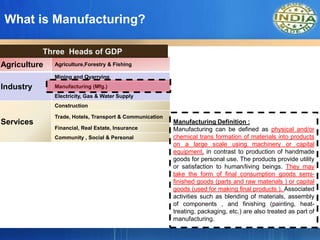
What is Manufacturing?
Three Heads of GDP
Agriculture

Agriculture,Forestry & Fishing

Mining and Qyarrying

Industry

Manufacturing (Mfg.)
Electricity, Gas & Water Supply
Construction

Services

Trade, Hotels, Transport & Communication
Financial, Real Estate, Insurance
Community , Social & Personal

Manufacturing Definition :
Manufacturing can be defined as physical and/or
chemical trans formation of materials into products
on a large scale using machinery or capital
equipment, in contrast to production of handmade
goods for personal use. The products provide utility
or satisfaction to human/living beings. They may
take the form of final consumption goods semifinished goods (parts and raw materials ) or capital
goods (used for making final products ). Associated
activities such as blending of materials, assembly
of components , and finishing (painting, heattreating, packaging, etc.) are also treated as part of
manufacturing.
Why Manufacturing (Mfg.) is Important?
 Mfg. Has Been Path to Development.
- Strategic achievement of rich nations to create high quality Mfg. ~ To develop national wealth
& power.

- Rise of England in 19th century. Rise of US,Germany,Japan & USSR (Russia) in 20th century.
- Newly industrialized countries Korea, Taiwan & China ~ Mfg. key to prosperity.
 Mfg. Foundation tobe Great Power.
- Most powerful nations are those that control bulk of manufacturing technology .
- Nation must know how to make machinery that make goods.
- 80% world production of factory machinery control by “Great Powers.”
 Global Trade Based on Goods, not Services.
- According to WTO, 80% of world trade in merchandise trade and remaining 20% in services.
Services are Based on Manufactured Goods.
- Exa: Retail and Wholesale – Act of buying & selling manufactured goods.
.

Health – Act of using medical equipment.
Manufacturing Sector Classification : Use based

Source : RBI
India‟s Top Companies
Revenue in INR 1000 crores
Auto
Revenue:59.85

Tobaco & FMCG
Revenue:27.33

Heavy Engg
Revenue : 49.61

Diversified
Revenue : 25.98

Steel
Revenue : 137.834

Steel
Revenue : 48.773

Two Wheeler
Revenue : 23.94

Coal
Revenue : 82.64

Metals
Revenue : 44.34

Personal Care
Revenue : 23.83

Aluminum
Revenue : 81.60

Auto
Revenue : 39.62

Auto
Revenue : 20.20

Diversified
Revenue : 65.19

Steel
Revenue : 34.44

Steel
Revenue : 13.35

Diversified
Revenue : 364.695

Auto
Revenue : 166.316

Source : ET 500 List
Global Fortune 500 List
Company Name
Indian Oil

88

Reliance Industries

107

Bharat Petroleum

229

Hindustan
Petroleum

260

SBI

298

Tata Motors

316

ONGC

369

Tata Steel

Source : Fortune 500 list

Global Rank

471
Brief History of Policy Developments
1951-1966
First Three Five Year Plans

YOY Growth Rate

Average Growth Rate 6.6 %

 Emphasis on Heavy Industries – Government Investment

 Private Sector Encouraged in
Textile , Cement & Jute

Source : NMCC Report
Brief History of Policy Developments
1965-1981

YOY Growth Rate

Average Growth Rate 3.9 %

Not Many Public Sector Units Established except Maruti Udyog Ltd.
Private Sector Not Allowed to Build & Expand – MRTP Act
Tighter Restriction on Foreign Firms – FERA Act
Number of Products – Reserved for Small Scale Industries
Tightened Industrial Licensing Policy


Source : NMCC Report

(Contd…)
Brief History of Policy Developments

(Contd…)

1981 - 1991

YOY Growth Rate

Average Growth Rate 5.7 %

First Round of Reforms – Liberalization Started in Modest Way
Industrial Licensing Reforms Undertaken ~ Eased restrictions & enabled firms to expand


Foreign

Investment allowed in Gradual Manner

Source : NMCC Report
Brief History of Policy Developments

(Contd…)

1991 to date

YOY Growth Rate

Average Growth Rate 6.75 %



Some Radical Changes Required
to Achieve Higher Growth Rate

Characterized by „Big Bang Reforms‟

Peak rate of customs duty @ 110% in 1991 , reduced to 7.5% to 10% by 2007
For IT Hardware Sector – Duty down to zero under IT agreement
FERA replaced by FEMA


Privatization

and Disinvestment began
 By 2000 almost all Mfg Sub Sectors Lieralized ~ 100 % FDI (barring few sectors)
Source : NMCC Report
Performance of India‟s Manufacturing Sector
Size of Manufacturing (Mfg.) Sector

2012 –
Rs 28,156 Bn
1990Rs 1263 Bn
India has much higher potential for growth in Manufacturing.

Source : World Bank 2012
Size Mfg. Sector - Global Benchmarks

Source : Deloitte Analysis
Top 15 Manufacturers

India‟s Mfg. Sector can become 3rd largest globally @ 11% p.a. growth rate

Ranked 25th in
1980

Source : Mckinsey Global Institute Analysis
Global Population & Mfg. Share
Global Population Break Up

Chinas share in
world Mfg.

2010‟s

1980s

1990s

2000s

3.83%

5.26%

10.82% 13.7%

India‟s share in world
Mfg.

1980s

1990s

2000s

2010‟s

1.03%

0.98%

1.36%

1.8%

Source : Eurostat & NMMC Report
Share of Manufacturing Sector in GDP
Share of Mfg. as % of GDP

Decreasing in %
terms

Share of manufacturing sector hovered around 15 to 16%

Source : Data.gov.in
Global Comparison – Mfg. Share of GDP

% Share of Total GDP

Contribution of Mfg. to GDP – Very Low in India

Manufacturing GDP as a % GDP 2012

Share of Mfg. in GDP (%) , International Comparison

1970s

1980s

1990s

2000s

South Korea

12.3

17.4

19.4

24.7

China

25

27.4

36.0

41.1

India

11.7

13.1

14.4

14.7

Source : United Nations Stats
Performance of Manufacturing Sector So far
1950-1980
Mfg Growth Rate higher than GDP growth rate

To attain` 25% share of GDP ,
Mfg has to grow at 3-4%
higher than GDP assuming
GDP growth 7-8%

Source : BCG Report

1980 Onwards
Mfg Growth Rate has been tracking GDP
Sectoral Contribution to GDP

% Share of Total GDP

Services
Agriculture
Industry

Manufacturing

 India has not been able to draw employment from agriculture to Mfg.
Mining
 India‟s economy has largely been led by Services sector.
75% of working population educated to middle school & below.
600 mn people not equipped to benefit from Knowledge sector – Labor intensive mfg. has the
capacity to generate employment.
Source : Data.gov.in
Sectoral Employment - Global Comparison
Employment Distribution between Mfg., Agriculture & Services



Agriculture still remains highest
employment generator.



@ 12% of employment (53 Mn),
share is less than other countries.



Mfg should become an engine of
growth.



Necessary for Inclusive growth.

Source : Euromonitor
Export – Import Data
Export - Import Trend

India‟s Share in World Merchandise Exports : 1.6%

Trade Deficit

306

Source : Ministry of Commerce & Industry

300
Manufacturing Sector Export
Share of Mfg. In India‟s Total Merchandise Exports
 Better Performance by India‟s
Competitors.

76.1%
61.5%

93%

Serious Consequences to Economy
Increasing Current Account
Deficit.
Reliance on Foreign Capital.
Growth Slowdown.

Source : DGCI S’2012
Manufacturing Sector Export (Contd….)
Composition of Mfg. Exports (Source DGCI&S)
Item Group

2002-03

2006-07

2007-08

2010-11

Gems & Jewellery

24.01

20.1

20.54

22.19

Engineering Goods

20.44

33.33

34.96

39.8

Ready Made Garments

15.13

11.19

10.04

7.39

Cotton Yarn / Fabrics etc.

8.91

5.31

4.77

3.75

Drug, Pharmaceuticals & Fine Chemicals

7.05

7.48

7.68

6.83

Other Basic Chemicals

5.34

6.31

6.55

5.7

Leather & Leather Products

4.8

3.69

3.52

2.43

Man Made Yarn / Fabrics etc.

3.65

2.77

3

2.77

Electronic Goods

3.33

3.59

3.48

4.88

Plasitc Etc.

3.25

4.09

3.41

3.04

Handicrafts excl Handmade Carpet

2.09

0.55

0.53

0.15

Carpet

1.42

1.17

1.01

0.75

Jute Mfg

0.5

0.33

0.34

0.29

Computer Software

0.11

0.11

0.15

0.03
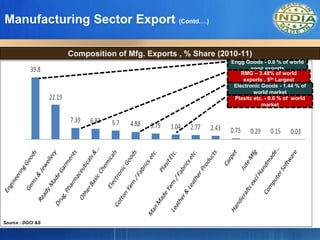
Manufacturing Sector Export (Contd….)
Composition of Mfg. Exports , % Share (2010-11)
Engg Goods - 0.8 % of world
engg exports
RMG – 3.48% of world
exports , 5th Largest
Electronic Goods - 1.44 % of
world market
Plasitc etc. - 0.6 % of world
market

Source : DGCI &S
India Trade Basket

Only 20% of Electronic
Goods from Domestic
Sources

Source : Ministry of Commerce & Industry
Capital Goods
Capital Goods Sector
Broadly comprises of plant machinery
required for manufacture or production of
goods.

Strategic Importance
Multiplier effect on economic growth.
Provides critical inputs.
 Ensures Self Reliance.
 Contributes 12% of total Mfg. activity ~ 1.8 % of GDP.

Source : BCG Report Nov,2012
Capital Goods (Contd….)
Recent Performance – Split of Imports & Exports (2010-11)

Increasing dependence
on Imports

Import accounts for 30%
of domestic demand

Import proportion high for
critical components

Source : BCG Report Nov’012
Capital Goods – Share of Global Market
Share in Global Exports – India & Five Other Nations (2010)
Ranges from 7.7 to
16.3%

China

USA

Germany

Ranges from 0.1 to 0.6%
Japan
Korea

Source : BCG Report Nov’2012
Mfg. Industry – Technology Classification

Source : WTO Studies ‘ 2013
Manufacturing Export – Technology Classification

Percentage

India – Technology Intensive Mfg. Exports

Medium Low Technology (ML)
Low Technology (L)

Medium High Technology (MH)

High Technology (HT)

1990

Medium Low Technology (ML)

High Technology (HT)

2011

34.19%
1990

14.63%
2011

39.70%

45.02%

1990

Low Technology (L)

2011

6.69%

11.89%

Weak Performance in HT Exports
27.5%

68%
Philippines

Source : WTO Studies ‘ 2013
Research & Development Spend
R & D Spend – Global Comparison

R&D defined as expenditure on creative activity intended to develop stock of knowledge leading to
new devices, products or processes
Source : BCG Report & NMCC Report
Research & Development Professionals
R & D Professionals – Global Comparison
R&D Spend by Govt. 60%
 R&D Spend by Govt – Mostly on
Space & Defense
Global Peers (USA,Germany,China,
UK) – Industry leads R&D spend

“ Globalisation requires being at the forefront of
Innovation”
Source : BCG Report & NMCC Report
Global Competitiveness
Drivers of Global Mfg. Competitiveness
Country Level Ratings – Key Drivers of Competitiveness

Scores on a 10 point scale, where 1 being "Least competitive" and 10 being "Most competitive”
Source : Deloitte , U.S. Council on Competitiveness, 2013 Global Manufacturing Competitiveness Index
Country Level Ratings – Ease of Doing Business
Investments in Mfg. registered sharp drop in last two years

India Ranked 132nd among 185 countries on ease of doing business

Source : World Bank Doing Business Report 2013 (Rank / 185 countries) , BCG Analysis
Key Challenges & Highlights
Key Challenges
Infrastructure Deficit
• 36 checkpoints - “truck carrying
goods from Gurgaon to Mumbai has
to pass.‟

• 57%- Goods in India are
transported by Road – Most
inefficient ,expensive mode.

• 22%- Comparable number for
China.

“ Every Dollar of Infra. Spend Generates additional 60 cents
in Economic Activity ”US Budget Office

Source : PWC Report
Key Challenges (Contd….)
Land Acquisition
•

Multiple Land Acquisition Policies.

•

Variation in land acquisition and
compensation rules.

Source : PWC Report
Key Challenges (Contd….)
Land Acquisition

19th July’2013

FICCI has been suggesting that the concept of
rehabilitation and resettlement (R&R) should
not be stipulated when land is acquired by
large private sector projects where there is a
willing seller and willing buyer.
The apex chamber has been questioning the
need for R&R in a private transaction
involving a willing seller.
Key Challenges (contd…)
Land Acquisition
18th July’2013

In the biggest foreign investment pullout,
world's largest steel maker ArcelorMittal today
scrapped its USD 12 billion (Rs 50,000 crore)
steel plant in Odisha over inordinate delays,
problems in acquiring land and securing iron
ore linkages.
Key Challenges (Contd….)
Environmental Clearances
•
•

Key Road bolck
Long Delays and Social Hurdles
30th June’2013

Source : PWC Report
Key Challenges (Contd….)
Multi-Tier Regulatory & Complex Framework

• Prevailing at Central & State Level
• “Manufacturer has to comply with‟‟ - 70 regulations & file
100 returns a year

Source : PWC Report
Key Challenges (Contd….)
World Bank Report 2012

World Bank Report 2005

• 89 days – to start business in
India, compared to 41 days in
China

• 425 days – to enforce contracts

in India, compared to 241 days in
China

• 10 years– to complete
insolvency proceedings India,

compared to 2.4 years in China
The procedures and costs for starting a manufacturing business in India are
among the most cumbersome.

Source : World Bank Report 2012 , NMMC report
Key Challenges (Contd….)
•

Higher

Interest Rate.

• Archaic Labor Laws ~

difficult to fire permanent laborincreasingly hiring contract labor - wage disparity.

•

Firms

focused on Indian demands
and never considered India as a base for global supplies.
MNC‟s as well as Indian companies always

• Coalition politics~ difficult to reach consensus for policy reforms.

• Corruption due to inept leadership.
Whats Making The News?
12th Aug’2013

Industry Reactions :
“Relaxation in area norms will encourage small IT zones
come up in the rural areas and provide employment to locals.
It would also help developers downsize their zones and put land to
alternative use. But, the norms would not help attract large

investments,” said P. C. Nambiar, Chairman, Export
Promotion Council for EoUs and SEZs.
After Minimum Alternate Tax (effective at 22.5 per cent) and
Dividend Distribution Tax (at 15 per cent) were levied by
Finance Ministry on SEZs, new applications have reduced
significantly and 216 notified SEZs have not started
operations. Today, there are 173 operational SEZs in the
country.
India Manufacturing Sector SWOT Analysis
SWOT Analysis – Mfg. In India

Strength

• Sustained availability of quality
workforce.
• Responsible business houses
operating with credibility and
professionalism.
• Strong consumerism in the
domestic market.
• Strong technical and engineering
capability.
• Well regulated and stable
financial markets open to FDI.
SWOT Analysis – Mfg. In India

Weaknesses

• Low employee productivity, high
illiteracy.
• Volatile governance and regulatory
environment – Policy rollbacks.
• Poor power and transport
infrastructure.
• Rising input costs.
• Inadequate credit flow and rising
cost of credit.
• Small firm size, clustering and
economies of scale not effectively
utilised.
• Slow pace of reforms and policy
implementation.
SWOT Analysis – Mfg. In India

Opportunities

• Easing excise restrictions can open
up large import and export market.
• Global slowdown will trigger
opportunities for low cost
economies such as India.
• Government procurement will boost
demand and provide economies of
scale.
• Role of SMEs in innovating and
supplying to large manufacturers.
• India emerging as an attractive
destination.
SWOT Analysis – Mfg. In India
National Manufacturing Policy : Overview & Analysis
National Manufacturing Policy
Key Objectives
 Increase manufacturing sector growth to 12-14 per cent over the medium term so that it
could contribute at least 25 per cent of the national GDP by 2022 from 16 per cent at
present.
 Increase the rate of job creation in mfg. to create 100 million additional jobs by 2022.
 Creation of appropriate skill sets among rural migrants and urban poor for inclusive
growth.
 Increase domestic value addition and technological 'depth' in manufacturing.
National Manufacturing Policy
Key Provisions for SME‟s
Current Scenario

NMP Announcement

Impact

Inclusion of SME‟s as a part of
priority sector.

Higher Fund Availability.

Financial
Limited capital / inadequate
access to finance for SME‟s.

Tax Relief, Incentives & Subsidies
High
taxes
for
venture
capitalists (VC‟s) looking to
invest in SMEs.

Tax Pass Through Status for
VC‟s with SME focus.

Renewed Interest of VC‟s in
SME‟s.

Setting up Service Entity for
collecting statutory dues.

More
Transparency
Speeding
up
of
Procedures.

Compliance
Compliance burden of laws and
regulations, & tedious followup with various government
agencies to resolve problems.

and
Govt.
National Manufacturing Policy
Incentives
 For Promoting Technology Acquisition.
 For Promoting Green Manufacturing.
 For Encouraging Skill Development.
National Manufacturing Policy
National Investment & Manufacturing Zones – Heart of NMP
National Manufacturing Policy
NIMZ‟s - Key Highlights
 Integrated Industrial Townships with World Class Infrastructure.
 Land Area – 5000 Hectares , Processing area may include one or more SEZ‟s.
 State Govt. Responsible For Selection of Suitable Land.
 State Govt. to Facilitate Utility Infra.

 Master Planning Cost – Central Government.
 Financial Support – VGF.

 Soft Loans, ECB allowed.
 Tax Deductions Provisions.
National Manufacturing Policy
Analysis

Gap
NMP Target
*Likely Achievement

 To achieve NMP target Mfg. sector will have to grow by more than 16 per cent per year, between
2012-13 and 2021-22. Even China has not achieved such high decadal growth rates in the past.
* Likely achievement as per CII – BCG Mfg. Survey
Source : CII & BCG Report
NMP Key Success Factors

“The implementation of the National Manufacturing Policy during this decade
will coincide with a relatively unfavourable global economic scenario. We
believe that in such an environment policy support will be pivotal
to raise manufacturing growth as well as to generate significant employment
gains. Policy measures would have to focus on providing quality
infrastructure and reforming labour laws to arrest the pace of decline in
employment intensity.”
Wayforward
• Emphasis on Domestic R&D
• FDI Policy & Technology Development :
Incorporate conditions in the FDI in terms of Technology Transfer

• Regulation and Procedural Reforms
• Raw Material : Acquisition of assets abroad by India companies
• Address Infrastructure Issue
• Labour Reforms
• Improved Co-ordination Between Centre & State
Manufacturing final

Manufacturing final

  • 1.
  • 2.
    Contents Manufacturing Sector :An Overview Brief History of Policy Developments Performance of India‟s Manufacturing Sector Export – Import Data Global Competitiveness Key Challenges India Manufacturing Sector SWOT Analysis National Manufacturing Policy : Overview & Analysis
  • 3.
  • 4.
    What is Manufacturing? ThreeHeads of GDP Agriculture Agriculture,Forestry & Fishing Mining and Qyarrying Industry Manufacturing (Mfg.) Electricity, Gas & Water Supply Construction Services Trade, Hotels, Transport & Communication Financial, Real Estate, Insurance Community , Social & Personal Manufacturing Definition : Manufacturing can be defined as physical and/or chemical trans formation of materials into products on a large scale using machinery or capital equipment, in contrast to production of handmade goods for personal use. The products provide utility or satisfaction to human/living beings. They may take the form of final consumption goods semifinished goods (parts and raw materials ) or capital goods (used for making final products ). Associated activities such as blending of materials, assembly of components , and finishing (painting, heattreating, packaging, etc.) are also treated as part of manufacturing.
  • 5.
    Why Manufacturing (Mfg.)is Important?  Mfg. Has Been Path to Development. - Strategic achievement of rich nations to create high quality Mfg. ~ To develop national wealth & power. - Rise of England in 19th century. Rise of US,Germany,Japan & USSR (Russia) in 20th century. - Newly industrialized countries Korea, Taiwan & China ~ Mfg. key to prosperity.  Mfg. Foundation tobe Great Power. - Most powerful nations are those that control bulk of manufacturing technology . - Nation must know how to make machinery that make goods. - 80% world production of factory machinery control by “Great Powers.”  Global Trade Based on Goods, not Services. - According to WTO, 80% of world trade in merchandise trade and remaining 20% in services. Services are Based on Manufactured Goods. - Exa: Retail and Wholesale – Act of buying & selling manufactured goods. . Health – Act of using medical equipment.
  • 6.
    Manufacturing Sector Classification: Use based Source : RBI
  • 7.
    India‟s Top Companies Revenuein INR 1000 crores Auto Revenue:59.85 Tobaco & FMCG Revenue:27.33 Heavy Engg Revenue : 49.61 Diversified Revenue : 25.98 Steel Revenue : 137.834 Steel Revenue : 48.773 Two Wheeler Revenue : 23.94 Coal Revenue : 82.64 Metals Revenue : 44.34 Personal Care Revenue : 23.83 Aluminum Revenue : 81.60 Auto Revenue : 39.62 Auto Revenue : 20.20 Diversified Revenue : 65.19 Steel Revenue : 34.44 Steel Revenue : 13.35 Diversified Revenue : 364.695 Auto Revenue : 166.316 Source : ET 500 List
  • 8.
    Global Fortune 500List Company Name Indian Oil 88 Reliance Industries 107 Bharat Petroleum 229 Hindustan Petroleum 260 SBI 298 Tata Motors 316 ONGC 369 Tata Steel Source : Fortune 500 list Global Rank 471
  • 9.
    Brief History ofPolicy Developments
  • 10.
    Brief History ofPolicy Developments 1951-1966 First Three Five Year Plans YOY Growth Rate Average Growth Rate 6.6 %  Emphasis on Heavy Industries – Government Investment  Private Sector Encouraged in Textile , Cement & Jute Source : NMCC Report
  • 11.
    Brief History ofPolicy Developments 1965-1981 YOY Growth Rate Average Growth Rate 3.9 % Not Many Public Sector Units Established except Maruti Udyog Ltd. Private Sector Not Allowed to Build & Expand – MRTP Act Tighter Restriction on Foreign Firms – FERA Act Number of Products – Reserved for Small Scale Industries Tightened Industrial Licensing Policy  Source : NMCC Report (Contd…)
  • 12.
    Brief History ofPolicy Developments (Contd…) 1981 - 1991 YOY Growth Rate Average Growth Rate 5.7 % First Round of Reforms – Liberalization Started in Modest Way Industrial Licensing Reforms Undertaken ~ Eased restrictions & enabled firms to expand  Foreign Investment allowed in Gradual Manner Source : NMCC Report
  • 13.
    Brief History ofPolicy Developments (Contd…) 1991 to date YOY Growth Rate Average Growth Rate 6.75 %  Some Radical Changes Required to Achieve Higher Growth Rate Characterized by „Big Bang Reforms‟ Peak rate of customs duty @ 110% in 1991 , reduced to 7.5% to 10% by 2007 For IT Hardware Sector – Duty down to zero under IT agreement FERA replaced by FEMA  Privatization and Disinvestment began  By 2000 almost all Mfg Sub Sectors Lieralized ~ 100 % FDI (barring few sectors) Source : NMCC Report
  • 14.
    Performance of India‟sManufacturing Sector
  • 15.
    Size of Manufacturing(Mfg.) Sector 2012 – Rs 28,156 Bn 1990Rs 1263 Bn India has much higher potential for growth in Manufacturing. Source : World Bank 2012
  • 16.
    Size Mfg. Sector- Global Benchmarks Source : Deloitte Analysis
  • 17.
    Top 15 Manufacturers India‟sMfg. Sector can become 3rd largest globally @ 11% p.a. growth rate Ranked 25th in 1980 Source : Mckinsey Global Institute Analysis
  • 18.
    Global Population &Mfg. Share Global Population Break Up Chinas share in world Mfg. 2010‟s 1980s 1990s 2000s 3.83% 5.26% 10.82% 13.7% India‟s share in world Mfg. 1980s 1990s 2000s 2010‟s 1.03% 0.98% 1.36% 1.8% Source : Eurostat & NMMC Report
  • 19.
    Share of ManufacturingSector in GDP Share of Mfg. as % of GDP Decreasing in % terms Share of manufacturing sector hovered around 15 to 16% Source : Data.gov.in
  • 20.
    Global Comparison –Mfg. Share of GDP % Share of Total GDP Contribution of Mfg. to GDP – Very Low in India Manufacturing GDP as a % GDP 2012 Share of Mfg. in GDP (%) , International Comparison 1970s 1980s 1990s 2000s South Korea 12.3 17.4 19.4 24.7 China 25 27.4 36.0 41.1 India 11.7 13.1 14.4 14.7 Source : United Nations Stats
  • 21.
    Performance of ManufacturingSector So far 1950-1980 Mfg Growth Rate higher than GDP growth rate To attain` 25% share of GDP , Mfg has to grow at 3-4% higher than GDP assuming GDP growth 7-8% Source : BCG Report 1980 Onwards Mfg Growth Rate has been tracking GDP
  • 22.
    Sectoral Contribution toGDP % Share of Total GDP Services Agriculture Industry Manufacturing  India has not been able to draw employment from agriculture to Mfg. Mining  India‟s economy has largely been led by Services sector. 75% of working population educated to middle school & below. 600 mn people not equipped to benefit from Knowledge sector – Labor intensive mfg. has the capacity to generate employment. Source : Data.gov.in
  • 23.
    Sectoral Employment -Global Comparison Employment Distribution between Mfg., Agriculture & Services  Agriculture still remains highest employment generator.  @ 12% of employment (53 Mn), share is less than other countries.  Mfg should become an engine of growth.  Necessary for Inclusive growth. Source : Euromonitor
  • 24.
  • 25.
    Export - ImportTrend India‟s Share in World Merchandise Exports : 1.6% Trade Deficit 306 Source : Ministry of Commerce & Industry 300
  • 26.
    Manufacturing Sector Export Shareof Mfg. In India‟s Total Merchandise Exports  Better Performance by India‟s Competitors. 76.1% 61.5% 93% Serious Consequences to Economy Increasing Current Account Deficit. Reliance on Foreign Capital. Growth Slowdown. Source : DGCI S’2012
  • 27.
    Manufacturing Sector Export(Contd….) Composition of Mfg. Exports (Source DGCI&S) Item Group 2002-03 2006-07 2007-08 2010-11 Gems & Jewellery 24.01 20.1 20.54 22.19 Engineering Goods 20.44 33.33 34.96 39.8 Ready Made Garments 15.13 11.19 10.04 7.39 Cotton Yarn / Fabrics etc. 8.91 5.31 4.77 3.75 Drug, Pharmaceuticals & Fine Chemicals 7.05 7.48 7.68 6.83 Other Basic Chemicals 5.34 6.31 6.55 5.7 Leather & Leather Products 4.8 3.69 3.52 2.43 Man Made Yarn / Fabrics etc. 3.65 2.77 3 2.77 Electronic Goods 3.33 3.59 3.48 4.88 Plasitc Etc. 3.25 4.09 3.41 3.04 Handicrafts excl Handmade Carpet 2.09 0.55 0.53 0.15 Carpet 1.42 1.17 1.01 0.75 Jute Mfg 0.5 0.33 0.34 0.29 Computer Software 0.11 0.11 0.15 0.03
  • 28.
    Manufacturing Sector Export(Contd….) Composition of Mfg. Exports , % Share (2010-11) Engg Goods - 0.8 % of world engg exports RMG – 3.48% of world exports , 5th Largest Electronic Goods - 1.44 % of world market Plasitc etc. - 0.6 % of world market Source : DGCI &S
  • 29.
    India Trade Basket Only20% of Electronic Goods from Domestic Sources Source : Ministry of Commerce & Industry
  • 30.
    Capital Goods Capital GoodsSector Broadly comprises of plant machinery required for manufacture or production of goods. Strategic Importance Multiplier effect on economic growth. Provides critical inputs.  Ensures Self Reliance.  Contributes 12% of total Mfg. activity ~ 1.8 % of GDP. Source : BCG Report Nov,2012
  • 31.
    Capital Goods (Contd….) RecentPerformance – Split of Imports & Exports (2010-11) Increasing dependence on Imports Import accounts for 30% of domestic demand Import proportion high for critical components Source : BCG Report Nov’012
  • 32.
    Capital Goods –Share of Global Market Share in Global Exports – India & Five Other Nations (2010) Ranges from 7.7 to 16.3% China USA Germany Ranges from 0.1 to 0.6% Japan Korea Source : BCG Report Nov’2012
  • 33.
    Mfg. Industry –Technology Classification Source : WTO Studies ‘ 2013
  • 34.
    Manufacturing Export –Technology Classification Percentage India – Technology Intensive Mfg. Exports Medium Low Technology (ML) Low Technology (L) Medium High Technology (MH) High Technology (HT) 1990 Medium Low Technology (ML) High Technology (HT) 2011 34.19% 1990 14.63% 2011 39.70% 45.02% 1990 Low Technology (L) 2011 6.69% 11.89% Weak Performance in HT Exports 27.5% 68% Philippines Source : WTO Studies ‘ 2013
  • 35.
    Research & DevelopmentSpend R & D Spend – Global Comparison R&D defined as expenditure on creative activity intended to develop stock of knowledge leading to new devices, products or processes Source : BCG Report & NMCC Report
  • 36.
    Research & DevelopmentProfessionals R & D Professionals – Global Comparison R&D Spend by Govt. 60%  R&D Spend by Govt – Mostly on Space & Defense Global Peers (USA,Germany,China, UK) – Industry leads R&D spend “ Globalisation requires being at the forefront of Innovation” Source : BCG Report & NMCC Report
  • 37.
  • 38.
    Drivers of GlobalMfg. Competitiveness
  • 39.
    Country Level Ratings– Key Drivers of Competitiveness Scores on a 10 point scale, where 1 being "Least competitive" and 10 being "Most competitive” Source : Deloitte , U.S. Council on Competitiveness, 2013 Global Manufacturing Competitiveness Index
  • 40.
    Country Level Ratings– Ease of Doing Business Investments in Mfg. registered sharp drop in last two years India Ranked 132nd among 185 countries on ease of doing business Source : World Bank Doing Business Report 2013 (Rank / 185 countries) , BCG Analysis
  • 41.
    Key Challenges &Highlights
  • 42.
    Key Challenges Infrastructure Deficit •36 checkpoints - “truck carrying goods from Gurgaon to Mumbai has to pass.‟ • 57%- Goods in India are transported by Road – Most inefficient ,expensive mode. • 22%- Comparable number for China. “ Every Dollar of Infra. Spend Generates additional 60 cents in Economic Activity ”US Budget Office Source : PWC Report
  • 43.
    Key Challenges (Contd….) LandAcquisition • Multiple Land Acquisition Policies. • Variation in land acquisition and compensation rules. Source : PWC Report
  • 44.
    Key Challenges (Contd….) LandAcquisition 19th July’2013 FICCI has been suggesting that the concept of rehabilitation and resettlement (R&R) should not be stipulated when land is acquired by large private sector projects where there is a willing seller and willing buyer. The apex chamber has been questioning the need for R&R in a private transaction involving a willing seller.
  • 45.
    Key Challenges (contd…) LandAcquisition 18th July’2013 In the biggest foreign investment pullout, world's largest steel maker ArcelorMittal today scrapped its USD 12 billion (Rs 50,000 crore) steel plant in Odisha over inordinate delays, problems in acquiring land and securing iron ore linkages.
  • 46.
    Key Challenges (Contd….) EnvironmentalClearances • • Key Road bolck Long Delays and Social Hurdles 30th June’2013 Source : PWC Report
  • 47.
    Key Challenges (Contd….) Multi-TierRegulatory & Complex Framework • Prevailing at Central & State Level • “Manufacturer has to comply with‟‟ - 70 regulations & file 100 returns a year Source : PWC Report
  • 48.
    Key Challenges (Contd….) WorldBank Report 2012 World Bank Report 2005 • 89 days – to start business in India, compared to 41 days in China • 425 days – to enforce contracts in India, compared to 241 days in China • 10 years– to complete insolvency proceedings India, compared to 2.4 years in China The procedures and costs for starting a manufacturing business in India are among the most cumbersome. Source : World Bank Report 2012 , NMMC report
  • 49.
    Key Challenges (Contd….) • Higher InterestRate. • Archaic Labor Laws ~ difficult to fire permanent laborincreasingly hiring contract labor - wage disparity. • Firms focused on Indian demands and never considered India as a base for global supplies. MNC‟s as well as Indian companies always • Coalition politics~ difficult to reach consensus for policy reforms. • Corruption due to inept leadership.
  • 50.
    Whats Making TheNews? 12th Aug’2013 Industry Reactions : “Relaxation in area norms will encourage small IT zones come up in the rural areas and provide employment to locals. It would also help developers downsize their zones and put land to alternative use. But, the norms would not help attract large investments,” said P. C. Nambiar, Chairman, Export Promotion Council for EoUs and SEZs. After Minimum Alternate Tax (effective at 22.5 per cent) and Dividend Distribution Tax (at 15 per cent) were levied by Finance Ministry on SEZs, new applications have reduced significantly and 216 notified SEZs have not started operations. Today, there are 173 operational SEZs in the country.
  • 51.
  • 52.
    SWOT Analysis –Mfg. In India Strength • Sustained availability of quality workforce. • Responsible business houses operating with credibility and professionalism. • Strong consumerism in the domestic market. • Strong technical and engineering capability. • Well regulated and stable financial markets open to FDI.
  • 53.
    SWOT Analysis –Mfg. In India Weaknesses • Low employee productivity, high illiteracy. • Volatile governance and regulatory environment – Policy rollbacks. • Poor power and transport infrastructure. • Rising input costs. • Inadequate credit flow and rising cost of credit. • Small firm size, clustering and economies of scale not effectively utilised. • Slow pace of reforms and policy implementation.
  • 54.
    SWOT Analysis –Mfg. In India Opportunities • Easing excise restrictions can open up large import and export market. • Global slowdown will trigger opportunities for low cost economies such as India. • Government procurement will boost demand and provide economies of scale. • Role of SMEs in innovating and supplying to large manufacturers. • India emerging as an attractive destination.
  • 55.
    SWOT Analysis –Mfg. In India
  • 56.
    National Manufacturing Policy: Overview & Analysis
  • 57.
    National Manufacturing Policy KeyObjectives  Increase manufacturing sector growth to 12-14 per cent over the medium term so that it could contribute at least 25 per cent of the national GDP by 2022 from 16 per cent at present.  Increase the rate of job creation in mfg. to create 100 million additional jobs by 2022.  Creation of appropriate skill sets among rural migrants and urban poor for inclusive growth.  Increase domestic value addition and technological 'depth' in manufacturing.
  • 58.
    National Manufacturing Policy KeyProvisions for SME‟s Current Scenario NMP Announcement Impact Inclusion of SME‟s as a part of priority sector. Higher Fund Availability. Financial Limited capital / inadequate access to finance for SME‟s. Tax Relief, Incentives & Subsidies High taxes for venture capitalists (VC‟s) looking to invest in SMEs. Tax Pass Through Status for VC‟s with SME focus. Renewed Interest of VC‟s in SME‟s. Setting up Service Entity for collecting statutory dues. More Transparency Speeding up of Procedures. Compliance Compliance burden of laws and regulations, & tedious followup with various government agencies to resolve problems. and Govt.
  • 59.
    National Manufacturing Policy Incentives For Promoting Technology Acquisition.  For Promoting Green Manufacturing.  For Encouraging Skill Development.
  • 60.
    National Manufacturing Policy NationalInvestment & Manufacturing Zones – Heart of NMP
  • 61.
    National Manufacturing Policy NIMZ‟s- Key Highlights  Integrated Industrial Townships with World Class Infrastructure.  Land Area – 5000 Hectares , Processing area may include one or more SEZ‟s.  State Govt. Responsible For Selection of Suitable Land.  State Govt. to Facilitate Utility Infra.  Master Planning Cost – Central Government.  Financial Support – VGF.  Soft Loans, ECB allowed.  Tax Deductions Provisions.
  • 62.
    National Manufacturing Policy Analysis Gap NMPTarget *Likely Achievement  To achieve NMP target Mfg. sector will have to grow by more than 16 per cent per year, between 2012-13 and 2021-22. Even China has not achieved such high decadal growth rates in the past. * Likely achievement as per CII – BCG Mfg. Survey Source : CII & BCG Report
  • 63.
    NMP Key SuccessFactors “The implementation of the National Manufacturing Policy during this decade will coincide with a relatively unfavourable global economic scenario. We believe that in such an environment policy support will be pivotal to raise manufacturing growth as well as to generate significant employment gains. Policy measures would have to focus on providing quality infrastructure and reforming labour laws to arrest the pace of decline in employment intensity.”
  • 64.
    Wayforward • Emphasis onDomestic R&D • FDI Policy & Technology Development : Incorporate conditions in the FDI in terms of Technology Transfer • Regulation and Procedural Reforms • Raw Material : Acquisition of assets abroad by India companies • Address Infrastructure Issue • Labour Reforms • Improved Co-ordination Between Centre & State