REGIONAL DISPARITY IN FINANCIAL
INCLUSION:THE INDIAN EVIDENCE
DR.RAM PRATAP SINHADR.RAM PRATAP SINHA
ASSOCIATE PROFESSOR OF ECONOMICSASSOCIATE PROFESSOR OF ECONOMICS
GOVERNMENT COLLEGE OF ENGINEERING AND LEATHERGOVERNMENT COLLEGE OF ENGINEERING AND LEATHER
TECHNOLOGYTECHNOLOGY
LB BLOCK, SECTORLB BLOCK, SECTOR--III,SALT LAKE, KOLKATAIII,SALT LAKE, KOLKATA--700098700098
E MAILE MAIL:: rampratapsinha39@gmail.comrampratapsinha39@gmail.com
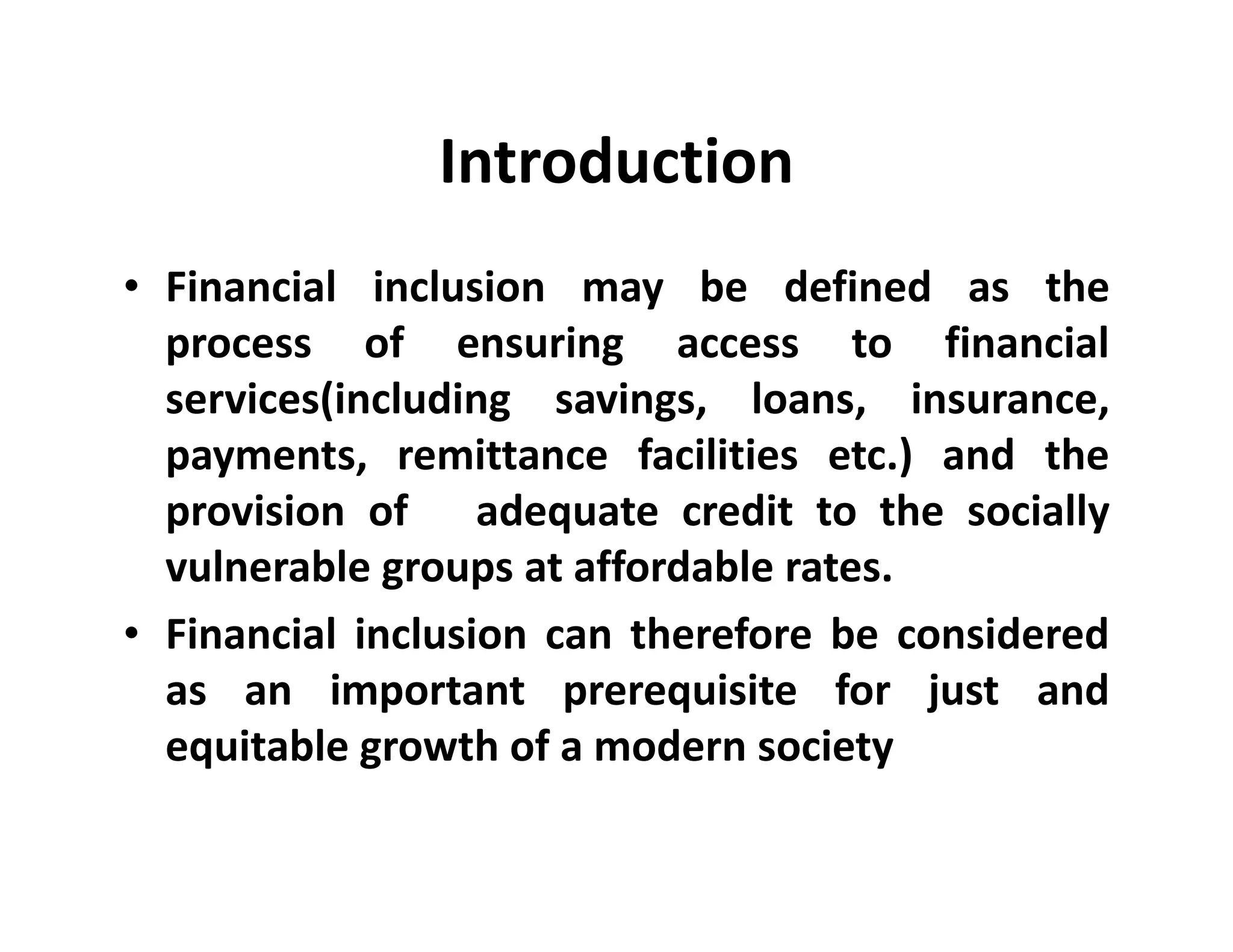
Introduction
• Financial inclusion may be defined as the
process of ensuring access to financial
services(including savings, loans, insurance,
payments, remittance facilities etc.) and thepayments, remittance facilities etc.) and the
provision of adequate credit to the socially
vulnerable groups at affordable rates.
• Financial inclusion can therefore be considered
as an important prerequisite for just and
equitable growth of a modern society
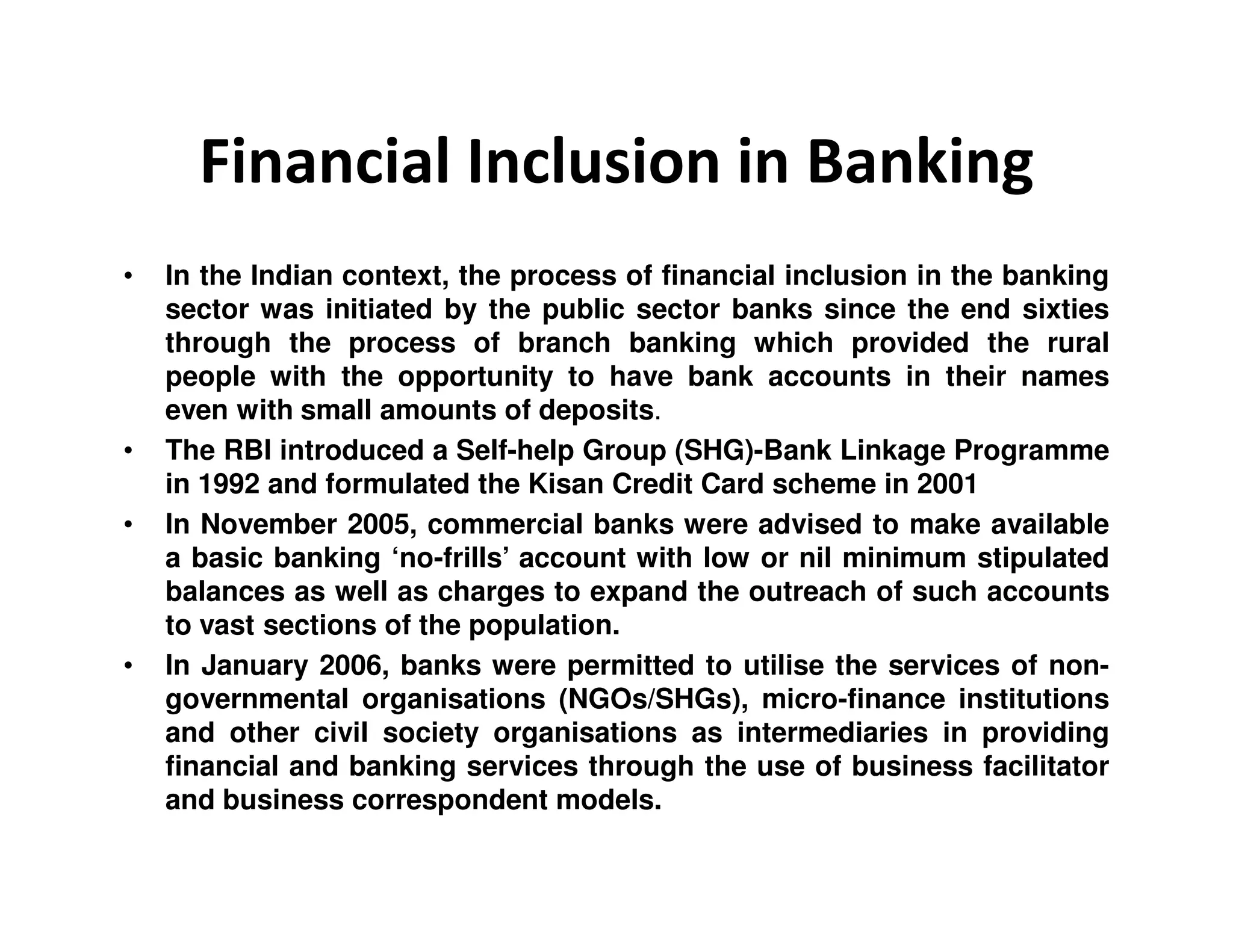
Financial Inclusion in Banking
• In the Indian context, the process of financial inclusion in the banking
sector was initiated by the public sector banks since the end sixties
through the process of branch banking which provided the rural
people with the opportunity to have bank accounts in their names
even with small amounts of deposits.
• The RBI introduced a Self-help Group (SHG)-Bank Linkage Programme
in 1992 and formulated the Kisan Credit Card scheme in 2001in 1992 and formulated the Kisan Credit Card scheme in 2001
• In November 2005, commercial banks were advised to make available
a basic banking ‘no-frills’ account with low or nil minimum stipulated
balances as well as charges to expand the outreach of such accounts
to vast sections of the population.
• In January 2006, banks were permitted to utilise the services of non-
governmental organisations (NGOs/SHGs), micro-finance institutions
and other civil society organisations as intermediaries in providing
financial and banking services through the use of business facilitator
and business correspondent models.
Financial Inclusion in Insurance
• The IRDA introduced social and rural sector obligations for the
insurance companies in 2002:
• Rural sector was defined by the IRDA as comprising of (a) a
population <5000,(b) density of population <400 per square kilometer,
and (c) more than twenty five % of the male working population is
engaged in agricultural activity.
• The social sector is defined to comprise of (i)unorganized
sector,(ii)informal sector,(iii) economically vulnerable or backward
classes, and (iv) other categories of persons, both in rural and urban
areas.
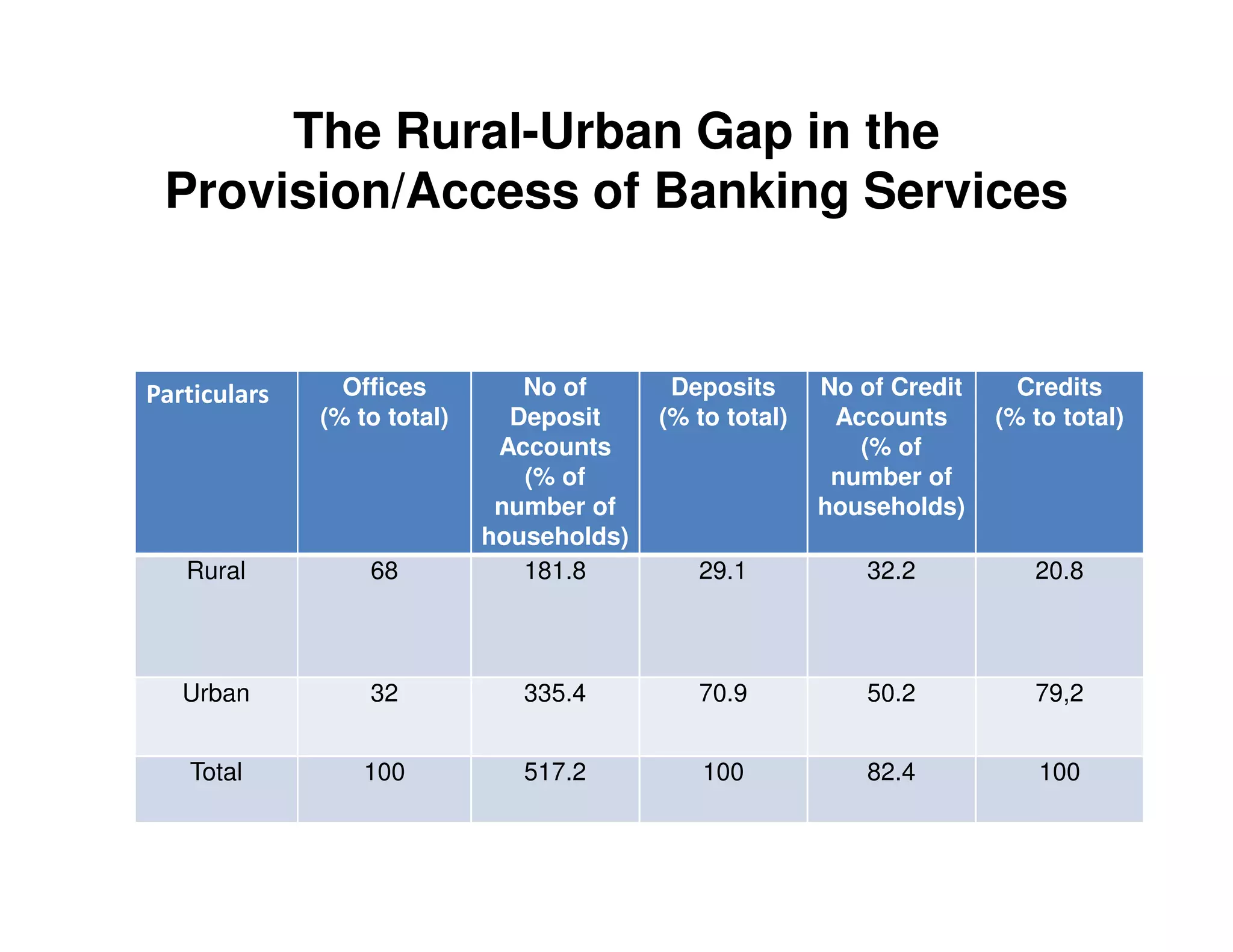
The Rural-Urban Gap in the
Provision/Access of Banking Services
Particulars Offices
(% to total)
No of
Deposit
Accounts
(% of
Deposits
(% to total)
No of Credit
Accounts
(% of
number of
Credits
(% to total)
(% of
number of
households)
number of
households)
Rural 68 181.8 29.1 32.2 20.8
Urban 32 335.4 70.9 50.2 79,2
Total 100 517.2 100 82.4 100
Index of Financial Inclusion
• Sarma(2008) pointed out that while there is an widespread
recognition of the importance of financial inclusion,one does
not find any comprehensive measure of financial inclusion in
the literature which may be used to measure the extent of
financial inclusion across economies.
• In her paper she presented an approach for the construction of
an index of financial inclusion and used the same to compare
100 countries in respect of financial inclusion.
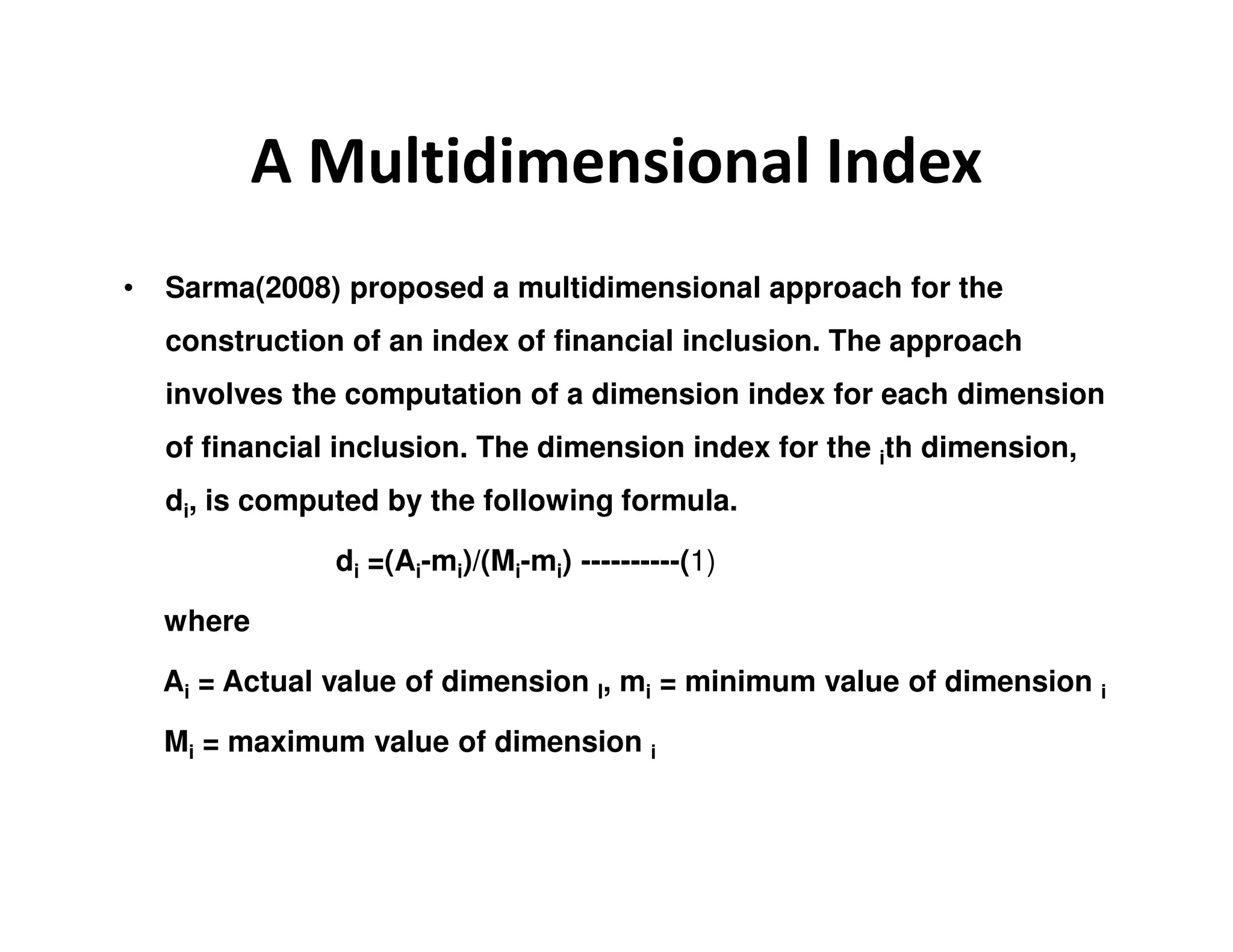
A Multidimensional Index
• Sarma(2008) proposed a multidimensional approach for the
construction of an index of financial inclusion. The approach
involves the computation of a dimension index for each dimension
of financial inclusion. The dimension index for the ith dimension,
di, is computed by the following formula.
di =(Ai-mi)/(Mi-mi) ----------(1)
where
Ai = Actual value of dimension I, mi = minimum value of dimension i
Mi = maximum value of dimension i
The Index
• Formula (1) ensures that 0 ≤ di ≤ 1. Higher the value of di, higher the
country’s achievement in dimension i. If n dimensions of financial
inclusion are considered, then, a country i will be represented by a
point Di = (d1, d2, d3, ….dn) on the n dimensional Cartesian space.
• Then the Index of Financial Inclusion (IFI) for entity i is computed as:
IFIi =1-√[(1-d1)2+(1-d2)2+-----+(1-dn)2]/√n
Studies Based on the Multidimensional
Index
• Sarma(2008) made use of the Index of Financial Inclusion to make a cross-country
comparison of financial inclusion for the year 2004 using three dimensions of
financial inclusion:
• (a)banking penetration (BP) as measured by bank accounts/population,
(b)availability of the banking services (BS) as measured by the number of bank
branches per 1000 population andbranches per 1000 population and
(c) usage of the banking system (BU) as measured by the volume of deposit and
credit to GDP.
• Goyal(2009) used the multidimensional index of financial inclusion to compare
the state of financial inclusion of the north eastern states for the year 2005
using the same dimensions used by Sarma.However, the index computed by
Goyal included per capita credit and deposit instead of the volume of credit
and deposit as proportion of the Country’s GDP used by Sarma.
Objective of the Present Paper
• Given the backdrop outlined previously, the objective of the present
paper is twofold:
• To suggest how alternative indices could be constructed using
mathematical programming.
• To provide an inter- state and inter-regional study in the Indian context
on financial inclusion using both the multidimensional index and the
mathematical programming approach.
Construction of a new Index of Financial
Inclusion
• In the present context, we propose to develop an index based on data
envelopment analysis. However, one can make use of other methods
like the Free Disposal Hull (FDH) Approach as well.
• We have a total of 35 states and union territories to compare. We
assume that for each state the provision of financial services is
dependent on population. We choose Deposit collected by commercial
banks, credit disbursed and insurance premia mobilised as the threee
indicators of financial inclusion.
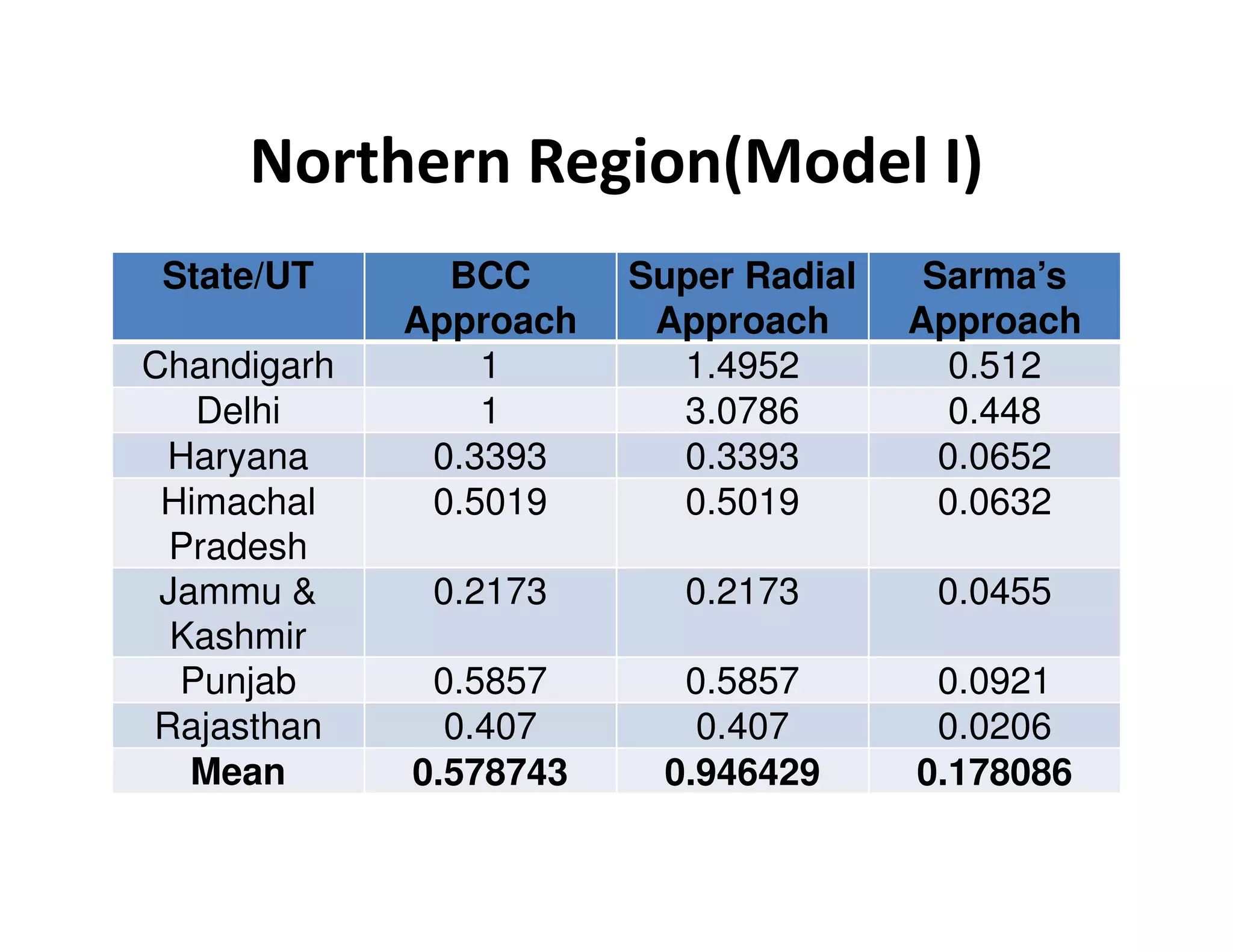
Northern Region(Model I)
State/UT BCC
Approach
Super Radial
Approach
Sarma’s
Approach
Chandigarh 1 1.4952 0.512
Delhi 1 3.0786 0.448
Haryana 0.3393 0.3393 0.0652Haryana 0.3393 0.3393 0.0652
Himachal
Pradesh
0.5019 0.5019 0.0632
Jammu &
Kashmir
0.2173 0.2173 0.0455
Punjab 0.5857 0.5857 0.0921
Rajasthan 0.407 0.407 0.0206
Mean 0.578743 0.946429 0.178086
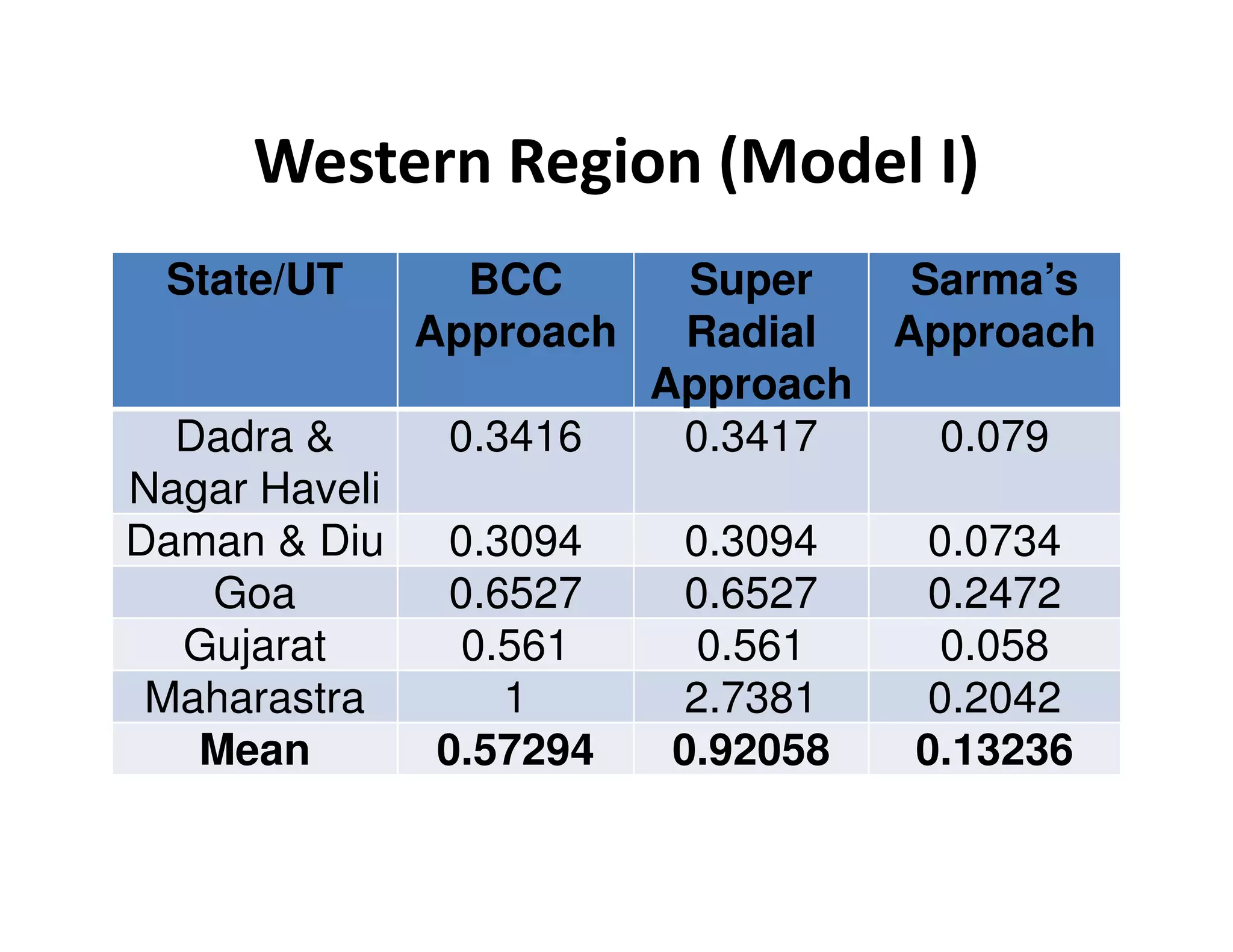
Western Region (Model I)
State/UT BCC
Approach
Super
Radial
Approach
Sarma’s
Approach
Dadra &
Nagar Haveli
0.3416 0.3417 0.079
Nagar Haveli
Daman & Diu 0.3094 0.3094 0.0734
Goa 0.6527 0.6527 0.2472
Gujarat 0.561 0.561 0.058
Maharastra 1 2.7381 0.2042
Mean 0.57294 0.92058 0.13236
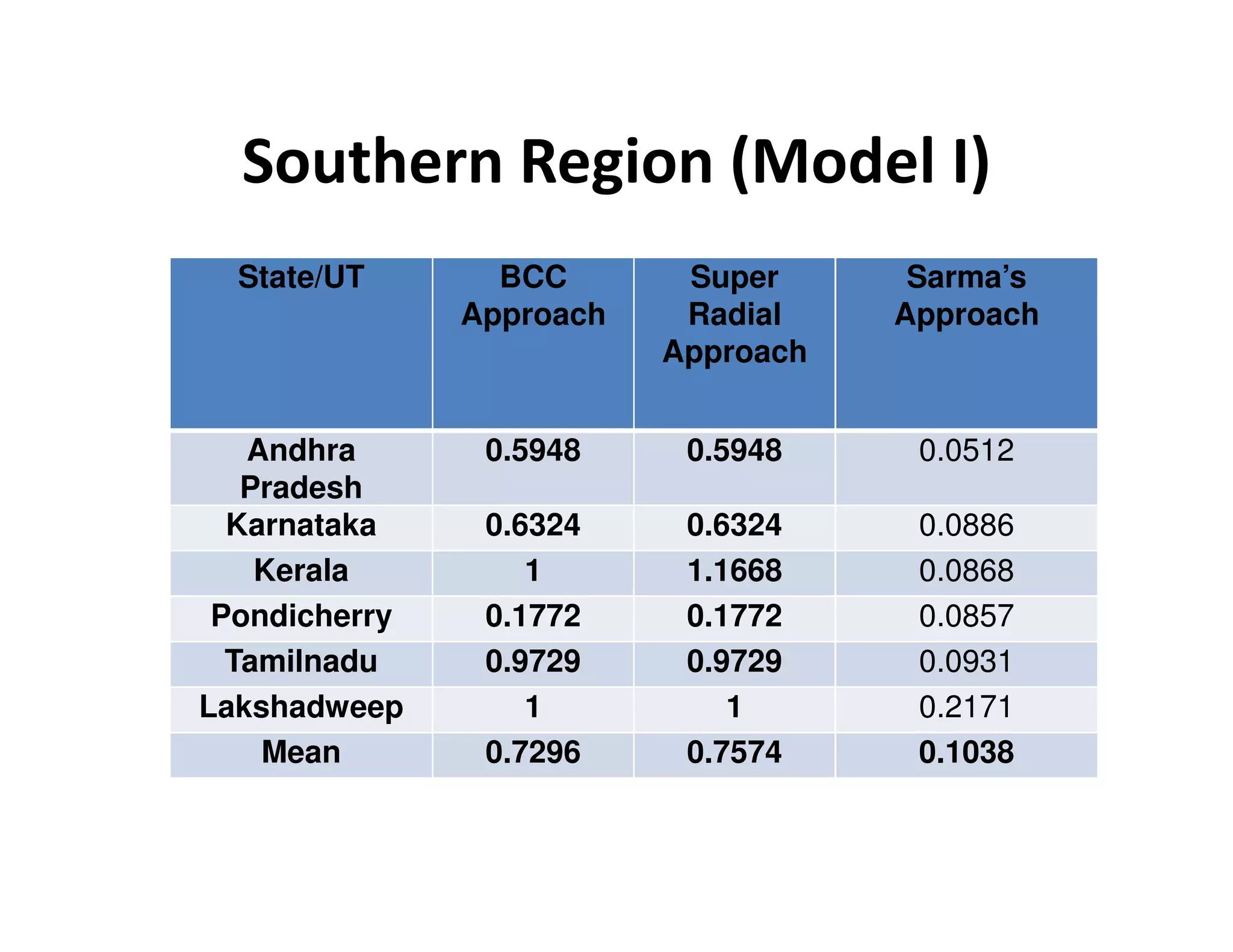
Southern Region (Model I)
State/UT BCC
Approach
Super
Radial
Approach
Sarma’s
Approach
Andhra
Pradesh
0.5948 0.5948 0.0512
Pradesh
Karnataka 0.6324 0.6324 0.0886
Kerala 1 1.1668 0.0868
Pondicherry 0.1772 0.1772 0.0857
Tamilnadu 0.9729 0.9729 0.0931
Lakshadweep 1 1 0.2171
Mean 0.7296 0.7574 0.1038
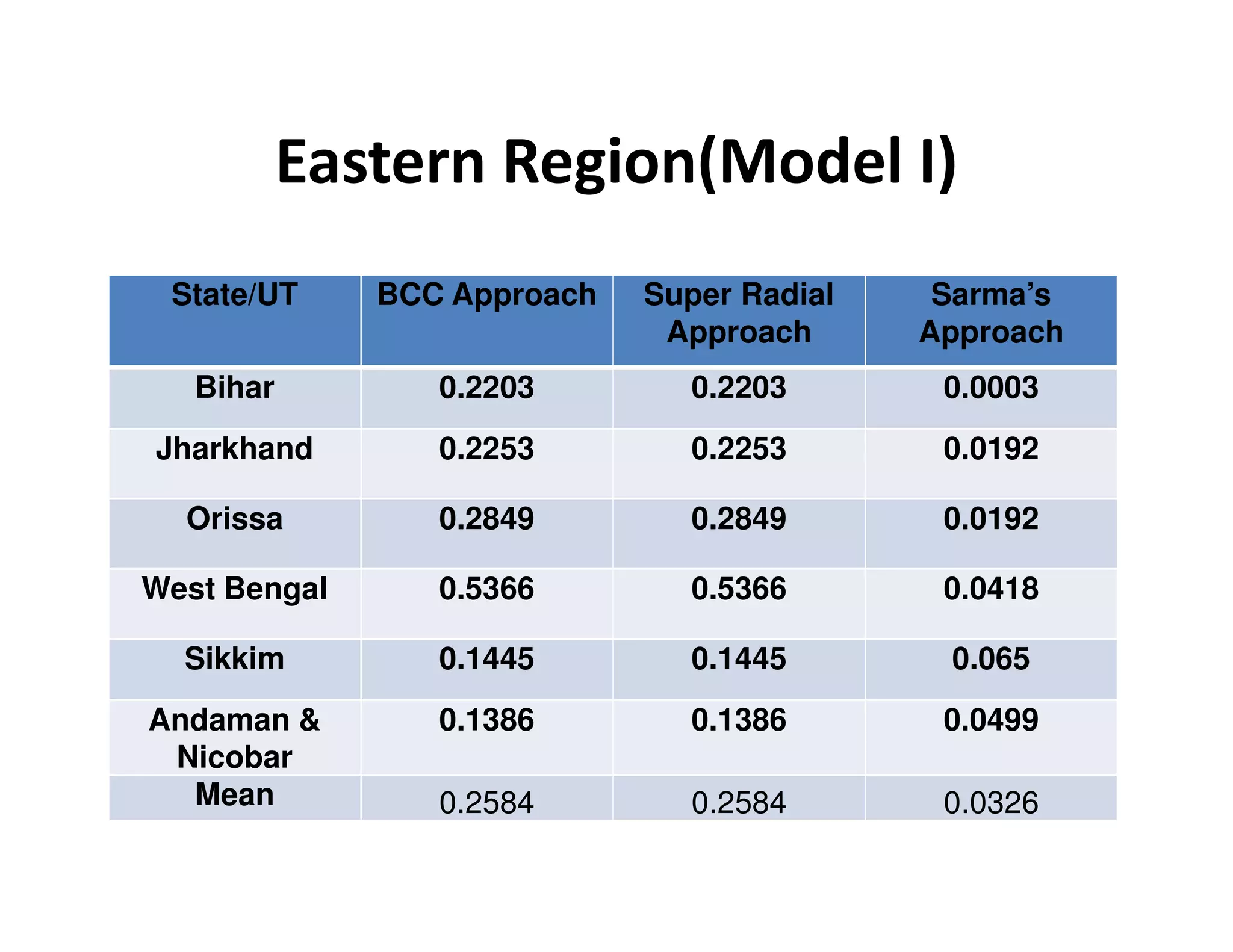
Eastern Region(Model I)
State/UT BCC Approach Super Radial
Approach
Sarma’s
Approach
Bihar 0.2203 0.2203 0.0003
Jharkhand 0.2253 0.2253 0.0192
Orissa 0.2849 0.2849 0.0192
West Bengal 0.5366 0.5366 0.0418
Sikkim 0.1445 0.1445 0.065
Andaman &
Nicobar
0.1386 0.1386 0.0499
Mean 0.2584 0.2584 0.0326
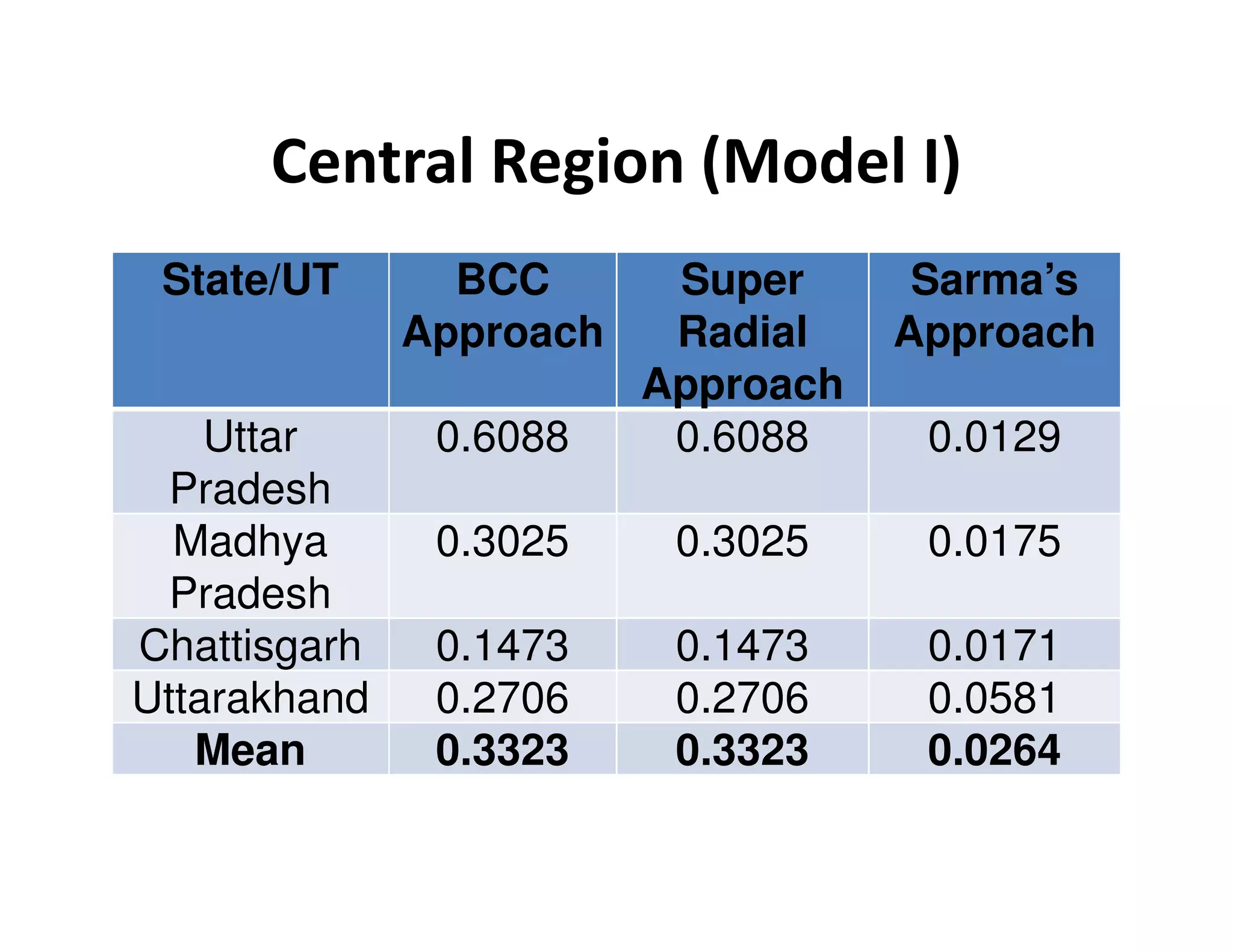
Central Region (Model I)
State/UT BCC
Approach
Super
Radial
Approach
Sarma’s
Approach
Uttar
Pradesh
0.6088 0.6088 0.0129
Pradesh
Madhya
Pradesh
0.3025 0.3025 0.0175
Chattisgarh 0.1473 0.1473 0.0171
Uttarakhand 0.2706 0.2706 0.0581
Mean 0.3323 0.3323 0.0264
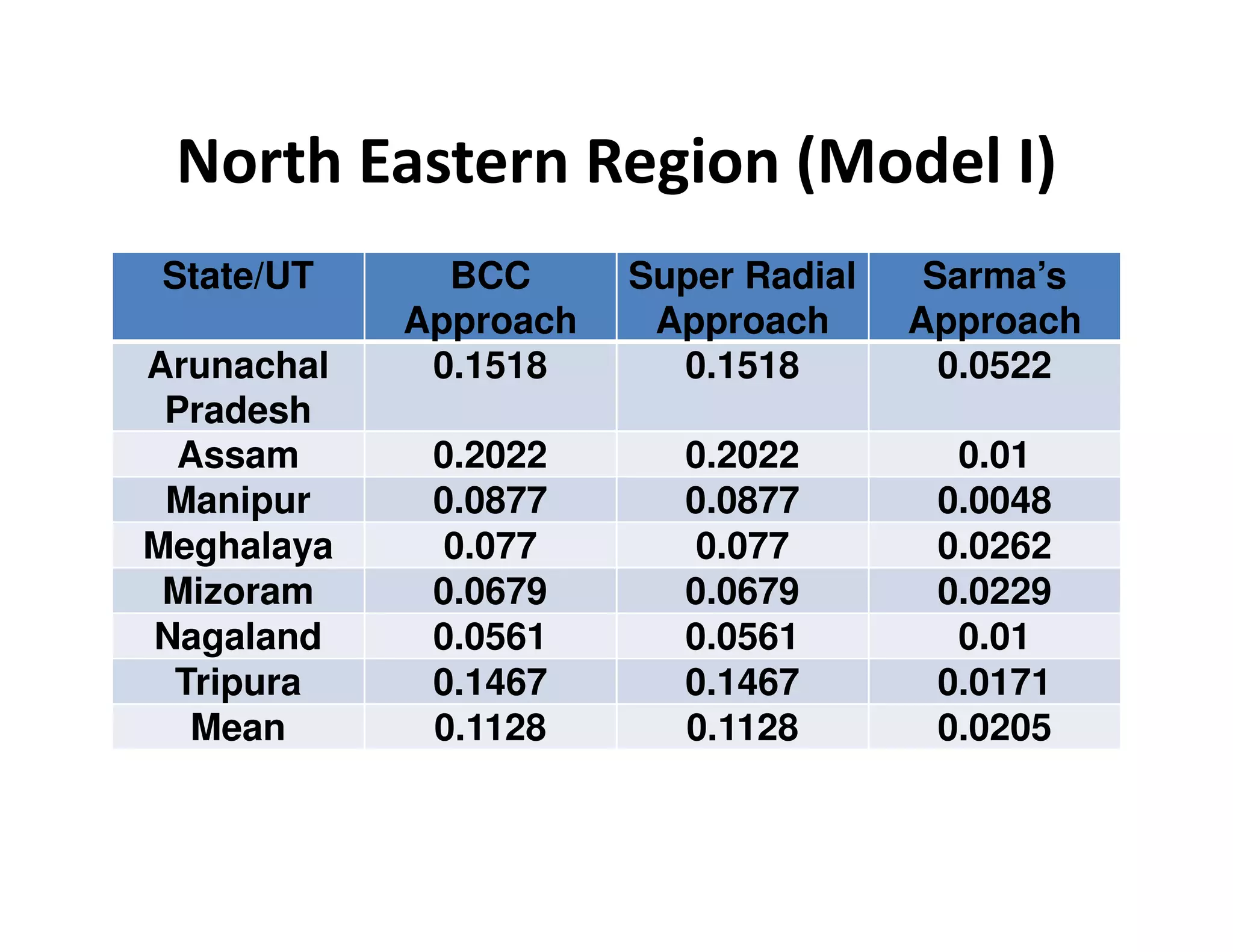
North Eastern Region (Model I)
State/UT BCC
Approach
Super Radial
Approach
Sarma’s
Approach
Arunachal
Pradesh
0.1518 0.1518 0.0522
Assam 0.2022 0.2022 0.01
Manipur 0.0877 0.0877 0.0048
Meghalaya 0.077 0.077 0.0262
Mizoram 0.0679 0.0679 0.0229
Nagaland 0.0561 0.0561 0.01
Tripura 0.1467 0.1467 0.0171
Mean 0.1128 0.1128 0.0205
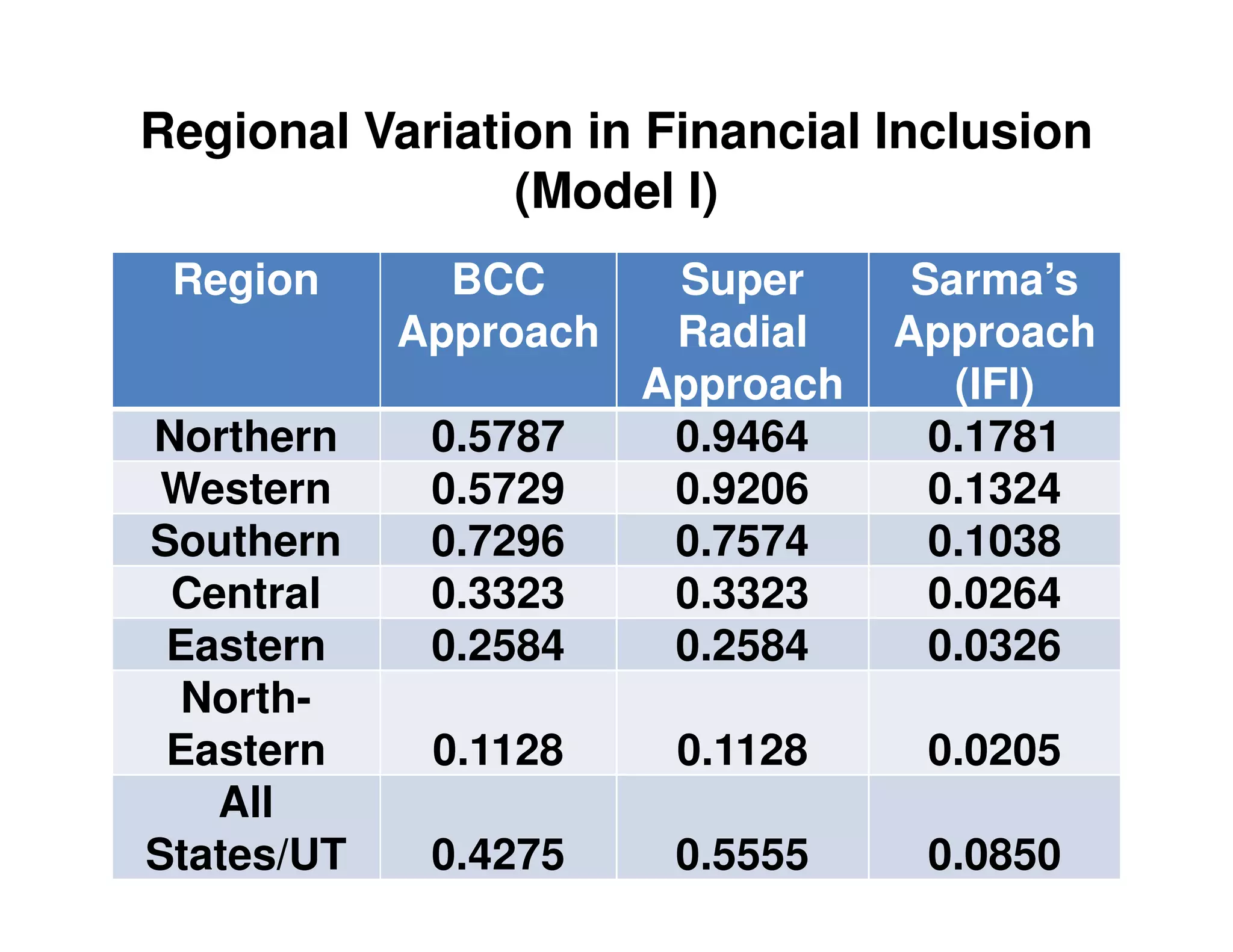
Regional Variation in Financial Inclusion
(Model I)
Region BCC
Approach
Super
Radial
Approach
Sarma’s
Approach
(IFI)
Northern 0.5787 0.9464 0.1781
Western 0.5729 0.9206 0.1324Western 0.5729 0.9206 0.1324
Southern 0.7296 0.7574 0.1038
Central 0.3323 0.3323 0.0264
Eastern 0.2584 0.2584 0.0326
North-
Eastern 0.1128 0.1128 0.0205
All
States/UT 0.4275 0.5555 0.0850
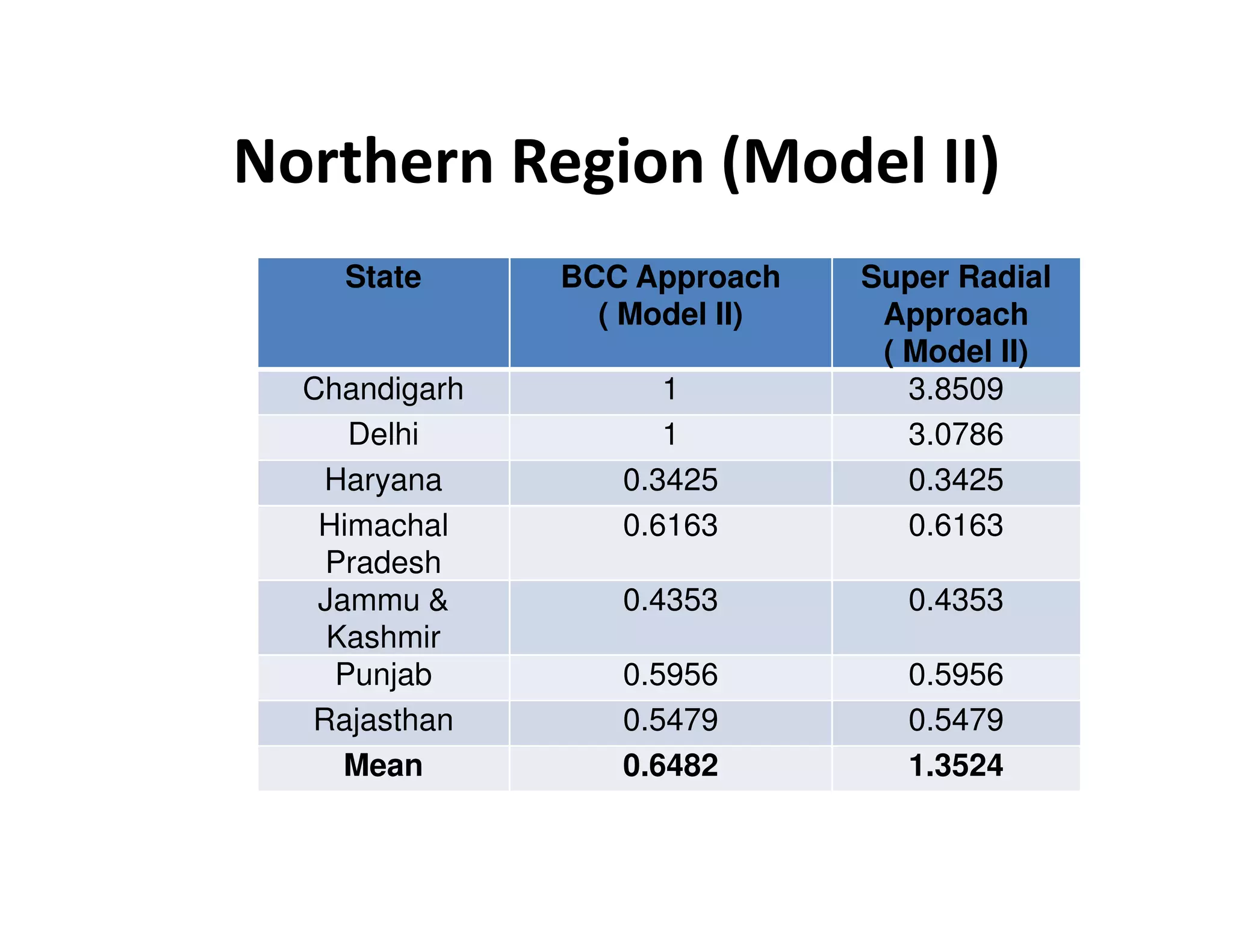
Northern Region (Model II)
State BCC Approach
( Model II)
Super Radial
Approach
( Model II)
Chandigarh 1 3.8509
Delhi 1 3.0786
Haryana 0.3425 0.3425Haryana 0.3425 0.3425
Himachal
Pradesh
0.6163 0.6163
Jammu &
Kashmir
0.4353 0.4353
Punjab 0.5956 0.5956
Rajasthan 0.5479 0.5479
Mean 0.6482 1.3524
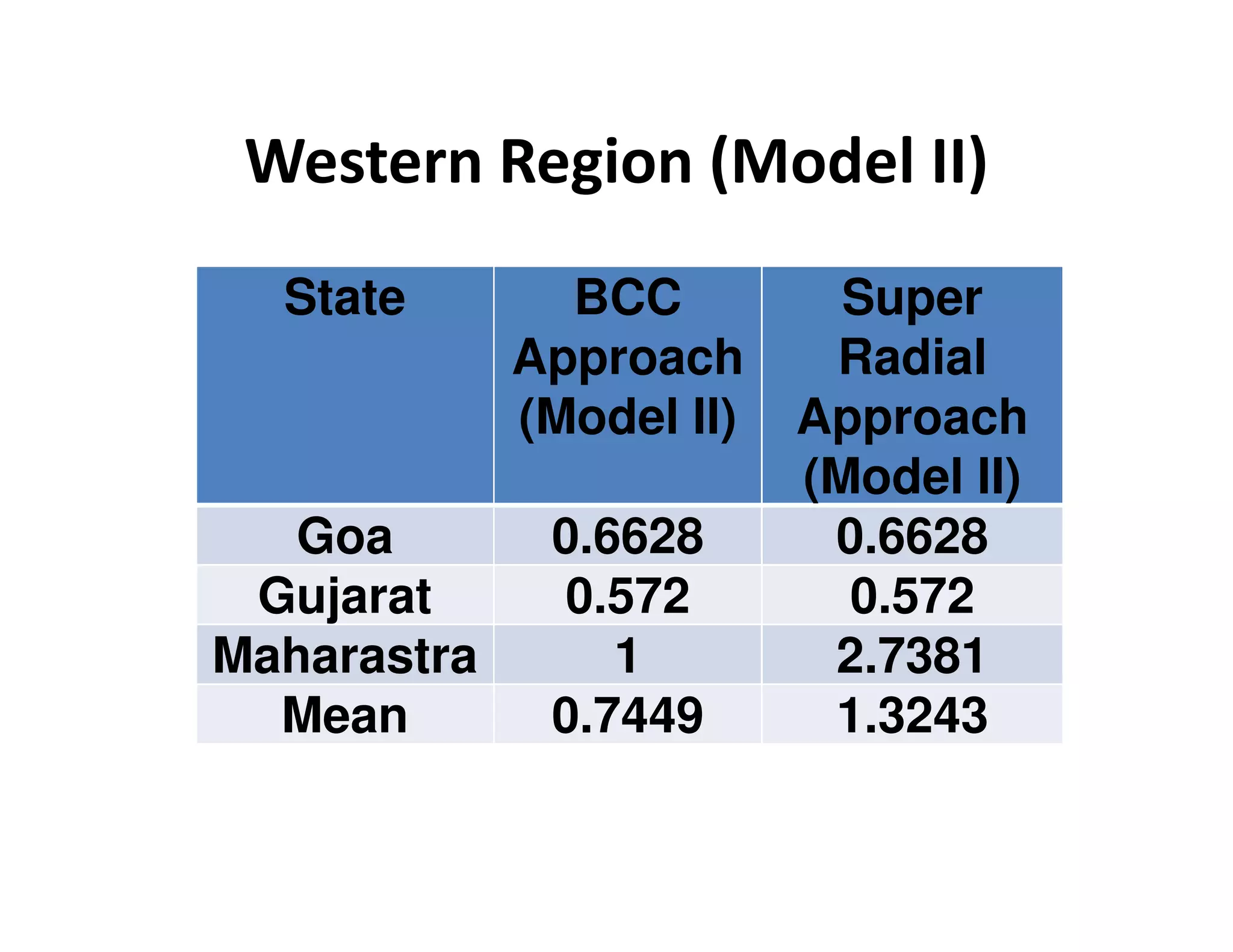
Western Region (Model II)
State BCC
Approach
(Model II)
Super
Radial
Approach
(Model II)(Model II)
Goa 0.6628 0.6628
Gujarat 0.572 0.572
Maharastra 1 2.7381
Mean 0.7449 1.3243
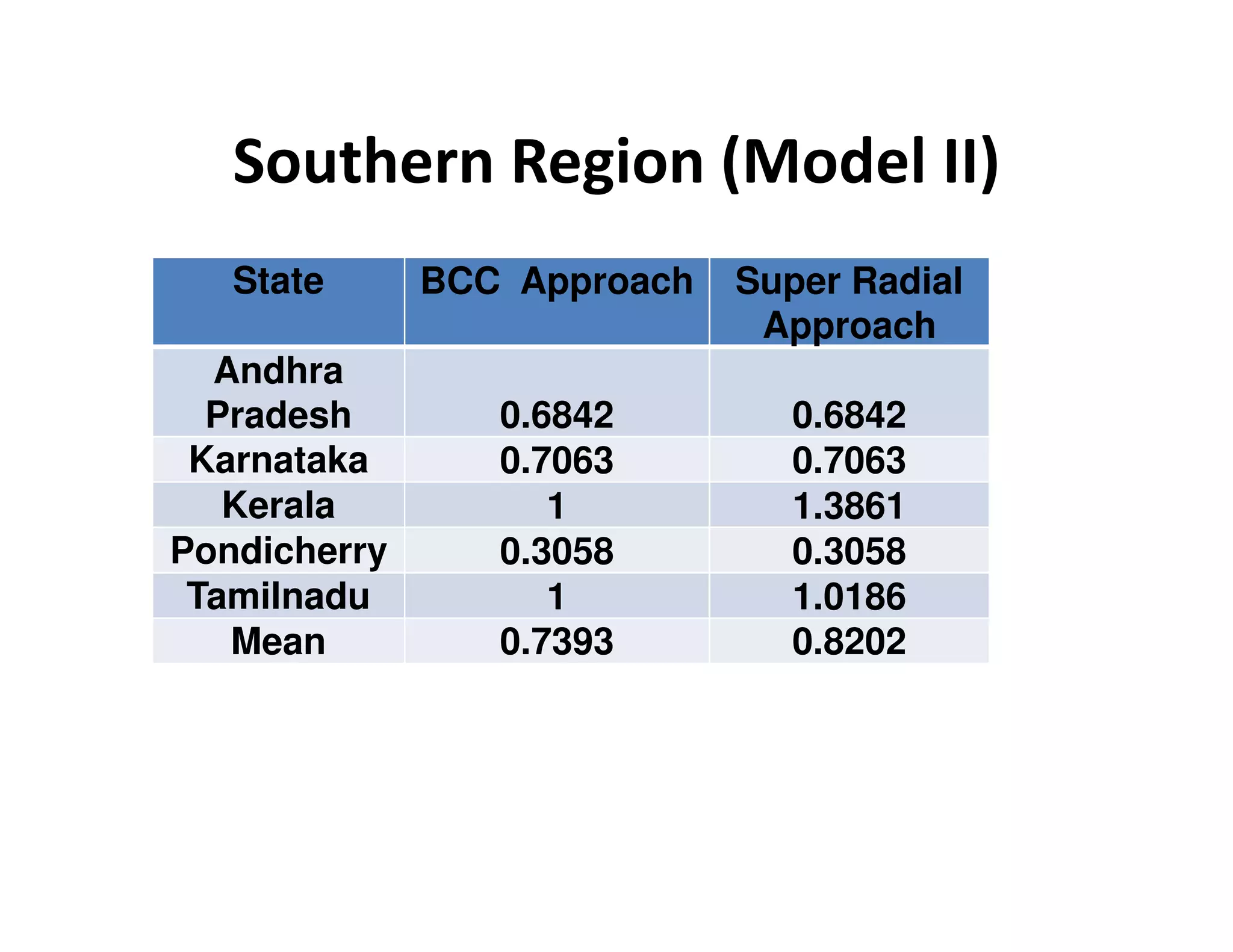
Southern Region (Model II)
State BCC Approach Super Radial
Approach
Andhra
Pradesh 0.6842 0.6842
Karnataka 0.7063 0.7063Karnataka 0.7063 0.7063
Kerala 1 1.3861
Pondicherry 0.3058 0.3058
Tamilnadu 1 1.0186
Mean 0.7393 0.8202
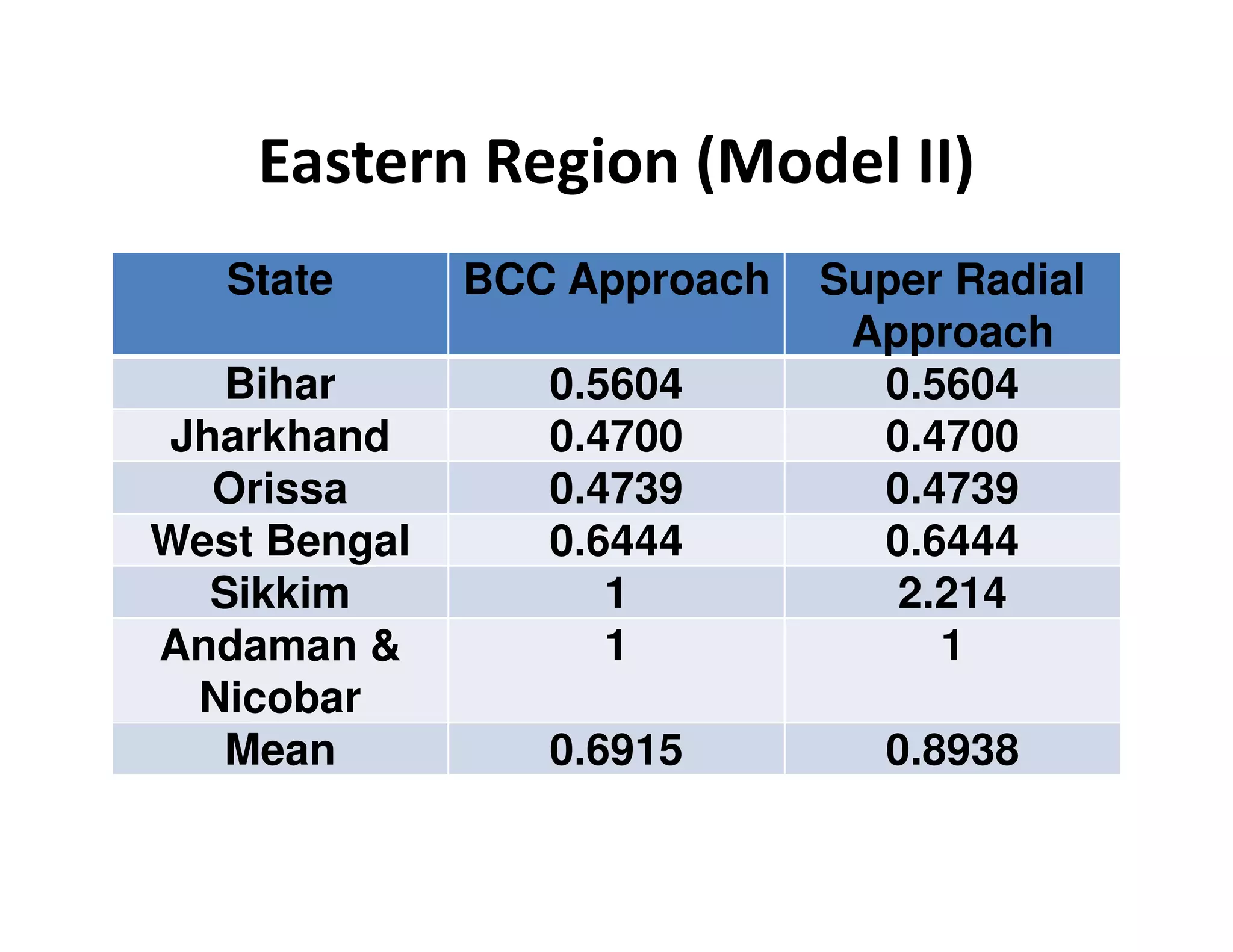
Eastern Region (Model II)
State BCC Approach Super Radial
Approach
Bihar 0.5604 0.5604
Jharkhand 0.4700 0.4700
Orissa 0.4739 0.4739Orissa 0.4739 0.4739
West Bengal 0.6444 0.6444
Sikkim 1 2.214
Andaman &
Nicobar
1 1
Mean 0.6915 0.8938
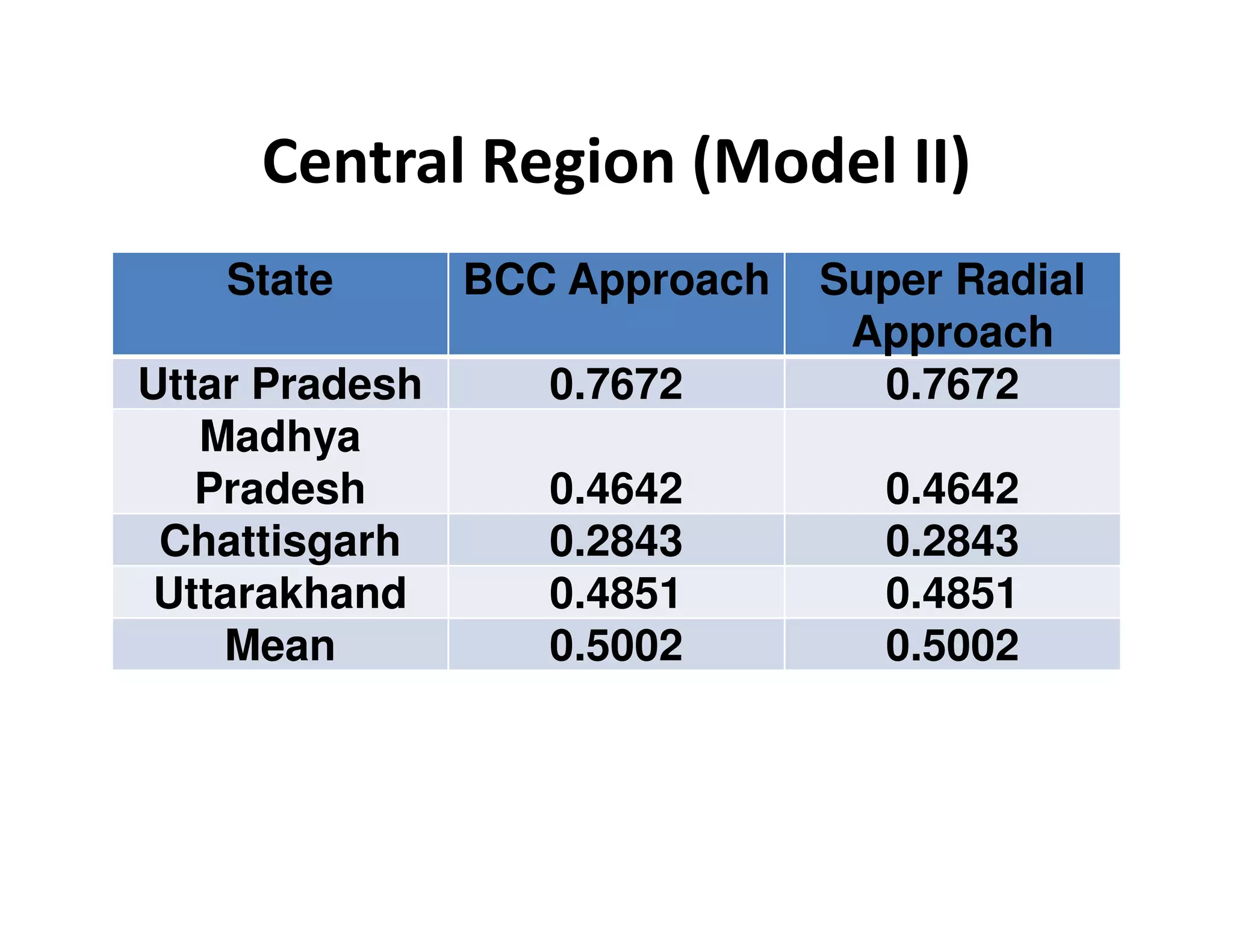
Central Region (Model II)
State BCC Approach Super Radial
Approach
Uttar Pradesh 0.7672 0.7672
Madhya
Pradesh 0.4642 0.4642Pradesh 0.4642 0.4642
Chattisgarh 0.2843 0.2843
Uttarakhand 0.4851 0.4851
Mean 0.5002 0.5002
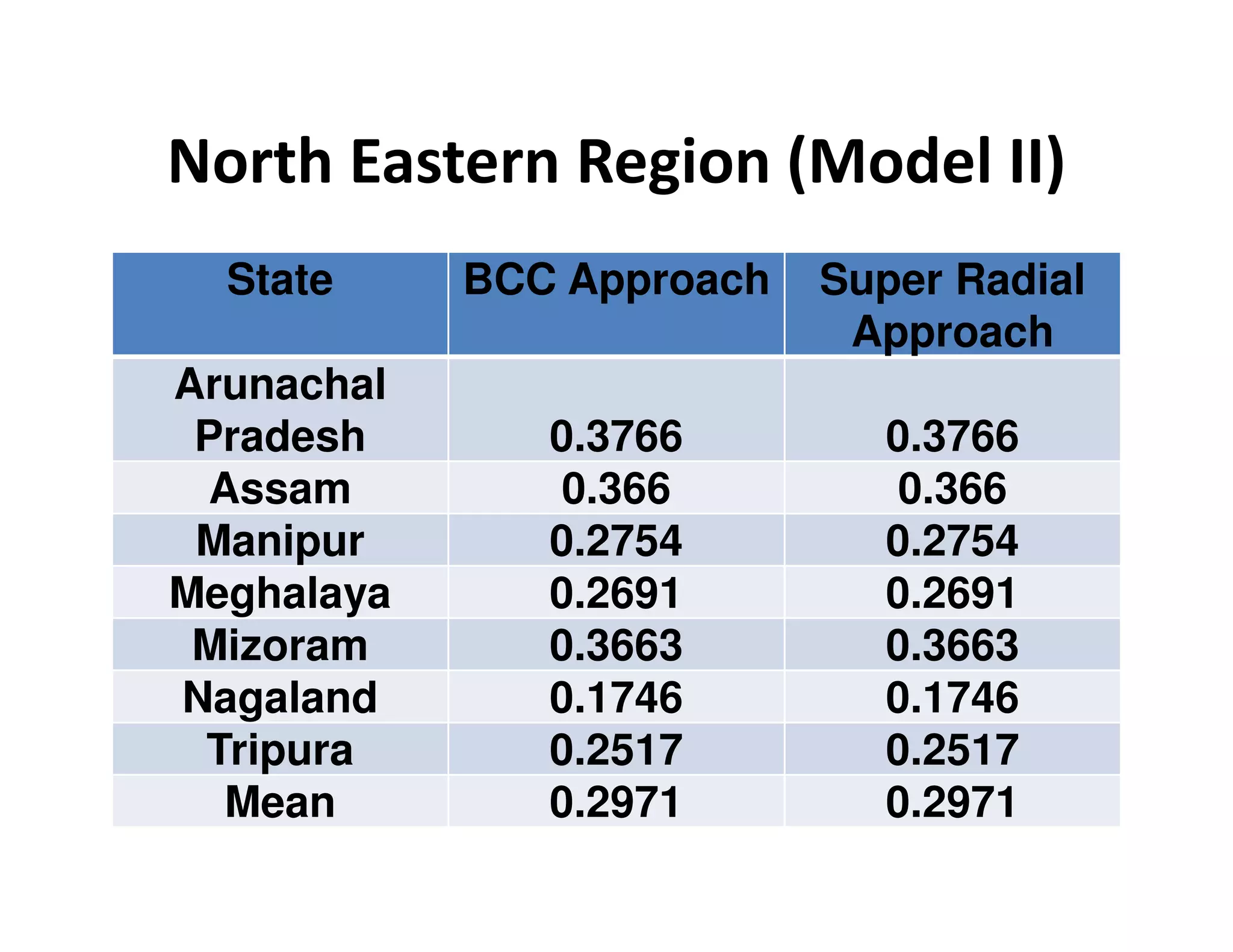
North Eastern Region (Model II)
State BCC Approach Super Radial
Approach
Arunachal
Pradesh 0.3766 0.3766
Assam 0.366 0.366Assam 0.366 0.366
Manipur 0.2754 0.2754
Meghalaya 0.2691 0.2691
Mizoram 0.3663 0.3663
Nagaland 0.1746 0.1746
Tripura 0.2517 0.2517
Mean 0.2971 0.2971
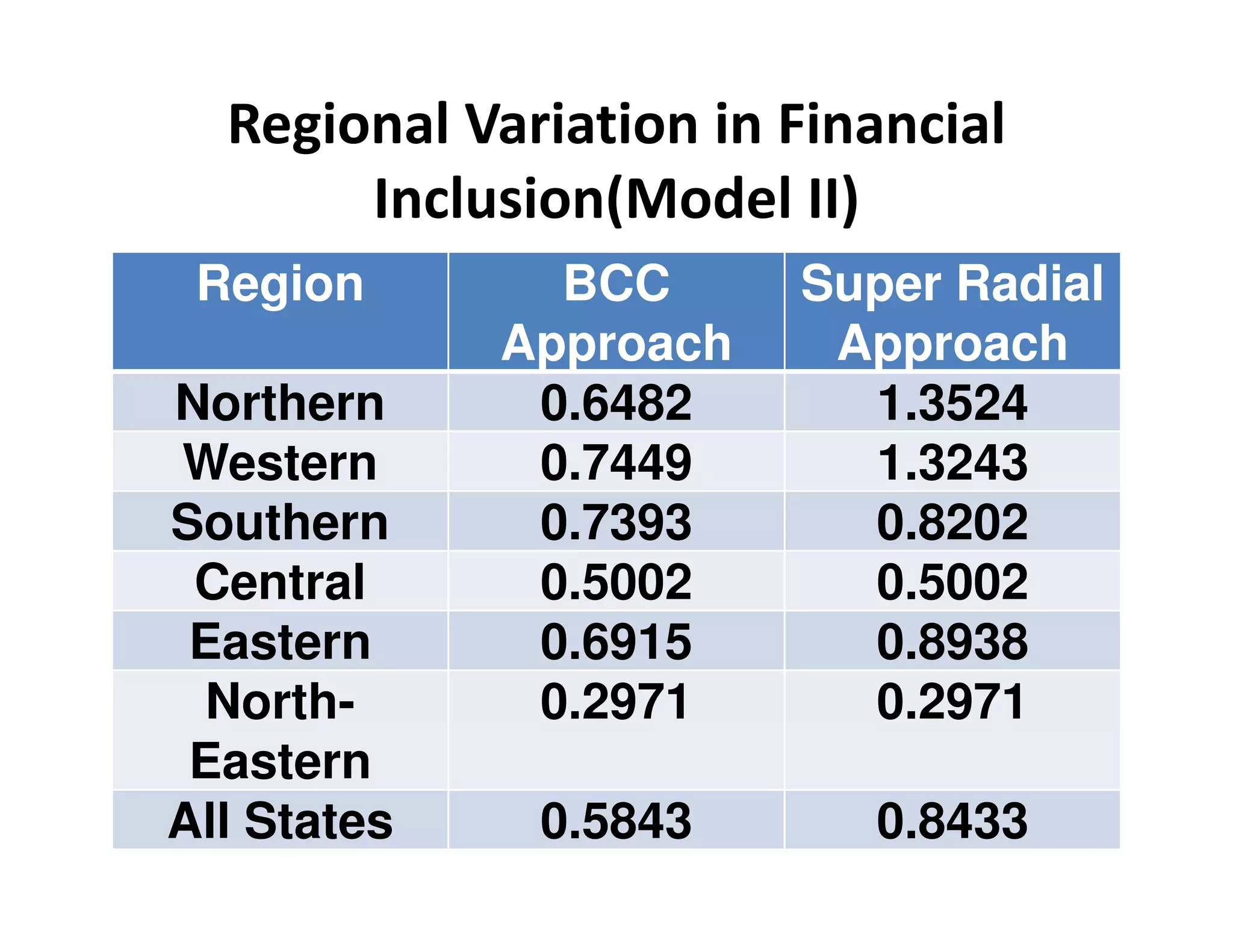
Regional Variation in Financial
Inclusion(Model II)
Region BCC
Approach
Super Radial
Approach
Northern 0.6482 1.3524
Western 0.7449 1.3243Western 0.7449 1.3243
Southern 0.7393 0.8202
Central 0.5002 0.5002
Eastern 0.6915 0.8938
North-
Eastern
0.2971 0.2971
All States 0.5843 0.8433

Regional disparity in financial inclusion [compatibility mode]

  • 1.
    REGIONAL DISPARITY INFINANCIAL INCLUSION:THE INDIAN EVIDENCE DR.RAM PRATAP SINHADR.RAM PRATAP SINHA ASSOCIATE PROFESSOR OF ECONOMICSASSOCIATE PROFESSOR OF ECONOMICS GOVERNMENT COLLEGE OF ENGINEERING AND LEATHERGOVERNMENT COLLEGE OF ENGINEERING AND LEATHER TECHNOLOGYTECHNOLOGY LB BLOCK, SECTORLB BLOCK, SECTOR--III,SALT LAKE, KOLKATAIII,SALT LAKE, KOLKATA--700098700098 E MAILE MAIL:: rampratapsinha39@gmail.comrampratapsinha39@gmail.com
  • 2.
    Introduction • Financial inclusionmay be defined as the process of ensuring access to financial services(including savings, loans, insurance, payments, remittance facilities etc.) and thepayments, remittance facilities etc.) and the provision of adequate credit to the socially vulnerable groups at affordable rates. • Financial inclusion can therefore be considered as an important prerequisite for just and equitable growth of a modern society
  • 3.
    Financial Inclusion inBanking • In the Indian context, the process of financial inclusion in the banking sector was initiated by the public sector banks since the end sixties through the process of branch banking which provided the rural people with the opportunity to have bank accounts in their names even with small amounts of deposits. • The RBI introduced a Self-help Group (SHG)-Bank Linkage Programme in 1992 and formulated the Kisan Credit Card scheme in 2001in 1992 and formulated the Kisan Credit Card scheme in 2001 • In November 2005, commercial banks were advised to make available a basic banking ‘no-frills’ account with low or nil minimum stipulated balances as well as charges to expand the outreach of such accounts to vast sections of the population. • In January 2006, banks were permitted to utilise the services of non- governmental organisations (NGOs/SHGs), micro-finance institutions and other civil society organisations as intermediaries in providing financial and banking services through the use of business facilitator and business correspondent models.
  • 4.
    Financial Inclusion inInsurance • The IRDA introduced social and rural sector obligations for the insurance companies in 2002: • Rural sector was defined by the IRDA as comprising of (a) a population <5000,(b) density of population <400 per square kilometer, and (c) more than twenty five % of the male working population is engaged in agricultural activity. • The social sector is defined to comprise of (i)unorganized sector,(ii)informal sector,(iii) economically vulnerable or backward classes, and (iv) other categories of persons, both in rural and urban areas.
  • 5.
    The Rural-Urban Gapin the Provision/Access of Banking Services Particulars Offices (% to total) No of Deposit Accounts (% of Deposits (% to total) No of Credit Accounts (% of number of Credits (% to total) (% of number of households) number of households) Rural 68 181.8 29.1 32.2 20.8 Urban 32 335.4 70.9 50.2 79,2 Total 100 517.2 100 82.4 100
  • 6.
    Index of FinancialInclusion • Sarma(2008) pointed out that while there is an widespread recognition of the importance of financial inclusion,one does not find any comprehensive measure of financial inclusion in the literature which may be used to measure the extent of financial inclusion across economies. • In her paper she presented an approach for the construction of an index of financial inclusion and used the same to compare 100 countries in respect of financial inclusion.
  • 7.
    A Multidimensional Index •Sarma(2008) proposed a multidimensional approach for the construction of an index of financial inclusion. The approach involves the computation of a dimension index for each dimension of financial inclusion. The dimension index for the ith dimension, di, is computed by the following formula. di =(Ai-mi)/(Mi-mi) ----------(1) where Ai = Actual value of dimension I, mi = minimum value of dimension i Mi = maximum value of dimension i
  • 8.
    The Index • Formula(1) ensures that 0 ≤ di ≤ 1. Higher the value of di, higher the country’s achievement in dimension i. If n dimensions of financial inclusion are considered, then, a country i will be represented by a point Di = (d1, d2, d3, ….dn) on the n dimensional Cartesian space. • Then the Index of Financial Inclusion (IFI) for entity i is computed as: IFIi =1-√[(1-d1)2+(1-d2)2+-----+(1-dn)2]/√n
  • 9.
    Studies Based onthe Multidimensional Index • Sarma(2008) made use of the Index of Financial Inclusion to make a cross-country comparison of financial inclusion for the year 2004 using three dimensions of financial inclusion: • (a)banking penetration (BP) as measured by bank accounts/population, (b)availability of the banking services (BS) as measured by the number of bank branches per 1000 population andbranches per 1000 population and (c) usage of the banking system (BU) as measured by the volume of deposit and credit to GDP. • Goyal(2009) used the multidimensional index of financial inclusion to compare the state of financial inclusion of the north eastern states for the year 2005 using the same dimensions used by Sarma.However, the index computed by Goyal included per capita credit and deposit instead of the volume of credit and deposit as proportion of the Country’s GDP used by Sarma.
  • 10.
    Objective of thePresent Paper • Given the backdrop outlined previously, the objective of the present paper is twofold: • To suggest how alternative indices could be constructed using mathematical programming. • To provide an inter- state and inter-regional study in the Indian context on financial inclusion using both the multidimensional index and the mathematical programming approach.
  • 11.
    Construction of anew Index of Financial Inclusion • In the present context, we propose to develop an index based on data envelopment analysis. However, one can make use of other methods like the Free Disposal Hull (FDH) Approach as well. • We have a total of 35 states and union territories to compare. We assume that for each state the provision of financial services is dependent on population. We choose Deposit collected by commercial banks, credit disbursed and insurance premia mobilised as the threee indicators of financial inclusion.
  • 12.
    Northern Region(Model I) State/UTBCC Approach Super Radial Approach Sarma’s Approach Chandigarh 1 1.4952 0.512 Delhi 1 3.0786 0.448 Haryana 0.3393 0.3393 0.0652Haryana 0.3393 0.3393 0.0652 Himachal Pradesh 0.5019 0.5019 0.0632 Jammu & Kashmir 0.2173 0.2173 0.0455 Punjab 0.5857 0.5857 0.0921 Rajasthan 0.407 0.407 0.0206 Mean 0.578743 0.946429 0.178086
  • 13.
    Western Region (ModelI) State/UT BCC Approach Super Radial Approach Sarma’s Approach Dadra & Nagar Haveli 0.3416 0.3417 0.079 Nagar Haveli Daman & Diu 0.3094 0.3094 0.0734 Goa 0.6527 0.6527 0.2472 Gujarat 0.561 0.561 0.058 Maharastra 1 2.7381 0.2042 Mean 0.57294 0.92058 0.13236
  • 14.
    Southern Region (ModelI) State/UT BCC Approach Super Radial Approach Sarma’s Approach Andhra Pradesh 0.5948 0.5948 0.0512 Pradesh Karnataka 0.6324 0.6324 0.0886 Kerala 1 1.1668 0.0868 Pondicherry 0.1772 0.1772 0.0857 Tamilnadu 0.9729 0.9729 0.0931 Lakshadweep 1 1 0.2171 Mean 0.7296 0.7574 0.1038
  • 15.
    Eastern Region(Model I) State/UTBCC Approach Super Radial Approach Sarma’s Approach Bihar 0.2203 0.2203 0.0003 Jharkhand 0.2253 0.2253 0.0192 Orissa 0.2849 0.2849 0.0192 West Bengal 0.5366 0.5366 0.0418 Sikkim 0.1445 0.1445 0.065 Andaman & Nicobar 0.1386 0.1386 0.0499 Mean 0.2584 0.2584 0.0326
  • 16.
    Central Region (ModelI) State/UT BCC Approach Super Radial Approach Sarma’s Approach Uttar Pradesh 0.6088 0.6088 0.0129 Pradesh Madhya Pradesh 0.3025 0.3025 0.0175 Chattisgarh 0.1473 0.1473 0.0171 Uttarakhand 0.2706 0.2706 0.0581 Mean 0.3323 0.3323 0.0264
  • 17.
    North Eastern Region(Model I) State/UT BCC Approach Super Radial Approach Sarma’s Approach Arunachal Pradesh 0.1518 0.1518 0.0522 Assam 0.2022 0.2022 0.01 Manipur 0.0877 0.0877 0.0048 Meghalaya 0.077 0.077 0.0262 Mizoram 0.0679 0.0679 0.0229 Nagaland 0.0561 0.0561 0.01 Tripura 0.1467 0.1467 0.0171 Mean 0.1128 0.1128 0.0205
  • 18.
    Regional Variation inFinancial Inclusion (Model I) Region BCC Approach Super Radial Approach Sarma’s Approach (IFI) Northern 0.5787 0.9464 0.1781 Western 0.5729 0.9206 0.1324Western 0.5729 0.9206 0.1324 Southern 0.7296 0.7574 0.1038 Central 0.3323 0.3323 0.0264 Eastern 0.2584 0.2584 0.0326 North- Eastern 0.1128 0.1128 0.0205 All States/UT 0.4275 0.5555 0.0850
  • 19.
    Northern Region (ModelII) State BCC Approach ( Model II) Super Radial Approach ( Model II) Chandigarh 1 3.8509 Delhi 1 3.0786 Haryana 0.3425 0.3425Haryana 0.3425 0.3425 Himachal Pradesh 0.6163 0.6163 Jammu & Kashmir 0.4353 0.4353 Punjab 0.5956 0.5956 Rajasthan 0.5479 0.5479 Mean 0.6482 1.3524
  • 20.
    Western Region (ModelII) State BCC Approach (Model II) Super Radial Approach (Model II)(Model II) Goa 0.6628 0.6628 Gujarat 0.572 0.572 Maharastra 1 2.7381 Mean 0.7449 1.3243
  • 21.
    Southern Region (ModelII) State BCC Approach Super Radial Approach Andhra Pradesh 0.6842 0.6842 Karnataka 0.7063 0.7063Karnataka 0.7063 0.7063 Kerala 1 1.3861 Pondicherry 0.3058 0.3058 Tamilnadu 1 1.0186 Mean 0.7393 0.8202
  • 22.
    Eastern Region (ModelII) State BCC Approach Super Radial Approach Bihar 0.5604 0.5604 Jharkhand 0.4700 0.4700 Orissa 0.4739 0.4739Orissa 0.4739 0.4739 West Bengal 0.6444 0.6444 Sikkim 1 2.214 Andaman & Nicobar 1 1 Mean 0.6915 0.8938
  • 23.
    Central Region (ModelII) State BCC Approach Super Radial Approach Uttar Pradesh 0.7672 0.7672 Madhya Pradesh 0.4642 0.4642Pradesh 0.4642 0.4642 Chattisgarh 0.2843 0.2843 Uttarakhand 0.4851 0.4851 Mean 0.5002 0.5002
  • 24.
    North Eastern Region(Model II) State BCC Approach Super Radial Approach Arunachal Pradesh 0.3766 0.3766 Assam 0.366 0.366Assam 0.366 0.366 Manipur 0.2754 0.2754 Meghalaya 0.2691 0.2691 Mizoram 0.3663 0.3663 Nagaland 0.1746 0.1746 Tripura 0.2517 0.2517 Mean 0.2971 0.2971
  • 25.
    Regional Variation inFinancial Inclusion(Model II) Region BCC Approach Super Radial Approach Northern 0.6482 1.3524 Western 0.7449 1.3243Western 0.7449 1.3243 Southern 0.7393 0.8202 Central 0.5002 0.5002 Eastern 0.6915 0.8938 North- Eastern 0.2971 0.2971 All States 0.5843 0.8433