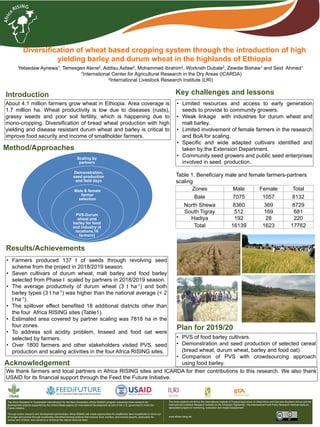
Diversification of wheat based cropping system through the introduction of high
yielding barley and durum wheat in the highlands of Ethiopia
Yetsedaw Aynewa1, Temesgen Alene2, Addisu Asfaw2, Mohammed Ibrahim2, Workneh Dubale2, Zewdie Bishaw1 and Seid Ahmed1
1International Center for Agricultural Research in the Dry Areas (ICARDA)
2International Livestock Research Institute (LRI)
Introduction
About 4.1 million farmers grow wheat in Ethiopia. Area coverage is
1.7 million ha. Wheat productivity is low due to diseases (rusts),
grassy weeds and poor soil fertility, which is happening due to
mono-cropping. Diversification of bread wheat production with high
yielding and disease resistant durum wheat and barley is critical to
improve food security and income of smallholder farmers.
Results/Achievements
Method/Approaches
• Farmers produced 137 t of seeds through revolving seed
scheme from the project in 2018/2019 season.
• Seven cultivars of durum wheat, malt barley and food barley
selected from Phase I scaled by partners in 2018/2019 season.
• The average productivity of durum wheat (3 t ha-1) and both
barley types (3 t ha-1) was higher than the national average (< 2
t ha-1).
• The spillover effect benefited 18 additional districts other than
the four Africa RISING sites (Table1).
• Estimated area covered by partner scaling was 7818 ha in the
four zones.
• To address soil acidity problem, linseed and food oat were
selected by farmers.
• Over 1800 farmers and other stakeholders visited PVS, seed
production and scaling activities in the four Africa RISING sites.
• PVS of food barley cultivars.
• Demonstration and seed production of selected cereal
(bread wheat, durum wheat, barley and food oat).
• Comparison of PVS with crowdsourcing approach
using food barley.
Plan for 2019/20
• Limited resources and access to early generation
seeds to provide to community growers.
• Weak linkage with industries for durum wheat and
malt barley.
• Limited involvement of female farmers in the research
and BoA for scaling.
• Specific and wide adapted cultivars identified and
taken by the Extension Department.
• Community seed growers and public seed enterprises
involved in seed production.
The Africa Research In Sustainable Intensification for the Next Generation (Africa RISING) program comprises three research-for-
development projects supported by the United States Agency for International Development as part of the U.S. government’s Feed the
Future initiative.
Through action research and development partnerships, Africa RISING will create opportunities for smallholder farm households to move out
of hunger and poverty through sustainably intensified farming systems that improve food, nutrition, and income security, particularly for
women and children, and conserve or enhance the natural resource base.
The three projects are led by the International Institute of Tropical Agriculture (in West Africa and East and Southern Africa) and the
International Livestock Research Institute (in the Ethiopian Highlands). The International Food Policy Research Institute leads an
associated project on monitoring, evaluation and impact assessment.
www.africa-rising.net
Key challenges and lessons
We thank farmers and local partners in Africa RISING sites and ICARDA for their contributions to this research. We also thank
USAID for its financial support through the Feed the Future Initiative.
Acknowledgement
Scaling by
partners
Demonstration,
seed production
and field days
Male & female
farmer
selection
PVS-Durum
wheat and
barley for food
and industry (4
locations,16
farmers)
Zones Male Female Total
Bale 7075 1057 8132
North Shewa 8360 369 8729
South Tigray 512 169 681
Hadiya 192 28 220
Total 16139 1623 17762
Table 1. Beneficiary male and female farmers-partners
scaling

Diversification of wheat based cropping system through the introduction of high yielding barley and durum wheat in the highlands of Ethiopia

  • 1.
    Diversification of wheatbased cropping system through the introduction of high yielding barley and durum wheat in the highlands of Ethiopia Yetsedaw Aynewa1, Temesgen Alene2, Addisu Asfaw2, Mohammed Ibrahim2, Workneh Dubale2, Zewdie Bishaw1 and Seid Ahmed1 1International Center for Agricultural Research in the Dry Areas (ICARDA) 2International Livestock Research Institute (LRI) Introduction About 4.1 million farmers grow wheat in Ethiopia. Area coverage is 1.7 million ha. Wheat productivity is low due to diseases (rusts), grassy weeds and poor soil fertility, which is happening due to mono-cropping. Diversification of bread wheat production with high yielding and disease resistant durum wheat and barley is critical to improve food security and income of smallholder farmers. Results/Achievements Method/Approaches • Farmers produced 137 t of seeds through revolving seed scheme from the project in 2018/2019 season. • Seven cultivars of durum wheat, malt barley and food barley selected from Phase I scaled by partners in 2018/2019 season. • The average productivity of durum wheat (3 t ha-1) and both barley types (3 t ha-1) was higher than the national average (< 2 t ha-1). • The spillover effect benefited 18 additional districts other than the four Africa RISING sites (Table1). • Estimated area covered by partner scaling was 7818 ha in the four zones. • To address soil acidity problem, linseed and food oat were selected by farmers. • Over 1800 farmers and other stakeholders visited PVS, seed production and scaling activities in the four Africa RISING sites. • PVS of food barley cultivars. • Demonstration and seed production of selected cereal (bread wheat, durum wheat, barley and food oat). • Comparison of PVS with crowdsourcing approach using food barley. Plan for 2019/20 • Limited resources and access to early generation seeds to provide to community growers. • Weak linkage with industries for durum wheat and malt barley. • Limited involvement of female farmers in the research and BoA for scaling. • Specific and wide adapted cultivars identified and taken by the Extension Department. • Community seed growers and public seed enterprises involved in seed production. The Africa Research In Sustainable Intensification for the Next Generation (Africa RISING) program comprises three research-for- development projects supported by the United States Agency for International Development as part of the U.S. government’s Feed the Future initiative. Through action research and development partnerships, Africa RISING will create opportunities for smallholder farm households to move out of hunger and poverty through sustainably intensified farming systems that improve food, nutrition, and income security, particularly for women and children, and conserve or enhance the natural resource base. The three projects are led by the International Institute of Tropical Agriculture (in West Africa and East and Southern Africa) and the International Livestock Research Institute (in the Ethiopian Highlands). The International Food Policy Research Institute leads an associated project on monitoring, evaluation and impact assessment. www.africa-rising.net Key challenges and lessons We thank farmers and local partners in Africa RISING sites and ICARDA for their contributions to this research. We also thank USAID for its financial support through the Feed the Future Initiative. Acknowledgement Scaling by partners Demonstration, seed production and field days Male & female farmer selection PVS-Durum wheat and barley for food and industry (4 locations,16 farmers) Zones Male Female Total Bale 7075 1057 8132 North Shewa 8360 369 8729 South Tigray 512 169 681 Hadiya 192 28 220 Total 16139 1623 17762 Table 1. Beneficiary male and female farmers-partners scaling