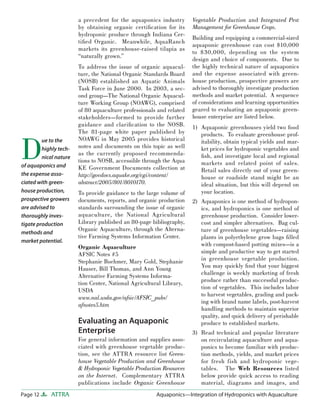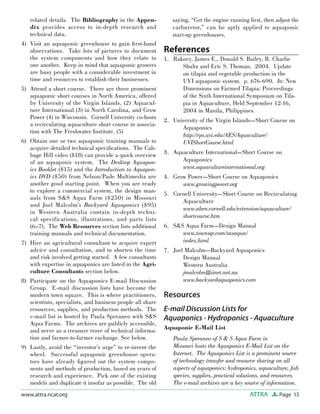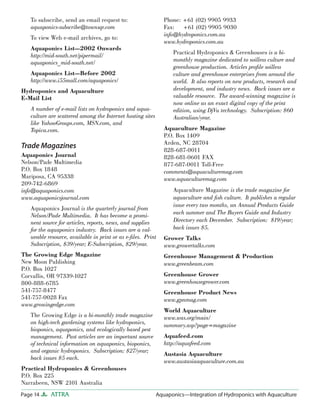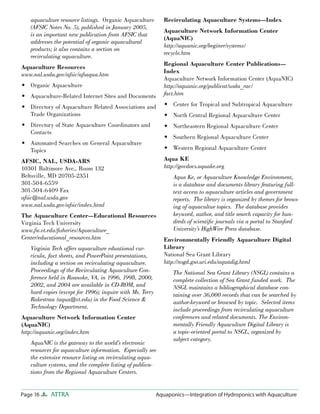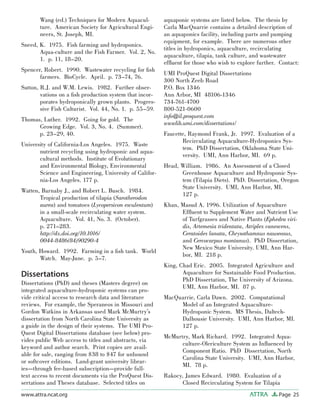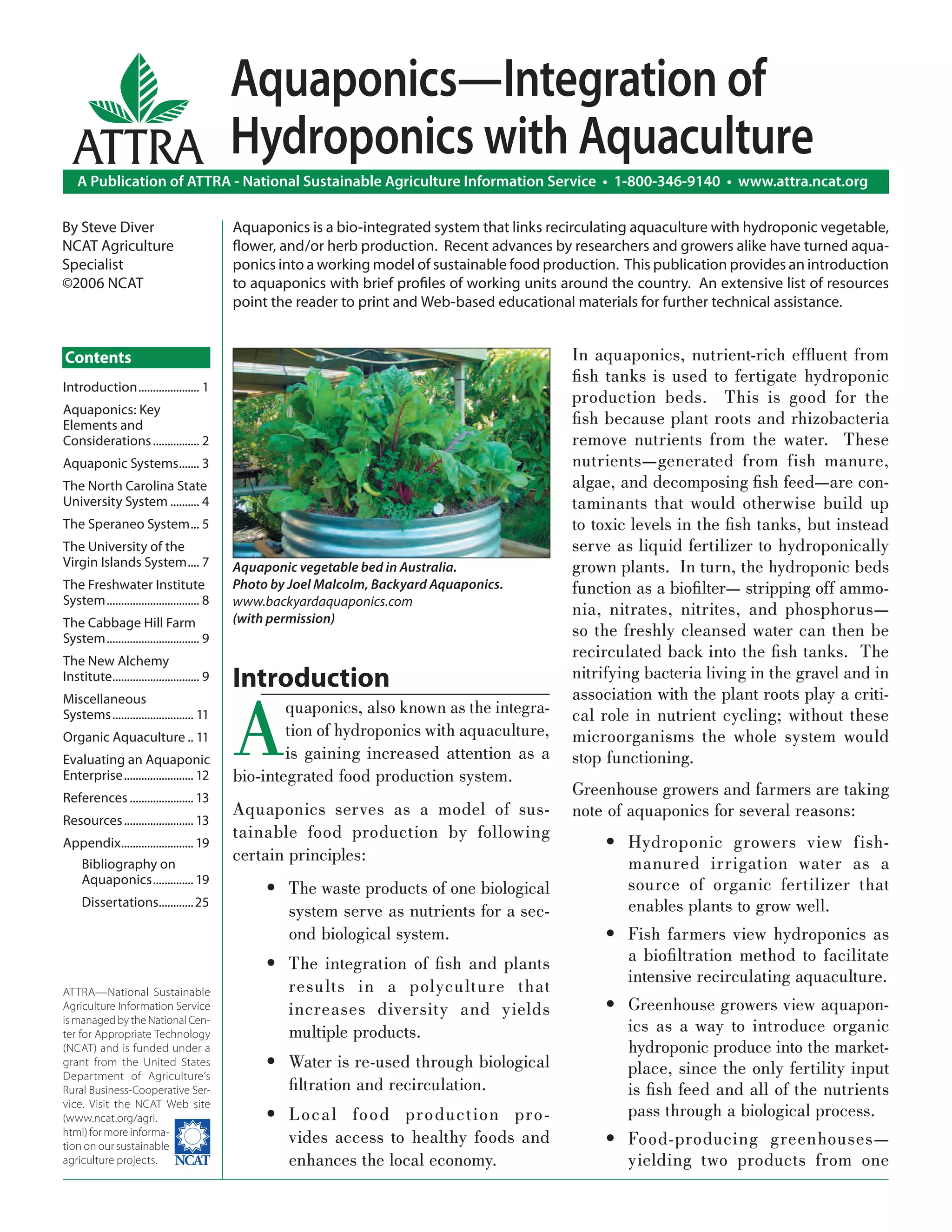
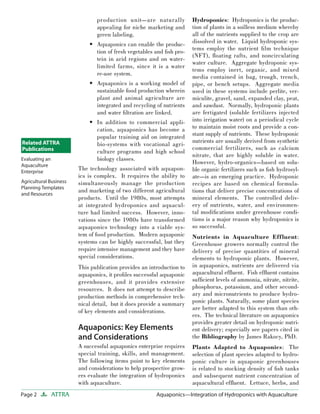
Aquaponic vegetable bed in Australia.
Photo by Joel Malcolm, Backyard Aquaponics.
www.backyardaquaponics.com
(with permission)
Introduction
A
quaponics, also known as the integra-
tion of hydroponics with aquaculture,
is gaining increased attention as a
bio-integrated food production system.
Aquaponics serves as a model of sus-
tainable food production by following
certain principles:
The waste products of one biological
system serve as nutrients for a sec-
ond biological system.
The integration of fish and plants
results in a polyculture that
increases diversity and yields
multiple products.
Water is re-used through biological
filtration and recirculation.
Local food production pro-
vides access to healthy foods and
enhances the local economy.
•
•
•
•
In aquaponics, nutrient-rich effluent from
fish tanks is used to fertigate hydroponic
production beds. This is good for the
fish because plant roots and rhizobacteria
remove nutrients from the water. These
nutrients—generated from fish manure,
algae, and decomposing fish feed—are con-
taminants that would otherwise build up
to toxic levels in the fish tanks, but instead
serve as liquid fertilizer to hydroponically
grown plants. In turn, the hydroponic beds
function as a biofilter— stripping off ammo-
nia, nitrates, nitrites, and phosphorus—
so the freshly cleansed water can then be
recirculated back into the fish tanks. The
nitrifying bacteria living in the gravel and in
association with the plant roots play a criti-
cal role in nutrient cycling; without these
microorganisms the whole system would
stop functioning.
Greenhouse growers and farmers are taking
note of aquaponics for several reasons:
Hydroponic growers view fish-
manured irrigation water as a
source of organic fertilizer that
enables plants to grow well.
Fish farmers view hydroponics as
a biofiltration method to facilitate
intensive recirculating aquaculture.
Greenhouse growers view aquapon-
ics as a way to introduce organic
hydroponic produce into the market-
place, since the only fertility input
is fish feed and all of the nutrients
pass through a biological process.
Food-producing greenhouses—
yielding two products from one
•
•
•
•
Introduction..................... 1
Aquaponics: Key
Elements and
Considerations................ 2
Aquaponic Systems....... 3
The North Carolina State
University System .......... 4
The Speraneo System... 5
The University of the
Virgin Islands System.... 7
The Freshwater Institute
System................................ 8
The Cabbage Hill Farm
System................................ 9
The New Alchemy
Institute.............................. 9
Miscellaneous
Systems............................ 11
Organic Aquaculture .. 11
Evaluating an Aquaponic
Enterprise........................ 12
References ...................... 13
Resources........................ 13
Appendix......................... 19
Bibliography on
Aquaponics.............. 19
Dissertations............25
A Publication of ATTRA - National Sustainable Agriculture Information Service • 1-800-346-9140 • www.attra.ncat.org
ATTRA—National Sustainable
Agriculture Information Service
is managed by the National Cen-
ter for Appropriate Technology
(NCAT) and is funded under a
grant from the United States
Department of Agriculture’s
Rural Business-Cooperative Ser-
vice. Visit the NCAT Web site
(www.ncat.org/agri.
html) for more informa-
tion on our sustainable
agriculture projects. ����
ATTRA
Contents
By Steve Diver
NCAT Agriculture
Specialist
©2006 NCAT
Aquaponics—Integration of
Hydroponics with Aquaculture
Aquaponics is a bio-integrated system that links recirculating aquaculture with hydroponic vegetable,
flower, and/or herb production. Recent advances by researchers and growers alike have turned aqua-
ponics into a working model of sustainable food production. This publication provides an introduction
to aquaponics with brief profiles of working units around the country. An extensive list of resources
point the reader to print and Web-based educational materials for further technical assistance.
Page 2 ATTRA Aquaponics—Integration of Hydroponics with AquacultureAquaponics—Integration of Hydroponics with Aquaculture
production unit—are naturally
appealing for niche marketing and
green labeling.
Aquaponics can enable the produc-
tion of fresh vegetables and fish pro-
tein in arid regions and on water-
limited farms, since it is a water
re-use system.
Aquaponics is a working model of
sustainable food production wherein
plant and animal agriculture are
integrated and recycling of nutrients
and water filtration are linked.
In addition to commercial appli-
cation, aquaponics has become a
popular training aid on integrated
bio-systems with vocational agri-
culture programs and high school
biology classes.
The technology associated with aquapon-
ics is complex. It requires the ability to
simultaneously manage the production
and marketing of two different agricultural
products. Until the 1980s, most attempts
at integrated hydroponics and aquacul-
ture had limited success. However, inno-
vations since the 1980s have transformed
aquaponics technology into a viable sys-
tem of food production. Modern aquaponic
systems can be highly successful, but they
require intensive management and they have
special considerations.
This publication provides an introduction to
aquaponics, it profiles successful aquaponic
greenhouses, and it provides extensive
resources. It does not attempt to describe
production methods in comprehensive tech-
nical detail, but it does provide a summary
of key elements and considerations.
Aquaponics: Key Elements
and Considerations
A successful aquaponics enterprise requires
special training, skills, and management.
The following items point to key elements
and considerations to help prospective grow-
ers evaluate the integration of hydroponics
with aquaculture.
•
•
•
Hydroponics: Hydroponics is the produc-
tion of plants in a soilless medium whereby
all of the nutrients supplied to the crop are
dissolved in water. Liquid hydroponic sys-
tems employ the nutrient film technique
(NFT), floating rafts, and noncirculating
water culture. Aggregate hydroponic sys-
tems employ inert, organic, and mixed
media contained in bag, trough, trench,
pipe, or bench setups. Aggregate media
used in these systems include perlite, ver-
miculite, gravel, sand, expanded clay, peat,
and sawdust. Normally, hydroponic plants
are fertigated (soluble fertilizers injected
into irrigation water) on a periodical cycle
to maintain moist roots and provide a con-
stant supply of nutrients. These hydroponic
nutrients are usually derived from synthetic
commercial fertilizers, such as calcium
nitrate, that are highly soluble in water.
However, hydro-organics—based on solu-
ble organic fertilizers such as fish hydrosyl-
ate—is an emerging practice. Hydroponic
recipes are based on chemical formula-
tions that deliver precise concentrations of
mineral elements. The controlled deliv-
ery of nutrients, water, and environmen-
tal modifications under greenhouse condi-
tions is a major reason why hydroponics is
so successful.
Nutrients in Aquaculture Effluent:
Greenhouse growers normally control the
delivery of precise quantities of mineral
elements to hydroponic plants. However,
in aquaponics, nutrients are delivered via
aquacultural effluent. Fish effluent contains
sufficient levels of ammonia, nitrate, nitrite,
phosphorus, potassium, and other second-
ary and micronutrients to produce hydro-
ponic plants. Naturally, some plant species
are better adapted to this system than oth-
ers. The technical literature on aquaponics
provides greater detail on hydroponic nutri-
ent delivery; especially see papers cited in
the Bibliography by James Rakocy, PhD.
Plants Adapted to Aquaponics: The
selection of plant species adapted to hydro-
ponic culture in aquaponic greenhouses
is related to stocking density of fish tanks
and subsequent nutrient concentration of
aquacultural effluent. Lettuce, herbs, and
Related ATTRA
Publications
Evaluating an
Aquaculture
Enterprise
Agricultural Business
Planning Templates
and Resources
Page 3ATTRAwww.attra.ncat.org
specialty greens (spinach, chives, basil, and
watercress) have low to medium nutritional
requirements and are well adapted to aqua-
ponic systems. Plants yielding fruit (toma-
toes, bell peppers, and cucumbers) have
a higher nutritional demand and perform
better in a heavily stocked, well established
aquaponic system. Greenhouse varieties
of tomatoes are better adapted to low light,
high humidity conditions in greenhouses
than field varieties.
Fish Species: Several warm-water and
cold-water fish species are adapted to recir-
culating aquaculture systems, including
tilapia, trout, perch, Arctic char, and bass.
However, most commercial aquaponic sys-
tems in North America are based on tila-
pia. Tilapia is a warm-water species that
grows well in a recirculating tank culture.
Furthermore, tilapia is tolerant of fluctuat-
ing water conditions such as pH, tempera-
ture, oxygen, and dissolved solids. Tilapia
produces a white-fleshed meat suitable to
local and wholesale markets. The literature
on tilapia contains extensive technical doc-
umentation and cultural procedures. Bar-
ramundi and Murray cod fish species are
raised in recirculating aquaponic systems
in Australia.
Water Quality Characteristics: Fish
raised in recirculating tank culture require
good water quality conditions. Water qual-
ity testing kits from aquacultural sup-
ply companies are fundamental. Critical
water quality parameters include dissolved
oxygen, carbon dioxide, ammonia, nitrate,
nitrite, pH, chlorine, and other character-
istics. The stocking density of fish, growth
rate of fish, feeding rate and volume, and
related environmental fluctuations can elicit
rapid changes in water quality; constant
and vigilant water quality monitoring
is essential.
Biofiltration and Suspended Solids:
Aquaculture effluent contains nutrients, dis-
solved solids, and waste byproducts. Some
aquaponic systems are designed with inter-
mediate filters and cartridges to collect sus-
pended solids in fish effluent, and to facili-
tate conversion of ammonia and other waste
products to forms more available to plants
prior to delivery to hydroponic vegetable
beds. Other systems deliver fish effluent
directly to gravel-cultured hydroponic veg-
etable beds. The gravel functions as a “flu-
idized bed bioreactor,” removing dissolved
solids and providing habitat for nitrifying
bacteria involved in nutrient conversions.
The design manuals and technical docu-
mentation available in the Resources sec-
tion can help growers decide which system
is most appropriate.
Component Ratio: Matching the volume
of fish tank water to volume of hydroponic
media is known as component ratio. Early
aquaponics systems were based on a ratio
of 1:1, but 1:2 is now common and tank:
bed ratios as high as 1:4 are employed.
The variation in range depends on type of
hydroponic system (gravel vs. raft), fish spe-
cies, fish density, feeding rate, plant spe-
cies, etc. For example, the Speraneo system
described below is designed for one cubic
foot of water to two cubic feet of grow bed
media (pea gravel). Further, when shallow
bed systems only three inches in depth are
employed for the production of specialty
greens such as lettuce and basil, the square
footage of grow space will increase four
times. Depending on the system design, the
component ratio can favor greater outputs of
either hydroponic produce or fish protein.
A “node” is a configuration that links one
fish tank to a certain number of hydroponic
beds. Thus, one greenhouse may contain
a multiple number of fish tanks and asso-
ciated growing beds, each arranged in a
separate node.
Aquaponic Systems
Profiles of several aquaponic greenhouses
are highlighted below as models of com-
mercially viable systems. Most of these
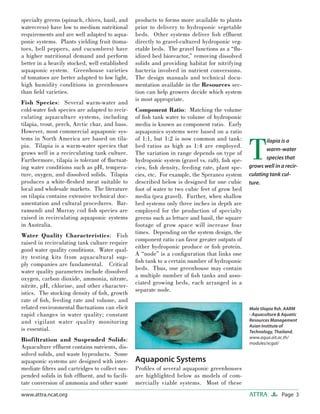
Male tilapia fish. AARM
- Aquaculture & Aquatic
Resources Management
Asian Institute of
Technology, Thailand.
www.aqua.ait.ac.th/
modules/xcgal/
T
ilapia is a
warm-water
species that
grows well in a recir-
culating tank cul-
ture.
Page 4 ATTRA Aquaponics—Integration of Hydroponics with AquacultureAquaponics—Integration of Hydroponics with Aquaculture
operations are featured in magazine articles
and conference proceedings. Some oper-
ations offer technical assistance through
short courses, design manuals, and on-site
tours. Please refer to articles in the Sug-
gested Reading list, the Resources sec-
tion, and the Bibliography for in-depth
descriptions and technical details.
The North Carolina State
University System
In the 1980’s Mark McMurtry (former
graduate student) and the late Doug Sand-
ers (professor) at North Carolina State Uni-
versity developed an aqua-vegeculture sys-
tem based on tilapia fish tanks sunk below
the greenhouse floor. Effluent from the fish
tanks was trickle-irrigated onto sand-cul-
tured hydroponic vegetable beds located at
ground level. The nutrients in the irrigation
water fed tomato and cucumber crops, and
the sand beds and plant roots functioned as
a biofilter. After draining from the beds,
the water recirculated back into the fish
tanks. The only fertility input to the system
was fish feed (32 percent protein).
Some findings and highlights of
McMurtry’s research:
Benefits of integrating aquaculture
and vegetable production are:
conservation of water resources
and plant nutrients
intensive production of fish
protein
reduced operating costs relative
to either system in isolation.
Water consumption in an integrated
aqua-vegeculture system amounts to
1 percent of that required in pond
culture to produce equivalent tilapia
yields.
Such low-water-use symbiotic sys-
tems are applicable to the needs
of arid or semi-arid regions where
fish and fresh vegetables are in high
demand.
Organic vine-ripened, pesticide-
free produce and “fresh-daily”
•
1.
2.
3.
•
•
•
fish can bring premium prices,
particularly during winter months
in urban areas.
Biofilters (sand beds with vegeta-
bles) that are alternately flooded
and drained with nutrient-laden fish
tank water are called reciprocating
biofilters.
Reciprocating biofilters provide
uniform distribution of nutrient-
laden water within the filtration
medium during the flood cycle, and
improved aeration from atmospheric
exchange during each dewatering
with benefits to both nitrifying bac-
teria and plant roots.
Dissolved and suspended organic
materials accumulate rapidly
in aquaculture systems and must
be removed for efficient fish
production.
Previous integrated fish-vegetable
systems removed suspended solids
from the water by sedimentation in
clarifiers prior to plant application.
Removal of the solid wastes resulted
in insufficient residual nutrients for
good plant growth; acceptable fruit
yields had previously only been
achieved with substantial supple-
mentation of plant nutrients.
Aquaeous nitrate concentrations in
recirculating aquaculture can be
adequately regulated when fish and
vegetable production are linked via
reciprocating biofilters.
Tomatoes may have also assimi-
lated nitrogen in organic amino
acid forms. In 1950 Gosh and Bur-
ris (Utilization of nitrogenous com-
pounds by plants. Soil Science.
Vol. 70: 187-203) found that toma-
toes utilize alanine, glutamic acid,
histidine, and leucine as effectively
as inorganic nitrogen sources.
Research to determine the optimum
ratio of fish tank to biofilter volume
on fish growth rate and water qual-
ity found that stocking density of
fish and plants can vary depending
•
•
•
•
•
•
•
W
ater con-
sump-
tion in
an integrated aqua-
vegeculture system
amounts to 1 per-
cent of that required
in pond culture to
produce equivalent
tilapia yields.
Page 5ATTRAwww.attra.ncat.org
on desired goal. The component
ratios of the system may be manipu-
lated to favour fish or vegetable pro-
duction according to local market
trends or dietary needs. Fish stock-
ing density and feeding rates are
adjusted to optimize water quality
as influenced by plant growth rate.
See the Bibliography on Aquaponics
in the appendix for a of list articles that
resulted from the North Carolina research.
Aqua-vegeculture research at NCSU has
been discontinued because the technology
had evolved to the point where it is ready
for grower application. The Department of
Horticulture and the Cooperative Extension
Service at NCSU provide technical assis-
tance to aquaponic greenhouse growers in
North Carolina.
The Speraneo System
In the early 1990s, Tom and Paula Spe-
raneo—owners of S & S Aqua Farm near
West Plains, Missouri—modified the North
Carolina State method by raising tilapia in
a 500-gallon tank, with fish effluent linked
to gravel-cultured hydroponic vegetable
beds inside an attached solar greenhouse.
Later, they expanded to a full-size commer-
cial greenhouse. The Speraneo system was
practical, productive, and wildly successful.
It became the model for dozens of commer-
cial aquaponic greenhouses and high school
biology programs.
Sadly, Tom Speraneo died in February
2004. Tom was a true pioneer in aqua-
ponics, and he was unfailingly generous
and helpful to others. Paula Speraneo
and her family continue to run the green-
house and actively participate in aqua-
ponics technology transfer. The following
notes describe the Speraneo system and
available resources.
The commercial-scale solar green-
house at S & S Aqua Farm is 50 feet by
80 feet, oriented East-West to create a
south-facing slope. It contains six 1,200
gallon fish tanks. Each tank is linked to
six one-foot-deep hydroponic beds filled
with river gravel. Tom referred to each
tank-plus-hydroponic bed setup as a “node.”
This way, each node can operate indepen-
dently of one another.
Some aspects of the Speraneo system were
modeled after the aquaponics research at
North Carolina State University, while oth-
ers are modified. The Speraneos employ
hydroponic vegetable beds as “fluidized
bed reactors,” but they use pea-grade river
gravel instead of sand. Tilapia are raised
in fish tanks, but the tanks are more con-
veniently located above ground and tilapia
hybrids adapted to cooler water tempera-
tures are grown. The reciprocating water
cycle, PVC piping, and return-flow water
pumping methods were designed by Tom
and Paula to match their system.
For years, Purina® fish chow at 40 percent
protein was the primary fertility input, sup-
plemented with tank-cultured algae. Tila-
pia in the Speraneo system are raised for
7 to 12 months, then harvested at one to
one-and-a-half pounds in size. Later, Tom
started adding small amounts of Planters
2® rock dust on top of the gravel as a trace
element supplement.
S & S Aqua Farm has grown fresh basil,
tomatoes, cucumbers, mixed salad greens,
and an assortment of vegetable, herb, and
ornamental bedding plants in the aqua-
ponic greenhouse. In the early 1990’s,
Tom and Paula were raising and selling
basil for $12 a pound to gourmet restau-
rants about four hours away in St. Louis,
Missouri. Following passage of the North
American Free Trade Agreement (NAFTA),
however, Mexican imports of basil resulted
in a market crash to $4 per pound, so they
dropped the St. Louis market. S & S Aqua
Farm now grows a diverse variety of vege-
table and herbs, selling locally at a farmers
market combined with direct sales out of
their greenhouse.
Tom once calculated the farm produces 45
to 70 pounds of produce for every pound of
tilapia, an impressive yield. However, Paula
explained this figure takes into account the
cummulative yields of multiple vegetable
crops raised during the 7 to 12 month time
period required to raise fish to harvest.
T
he Spera-
neo system
was practi-
cal, productive, and
wildly successful.
Page 6 ATTRA Aquaponics—Integration of Hydroponics with AquacultureAquaponics—Integration of Hydroponics with Aquaculture
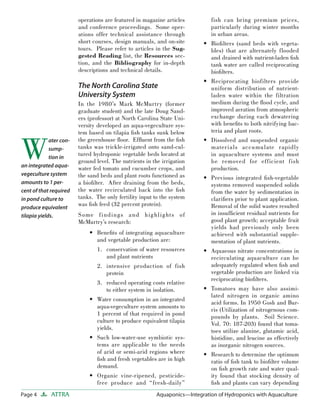
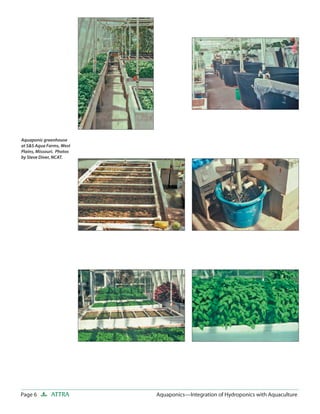
Aquaponic greenhouse
at S&S Aqua Farms, West
Plains, Missouri. Photos
by Steve Diver, NCAT.
Page 7ATTRAwww.attra.ncat.org
The component ratio favors vegetables over
fish yields in the Speraneo system.
Interest in the Speraneo system resulted
in more than 10,000 visitors to the small
farm in Missouri, including school children,
farmers, researchers, and government offi-
cials. To handle requests for assistance, the
Speraneos compiled a resource packet and
design manual with technical specifications
to establish an S & S Aqua Farm-style aqua-
ponic system. The resource packet includes
a 10-minute video and a list of supplies.
Response from growers to a practical design
manual such as this was tremendous. The
Speraneo system is now in use worldwide.
The resource packet, which sells for $250,
is available through:
S & S Aqua Farm
[Contact: Paula Speraneo]
8386 County Rd. 8820
West Plains, MO 65775
417-256-5124
snsaquasys@townsqr.com
www.townsqr.com/snsaqua/index.html
Especially see:
Maturing Marvel
by Vern Modeland
The Growing Edge, May-June 1998
www.townsqr.com/snsaqua/0905ssaf.pdf
The Genius of Simplicity
by John Wesely Smith
The Growing Edge, Winter 1993-94
www.townsqr.com/snsaqua/0502ssaf.pdf
Bioponics—Revolution in Food Grow-
ing: Missouri Aquafarmer Discovers
Huge Benefits in Trace Elements
by David Yarrow
Remineralize the Earth, December 1997
www.championtrees.org/topsoil/
bioponics.htm
The University of the Virgin
Islands System
James Rakocy, PhD, and associates at the
University of the Virgin Islands (UVI) devel-
oped a commercial-scale aquaponic system
that has run continuously for more than five
years. Nile and red tilapia are raised in fish
rearing tanks, and the aquacultural efflu-
ent is linked to floating raft hydroponics.
Basil, lettuce, okra, and other crops have
been raised successfully, with outstanding
quality and yields.
The system components include: Four fish
rearing tanks at 7,800 liters each, clarifi-
ers, filter and degassing tanks, air diffus-
ers, sump, base addition tank, pipes and
pumps, and six 400-square foot hydroponic
troughs totaling 2,400 sq. ft. The pH is
monitored daily and maintained at 7.0 to
7.5 by alternately adding calcium hydroxide
and potassium hydroxide to the base addi-
tion tank, which buffers the aquatic system
and supplements calcium and potassium
ions at the same time. The only other sup-
plemental nutrient required is iron, which
is added in a chelated form once every
three weeks.
Tilapia are stocked at a rate of 77 fish per
cubic meter for Nile tilapia, or 154 fish per
cubic meter for red tilapia and cultured for
24 weeks. The production schedule is stag-
gered so that one tank is harvested every
six weeks. After harvest, the fish tank is
immediately restocked. The fish are fed
three times daily with a complete, floating
fish pellet at 32 percent protein. Projected
annual fish production is 4.16 metric tons
for Nile tilapia and 4.78 metric tons for
red tilapia.
In one notable experiment the UVI
researchers compared the yields of a leafy
herb (basil) and a fruiting vegetable (okra)
grown in aquaponic vs field production sys-
tems. Basil and okra were raised in raft
hydroponics. Yields of aquaponic basil
were three times greater than field-grown,
while yields of aquaponic okra were 18
times greater than field-grown. Based on
a market price in the U.S. Virgin Islands
of $22 per kg for fresh basil with stems,
researchers calculated gross income poten-
tial. The aquaponic method would result in
$515 per cubic meter per year or $110,210
per system per year. This compares to field-
produced basil at $172 per cubic meter
per year or $36,808 per year for the same
production area. When fish sales
J
ames Rakocy,
PhD, and asso-
ciates at the
University of the
Virgin Islands (UVI)
developed a com-
mercial-scale aqua-
ponic system that
has run continu-
ously for more than
five years.
Page 8 ATTRA Aquaponics—Integration of Hydroponics with AquacultureAquaponics—Integration of Hydroponics with Aquaculture
are included, the aquaponic system
yields $134,245. (1)
Like McMurtry, researcher Rakocy sees
integrated water reuse systems as a viable
solution to sustainable food production in
developing countries and arid regions—
such as the Caribbean Islands—where fresh
water is scarce.
To provide in-depth technical support, the
UVI research team offers a week-long short
course on aquaponics each year at the UVI
agricultural experiment station. The UVI
short course is the premier educational
training program available to farmers in the
world. In addition to aquaponics, UVI spe-
cializes in greenwater tank culture, a recir-
culating aquaculture system.
Rakocy has published extensive research
reports and several Extension Service bul-
letins on recirculating aquaculture and
aquaponics. See the Bibliography in the
appendix for citations to articles and papers
by Rackocy.
Contact:
James Rakocy, PhD
University of the Virgin Islands
Agriculture Experiment Station
RR 1, Box 10,000
Kingshill, St. Croix
U.S. Virgin Islands 00850-9781
340-692-4020
jrakocy@uvi.edu
http://rps.uvi.edu/AES/Aquaculture/
aqua.html
http://rps.uvi.edu/AES/Aquaculture/
aquaponics.html
Especially see:
Update on Tilapia and Vegetable Pro-
duction in the UVI Aquaponic System
James E. Rakocy, Donald S. Bailey, R.
Charlie Shultz and Eric S. Thoman page
676-690. In: New Dimensions on Farmed
Tilapia: Proceedings of the Sixth Inter-
national Symposium on Tilapia in Aqua-
culture, Held September 12-16, 2004 in
Manila, Philippines.
Proceedings paper: 15 pages
http://ag.arizona.edu/azaqua/ista/ista6/
ista6web/pdf/676.pdf
PowerPoint presentation; 49 pages
http://ag.arizona.edu/azaqua/ista/ista6/
ista6web/presentation/p676.pdf
Aquaponics: Integrated Technology
for Fish and Vegetable Production in
Recirculating Systems
James Rakocy, University of the Virgin
Islands
USDA Ministerial Conference and Expo on
Agricultural Science and Technology
PowerPoint presentation; 69 slides
http://ffas.usda.gov/icd/stconf/session2/
session%202d/02-rakocy_j-2D%202nd_
files/frame.htm
The Freshwater Institute System
The Freshwater Institute in Shepherdstown,
West Virginia—a program of The Conser-
vation Fund, an environmental non-profit
organization—specializes in aquaculture
research and education. Fresh spring water
is an abundant resource in the Appala-
chian region. However, protection of spring
water quality as it relates to aquaculture
effluent is viewed as a vital component of
this technology.
For years, the institute has specialized in
cold-water recirculating aquaculture systems
raising trout and arctic char. The institute
helps Appalachian farmers set up two types
of aquaculture systems: (a) an indoor, high-
tech recirculating tank method and (b) an
outdoor, low-tech recirculating tank method.
Treatment of aquaculture effluent prior to
its return to the natural stream flow led
to collaborative research with USDA-ARS
scientists in Kearneysville, West Virginia,
on integrated hydroponic-fish culture
systems. Trials at the institute’s green-
houses showed that nitrogen, phosphorus,
and other nutrients in aquaculture efflu-
ent can be effectively removed by plants
grown in NFT hydroponics or constructed
wetland systems.
In the mid-1990s, the institute implemented
an aquaponic demonstration program based
on a Sperraneo-style gravel-cultured sys-
tem. Tilapia is raised as a warm-water fish
L
ike
McMurtry,
researcher
Rakocy sees inte-
grated water reuse
systems as a viable
solution to sustain-
able food produc-
tion in develop-
ing countries and
arid regions—such
as the Caribbean
Islands—where
fresh water is scarce.
Page 9ATTRAwww.attra.ncat.org
species. Hydroponic crops include basil,
lettuce, and wetland plants.
To provide technical assistance to farmers
and high school biology teachers, the insti-
tute published a series of publications on
recirculating aquaculture and aquaponics.
The Freshwater Institute Natural Gas Pow-
ered Aquaponic System—Design Manual is a
37-page manual published by the institute
in 1997. Included are diagrams and pho-
tos, details on greenhouse layout and aqua-
ponic production, parts list with suppliers
and cost, estimated operating expense, and
further informational resources.
Please note the institute no longer pro-
vides direct technical assistance to farm-
ers on aquaponics. Instead, it has made
the aquaponics design manual and related
publications on recirculating aquaculture
and aquaponics available as free
Web downloads.
The Freshwater Institute
Shepherdstown, WV
www.freshwaterinstitute.org
Selected Web Publications from The
Freshwater Institute
Suggested Management Guidelines
for An Integrated Recycle Aquacul-
ture – Hydroponic System
The Freshwater Institute Natural
Gas Powered Aquaponic System -
Design Manual
880 Gallon Recycle Aquaculture
System Installation Guide
Linking Hydroponics to a 880 Gal-
lon Recycle Fish Rearing System
Operators Manual for 880 - Recycle
System
The Cabbage Hill Farm System
Cabbage Hill Farm is a non-profit organi-
zation located about 30 miles north of New
York City. The foundation is dedicated
to the preservation of rare breeds of farm
animals, sustainable agriculture and
local food systems, and aquaponic
greenhouse production.
•
•
•
•
•
Cabbage Hill Farm designed and continues
to operate a simple recirculating aquaponic
system. Cabbage Hill Farm promotes edu-
cation on aquaponics and hosts greenhouse
interns. Tours are available.
Tilapia fish and leaf lettuce are the main
products of the Cabbage Hill Farm system,
though basil and watercress are also grown
in smaller quantities. In addition to hydro-
ponics, water passes through a constructed
reed bed outside the greenhouse for addi-
tional nutrient removal.
Aquaponics—Preserving the Future is a video
film documenting the research and dem-
onstration of aquaponics at Cabbage Hill
Farms. The cost is $18.
Cabbage Hill Farm
205 Crow Hill Road
Mount Kisco, NY 10549
914-241-2658
914-241-8264 FAX
www.cabbagehillfarm.org
The New Alchemy Institute
The New Alchemy Institute in East Fal-
mouth, Massachusetts, conducted research
on integrated aquaculture systems during
the 1970s and 1980s. Although the insti-
tute closed in 1991, New Alchemy pub-
lications on greenhouse production and
aquaponics provide historical insight to
the emerging bioshelter (ecosystem green-
houses) concept and are still a valuable
resource for technical information. The
Green Center, formed by a group of for-
mer New Alchemists, is again making these
publications available for sale. The Web
site has a section featuring for-sale articles
on aquaculture and bioshelters (integrated
systems). A selection of past articles is
available online.
Contact:
The Green Center
237 Hatchville Rd.
East Falmouth, MA 02536
www.vsb.cape.com/~nature/greencenter/
C
abbage Hill
Farm pro-
motes edu-
cation on aqua-
ponics and hosts
greenhouse interns.
Page 10 ATTRA Aquaponics—Integration of Hydroponics with AquacultureAquaponics—Integration of Hydroponics with Aquaculture
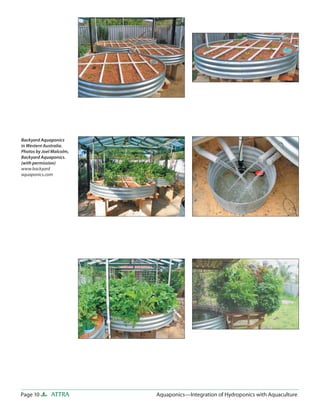
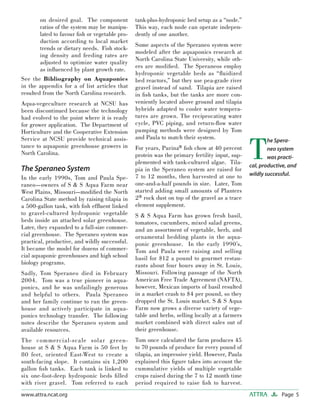
Backyard Aquaponics
in Western Australia.
Photos by Joel Malcolm,
Backyard Aquaponics.
(with permission)
www.backyard
aquaponics.com
Page 11ATTRAwww.attra.ncat.org
Especially see:
An Integrated Fish Culture Hydro-
ponic Vegetable Production System
by Ronald D. Zweig
Aquaculture Magazine, May-June 1986.
www.vsb.cape.com/~nature/greencenter/pdf/
zweig.pdf
Summary of Fish Culture Techniques
in Solar Aquatic Ponds
by John Wolfe and Ron Zweig
Journal of The New Alchemists, 1977
www.vsb.cape.com/~nature/greencenter/pdf/
j6ponds.pdf
Miscellaneous Systems
Instead of locating the fish and vegetable
components in separate containers inside a
greenhouse, fish production can be located
in outdoor tanks or adjacent buildings. The
effluent simply needs to be delivered to
hydroponic vegetable beds.
In warm climates, hydroponic vegetable
beds may be located outside. As an exam-
ple, the Center for Regenerative Studies
at California State Polytechnic University-
Pomona implemented an outdoor integrated
bio-system that links: (a) a pond contain-
ing treated sewage wastewater stocked with
tilapia and carp; (b) water hyacinth—an
aquatic plant very efficient at sucking up
nutrients—covering 50 percent of the water
surface area; the plant biomass generated
by water hyacinth is used as feedstock
for compost heaps; (c) nearby vegetable
gardens irrigated with nutrient-laden
pond water.
In addition to locating the fish and vegetable
components in separate containers, fish and
plants can be placed in the same container
to function as a polyculture. For exam-
ple, plants sit on top of floating polystyrene
panels with their roots hanging down into
the water that fish swim around in. Mod-
els include the Rackocy system, solar-algae
ponds (see literature by Zweig and Klein-
holz), and the solar-aquatic ponds, or Liv-
ing Machines, made popular by John Todd
at Ocean Arks International.
In Australia, barramundi (Lates calcari-
fer) and Murray cod (Maccullochella peelii
peelii) fish species have been adapted to
recirculating aquaculture and aquaponics
systems. The stocking densities for these
fish species is higher than tilapia, which
in turn results in greater hydroponic sur-
face under production. Several references
are provided on these fish species and
aquaponic systems in the Resources and
Bibliography sections.
Organic Aquaculture
Organic production of crops and livestock in
the United States is regulated by the Depart-
ment of Agriculture’s National Organic Pro-
gram, or NOP. The NOP is an organic
certification and marketing program that
ensures foods and food products labeled
as “organic” meet universal standards and
guidelines for organic production. Produc-
tion inputs used in organic production—
such as feed and fertilizers—must be of nat-
ural origin and free of synthetic materials.
A farm plan, documentation of inputs and
production methods, and farm inspection
are required to obtain “certified organic”
status. This process allows farm products
to be labeled and sold as organic.
Organic trout, tilapia, salmon and other fish
species are raised in Europe, Australia, and
Israel using production standards devel-
oped by international organic certification
agencies. However, organic aquaculture
was not clearly defined in the NOP and the
lack of organic aquaculture guidelines has
hampered the growth of a domestic organic
aquaculture industry in the United States.
The ATTRA publication Evaluating an
Aquaculture Enterprise contains a section on
organic aquaculture. It states that accred-
ited organic certifying agencies can cer-
tify organic aquaculture operations, but the
products are not allowed to carry the USDA
organic label.
In fact, Quality Certification Services in
Florida has certified about a dozen organic
aquaculture operations in the U.S. and
abroad under a private label. AquaRanch,
an aquaponic greenhouse in Illinois, set
O
rganic pro-
duction
of crops
and livestock in
the United States
is regulated by the
Department of Agri-
culture’s National
Organic Program, or
NOP.
Page 12 ATTRA Aquaponics—Integration of Hydroponics with Aquaculture
a precedent for the aquaponics industry
by obtaining organic certification for its
hydroponic produce through Indiana Cer-
tified Organic. Meanwhile, AquaRanch
markets its greenhouse-raised tilapia as
“naturally grown.”
To address the issue of organic aquacul-
ture, the National Organic Standards Board
(NOSB) established an Aquatic Animals
Task Force in June 2000. In 2003, a sec-
ond group—The National Organic Aquacul-
ture Working Group (NOAWG), comprised
of 80 aquaculture professionals and related
stakeholders—formed to provide further
guidance and clarification to the NOSB.
The 81-page white paper published by
NOAWG in May 2005 provides historical
notes and documents on this topic as well
as the currently proposed recommenda-
tions to NOSB, accessible through the Aqua
KE Government Documents collection at
http://govdocs.aquake.org/cgi/content/
abstract/2005/801/8010170.
To provide guidance to the large volume of
documents, reports, and organic production
standards surrounding the issue of organic
aquaculture, the National Agricultural
Library published an 80-page bibliography,
Organic Aquaculture, through the Alterna-
tive Farming Systems Information Center.
Organic Aquaculture
AFSIC Notes #5
Stephanie Boehmer, Mary Gold, Stephanie
Hauser, Bill Thomas, and Ann Young
Alternative Farming Systems Informa-
tion Center, National Agricultural Library,
USDA
www.nal.usda.gov/afsic/AFSIC_pubs/
afnotes5.htm
Evaluating an Aquaponic
Enterprise
For general information and supplies asso-
ciated with greenhouse vegetable produc-
tion, see the ATTRA resource list Green-
house Vegetable Production and Greenhouse
& Hydroponic Vegetable Production Resources
on the Internet. Complementary ATTRA
publications include Organic Greenhouse
Vegetable Production and Integrated Pest
Management for Greenhouse Crops.
Building and equipping a commercial-sized
aquaponic greenhouse can cost $10,000
to $30,000, depending on the system
design and choice of components. Due to
the highly technical nature of aquaponics
and the expense associated with green-
house production, prospective growers are
advised to thoroughly investigate production
methods and market potential. A sequence
of considerations and learning opportunities
geared to evaluating an aquaponic green-
house enterprise are listed below.
Aquaponic greenhouses yield two food
products. To evaluate greenhouse prof-
itability, obtain typical yields and mar-
ket prices for hydroponic vegetables and
fish, and investigate local and regional
markets and related point of sales.
Retail sales directly out of your green-
house or roadside stand might be an
ideal situation, but this will depend on
your location.
Aquaponics is one method of hydropon-
ics, and hydroponics is one method of
greenhouse production. Consider lower-
cost and simpler alternatives. Bag cul-
ture of greenhouse vegetables—raising
plants in polyethylene grow bags filled
with compost-based potting mixes—is a
simple and productive way to get started
in greenhouse vegetable production.
You may quickly find that your biggest
challenge is weekly marketing of fresh
produce rather than successful produc-
tion of vegetables. This includes labor
to harvest vegetables, grading and pack-
ing with brand name labels, post-harvest
handling methods to maintain superior
quality, and quick delivery of perishable
produce to established markets.
Read technical and popular literature
on recirculating aquaculture and aqua-
ponics to become familiar with produc-
tion methods, yields, and market prices
for fresh fish and hydroponic vege-
tables. The Web Resources listed
below provide quick access to reading
material, diagrams and images, and
1)
2)
3)
D
ue to the
highly tech-
nical nature
of aquaponics and
the expense asso-
ciated with green-
house production,
prospective growers
are advised to
thoroughly inves-
tigate production
methods and
market potential.
Page 13ATTRAwww.attra.ncat.org
related details. The Bibliography in the Appen-
dix provides access to in-depth research and
technical data.
Visit an aquaponic greenhouse to gain first-hand
observations. Take lots of pictures to document
the system components and how they relate to
one another. Keep in mind that aquaponic growers
are busy people with a considerable investment in
time and resources to establish their businesses.
Attend a short course. There are three prominent
aquaponic short courses in North America, offered
by University of the Virgin Islands, (2) Aquacul-
ture International (3) in North Carolina, and Grow
Power (4) in Wisconsin. Cornell University co-hosts
a recirculating aquaculture short course in associa-
tion with The Freshwater Institute. (5)
Obtain one or two aquaponic training manuals to
acquire detailed technical specifications. The Cab-
bage Hill video ($18) can provide a quick overview
of an aquaponic system. The Desktop Aquapon-
ics Booklet ($15) and the Introduction to Aquapon-
ics DVD ($50) from Nelson/Pade Multimedia are
another good starting point. When you are ready
to explore a commercial system, the design man-
uals from S&S Aqua Farm ($250) in Missouri
and Joel Malcolm’s Backyard Aquaponics ($95)
in Western Australia contain in-depth techni-
cal specifications, illustrations, and parts lists
(6–7). The Web Resources section lists additional
training manuals and technical documentation.
Hire an agricultural consultant to acquire expert
advice and consultation, and to shorten the time
and risk involved getting started. A few consultants
with expertise in aquaponics are listed in the Agri-
culture Consultants section below.
Participate on the Aquaponics E-mail Discussion
Group. E-mail discussion lists have become the
modern town square. This is where practitioners,
scientists, specialists, and business people all share
resources, supplies, and production methods. The
e-mail list is hosted by Paula Speraneo with S&S
Aqua Farms. The archives are publicly accessible,
and serve as a treasure trove of technical informa-
tion and farmer-to-farmer exchange. See below.
Lastly, avoid the “inventor’s urge” to re-invent the
wheel. Successful aquaponic greenhouse opera-
tors have already figured out the system compo-
nents and methods of production, based on years of
research and experience. Pick one of the existing
models and duplicate it insofar as possible. The old
4)
5)
6)
7)
8)
9)
saying, “Get the engine running first, then adjust the
carburetor,” can be aptly applied to aquaponic
start-up greenhouses.
References
Rakocy, James E., Donald S. Bailey, R. Charlie
Shultz and Eric S. Thoman. 2004. Update
on tilapia and vegetable production in the
UVI aquaponic system. p. 676-690. In: New
Dimensions on Farmed Tilapia: Proceedings
of the Sixth International Symposium on Tila-
pia in Aquaculture, Held September 12-16,
2004 in Manila, Philippines.
University of the Virgin Islands—Short Course on
Aquaponics
http://rps.uvi.edu/AES/Aquaculture/
UVIShortCourse.html
Aquaculture International—Short Course on
Aquaponics
www.aquacultureinternational.org
Grow Power—Short Course on Aquaponics
www.growingpower.org
Cornell University—Short Course on Recirculating
Aquaculture
www.aben.cornell.edu/extension/aquaculture/
shortcourse.htm
S&S Aqua Farm—Design Manual
www.townsqr.com/snsaqua/
index.html
Joel Malcolm—Backyard Aquaponics
Design Manual
Western Australia
jmalcolm@iinet.net.au
www.backyardaquaponics.com
Resources
E-mail Discussion Lists for
Aquaponics - Hydroponics - Aquaculture
Aquaponic E-Mail List
Paula Speraneo of S & S Aqua Farm in
Missouri hosts the Aquaponics E-Mail List on the
Internet. The Aquaponics List is a prominent source
of technology transfer and resource sharing on all
aspects of aquaponics: hydroponics, aquaculture, fish
species, supplies, practical solutions, and resources.
The e-mail archives are a key source of information.
1.
2.
3.
4.
5.
6.
7.
Page 14 ATTRA Aquaponics—Integration of Hydroponics with Aquaculture
To subscribe, send an email request to:
aquaponics-subscribe@townsqr.com
To view Web e-mail archives, go to:
Aquaponics List—2002 Onwards
http://mid-south.net/pipermail/
aquaponics_mid-south.net/
Aquaponics List—Before 2002
http://www.i55mall.com/aquaponics/
Hydroponics and Aquaculture
E-Mail List
A number of e-mail lists on hydroponics and aqua-
culture are scattered among the Internet hosting sites
like YahooGroups.com, MSN.com, and
Topica.com.
Trade Magazines
Aquaponics Journal
Nelson/Pade Multimedia
P.O. Box 1848
Mariposa, CA 95338
209-742-6869
info@aquaponics.com
www.aquaponicsjournal.com
Aquaponics Journal is the quarterly journal from
Nelson/Pade Multimedia. It has become a promi-
nent source for articles, reports, news, and supplies
for the aquaponics industry. Back issues are a val-
ueable resource, available in print or as e-files. Print
Subscription, $39/year; E-Subscription, $29/year.
The Growing Edge Magazine
New Moon Publishing
P.O. Box 1027
Corvallis, OR 97339-1027
800-888-6785
541-757-8477
541-757-0028 Fax
www.growingedge.com
The Growing Edge is a bi-monthly trade magazine
on high-tech gardening systems like hydroponics,
bioponics, aquaponics, and ecologically based pest
management. Past articles are an important source
of technical information on aquaponics, bioponics,
and organic hydroponics. Subscription: $27/year;
back issues $5 each.
Practical Hydroponics & Greenhouses
P.O. Box 225
Narrabeen, NSW 2101 Australia
Phone: +61 (02) 9905 9933
Fax: +61 (02) 9905 9030
info@hydroponics.com.au
www.hydroponics.com.au
Practical Hydroponics & Greenhouses is a bi-
monthly magazine dedicated to soilless culture and
greenhouse production. Articles profile soilless
culture and greenhouse enterprises from around the
world. It also reports on new products, research and
development, and industry news. Back issues are a
valuable resource. The award-winning magazine is
now online as an exact digital copy of the print
edition, using DjVu technology. Subscription: $60
Australian/year.
Aquaculture Magazine
P.O. Box 1409
Arden, NC 28704
828-687-0011
828-681-0601 FAX
877-687-0011 Toll-Free
comments@aquaculturemag.com
www.aquaculturemag.com
Aquaculture Magazine is the trade magazine for
aquaculture and fish culture. It publishes a regular
issue every two months, an Annual Products Guide
each summer and The Buyers Guide and Industry
Directory each December. Subscription: $19/year;
back issues $5.
Grower Talks
www.growertalks.com
Greenhouse Management & Production
www.greenbeam.com
Greenhouse Grower
www.greenhousegrower.com
Greenhouse Product News
www.gpnmag.com
World Aquaculture
www.was.org/main/
summary.asp?page=magazine
Aquafeed.com
http://aquafeed.com
Austasia Aquaculture
www.austasiaaquaculture.com.au
Page 15ATTRAwww.attra.ncat.org
Aquaponic Books and Videos
Nelson/Pade Multimedia, publisher of Aquaponics
Journal, offers booklets, DVDs, videos, and educational
curricula on aquaponics, hydroponics, and aquaculture.
See their Web page for details. Contact:
Nelson/Pade Multimedia
P.O. Box 1848
Mariposa, CA 95338
209-742-6869
info@aquaponics.com
www.aquaponics.com
Agricultural Consultants for
Integrated Hydroponics and
Aquaculture
AquaRanch Industries, LLC
[Contact: Myles Harston]
404 D. East Lincoln St.
P.O. Box 658
Flanagan, IL 61740
309-208-5230
815-796-2978
309-923-7479 FAX
info@aquaranch.com
www.aquaranch.com
Fisheries Technology Associates, Inc.
[Contact: Bill Manci]
506 Wabash Street
Fort Collins, CO 80522-3245
970-225-0150
info@ftai.com
www.ftai.com
Future Aqua Farms Limited
[Contact: Carla MacQuarrie]
RR2, Site 1a, Box 26
Head of Chezzetcook, NS
Canada B0J 1N0
902-827-3682
Carla1@ns.sympatico.ca
www.futureaquafarms.com
Global Aquatics USA, Inc.
505 Aldino Stepney Rd.
Aberdeen, MD 21001 USA
443-243-8840
410-734-7473 FAX
aquatic@iximd.com
www.growfish.com
Gordon Creaser
5431 S. Bracken Court
Winter Park, FL 32792
407-671-5075
407-671-5628 FAX
GordonCreaser06@aol.com
www.gordoncreaser.com
Mark R. McMurtry
PMB 267
1627 W. Main St.
Bozeman, MT 59715-4011
406-580-0382
mcmurtry@3riversdbs.net
Nelson/Pade Multimedia
[Contact: John Pade and Rebecca Nelson]
P.O. Box 1848
Mariposa, CA 95338
209-742-6869
info@aquaponics.com
www.aquaponics.com
S&S Aqua Farms
[Contact: Paula Speraneo]
8386 County Rd. 8820
West Plains, MO 65775
417-256-5124
snsaquasys@townsqr.com
www.townsqr.com/snsaqua/index.html
Aquaculture Associations
Aquacultural Engineering Society
www.aesweb.org
American Tilapia Association
http://ag.arizona.edu/azaqua/ata.html
The Alternative Aquaculture
Association
www.altaqua.com
Directory of Aquaculture Associations
Aquaculture Network Information Center (AquaNIC)
http://aquanic.org/publicat/govagen/nal/associat.htm
Aquaculture Directories and Resource
Collections
National Agricultural Library—Alternative
Farming Systems Information Center
The Alternative Farming Systems Information Center
(AFSIC) at the National Agricultural Library,
a program of USDA-ARS, provides extensive
Page 16 ATTRA Aquaponics—Integration of Hydroponics with Aquaculture
aquaculture resource listings. Organic Aquaculture
(AFSIC Notes No. 5), published in January 2005,
is an important new publication from AFSIC that
addresses the potential of organic aquacultural
products; it also contains a section on
recirculating aquaculture.
Aquaculture Resources
www.nal.usda.gov/afsic/afsaqua.htm
Organic Aquaculture
Aquaculture-Related Internet Sites and Documents
Directory of Aquaculture Related Associations and
Trade Organizations
Directory of State Aquaculture Coordinators and
Contacts
Automated Searches on General Aquaculture
Topics
AFSIC, NAL, USDA-ARS
10301 Baltimore Ave., Room 132
Beltsville, MD 20705-2351
301-504-6559
301-504-6409 Fax
afsic@nal.usda.gov
www.nal.usda.gov/afsic/index.html
The Aquaculture Center—Educational Resources
Virginia Tech University
www.fw.vt.edu/fisheries/Aquaculture_
Center/educational_resources.htm
Virginia Tech offers aquaculture eduational cur-
ricula, fact sheets, and PowerPoint presentations,
including a section on recirculating aquaculture.
Proceedings of the Recirculating Aquaculture Con-
ference held in Roanoke, VA, in 1996, 1998, 2000,
2002, and 2004 are available in CD-ROM, and
hard copies (except for 1996); inquire with Ms. Terry
Rakestraw (aqua@vt.edu) in the Food Science &
Technology Department.
Aquaculture Network Information Center
(AquaNIC)
http://aquanic.org/index.htm
AquaNIC is the gateway to the world’s electronic
resources for aquaculture information. Especially see
the extensive resource listing on recirculating aqua-
culture systems, and the complete listing of publica-
tions from the Regional Aquaculture Centers.
•
•
•
•
•
Recirculating Aquaculture Systems—Index
Aquaculture Network Information Center
(AquaNIC)
http://aquanic.org/beginer/systems/
recycle.htm
Regional Aquaculture Center Publications—
Index
Aquaculture Network Information Center (AquaNIC)
http://aquanic.org/publicat/usda_rac/
fact.htm
Center for Tropical and Subtropical Aquaculture
North Central Regional Aquaculture Center
Northeastern Regional Aquaculture Center
Southern Regional Aquaculture Center
Western Regional Aquaculture Center
Aqua KE
http://govdocs.aquake.org
Aqua Ke, or Aquaculture Knowledge Environment,
is a database and documents library featuring full-
text access to aquaculture articles and government
reports. The library is organized by themes for brows-
ing of aquacultue topics. The database provides
keyword, author, and title search capacity for hun-
dreds of scientific journals via a portal to Stanford
University’s HighWire Press database.
Environmentally Friendly Aquaculture Digital
Library
National Sea Grant Library
http://nsgd.gso.uri.edu/aquadig.html
The National Sea Grant Library (NSGL) contains a
complete collection of Sea Grant funded work. The
NSGL maintains a bibliographical database con-
taining over 36,000 records that can be searched by
author-keyword or browsed by topic. Selected items
include proceedings from recirculating aquaculture
conferences and related documents. The Environ-
mentally Friendly Aquaculture Digital Library is
a topic-oriented portal to NSGL, organized by
subject category.
•
•
•
•
•
Page 17ATTRAwww.attra.ncat.org
Aquaponic Resources on the Web
Selected Publications from Southern
Regional Aquaculture Center (SRAC)
Recirculating Aquaculture Tank Production Sys-
tems: Integrating Fish and Plant Culture
SRAC Publication No. 454
http://srac.tamu.edu/tmppdfs/
6807933-454fs.pdf
Recirculating Aquaculture Tank
Production Systems: An Overview of Critical
Considerations
SRAC Publication No. 451
http://srac.tamu.edu/tmppdfs/
6807933-451fs.pdf
Recirculating Aquaculture Tank Production Sys-
tems: Management of Recirculating Systems
SRAC Publication No. 452
http://srac.tamu.edu/tmppdfs/
6807933-452fs.pdf
Recirculating Aquaculture Tank
Production Systems: Component Options
SRAC Publication No. 453
http://srac.tamu.edu/tmppdfs/
6807933-453fs.pdf
Tank Culture of Tilapia
SRAC Publication No. 282
http://srac.tamu.edu/tmppdfs/
6807933-282fs.pdf
Selected Aquaponic Training
Materials and Design Manuals
S&S Aqua Farm
www.townsqr.com/snsaqua/index.html
Design manual with specifications
Backyard Aquaponics
www.backyardaquaponics.com
Design manual with specifications
A Prototype Recirculating Aquaculture-
Hydroponic System
By Donald Johnson and George Wardlow
University of Arkansas, Department of Agricultural
and Extension Education
AgriScience Project
www.uark.edu/depts/aeedhp/agscience/aquart2.pdf
A 10-page reprint article, originally published in
Journal of Agricultural Mechanization (1997). It
describes a low cost (less than $600) recirculating
aquaculture-hydroponic system suitable for use in
laboratory settings, including a materials list with
approximate cost of materials to set up a 350-gallon
aquaponic unit.
The Freshwater Institute Publications Index
Shepherdstown, West Virginia
www.conservationfund.org/conservation/freshwater/
index.html
Suggested Management Guidelines for An Inte-
grated Recycle Aquaculture – Hydroponic System
The Freshwater Institute Natural Gas Powered
Aquaponic System - Design Manual
880 Gallon Recycle Aquaculture System
Installation Guide
Linking Hydroponics to a 880 Gallon Recycle Fish
Rearing System
Operators Manual for 880 - Recycle System
Aquaculture on Cat Beach
HTML
www.itv.se/rainbow/english/index.html
DOC
www.itv.se/rainbow/bilder/education_
short.doc
A 10-page booklet with directions on establishing a
small aquaponic system, including a parts list. The
HTML version contains additional photos that illus-
trate system components and greenhouse production.
OneSeedling.com
www.oneseedling.com
Paul and Bonnie Range, homesteaders in Texas,
offer two aquaponic manuals: Small Unit Aqua-
ponics Manual and Simplified Aquaponics Manual
for $20 each.
Barrel-Ponic (aka Aquaponics in a Barrel)
By Travis W. Hughey
www.aces.edu/dept/fisheries/education/documents/
barrel-ponics.pdf
General Aquaponic Resources on the Web
The Essence of Aquaponics—Index to
Aquaponics Mail Group Topics
www.itv.se/rainbow/mailgroup/index.html
•
•
•
•
•
Page 18 ATTRA Aquaponics—Integration of Hydroponics with Aquaculture
The Essence of Aquaponics Web site of Pekka Nygard
and Stefan Goës in Sweden provides an index to
key topics (aquaponics, fish, fish feed, plants, plant
nutrition, water, biofilters, greenhouses, mainte-
nance, economics, links, literature) posted on the
Aquaponics Mail Group (see e-mail resources above).
Aquaponics Library
http://aquaponicslibrary.20megsfree.com/Index.htm
Enhancing Student Interests in the Agricultural
Sciences through Aquaponics
by G.W. Wardlow and D.M. Johnson
University of Arkansas, Department of Agricultural
and Extension Education
www.uark.edu/depts/aeedhp/agscience/aquart.pdf
Aquaponics - The Theory Behind
Integration
by Wilson Lennard
Gippsland Aquaculture Industry Network
www.growfish.com.au/
content.asp?ContentId=1060
ADM - Turning Waste into Growth
Practical Hydroponics & Greenhouses, May-June
2000
www.hydroponics.com.au/back_issues/issue52.html
Tailormade Aquaponics
Practical Hydroponics & Greenhouses, November-
December 1998
www.hydroponics.com.au/back_issues/issue43.html
Aquaponics Simplified
Practical Hydroponics & Greenhouses,
July-August 2005
www.hydroponics.com.au/back_issues/issue83.html
Young’s Greenhouses, Texas
Practical Hydroponics & Greenhouses,
January-February 2000
www.hydroponics.com.au/back_issues/issue50.html
Aquaponics Proves Profitable in Australia
Aquaponics Journal, First Quarter, 2002.
www.aquaponicsjournal.com/
articleaustralia.htm
Developing an Aquaponic System
Aquaponics Journal, July-August 1999
www.bagelhole.org/?page=250
Vertical Aquaponics
by Tom Osher
www.bagelhole.org/?page=288
Integrated Systems of Agriculture and
Aquaculture
Aquaculture in the Classroom, University of Arizona
http://ag.arizona.edu/azaqua/extension/Classroom/
Aquaponics.htm
Aquaculture on the Web
Greenhouse Tilapia Production in
Louisiana
Louisiana State University
www.lsuagcenter.com/en/crops_livestock/aquaculture/
tilapia/Greenhouse+Tilapia+
Production+in+Louisiana.htm
Recirculating Aquaculture Systems -- Teacher’s
Resource Web Site
Auburn University
www.aces.edu/dept/fisheries/education/
recirculatingaquaculture.php
The Urban Aquaculture Manual
by Jonathan Woods
www.webofcreation.org/BuildingGrounds/aqua/
TOC.html
Regional Aquaculture Centers sponsored
by the Extension Service
Northeastern Regional Aquaculture Center
(NRAC)
www.nrac.umd.edu
North Central Regional Aquaculture Center
(NCRAC)
www.ncrac.org
Southern Regional Aquaculture Center (SRAC)
www.msstate.edu/dept/srac/
Western Regional Aquaculture Center (WRAC)
www.fish.washington.edu/wrac/
Center for Tropical and Subtropical Aquaculture
www.ctsa.org
Aquaculture Network Information Center
www.aquanic.org
Fisheries Publications at Texas A&M
http://agpublications.tamu.edu/pubs/efish/
Southern Regional Aquaculture Center Publica-
tions at Texas A&M
http://srac.tamu.edu
Page 19ATTRAwww.attra.ncat.org
Scientific Journals on Aquaculture
Aquaculture (Elsevier journal)
www.sciencedirect.com/science/journal/00448486
Aquacultural Engineering (Elsevier journal)
www.sciencedirect.com/science/journal/01448609
Aquaculture International (Springer journal)
www.springerlink.com/link.asp?id=100128
Aquaculture Research (Blackwell journal)
www.blackwell-synergy.com/loi/are
Integrated Bio-Systems on the Web
Internet Conference on Integrated Bio-Systems
in Zero Emissions Applications
www.ias.unu.edu/proceedings/icibs/
Demonstrating Ecological Engineering for
Wastewater Treatment in a Nordic Climate
using Aquaculture Principles in a Green-
house Mesocosm
by Bjorn Guterstam and Lasse Forsberg
Internet Conference on Integrated Bio-Systems in
Zero Emissions Applications
www.ias.unu.edu/proceedings/icibs/bjorn/paper.htm
The design of living technologies for waste
treatment
by John Todd and Beth Josephson
Internet Conference on Integrated Bio-Systems in
Zero Emissions Applications
www.ias.unu.edu/proceedings/icibs/todd/paper.htm
Internet Conference on Material Flow Analysis
of Integrated Bio-Systems
www.ias.unu.edu/proceedings/icibs/ic-mfa/
Study of Agriculture-Aquaculture Ecological
Economic System With Nutrient Flow Analy-
sis (Surface Aquaponics)
by Song Xiangfu, et al.
Internet Conference on Material Flow Analysis of
Integrated Bio-Systems
www.ias.unu.edu/proceedings/icibs/ic-mfa/song/
paperv2.html
Phytoremediation of Aquaculture Effluents
by Paul Adler
Internet Conference on Material Flow Analysis of
Integrated Bio-Systems
www.ias.unu.edu/proceedings/icibs/ic-mfa/adler/
index.html
Wastewater- Fed Aquaculture Systems: Status
and Prospects
by Peter Edwards
Aquaculture and Aquatic Resources Management Pro-
gram, Asian Institute of Technology
www.aqua-information.ait.ac.th/aarmpage/Documents/
Readings3New.pdf
World Fish Center
www.worldfishcenter.org
Ecological Engineering (Elsevier journal)
www.sciencedirect.com/science/journal/09258574
Ecological engineering has been defined as the
design of ecosystems for the mutual benefit of
humans and nature. Specific topics covered in the
journal include: ecotechnology; synthetic ecology;
bioengineering; sustainable agroecology; habitat
reconstruction; restoration ecology; ecosystem
conservation; ecosystem rehabilitation; stream
and river restoration; wetland restoration and
construction; reclamation ecology; non-renewable
resource conservation.
Wastewater-fed Aquaculture in Temperate
Climates - Nutrient recycling with Daphnia
and Fish
4th International Conference on Ecological Engineer-
ing for Wastewater Treatment, June 1999, Aas Norway
www.hortikultur.ch/pub/files/15.pdf
Appendix
Bibliography on Aquaponics
The following bibliography contains selected literature
citations on aquaponics and integrated hydroponics-
aquaculture published in trade magazines and sci-
entific journals. Collectively, these articles provide
an instant library on aquaponics. They are provided
here as an important time saver to those seeking tech-
nical and popular information on this topic. Univer-
sity libraries carry scientific journals (e.g., Aquacul-
ture International, Aquacultural Engineering) and trade
magazines (Aquaculture, Greenhouse Management
and Production), and they offer on-site photocoping
services to library visitors. Inter-Library Loan is a
service available through most local libraries, and can
provide photocopies of articles for a small fee.
Please note The Growing Edge, Aquaponics Journal,
and Practical Hydroponics & Greenhouses are the most
relevant trade magazines for aquaponics, recirculating
aquaculture, hydroponics, and related topics,
Page 20 ATTRA Aquaponics—Integration of Hydroponics with Aquaculture
including farmer profiles. However, they are relatively
new and less widely distributed in university libraries.
For a complete list of articles and back issues
available through these trade magazines, see the
publisher’s Web sites:
The Growing Edge
www.growingedge.com/magazine/compindex.html
Aquaponics Journal
www.aquaponicsjournal.com/BackIssues.htm
Practical Hydroponics & Greenhouses
www.hydroponics.com.au/back_issues.html
North Carolina State University
McMurtry, M.R., et al. 1990. Sand culture of vegeta-
bles using recirculating aquacultural effluents.
Applied Agricultural Research. Vol. 5, No. 4.
(Fall). p. 280–284.
McMurtry, Mark Richard. 1992. Integrated Aqua-
culture-Olericulture System as Influenced by
Component Ratio. PhD. Dissertation, North
Carolina State University. UMI, Ann Harbor,
MI. 78 p.
McMurtry, M.R., D.C. Sanders, and P.V. Nelson.
1993. Mineral nutrient concentration and
uptake by tomato irrigated with recirculating
aquaculture water as influenced by quantity of
fish waste products supplied. Journal of Plant
Nutrition. Vol. 16, No. 3. p. 407–409.
McMurtry, M.R., et al. 1993. Yield of tomato irri-
gated with recirculating aquacultural water.
Journal of Production Agriculture. Vol. 6, No.
3. (July-September). p. 428–432.
McMurtry, M.R., D.C. Sanders, and R.G. Hodson.
1997. Effects of biofilter/culture tank volume
ratios on productivity of a recirculating fish/
vegetable co-culture system. Journal
of Applied Aquaculture. Vol. 7, No. 4.
p. 33–51.
McMurtry, M.R., D.C. Sanders, J.D. Cure, R.G. Hod-
son, B.C. Haning, and P.C.S. Amand. 1997.
Efficiency of water use of an integrated fish/
vegetable co-culture system. Journal of the
World Aquaculture Society. Vol. 28, No. 4.
p. 420–428.
Sanders, Doug, and Mark McMurtry. 1988. Fish
increase greenhouse profits. American Veg-
etable Grower. February. p. 32–33.
The Speraneo System
Durham, Deni. 1992. Low-tech polycultural yields,
high profit. Small Farm Today. June.
p. 23–25.
Modeland, Vern. 1993. Aquafarming on a budget.
BackHome. Summer. p. 28–31.
Modeland, Vern. 1998. The Ozarks’ S&S aqua farm.
The Ozarks Mountaineer. June-July.
p. 42–44.
Modeland, Vern. 1998. Maturing marvel: S&S Aqua
Farm. The Growing Edge. Vol. 9, No. 5 (May-
June). p. 35–38.
Rich, Doug. 1998. Closed system opens markets.
The High Plains Journal. Vol. 115, No. 34.
August 24. p. 1–A.
Smith, John Wesley. 1993. The genius of simplicity.
The Growing Edge. Vol. 5, No. 2. (Fall).
p. 40–44, 70.
Thompson, Nina. 1993. Fish + plants = food. Mis-
souri Conservationist. August. p. 28.
Yarrow, David. 1998. A food production revolution:
Missouri aquafarmers discover huge benefits
in trace elements integrated with hydroponics.
Remineralize the Earth. Spring-Fall, No. 12-
13. p. 38–43.
The Rakocy System and Related Papers
Rakocy, J., R.C. Shultz, D.S. Bailey, E.S. and
Thoman. 2004. Aquaponic production of
tilapia and basil: comparing a batch and stag-
gered cropping system. Acta Horticulturae.
Vol. 648. p. 63–69.
www.actahort.org/books/648/648_8.htm
Rakocy, James E., Donald S. Bailey, R. Charlie Shultz
and Eric S. Thoman. 2004. Update on tila-
pia and vegetable production in the UVI aqua-
ponic system. p. 676–690. In: New Dimen-
sions on Farmed Tilapia: Proceedings of the
Sixth International Symposium on Tilapia in
Aquaculture, Manila, Philippines.
http://ag.arizona.edu/azaqua/ista/ista6/
ista6web/pdf/676.pdf
Rakocy, James E., Donald S. Bailey, Eric. S. Thoman
and R. Charlie Shultz. 2004. Intensive tank
culture of tilapia with a suspended, bacterial-
based, treatment process. p. 584–596. In:
Page 21ATTRAwww.attra.ncat.org
New Dimensions on Farmed Tilapia: Proceed-
ings of the Sixth International Symposium on
Tilapia in Aquaculture.
http://ag.arizona.edu/azaqua/ista/ista6/
ista6web/pdf/584.pdf
Rakocy, J.E., D.S. Bailey, J.M. Martin and R.C.
Shultz. 2003. Tilapia production systems for
the Lesser Antilles and other resource-limited,
tropical areas. In: Report of the Subregional
Workshop to Promote Sustainable Aquaculture
Development in the Small Island Developing
States of the Lesser Antilles. FAO Fisheries
Report No. 704
www.fao.org/DOCREP/006/Y4921E/
y4921e00.HTM
Rakocy, James E. 1998. Integrating hydroponic
plant production with recirculating system
aquaculture: Some factors to consider. p.
392–394. In: Proceedings of Second Interna-
tional Conference on Recirculating Aquacul-
ture, Held July 16-19, Roanoke, VA.
http://nsgl.gso.uri.edu/searchguide.html
Rackocy, James. 1999. The status of aquaponics,
Part I. Aquaculture Magazine. July-August.
p. 83–88.
Rackocy, James. 1999. The status of aquaponics,
Part II. Aquaculture Magazine. September-
October. p. 64–70.
Rakocy, J.E., D.S. Bailey, K.A. Shultz and W.M. Cole.
1997. Evaluation of a commercial-scale aqua-
ponic unit for the production of tilapia and
lettuce. p. 357–372. In: Tilapia Aquacul-
ture: Proceedings from the Fourth Interna-
tional Symposium on Tilapia in Aquaculture.
Orlando, FL.
Rakocy, J.E. 1997. Integrating tilapia culture with
vegetable hydroponics in recirculating sys-
tems. p. 163–184. In: B.A. Costa Pierce and
J.E. Rakocy (eds.) Tilapia Aquaculture in the
Americas. Vol. 1. World Aquaculture Society,
Baton Rouge, LA. 258 p.
Rakocy, J.E. and J.A. Hargreaves. 1993. Integration
of vegetable hydroponics with fish culture: A
review, p. 112–136. In: J.K. Wang (ed.) Tech-
niques for Modern Aquaculture, Proceedings
Aquacultural Engineering Conference. Ameri-
can Society for Agricultural Engineers, St.
Joseph, MI.
Rakocy, J.E., J.A. Hargreaves, and D.S. Bailey.
1993. Nutrient accumulation in a
recirculating aquaculture system integrated
with hydroponic vegetable gardening, p. 148–
158. In: J.K. Wang (ed.) Techniques for Mod-
ern Aquaculture, Proceedings Aquacultural
Engineering Conference. American Society
for Agricultural Engineers, St. Joseph, MI.
Rakocy, James E., Thomas M. Losordo, and Michael
P. Masser. 1992. Recirculating Aquaculture
Tank Production Systems: Integrating Fish and
Plant Culture. SRAC Publication No. 454.
Southern Region Aquaculture Center, Missis-
sippi State University. 6 p.
Rakocy, J.E., and A. Nair. 1987. Integrating fish cul-
ture and vegetable hydroponics: Problems and
prospects. Virgin Islands Perspectives, Univer-
sity of the Virgin Islands Agricultural Experi-
ment Station, St. Croix, U.S. Virgin Islands.
Vol. 1, No. 1. (Winter/Spring 1987).
p. 19–23.
Rakocy, James E. 1984. A recirculating system for
tilapia culture and vegetable hydroponics in
the Caribbean. Presented at the Auburn Fish-
eries and Aquaculture Symposium, September
20–22, 1984, Auburn University, Alabama.
30 p.
Rakocy, James E. 1989. Vegetable hydroponics and
fish culture: A productive interface. World
Aquaculture. September. p. 42–47.
Bailey, D.S., J.E. Rakocy, W.M. Cole and K.A. Shultz.
1997. Economic analysis of a commercial-
scale aquaponic system for the production of
tilapia and lettuce. p. 603–612. In: Tilapia
Aquaculture: Proceedings from the Fourth
International Symposium on Tilapia in Aqua-
culture, Orlando, FL.
Cole, W.M., J.E. Rakocy, K.A. Shultz and D.S. Bai-
ley. 1997. Effects of solids removal on tilapia
production and water quality in continuously
aerated, outdoor tanks. p. 373–384. In: Tila-
pia Aquaculture: Proceedings from the Fourth
International Symposium on Tilapia in Aqua-
culture, Orlando, FL.
Nair, Ayyappan, James E. Rakocy, and John A. Har-
greaves. 1985. Water quality characteristics
of a closed recirculating system for tilapia cul-
ture and tomato hydroponics. p. 223–254.
Page 22 ATTRA Aquaponics—Integration of Hydroponics with Aquaculture
In: Randy Day and Thomas L. Richards (ed).
Proceedings of the Second International
Conference on Warm Water Aquaculture - Fin-
fish. Brigham Young University Hawaii Cam-
pus, February 5–8, 1985.
Bioshelters, Inc.
Dinda, Kara. 1997. Hydroponics & aquaculture
working together: A case study. The Growing
Edge. September-October. p. 56–59.
Spencer, Robert. 1990. Investing in an ecosystem.
In Business. July-August. p. 40–42.
The Freshwater Institute/USDA-ARS
Adler, Paul R., Steven T. Summerfelt, D. Michael
Glenn and Fumiomi Takeda. 2003. Mecha-
nistic approach to phytoremediation of water.
Ecological Engineering. Vol. 20, No. 3.
p. 251–264.
http://dx.doi.org/10.1016/
S0925-8574(03)00044-2
Adler, P.R. 2001. Overview of economic evaluation
of phosphorus removal by plants. Aquaponics
Journal. Vol. 5, No. 4. p. 15–18.
Adler, P.R., J.K. Harper, E.W. Wade, F. Takeda, and
S.T. Summerfelt. 2000. Economic analysis of
an aquaponic system for the integrated produc-
tion of rainbow trout and plants. International
Journal of Recirculating Aquaculture. Vol. 1,
No. 1. p. 15–34.
Adler, P.R., J.K. Harper, F. Takeda, E.M. Wade, and
S.T. Summerfelt. 2000. Economic evaluation
of hydroponics and other treatment options for
phosphorus removal in aquaculture effluent.
HortScience. Vol. 35, No. 6. p. 993–999.
Adler, P.R. 1998. Phytoremediation of aquaculture
effluents. Aquaponics Journal. Vol. 4, No. 4.
p. 10–15.
Adler, P. R., S.T. Summerfelt, D.M. Glenn, and F.
Takeda. 1996. Evaluation of the effect of a
conveyor production strategy on lettuce and
basil productivity and phosphorus removal
from aquaculture wastewater. Environmental
Research Forum. Vols. 5–6. p. 131–136.
Brown, Robert H. 1993. Scientists seek better ways
of utilizing effluent from fish. Feedstuffs. May
31. Vol. 65, No. 22. p. 10.
Jenkins, M.R., Jr. and S.T. Summerfelt. 2000. A nat-
ural gas-powered small-scale: aquaponic
demonstration project. Small Farm Today.
Vol. 17, No. 4. (July-Aug). p. 45–46.
Jenkins, M. R., and S.T. Summerfelt. 1999. Demon-
strating aquaponics. Practical Hydroponics &
Greenhouses. Vol. 44. January-February.
p. 48–51.
Stanley, Doris. 1993. Aquaculture springs up in
West Virginia. Agricultural Research. March.
p. 4–8.
Takeda, F., P. Adler, and D.M. Glenn. 1993. Grow-
ing greenhouse strawberries with aquaculture
effluent. Acta Horticulturae. Vol. 348.
p. 264–267.
Takeda, F., P.R. Adler, and D.M. Glenn. 1997. Straw-
berry production linked to aquaculture waste-
water treatment. Acta Horticulturae. Vol. 439.
p. 673–678.
www.actahort.org/books/439/439_113.htm
Williams, Greg, and Pat Williams (ed.) 1992. Fish-
pond effluent + iron=good crop nutrition.
HortIdeas. Vol. 9, No. 11. p. 130.
Inslee’s Fish Farm
Nelson, R.L. 1999. Inslee’s aquaponics. AgVen-
tures. Vol. 3, No. 5. (October-November).
p. 57–61.
Watkins, Gordon. 1999. Inslee fish farm: A fam-
ily run aquaponic operation produces chives
and fish. The Growing Edge. Vol. 10, No. 5.
(May-June). p. 35–40.
Gordon Watkins’ System
Watkins, Gordon. 1993. Aqua-vegeculture: more
food from our water. Farmer to Farmer: Better
Farming in the Ozarks. Vol. 3, No. 4. (Winter
1992–1993). p. 1–3, 12.
Watkins, Gordon. 1998. Integrating aquaculture and
hydroponics on the small farm. The Growing
Edge. Vol. 9, No. 5. (May-June) p. 17–21, 23.
New Alchemy
Anon. 1982. Hydroponics in the Ark. Journal of the
New Alchemists. No. 8. (Spring). p. 10.
Page 23ATTRAwww.attra.ncat.org
Baum, Carl. 1981. Gardening in fertile waters. New
Alchemy Quarterly. Summer. p. 2–8.
Burgoon, P.S., and C. Baum. 1984. Year round fish
and vegetable production in a passive solar
greenhouse. International Society for Soilless
Culture (ISOSC) Proceedings. p. 151–171.
McLarney, Bill. 1983. Integration of aquaculture
and agriculture, in the Northern United States.
New Alchemy Quarterly. No. 11. (Spring).
p. 7–14.
Sardinsky, Robert. 1985. Water farms: Integrated
hydroponics in Maine. New Alchemy Quar-
terly. Spring. p. 13–4.
Zweig, Ronald D. 1986. An integrated fish cul-
ture hydroponic vegetable production system.
Aquaculture Magazine. Vol. 12, No. 3. (May-
June). p. 34, 36–40.
Barramundi and Murray Cod Systems
Lennard, Wilson A. and Brian V. Leonard. 2005. A
comparison of reciprocating flow versus con-
stant flow in an integrated, gravel bed, aqua-
ponic test system. Aquaculture International.
Volume 12, Number 6. p. 539–553.
http://dx.doi.org/10.1007/s10499-005-8528-x
Wilson, Geoff. 2005. Australian barramundi farm
goes aquaponic. Aquaponics Journal. Issue
No. 37, 2nd Quarter. p. 12–16.
Miscellaneous
Bender, Judith. 1984. An integrated system of aqua-
culture, vegetable production and solar heating
in an urban environment. Aquacultural Engi-
neering. Vol. 3, No. 2. p. 141–152.
http://dx.doi.org/10.1016/
0144-8609(84)90004-9
Belusz, Larry. 1993. Recirculating aquaculture: Is it
for you? Small Farm Today. June. p. 23–24.
Bird, Kimon T. 1993. Aquatic plants for treatment of
aquaculture wastewater. Aquaculture Maga-
zine. January-February. p. 39–42.
Burgoon, P.S. and C. Baum. 1984. Year round fish
and vegetable production in a passive solar
greenhouse. p. 151–171. In. Proceedings of
the 6th International Congress on Soilless
Culture. Held April 28–May 5, Luntern,
The Netherlands. ISOSC, Wageningen,
The Netherlands.
Chaves, P.A., R.M. Sutherland, and L.M. Laird.
1999. An economic and technical evaluation
of integrating hydroponics in a recirculation
fish production system. Aquaculture Econom-
ics & Management. Vol. 3, No. 1 (March).
p. 83–91.
Clarkson, R. and S.D. Lane. 1991. Use of small-scale
nutrient film hydroponic technique to reduce
mineral accumulation in aquarium water.
Aquaculture and Fisheries Management. Vol.
22. p. 37–45.
Costa-Pierce, B.A. 1998. Preliminary investigation
of an integrated aquaculture-wetland ecosys-
tem using tertiary-treated municipal wastewa-
ter in Los Angeles County, California. Ecolog-
ical Engineering. Vol. 10, No. 4.
p. 341–354.
http://dx.doi.org/10.1016/S0925-
8574(98)00003-2
Dontje, J.H. and C.J. Clanton. 1999. Nutrient fate
in aquacultural systems for waste treatment.
Transactions of the ASAE. Vol. 42, No. 4.
p. 1073–1085.
Creaser, Gordon. 1997. Aquaponics—combining
aquaculture with hydroponics. The Growing
Edge. Vol. 1, No. 9.
Ghaly, A.E., M. Kamal, and N. S. Mahmoud. 2005.
Phytoremediation of aquaculture wastewater
for water recycling and production of fish feed.
Environment International. Vol. 31, No. 1
(January). p. 1–13.
http://dx.doi.org/10.1016/j.envint.2004.05.011
Guterstam, B. 1996. Demonstrating ecological engi-
neering for wastewater treatment in a Nor-
dic climate using aquaculture principles in a
greenhouse mesocosm. Ecological Engineer-
ing. Vol. 6. p. 73–97.
Head, William, and Jon Splane. 1980. Fish Farming
in Your Solar Greenhouse. Amity Foundation,
Eugene, OR. 43 p.
Kleinholz, Conrad, Glen Gebhart, and Ken Williams.
1987. Hydroponic/Aquaculture and Aquacul-
ture/Irrigation Systems: Fish Waste as a Plant
Fertilizer. U.S. Department of Interior, Bureau
Page 24 ATTRA Aquaponics—Integration of Hydroponics with Aquaculture
of Reclamation Research Report. Langston
University, Langston, OK. 65 p.
Kubiak, Jan. 1998. Cape Cod Aquafarm: Combining
Ingenuity and Enterprise. The Growing Edge.
July-August. p. 36–37, 39-41.
Langford, Norma Jane. 1998. Cell fish and plant
pipes and young moms. Maine Organic
Farmer and Gardener. Vol. 24, No. 4. (Decem-
ber). p. 24–26.
Letterman, Gordon R., and Ellen F. Letterman.
1985. Propagation of prawns and plants in
the same environment. Combined Proceed-
ings International Plant Propagator’s Society.
Vol. 34. p. 185–188.
Lewis, W.M., J.H. Yopp, H. L. Schramm Jr., and A.
M. Brandenburg. 1978. Use of hydropon-
ics to maintain quality of recirculated water
in a fish culture system. Transactions of the
American Fisheries Society. Vol. 107, No. 1.
p. 92–99.
http://dx.doi.org/10.1577/1548-
8659(1978)107<92:UOHTMQ>2.0.CO;2
Lewis, W.M., J.H. Yopp, A.M. Brandenburg, and
K.D. Schnoor. 1981. On the maintenance of
water quality for closed fish production sys-
tems by means of hydroponically grown veg-
etable crops. p. 121–130. In: K. Tiews and
H. Heenemann (ed.) Aquaculture in Heated
Effluents and Recirculation Systems. Volume
1. Berlin, Germany.
Mathieu, Jennifer J., and Jaw-Kai Wang. 1995. The
effect of water velocity and nutrient concen-
tration on plant nutrient uptake; A literature
review. p. 187–211. In: Aquacultural Engi-
neering and Waste Management. Proceedings
from Aquaculture Expo VIII and Aquaculture
in the Mid-Atlantic Conference.
McClintic, Dennis. 1994. Double-duty greenhouse.
The Furrow. March-April. p. 41–42.
Naegel, L.C.A. 1977. Combined production of fish
and plants in recirculating water. Aquaculture.
Vol. 10, No. 1. p. 17–24.
Newton, Scott and Jimmy Mullins. 1990. Hydroponic
Tomato Production Using Fish Pond Water.
Virginia Cooperative Extension Service. Fact
Sheet No. 31. 3 p.
Pierce, Barry A. 1980. Water reuse aquaculture sys-
tems in two solar greenhouses in Northern Ver-
mont. Proceedings of the Annual Meeting of
the World Mariculture Society. Vol. 11.
p. 118–127.
Przybylowicz, Paul. 1991. Surfless and turfless: A
new wave in integrated food production. The
Growing Edge. Vol. 2, No. 3. (Spring). p.
28–34, 60–61.
Quillere, I., D. Marie, L. Roux, F. Gosse, J.F. Morot-
Gaudry. 1993. An artificial productive
ecosystem based on a fish/bacteria/plant
association. 1. Design and management.
Agriculture, Ecosystems and Environment.
Vol. 47, No. 1. (October). p. 13–30.
Quillere, I., D. Marie, L. Roux, F. Gosse, J.F. Morot-
Gaudry. 1995. An artificial productive eco-
system based on a fish/bacteria/plant asso-
ciation. 2. Performance. Agriculture,
Ecosystems and Environment. Vol. 53, No. 1.
(March). p. 19–30.
Rafiee, Gholamreza and Che Roos Saad. 2005.
Nutrient cycle and sludge production during
different stages of red tilapia (Oreochromis sp.)
growth in a recirculating aquaculture system.
Aquaculture. Vol. 244, No. 1-4.
p. 109–118.
http://dx.doi.org/10.1016/j.aquaculture.
2004.10.029
Rennert, B. and M. Drews. 1989. The possibility
of combined fish and vegetable production in
greenhouses. Advanced Fish Science. Vol. 8.
p. 19–27.
Rivera, Gregg, and Bruce Isaacs. 1990. Final
Report: A Demonstration of an Integrated
Hydroponics and Fish Culture System.
Submitted to: New York State Department of
Agriculture & Markets, Agricultural Research
and Development Grants Program. 15 p.
Seawright, D.E., R.R. Stickney, and R.B. Walker.
1998. Nutrient dynamics in integrated aqua-
culture-hydroponics systems. Aquaculture.
Vol. 160, No. 34 (January). p. 215–237.
http://dx.doi.org/10.1016/
S0044-8486(97)00168-3
Seawright, D.E. 1993. A method for investigating
nutrient dynamics in integrated aquaculture-
hydroponics systems, p. 137–47. In: J.K.
Page 25ATTRAwww.attra.ncat.org
Wang (ed.) Techniques for Modern Aquacul-
ture. American Society for Agricultural Engi-
neers, St. Joseph, MI.
Sneed, K. 1975. Fish farming and hydroponics.
Aqua-culture and the Fish Farmer. Vol. 2, No.
1. p. 11, 18–20.
Spencer, Robert. 1990. Wastewater recycling for fish
farmers. BioCycle. April. p. 73–74, 76.
Sutton, R.J. and W.M. Lewis. 1982. Further obser-
vations on a fish production system that incor-
porates hydroponically grown plants. Progres-
sive Fish Culturist. Vol. 44, No. 1. p. 55–59.
Thomas, Luther. 1992. Going for gold. The
Growing Edge. Vol. 3, No. 4. (Summer).
p. 23–29, 40.
University of California-Los Angeles. 1975. Waste
nutrient recycling using hydroponic and aqua-
cultural methods. Institute of Evolutionary
and Environmental Biology, Environmental
Science and Engineering, University of Califor-
nia-Los Angeles. 177 p.
Watten, Barnaby J., and Robert L. Busch. 1984.
Tropical production of tilapia (Sarotherodon
aurea) and tomatoes (Lycopersicon esculentum)
in a small-scale recirculating water system.
Aquaculture. Vol. 41, No. 3. (October).
p. 271–283.
http://dx.doi.org/10.1016/
0044-8486(84)90290-4
Youth, Howard. 1992. Farming in a fish tank. World
Watch. May-June. p. 5–7.
Dissertations
Dissertations (PhD) and theses (Masters degree) on
integrated aquaculture-hydroponic systems can pro-
vide critical access to research data and literature
reviews. For example, the Speraneos in Missouri and
Gordon Watkins in Arkansas used Mark McMurtry’s
dissertation from North Carolina State University as
a guide in the design of their systems. The UMI Pro-
Quest Digital Dissertations database (see below) pro-
vides public Web access to titles and abstracts, via
keyword and author search. Print copies are avail-
able for sale, ranging from $38 to $47 for unbound
or softcover editions. Land-grant university librar-
ies—through fee-based subscription—provide full-
text access to recent documents via the ProQuest Dis-
sertations and Theses database. Selected titles on
aquaponic systems are listed below. The thesis by
Carla MacQuarrie contains a detailed description of
an aquaponics facility, including parts and pumping
equipment, for example. There are numerous other
titles in hydroponics, aquaculture, recirculating
aquaculture, tilapia, tank culture, and wastewater
effluent for those who wish to explore further. Contact:
UMI ProQuest Digital Dissertations
300 North Zeeb Road
P.O. Box 1346
Ann Arbor, MI 48106-1346
734-761-4700
800-521-0600
info@il.proquest.com
wwwlib.umi.com/dissertations/
Faucette, Raymond Frank, Jr. 1997. Evaluation of a
Recirculating Aquaculture-Hydroponics Sys-
tem. PhD Dissertation, Oklahoma State Uni-
versity. UMI, Ann Harbor, MI. 69 p.
Head, William. 1986. An Assessment of a Closed
Greenhouse Aquaculture and Hydroponic Sys-
tem (Tilapia Diets). PhD. Dissertation, Oregon
State University. UMI, Ann Harbor, MI.
127 p.
Khan, Masud A. 1996. Utilization of Aquaculture
Effluent to Supplement Water and Nutrient Use
of Turfgrasses and Native Plants (Ephedra viri-
dis, Artemesia tridentata, Atriplex canescens,
Ceratoides lanata, Chrysothamnus nauseosus,
and Cercocarpus montanus). PhD Dissertation,
New Mexico State University. UMI, Ann Har-
bor, MI. 218 p.
King, Chad Eric. 2005. Integrated Agriculture and
Aquaculture for Sustainable Food Production.
PhD Dissertation, The University of Arizona.
UMI, Ann Harbor, MI. 87 p.
MacQuarrie, Carla Dawn. 2002. Computational
Model of an Integrated Aquaculture-
Hydroponic System. MS Thesis, Daltech-
Dalhousie University. UMI, Ann Harbor, MI.
127 p.
McMurtry, Mark Richard. 1992. Integrated Aqua-
culture-Olericulture System as Influenced by
Component Ratio. PhD Dissertation, North
Carolina State University. UMI, Ann Harbor,
MI. 78 p.
Rakocy, James Edward. 1980. Evaluation of a
Closed Recirculating System for Tilapia
Page 26 ATTRA Aquaponics—Integration of Hydroponics with Aquaculture
Culture. PhD Disseration, Auburn University.
UMI, Ann Harbor, MI. 129 p.
Seawright, Damon Eurgene. 1995. Integrated Aqua-
culture-Hydroponic Systems: Nutrient Dynam-
ics and Designer Diet Development. PhD
Dissertation, University of Mexico. UMI, Ann
Harbor, MI. 274 p.
Singh, Sahdev. 1996. A Computer Simulation Model
for Wastewater Management in an Integrated
(Fish Production-Hydroponics) System. PhD
Dissertation, Virginia Polytechnic Institute and
State University. UMI, Ann Harbor, MI.
150 p.
Page 27ATTRAwww.attra.ncat.org
Notes
Page 28 ATTRA
Aquaponics—Integration of Hydroponics with
Aquaculture
By Steve Diver
NCAT Agriculture Specialist
©2006 NCAT
Paul Driscoll, Editor
Cynthia Arnold, Production
This publication is available on the Web at:
www.attra.ncat.org/attra-pub/aquaponic.html
and
www.attra.ncat.org/attra-pub/PDF/aquaponic.pdf
IP163
Slot 54
Version 090606

Aquaponic basic

  • 1.
    Aquaponic vegetable bedin Australia. Photo by Joel Malcolm, Backyard Aquaponics. www.backyardaquaponics.com (with permission) Introduction A quaponics, also known as the integra- tion of hydroponics with aquaculture, is gaining increased attention as a bio-integrated food production system. Aquaponics serves as a model of sus- tainable food production by following certain principles: The waste products of one biological system serve as nutrients for a sec- ond biological system. The integration of fish and plants results in a polyculture that increases diversity and yields multiple products. Water is re-used through biological filtration and recirculation. Local food production pro- vides access to healthy foods and enhances the local economy. • • • • In aquaponics, nutrient-rich effluent from fish tanks is used to fertigate hydroponic production beds. This is good for the fish because plant roots and rhizobacteria remove nutrients from the water. These nutrients—generated from fish manure, algae, and decomposing fish feed—are con- taminants that would otherwise build up to toxic levels in the fish tanks, but instead serve as liquid fertilizer to hydroponically grown plants. In turn, the hydroponic beds function as a biofilter— stripping off ammo- nia, nitrates, nitrites, and phosphorus— so the freshly cleansed water can then be recirculated back into the fish tanks. The nitrifying bacteria living in the gravel and in association with the plant roots play a criti- cal role in nutrient cycling; without these microorganisms the whole system would stop functioning. Greenhouse growers and farmers are taking note of aquaponics for several reasons: Hydroponic growers view fish- manured irrigation water as a source of organic fertilizer that enables plants to grow well. Fish farmers view hydroponics as a biofiltration method to facilitate intensive recirculating aquaculture. Greenhouse growers view aquapon- ics as a way to introduce organic hydroponic produce into the market- place, since the only fertility input is fish feed and all of the nutrients pass through a biological process. Food-producing greenhouses— yielding two products from one • • • • Introduction..................... 1 Aquaponics: Key Elements and Considerations................ 2 Aquaponic Systems....... 3 The North Carolina State University System .......... 4 The Speraneo System... 5 The University of the Virgin Islands System.... 7 The Freshwater Institute System................................ 8 The Cabbage Hill Farm System................................ 9 The New Alchemy Institute.............................. 9 Miscellaneous Systems............................ 11 Organic Aquaculture .. 11 Evaluating an Aquaponic Enterprise........................ 12 References ...................... 13 Resources........................ 13 Appendix......................... 19 Bibliography on Aquaponics.............. 19 Dissertations............25 A Publication of ATTRA - National Sustainable Agriculture Information Service • 1-800-346-9140 • www.attra.ncat.org ATTRA—National Sustainable Agriculture Information Service is managed by the National Cen- ter for Appropriate Technology (NCAT) and is funded under a grant from the United States Department of Agriculture’s Rural Business-Cooperative Ser- vice. Visit the NCAT Web site (www.ncat.org/agri. html) for more informa- tion on our sustainable agriculture projects. ���� ATTRA Contents By Steve Diver NCAT Agriculture Specialist ©2006 NCAT Aquaponics—Integration of Hydroponics with Aquaculture Aquaponics is a bio-integrated system that links recirculating aquaculture with hydroponic vegetable, flower, and/or herb production. Recent advances by researchers and growers alike have turned aqua- ponics into a working model of sustainable food production. This publication provides an introduction to aquaponics with brief profiles of working units around the country. An extensive list of resources point the reader to print and Web-based educational materials for further technical assistance.
  • 2.
    Page 2 ATTRAAquaponics—Integration of Hydroponics with AquacultureAquaponics—Integration of Hydroponics with Aquaculture production unit—are naturally appealing for niche marketing and green labeling. Aquaponics can enable the produc- tion of fresh vegetables and fish pro- tein in arid regions and on water- limited farms, since it is a water re-use system. Aquaponics is a working model of sustainable food production wherein plant and animal agriculture are integrated and recycling of nutrients and water filtration are linked. In addition to commercial appli- cation, aquaponics has become a popular training aid on integrated bio-systems with vocational agri- culture programs and high school biology classes. The technology associated with aquapon- ics is complex. It requires the ability to simultaneously manage the production and marketing of two different agricultural products. Until the 1980s, most attempts at integrated hydroponics and aquacul- ture had limited success. However, inno- vations since the 1980s have transformed aquaponics technology into a viable sys- tem of food production. Modern aquaponic systems can be highly successful, but they require intensive management and they have special considerations. This publication provides an introduction to aquaponics, it profiles successful aquaponic greenhouses, and it provides extensive resources. It does not attempt to describe production methods in comprehensive tech- nical detail, but it does provide a summary of key elements and considerations. Aquaponics: Key Elements and Considerations A successful aquaponics enterprise requires special training, skills, and management. The following items point to key elements and considerations to help prospective grow- ers evaluate the integration of hydroponics with aquaculture. • • • Hydroponics: Hydroponics is the produc- tion of plants in a soilless medium whereby all of the nutrients supplied to the crop are dissolved in water. Liquid hydroponic sys- tems employ the nutrient film technique (NFT), floating rafts, and noncirculating water culture. Aggregate hydroponic sys- tems employ inert, organic, and mixed media contained in bag, trough, trench, pipe, or bench setups. Aggregate media used in these systems include perlite, ver- miculite, gravel, sand, expanded clay, peat, and sawdust. Normally, hydroponic plants are fertigated (soluble fertilizers injected into irrigation water) on a periodical cycle to maintain moist roots and provide a con- stant supply of nutrients. These hydroponic nutrients are usually derived from synthetic commercial fertilizers, such as calcium nitrate, that are highly soluble in water. However, hydro-organics—based on solu- ble organic fertilizers such as fish hydrosyl- ate—is an emerging practice. Hydroponic recipes are based on chemical formula- tions that deliver precise concentrations of mineral elements. The controlled deliv- ery of nutrients, water, and environmen- tal modifications under greenhouse condi- tions is a major reason why hydroponics is so successful. Nutrients in Aquaculture Effluent: Greenhouse growers normally control the delivery of precise quantities of mineral elements to hydroponic plants. However, in aquaponics, nutrients are delivered via aquacultural effluent. Fish effluent contains sufficient levels of ammonia, nitrate, nitrite, phosphorus, potassium, and other second- ary and micronutrients to produce hydro- ponic plants. Naturally, some plant species are better adapted to this system than oth- ers. The technical literature on aquaponics provides greater detail on hydroponic nutri- ent delivery; especially see papers cited in the Bibliography by James Rakocy, PhD. Plants Adapted to Aquaponics: The selection of plant species adapted to hydro- ponic culture in aquaponic greenhouses is related to stocking density of fish tanks and subsequent nutrient concentration of aquacultural effluent. Lettuce, herbs, and Related ATTRA Publications Evaluating an Aquaculture Enterprise Agricultural Business Planning Templates and Resources
  • 3.
    Page 3ATTRAwww.attra.ncat.org specialty greens(spinach, chives, basil, and watercress) have low to medium nutritional requirements and are well adapted to aqua- ponic systems. Plants yielding fruit (toma- toes, bell peppers, and cucumbers) have a higher nutritional demand and perform better in a heavily stocked, well established aquaponic system. Greenhouse varieties of tomatoes are better adapted to low light, high humidity conditions in greenhouses than field varieties. Fish Species: Several warm-water and cold-water fish species are adapted to recir- culating aquaculture systems, including tilapia, trout, perch, Arctic char, and bass. However, most commercial aquaponic sys- tems in North America are based on tila- pia. Tilapia is a warm-water species that grows well in a recirculating tank culture. Furthermore, tilapia is tolerant of fluctuat- ing water conditions such as pH, tempera- ture, oxygen, and dissolved solids. Tilapia produces a white-fleshed meat suitable to local and wholesale markets. The literature on tilapia contains extensive technical doc- umentation and cultural procedures. Bar- ramundi and Murray cod fish species are raised in recirculating aquaponic systems in Australia. Water Quality Characteristics: Fish raised in recirculating tank culture require good water quality conditions. Water qual- ity testing kits from aquacultural sup- ply companies are fundamental. Critical water quality parameters include dissolved oxygen, carbon dioxide, ammonia, nitrate, nitrite, pH, chlorine, and other character- istics. The stocking density of fish, growth rate of fish, feeding rate and volume, and related environmental fluctuations can elicit rapid changes in water quality; constant and vigilant water quality monitoring is essential. Biofiltration and Suspended Solids: Aquaculture effluent contains nutrients, dis- solved solids, and waste byproducts. Some aquaponic systems are designed with inter- mediate filters and cartridges to collect sus- pended solids in fish effluent, and to facili- tate conversion of ammonia and other waste products to forms more available to plants prior to delivery to hydroponic vegetable beds. Other systems deliver fish effluent directly to gravel-cultured hydroponic veg- etable beds. The gravel functions as a “flu- idized bed bioreactor,” removing dissolved solids and providing habitat for nitrifying bacteria involved in nutrient conversions. The design manuals and technical docu- mentation available in the Resources sec- tion can help growers decide which system is most appropriate. Component Ratio: Matching the volume of fish tank water to volume of hydroponic media is known as component ratio. Early aquaponics systems were based on a ratio of 1:1, but 1:2 is now common and tank: bed ratios as high as 1:4 are employed. The variation in range depends on type of hydroponic system (gravel vs. raft), fish spe- cies, fish density, feeding rate, plant spe- cies, etc. For example, the Speraneo system described below is designed for one cubic foot of water to two cubic feet of grow bed media (pea gravel). Further, when shallow bed systems only three inches in depth are employed for the production of specialty greens such as lettuce and basil, the square footage of grow space will increase four times. Depending on the system design, the component ratio can favor greater outputs of either hydroponic produce or fish protein. A “node” is a configuration that links one fish tank to a certain number of hydroponic beds. Thus, one greenhouse may contain a multiple number of fish tanks and asso- ciated growing beds, each arranged in a separate node. Aquaponic Systems Profiles of several aquaponic greenhouses are highlighted below as models of com- mercially viable systems. Most of these Male tilapia fish. AARM - Aquaculture & Aquatic Resources Management Asian Institute of Technology, Thailand. www.aqua.ait.ac.th/ modules/xcgal/ T ilapia is a warm-water species that grows well in a recir- culating tank cul- ture.
  • 4.
    Page 4 ATTRAAquaponics—Integration of Hydroponics with AquacultureAquaponics—Integration of Hydroponics with Aquaculture operations are featured in magazine articles and conference proceedings. Some oper- ations offer technical assistance through short courses, design manuals, and on-site tours. Please refer to articles in the Sug- gested Reading list, the Resources sec- tion, and the Bibliography for in-depth descriptions and technical details. The North Carolina State University System In the 1980’s Mark McMurtry (former graduate student) and the late Doug Sand- ers (professor) at North Carolina State Uni- versity developed an aqua-vegeculture sys- tem based on tilapia fish tanks sunk below the greenhouse floor. Effluent from the fish tanks was trickle-irrigated onto sand-cul- tured hydroponic vegetable beds located at ground level. The nutrients in the irrigation water fed tomato and cucumber crops, and the sand beds and plant roots functioned as a biofilter. After draining from the beds, the water recirculated back into the fish tanks. The only fertility input to the system was fish feed (32 percent protein). Some findings and highlights of McMurtry’s research: Benefits of integrating aquaculture and vegetable production are: conservation of water resources and plant nutrients intensive production of fish protein reduced operating costs relative to either system in isolation. Water consumption in an integrated aqua-vegeculture system amounts to 1 percent of that required in pond culture to produce equivalent tilapia yields. Such low-water-use symbiotic sys- tems are applicable to the needs of arid or semi-arid regions where fish and fresh vegetables are in high demand. Organic vine-ripened, pesticide- free produce and “fresh-daily” • 1. 2. 3. • • • fish can bring premium prices, particularly during winter months in urban areas. Biofilters (sand beds with vegeta- bles) that are alternately flooded and drained with nutrient-laden fish tank water are called reciprocating biofilters. Reciprocating biofilters provide uniform distribution of nutrient- laden water within the filtration medium during the flood cycle, and improved aeration from atmospheric exchange during each dewatering with benefits to both nitrifying bac- teria and plant roots. Dissolved and suspended organic materials accumulate rapidly in aquaculture systems and must be removed for efficient fish production. Previous integrated fish-vegetable systems removed suspended solids from the water by sedimentation in clarifiers prior to plant application. Removal of the solid wastes resulted in insufficient residual nutrients for good plant growth; acceptable fruit yields had previously only been achieved with substantial supple- mentation of plant nutrients. Aquaeous nitrate concentrations in recirculating aquaculture can be adequately regulated when fish and vegetable production are linked via reciprocating biofilters. Tomatoes may have also assimi- lated nitrogen in organic amino acid forms. In 1950 Gosh and Bur- ris (Utilization of nitrogenous com- pounds by plants. Soil Science. Vol. 70: 187-203) found that toma- toes utilize alanine, glutamic acid, histidine, and leucine as effectively as inorganic nitrogen sources. Research to determine the optimum ratio of fish tank to biofilter volume on fish growth rate and water qual- ity found that stocking density of fish and plants can vary depending • • • • • • • W ater con- sump- tion in an integrated aqua- vegeculture system amounts to 1 per- cent of that required in pond culture to produce equivalent tilapia yields.
  • 5.
    Page 5ATTRAwww.attra.ncat.org on desiredgoal. The component ratios of the system may be manipu- lated to favour fish or vegetable pro- duction according to local market trends or dietary needs. Fish stock- ing density and feeding rates are adjusted to optimize water quality as influenced by plant growth rate. See the Bibliography on Aquaponics in the appendix for a of list articles that resulted from the North Carolina research. Aqua-vegeculture research at NCSU has been discontinued because the technology had evolved to the point where it is ready for grower application. The Department of Horticulture and the Cooperative Extension Service at NCSU provide technical assis- tance to aquaponic greenhouse growers in North Carolina. The Speraneo System In the early 1990s, Tom and Paula Spe- raneo—owners of S & S Aqua Farm near West Plains, Missouri—modified the North Carolina State method by raising tilapia in a 500-gallon tank, with fish effluent linked to gravel-cultured hydroponic vegetable beds inside an attached solar greenhouse. Later, they expanded to a full-size commer- cial greenhouse. The Speraneo system was practical, productive, and wildly successful. It became the model for dozens of commer- cial aquaponic greenhouses and high school biology programs. Sadly, Tom Speraneo died in February 2004. Tom was a true pioneer in aqua- ponics, and he was unfailingly generous and helpful to others. Paula Speraneo and her family continue to run the green- house and actively participate in aqua- ponics technology transfer. The following notes describe the Speraneo system and available resources. The commercial-scale solar green- house at S & S Aqua Farm is 50 feet by 80 feet, oriented East-West to create a south-facing slope. It contains six 1,200 gallon fish tanks. Each tank is linked to six one-foot-deep hydroponic beds filled with river gravel. Tom referred to each tank-plus-hydroponic bed setup as a “node.” This way, each node can operate indepen- dently of one another. Some aspects of the Speraneo system were modeled after the aquaponics research at North Carolina State University, while oth- ers are modified. The Speraneos employ hydroponic vegetable beds as “fluidized bed reactors,” but they use pea-grade river gravel instead of sand. Tilapia are raised in fish tanks, but the tanks are more con- veniently located above ground and tilapia hybrids adapted to cooler water tempera- tures are grown. The reciprocating water cycle, PVC piping, and return-flow water pumping methods were designed by Tom and Paula to match their system. For years, Purina® fish chow at 40 percent protein was the primary fertility input, sup- plemented with tank-cultured algae. Tila- pia in the Speraneo system are raised for 7 to 12 months, then harvested at one to one-and-a-half pounds in size. Later, Tom started adding small amounts of Planters 2® rock dust on top of the gravel as a trace element supplement. S & S Aqua Farm has grown fresh basil, tomatoes, cucumbers, mixed salad greens, and an assortment of vegetable, herb, and ornamental bedding plants in the aqua- ponic greenhouse. In the early 1990’s, Tom and Paula were raising and selling basil for $12 a pound to gourmet restau- rants about four hours away in St. Louis, Missouri. Following passage of the North American Free Trade Agreement (NAFTA), however, Mexican imports of basil resulted in a market crash to $4 per pound, so they dropped the St. Louis market. S & S Aqua Farm now grows a diverse variety of vege- table and herbs, selling locally at a farmers market combined with direct sales out of their greenhouse. Tom once calculated the farm produces 45 to 70 pounds of produce for every pound of tilapia, an impressive yield. However, Paula explained this figure takes into account the cummulative yields of multiple vegetable crops raised during the 7 to 12 month time period required to raise fish to harvest. T he Spera- neo system was practi- cal, productive, and wildly successful.
  • 6.
    Page 6 ATTRAAquaponics—Integration of Hydroponics with AquacultureAquaponics—Integration of Hydroponics with Aquaculture Aquaponic greenhouse at S&S Aqua Farms, West Plains, Missouri. Photos by Steve Diver, NCAT.
  • 7.
    Page 7ATTRAwww.attra.ncat.org The componentratio favors vegetables over fish yields in the Speraneo system. Interest in the Speraneo system resulted in more than 10,000 visitors to the small farm in Missouri, including school children, farmers, researchers, and government offi- cials. To handle requests for assistance, the Speraneos compiled a resource packet and design manual with technical specifications to establish an S & S Aqua Farm-style aqua- ponic system. The resource packet includes a 10-minute video and a list of supplies. Response from growers to a practical design manual such as this was tremendous. The Speraneo system is now in use worldwide. The resource packet, which sells for $250, is available through: S & S Aqua Farm [Contact: Paula Speraneo] 8386 County Rd. 8820 West Plains, MO 65775 417-256-5124 snsaquasys@townsqr.com www.townsqr.com/snsaqua/index.html Especially see: Maturing Marvel by Vern Modeland The Growing Edge, May-June 1998 www.townsqr.com/snsaqua/0905ssaf.pdf The Genius of Simplicity by John Wesely Smith The Growing Edge, Winter 1993-94 www.townsqr.com/snsaqua/0502ssaf.pdf Bioponics—Revolution in Food Grow- ing: Missouri Aquafarmer Discovers Huge Benefits in Trace Elements by David Yarrow Remineralize the Earth, December 1997 www.championtrees.org/topsoil/ bioponics.htm The University of the Virgin Islands System James Rakocy, PhD, and associates at the University of the Virgin Islands (UVI) devel- oped a commercial-scale aquaponic system that has run continuously for more than five years. Nile and red tilapia are raised in fish rearing tanks, and the aquacultural efflu- ent is linked to floating raft hydroponics. Basil, lettuce, okra, and other crops have been raised successfully, with outstanding quality and yields. The system components include: Four fish rearing tanks at 7,800 liters each, clarifi- ers, filter and degassing tanks, air diffus- ers, sump, base addition tank, pipes and pumps, and six 400-square foot hydroponic troughs totaling 2,400 sq. ft. The pH is monitored daily and maintained at 7.0 to 7.5 by alternately adding calcium hydroxide and potassium hydroxide to the base addi- tion tank, which buffers the aquatic system and supplements calcium and potassium ions at the same time. The only other sup- plemental nutrient required is iron, which is added in a chelated form once every three weeks. Tilapia are stocked at a rate of 77 fish per cubic meter for Nile tilapia, or 154 fish per cubic meter for red tilapia and cultured for 24 weeks. The production schedule is stag- gered so that one tank is harvested every six weeks. After harvest, the fish tank is immediately restocked. The fish are fed three times daily with a complete, floating fish pellet at 32 percent protein. Projected annual fish production is 4.16 metric tons for Nile tilapia and 4.78 metric tons for red tilapia. In one notable experiment the UVI researchers compared the yields of a leafy herb (basil) and a fruiting vegetable (okra) grown in aquaponic vs field production sys- tems. Basil and okra were raised in raft hydroponics. Yields of aquaponic basil were three times greater than field-grown, while yields of aquaponic okra were 18 times greater than field-grown. Based on a market price in the U.S. Virgin Islands of $22 per kg for fresh basil with stems, researchers calculated gross income poten- tial. The aquaponic method would result in $515 per cubic meter per year or $110,210 per system per year. This compares to field- produced basil at $172 per cubic meter per year or $36,808 per year for the same production area. When fish sales J ames Rakocy, PhD, and asso- ciates at the University of the Virgin Islands (UVI) developed a com- mercial-scale aqua- ponic system that has run continu- ously for more than five years.
  • 8.
    Page 8 ATTRAAquaponics—Integration of Hydroponics with AquacultureAquaponics—Integration of Hydroponics with Aquaculture are included, the aquaponic system yields $134,245. (1) Like McMurtry, researcher Rakocy sees integrated water reuse systems as a viable solution to sustainable food production in developing countries and arid regions— such as the Caribbean Islands—where fresh water is scarce. To provide in-depth technical support, the UVI research team offers a week-long short course on aquaponics each year at the UVI agricultural experiment station. The UVI short course is the premier educational training program available to farmers in the world. In addition to aquaponics, UVI spe- cializes in greenwater tank culture, a recir- culating aquaculture system. Rakocy has published extensive research reports and several Extension Service bul- letins on recirculating aquaculture and aquaponics. See the Bibliography in the appendix for citations to articles and papers by Rackocy. Contact: James Rakocy, PhD University of the Virgin Islands Agriculture Experiment Station RR 1, Box 10,000 Kingshill, St. Croix U.S. Virgin Islands 00850-9781 340-692-4020 jrakocy@uvi.edu http://rps.uvi.edu/AES/Aquaculture/ aqua.html http://rps.uvi.edu/AES/Aquaculture/ aquaponics.html Especially see: Update on Tilapia and Vegetable Pro- duction in the UVI Aquaponic System James E. Rakocy, Donald S. Bailey, R. Charlie Shultz and Eric S. Thoman page 676-690. In: New Dimensions on Farmed Tilapia: Proceedings of the Sixth Inter- national Symposium on Tilapia in Aqua- culture, Held September 12-16, 2004 in Manila, Philippines. Proceedings paper: 15 pages http://ag.arizona.edu/azaqua/ista/ista6/ ista6web/pdf/676.pdf PowerPoint presentation; 49 pages http://ag.arizona.edu/azaqua/ista/ista6/ ista6web/presentation/p676.pdf Aquaponics: Integrated Technology for Fish and Vegetable Production in Recirculating Systems James Rakocy, University of the Virgin Islands USDA Ministerial Conference and Expo on Agricultural Science and Technology PowerPoint presentation; 69 slides http://ffas.usda.gov/icd/stconf/session2/ session%202d/02-rakocy_j-2D%202nd_ files/frame.htm The Freshwater Institute System The Freshwater Institute in Shepherdstown, West Virginia—a program of The Conser- vation Fund, an environmental non-profit organization—specializes in aquaculture research and education. Fresh spring water is an abundant resource in the Appala- chian region. However, protection of spring water quality as it relates to aquaculture effluent is viewed as a vital component of this technology. For years, the institute has specialized in cold-water recirculating aquaculture systems raising trout and arctic char. The institute helps Appalachian farmers set up two types of aquaculture systems: (a) an indoor, high- tech recirculating tank method and (b) an outdoor, low-tech recirculating tank method. Treatment of aquaculture effluent prior to its return to the natural stream flow led to collaborative research with USDA-ARS scientists in Kearneysville, West Virginia, on integrated hydroponic-fish culture systems. Trials at the institute’s green- houses showed that nitrogen, phosphorus, and other nutrients in aquaculture efflu- ent can be effectively removed by plants grown in NFT hydroponics or constructed wetland systems. In the mid-1990s, the institute implemented an aquaponic demonstration program based on a Sperraneo-style gravel-cultured sys- tem. Tilapia is raised as a warm-water fish L ike McMurtry, researcher Rakocy sees inte- grated water reuse systems as a viable solution to sustain- able food produc- tion in develop- ing countries and arid regions—such as the Caribbean Islands—where fresh water is scarce.
  • 9.
    Page 9ATTRAwww.attra.ncat.org species. Hydroponiccrops include basil, lettuce, and wetland plants. To provide technical assistance to farmers and high school biology teachers, the insti- tute published a series of publications on recirculating aquaculture and aquaponics. The Freshwater Institute Natural Gas Pow- ered Aquaponic System—Design Manual is a 37-page manual published by the institute in 1997. Included are diagrams and pho- tos, details on greenhouse layout and aqua- ponic production, parts list with suppliers and cost, estimated operating expense, and further informational resources. Please note the institute no longer pro- vides direct technical assistance to farm- ers on aquaponics. Instead, it has made the aquaponics design manual and related publications on recirculating aquaculture and aquaponics available as free Web downloads. The Freshwater Institute Shepherdstown, WV www.freshwaterinstitute.org Selected Web Publications from The Freshwater Institute Suggested Management Guidelines for An Integrated Recycle Aquacul- ture – Hydroponic System The Freshwater Institute Natural Gas Powered Aquaponic System - Design Manual 880 Gallon Recycle Aquaculture System Installation Guide Linking Hydroponics to a 880 Gal- lon Recycle Fish Rearing System Operators Manual for 880 - Recycle System The Cabbage Hill Farm System Cabbage Hill Farm is a non-profit organi- zation located about 30 miles north of New York City. The foundation is dedicated to the preservation of rare breeds of farm animals, sustainable agriculture and local food systems, and aquaponic greenhouse production. • • • • • Cabbage Hill Farm designed and continues to operate a simple recirculating aquaponic system. Cabbage Hill Farm promotes edu- cation on aquaponics and hosts greenhouse interns. Tours are available. Tilapia fish and leaf lettuce are the main products of the Cabbage Hill Farm system, though basil and watercress are also grown in smaller quantities. In addition to hydro- ponics, water passes through a constructed reed bed outside the greenhouse for addi- tional nutrient removal. Aquaponics—Preserving the Future is a video film documenting the research and dem- onstration of aquaponics at Cabbage Hill Farms. The cost is $18. Cabbage Hill Farm 205 Crow Hill Road Mount Kisco, NY 10549 914-241-2658 914-241-8264 FAX www.cabbagehillfarm.org The New Alchemy Institute The New Alchemy Institute in East Fal- mouth, Massachusetts, conducted research on integrated aquaculture systems during the 1970s and 1980s. Although the insti- tute closed in 1991, New Alchemy pub- lications on greenhouse production and aquaponics provide historical insight to the emerging bioshelter (ecosystem green- houses) concept and are still a valuable resource for technical information. The Green Center, formed by a group of for- mer New Alchemists, is again making these publications available for sale. The Web site has a section featuring for-sale articles on aquaculture and bioshelters (integrated systems). A selection of past articles is available online. Contact: The Green Center 237 Hatchville Rd. East Falmouth, MA 02536 www.vsb.cape.com/~nature/greencenter/ C abbage Hill Farm pro- motes edu- cation on aqua- ponics and hosts greenhouse interns.
  • 10.
    Page 10 ATTRAAquaponics—Integration of Hydroponics with AquacultureAquaponics—Integration of Hydroponics with Aquaculture Backyard Aquaponics in Western Australia. Photos by Joel Malcolm, Backyard Aquaponics. (with permission) www.backyard aquaponics.com
  • 11.
    Page 11ATTRAwww.attra.ncat.org Especially see: AnIntegrated Fish Culture Hydro- ponic Vegetable Production System by Ronald D. Zweig Aquaculture Magazine, May-June 1986. www.vsb.cape.com/~nature/greencenter/pdf/ zweig.pdf Summary of Fish Culture Techniques in Solar Aquatic Ponds by John Wolfe and Ron Zweig Journal of The New Alchemists, 1977 www.vsb.cape.com/~nature/greencenter/pdf/ j6ponds.pdf Miscellaneous Systems Instead of locating the fish and vegetable components in separate containers inside a greenhouse, fish production can be located in outdoor tanks or adjacent buildings. The effluent simply needs to be delivered to hydroponic vegetable beds. In warm climates, hydroponic vegetable beds may be located outside. As an exam- ple, the Center for Regenerative Studies at California State Polytechnic University- Pomona implemented an outdoor integrated bio-system that links: (a) a pond contain- ing treated sewage wastewater stocked with tilapia and carp; (b) water hyacinth—an aquatic plant very efficient at sucking up nutrients—covering 50 percent of the water surface area; the plant biomass generated by water hyacinth is used as feedstock for compost heaps; (c) nearby vegetable gardens irrigated with nutrient-laden pond water. In addition to locating the fish and vegetable components in separate containers, fish and plants can be placed in the same container to function as a polyculture. For exam- ple, plants sit on top of floating polystyrene panels with their roots hanging down into the water that fish swim around in. Mod- els include the Rackocy system, solar-algae ponds (see literature by Zweig and Klein- holz), and the solar-aquatic ponds, or Liv- ing Machines, made popular by John Todd at Ocean Arks International. In Australia, barramundi (Lates calcari- fer) and Murray cod (Maccullochella peelii peelii) fish species have been adapted to recirculating aquaculture and aquaponics systems. The stocking densities for these fish species is higher than tilapia, which in turn results in greater hydroponic sur- face under production. Several references are provided on these fish species and aquaponic systems in the Resources and Bibliography sections. Organic Aquaculture Organic production of crops and livestock in the United States is regulated by the Depart- ment of Agriculture’s National Organic Pro- gram, or NOP. The NOP is an organic certification and marketing program that ensures foods and food products labeled as “organic” meet universal standards and guidelines for organic production. Produc- tion inputs used in organic production— such as feed and fertilizers—must be of nat- ural origin and free of synthetic materials. A farm plan, documentation of inputs and production methods, and farm inspection are required to obtain “certified organic” status. This process allows farm products to be labeled and sold as organic. Organic trout, tilapia, salmon and other fish species are raised in Europe, Australia, and Israel using production standards devel- oped by international organic certification agencies. However, organic aquaculture was not clearly defined in the NOP and the lack of organic aquaculture guidelines has hampered the growth of a domestic organic aquaculture industry in the United States. The ATTRA publication Evaluating an Aquaculture Enterprise contains a section on organic aquaculture. It states that accred- ited organic certifying agencies can cer- tify organic aquaculture operations, but the products are not allowed to carry the USDA organic label. In fact, Quality Certification Services in Florida has certified about a dozen organic aquaculture operations in the U.S. and abroad under a private label. AquaRanch, an aquaponic greenhouse in Illinois, set O rganic pro- duction of crops and livestock in the United States is regulated by the Department of Agri- culture’s National Organic Program, or NOP.
  • 12.
    Page 12 ATTRAAquaponics—Integration of Hydroponics with Aquaculture a precedent for the aquaponics industry by obtaining organic certification for its hydroponic produce through Indiana Cer- tified Organic. Meanwhile, AquaRanch markets its greenhouse-raised tilapia as “naturally grown.” To address the issue of organic aquacul- ture, the National Organic Standards Board (NOSB) established an Aquatic Animals Task Force in June 2000. In 2003, a sec- ond group—The National Organic Aquacul- ture Working Group (NOAWG), comprised of 80 aquaculture professionals and related stakeholders—formed to provide further guidance and clarification to the NOSB. The 81-page white paper published by NOAWG in May 2005 provides historical notes and documents on this topic as well as the currently proposed recommenda- tions to NOSB, accessible through the Aqua KE Government Documents collection at http://govdocs.aquake.org/cgi/content/ abstract/2005/801/8010170. To provide guidance to the large volume of documents, reports, and organic production standards surrounding the issue of organic aquaculture, the National Agricultural Library published an 80-page bibliography, Organic Aquaculture, through the Alterna- tive Farming Systems Information Center. Organic Aquaculture AFSIC Notes #5 Stephanie Boehmer, Mary Gold, Stephanie Hauser, Bill Thomas, and Ann Young Alternative Farming Systems Informa- tion Center, National Agricultural Library, USDA www.nal.usda.gov/afsic/AFSIC_pubs/ afnotes5.htm Evaluating an Aquaponic Enterprise For general information and supplies asso- ciated with greenhouse vegetable produc- tion, see the ATTRA resource list Green- house Vegetable Production and Greenhouse & Hydroponic Vegetable Production Resources on the Internet. Complementary ATTRA publications include Organic Greenhouse Vegetable Production and Integrated Pest Management for Greenhouse Crops. Building and equipping a commercial-sized aquaponic greenhouse can cost $10,000 to $30,000, depending on the system design and choice of components. Due to the highly technical nature of aquaponics and the expense associated with green- house production, prospective growers are advised to thoroughly investigate production methods and market potential. A sequence of considerations and learning opportunities geared to evaluating an aquaponic green- house enterprise are listed below. Aquaponic greenhouses yield two food products. To evaluate greenhouse prof- itability, obtain typical yields and mar- ket prices for hydroponic vegetables and fish, and investigate local and regional markets and related point of sales. Retail sales directly out of your green- house or roadside stand might be an ideal situation, but this will depend on your location. Aquaponics is one method of hydropon- ics, and hydroponics is one method of greenhouse production. Consider lower- cost and simpler alternatives. Bag cul- ture of greenhouse vegetables—raising plants in polyethylene grow bags filled with compost-based potting mixes—is a simple and productive way to get started in greenhouse vegetable production. You may quickly find that your biggest challenge is weekly marketing of fresh produce rather than successful produc- tion of vegetables. This includes labor to harvest vegetables, grading and pack- ing with brand name labels, post-harvest handling methods to maintain superior quality, and quick delivery of perishable produce to established markets. Read technical and popular literature on recirculating aquaculture and aqua- ponics to become familiar with produc- tion methods, yields, and market prices for fresh fish and hydroponic vege- tables. The Web Resources listed below provide quick access to reading material, diagrams and images, and 1) 2) 3) D ue to the highly tech- nical nature of aquaponics and the expense asso- ciated with green- house production, prospective growers are advised to thoroughly inves- tigate production methods and market potential.
  • 13.
    Page 13ATTRAwww.attra.ncat.org related details.The Bibliography in the Appen- dix provides access to in-depth research and technical data. Visit an aquaponic greenhouse to gain first-hand observations. Take lots of pictures to document the system components and how they relate to one another. Keep in mind that aquaponic growers are busy people with a considerable investment in time and resources to establish their businesses. Attend a short course. There are three prominent aquaponic short courses in North America, offered by University of the Virgin Islands, (2) Aquacul- ture International (3) in North Carolina, and Grow Power (4) in Wisconsin. Cornell University co-hosts a recirculating aquaculture short course in associa- tion with The Freshwater Institute. (5) Obtain one or two aquaponic training manuals to acquire detailed technical specifications. The Cab- bage Hill video ($18) can provide a quick overview of an aquaponic system. The Desktop Aquapon- ics Booklet ($15) and the Introduction to Aquapon- ics DVD ($50) from Nelson/Pade Multimedia are another good starting point. When you are ready to explore a commercial system, the design man- uals from S&S Aqua Farm ($250) in Missouri and Joel Malcolm’s Backyard Aquaponics ($95) in Western Australia contain in-depth techni- cal specifications, illustrations, and parts lists (6–7). The Web Resources section lists additional training manuals and technical documentation. Hire an agricultural consultant to acquire expert advice and consultation, and to shorten the time and risk involved getting started. A few consultants with expertise in aquaponics are listed in the Agri- culture Consultants section below. Participate on the Aquaponics E-mail Discussion Group. E-mail discussion lists have become the modern town square. This is where practitioners, scientists, specialists, and business people all share resources, supplies, and production methods. The e-mail list is hosted by Paula Speraneo with S&S Aqua Farms. The archives are publicly accessible, and serve as a treasure trove of technical informa- tion and farmer-to-farmer exchange. See below. Lastly, avoid the “inventor’s urge” to re-invent the wheel. Successful aquaponic greenhouse opera- tors have already figured out the system compo- nents and methods of production, based on years of research and experience. Pick one of the existing models and duplicate it insofar as possible. The old 4) 5) 6) 7) 8) 9) saying, “Get the engine running first, then adjust the carburetor,” can be aptly applied to aquaponic start-up greenhouses. References Rakocy, James E., Donald S. Bailey, R. Charlie Shultz and Eric S. Thoman. 2004. Update on tilapia and vegetable production in the UVI aquaponic system. p. 676-690. In: New Dimensions on Farmed Tilapia: Proceedings of the Sixth International Symposium on Tila- pia in Aquaculture, Held September 12-16, 2004 in Manila, Philippines. University of the Virgin Islands—Short Course on Aquaponics http://rps.uvi.edu/AES/Aquaculture/ UVIShortCourse.html Aquaculture International—Short Course on Aquaponics www.aquacultureinternational.org Grow Power—Short Course on Aquaponics www.growingpower.org Cornell University—Short Course on Recirculating Aquaculture www.aben.cornell.edu/extension/aquaculture/ shortcourse.htm S&S Aqua Farm—Design Manual www.townsqr.com/snsaqua/ index.html Joel Malcolm—Backyard Aquaponics Design Manual Western Australia jmalcolm@iinet.net.au www.backyardaquaponics.com Resources E-mail Discussion Lists for Aquaponics - Hydroponics - Aquaculture Aquaponic E-Mail List Paula Speraneo of S & S Aqua Farm in Missouri hosts the Aquaponics E-Mail List on the Internet. The Aquaponics List is a prominent source of technology transfer and resource sharing on all aspects of aquaponics: hydroponics, aquaculture, fish species, supplies, practical solutions, and resources. The e-mail archives are a key source of information. 1. 2. 3. 4. 5. 6. 7.
  • 14.
    Page 14 ATTRAAquaponics—Integration of Hydroponics with Aquaculture To subscribe, send an email request to: aquaponics-subscribe@townsqr.com To view Web e-mail archives, go to: Aquaponics List—2002 Onwards http://mid-south.net/pipermail/ aquaponics_mid-south.net/ Aquaponics List—Before 2002 http://www.i55mall.com/aquaponics/ Hydroponics and Aquaculture E-Mail List A number of e-mail lists on hydroponics and aqua- culture are scattered among the Internet hosting sites like YahooGroups.com, MSN.com, and Topica.com. Trade Magazines Aquaponics Journal Nelson/Pade Multimedia P.O. Box 1848 Mariposa, CA 95338 209-742-6869 info@aquaponics.com www.aquaponicsjournal.com Aquaponics Journal is the quarterly journal from Nelson/Pade Multimedia. It has become a promi- nent source for articles, reports, news, and supplies for the aquaponics industry. Back issues are a val- ueable resource, available in print or as e-files. Print Subscription, $39/year; E-Subscription, $29/year. The Growing Edge Magazine New Moon Publishing P.O. Box 1027 Corvallis, OR 97339-1027 800-888-6785 541-757-8477 541-757-0028 Fax www.growingedge.com The Growing Edge is a bi-monthly trade magazine on high-tech gardening systems like hydroponics, bioponics, aquaponics, and ecologically based pest management. Past articles are an important source of technical information on aquaponics, bioponics, and organic hydroponics. Subscription: $27/year; back issues $5 each. Practical Hydroponics & Greenhouses P.O. Box 225 Narrabeen, NSW 2101 Australia Phone: +61 (02) 9905 9933 Fax: +61 (02) 9905 9030 info@hydroponics.com.au www.hydroponics.com.au Practical Hydroponics & Greenhouses is a bi- monthly magazine dedicated to soilless culture and greenhouse production. Articles profile soilless culture and greenhouse enterprises from around the world. It also reports on new products, research and development, and industry news. Back issues are a valuable resource. The award-winning magazine is now online as an exact digital copy of the print edition, using DjVu technology. Subscription: $60 Australian/year. Aquaculture Magazine P.O. Box 1409 Arden, NC 28704 828-687-0011 828-681-0601 FAX 877-687-0011 Toll-Free comments@aquaculturemag.com www.aquaculturemag.com Aquaculture Magazine is the trade magazine for aquaculture and fish culture. It publishes a regular issue every two months, an Annual Products Guide each summer and The Buyers Guide and Industry Directory each December. Subscription: $19/year; back issues $5. Grower Talks www.growertalks.com Greenhouse Management & Production www.greenbeam.com Greenhouse Grower www.greenhousegrower.com Greenhouse Product News www.gpnmag.com World Aquaculture www.was.org/main/ summary.asp?page=magazine Aquafeed.com http://aquafeed.com Austasia Aquaculture www.austasiaaquaculture.com.au
  • 15.
    Page 15ATTRAwww.attra.ncat.org Aquaponic Booksand Videos Nelson/Pade Multimedia, publisher of Aquaponics Journal, offers booklets, DVDs, videos, and educational curricula on aquaponics, hydroponics, and aquaculture. See their Web page for details. Contact: Nelson/Pade Multimedia P.O. Box 1848 Mariposa, CA 95338 209-742-6869 info@aquaponics.com www.aquaponics.com Agricultural Consultants for Integrated Hydroponics and Aquaculture AquaRanch Industries, LLC [Contact: Myles Harston] 404 D. East Lincoln St. P.O. Box 658 Flanagan, IL 61740 309-208-5230 815-796-2978 309-923-7479 FAX info@aquaranch.com www.aquaranch.com Fisheries Technology Associates, Inc. [Contact: Bill Manci] 506 Wabash Street Fort Collins, CO 80522-3245 970-225-0150 info@ftai.com www.ftai.com Future Aqua Farms Limited [Contact: Carla MacQuarrie] RR2, Site 1a, Box 26 Head of Chezzetcook, NS Canada B0J 1N0 902-827-3682 Carla1@ns.sympatico.ca www.futureaquafarms.com Global Aquatics USA, Inc. 505 Aldino Stepney Rd. Aberdeen, MD 21001 USA 443-243-8840 410-734-7473 FAX aquatic@iximd.com www.growfish.com Gordon Creaser 5431 S. Bracken Court Winter Park, FL 32792 407-671-5075 407-671-5628 FAX GordonCreaser06@aol.com www.gordoncreaser.com Mark R. McMurtry PMB 267 1627 W. Main St. Bozeman, MT 59715-4011 406-580-0382 mcmurtry@3riversdbs.net Nelson/Pade Multimedia [Contact: John Pade and Rebecca Nelson] P.O. Box 1848 Mariposa, CA 95338 209-742-6869 info@aquaponics.com www.aquaponics.com S&S Aqua Farms [Contact: Paula Speraneo] 8386 County Rd. 8820 West Plains, MO 65775 417-256-5124 snsaquasys@townsqr.com www.townsqr.com/snsaqua/index.html Aquaculture Associations Aquacultural Engineering Society www.aesweb.org American Tilapia Association http://ag.arizona.edu/azaqua/ata.html The Alternative Aquaculture Association www.altaqua.com Directory of Aquaculture Associations Aquaculture Network Information Center (AquaNIC) http://aquanic.org/publicat/govagen/nal/associat.htm Aquaculture Directories and Resource Collections National Agricultural Library—Alternative Farming Systems Information Center The Alternative Farming Systems Information Center (AFSIC) at the National Agricultural Library, a program of USDA-ARS, provides extensive
  • 16.
    Page 16 ATTRAAquaponics—Integration of Hydroponics with Aquaculture aquaculture resource listings. Organic Aquaculture (AFSIC Notes No. 5), published in January 2005, is an important new publication from AFSIC that addresses the potential of organic aquacultural products; it also contains a section on recirculating aquaculture. Aquaculture Resources www.nal.usda.gov/afsic/afsaqua.htm Organic Aquaculture Aquaculture-Related Internet Sites and Documents Directory of Aquaculture Related Associations and Trade Organizations Directory of State Aquaculture Coordinators and Contacts Automated Searches on General Aquaculture Topics AFSIC, NAL, USDA-ARS 10301 Baltimore Ave., Room 132 Beltsville, MD 20705-2351 301-504-6559 301-504-6409 Fax afsic@nal.usda.gov www.nal.usda.gov/afsic/index.html The Aquaculture Center—Educational Resources Virginia Tech University www.fw.vt.edu/fisheries/Aquaculture_ Center/educational_resources.htm Virginia Tech offers aquaculture eduational cur- ricula, fact sheets, and PowerPoint presentations, including a section on recirculating aquaculture. Proceedings of the Recirculating Aquaculture Con- ference held in Roanoke, VA, in 1996, 1998, 2000, 2002, and 2004 are available in CD-ROM, and hard copies (except for 1996); inquire with Ms. Terry Rakestraw (aqua@vt.edu) in the Food Science & Technology Department. Aquaculture Network Information Center (AquaNIC) http://aquanic.org/index.htm AquaNIC is the gateway to the world’s electronic resources for aquaculture information. Especially see the extensive resource listing on recirculating aqua- culture systems, and the complete listing of publica- tions from the Regional Aquaculture Centers. • • • • • Recirculating Aquaculture Systems—Index Aquaculture Network Information Center (AquaNIC) http://aquanic.org/beginer/systems/ recycle.htm Regional Aquaculture Center Publications— Index Aquaculture Network Information Center (AquaNIC) http://aquanic.org/publicat/usda_rac/ fact.htm Center for Tropical and Subtropical Aquaculture North Central Regional Aquaculture Center Northeastern Regional Aquaculture Center Southern Regional Aquaculture Center Western Regional Aquaculture Center Aqua KE http://govdocs.aquake.org Aqua Ke, or Aquaculture Knowledge Environment, is a database and documents library featuring full- text access to aquaculture articles and government reports. The library is organized by themes for brows- ing of aquacultue topics. The database provides keyword, author, and title search capacity for hun- dreds of scientific journals via a portal to Stanford University’s HighWire Press database. Environmentally Friendly Aquaculture Digital Library National Sea Grant Library http://nsgd.gso.uri.edu/aquadig.html The National Sea Grant Library (NSGL) contains a complete collection of Sea Grant funded work. The NSGL maintains a bibliographical database con- taining over 36,000 records that can be searched by author-keyword or browsed by topic. Selected items include proceedings from recirculating aquaculture conferences and related documents. The Environ- mentally Friendly Aquaculture Digital Library is a topic-oriented portal to NSGL, organized by subject category. • • • • •
  • 17.
    Page 17ATTRAwww.attra.ncat.org Aquaponic Resourceson the Web Selected Publications from Southern Regional Aquaculture Center (SRAC) Recirculating Aquaculture Tank Production Sys- tems: Integrating Fish and Plant Culture SRAC Publication No. 454 http://srac.tamu.edu/tmppdfs/ 6807933-454fs.pdf Recirculating Aquaculture Tank Production Systems: An Overview of Critical Considerations SRAC Publication No. 451 http://srac.tamu.edu/tmppdfs/ 6807933-451fs.pdf Recirculating Aquaculture Tank Production Sys- tems: Management of Recirculating Systems SRAC Publication No. 452 http://srac.tamu.edu/tmppdfs/ 6807933-452fs.pdf Recirculating Aquaculture Tank Production Systems: Component Options SRAC Publication No. 453 http://srac.tamu.edu/tmppdfs/ 6807933-453fs.pdf Tank Culture of Tilapia SRAC Publication No. 282 http://srac.tamu.edu/tmppdfs/ 6807933-282fs.pdf Selected Aquaponic Training Materials and Design Manuals S&S Aqua Farm www.townsqr.com/snsaqua/index.html Design manual with specifications Backyard Aquaponics www.backyardaquaponics.com Design manual with specifications A Prototype Recirculating Aquaculture- Hydroponic System By Donald Johnson and George Wardlow University of Arkansas, Department of Agricultural and Extension Education AgriScience Project www.uark.edu/depts/aeedhp/agscience/aquart2.pdf A 10-page reprint article, originally published in Journal of Agricultural Mechanization (1997). It describes a low cost (less than $600) recirculating aquaculture-hydroponic system suitable for use in laboratory settings, including a materials list with approximate cost of materials to set up a 350-gallon aquaponic unit. The Freshwater Institute Publications Index Shepherdstown, West Virginia www.conservationfund.org/conservation/freshwater/ index.html Suggested Management Guidelines for An Inte- grated Recycle Aquaculture – Hydroponic System The Freshwater Institute Natural Gas Powered Aquaponic System - Design Manual 880 Gallon Recycle Aquaculture System Installation Guide Linking Hydroponics to a 880 Gallon Recycle Fish Rearing System Operators Manual for 880 - Recycle System Aquaculture on Cat Beach HTML www.itv.se/rainbow/english/index.html DOC www.itv.se/rainbow/bilder/education_ short.doc A 10-page booklet with directions on establishing a small aquaponic system, including a parts list. The HTML version contains additional photos that illus- trate system components and greenhouse production. OneSeedling.com www.oneseedling.com Paul and Bonnie Range, homesteaders in Texas, offer two aquaponic manuals: Small Unit Aqua- ponics Manual and Simplified Aquaponics Manual for $20 each. Barrel-Ponic (aka Aquaponics in a Barrel) By Travis W. Hughey www.aces.edu/dept/fisheries/education/documents/ barrel-ponics.pdf General Aquaponic Resources on the Web The Essence of Aquaponics—Index to Aquaponics Mail Group Topics www.itv.se/rainbow/mailgroup/index.html • • • • •
  • 18.
    Page 18 ATTRAAquaponics—Integration of Hydroponics with Aquaculture The Essence of Aquaponics Web site of Pekka Nygard and Stefan Goës in Sweden provides an index to key topics (aquaponics, fish, fish feed, plants, plant nutrition, water, biofilters, greenhouses, mainte- nance, economics, links, literature) posted on the Aquaponics Mail Group (see e-mail resources above). Aquaponics Library http://aquaponicslibrary.20megsfree.com/Index.htm Enhancing Student Interests in the Agricultural Sciences through Aquaponics by G.W. Wardlow and D.M. Johnson University of Arkansas, Department of Agricultural and Extension Education www.uark.edu/depts/aeedhp/agscience/aquart.pdf Aquaponics - The Theory Behind Integration by Wilson Lennard Gippsland Aquaculture Industry Network www.growfish.com.au/ content.asp?ContentId=1060 ADM - Turning Waste into Growth Practical Hydroponics & Greenhouses, May-June 2000 www.hydroponics.com.au/back_issues/issue52.html Tailormade Aquaponics Practical Hydroponics & Greenhouses, November- December 1998 www.hydroponics.com.au/back_issues/issue43.html Aquaponics Simplified Practical Hydroponics & Greenhouses, July-August 2005 www.hydroponics.com.au/back_issues/issue83.html Young’s Greenhouses, Texas Practical Hydroponics & Greenhouses, January-February 2000 www.hydroponics.com.au/back_issues/issue50.html Aquaponics Proves Profitable in Australia Aquaponics Journal, First Quarter, 2002. www.aquaponicsjournal.com/ articleaustralia.htm Developing an Aquaponic System Aquaponics Journal, July-August 1999 www.bagelhole.org/?page=250 Vertical Aquaponics by Tom Osher www.bagelhole.org/?page=288 Integrated Systems of Agriculture and Aquaculture Aquaculture in the Classroom, University of Arizona http://ag.arizona.edu/azaqua/extension/Classroom/ Aquaponics.htm Aquaculture on the Web Greenhouse Tilapia Production in Louisiana Louisiana State University www.lsuagcenter.com/en/crops_livestock/aquaculture/ tilapia/Greenhouse+Tilapia+ Production+in+Louisiana.htm Recirculating Aquaculture Systems -- Teacher’s Resource Web Site Auburn University www.aces.edu/dept/fisheries/education/ recirculatingaquaculture.php The Urban Aquaculture Manual by Jonathan Woods www.webofcreation.org/BuildingGrounds/aqua/ TOC.html Regional Aquaculture Centers sponsored by the Extension Service Northeastern Regional Aquaculture Center (NRAC) www.nrac.umd.edu North Central Regional Aquaculture Center (NCRAC) www.ncrac.org Southern Regional Aquaculture Center (SRAC) www.msstate.edu/dept/srac/ Western Regional Aquaculture Center (WRAC) www.fish.washington.edu/wrac/ Center for Tropical and Subtropical Aquaculture www.ctsa.org Aquaculture Network Information Center www.aquanic.org Fisheries Publications at Texas A&M http://agpublications.tamu.edu/pubs/efish/ Southern Regional Aquaculture Center Publica- tions at Texas A&M http://srac.tamu.edu
  • 19.
    Page 19ATTRAwww.attra.ncat.org Scientific Journalson Aquaculture Aquaculture (Elsevier journal) www.sciencedirect.com/science/journal/00448486 Aquacultural Engineering (Elsevier journal) www.sciencedirect.com/science/journal/01448609 Aquaculture International (Springer journal) www.springerlink.com/link.asp?id=100128 Aquaculture Research (Blackwell journal) www.blackwell-synergy.com/loi/are Integrated Bio-Systems on the Web Internet Conference on Integrated Bio-Systems in Zero Emissions Applications www.ias.unu.edu/proceedings/icibs/ Demonstrating Ecological Engineering for Wastewater Treatment in a Nordic Climate using Aquaculture Principles in a Green- house Mesocosm by Bjorn Guterstam and Lasse Forsberg Internet Conference on Integrated Bio-Systems in Zero Emissions Applications www.ias.unu.edu/proceedings/icibs/bjorn/paper.htm The design of living technologies for waste treatment by John Todd and Beth Josephson Internet Conference on Integrated Bio-Systems in Zero Emissions Applications www.ias.unu.edu/proceedings/icibs/todd/paper.htm Internet Conference on Material Flow Analysis of Integrated Bio-Systems www.ias.unu.edu/proceedings/icibs/ic-mfa/ Study of Agriculture-Aquaculture Ecological Economic System With Nutrient Flow Analy- sis (Surface Aquaponics) by Song Xiangfu, et al. Internet Conference on Material Flow Analysis of Integrated Bio-Systems www.ias.unu.edu/proceedings/icibs/ic-mfa/song/ paperv2.html Phytoremediation of Aquaculture Effluents by Paul Adler Internet Conference on Material Flow Analysis of Integrated Bio-Systems www.ias.unu.edu/proceedings/icibs/ic-mfa/adler/ index.html Wastewater- Fed Aquaculture Systems: Status and Prospects by Peter Edwards Aquaculture and Aquatic Resources Management Pro- gram, Asian Institute of Technology www.aqua-information.ait.ac.th/aarmpage/Documents/ Readings3New.pdf World Fish Center www.worldfishcenter.org Ecological Engineering (Elsevier journal) www.sciencedirect.com/science/journal/09258574 Ecological engineering has been defined as the design of ecosystems for the mutual benefit of humans and nature. Specific topics covered in the journal include: ecotechnology; synthetic ecology; bioengineering; sustainable agroecology; habitat reconstruction; restoration ecology; ecosystem conservation; ecosystem rehabilitation; stream and river restoration; wetland restoration and construction; reclamation ecology; non-renewable resource conservation. Wastewater-fed Aquaculture in Temperate Climates - Nutrient recycling with Daphnia and Fish 4th International Conference on Ecological Engineer- ing for Wastewater Treatment, June 1999, Aas Norway www.hortikultur.ch/pub/files/15.pdf Appendix Bibliography on Aquaponics The following bibliography contains selected literature citations on aquaponics and integrated hydroponics- aquaculture published in trade magazines and sci- entific journals. Collectively, these articles provide an instant library on aquaponics. They are provided here as an important time saver to those seeking tech- nical and popular information on this topic. Univer- sity libraries carry scientific journals (e.g., Aquacul- ture International, Aquacultural Engineering) and trade magazines (Aquaculture, Greenhouse Management and Production), and they offer on-site photocoping services to library visitors. Inter-Library Loan is a service available through most local libraries, and can provide photocopies of articles for a small fee. Please note The Growing Edge, Aquaponics Journal, and Practical Hydroponics & Greenhouses are the most relevant trade magazines for aquaponics, recirculating aquaculture, hydroponics, and related topics,
  • 20.
    Page 20 ATTRAAquaponics—Integration of Hydroponics with Aquaculture including farmer profiles. However, they are relatively new and less widely distributed in university libraries. For a complete list of articles and back issues available through these trade magazines, see the publisher’s Web sites: The Growing Edge www.growingedge.com/magazine/compindex.html Aquaponics Journal www.aquaponicsjournal.com/BackIssues.htm Practical Hydroponics & Greenhouses www.hydroponics.com.au/back_issues.html North Carolina State University McMurtry, M.R., et al. 1990. Sand culture of vegeta- bles using recirculating aquacultural effluents. Applied Agricultural Research. Vol. 5, No. 4. (Fall). p. 280–284. McMurtry, Mark Richard. 1992. Integrated Aqua- culture-Olericulture System as Influenced by Component Ratio. PhD. Dissertation, North Carolina State University. UMI, Ann Harbor, MI. 78 p. McMurtry, M.R., D.C. Sanders, and P.V. Nelson. 1993. Mineral nutrient concentration and uptake by tomato irrigated with recirculating aquaculture water as influenced by quantity of fish waste products supplied. Journal of Plant Nutrition. Vol. 16, No. 3. p. 407–409. McMurtry, M.R., et al. 1993. Yield of tomato irri- gated with recirculating aquacultural water. Journal of Production Agriculture. Vol. 6, No. 3. (July-September). p. 428–432. McMurtry, M.R., D.C. Sanders, and R.G. Hodson. 1997. Effects of biofilter/culture tank volume ratios on productivity of a recirculating fish/ vegetable co-culture system. Journal of Applied Aquaculture. Vol. 7, No. 4. p. 33–51. McMurtry, M.R., D.C. Sanders, J.D. Cure, R.G. Hod- son, B.C. Haning, and P.C.S. Amand. 1997. Efficiency of water use of an integrated fish/ vegetable co-culture system. Journal of the World Aquaculture Society. Vol. 28, No. 4. p. 420–428. Sanders, Doug, and Mark McMurtry. 1988. Fish increase greenhouse profits. American Veg- etable Grower. February. p. 32–33. The Speraneo System Durham, Deni. 1992. Low-tech polycultural yields, high profit. Small Farm Today. June. p. 23–25. Modeland, Vern. 1993. Aquafarming on a budget. BackHome. Summer. p. 28–31. Modeland, Vern. 1998. The Ozarks’ S&S aqua farm. The Ozarks Mountaineer. June-July. p. 42–44. Modeland, Vern. 1998. Maturing marvel: S&S Aqua Farm. The Growing Edge. Vol. 9, No. 5 (May- June). p. 35–38. Rich, Doug. 1998. Closed system opens markets. The High Plains Journal. Vol. 115, No. 34. August 24. p. 1–A. Smith, John Wesley. 1993. The genius of simplicity. The Growing Edge. Vol. 5, No. 2. (Fall). p. 40–44, 70. Thompson, Nina. 1993. Fish + plants = food. Mis- souri Conservationist. August. p. 28. Yarrow, David. 1998. A food production revolution: Missouri aquafarmers discover huge benefits in trace elements integrated with hydroponics. Remineralize the Earth. Spring-Fall, No. 12- 13. p. 38–43. The Rakocy System and Related Papers Rakocy, J., R.C. Shultz, D.S. Bailey, E.S. and Thoman. 2004. Aquaponic production of tilapia and basil: comparing a batch and stag- gered cropping system. Acta Horticulturae. Vol. 648. p. 63–69. www.actahort.org/books/648/648_8.htm Rakocy, James E., Donald S. Bailey, R. Charlie Shultz and Eric S. Thoman. 2004. Update on tila- pia and vegetable production in the UVI aqua- ponic system. p. 676–690. In: New Dimen- sions on Farmed Tilapia: Proceedings of the Sixth International Symposium on Tilapia in Aquaculture, Manila, Philippines. http://ag.arizona.edu/azaqua/ista/ista6/ ista6web/pdf/676.pdf Rakocy, James E., Donald S. Bailey, Eric. S. Thoman and R. Charlie Shultz. 2004. Intensive tank culture of tilapia with a suspended, bacterial- based, treatment process. p. 584–596. In:
  • 21.
    Page 21ATTRAwww.attra.ncat.org New Dimensionson Farmed Tilapia: Proceed- ings of the Sixth International Symposium on Tilapia in Aquaculture. http://ag.arizona.edu/azaqua/ista/ista6/ ista6web/pdf/584.pdf Rakocy, J.E., D.S. Bailey, J.M. Martin and R.C. Shultz. 2003. Tilapia production systems for the Lesser Antilles and other resource-limited, tropical areas. In: Report of the Subregional Workshop to Promote Sustainable Aquaculture Development in the Small Island Developing States of the Lesser Antilles. FAO Fisheries Report No. 704 www.fao.org/DOCREP/006/Y4921E/ y4921e00.HTM Rakocy, James E. 1998. Integrating hydroponic plant production with recirculating system aquaculture: Some factors to consider. p. 392–394. In: Proceedings of Second Interna- tional Conference on Recirculating Aquacul- ture, Held July 16-19, Roanoke, VA. http://nsgl.gso.uri.edu/searchguide.html Rackocy, James. 1999. The status of aquaponics, Part I. Aquaculture Magazine. July-August. p. 83–88. Rackocy, James. 1999. The status of aquaponics, Part II. Aquaculture Magazine. September- October. p. 64–70. Rakocy, J.E., D.S. Bailey, K.A. Shultz and W.M. Cole. 1997. Evaluation of a commercial-scale aqua- ponic unit for the production of tilapia and lettuce. p. 357–372. In: Tilapia Aquacul- ture: Proceedings from the Fourth Interna- tional Symposium on Tilapia in Aquaculture. Orlando, FL. Rakocy, J.E. 1997. Integrating tilapia culture with vegetable hydroponics in recirculating sys- tems. p. 163–184. In: B.A. Costa Pierce and J.E. Rakocy (eds.) Tilapia Aquaculture in the Americas. Vol. 1. World Aquaculture Society, Baton Rouge, LA. 258 p. Rakocy, J.E. and J.A. Hargreaves. 1993. Integration of vegetable hydroponics with fish culture: A review, p. 112–136. In: J.K. Wang (ed.) Tech- niques for Modern Aquaculture, Proceedings Aquacultural Engineering Conference. Ameri- can Society for Agricultural Engineers, St. Joseph, MI. Rakocy, J.E., J.A. Hargreaves, and D.S. Bailey. 1993. Nutrient accumulation in a recirculating aquaculture system integrated with hydroponic vegetable gardening, p. 148– 158. In: J.K. Wang (ed.) Techniques for Mod- ern Aquaculture, Proceedings Aquacultural Engineering Conference. American Society for Agricultural Engineers, St. Joseph, MI. Rakocy, James E., Thomas M. Losordo, and Michael P. Masser. 1992. Recirculating Aquaculture Tank Production Systems: Integrating Fish and Plant Culture. SRAC Publication No. 454. Southern Region Aquaculture Center, Missis- sippi State University. 6 p. Rakocy, J.E., and A. Nair. 1987. Integrating fish cul- ture and vegetable hydroponics: Problems and prospects. Virgin Islands Perspectives, Univer- sity of the Virgin Islands Agricultural Experi- ment Station, St. Croix, U.S. Virgin Islands. Vol. 1, No. 1. (Winter/Spring 1987). p. 19–23. Rakocy, James E. 1984. A recirculating system for tilapia culture and vegetable hydroponics in the Caribbean. Presented at the Auburn Fish- eries and Aquaculture Symposium, September 20–22, 1984, Auburn University, Alabama. 30 p. Rakocy, James E. 1989. Vegetable hydroponics and fish culture: A productive interface. World Aquaculture. September. p. 42–47. Bailey, D.S., J.E. Rakocy, W.M. Cole and K.A. Shultz. 1997. Economic analysis of a commercial- scale aquaponic system for the production of tilapia and lettuce. p. 603–612. In: Tilapia Aquaculture: Proceedings from the Fourth International Symposium on Tilapia in Aqua- culture, Orlando, FL. Cole, W.M., J.E. Rakocy, K.A. Shultz and D.S. Bai- ley. 1997. Effects of solids removal on tilapia production and water quality in continuously aerated, outdoor tanks. p. 373–384. In: Tila- pia Aquaculture: Proceedings from the Fourth International Symposium on Tilapia in Aqua- culture, Orlando, FL. Nair, Ayyappan, James E. Rakocy, and John A. Har- greaves. 1985. Water quality characteristics of a closed recirculating system for tilapia cul- ture and tomato hydroponics. p. 223–254.
  • 22.
    Page 22 ATTRAAquaponics—Integration of Hydroponics with Aquaculture In: Randy Day and Thomas L. Richards (ed). Proceedings of the Second International Conference on Warm Water Aquaculture - Fin- fish. Brigham Young University Hawaii Cam- pus, February 5–8, 1985. Bioshelters, Inc. Dinda, Kara. 1997. Hydroponics & aquaculture working together: A case study. The Growing Edge. September-October. p. 56–59. Spencer, Robert. 1990. Investing in an ecosystem. In Business. July-August. p. 40–42. The Freshwater Institute/USDA-ARS Adler, Paul R., Steven T. Summerfelt, D. Michael Glenn and Fumiomi Takeda. 2003. Mecha- nistic approach to phytoremediation of water. Ecological Engineering. Vol. 20, No. 3. p. 251–264. http://dx.doi.org/10.1016/ S0925-8574(03)00044-2 Adler, P.R. 2001. Overview of economic evaluation of phosphorus removal by plants. Aquaponics Journal. Vol. 5, No. 4. p. 15–18. Adler, P.R., J.K. Harper, E.W. Wade, F. Takeda, and S.T. Summerfelt. 2000. Economic analysis of an aquaponic system for the integrated produc- tion of rainbow trout and plants. International Journal of Recirculating Aquaculture. Vol. 1, No. 1. p. 15–34. Adler, P.R., J.K. Harper, F. Takeda, E.M. Wade, and S.T. Summerfelt. 2000. Economic evaluation of hydroponics and other treatment options for phosphorus removal in aquaculture effluent. HortScience. Vol. 35, No. 6. p. 993–999. Adler, P.R. 1998. Phytoremediation of aquaculture effluents. Aquaponics Journal. Vol. 4, No. 4. p. 10–15. Adler, P. R., S.T. Summerfelt, D.M. Glenn, and F. Takeda. 1996. Evaluation of the effect of a conveyor production strategy on lettuce and basil productivity and phosphorus removal from aquaculture wastewater. Environmental Research Forum. Vols. 5–6. p. 131–136. Brown, Robert H. 1993. Scientists seek better ways of utilizing effluent from fish. Feedstuffs. May 31. Vol. 65, No. 22. p. 10. Jenkins, M.R., Jr. and S.T. Summerfelt. 2000. A nat- ural gas-powered small-scale: aquaponic demonstration project. Small Farm Today. Vol. 17, No. 4. (July-Aug). p. 45–46. Jenkins, M. R., and S.T. Summerfelt. 1999. Demon- strating aquaponics. Practical Hydroponics & Greenhouses. Vol. 44. January-February. p. 48–51. Stanley, Doris. 1993. Aquaculture springs up in West Virginia. Agricultural Research. March. p. 4–8. Takeda, F., P. Adler, and D.M. Glenn. 1993. Grow- ing greenhouse strawberries with aquaculture effluent. Acta Horticulturae. Vol. 348. p. 264–267. Takeda, F., P.R. Adler, and D.M. Glenn. 1997. Straw- berry production linked to aquaculture waste- water treatment. Acta Horticulturae. Vol. 439. p. 673–678. www.actahort.org/books/439/439_113.htm Williams, Greg, and Pat Williams (ed.) 1992. Fish- pond effluent + iron=good crop nutrition. HortIdeas. Vol. 9, No. 11. p. 130. Inslee’s Fish Farm Nelson, R.L. 1999. Inslee’s aquaponics. AgVen- tures. Vol. 3, No. 5. (October-November). p. 57–61. Watkins, Gordon. 1999. Inslee fish farm: A fam- ily run aquaponic operation produces chives and fish. The Growing Edge. Vol. 10, No. 5. (May-June). p. 35–40. Gordon Watkins’ System Watkins, Gordon. 1993. Aqua-vegeculture: more food from our water. Farmer to Farmer: Better Farming in the Ozarks. Vol. 3, No. 4. (Winter 1992–1993). p. 1–3, 12. Watkins, Gordon. 1998. Integrating aquaculture and hydroponics on the small farm. The Growing Edge. Vol. 9, No. 5. (May-June) p. 17–21, 23. New Alchemy Anon. 1982. Hydroponics in the Ark. Journal of the New Alchemists. No. 8. (Spring). p. 10.
  • 23.
    Page 23ATTRAwww.attra.ncat.org Baum, Carl.1981. Gardening in fertile waters. New Alchemy Quarterly. Summer. p. 2–8. Burgoon, P.S., and C. Baum. 1984. Year round fish and vegetable production in a passive solar greenhouse. International Society for Soilless Culture (ISOSC) Proceedings. p. 151–171. McLarney, Bill. 1983. Integration of aquaculture and agriculture, in the Northern United States. New Alchemy Quarterly. No. 11. (Spring). p. 7–14. Sardinsky, Robert. 1985. Water farms: Integrated hydroponics in Maine. New Alchemy Quar- terly. Spring. p. 13–4. Zweig, Ronald D. 1986. An integrated fish cul- ture hydroponic vegetable production system. Aquaculture Magazine. Vol. 12, No. 3. (May- June). p. 34, 36–40. Barramundi and Murray Cod Systems Lennard, Wilson A. and Brian V. Leonard. 2005. A comparison of reciprocating flow versus con- stant flow in an integrated, gravel bed, aqua- ponic test system. Aquaculture International. Volume 12, Number 6. p. 539–553. http://dx.doi.org/10.1007/s10499-005-8528-x Wilson, Geoff. 2005. Australian barramundi farm goes aquaponic. Aquaponics Journal. Issue No. 37, 2nd Quarter. p. 12–16. Miscellaneous Bender, Judith. 1984. An integrated system of aqua- culture, vegetable production and solar heating in an urban environment. Aquacultural Engi- neering. Vol. 3, No. 2. p. 141–152. http://dx.doi.org/10.1016/ 0144-8609(84)90004-9 Belusz, Larry. 1993. Recirculating aquaculture: Is it for you? Small Farm Today. June. p. 23–24. Bird, Kimon T. 1993. Aquatic plants for treatment of aquaculture wastewater. Aquaculture Maga- zine. January-February. p. 39–42. Burgoon, P.S. and C. Baum. 1984. Year round fish and vegetable production in a passive solar greenhouse. p. 151–171. In. Proceedings of the 6th International Congress on Soilless Culture. Held April 28–May 5, Luntern, The Netherlands. ISOSC, Wageningen, The Netherlands. Chaves, P.A., R.M. Sutherland, and L.M. Laird. 1999. An economic and technical evaluation of integrating hydroponics in a recirculation fish production system. Aquaculture Econom- ics & Management. Vol. 3, No. 1 (March). p. 83–91. Clarkson, R. and S.D. Lane. 1991. Use of small-scale nutrient film hydroponic technique to reduce mineral accumulation in aquarium water. Aquaculture and Fisheries Management. Vol. 22. p. 37–45. Costa-Pierce, B.A. 1998. Preliminary investigation of an integrated aquaculture-wetland ecosys- tem using tertiary-treated municipal wastewa- ter in Los Angeles County, California. Ecolog- ical Engineering. Vol. 10, No. 4. p. 341–354. http://dx.doi.org/10.1016/S0925- 8574(98)00003-2 Dontje, J.H. and C.J. Clanton. 1999. Nutrient fate in aquacultural systems for waste treatment. Transactions of the ASAE. Vol. 42, No. 4. p. 1073–1085. Creaser, Gordon. 1997. Aquaponics—combining aquaculture with hydroponics. The Growing Edge. Vol. 1, No. 9. Ghaly, A.E., M. Kamal, and N. S. Mahmoud. 2005. Phytoremediation of aquaculture wastewater for water recycling and production of fish feed. Environment International. Vol. 31, No. 1 (January). p. 1–13. http://dx.doi.org/10.1016/j.envint.2004.05.011 Guterstam, B. 1996. Demonstrating ecological engi- neering for wastewater treatment in a Nor- dic climate using aquaculture principles in a greenhouse mesocosm. Ecological Engineer- ing. Vol. 6. p. 73–97. Head, William, and Jon Splane. 1980. Fish Farming in Your Solar Greenhouse. Amity Foundation, Eugene, OR. 43 p. Kleinholz, Conrad, Glen Gebhart, and Ken Williams. 1987. Hydroponic/Aquaculture and Aquacul- ture/Irrigation Systems: Fish Waste as a Plant Fertilizer. U.S. Department of Interior, Bureau
  • 24.
    Page 24 ATTRAAquaponics—Integration of Hydroponics with Aquaculture of Reclamation Research Report. Langston University, Langston, OK. 65 p. Kubiak, Jan. 1998. Cape Cod Aquafarm: Combining Ingenuity and Enterprise. The Growing Edge. July-August. p. 36–37, 39-41. Langford, Norma Jane. 1998. Cell fish and plant pipes and young moms. Maine Organic Farmer and Gardener. Vol. 24, No. 4. (Decem- ber). p. 24–26. Letterman, Gordon R., and Ellen F. Letterman. 1985. Propagation of prawns and plants in the same environment. Combined Proceed- ings International Plant Propagator’s Society. Vol. 34. p. 185–188. Lewis, W.M., J.H. Yopp, H. L. Schramm Jr., and A. M. Brandenburg. 1978. Use of hydropon- ics to maintain quality of recirculated water in a fish culture system. Transactions of the American Fisheries Society. Vol. 107, No. 1. p. 92–99. http://dx.doi.org/10.1577/1548- 8659(1978)107<92:UOHTMQ>2.0.CO;2 Lewis, W.M., J.H. Yopp, A.M. Brandenburg, and K.D. Schnoor. 1981. On the maintenance of water quality for closed fish production sys- tems by means of hydroponically grown veg- etable crops. p. 121–130. In: K. Tiews and H. Heenemann (ed.) Aquaculture in Heated Effluents and Recirculation Systems. Volume 1. Berlin, Germany. Mathieu, Jennifer J., and Jaw-Kai Wang. 1995. The effect of water velocity and nutrient concen- tration on plant nutrient uptake; A literature review. p. 187–211. In: Aquacultural Engi- neering and Waste Management. Proceedings from Aquaculture Expo VIII and Aquaculture in the Mid-Atlantic Conference. McClintic, Dennis. 1994. Double-duty greenhouse. The Furrow. March-April. p. 41–42. Naegel, L.C.A. 1977. Combined production of fish and plants in recirculating water. Aquaculture. Vol. 10, No. 1. p. 17–24. Newton, Scott and Jimmy Mullins. 1990. Hydroponic Tomato Production Using Fish Pond Water. Virginia Cooperative Extension Service. Fact Sheet No. 31. 3 p. Pierce, Barry A. 1980. Water reuse aquaculture sys- tems in two solar greenhouses in Northern Ver- mont. Proceedings of the Annual Meeting of the World Mariculture Society. Vol. 11. p. 118–127. Przybylowicz, Paul. 1991. Surfless and turfless: A new wave in integrated food production. The Growing Edge. Vol. 2, No. 3. (Spring). p. 28–34, 60–61. Quillere, I., D. Marie, L. Roux, F. Gosse, J.F. Morot- Gaudry. 1993. An artificial productive ecosystem based on a fish/bacteria/plant association. 1. Design and management. Agriculture, Ecosystems and Environment. Vol. 47, No. 1. (October). p. 13–30. Quillere, I., D. Marie, L. Roux, F. Gosse, J.F. Morot- Gaudry. 1995. An artificial productive eco- system based on a fish/bacteria/plant asso- ciation. 2. Performance. Agriculture, Ecosystems and Environment. Vol. 53, No. 1. (March). p. 19–30. Rafiee, Gholamreza and Che Roos Saad. 2005. Nutrient cycle and sludge production during different stages of red tilapia (Oreochromis sp.) growth in a recirculating aquaculture system. Aquaculture. Vol. 244, No. 1-4. p. 109–118. http://dx.doi.org/10.1016/j.aquaculture. 2004.10.029 Rennert, B. and M. Drews. 1989. The possibility of combined fish and vegetable production in greenhouses. Advanced Fish Science. Vol. 8. p. 19–27. Rivera, Gregg, and Bruce Isaacs. 1990. Final Report: A Demonstration of an Integrated Hydroponics and Fish Culture System. Submitted to: New York State Department of Agriculture & Markets, Agricultural Research and Development Grants Program. 15 p. Seawright, D.E., R.R. Stickney, and R.B. Walker. 1998. Nutrient dynamics in integrated aqua- culture-hydroponics systems. Aquaculture. Vol. 160, No. 34 (January). p. 215–237. http://dx.doi.org/10.1016/ S0044-8486(97)00168-3 Seawright, D.E. 1993. A method for investigating nutrient dynamics in integrated aquaculture- hydroponics systems, p. 137–47. In: J.K.
  • 25.
    Page 25ATTRAwww.attra.ncat.org Wang (ed.)Techniques for Modern Aquacul- ture. American Society for Agricultural Engi- neers, St. Joseph, MI. Sneed, K. 1975. Fish farming and hydroponics. Aqua-culture and the Fish Farmer. Vol. 2, No. 1. p. 11, 18–20. Spencer, Robert. 1990. Wastewater recycling for fish farmers. BioCycle. April. p. 73–74, 76. Sutton, R.J. and W.M. Lewis. 1982. Further obser- vations on a fish production system that incor- porates hydroponically grown plants. Progres- sive Fish Culturist. Vol. 44, No. 1. p. 55–59. Thomas, Luther. 1992. Going for gold. The Growing Edge. Vol. 3, No. 4. (Summer). p. 23–29, 40. University of California-Los Angeles. 1975. Waste nutrient recycling using hydroponic and aqua- cultural methods. Institute of Evolutionary and Environmental Biology, Environmental Science and Engineering, University of Califor- nia-Los Angeles. 177 p. Watten, Barnaby J., and Robert L. Busch. 1984. Tropical production of tilapia (Sarotherodon aurea) and tomatoes (Lycopersicon esculentum) in a small-scale recirculating water system. Aquaculture. Vol. 41, No. 3. (October). p. 271–283. http://dx.doi.org/10.1016/ 0044-8486(84)90290-4 Youth, Howard. 1992. Farming in a fish tank. World Watch. May-June. p. 5–7. Dissertations Dissertations (PhD) and theses (Masters degree) on integrated aquaculture-hydroponic systems can pro- vide critical access to research data and literature reviews. For example, the Speraneos in Missouri and Gordon Watkins in Arkansas used Mark McMurtry’s dissertation from North Carolina State University as a guide in the design of their systems. The UMI Pro- Quest Digital Dissertations database (see below) pro- vides public Web access to titles and abstracts, via keyword and author search. Print copies are avail- able for sale, ranging from $38 to $47 for unbound or softcover editions. Land-grant university librar- ies—through fee-based subscription—provide full- text access to recent documents via the ProQuest Dis- sertations and Theses database. Selected titles on aquaponic systems are listed below. The thesis by Carla MacQuarrie contains a detailed description of an aquaponics facility, including parts and pumping equipment, for example. There are numerous other titles in hydroponics, aquaculture, recirculating aquaculture, tilapia, tank culture, and wastewater effluent for those who wish to explore further. Contact: UMI ProQuest Digital Dissertations 300 North Zeeb Road P.O. Box 1346 Ann Arbor, MI 48106-1346 734-761-4700 800-521-0600 info@il.proquest.com wwwlib.umi.com/dissertations/ Faucette, Raymond Frank, Jr. 1997. Evaluation of a Recirculating Aquaculture-Hydroponics Sys- tem. PhD Dissertation, Oklahoma State Uni- versity. UMI, Ann Harbor, MI. 69 p. Head, William. 1986. An Assessment of a Closed Greenhouse Aquaculture and Hydroponic Sys- tem (Tilapia Diets). PhD. Dissertation, Oregon State University. UMI, Ann Harbor, MI. 127 p. Khan, Masud A. 1996. Utilization of Aquaculture Effluent to Supplement Water and Nutrient Use of Turfgrasses and Native Plants (Ephedra viri- dis, Artemesia tridentata, Atriplex canescens, Ceratoides lanata, Chrysothamnus nauseosus, and Cercocarpus montanus). PhD Dissertation, New Mexico State University. UMI, Ann Har- bor, MI. 218 p. King, Chad Eric. 2005. Integrated Agriculture and Aquaculture for Sustainable Food Production. PhD Dissertation, The University of Arizona. UMI, Ann Harbor, MI. 87 p. MacQuarrie, Carla Dawn. 2002. Computational Model of an Integrated Aquaculture- Hydroponic System. MS Thesis, Daltech- Dalhousie University. UMI, Ann Harbor, MI. 127 p. McMurtry, Mark Richard. 1992. Integrated Aqua- culture-Olericulture System as Influenced by Component Ratio. PhD Dissertation, North Carolina State University. UMI, Ann Harbor, MI. 78 p. Rakocy, James Edward. 1980. Evaluation of a Closed Recirculating System for Tilapia
  • 26.
    Page 26 ATTRAAquaponics—Integration of Hydroponics with Aquaculture Culture. PhD Disseration, Auburn University. UMI, Ann Harbor, MI. 129 p. Seawright, Damon Eurgene. 1995. Integrated Aqua- culture-Hydroponic Systems: Nutrient Dynam- ics and Designer Diet Development. PhD Dissertation, University of Mexico. UMI, Ann Harbor, MI. 274 p. Singh, Sahdev. 1996. A Computer Simulation Model for Wastewater Management in an Integrated (Fish Production-Hydroponics) System. PhD Dissertation, Virginia Polytechnic Institute and State University. UMI, Ann Harbor, MI. 150 p.
  • 27.
  • 28.
    Page 28 ATTRA Aquaponics—Integrationof Hydroponics with Aquaculture By Steve Diver NCAT Agriculture Specialist ©2006 NCAT Paul Driscoll, Editor Cynthia Arnold, Production This publication is available on the Web at: www.attra.ncat.org/attra-pub/aquaponic.html and www.attra.ncat.org/attra-pub/PDF/aquaponic.pdf IP163 Slot 54 Version 090606