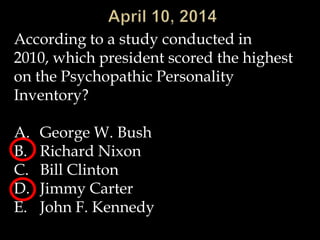
According to a study conducted in
2010, which president scored the highest
on the Psychopathic Personality
Inventory?
A. George W. Bush
B. Richard Nixon
C. Bill Clinton
D. Jimmy Carter
E. John F. Kennedy
Free write—write without picking up your
pen or pencil until I say stop. Do not
worry about grammar, spelling, or
sounding silly. Start with the prompt and
go where your mind takes you.
Prompt:
 Dutton quotes Winston Churchill at the
beginning of the first chapter: “Great and
Good are seldom the same man.” What do
you think this statement means? How
does it relate to psychopaths?
8:007:307:006:306:005:305:004:304:003:303:002:302:001:301:00:30:00
Link
 In groups of four, try to define
psychopath based on “Scorpio
Rising”
 Compare
 Look at Hare Checklist
 Discuss
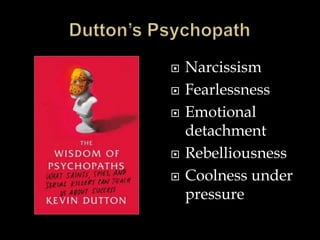
 Narcissism
 Fearlessness
 Emotional
detachment
 Rebelliousness
 Coolness under
pressure
Identifying Psychopaths with
the Hare Checklist
Slides adapted from http://www.wikihow.com/Identify-a-Psychopath
A psychopath will also put on what professionals refer
to as a "mask" of sanity that is likeable and pleasant.
Psychopaths will often believe they are smarter or more
powerful than they actually are.
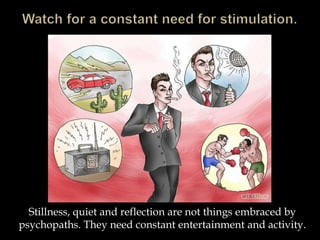
Stillness, quiet and reflection are not things embraced by
psychopaths. They need constant entertainment and activity.
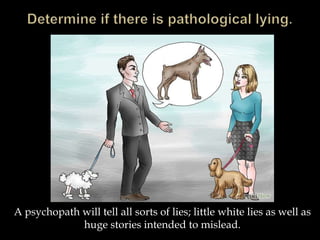
A psychopath will tell all sorts of lies; little white lies as well as
huge stories intended to mislead.
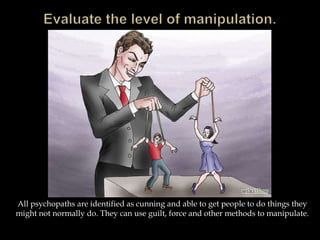
All psychopaths are identified as cunning and able to get people to do things they
might not normally do. They can use guilt, force and other methods to manipulate.
An absence of any guilt or remorse is a sign of
psychopathy.
Psychopaths demonstrate shallow emotional reactions to deaths, injuries,
trauma or other events that would otherwise cause a deeper response.
Psychopaths are callous and have no way of relating to non-psychopaths.
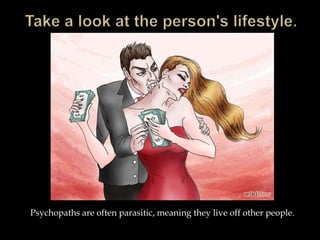
Psychopaths are often parasitic, meaning they live off other people.
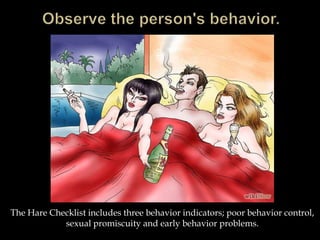
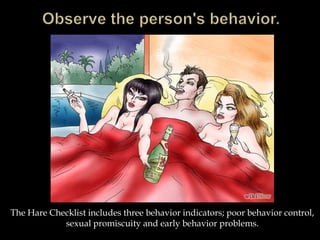
The Hare Checklist includes three behavior indicators; poor behavior control,
sexual promiscuity and early behavior problems.
Psychopaths have unrealistic goals for the long term. Either there are no goals
at all, or they are unattainable and based on the exaggerated sense of one's
own accomplishments and abilities.
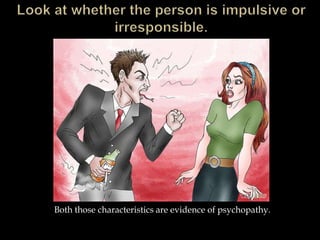
Both those characteristics are evidence of psychopathy.
A psychopath will never admit to being wrong or owning up to mistakes and
errors in judgment.
If there have been many short term marriages, the chances the person is a
psychopath increase.
Many psychopaths exhibit delinquent behaviors in their youth.
Psychopaths are able to get away with a lot, and while they might sometimes
get caught, the ability to be flexible when committing crimes is an indicator.
Psychopaths are experts at manipulating our
emotions and insecurities into causing us to view
them as "poor injusticed fellows," thus lowering our
sentimental guard and rendering us vulnerables for
future exploitation. If this psychologic resource is
continually combined with unacceptable and evil
actions, this equals to a powerful alert sign about this
person's real nature.
Psychopaths are generally prone to
belittle, humiliate, mistreat, mock and even attack
physically (or kill, in extreme cases) people who
normally would bring no benefits to him/her in
any way, such as subordinates, physically frail or
lower-ranking people, children, elderly people
and even animals - especially the latter ones.
Remember Arthur Schoepenhauer's famous
words: "A person who harms or kills animals
cannot be a good person at all."
If we buy Dutton’s argument
(that we can find wisdom from
psychopaths), how can these
traits be reframed as beneficial?
A psychopath will also put on what professionals refer
to as a "mask" of sanity that is likeable and pleasant.
Psychopaths will often believe they are smarter or more
powerful than they actually are.
Stillness, quiet and reflection are not things embraced by
psychopaths. They need constant entertainment and activity.
A psychopath will tell all sorts of lies; little white lies as well as
huge stories intended to mislead.
All psychopaths are identified as cunning and able to get people to do things they
might not normally do. They can use guilt, force and other methods to manipulate.
An absence of any guilt or remorse is a sign of
psychopathy.
Psychopaths demonstrate shallow emotional reactions to
deaths, injuries, trauma or other events that would otherwise cause a deeper
response.
Psychopaths are callous and have no way of relating to non-psychopaths.
Psychopaths are often parasitic, meaning they live off other people.
The Hare Checklist includes three behavior indicators; poor behavior control,
sexual promiscuity and early behavior problems.
Psychopaths have unrealistic goals for the long term. Either there are no goals
at all, or they are unattainable and based on the exaggerated sense of one's
own accomplishments and abilities.
Both those characteristics are evidence of psychopathy.
A psychopath will never admit to being wrong or owning up to mistakes and
errors in judgment.
If there have been many short term marriages, the chances the person is a
psychopath increase.
Many psychopaths exhibit delinquent behaviors in their youth.
Psychopaths are able to get away with a lot, and while they might sometimes
get caught, the ability to be flexible when committing crimes is an indicator.
Psychopaths are experts at manipulating our
emotions and insecurities into causing us to view
them as "poor injusticed fellows," thus lowering our
sentimental guard and rendering us vulnerables for
future exploitation. If this psychologic resource is
continually combined with unacceptable and evil
actions, this equals to a powerful alert sign about this
person's real nature.
Psychopaths are generally prone to belittle,
humiliate, mistreat, mock and even attack
physically (or kill, in extreme cases) people who
normally would bring no benefits to him/her in
any way, such as subordinates, physically frail or
lower-ranking people, children, elderly people
and even animals - especially the latter ones.
Remember Arthur Schoepenhauer's famous
words: "A person who harms or kills animals
cannot be a good person at all."
(sensitive/nervous vs. secure/confident). The tendency to
experience unpleasant emotions easily, such as
anger, anxiety, depression, and vulnerability. Neuroticism
also refers to the degree of emotional stability and impulse
control and is sometimes referred to by its low
pole, "emotional stability".
Average (39%)
High (33%)
(outgoing/energetic vs. solitary/reserved).
Energy, positive
emotions, surgency, assertiveness, sociability and
the tendency to seek stimulation in the company
of others, and talkativeness.
Average (33%)
High (28%)
Low (28%)
(inventive/curious vs. consistent/cautious). Appreciation for
art, emotion, adventure, unusual ideas, curiosity, and
variety of experience. Openness reflects the degree of
intellectual curiosity, creativity and a preference for
novelty and variety a person has. It is also described as the
extent to which a person is imaginative or
independent, and depicts a personal preference for a
variety of activities over a strict routine. Some
disagreement remains about how to interpret the
openness factor, which is sometimes called "intellect"
rather than openness to experience.
Average (39%)
High (22%)
Low (22%)
(friendly/compassionate vs. analytical/detached). A tendency
to be compassionate and cooperative rather than
suspicious and antagonistic towards others. It is also a
measure of one's trusting and helpful nature, and whether
a person is generally well tempered or not.
Average (44%)
Low (28%)
(efficient/organized vs. easy-going/careless). A tendency
to be organized and dependable, show self-discipline,
act dutifully, aim for achievement, and prefer
planned rather than spontaneous behavior.
Average (33%)
Low (33%)
The capability of a person or argument to
convince or persuade someone to accept a desired
way of thinking.
Very High (44%)
High (22%)
Only characteristic without a
person ranking “Very Low”
A. Free write
B. Defining psychopath
C. Class results of personality quiz
D. Discussion of “Scorpio Rising”
E. Essay #6 Prompt and Rubric
A. Free write
B. Defining psychopath
C. Class results of personality quiz
D. Discussion of “Scorpio Rising”
E. Essay #6 Prompt and Rubric
 Essay #5 is due Sunday at 11:55 p.m.
to Turnitin
 Read (and be prepared to discuss)
“Will the Real Psychopath Please
Stand Up” and “Carpe Noctem”
 Begin working and researching for
Essay #6
 Weekly discussion (post due
Thursday and responses due Sunday)

April 10 (101A)

  • 1.
    According to astudy conducted in 2010, which president scored the highest on the Psychopathic Personality Inventory? A. George W. Bush B. Richard Nixon C. Bill Clinton D. Jimmy Carter E. John F. Kennedy
  • 3.
    Free write—write withoutpicking up your pen or pencil until I say stop. Do not worry about grammar, spelling, or sounding silly. Start with the prompt and go where your mind takes you. Prompt:  Dutton quotes Winston Churchill at the beginning of the first chapter: “Great and Good are seldom the same man.” What do you think this statement means? How does it relate to psychopaths? 8:007:307:006:306:005:305:004:304:003:303:002:302:001:301:00:30:00
  • 4.
  • 5.
     In groupsof four, try to define psychopath based on “Scorpio Rising”  Compare  Look at Hare Checklist  Discuss
  • 6.
     Narcissism  Fearlessness Emotional detachment  Rebelliousness  Coolness under pressure
  • 7.
    Identifying Psychopaths with theHare Checklist Slides adapted from http://www.wikihow.com/Identify-a-Psychopath
  • 8.
    A psychopath willalso put on what professionals refer to as a "mask" of sanity that is likeable and pleasant.
  • 9.
    Psychopaths will oftenbelieve they are smarter or more powerful than they actually are.
  • 10.
    Stillness, quiet andreflection are not things embraced by psychopaths. They need constant entertainment and activity.
  • 11.
    A psychopath willtell all sorts of lies; little white lies as well as huge stories intended to mislead.
  • 12.
    All psychopaths areidentified as cunning and able to get people to do things they might not normally do. They can use guilt, force and other methods to manipulate.
  • 13.
    An absence ofany guilt or remorse is a sign of psychopathy.
  • 14.
    Psychopaths demonstrate shallowemotional reactions to deaths, injuries, trauma or other events that would otherwise cause a deeper response.
  • 15.
    Psychopaths are callousand have no way of relating to non-psychopaths.
  • 16.
    Psychopaths are oftenparasitic, meaning they live off other people.
  • 17.
    The Hare Checklistincludes three behavior indicators; poor behavior control, sexual promiscuity and early behavior problems.
  • 18.
    Psychopaths have unrealisticgoals for the long term. Either there are no goals at all, or they are unattainable and based on the exaggerated sense of one's own accomplishments and abilities.
  • 19.
    Both those characteristicsare evidence of psychopathy.
  • 20.
    A psychopath willnever admit to being wrong or owning up to mistakes and errors in judgment.
  • 21.
    If there havebeen many short term marriages, the chances the person is a psychopath increase.
  • 22.
    Many psychopaths exhibitdelinquent behaviors in their youth.
  • 23.
    Psychopaths are ableto get away with a lot, and while they might sometimes get caught, the ability to be flexible when committing crimes is an indicator.
  • 24.
    Psychopaths are expertsat manipulating our emotions and insecurities into causing us to view them as "poor injusticed fellows," thus lowering our sentimental guard and rendering us vulnerables for future exploitation. If this psychologic resource is continually combined with unacceptable and evil actions, this equals to a powerful alert sign about this person's real nature.
  • 25.
    Psychopaths are generallyprone to belittle, humiliate, mistreat, mock and even attack physically (or kill, in extreme cases) people who normally would bring no benefits to him/her in any way, such as subordinates, physically frail or lower-ranking people, children, elderly people and even animals - especially the latter ones. Remember Arthur Schoepenhauer's famous words: "A person who harms or kills animals cannot be a good person at all."
  • 26.
    If we buyDutton’s argument (that we can find wisdom from psychopaths), how can these traits be reframed as beneficial?
  • 27.
    A psychopath willalso put on what professionals refer to as a "mask" of sanity that is likeable and pleasant.
  • 28.
    Psychopaths will oftenbelieve they are smarter or more powerful than they actually are.
  • 29.
    Stillness, quiet andreflection are not things embraced by psychopaths. They need constant entertainment and activity.
  • 30.
    A psychopath willtell all sorts of lies; little white lies as well as huge stories intended to mislead.
  • 31.
    All psychopaths areidentified as cunning and able to get people to do things they might not normally do. They can use guilt, force and other methods to manipulate.
  • 32.
    An absence ofany guilt or remorse is a sign of psychopathy.
  • 33.
    Psychopaths demonstrate shallowemotional reactions to deaths, injuries, trauma or other events that would otherwise cause a deeper response.
  • 34.
    Psychopaths are callousand have no way of relating to non-psychopaths.
  • 35.
    Psychopaths are oftenparasitic, meaning they live off other people.
  • 36.
    The Hare Checklistincludes three behavior indicators; poor behavior control, sexual promiscuity and early behavior problems.
  • 37.
    Psychopaths have unrealisticgoals for the long term. Either there are no goals at all, or they are unattainable and based on the exaggerated sense of one's own accomplishments and abilities.
  • 38.
    Both those characteristicsare evidence of psychopathy.
  • 39.
    A psychopath willnever admit to being wrong or owning up to mistakes and errors in judgment.
  • 40.
    If there havebeen many short term marriages, the chances the person is a psychopath increase.
  • 41.
    Many psychopaths exhibitdelinquent behaviors in their youth.
  • 42.
    Psychopaths are ableto get away with a lot, and while they might sometimes get caught, the ability to be flexible when committing crimes is an indicator.
  • 43.
    Psychopaths are expertsat manipulating our emotions and insecurities into causing us to view them as "poor injusticed fellows," thus lowering our sentimental guard and rendering us vulnerables for future exploitation. If this psychologic resource is continually combined with unacceptable and evil actions, this equals to a powerful alert sign about this person's real nature.
  • 44.
    Psychopaths are generallyprone to belittle, humiliate, mistreat, mock and even attack physically (or kill, in extreme cases) people who normally would bring no benefits to him/her in any way, such as subordinates, physically frail or lower-ranking people, children, elderly people and even animals - especially the latter ones. Remember Arthur Schoepenhauer's famous words: "A person who harms or kills animals cannot be a good person at all."
  • 46.
    (sensitive/nervous vs. secure/confident).The tendency to experience unpleasant emotions easily, such as anger, anxiety, depression, and vulnerability. Neuroticism also refers to the degree of emotional stability and impulse control and is sometimes referred to by its low pole, "emotional stability". Average (39%) High (33%)
  • 47.
    (outgoing/energetic vs. solitary/reserved). Energy,positive emotions, surgency, assertiveness, sociability and the tendency to seek stimulation in the company of others, and talkativeness. Average (33%) High (28%) Low (28%)
  • 48.
    (inventive/curious vs. consistent/cautious).Appreciation for art, emotion, adventure, unusual ideas, curiosity, and variety of experience. Openness reflects the degree of intellectual curiosity, creativity and a preference for novelty and variety a person has. It is also described as the extent to which a person is imaginative or independent, and depicts a personal preference for a variety of activities over a strict routine. Some disagreement remains about how to interpret the openness factor, which is sometimes called "intellect" rather than openness to experience. Average (39%) High (22%) Low (22%)
  • 49.
    (friendly/compassionate vs. analytical/detached).A tendency to be compassionate and cooperative rather than suspicious and antagonistic towards others. It is also a measure of one's trusting and helpful nature, and whether a person is generally well tempered or not. Average (44%) Low (28%)
  • 50.
    (efficient/organized vs. easy-going/careless).A tendency to be organized and dependable, show self-discipline, act dutifully, aim for achievement, and prefer planned rather than spontaneous behavior. Average (33%) Low (33%)
  • 51.
    The capability ofa person or argument to convince or persuade someone to accept a desired way of thinking. Very High (44%) High (22%) Only characteristic without a person ranking “Very Low”
  • 54.
    A. Free write B.Defining psychopath C. Class results of personality quiz D. Discussion of “Scorpio Rising” E. Essay #6 Prompt and Rubric
  • 55.
    A. Free write B.Defining psychopath C. Class results of personality quiz D. Discussion of “Scorpio Rising” E. Essay #6 Prompt and Rubric
  • 56.
     Essay #5is due Sunday at 11:55 p.m. to Turnitin  Read (and be prepared to discuss) “Will the Real Psychopath Please Stand Up” and “Carpe Noctem”  Begin working and researching for Essay #6  Weekly discussion (post due Thursday and responses due Sunday)