Presentation to InvestorsPresentation to Investors
1st quarter 2010
Contents
• Company History
• Highlights
• Refractory Products
• Group Profile
• Mineral Reserves
• Production Process and Capacities
• Competition
Key Figures• Key Figures
• Competitive Advantages vs. Risks
2
• Stock Performance
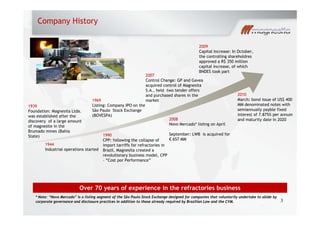
Company History
2009
Capital Increase: In October,
the controlling shareholdres
approved a R$ 350 million
2007
Control Change: GP and Gavea
acquired control of Magnesita
approved a R$ 350 million
capital increase, of which
BNDES took part
1939
Foundation: Magnesita Ltda.
1969
Listing: Company IPO on the
São Paulo Stock Exchange
q g
S.A., held two tender offers
and purchased shares in the
market
2010
March: bond issue of US$ 400
MM denominated notes with
semiannually payble fixed
f 8 %
g
was established after the
discovery of a large amount
of magnesite in the
Brumado mines (Bahia
State)
(BOVESPA)
1990
CPP f ll i h ll f
2008
Novo Mercado* lisitng on April
September: LWB is acquired for
€ 657 MM
interest of 7.875% per annum
and maturity date in 2020
1944
Industrial operations started
CPP: following the collapse of
import tarriffs for refractories in
Brazil, Magnesita created a
revolutionary business model, CPP
– “Cost por Performance”
€ 657 MM
Over 70 years of experience in the refractories business
3
Over 70 years of experience in the refractories business
* Note: “Novo Mercado” is a listing segment of the São Paulo Stock Exchange designed for companies that voluntarily undertake to abide by
corporate governance and disclosure practices in addition to those already required by Brazilian Law and the CVM.
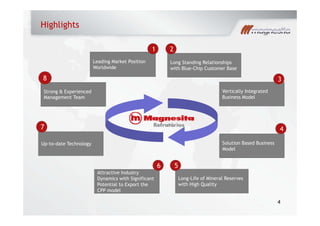
Highlights
Leading Market Position
1
Long Standing Relationships
2
Leading Market Position
Worldwide
38
Long Standing Relationships
with Blue-Chip Customer Base
Vertically Integrated
Business Model
Strong & Experienced
Management Team
47
Solution Based Business
Model
56
Up-to-date Technology
Long-Life of Mineral Reserves
with High Quality
5
Attractive Industry
Dynamics with Significant
Potential to Export the
CPP model
6
4
CPP model
Group Profile
York
Valenciennes
Flaumont
Hilden
Oberhausen
Hagen
Kruft
Taiyuan
Chizhou
Kaohsiung
Brumado
Coronel Fabriciano
Contagem
Ramalho (Arg) - RASA
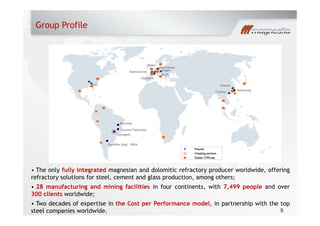
• The only fully integrated magnesian and dolomitic refractory producer worldwide, offering
refractory solutions for steel, cement and glass production, among others;
• 28 manufacturing and mining facilities in four continents, with 7,499 people and overg g p p
300 clients worldwide;
• Two decades of expertise in the Cost per Performance model, in partnership with the top
steel companies worldwide. 5
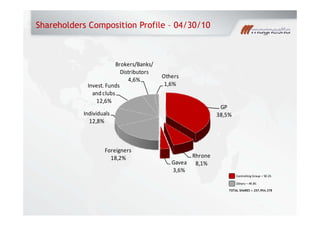
Shareholders Composition Profile – 04/30/10
Invest. Funds
Brokers/Banks/
Distributors
4,6%
Others
1,6%
GP
38 5%Individuals
Invest. Funds 
and clubs
12,6%
38,5%Individuals
12,8%
Rhrone
8 1%Gavea
Foreigners
18,2%
8,1%Gavea
3,6%
Controlling Group = 50.2%
TOTAL SHARES 257 954 378
Others = 49.8%
TOTAL SHARES = 257,954,378
Refractory Products
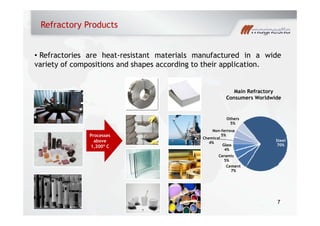
• Refractories are heat-resistant materials manufactured in a wide
i f i i d h di h i li ivariety of compositions and shapes according to their application.
Main Refractory
Consumers Worldwide
Processes
Chemical
Non-ferrous
5%
Others
5%
above
1,200º C
Steel
70%
Ceramic
5%
Glass
4%
Chemical
4%
Cement
7%
77 7
Refractory Products
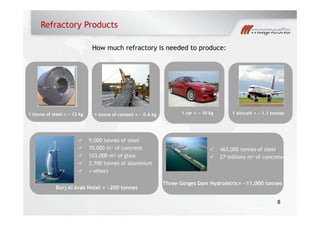
How much refractory is needed to produce:
1 f 0 6 k1 t f t l 12 k 1 car = ~ 10 kg 1 aircraft = 1 1 tonnes1 tonne of cement = ~ 0.6 kg1 tonne of steel = ~ 12 kg 1 car = ~ 10 kg 1 aircraft = ~ 1.1 tonnes
 9 000 t f t l 9,000 tonnes of steel
 70,000 m³ of concrete
 103,000 m² of glass
 2 700 tonnes of aluminium
 463,000 tonnes of steel
 27 millions m³ of concrete
 2,700 tonnes of aluminium
 + others
Burj Al Arab Hotel = ~200 tonnes
Three Gorges Dam Hydroletric= ~11,000 tonnes
88
j
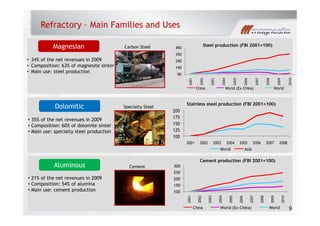
Refractory – Main Families and Uses
Magnesian Steel production (FBI 2001=100)
• 34% of the net revenues in 2009
Carbon Steel
290
390
490
• Composition: 63% of magnesite sinter
• Main use: steel production
90
190
290
2001
2002
2003
2004
2005
2006
2007
2008
2009
2010
Chi W ld (E Chi ) W ld
Dolomitic Specialty Steel
China World (Ex-China) World
200
Stainless steel production (FBI 2001=100)
• 35% of the net revenues in 2009
• Composition: 60% of dolomite sinter
• Main use: specialty steel production
100
125
150
175
Aluminous
2001 2002 2003 2004 2005 2006 2007 2008
World Asia
Cement production (FBI 2001=100)
Aluminous
• 21% of the net revenues in 2009
• Composition: 54% of alumina
• Main use: cement production
Cement
150
200
250
300
99
• Main use: cement production 100
2001
2002
2003
2004
2005
2006
2007
2008
2009
2010
China World (Ex-China) World 9
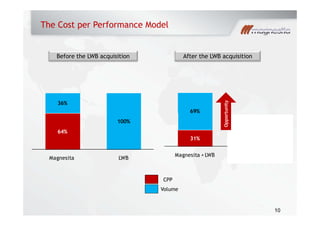
The Cost per Performance Model
After the LWB acquisitionBefore the LWB acquisition
69%
36%
tunity
31%
69%
64%
100%
Opport
31%
Magnesita + LWB
Magnesita LWB
CPP
Volume
10
Volume
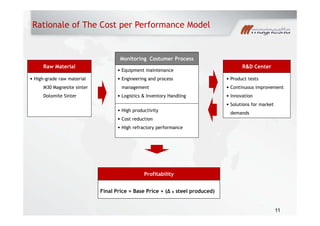
Rationale of The Cost per Performance Model
Monitoring Costumer Process
Raw Material R&D Center
• High-grade raw material
M30 Magnesite sinter
• Equipment maintenance
• Engineering and process
management
• Product tests
• Continuous improvementM30 Magnesite sinter
Dolomite Sinter
management
• Logistics & Inventory Handling
• Continuous improvement
• Innovation
• Solutions for market
demands
• High productivity
demands
g p y
• Cost reduction
• High refractory performance
Profitability
Fi l P i B P i (Δ t l d d)Final Price = Base Price + (Δ x steel produced)
11
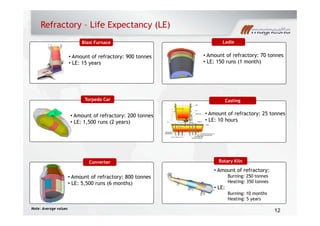
Refractory – Life Expectancy (LE)
Blast Furnace Ladle
• Amount of refractory: 900 tonnes
LE 15
• Amount of refractory: 70 tonnes
• LE: 150 runs (1 month)• LE: 15 years • LE: 150 runs (1 month)
Torpedo Car Casting
• Amount of refractory: 25 tonnes• Amount of refractory: 200 tonnes
• LE: 1,500 runs (2 years)
• Amount of refractory: 25 tonnes
• LE: 10 hours
Converter Rotary Kiln
• Amount of refractory: 800 tonnes
• LE: 5,500 runs (6 months)
• Amount of refractory:
Burning: 250 tonnes
Heating: 350 tonnes
• LE:
12
Burning: 10 months
Heating: 5 years
Note: Average values
12
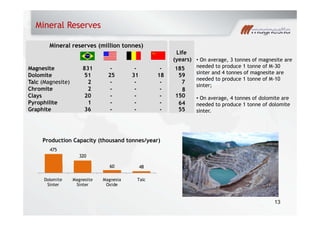
Mineral Reserves
Mineral reserves (million tonnes)
• On average, 3 tonnes of magnesite are
Life
(years)
Magnesite 831 - - -
Dolomite 51 25 31 18
Talc (Magnesite) 2 - - -
Ch it 2
g , g
needed to produce 1 tonne of M-30
sinter and 4 tonnes of magnesite are
needed to produce 1 tonne of M-10
sinter;
(y )
8
7
59
185
Chromite 2 - - -
Clays 20 - - -
Pyrophilite 1 - - -
Graphite 36 - - -
;
• On average, 4 tonnes of dolomite are
needed to produce 1 tonne of dolomite
sinter.55
64
150
8
P d ti C it (th d t / )Production Capacity (thousand tonnes/year)
475
320
60 48
Dolomite
Sinter
Magnesite
Sinter
Magnesia
Oxide
Talc
13
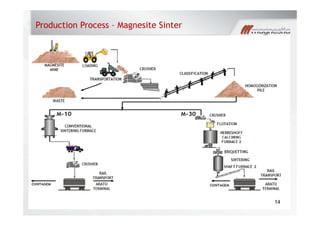
Production Process – Magnesite Sinter
14
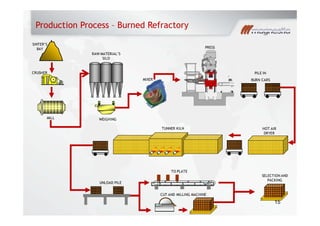
Production Process – Burned Refractory
RAW MATERIAL’S
SILO
PRESS
SINTER’S
BAY
MIXER
PILE IN
BURN CARS
CRUSHER
WEIGHING
HOT AIR
DRYER
TUNNER KILN
MILL
UNLOAD PILE
TO PLATE
SELECTION AND
PACKING
CUT AND MILLING MACHINE
15
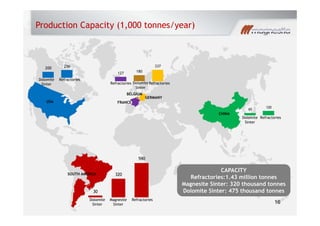
Production Capacity (1,000 tonnes/year)
200 256
Dolomite
Sinter
Refractories
127 180
337
Refractories Dolomite
Sinter
Refractories
USA
BELGIUM
FRANCE
GERMANY
CHINA
Sinter
65
120
CHINA
Dolomite
Sinter
Refractories
590
CAPACITY
Refractories:1.43 million tonnes
Magnesite Sinter: 320 thousand tonnes
Dolomite Sinter: 475 thousand tonnes30
320SOUTH AMERICA
Dolomite Sinter: 475 thousand tonnes30
Dolomite
Sinter
RefractoriesMagnesite
Sinter 16
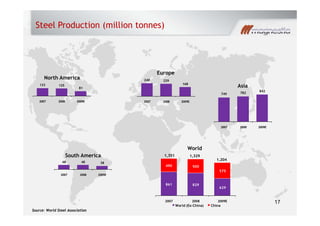
Steel Production (million tonnes)
133 125
81
240 229
168
North America
Europe
Asia81
2007 2008 2009E 2007 2008 2009E
749 782
842
Asia
2007 2008 2009E
48 48 38
1,351 1,329
1,204
South America
World
861 829
629
490 500
575
2007 2008 2009E
172007 2008 2009E
World (Ex-China) China
Source: World Steel Association
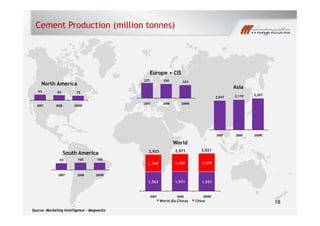
Cement Production (million tonnes)
372 350 324
North America
Europe + CIS
Asia
93 84 75
2007 2008 2009E
2007 2008 2009E
2,047 2,119 2,207
Asia
2007 2008 2009E
1,360 1,400 1,470
93 100 100
2,923 2,971 3,021
South America
World
1,563 1,571 1,551
1,360 1,400 ,
2007 2008 2009E
Source: Marketing Intelligence - Magnesita
2007 2008 2009E
World (Ex-China) China 18
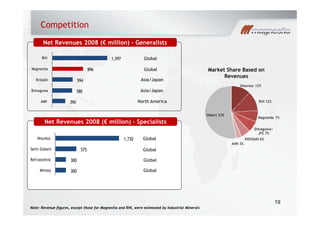
Competition
1,597RHI
Net Revenues 2008 (€ million) - Generalists
Global
594
896
Krosaki
Magnesita
Asia/Japan
Global
Vesuvius 12%
Market Share Based on
Revenues
390
580
ANH
Shinagawa
North America
Asia/Japan
RHI 12%
Net Revenues 2008 (€ million) - Specialists
1 730Vesuvius Global
Magnesita 7%
Shinagawa+
JFE 7%
KROSAKI 6%
Others 53%
300
575
1,730
Refratechnic
Saint-Gobain
Vesuvius Global
Global
Global
KROSAKI 6%
ANH 3%
300Minteq Global
19
Note: Revenue figures, except those for Magnesita and RHI, were estimated by Industrial Minerals
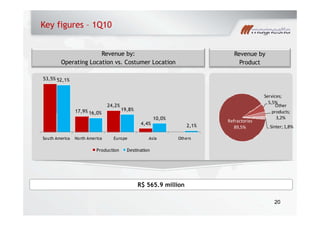
Key figures – 1Q10
Revenue by:
Operating Location vs Costumer Location
Revenue by
ProductOperating Location vs. Costumer Location Product
53,5% 52,1%
17,9%
24,2%
16 0%
19,8%
Services; 
5,5%
Other 
products;,
4,4%
16,0%
10,0%
2,1%
South America North America Europe Asia Others
Refractories
89,5%
products; 
3,2%
Sinter; 1,8%
South America North America Europe Asia Others
Production Destination
R$ 565.9 million
2020
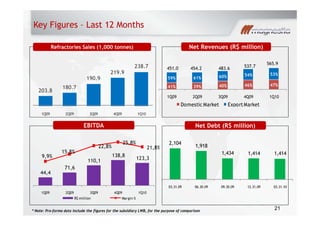
Key Figures – Last 12 Months
Net Revenues (R$ million)Refractories Sales (1,000 tonnes)
41% 39% 40% 46% 47%
59% 61% 60% 54% 53%
180 7
190.9
219.9
238.7 451.0 454.2 483.6 537.7
565.9
41% 39% 40%
1Q09 2Q09 3Q09 4Q09 1Q10
Domestic Market Export Market
203.8
180.7
1Q09 2Q09 3Q09 4Q09 1Q10
0,3
1Q09 2Q09 3Q09 4Q09 1Q10
EBITDA Net Debt (R$ million)
110,1
138,8
123,39,9%
15,8%
22,8%
25,8%
21,8%
0,1
0,2
0,3
2,104
1,918
1,434 1,414 1,414
44,4
71,6
-0,1
0
,
03.31.09 06.30.09 09.30.09 12.31.09 03.31.10
1Q09 2Q09 3Q09 4Q09 1Q10
R$ million Margin %
21* Note: Pro-forma data include the figures for the subsidiary LWB, for the purpose of comparison
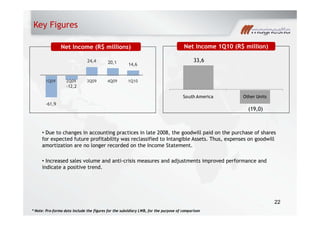
Key Figures
24 4 20 1
Net Income 1Q10 (R$ million)Net Income (R$ millions)
33,6
-12,2
24,4 20,1 14,6
1Q09 2Q09 3Q09 4Q09 1Q10
33,6
-61,9
12,2
(19,0)
South America Other Units
• Due to changes in accounting practices in late 2008, the goodwill paid on the purchase of shares
for expected future profitability was reclassified to Intangible Assets Thus expenses on goodwillfor expected future profitability was reclassified to Intangible Assets. Thus, expenses on goodwill
amortization are no longer recorded on the Income Statement.
• Increased sales volume and anti-crisis measures and adjustments improved performance and
indicate a positive trend.
22
* Note: Pro-forma data include the figures for the subsidiary LWB, for the purpose of comparison
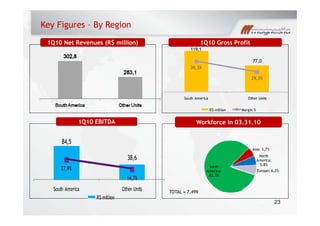
Key Figures – By Region
1Q10 Net Revenues (R$ million)
119,1
77 0
1Q10 Gross Profit
77,0
39,3%
29,3%
South America Other Units
R$ million Margin %
Workforce in 03.31.101Q10 EBITDA
Asia; 5,7%
North
America;
5 8%
84,5
38,6
South
America;
82,3%
5,8%
Europe; 6,2%27,9%
14,7%
South America Other Units
23
South America Other Units
R$ million
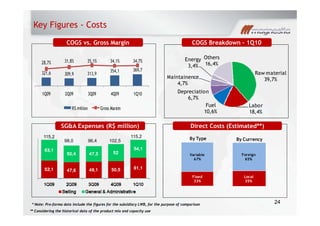
TOTAL = 7,499
Key Figures - Costs
COGS Breakdown – 1Q10
28 7% 31 8% 35 1% 34 1% 34 7%
COGS vs. Gross Margin
Energy Others
321,6 309,9 313,9
354,1 369,7
28,7% 31,8% 35,1% 34,1% 34,7%
Raw material
39,7%Maintainence
4,7%
gy
3,4% 16,4%
1Q09 2Q09 3Q09 4Q09 1Q10
R$ million Gross Margin
Labor
18,4%
Fuel
10,6%
Depreciation
6,7%
SG&A Expenses (R$ million) Direct Costs (Estimated**)
By Type By Currency
18,4%10,6%
115,2 115,2
Variable
67%
By Type
Foreign
65%
By Currency
,
98,0 96,4 102,5
,
Fixed
33%
Local
35%
24
** Considering the historical data of the product mix and capacity use
* Note: Pro-forma data include the figures for the subsidiary LWB, for the purpose of comparison
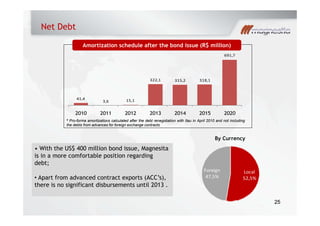
Net Debt
691,7
Amortization schedule after the bond issue (R$ million)
322,1 315,2 318,1
41,4
3,6 15,1
2010 2011 2012 2013 2014 2015 20202010 2011 2012 2013 2014 2015 2020
By Currency
* Pro-forma amortizations calculated after the debt renegotiation with Itau in April 2010 and not including
the debts from advances for foreign exchange contracts
• With the US$ 400 million bond issue, Magnesita
is in a more comfortable position regarding
debt;
By Currency
debt;
• Apart from advanced contract exports (ACC’s),
there is no significant disbursements until 2013 .
Local
52,5%
Foreign
47,5%
2525
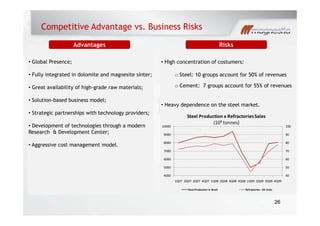
Competitive Advantage vs. Business Risks
• Global Presence;• Global Presence; • High concentration of costumers:• High concentration of costumers:
Advantages Risks
• Global Presence;
• Fully integrated in dolomite and magnesite sinter;
• Great availability of high grade raw materials;
• Global Presence;
• Fully integrated in dolomite and magnesite sinter;
• Great availability of high grade raw materials;
• High concentration of costumers:
o Steel: 10 groups account for 50% of revenues
o Cement: 7 groups account for 55% of revenues
• High concentration of costumers:
o Steel: 10 groups account for 50% of revenues
o Cement: 7 groups account for 55% of revenues• Great availability of high-grade raw materials;
• Solution-based business model;
• Strategic partnerships with technology providers;
• Great availability of high-grade raw materials;
• Solution-based business model;
• Strategic partnerships with technology providers;
o Cement: 7 groups account for 55% of revenues
• Heavy dependence on the steel market.
o Cement: 7 groups account for 55% of revenues
• Heavy dependence on the steel market.
• Strategic partnerships with technology providers;
• Development of technologies through a modern
Research & Development Center;
• Strategic partnerships with technology providers;
• Development of technologies through a modern
Research & Development Center; 90
100
9000
10000
Steel Production x Refractories Sales
(10³ tonnes)
• Aggressive cost management model.• Aggressive cost management model.
60
70
80
6000
7000
8000
40
50
4000
5000
1Q07 2Q07 3Q07 4Q07 1Q08 2Q08 3Q08 4Q08 1Q09 2Q09 3Q09 4Q09
SteelProduction in Brazil Refractories ‐ SA Units
26
Steel Production in Brazil Refractories ‐ SA Units
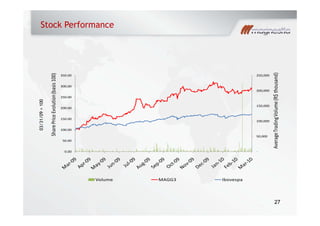
Stock Performance
250,000 
300.00
350.00
ousand) 
sis 100)
9=100
150,000 
200,000 
200.00
250.00
300.00
olume (R$ tho
Evolution (bas
03/31/09
50,000 
100,000 
100.00
150.00
age Trading Vo
Share Price E
‐0.00
50.00
Avera
Volume MAGG3 Ibovespa
2727
Thanks for your Attention!
Flavio Rezende Barbosa
y
Chief Financial and Investor Relations Officer
Adriana Fernandes Lana
I t R l ti M gInvestor Relations Manager
Phone: (+55 31) 3368-1069
Lucas Lima Ferreira
Investor Relations Analyst
Phone: (+55 31) 3368-1068
ri@magnesita.com.br www.magnesita.com.br
2828

Apres padrao mrsa_1_q10_eng

  • 1.
    Presentation to InvestorsPresentationto Investors 1st quarter 2010
  • 2.
    Contents • Company History •Highlights • Refractory Products • Group Profile • Mineral Reserves • Production Process and Capacities • Competition Key Figures• Key Figures • Competitive Advantages vs. Risks 2 • Stock Performance
  • 3.
    Company History 2009 Capital Increase:In October, the controlling shareholdres approved a R$ 350 million 2007 Control Change: GP and Gavea acquired control of Magnesita approved a R$ 350 million capital increase, of which BNDES took part 1939 Foundation: Magnesita Ltda. 1969 Listing: Company IPO on the São Paulo Stock Exchange q g S.A., held two tender offers and purchased shares in the market 2010 March: bond issue of US$ 400 MM denominated notes with semiannually payble fixed f 8 % g was established after the discovery of a large amount of magnesite in the Brumado mines (Bahia State) (BOVESPA) 1990 CPP f ll i h ll f 2008 Novo Mercado* lisitng on April September: LWB is acquired for € 657 MM interest of 7.875% per annum and maturity date in 2020 1944 Industrial operations started CPP: following the collapse of import tarriffs for refractories in Brazil, Magnesita created a revolutionary business model, CPP – “Cost por Performance” € 657 MM Over 70 years of experience in the refractories business 3 Over 70 years of experience in the refractories business * Note: “Novo Mercado” is a listing segment of the São Paulo Stock Exchange designed for companies that voluntarily undertake to abide by corporate governance and disclosure practices in addition to those already required by Brazilian Law and the CVM.
  • 4.
    Highlights Leading Market Position 1 LongStanding Relationships 2 Leading Market Position Worldwide 38 Long Standing Relationships with Blue-Chip Customer Base Vertically Integrated Business Model Strong & Experienced Management Team 47 Solution Based Business Model 56 Up-to-date Technology Long-Life of Mineral Reserves with High Quality 5 Attractive Industry Dynamics with Significant Potential to Export the CPP model 6 4 CPP model
  • 5.
    Group Profile York Valenciennes Flaumont Hilden Oberhausen Hagen Kruft Taiyuan Chizhou Kaohsiung Brumado Coronel Fabriciano Contagem Ramalho(Arg) - RASA • The only fully integrated magnesian and dolomitic refractory producer worldwide, offering refractory solutions for steel, cement and glass production, among others; • 28 manufacturing and mining facilities in four continents, with 7,499 people and overg g p p 300 clients worldwide; • Two decades of expertise in the Cost per Performance model, in partnership with the top steel companies worldwide. 5
  • 6.
    Shareholders Composition Profile– 04/30/10 Invest. Funds Brokers/Banks/ Distributors 4,6% Others 1,6% GP 38 5%Individuals Invest. Funds  and clubs 12,6% 38,5%Individuals 12,8% Rhrone 8 1%Gavea Foreigners 18,2% 8,1%Gavea 3,6% Controlling Group = 50.2% TOTAL SHARES 257 954 378 Others = 49.8% TOTAL SHARES = 257,954,378
  • 7.
    Refractory Products • Refractoriesare heat-resistant materials manufactured in a wide i f i i d h di h i li ivariety of compositions and shapes according to their application. Main Refractory Consumers Worldwide Processes Chemical Non-ferrous 5% Others 5% above 1,200º C Steel 70% Ceramic 5% Glass 4% Chemical 4% Cement 7% 77 7
  • 8.
    Refractory Products How muchrefractory is needed to produce: 1 f 0 6 k1 t f t l 12 k 1 car = ~ 10 kg 1 aircraft = 1 1 tonnes1 tonne of cement = ~ 0.6 kg1 tonne of steel = ~ 12 kg 1 car = ~ 10 kg 1 aircraft = ~ 1.1 tonnes  9 000 t f t l 9,000 tonnes of steel  70,000 m³ of concrete  103,000 m² of glass  2 700 tonnes of aluminium  463,000 tonnes of steel  27 millions m³ of concrete  2,700 tonnes of aluminium  + others Burj Al Arab Hotel = ~200 tonnes Three Gorges Dam Hydroletric= ~11,000 tonnes 88 j
  • 9.
    Refractory – MainFamilies and Uses Magnesian Steel production (FBI 2001=100) • 34% of the net revenues in 2009 Carbon Steel 290 390 490 • Composition: 63% of magnesite sinter • Main use: steel production 90 190 290 2001 2002 2003 2004 2005 2006 2007 2008 2009 2010 Chi W ld (E Chi ) W ld Dolomitic Specialty Steel China World (Ex-China) World 200 Stainless steel production (FBI 2001=100) • 35% of the net revenues in 2009 • Composition: 60% of dolomite sinter • Main use: specialty steel production 100 125 150 175 Aluminous 2001 2002 2003 2004 2005 2006 2007 2008 World Asia Cement production (FBI 2001=100) Aluminous • 21% of the net revenues in 2009 • Composition: 54% of alumina • Main use: cement production Cement 150 200 250 300 99 • Main use: cement production 100 2001 2002 2003 2004 2005 2006 2007 2008 2009 2010 China World (Ex-China) World 9
  • 10.
    The Cost perPerformance Model After the LWB acquisitionBefore the LWB acquisition 69% 36% tunity 31% 69% 64% 100% Opport 31% Magnesita + LWB Magnesita LWB CPP Volume 10 Volume
  • 11.
    Rationale of TheCost per Performance Model Monitoring Costumer Process Raw Material R&D Center • High-grade raw material M30 Magnesite sinter • Equipment maintenance • Engineering and process management • Product tests • Continuous improvementM30 Magnesite sinter Dolomite Sinter management • Logistics & Inventory Handling • Continuous improvement • Innovation • Solutions for market demands • High productivity demands g p y • Cost reduction • High refractory performance Profitability Fi l P i B P i (Δ t l d d)Final Price = Base Price + (Δ x steel produced) 11
  • 12.
    Refractory – LifeExpectancy (LE) Blast Furnace Ladle • Amount of refractory: 900 tonnes LE 15 • Amount of refractory: 70 tonnes • LE: 150 runs (1 month)• LE: 15 years • LE: 150 runs (1 month) Torpedo Car Casting • Amount of refractory: 25 tonnes• Amount of refractory: 200 tonnes • LE: 1,500 runs (2 years) • Amount of refractory: 25 tonnes • LE: 10 hours Converter Rotary Kiln • Amount of refractory: 800 tonnes • LE: 5,500 runs (6 months) • Amount of refractory: Burning: 250 tonnes Heating: 350 tonnes • LE: 12 Burning: 10 months Heating: 5 years Note: Average values 12
  • 13.
    Mineral Reserves Mineral reserves(million tonnes) • On average, 3 tonnes of magnesite are Life (years) Magnesite 831 - - - Dolomite 51 25 31 18 Talc (Magnesite) 2 - - - Ch it 2 g , g needed to produce 1 tonne of M-30 sinter and 4 tonnes of magnesite are needed to produce 1 tonne of M-10 sinter; (y ) 8 7 59 185 Chromite 2 - - - Clays 20 - - - Pyrophilite 1 - - - Graphite 36 - - - ; • On average, 4 tonnes of dolomite are needed to produce 1 tonne of dolomite sinter.55 64 150 8 P d ti C it (th d t / )Production Capacity (thousand tonnes/year) 475 320 60 48 Dolomite Sinter Magnesite Sinter Magnesia Oxide Talc 13
  • 14.
    Production Process –Magnesite Sinter 14
  • 15.
    Production Process –Burned Refractory RAW MATERIAL’S SILO PRESS SINTER’S BAY MIXER PILE IN BURN CARS CRUSHER WEIGHING HOT AIR DRYER TUNNER KILN MILL UNLOAD PILE TO PLATE SELECTION AND PACKING CUT AND MILLING MACHINE 15
  • 16.
    Production Capacity (1,000tonnes/year) 200 256 Dolomite Sinter Refractories 127 180 337 Refractories Dolomite Sinter Refractories USA BELGIUM FRANCE GERMANY CHINA Sinter 65 120 CHINA Dolomite Sinter Refractories 590 CAPACITY Refractories:1.43 million tonnes Magnesite Sinter: 320 thousand tonnes Dolomite Sinter: 475 thousand tonnes30 320SOUTH AMERICA Dolomite Sinter: 475 thousand tonnes30 Dolomite Sinter RefractoriesMagnesite Sinter 16
  • 17.
    Steel Production (milliontonnes) 133 125 81 240 229 168 North America Europe Asia81 2007 2008 2009E 2007 2008 2009E 749 782 842 Asia 2007 2008 2009E 48 48 38 1,351 1,329 1,204 South America World 861 829 629 490 500 575 2007 2008 2009E 172007 2008 2009E World (Ex-China) China Source: World Steel Association
  • 18.
    Cement Production (milliontonnes) 372 350 324 North America Europe + CIS Asia 93 84 75 2007 2008 2009E 2007 2008 2009E 2,047 2,119 2,207 Asia 2007 2008 2009E 1,360 1,400 1,470 93 100 100 2,923 2,971 3,021 South America World 1,563 1,571 1,551 1,360 1,400 , 2007 2008 2009E Source: Marketing Intelligence - Magnesita 2007 2008 2009E World (Ex-China) China 18
  • 19.
    Competition 1,597RHI Net Revenues 2008(€ million) - Generalists Global 594 896 Krosaki Magnesita Asia/Japan Global Vesuvius 12% Market Share Based on Revenues 390 580 ANH Shinagawa North America Asia/Japan RHI 12% Net Revenues 2008 (€ million) - Specialists 1 730Vesuvius Global Magnesita 7% Shinagawa+ JFE 7% KROSAKI 6% Others 53% 300 575 1,730 Refratechnic Saint-Gobain Vesuvius Global Global Global KROSAKI 6% ANH 3% 300Minteq Global 19 Note: Revenue figures, except those for Magnesita and RHI, were estimated by Industrial Minerals
  • 20.
    Key figures –1Q10 Revenue by: Operating Location vs Costumer Location Revenue by ProductOperating Location vs. Costumer Location Product 53,5% 52,1% 17,9% 24,2% 16 0% 19,8% Services;  5,5% Other  products;, 4,4% 16,0% 10,0% 2,1% South America North America Europe Asia Others Refractories 89,5% products;  3,2% Sinter; 1,8% South America North America Europe Asia Others Production Destination R$ 565.9 million 2020
  • 21.
    Key Figures –Last 12 Months Net Revenues (R$ million)Refractories Sales (1,000 tonnes) 41% 39% 40% 46% 47% 59% 61% 60% 54% 53% 180 7 190.9 219.9 238.7 451.0 454.2 483.6 537.7 565.9 41% 39% 40% 1Q09 2Q09 3Q09 4Q09 1Q10 Domestic Market Export Market 203.8 180.7 1Q09 2Q09 3Q09 4Q09 1Q10 0,3 1Q09 2Q09 3Q09 4Q09 1Q10 EBITDA Net Debt (R$ million) 110,1 138,8 123,39,9% 15,8% 22,8% 25,8% 21,8% 0,1 0,2 0,3 2,104 1,918 1,434 1,414 1,414 44,4 71,6 -0,1 0 , 03.31.09 06.30.09 09.30.09 12.31.09 03.31.10 1Q09 2Q09 3Q09 4Q09 1Q10 R$ million Margin % 21* Note: Pro-forma data include the figures for the subsidiary LWB, for the purpose of comparison
  • 22.
    Key Figures 24 420 1 Net Income 1Q10 (R$ million)Net Income (R$ millions) 33,6 -12,2 24,4 20,1 14,6 1Q09 2Q09 3Q09 4Q09 1Q10 33,6 -61,9 12,2 (19,0) South America Other Units • Due to changes in accounting practices in late 2008, the goodwill paid on the purchase of shares for expected future profitability was reclassified to Intangible Assets Thus expenses on goodwillfor expected future profitability was reclassified to Intangible Assets. Thus, expenses on goodwill amortization are no longer recorded on the Income Statement. • Increased sales volume and anti-crisis measures and adjustments improved performance and indicate a positive trend. 22 * Note: Pro-forma data include the figures for the subsidiary LWB, for the purpose of comparison
  • 23.
    Key Figures –By Region 1Q10 Net Revenues (R$ million) 119,1 77 0 1Q10 Gross Profit 77,0 39,3% 29,3% South America Other Units R$ million Margin % Workforce in 03.31.101Q10 EBITDA Asia; 5,7% North America; 5 8% 84,5 38,6 South America; 82,3% 5,8% Europe; 6,2%27,9% 14,7% South America Other Units 23 South America Other Units R$ million TOTAL = 7,499
  • 24.
    Key Figures -Costs COGS Breakdown – 1Q10 28 7% 31 8% 35 1% 34 1% 34 7% COGS vs. Gross Margin Energy Others 321,6 309,9 313,9 354,1 369,7 28,7% 31,8% 35,1% 34,1% 34,7% Raw material 39,7%Maintainence 4,7% gy 3,4% 16,4% 1Q09 2Q09 3Q09 4Q09 1Q10 R$ million Gross Margin Labor 18,4% Fuel 10,6% Depreciation 6,7% SG&A Expenses (R$ million) Direct Costs (Estimated**) By Type By Currency 18,4%10,6% 115,2 115,2 Variable 67% By Type Foreign 65% By Currency , 98,0 96,4 102,5 , Fixed 33% Local 35% 24 ** Considering the historical data of the product mix and capacity use * Note: Pro-forma data include the figures for the subsidiary LWB, for the purpose of comparison
  • 25.
    Net Debt 691,7 Amortization scheduleafter the bond issue (R$ million) 322,1 315,2 318,1 41,4 3,6 15,1 2010 2011 2012 2013 2014 2015 20202010 2011 2012 2013 2014 2015 2020 By Currency * Pro-forma amortizations calculated after the debt renegotiation with Itau in April 2010 and not including the debts from advances for foreign exchange contracts • With the US$ 400 million bond issue, Magnesita is in a more comfortable position regarding debt; By Currency debt; • Apart from advanced contract exports (ACC’s), there is no significant disbursements until 2013 . Local 52,5% Foreign 47,5% 2525
  • 26.
    Competitive Advantage vs.Business Risks • Global Presence;• Global Presence; • High concentration of costumers:• High concentration of costumers: Advantages Risks • Global Presence; • Fully integrated in dolomite and magnesite sinter; • Great availability of high grade raw materials; • Global Presence; • Fully integrated in dolomite and magnesite sinter; • Great availability of high grade raw materials; • High concentration of costumers: o Steel: 10 groups account for 50% of revenues o Cement: 7 groups account for 55% of revenues • High concentration of costumers: o Steel: 10 groups account for 50% of revenues o Cement: 7 groups account for 55% of revenues• Great availability of high-grade raw materials; • Solution-based business model; • Strategic partnerships with technology providers; • Great availability of high-grade raw materials; • Solution-based business model; • Strategic partnerships with technology providers; o Cement: 7 groups account for 55% of revenues • Heavy dependence on the steel market. o Cement: 7 groups account for 55% of revenues • Heavy dependence on the steel market. • Strategic partnerships with technology providers; • Development of technologies through a modern Research & Development Center; • Strategic partnerships with technology providers; • Development of technologies through a modern Research & Development Center; 90 100 9000 10000 Steel Production x Refractories Sales (10³ tonnes) • Aggressive cost management model.• Aggressive cost management model. 60 70 80 6000 7000 8000 40 50 4000 5000 1Q07 2Q07 3Q07 4Q07 1Q08 2Q08 3Q08 4Q08 1Q09 2Q09 3Q09 4Q09 SteelProduction in Brazil Refractories ‐ SA Units 26 Steel Production in Brazil Refractories ‐ SA Units
  • 27.
  • 28.
    Thanks for yourAttention! Flavio Rezende Barbosa y Chief Financial and Investor Relations Officer Adriana Fernandes Lana I t R l ti M gInvestor Relations Manager Phone: (+55 31) 3368-1069 Lucas Lima Ferreira Investor Relations Analyst Phone: (+55 31) 3368-1068 ri@magnesita.com.br www.magnesita.com.br 2828