APPROPRIATE DESALINATION TECHNOLOGIES
FOR REMOTE COMMUNITIES
BJ Elkins
MS Plan B Defense
Fall 2020
Master’s Committee:
Advisor: Jeffrey Niemann
Neil Grigg
Stephen Leisz
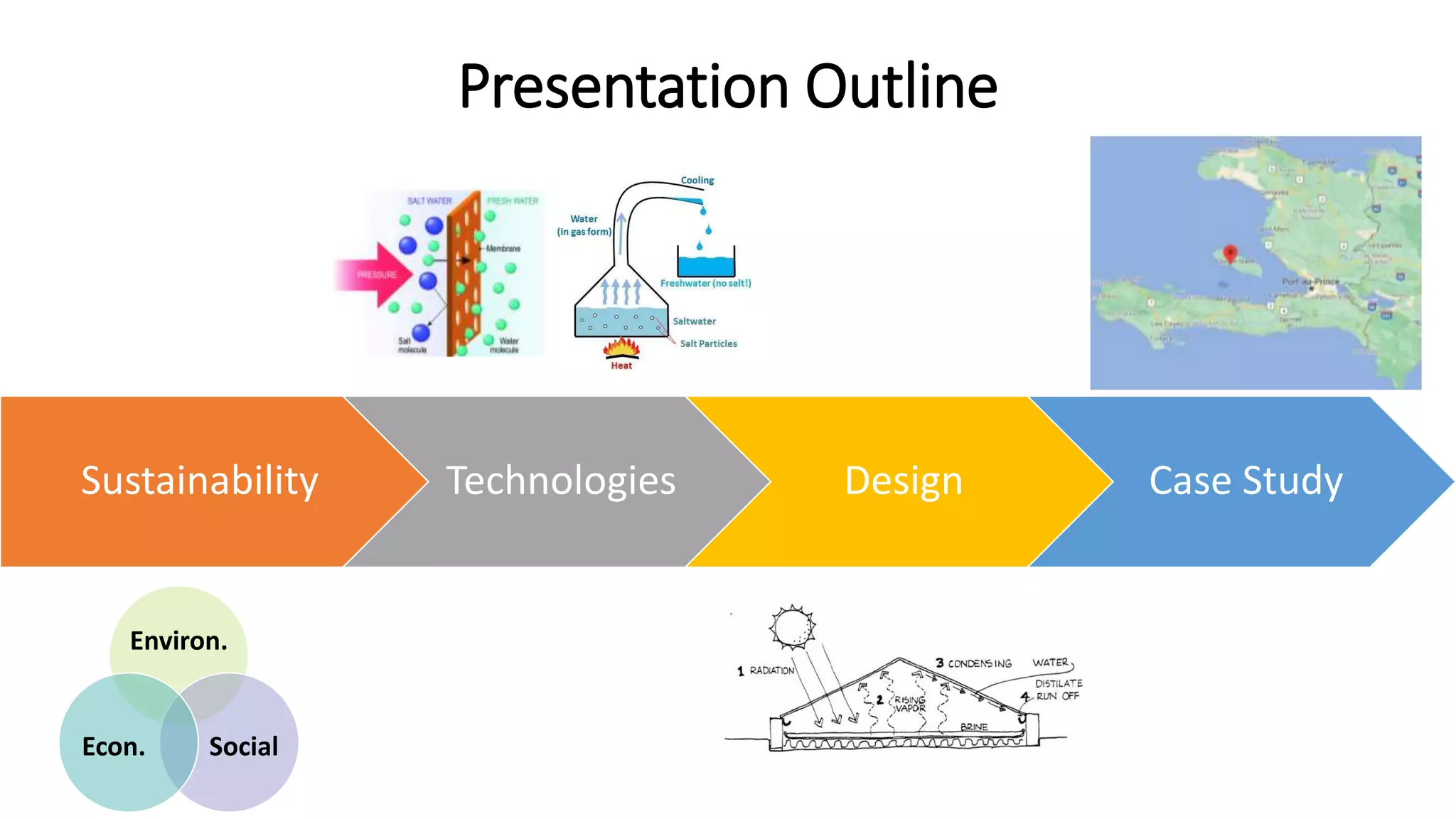
Sustainability Technologies Design Case Study
Presentation Outline
Environ.
SocialEcon.
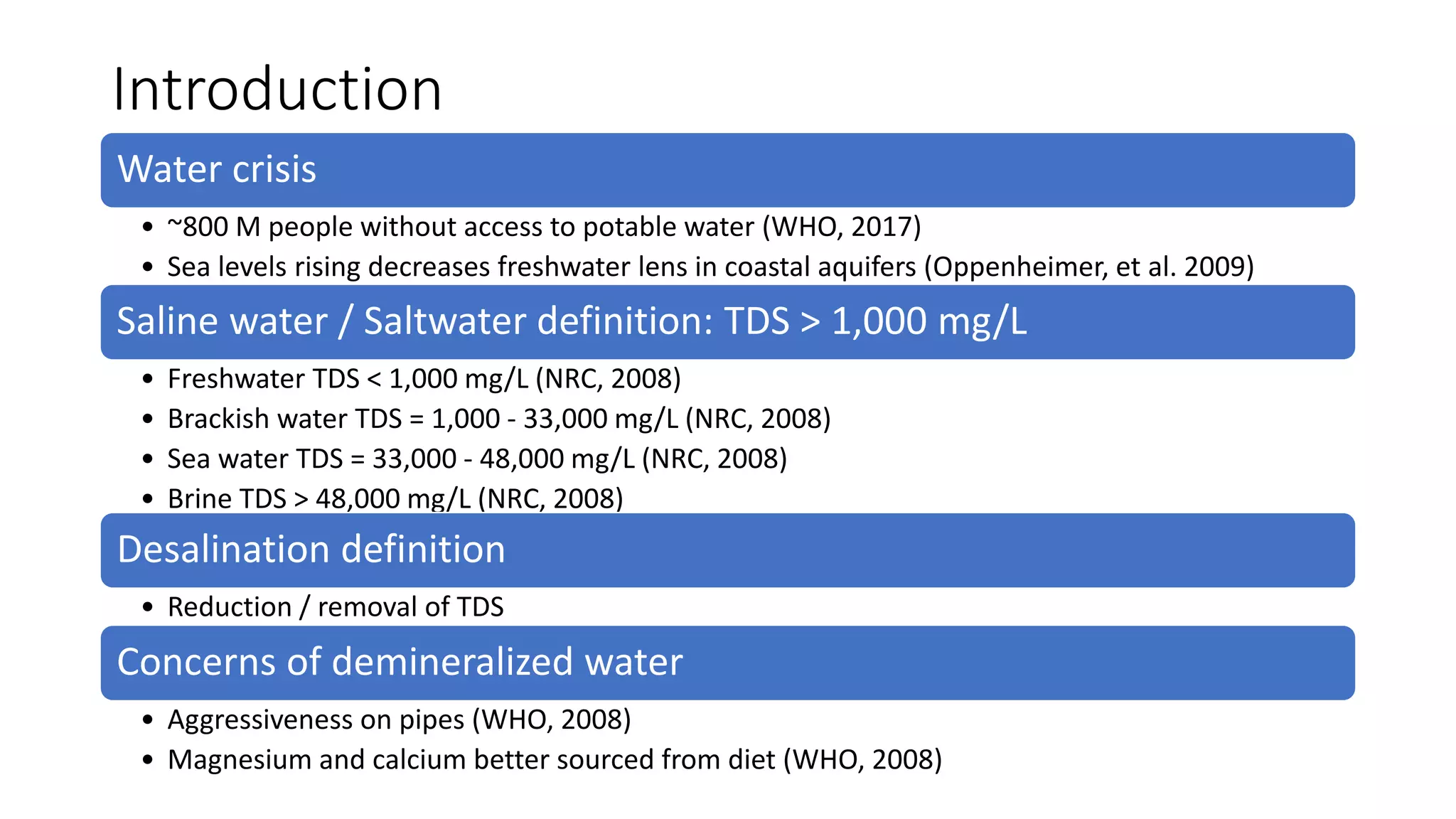
Introduction
Water crisis
• ~800 M people without access to potable water (WHO, 2017)
• Sea levels rising decreases freshwater lens in coastal aquifers (Oppenheimer, et al. 2009)
Saline water / Saltwater definition: TDS > 1,000 mg/L
• Freshwater TDS < 1,000 mg/L (NRC, 2008)
• Brackish water TDS = 1,000 - 33,000 mg/L (NRC, 2008)
• Sea water TDS = 33,000 - 48,000 mg/L (NRC, 2008)
• Brine TDS > 48,000 mg/L (NRC, 2008)
Desalination definition
• Reduction / removal of TDS
Concerns of demineralized water
• Aggressiveness on pipes (WHO, 2008)
• Magnesium and calcium better sourced from diet (WHO, 2008)
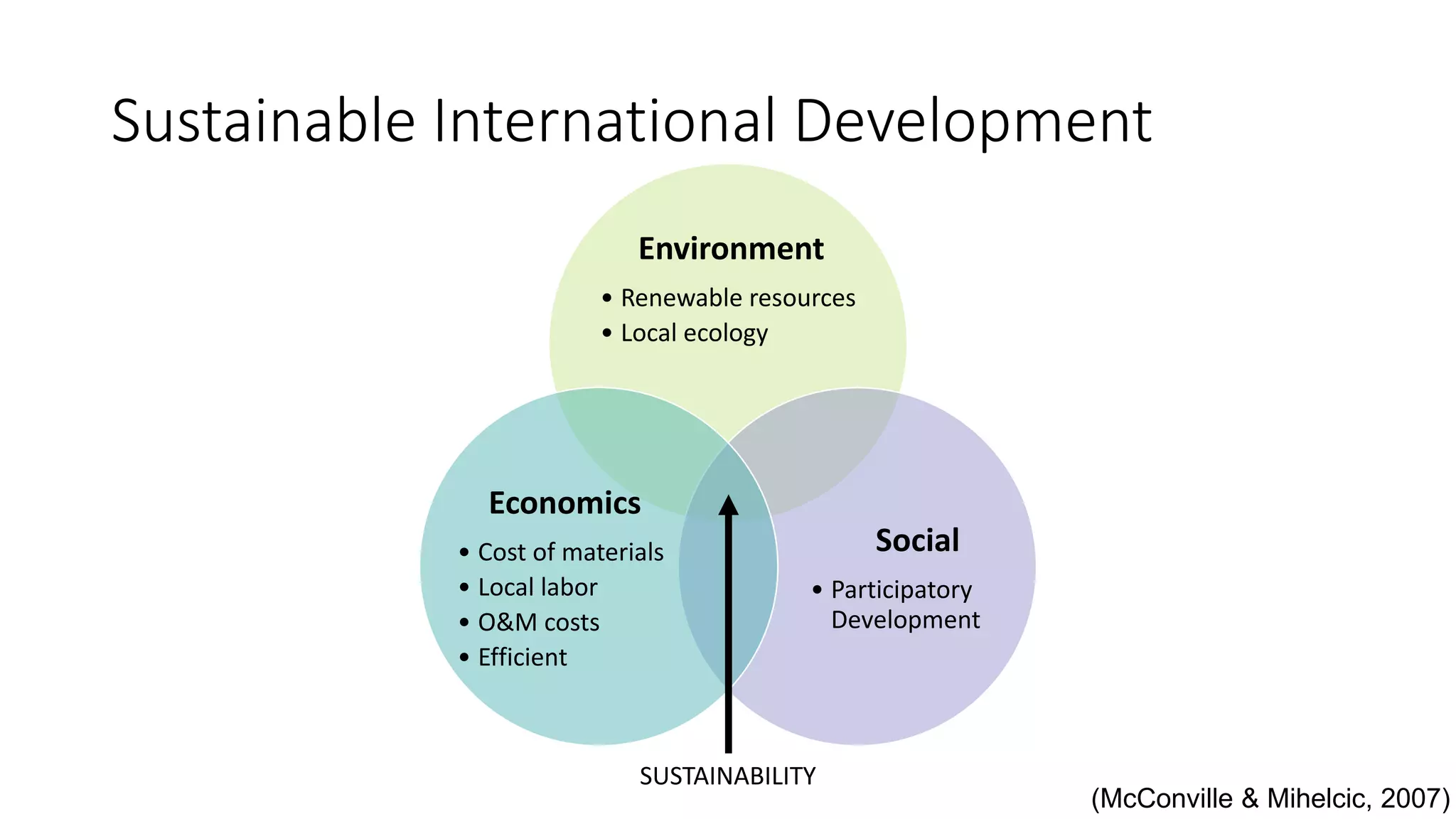
Sustainable International Development
Environment
• Renewable resources
• Local ecology
Social
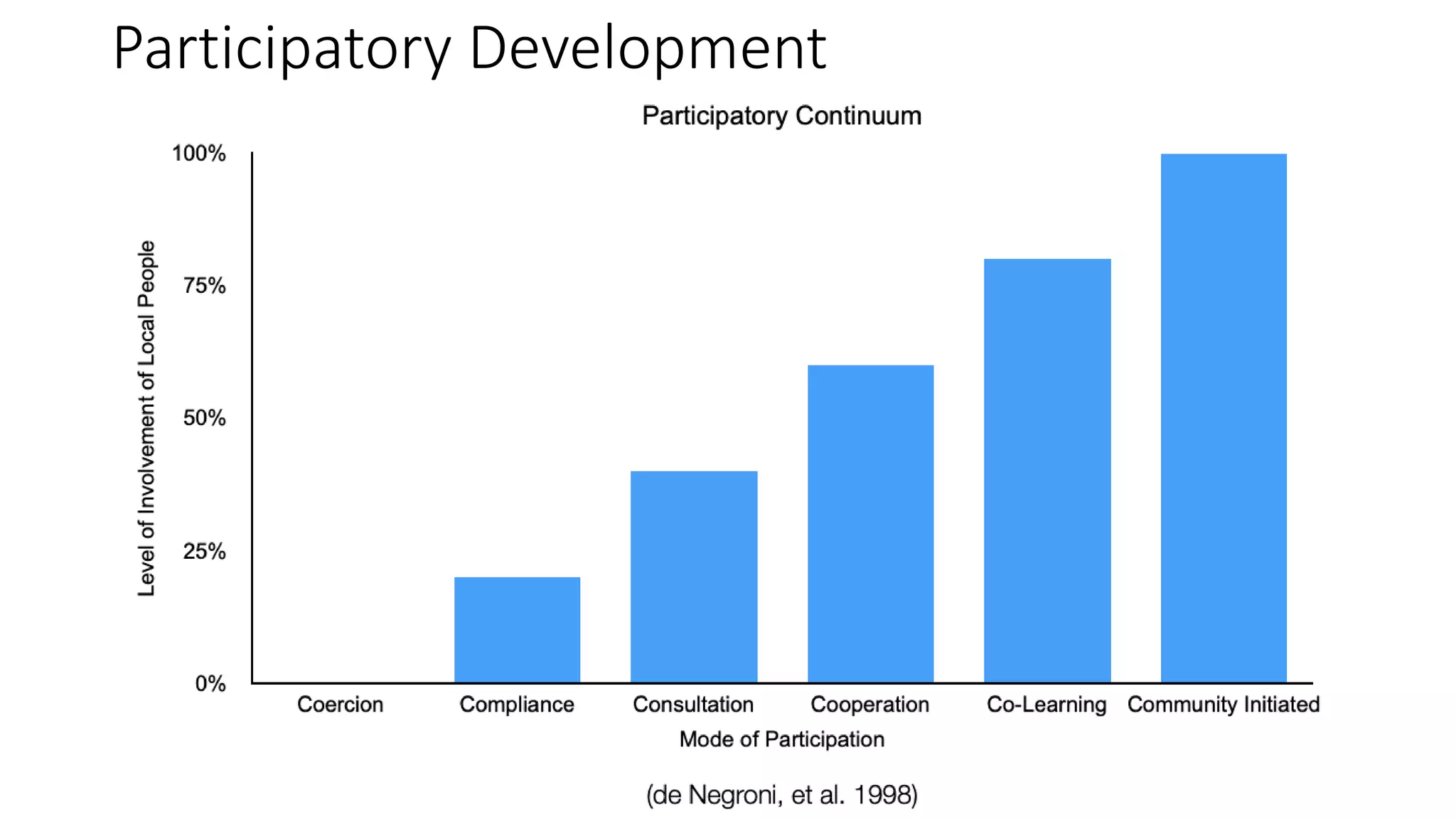
• Participatory
Development
Economics
• Cost of materials
• Local labor
• O&M costs
• Efficient
(McConville & Mihelcic, 2007)
SUSTAINABILITY
Participatory Development
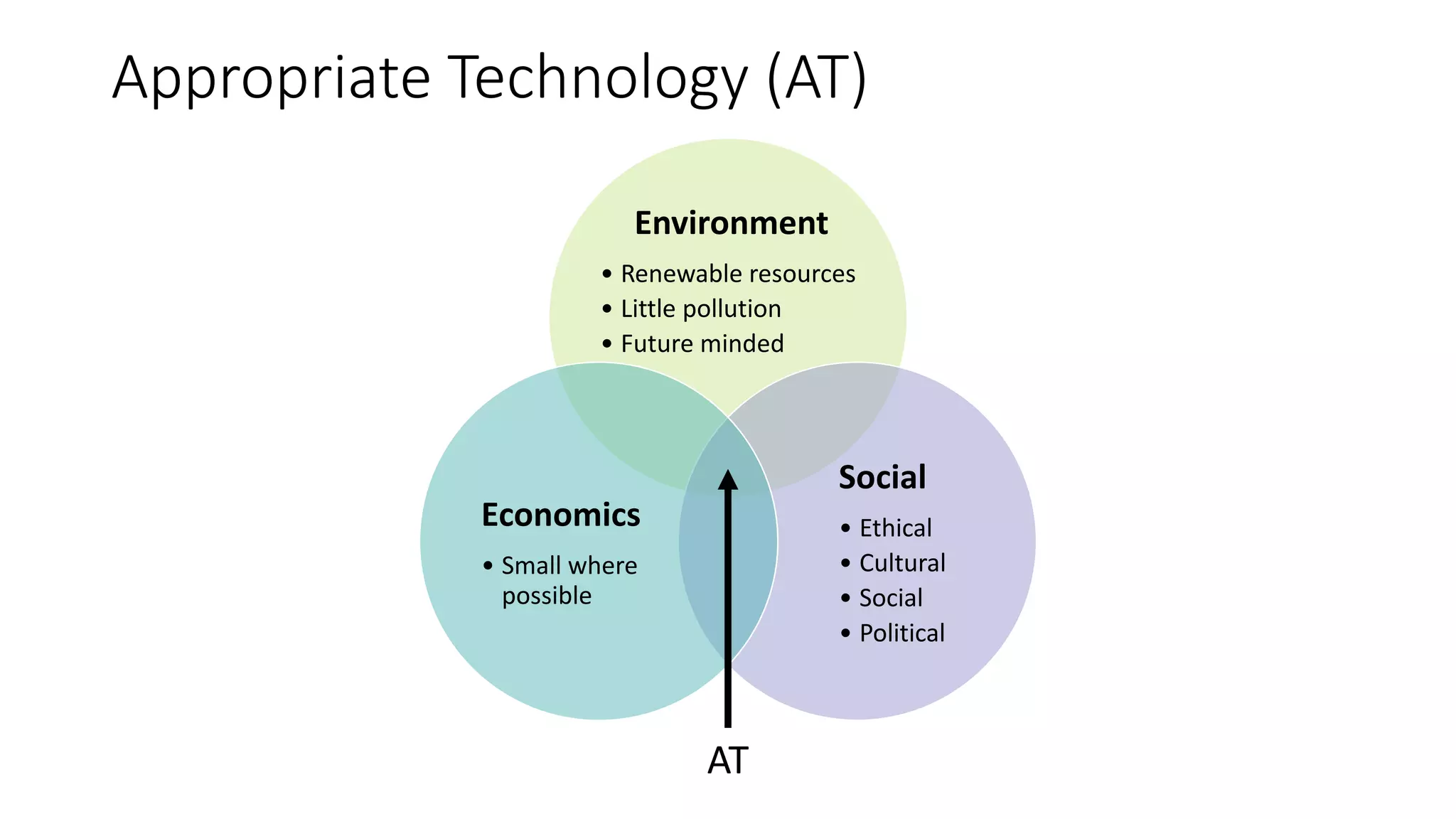
Appropriate Technology (AT)
Environment
• Renewable resources
• Little pollution
• Future minded
Social
• Ethical
• Cultural
• Social
• Political
Economics
• Small where
possible
AT
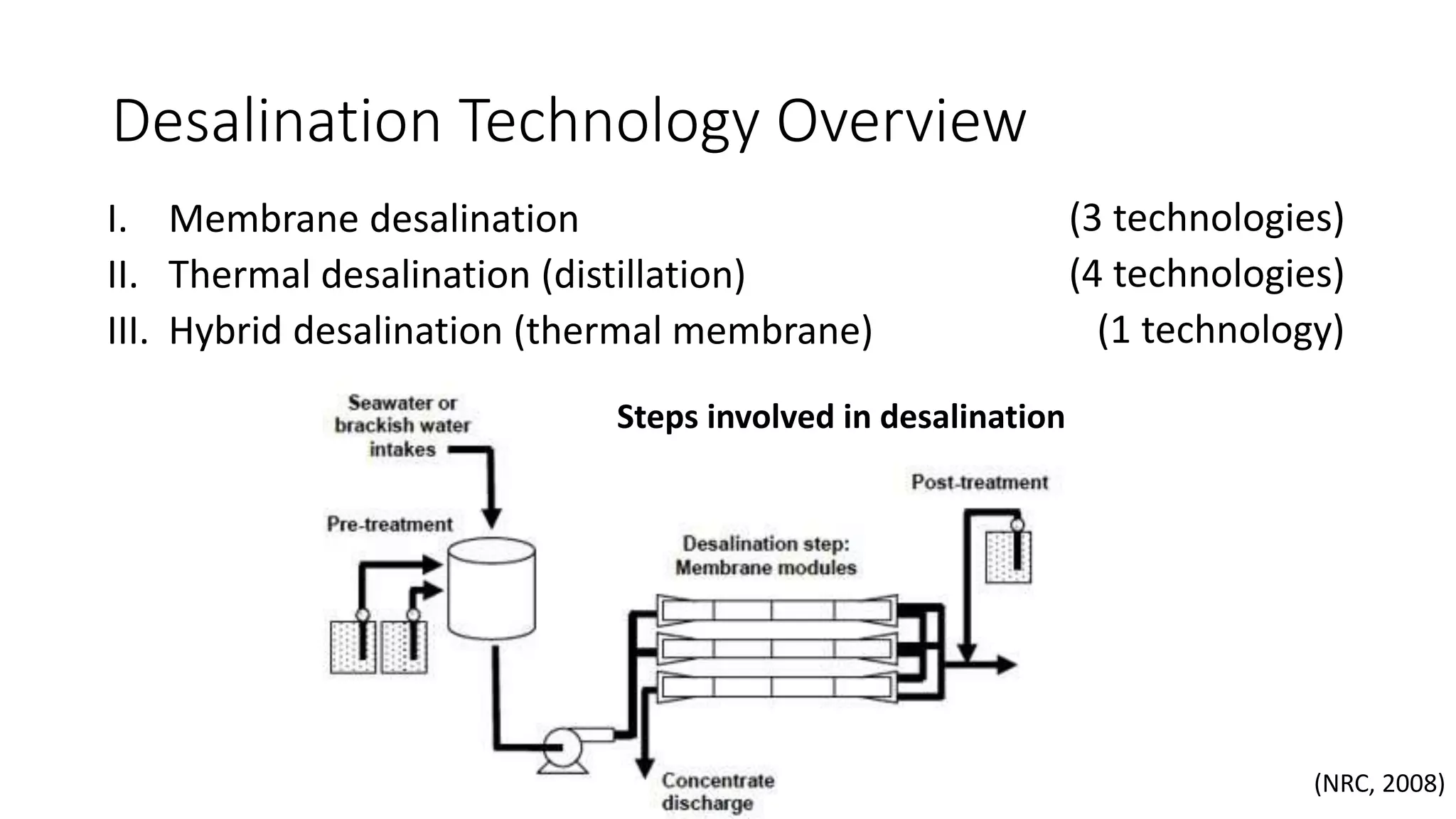
Desalination Technology Overview
I. Membrane desalination
II. Thermal desalination (distillation)
III. Hybrid desalination (thermal membrane)
(NRC, 2008)
Steps involved in desalination
(3 technologies)
(4 technologies)
(1 technology)
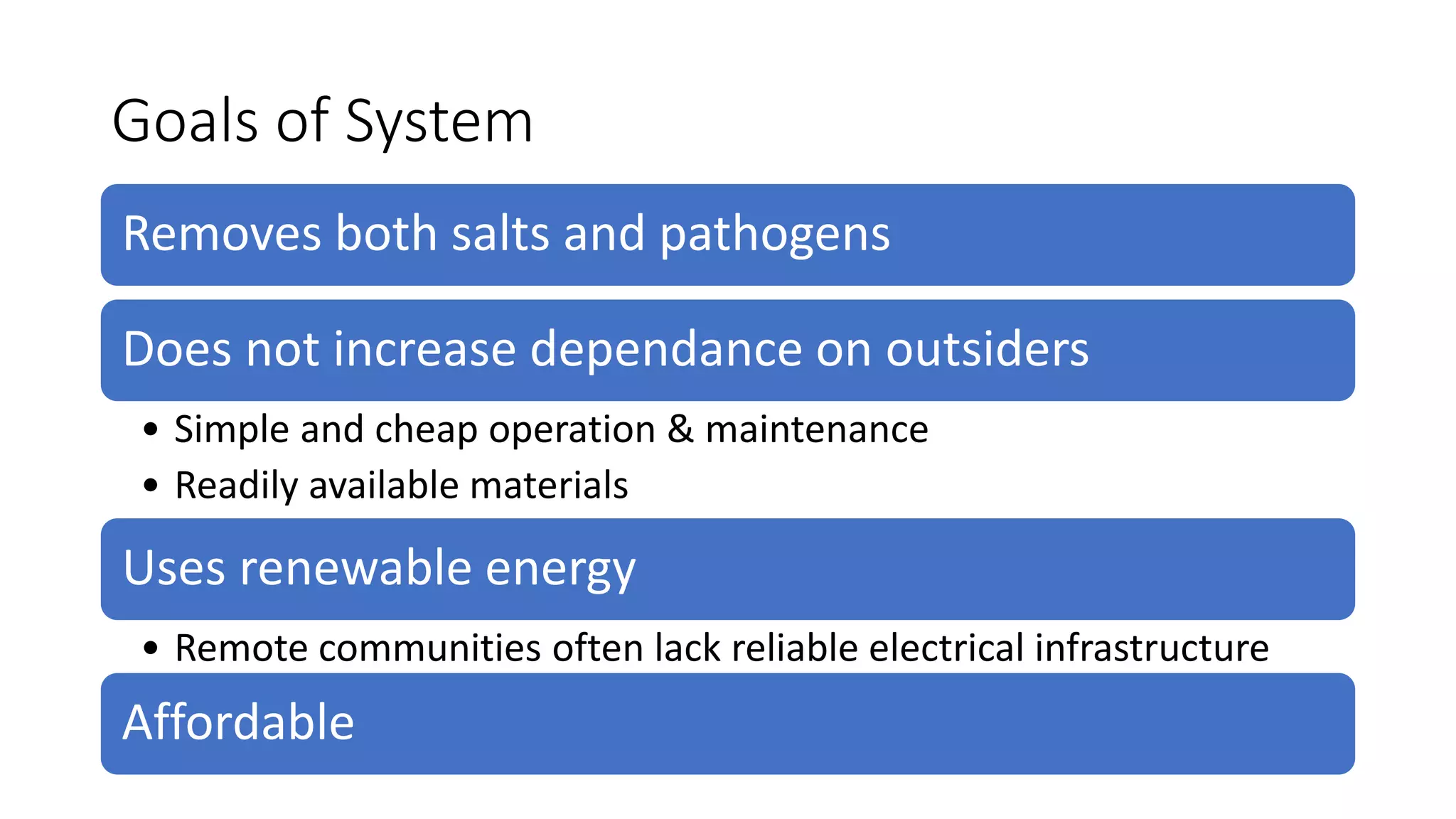
Goals of System
Removes both salts and pathogens
Does not increase dependance on outsiders
• Simple and cheap operation & maintenance
• Readily available materials
Uses renewable energy
• Remote communities often lack reliable electrical infrastructure
Affordable
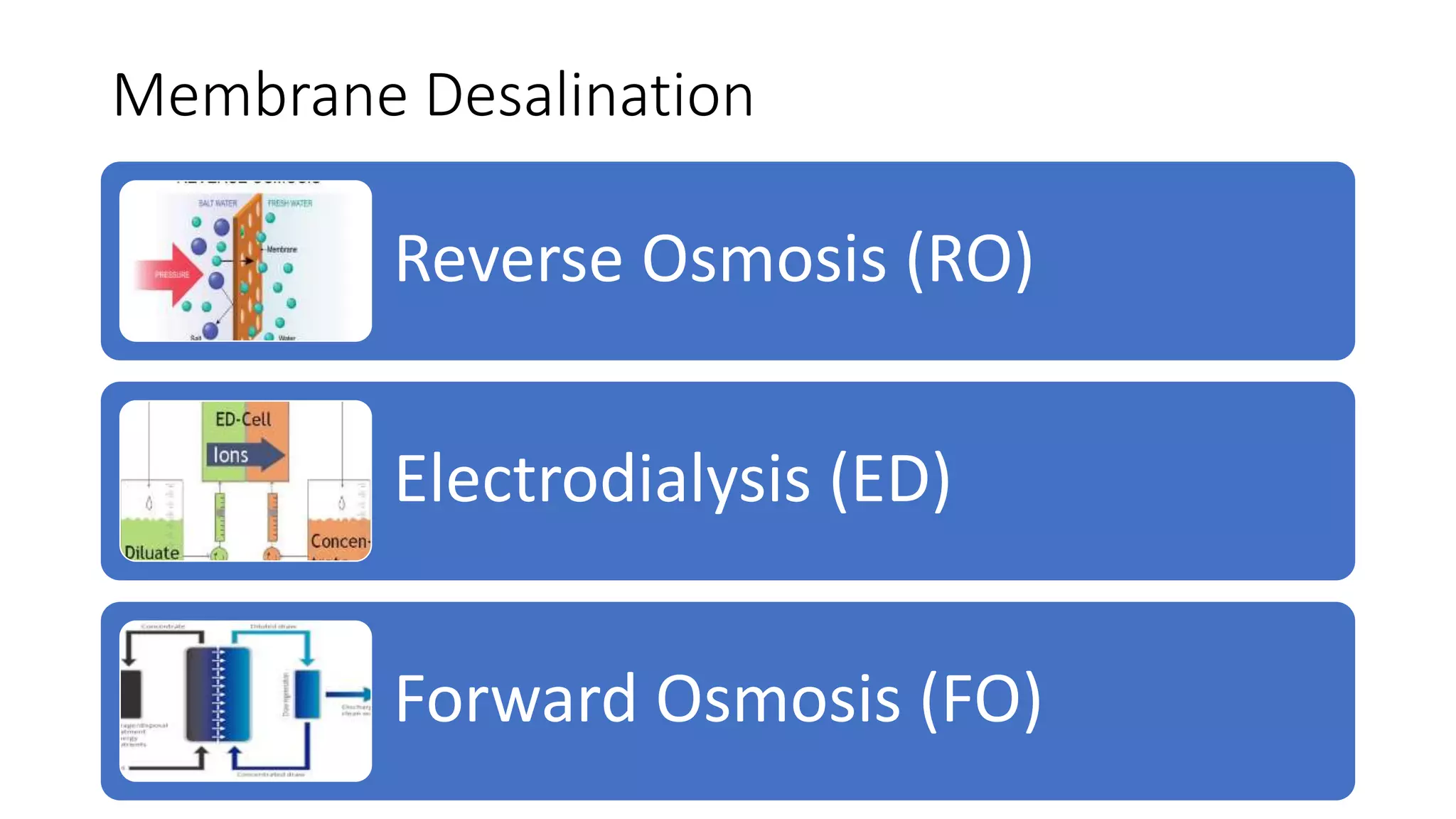
Membrane Desalination
Reverse Osmosis (RO)
Electrodialysis (ED)
Forward Osmosis (FO)
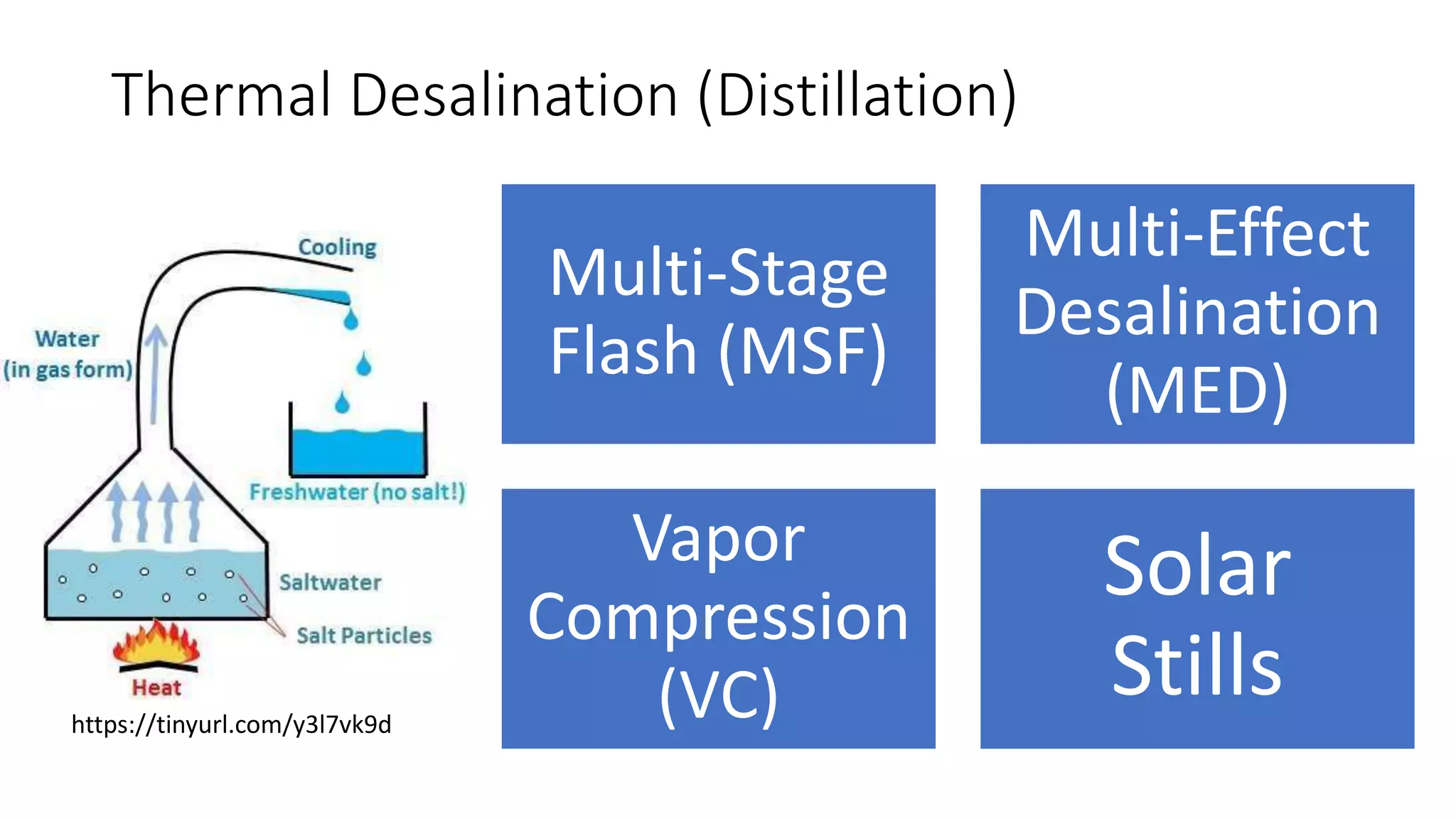
Thermal Desalination (Distillation)
Multi-Stage
Flash (MSF)
Multi-Effect
Desalination
(MED)
Vapor
Compression
(VC)
Solar
Stillshttps://tinyurl.com/y3l7vk9d
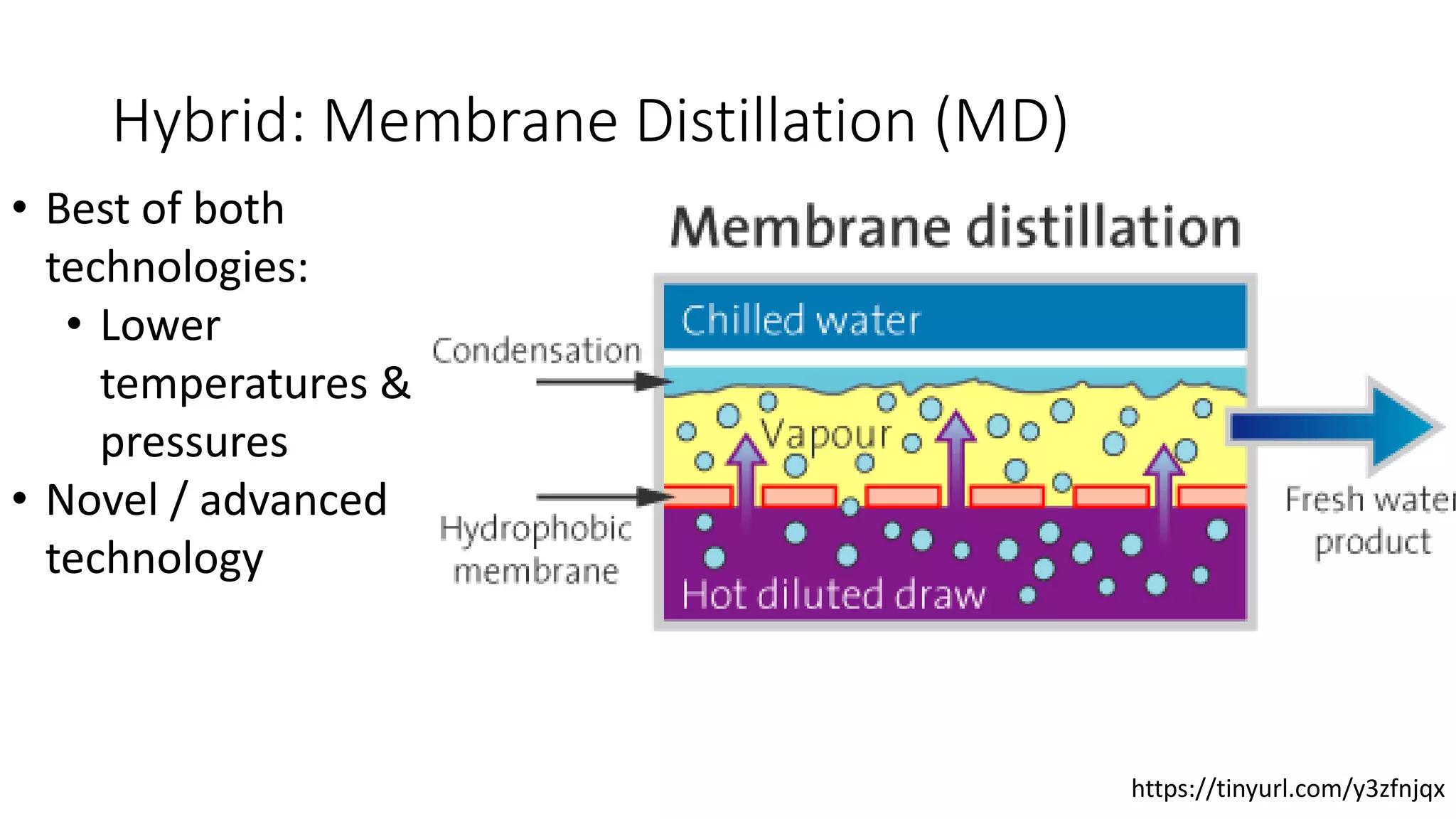
Hybrid: Membrane Distillation (MD)
https://tinyurl.com/y3zfnjqx
• Best of both
technologies:
• Lower
temperatures &
pressures
• Novel / advanced
technology
(Chandrashekara & Avadhesh, 2017)
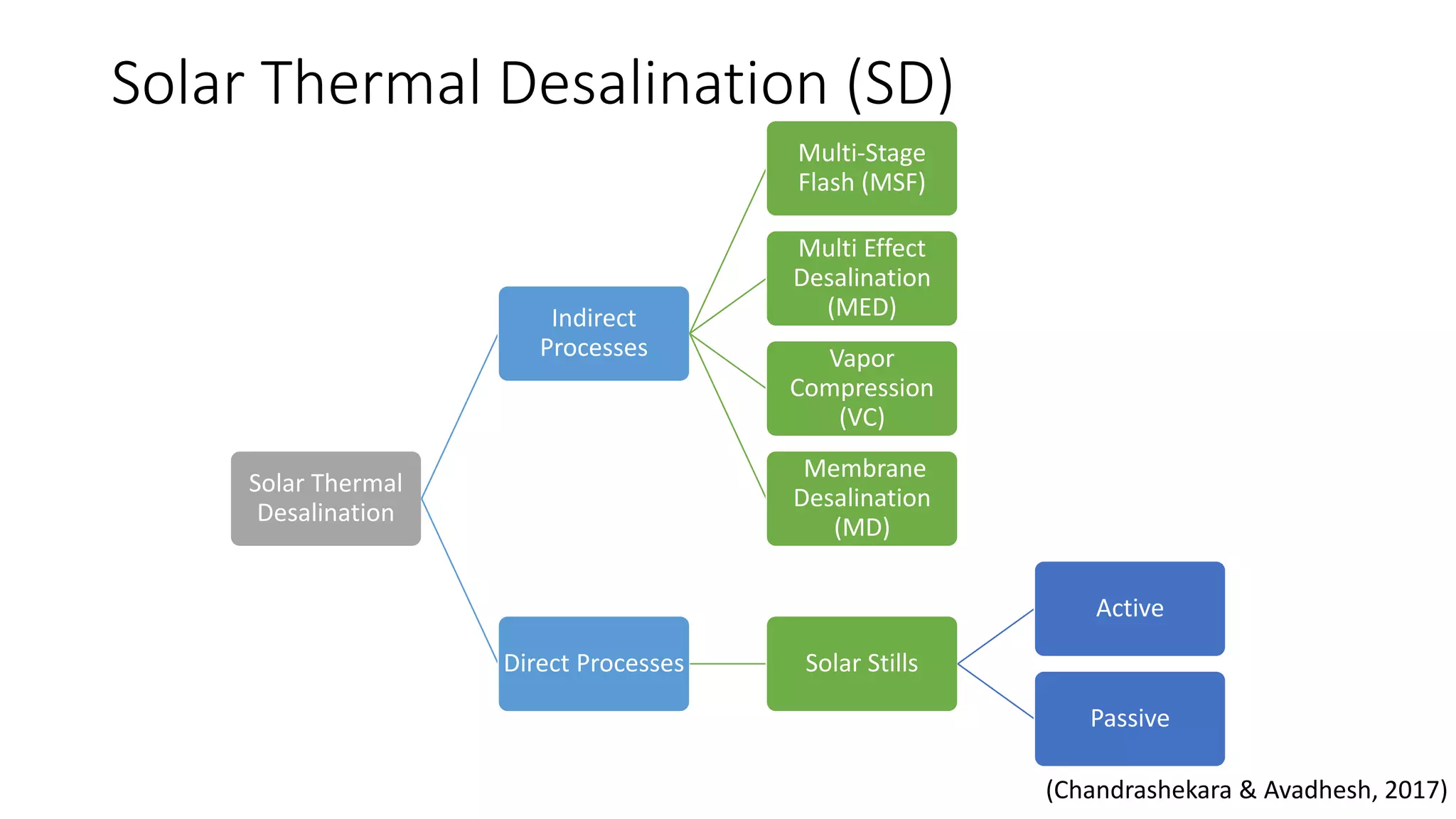
Solar Thermal Desalination (SD)
Solar Thermal
Desalination
Indirect
Processes
Multi-Stage
Flash (MSF)
Multi Effect
Desalination
(MED)
Vapor
Compression
(VC)
Membrane
Desalination
(MD)
Direct Processes Solar Stills
Active
Passive
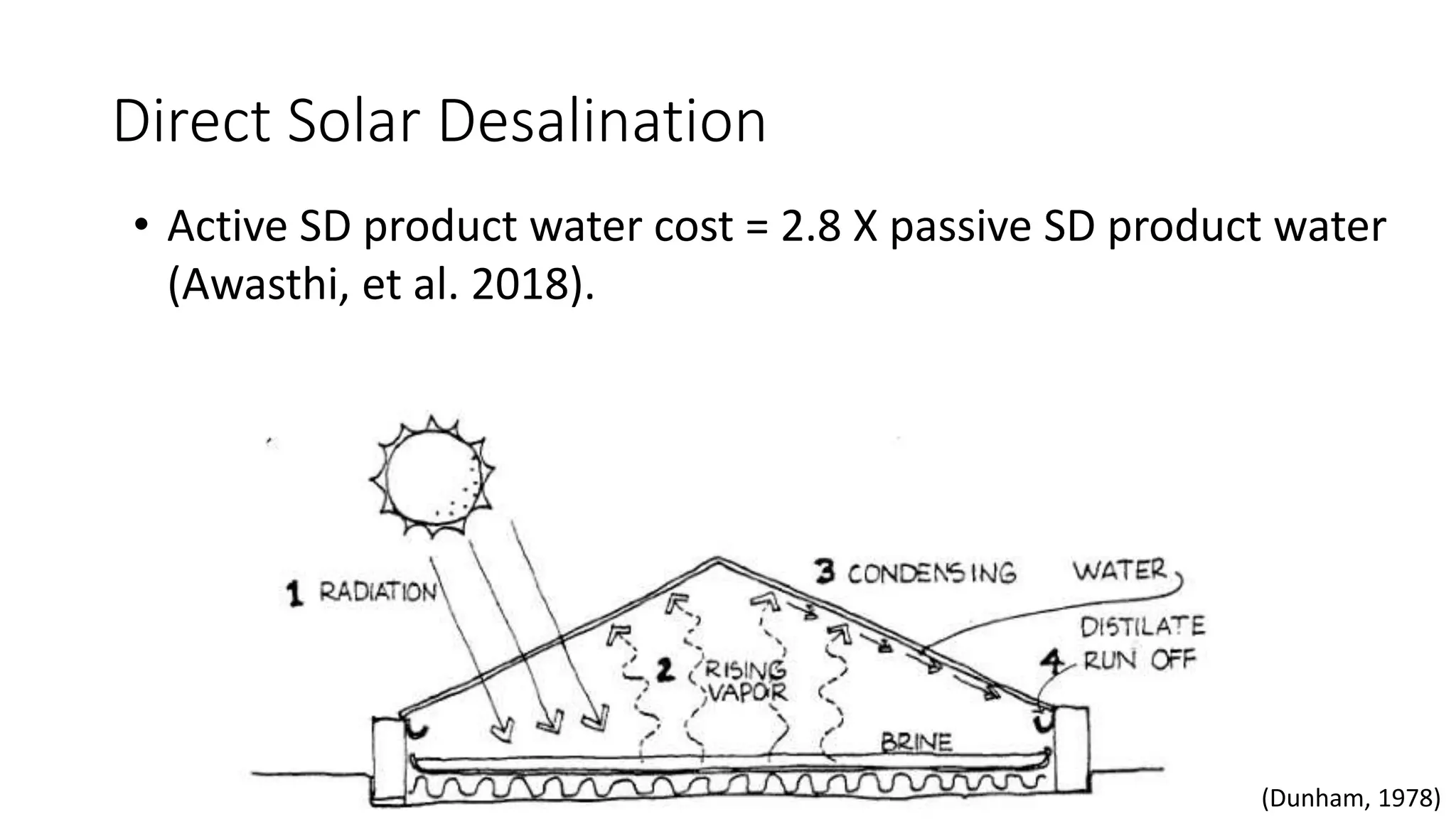
Direct Solar Desalination
(Dunham, 1978)
• Active SD product water cost = 2.8 X passive SD product water
(Awasthi, et al. 2018).
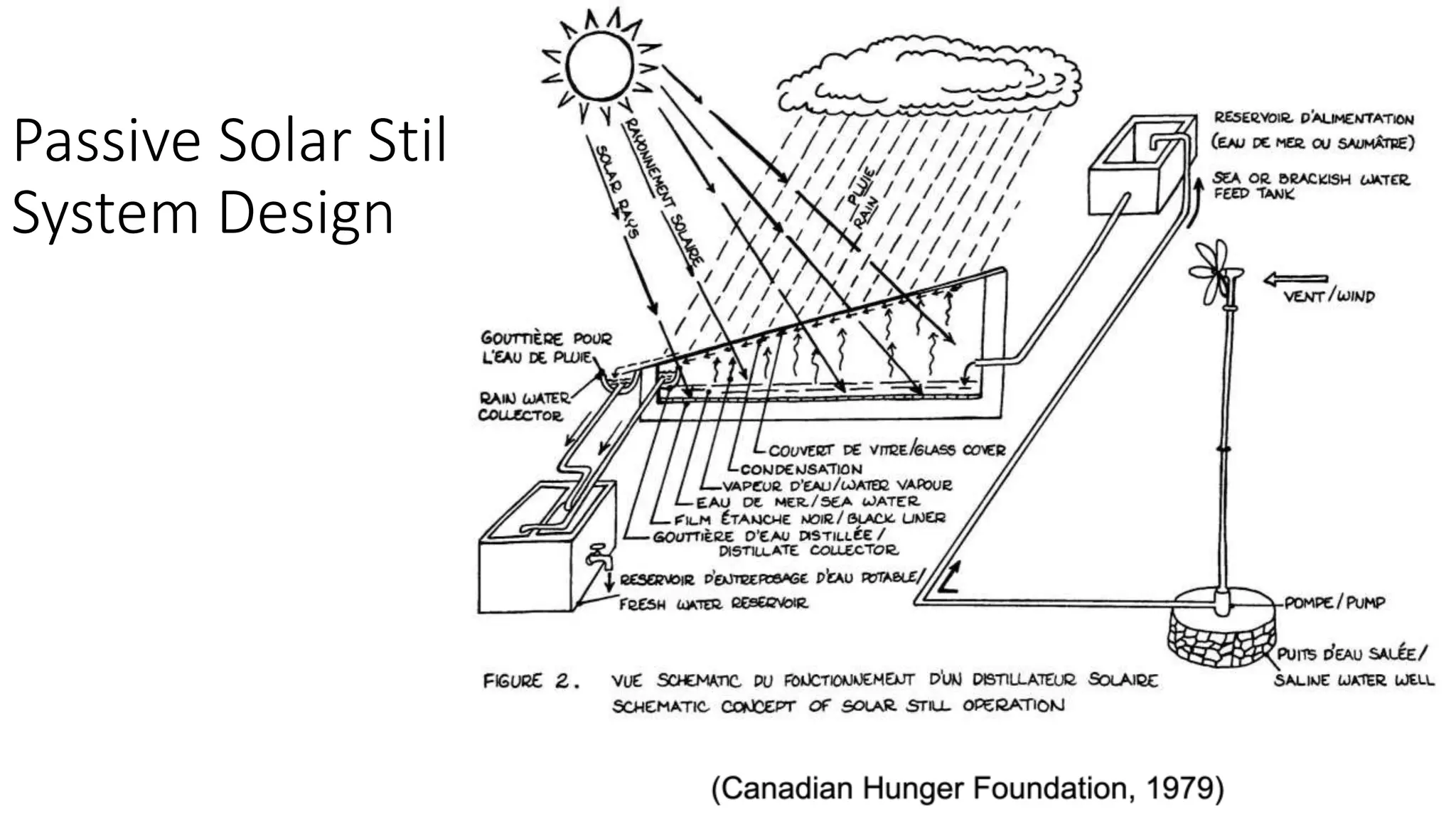
Passive Solar Still
System Design
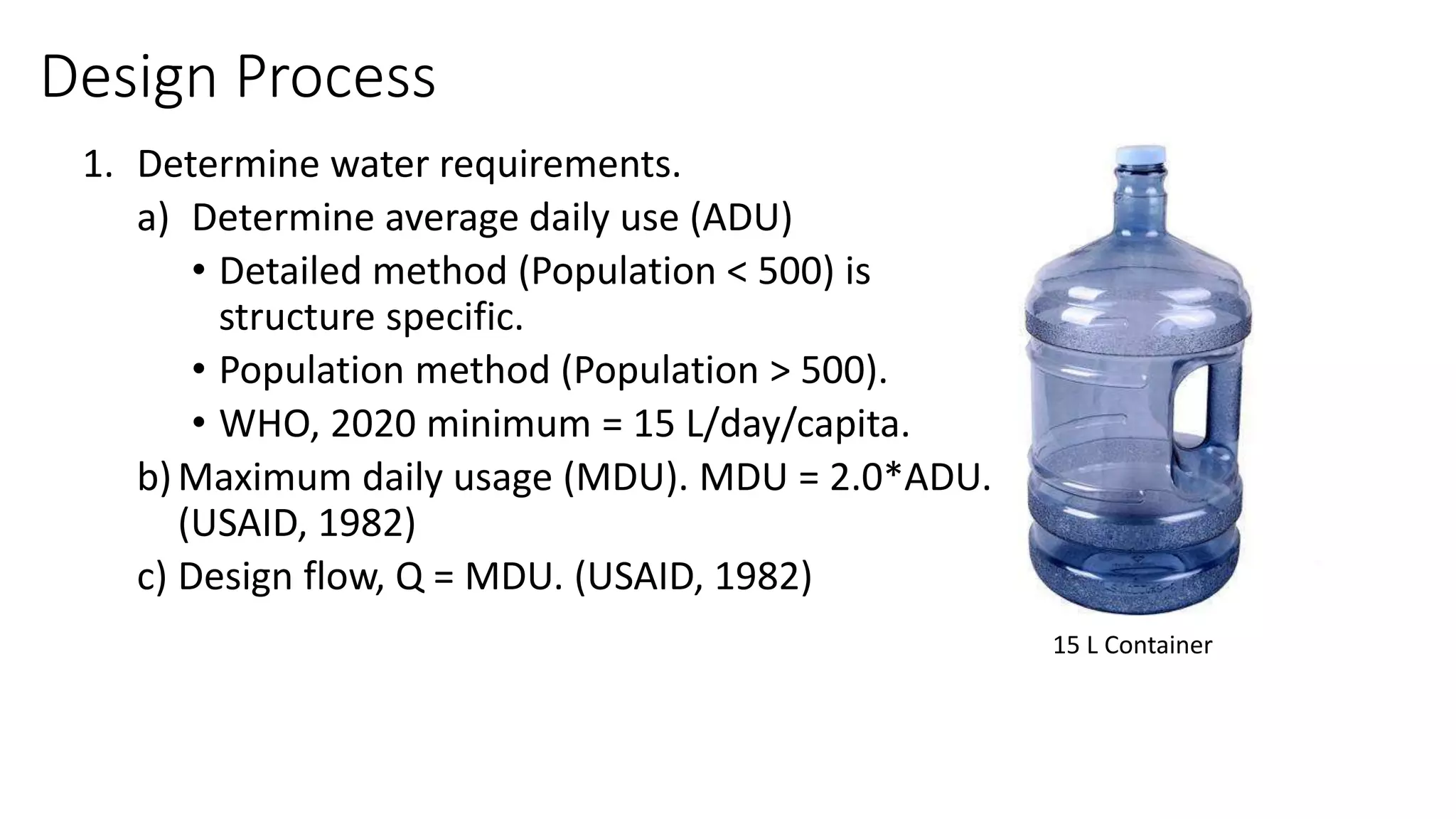
1. Determine water requirements.
a) Determine average daily use (ADU)
• Detailed method (Population < 500) is
structure specific.
• Population method (Population > 500).
• WHO, 2020 minimum = 15 L/day/capita.
b)Maximum daily usage (MDU). MDU = 2.0*ADU.
(USAID, 1982)
c) Design flow, Q = MDU. (USAID, 1982)
15 L Container
Design Process
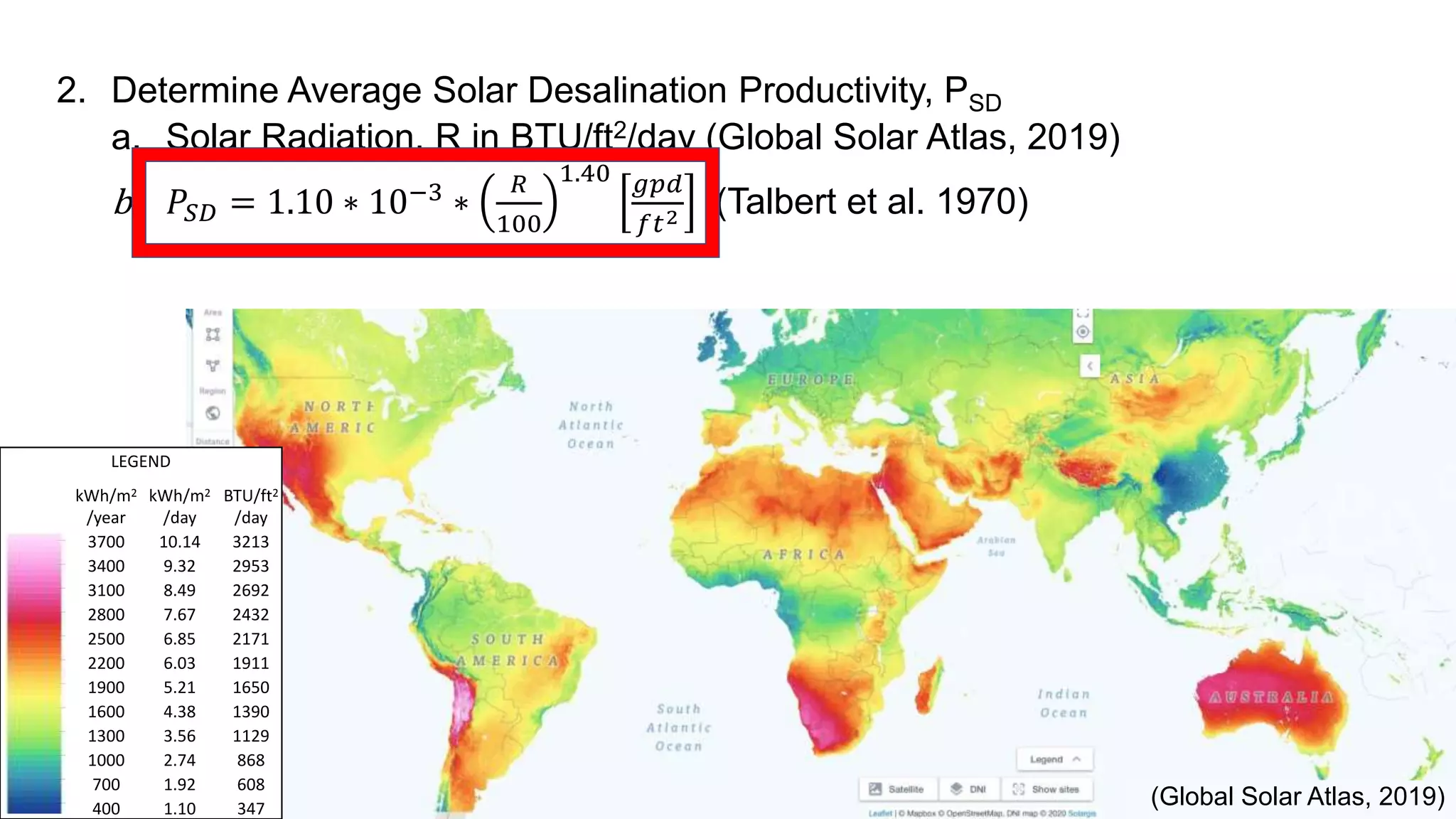
LEGEND
kWh/m2
/year
kWh/m2
/day
BTU/ft2
/day
3700 10.14 3213
3400 9.32 2953
3100 8.49 2692
2800 7.67 2432
2500 6.85 2171
2200 6.03 1911
1900 5.21 1650
1600 4.38 1390
1300 3.56 1129
1000 2.74 868
700 1.92 608
400 1.10 347
(Global Solar Atlas, 2019)
2. Determine Average Solar Desalination Productivity, PSD
a. Solar Radiation, R in BTU/ft2/day (Global Solar Atlas, 2019)
b. 𝑃𝑆𝐷 = 1.10 ∗ 10−3 ∗
𝑅
100
1.40 𝑔𝑝𝑑
𝑓𝑡2 (Talbert et al. 1970)
(UN FAO, 2020)
3. Rainwater Harvesting (RWH) Productivity, PRWH
• Find annual average rainfall, RW [feet/day] (UN FAO or regional data)
• 𝑉𝑅𝑊𝐻 = 0.8 ∗ 𝑅𝑊 ∗ 𝐴 [gpd] (USAID, 1982)
• 𝑃𝑅𝑊𝐻 =
𝑉 𝑅𝑊𝐻
𝐴
= 0.8 ∗ 𝑅𝑊
𝑔𝑝𝑑
𝑓𝑡2
4. Calculate Required Effective Area
𝐴 𝑒𝑓𝑓−𝑟𝑒𝑞 =
𝑄
𝑃 𝑆𝐷+𝑃 𝑅𝑊𝐻
[ft2]
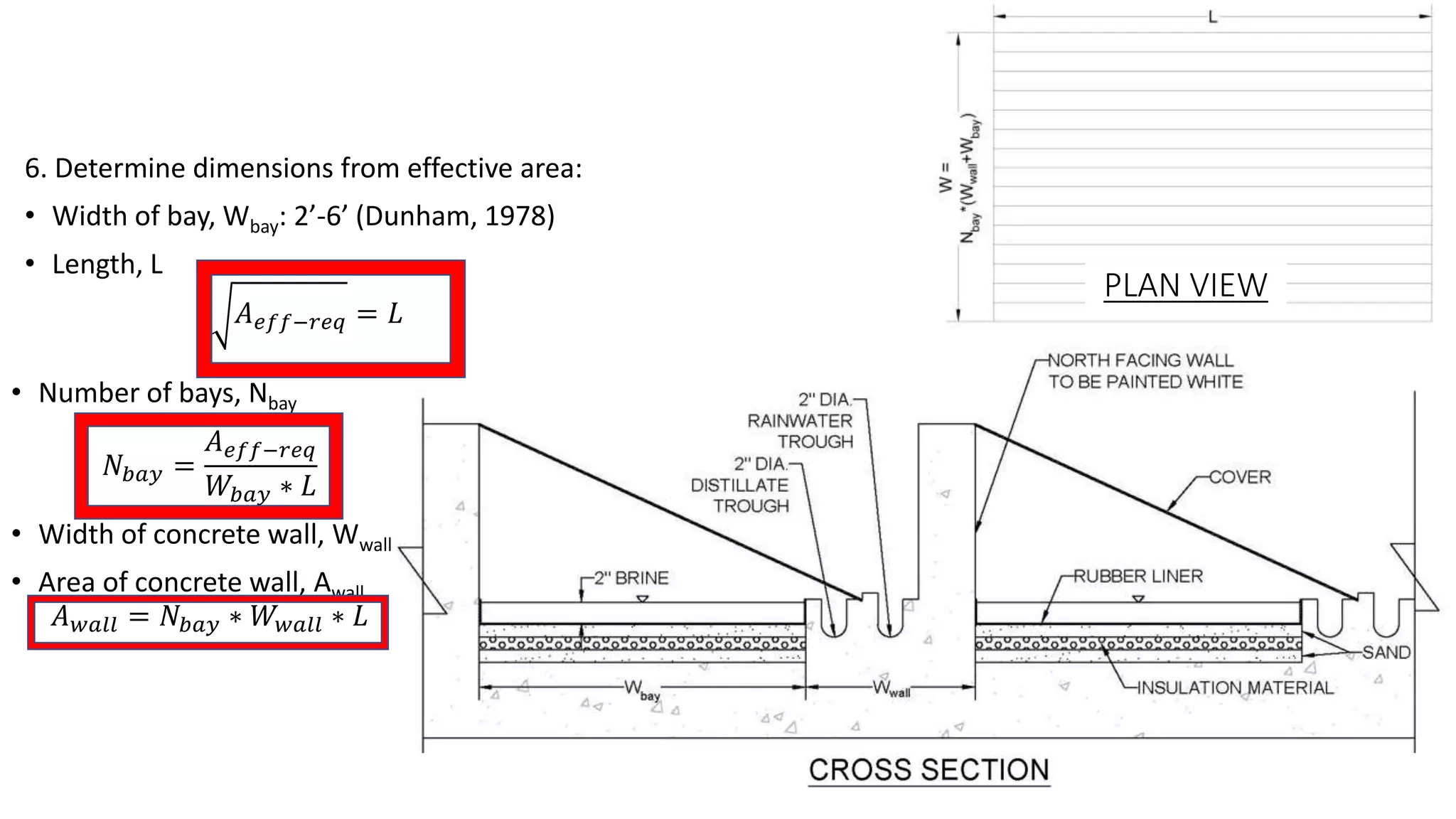
5. Choose Geometry of Still:
(Dunham, 1978)
• Number of bays, Nbay
𝑁𝑏𝑎𝑦 =
𝐴 𝑒𝑓𝑓−𝑟𝑒𝑞
𝑊𝑏𝑎𝑦 ∗ 𝐿
• Width of concrete wall, Wwall
• Area of concrete wall, Awall
𝐴 𝑤𝑎𝑙𝑙 = 𝑁𝑏𝑎𝑦 ∗ 𝑊 𝑤𝑎𝑙𝑙 ∗ 𝐿
PLAN VIEW
6. Determine dimensions from effective area:
• Width of bay, Wbay: 2’-6’ (Dunham, 1978)
• Length, L
𝐴 𝑒𝑓𝑓−𝑟𝑒𝑞 = 𝐿
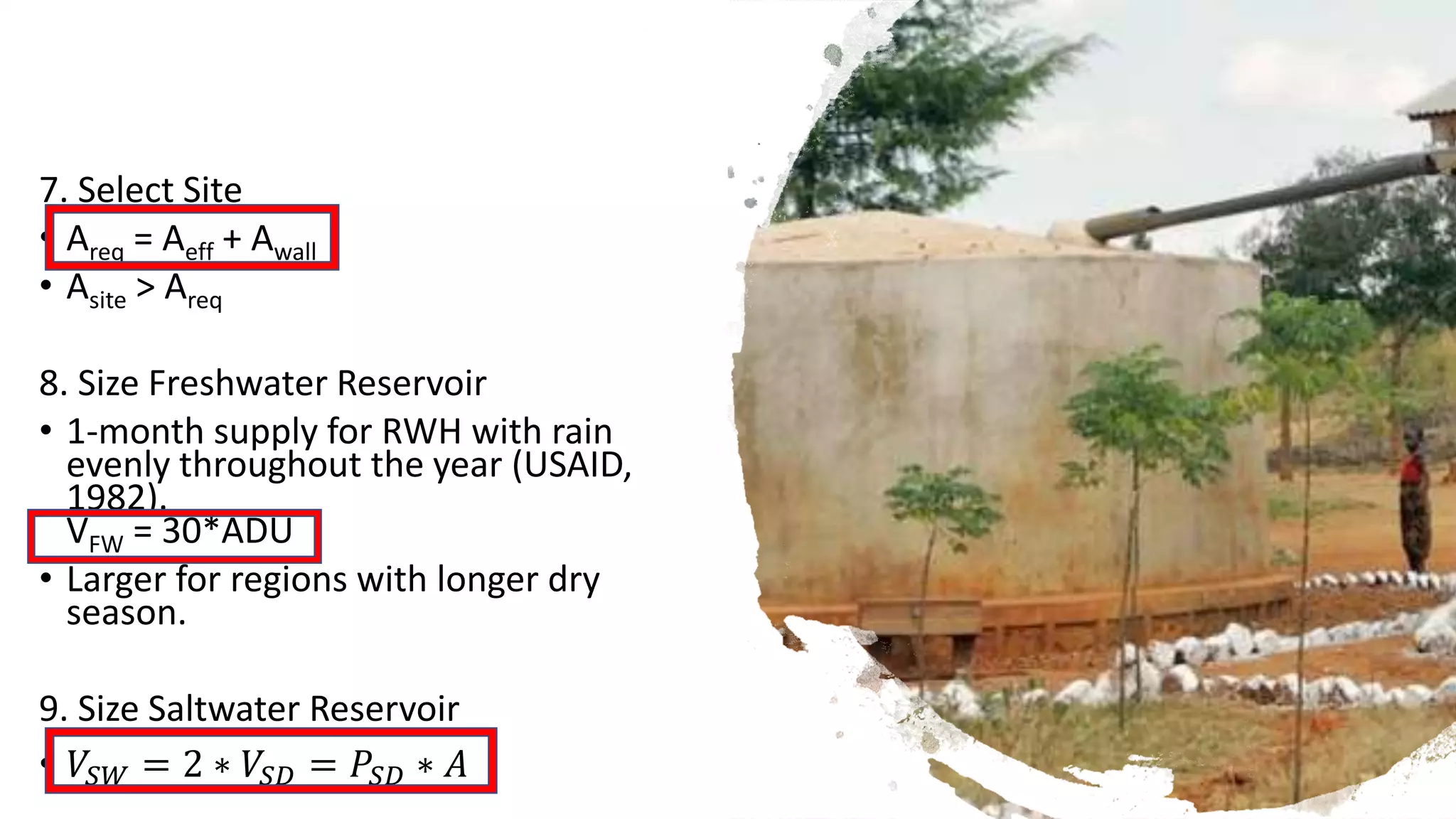
7. Select Site
• Areq = Aeff + Awall
• Asite > Areq
8. Size Freshwater Reservoir
• 1-month supply for RWH with rain
evenly throughout the year (USAID,
1982).
VFW = 30*ADU
• Larger for regions with longer dry
season.
9. Size Saltwater Reservoir
• 𝑉𝑆𝑊 = 2 ∗ 𝑉𝑆𝐷 = 𝑃𝑆𝐷 ∗ 𝐴
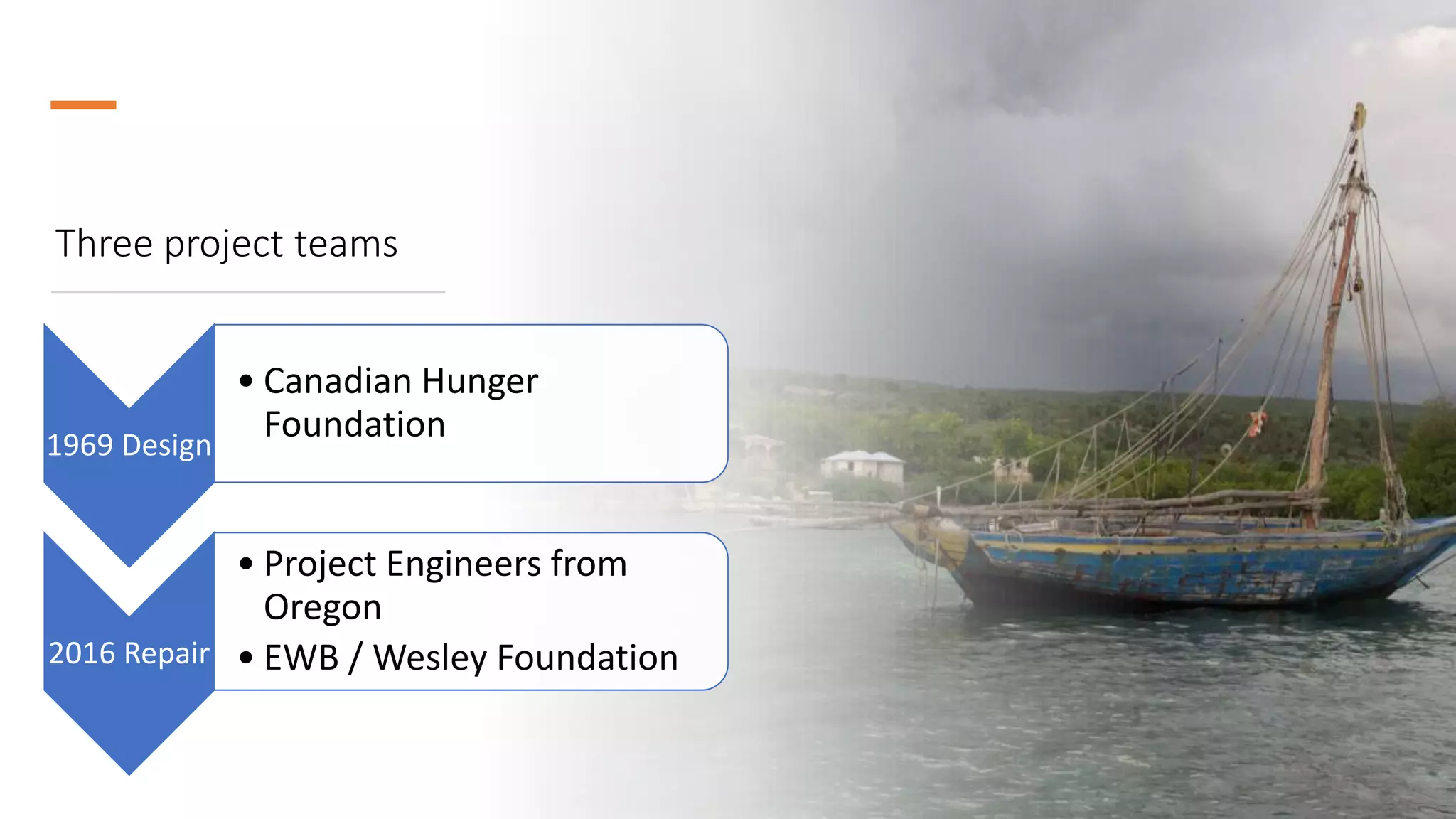
Three project teams
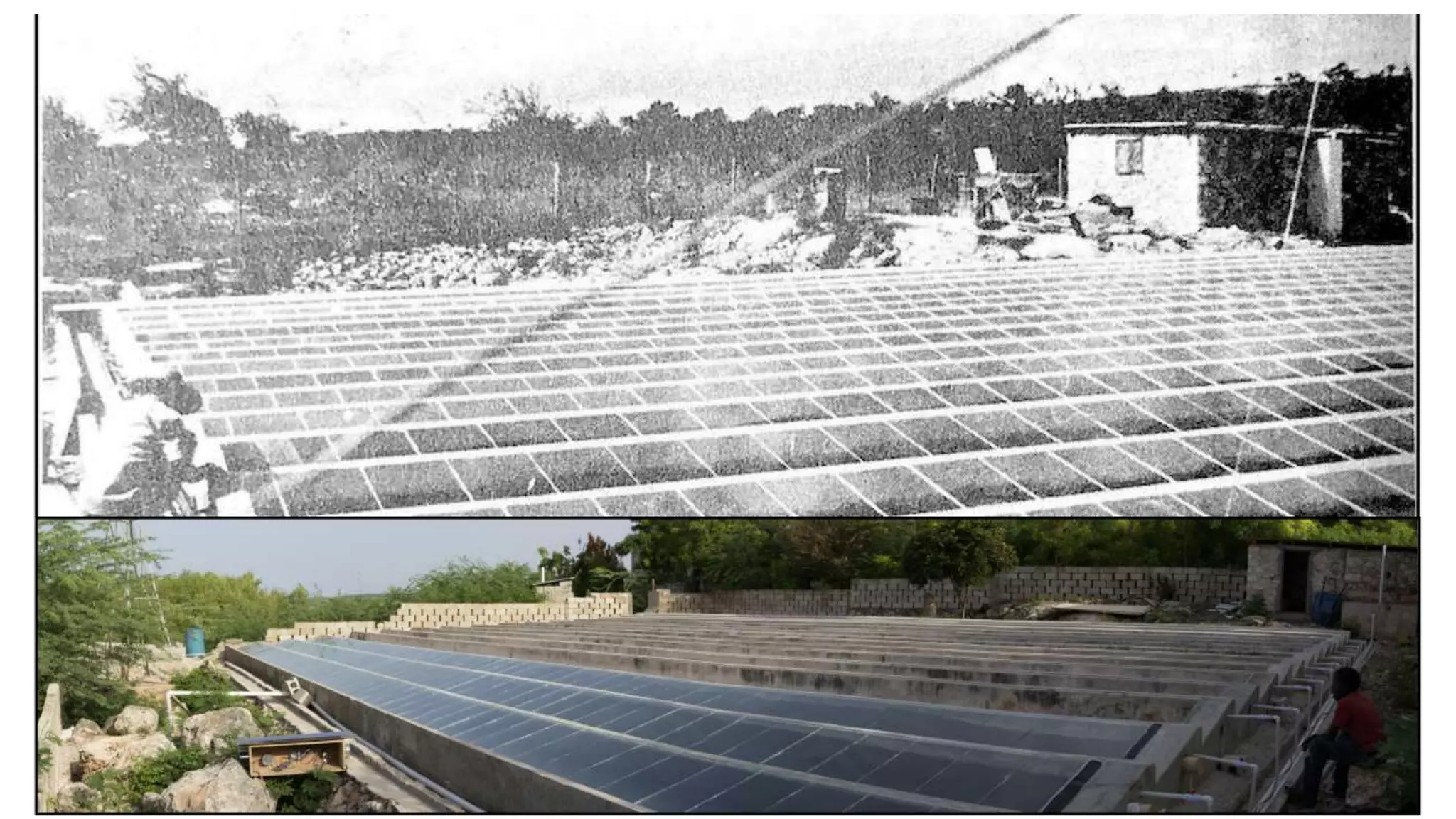
1969 Design
• Canadian Hunger
Foundation
2016 Repair
• Project Engineers from
Oregon
• EWB / Wesley Foundation
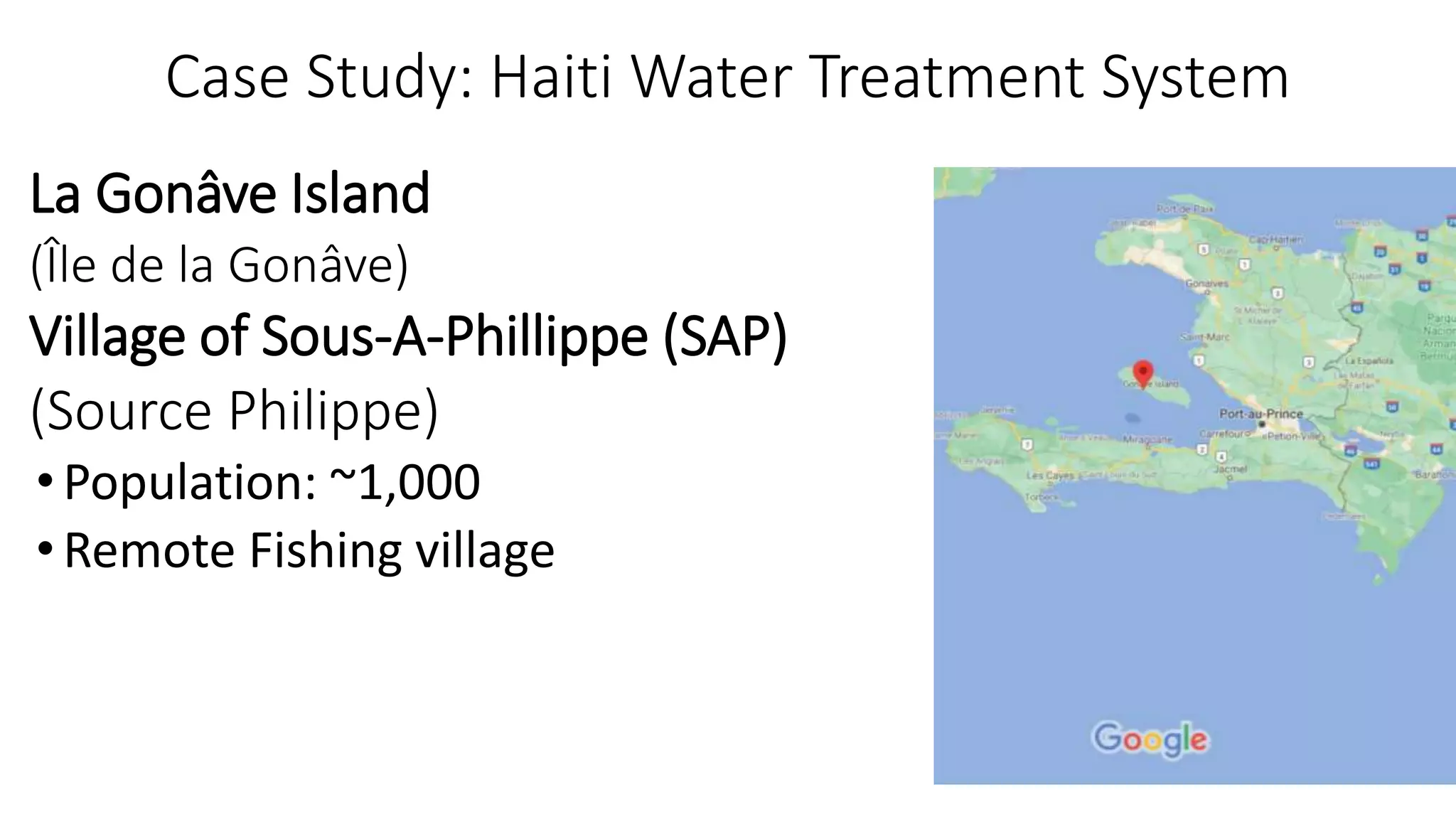
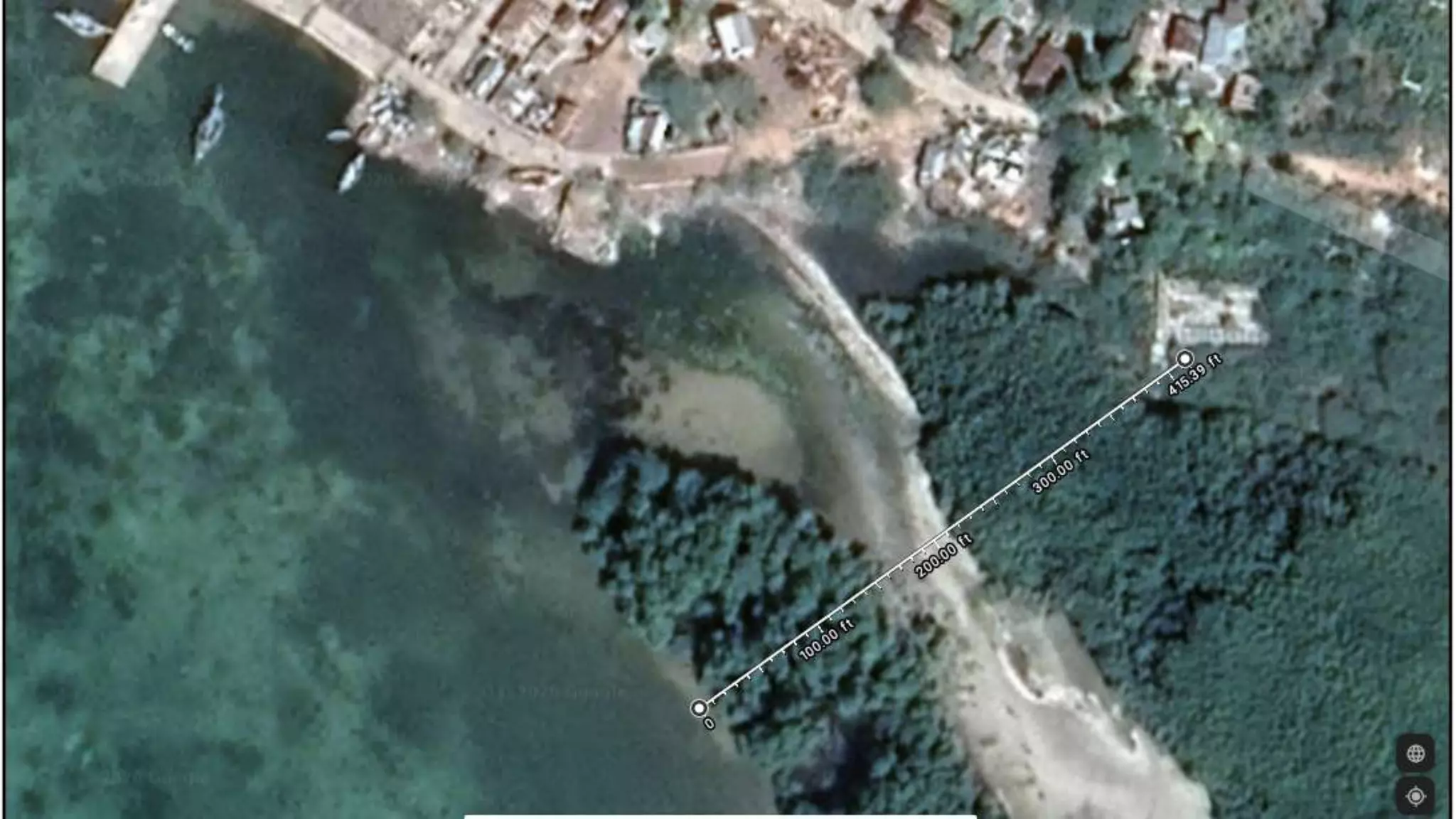
La Gonâve Island
(Île de la Gonâve)
Village of Sous-A-Phillippe (SAP)
(Source Philippe)
•Population: ~1,000
•Remote Fishing village
Case Study: Haiti Water Treatment System
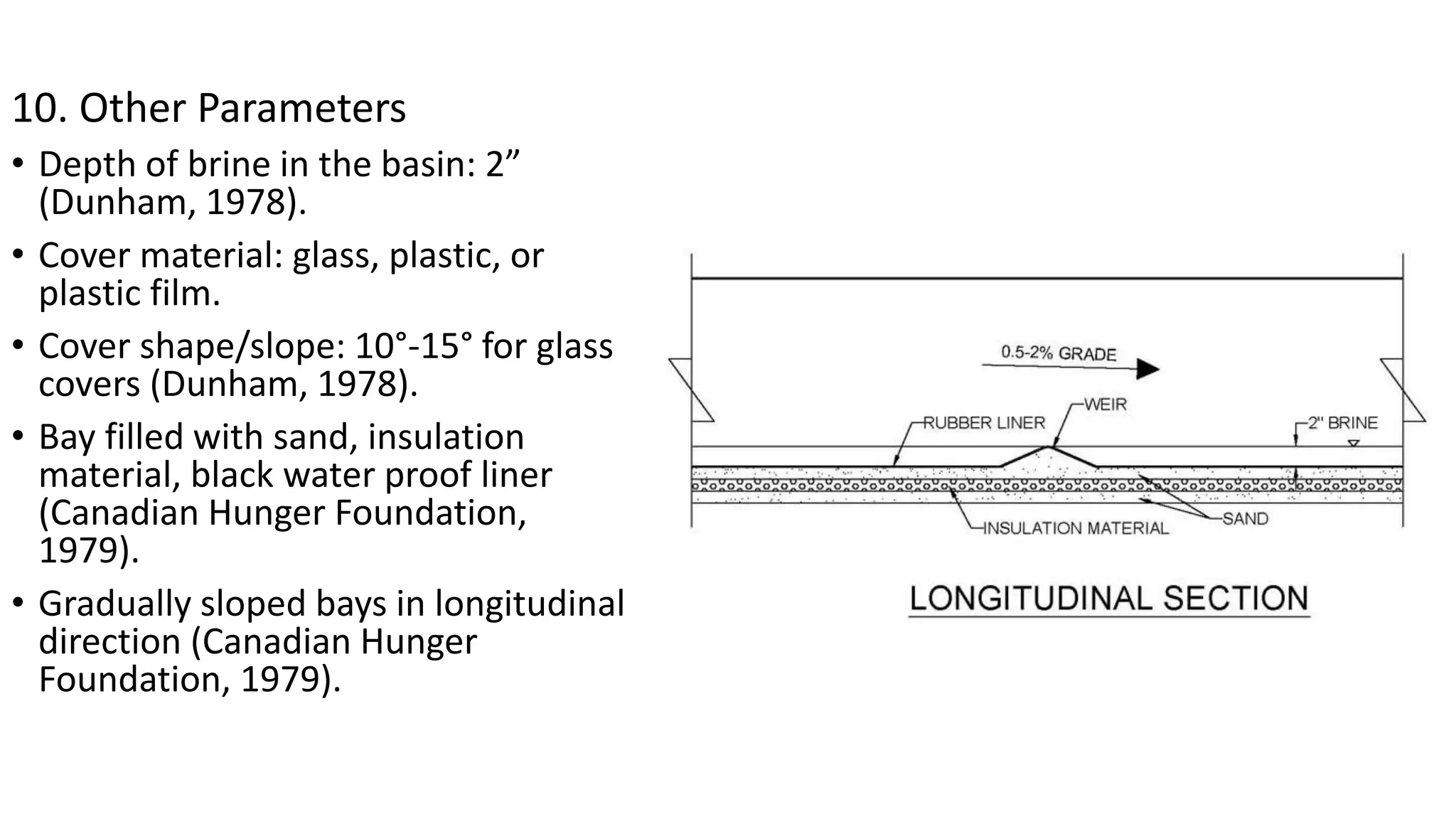
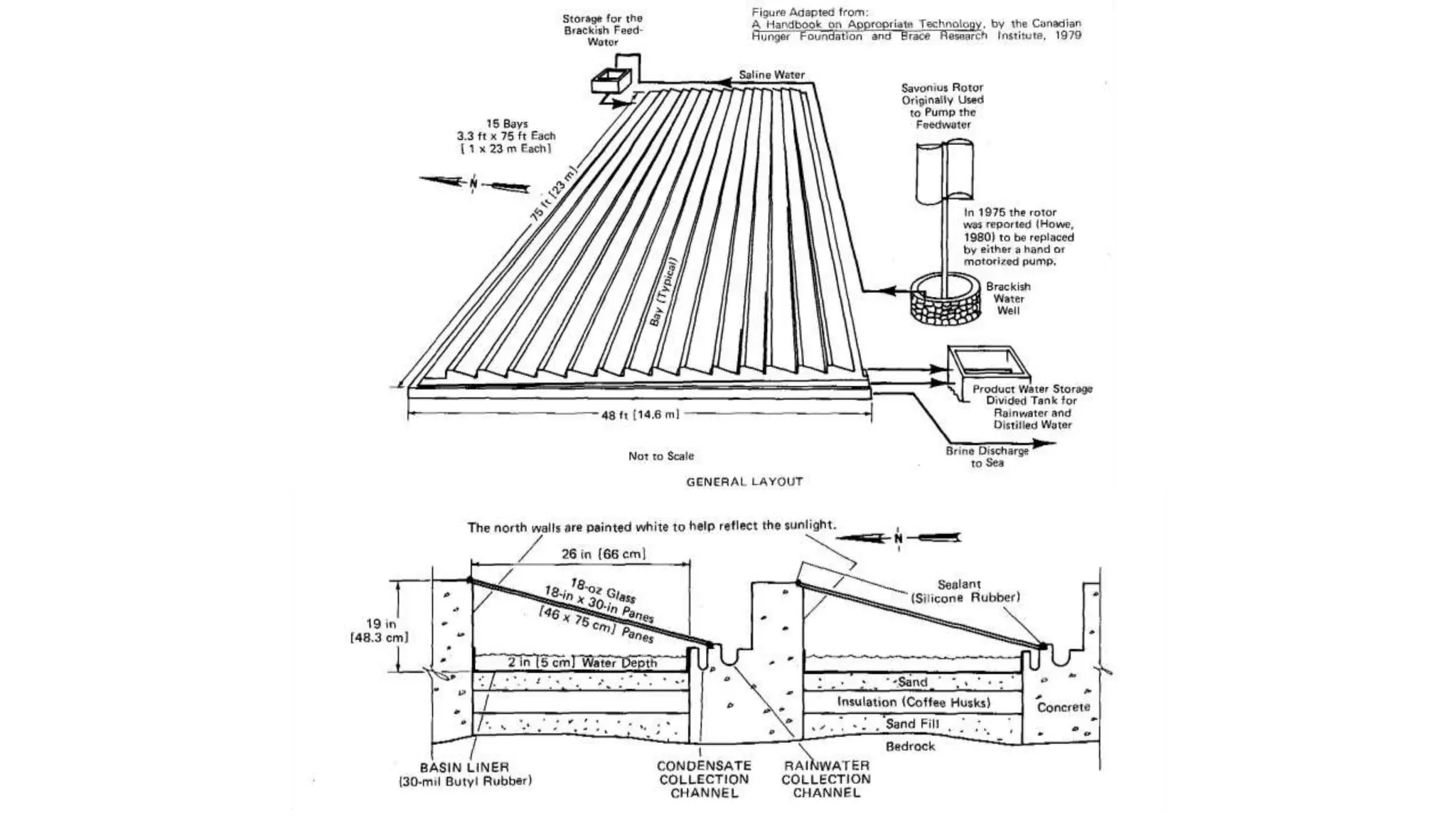
10. Other Parameters
• Depth of brine in the basin: 2”
(Dunham, 1978).
• Cover material: glass, plastic, or
plastic film.
• Cover shape/slope: 10°-15° for glass
covers (Dunham, 1978).
• Bay filled with sand, insulation
material, black water proof liner
(Canadian Hunger Foundation,
1979).
• Gradually sloped bays in longitudinal
direction (Canadian Hunger
Foundation, 1979).
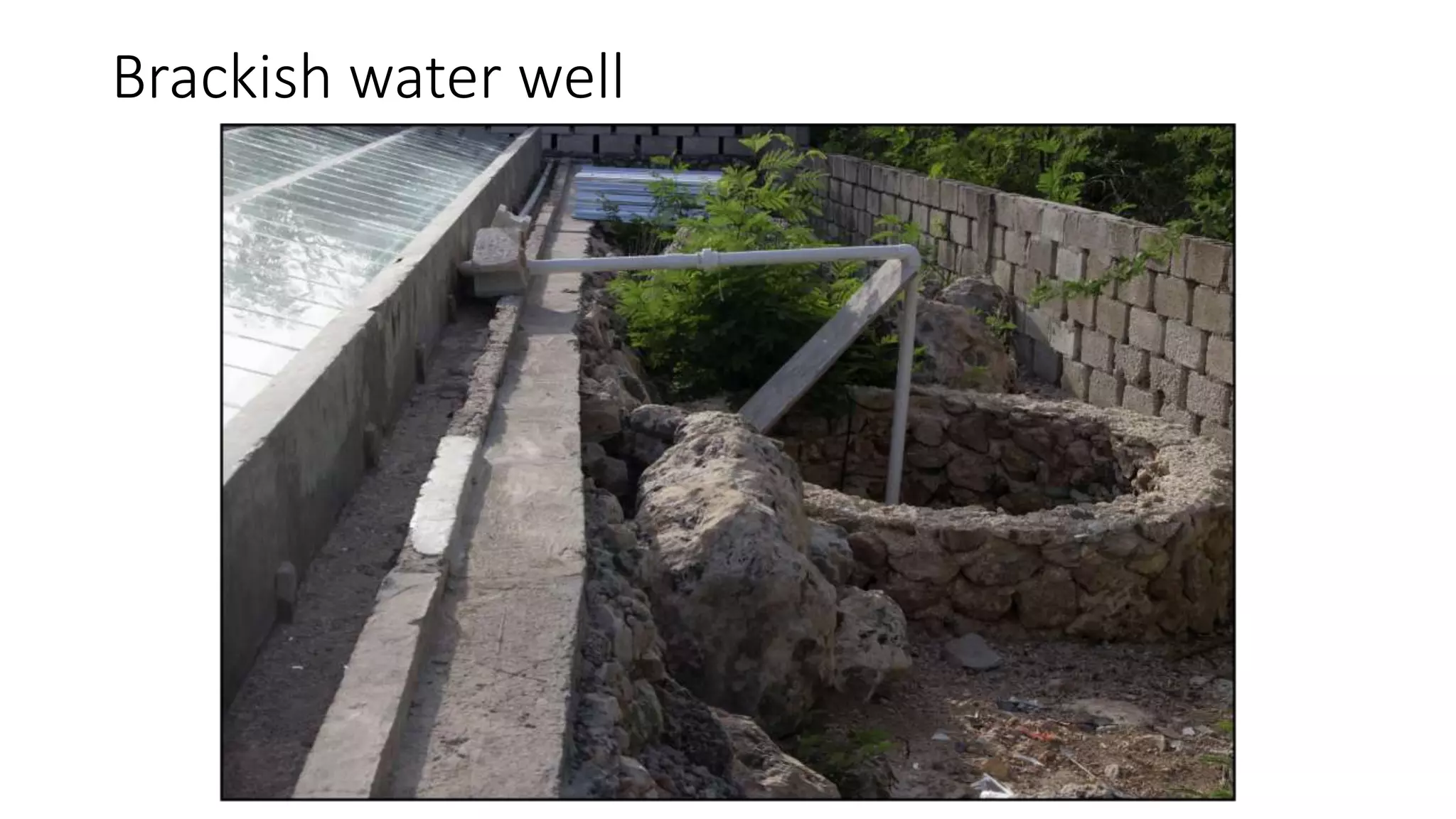
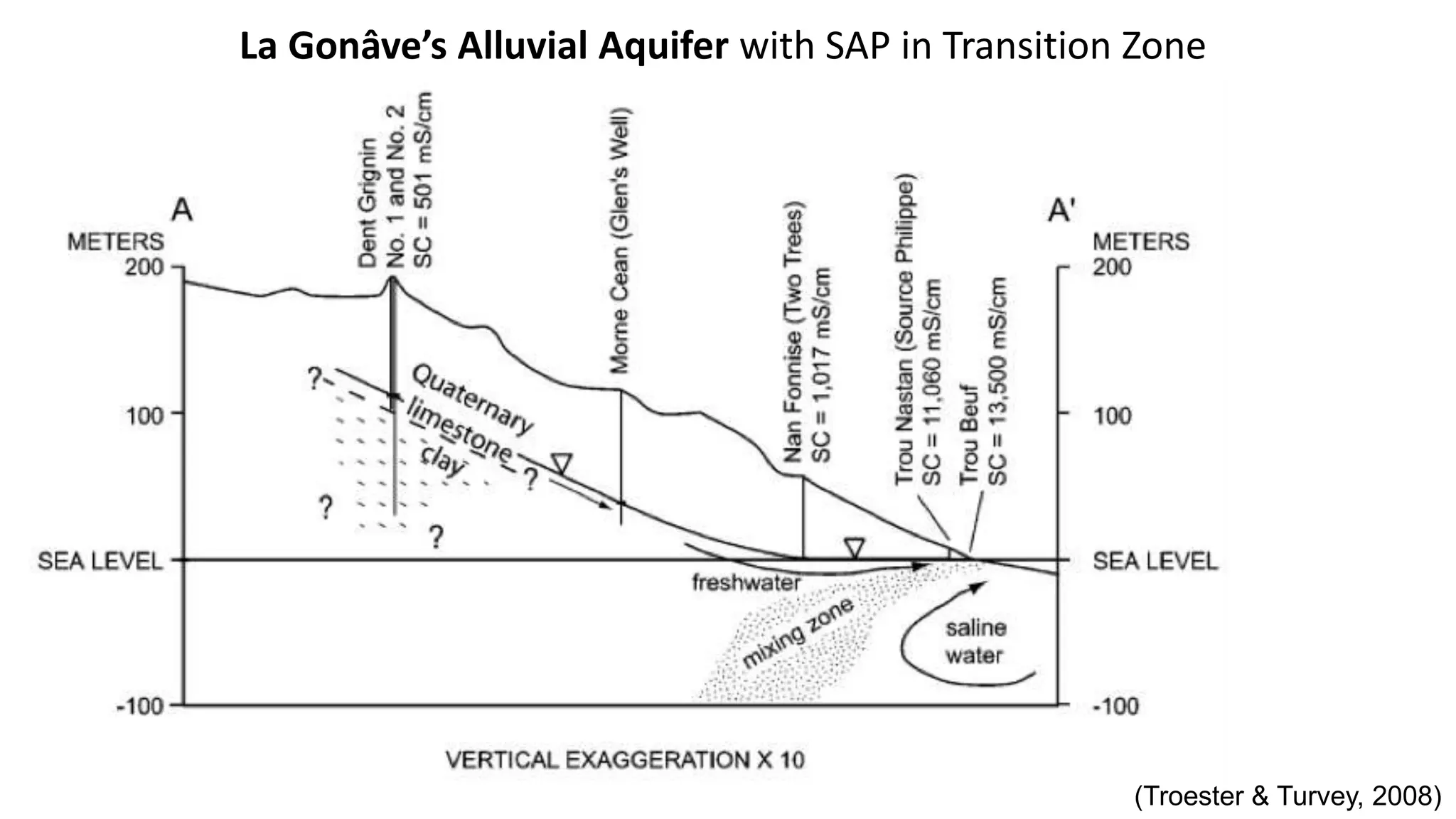
Brackish water well
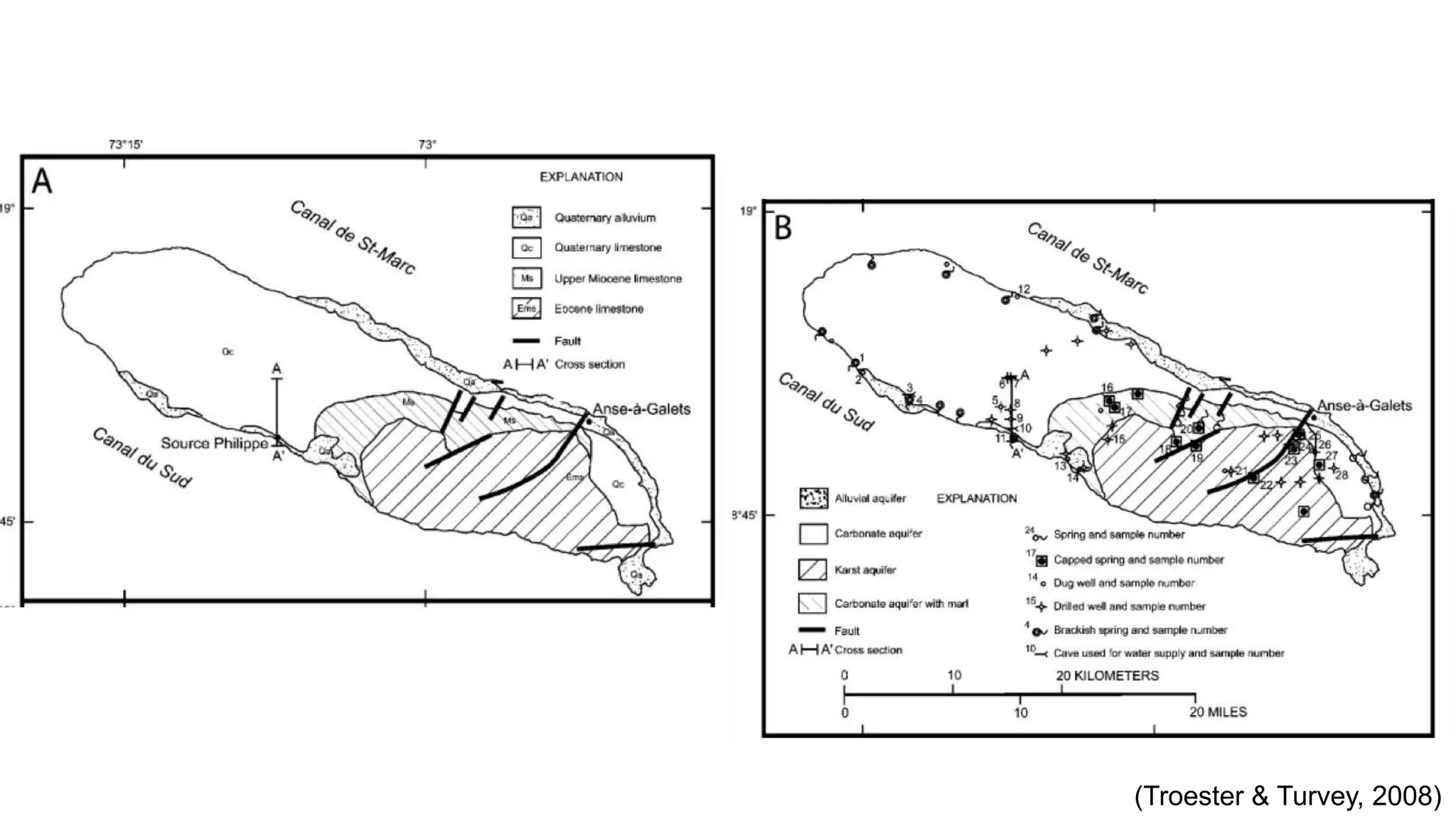
(Troester & Turvey, 2008)
La Gonâve’s Alluvial Aquifer with SAP in Transition Zone
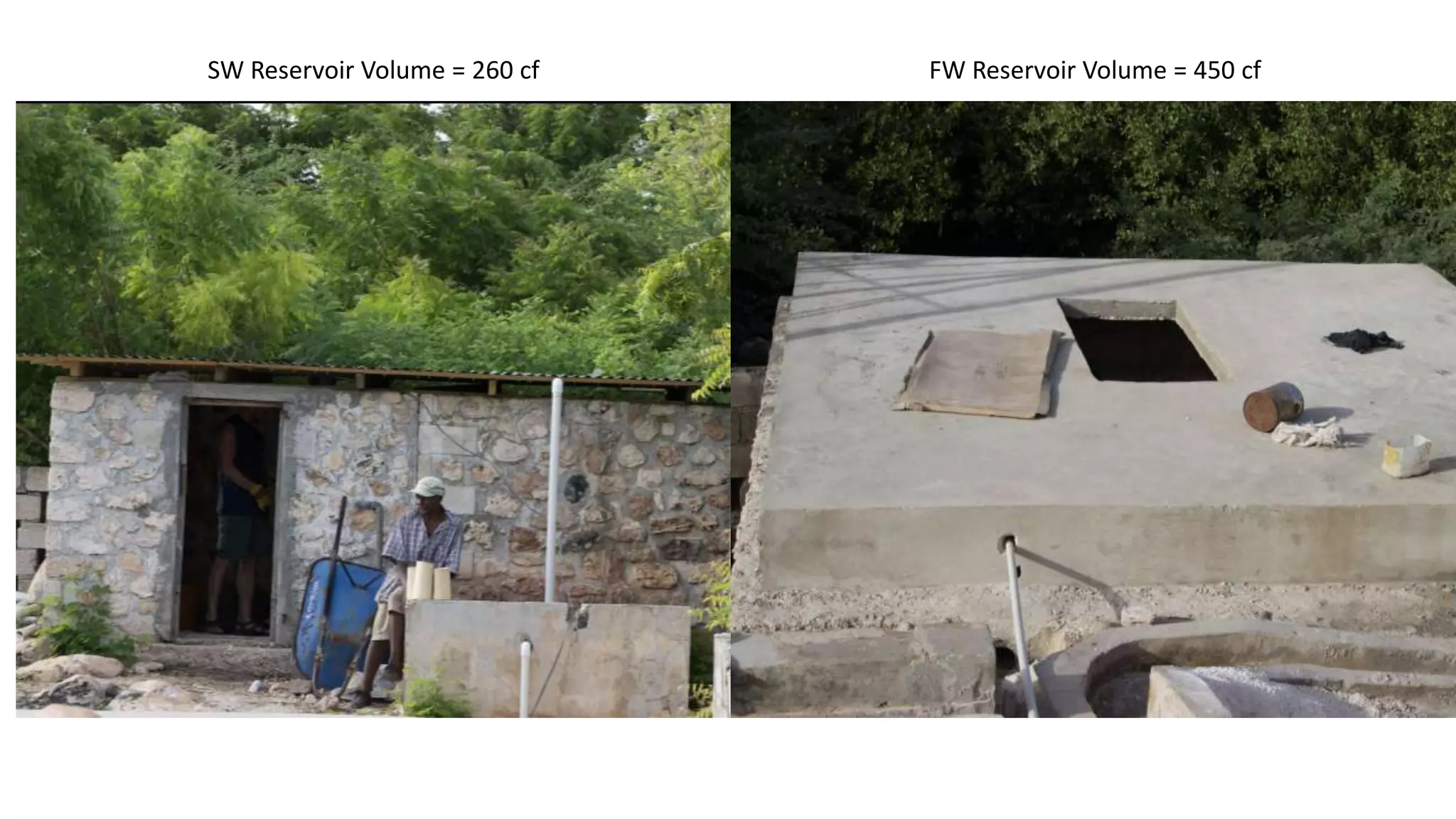
SW Reservoir Volume = 260 cf FW Reservoir Volume = 450 cf
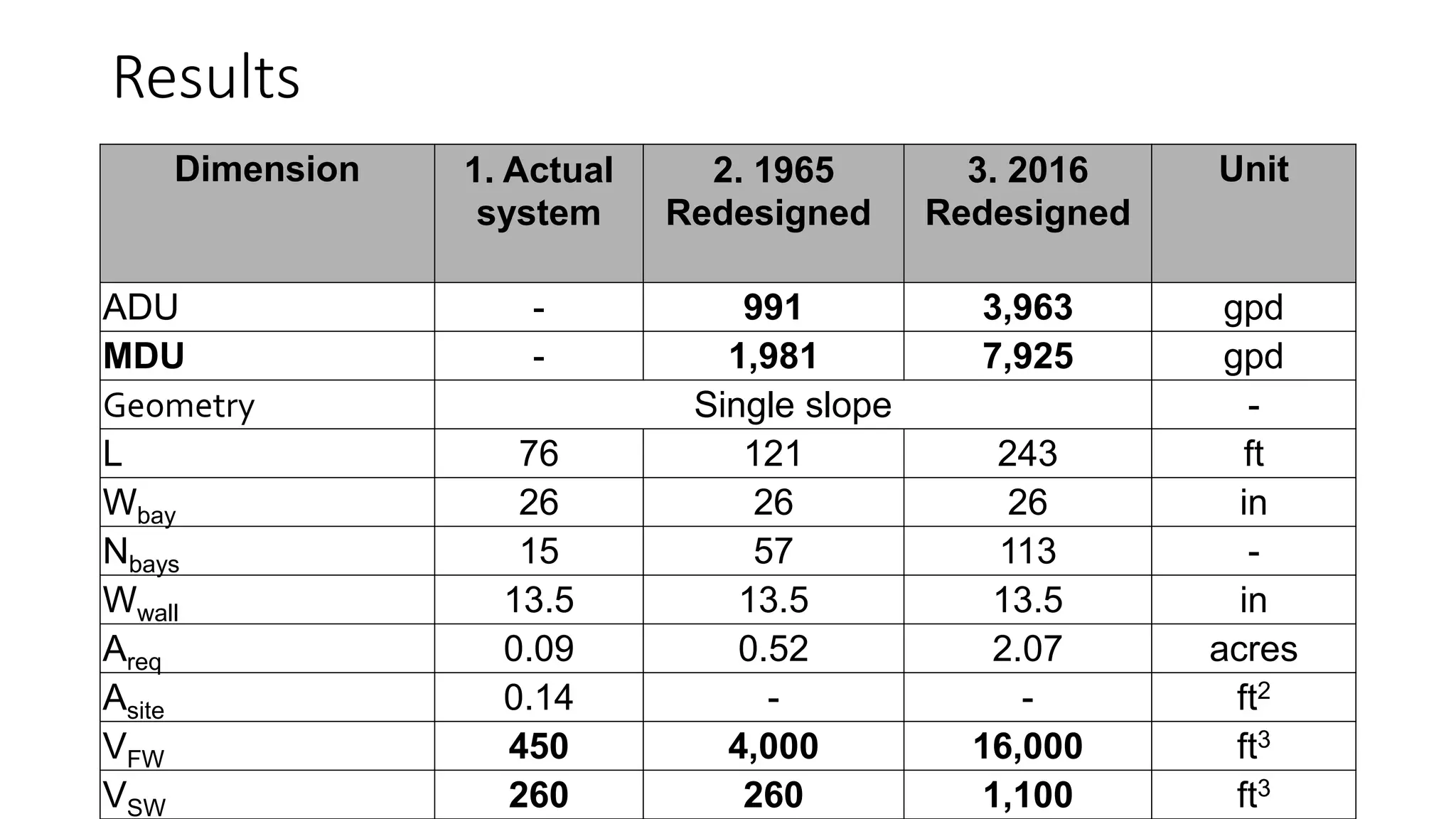
Results
Dimension 1. Actual
system
2. 1965
Redesigned
3. 2016
Redesigned
Unit
ADU - 991 3,963 gpd
MDU - 1,981 7,925 gpd
Geometry Single slope -
L 76 121 243 ft
Wbay 26 26 26 in
Nbays 15 57 113 -
Wwall 13.5 13.5 13.5 in
Areq 0.09 0.52 2.07 acres
Asite 0.14 - - ft2
VFW 450 4,000 16,000 ft3
VSW 260 260 1,100 ft3
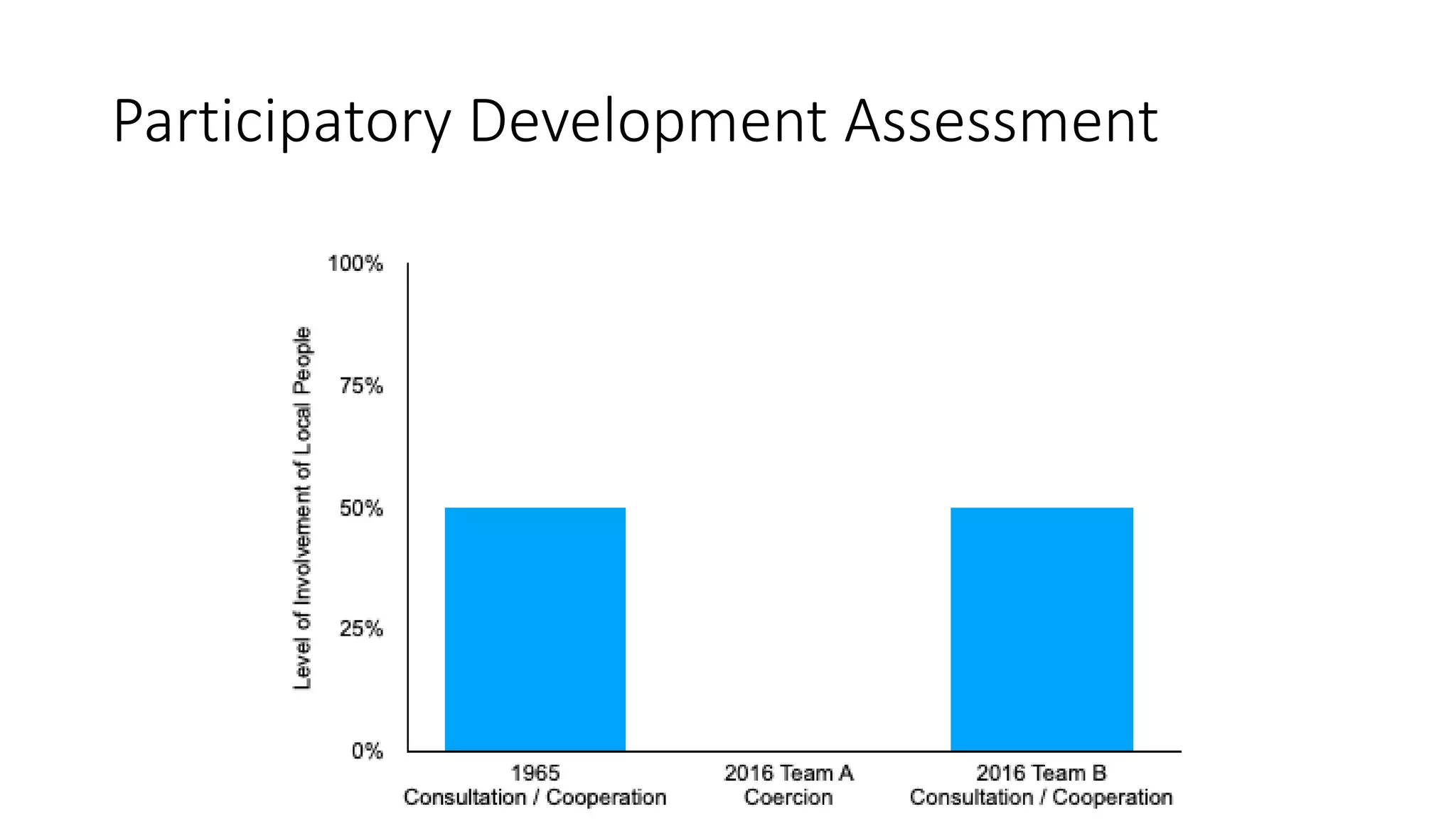
Participatory Development Assessment
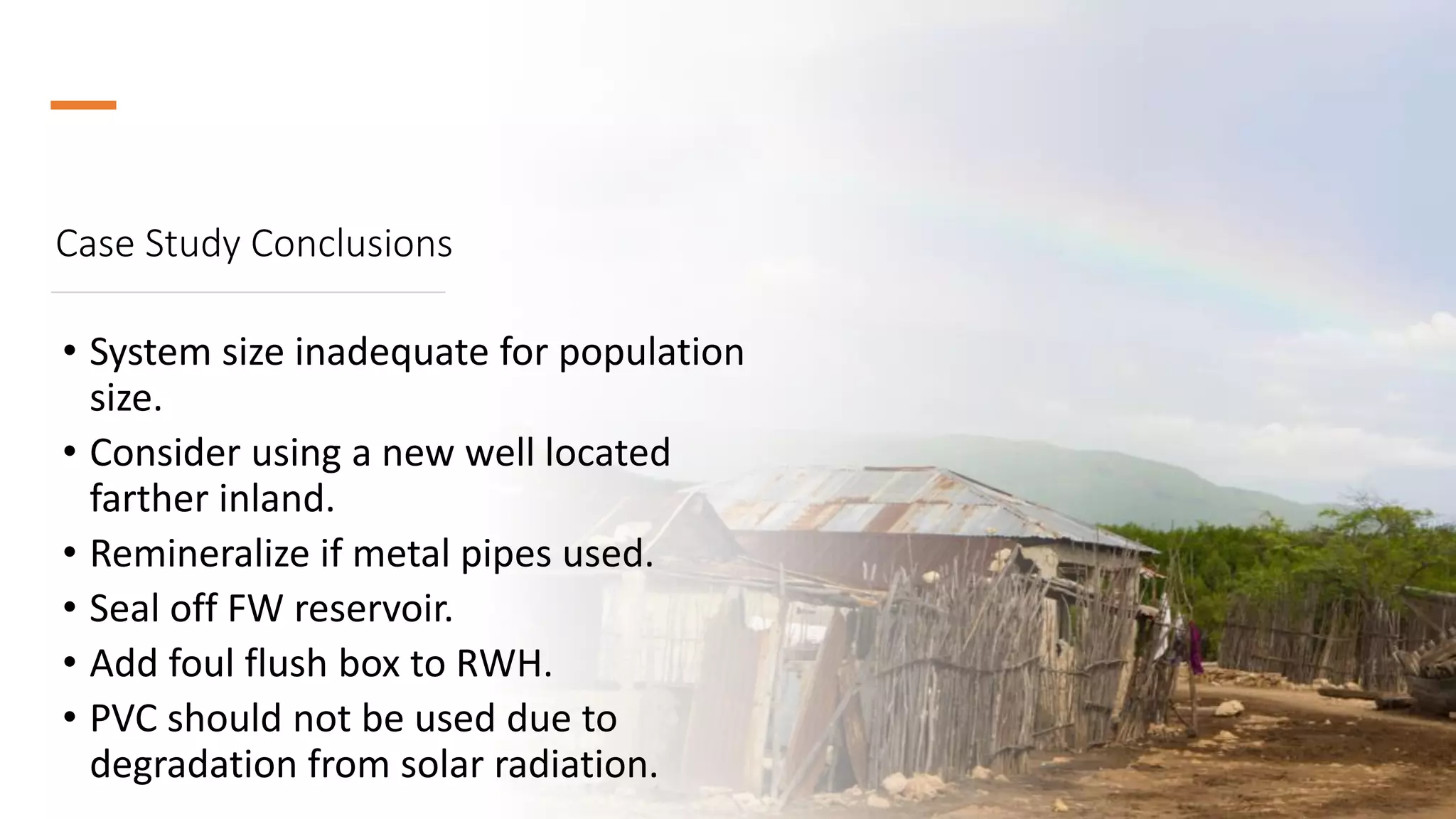
Case Study Conclusions
• System size inadequate for population
size.
• Consider using a new well located
farther inland.
• Remineralize if metal pipes used.
• Seal off FW reservoir.
• Add foul flush box to RWH.
• PVC should not be used due to
degradation from solar radiation.
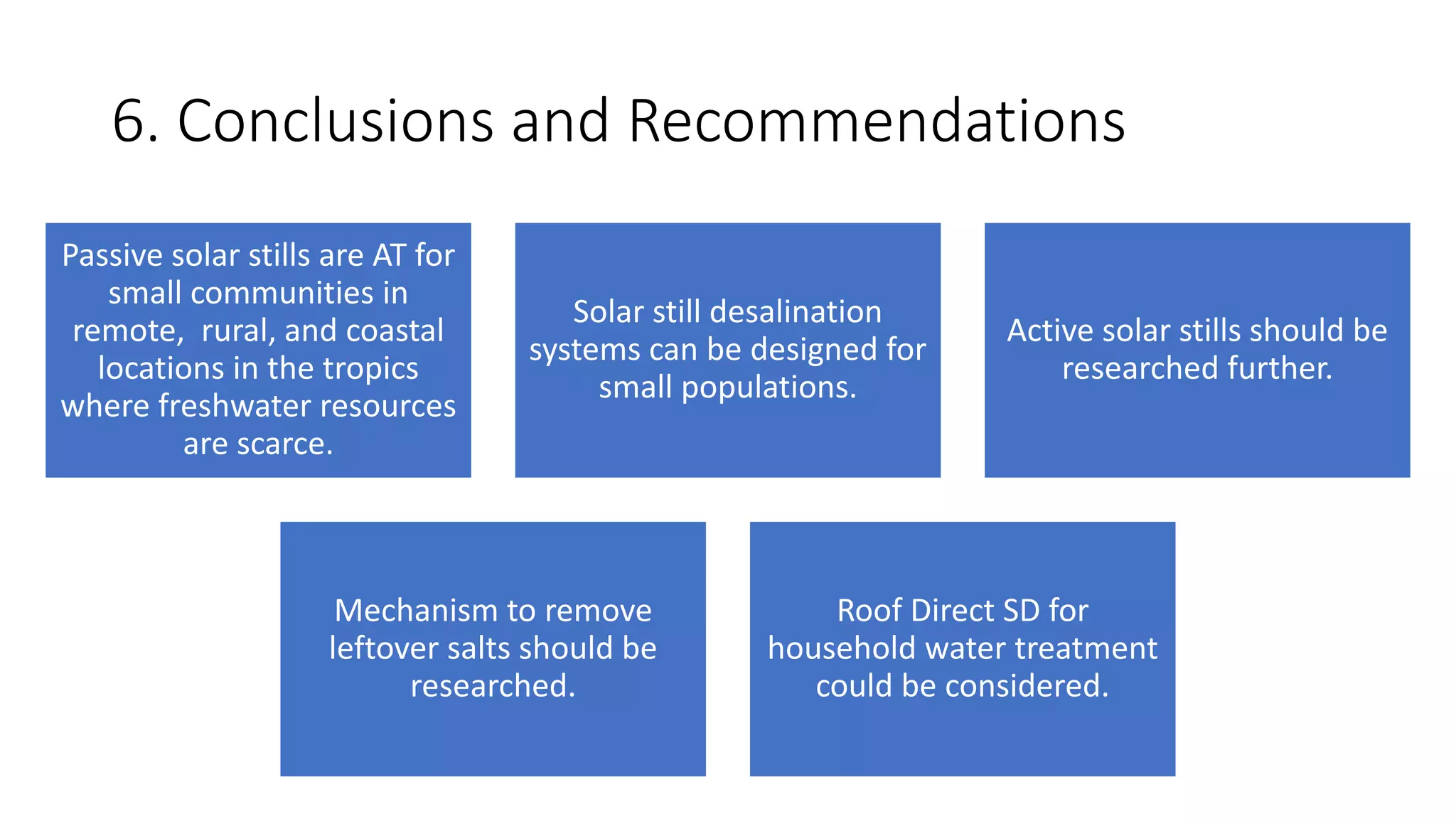
6. Conclusions and Recommendations
Passive solar stills are AT for
small communities in
remote, rural, and coastal
locations in the tropics
where freshwater resources
are scarce.
Solar still desalination
systems can be designed for
small populations.
Active solar stills should be
researched further.
Mechanism to remove
leftover salts should be
researched.
Roof Direct SD for
household water treatment
could be considered.
Questions?

Appropriate Desalination Technologies for Developing Communities

  • 1.
    APPROPRIATE DESALINATION TECHNOLOGIES FORREMOTE COMMUNITIES BJ Elkins MS Plan B Defense Fall 2020 Master’s Committee: Advisor: Jeffrey Niemann Neil Grigg Stephen Leisz
  • 2.
    Sustainability Technologies DesignCase Study Presentation Outline Environ. SocialEcon.
  • 3.
    Introduction Water crisis • ~800M people without access to potable water (WHO, 2017) • Sea levels rising decreases freshwater lens in coastal aquifers (Oppenheimer, et al. 2009) Saline water / Saltwater definition: TDS > 1,000 mg/L • Freshwater TDS < 1,000 mg/L (NRC, 2008) • Brackish water TDS = 1,000 - 33,000 mg/L (NRC, 2008) • Sea water TDS = 33,000 - 48,000 mg/L (NRC, 2008) • Brine TDS > 48,000 mg/L (NRC, 2008) Desalination definition • Reduction / removal of TDS Concerns of demineralized water • Aggressiveness on pipes (WHO, 2008) • Magnesium and calcium better sourced from diet (WHO, 2008)
  • 4.
    Sustainable International Development Environment •Renewable resources • Local ecology Social • Participatory Development Economics • Cost of materials • Local labor • O&M costs • Efficient (McConville & Mihelcic, 2007) SUSTAINABILITY
  • 5.
  • 6.
    Appropriate Technology (AT) Environment •Renewable resources • Little pollution • Future minded Social • Ethical • Cultural • Social • Political Economics • Small where possible AT
  • 7.
    Desalination Technology Overview I.Membrane desalination II. Thermal desalination (distillation) III. Hybrid desalination (thermal membrane) (NRC, 2008) Steps involved in desalination (3 technologies) (4 technologies) (1 technology)
  • 8.
    Goals of System Removesboth salts and pathogens Does not increase dependance on outsiders • Simple and cheap operation & maintenance • Readily available materials Uses renewable energy • Remote communities often lack reliable electrical infrastructure Affordable
  • 9.
    Membrane Desalination Reverse Osmosis(RO) Electrodialysis (ED) Forward Osmosis (FO)
  • 10.
    Thermal Desalination (Distillation) Multi-Stage Flash(MSF) Multi-Effect Desalination (MED) Vapor Compression (VC) Solar Stillshttps://tinyurl.com/y3l7vk9d
  • 11.
    Hybrid: Membrane Distillation(MD) https://tinyurl.com/y3zfnjqx • Best of both technologies: • Lower temperatures & pressures • Novel / advanced technology
  • 12.
    (Chandrashekara & Avadhesh,2017) Solar Thermal Desalination (SD) Solar Thermal Desalination Indirect Processes Multi-Stage Flash (MSF) Multi Effect Desalination (MED) Vapor Compression (VC) Membrane Desalination (MD) Direct Processes Solar Stills Active Passive
  • 13.
    Direct Solar Desalination (Dunham,1978) • Active SD product water cost = 2.8 X passive SD product water (Awasthi, et al. 2018).
  • 14.
  • 15.
    1. Determine waterrequirements. a) Determine average daily use (ADU) • Detailed method (Population < 500) is structure specific. • Population method (Population > 500). • WHO, 2020 minimum = 15 L/day/capita. b)Maximum daily usage (MDU). MDU = 2.0*ADU. (USAID, 1982) c) Design flow, Q = MDU. (USAID, 1982) 15 L Container Design Process
  • 16.
    LEGEND kWh/m2 /year kWh/m2 /day BTU/ft2 /day 3700 10.14 3213 34009.32 2953 3100 8.49 2692 2800 7.67 2432 2500 6.85 2171 2200 6.03 1911 1900 5.21 1650 1600 4.38 1390 1300 3.56 1129 1000 2.74 868 700 1.92 608 400 1.10 347 (Global Solar Atlas, 2019) 2. Determine Average Solar Desalination Productivity, PSD a. Solar Radiation, R in BTU/ft2/day (Global Solar Atlas, 2019) b. 𝑃𝑆𝐷 = 1.10 ∗ 10−3 ∗ 𝑅 100 1.40 𝑔𝑝𝑑 𝑓𝑡2 (Talbert et al. 1970)
  • 17.
    (UN FAO, 2020) 3.Rainwater Harvesting (RWH) Productivity, PRWH • Find annual average rainfall, RW [feet/day] (UN FAO or regional data) • 𝑉𝑅𝑊𝐻 = 0.8 ∗ 𝑅𝑊 ∗ 𝐴 [gpd] (USAID, 1982) • 𝑃𝑅𝑊𝐻 = 𝑉 𝑅𝑊𝐻 𝐴 = 0.8 ∗ 𝑅𝑊 𝑔𝑝𝑑 𝑓𝑡2
  • 18.
    4. Calculate RequiredEffective Area 𝐴 𝑒𝑓𝑓−𝑟𝑒𝑞 = 𝑄 𝑃 𝑆𝐷+𝑃 𝑅𝑊𝐻 [ft2] 5. Choose Geometry of Still: (Dunham, 1978)
  • 19.
    • Number ofbays, Nbay 𝑁𝑏𝑎𝑦 = 𝐴 𝑒𝑓𝑓−𝑟𝑒𝑞 𝑊𝑏𝑎𝑦 ∗ 𝐿 • Width of concrete wall, Wwall • Area of concrete wall, Awall 𝐴 𝑤𝑎𝑙𝑙 = 𝑁𝑏𝑎𝑦 ∗ 𝑊 𝑤𝑎𝑙𝑙 ∗ 𝐿 PLAN VIEW 6. Determine dimensions from effective area: • Width of bay, Wbay: 2’-6’ (Dunham, 1978) • Length, L 𝐴 𝑒𝑓𝑓−𝑟𝑒𝑞 = 𝐿
  • 20.
    7. Select Site •Areq = Aeff + Awall • Asite > Areq 8. Size Freshwater Reservoir • 1-month supply for RWH with rain evenly throughout the year (USAID, 1982). VFW = 30*ADU • Larger for regions with longer dry season. 9. Size Saltwater Reservoir • 𝑉𝑆𝑊 = 2 ∗ 𝑉𝑆𝐷 = 𝑃𝑆𝐷 ∗ 𝐴
  • 21.
    Three project teams 1969Design • Canadian Hunger Foundation 2016 Repair • Project Engineers from Oregon • EWB / Wesley Foundation
  • 22.
    La Gonâve Island (Îlede la Gonâve) Village of Sous-A-Phillippe (SAP) (Source Philippe) •Population: ~1,000 •Remote Fishing village Case Study: Haiti Water Treatment System
  • 23.
    10. Other Parameters •Depth of brine in the basin: 2” (Dunham, 1978). • Cover material: glass, plastic, or plastic film. • Cover shape/slope: 10°-15° for glass covers (Dunham, 1978). • Bay filled with sand, insulation material, black water proof liner (Canadian Hunger Foundation, 1979). • Gradually sloped bays in longitudinal direction (Canadian Hunger Foundation, 1979).
  • 25.
  • 26.
  • 27.
    (Troester & Turvey,2008) La Gonâve’s Alluvial Aquifer with SAP in Transition Zone
  • 30.
    SW Reservoir Volume= 260 cf FW Reservoir Volume = 450 cf
  • 31.
    Results Dimension 1. Actual system 2.1965 Redesigned 3. 2016 Redesigned Unit ADU - 991 3,963 gpd MDU - 1,981 7,925 gpd Geometry Single slope - L 76 121 243 ft Wbay 26 26 26 in Nbays 15 57 113 - Wwall 13.5 13.5 13.5 in Areq 0.09 0.52 2.07 acres Asite 0.14 - - ft2 VFW 450 4,000 16,000 ft3 VSW 260 260 1,100 ft3
  • 32.
  • 33.
    Case Study Conclusions •System size inadequate for population size. • Consider using a new well located farther inland. • Remineralize if metal pipes used. • Seal off FW reservoir. • Add foul flush box to RWH. • PVC should not be used due to degradation from solar radiation.
  • 34.
    6. Conclusions andRecommendations Passive solar stills are AT for small communities in remote, rural, and coastal locations in the tropics where freshwater resources are scarce. Solar still desalination systems can be designed for small populations. Active solar stills should be researched further. Mechanism to remove leftover salts should be researched. Roof Direct SD for household water treatment could be considered.
  • 35.

Editor's Notes

  • #6 Participatory development
  • #7 This will be the framework by which each of the technologies are evaluated. What if we applied this to AT? Merriam webster: AT is technology that is suitable to the social and economic conditions of the geographic area in which it is to be applied, is environmentally sound, and promotes self-sufficiency on the part of those using it From appropedia.org: Sustainable - requiring fewer natural resources and producing less pollution than techniques from mainstream technology, which are often wasteful and environmentally polluting. In addition, or in envisioning a future phase of AT that lies on a more subjectively-observed axis of knowing, proponents could also claim their methods make more life(-energy) sense, are more at balance or in harmony with the natural environment, and enable appropriate, healthier, happier, more fulfilling, meaningful or purposeful ways of life Small where possible (as in Small is Beautiful). This places more power at the grassroots, in the hands of the users. However, there are also times when the most appropriate technologies are large-scale. Appropriate to the context, including the environmental, ethical, cultural, social, political, and economical context. The appropriate technology for one context may not be appropriate for another.
  • #8 I investigated 7 technologies using the triple bottom line principles of sustainability as discussed prior.
  • #10 Membrane desalination uses a semipermeable membrane to separate molecules resulting in pure H20. Reverse osmosis uses very high pressures to force the H20 through the membrane from a higher concentration to a lower concentration. It requires Electrodialysis uses a voltage to draw ions out of water through an ionic permeable membrane Forward Osmosis uses a draw solution to cause H2O to travel through the membrane from a lower concentration to a higher concentration. The draw solution is then removed from the pure water. Each system requires access to electricity, access to membranes when replacement is necessary (2-10 years), and technical skills for operation and maintenance.
  • #11 I reviewed each of these thermal system and found that MSF and MED are given to economies of scale such that they require large capital investments. Vapor compression is prone to smaller systems but requires frequent maintenance. Solar stills seems to be the most promising because of its inherent simplicity and reliance on solar energy alone. Advantages Pretreatment not required High removal of TDS Pathogens removed Disadvantages Scaling and fouling Heat waste Large energy requirement
  • #13 Solar energy can be used in two methods: indirect and direct. With indirect, there are two steps: solar radiation collection and thermal desalination using any of the various methods.
  • #14 81. The sun's radiation passes through a transparent cover and heats the saline water within the still enclosure. 2. Water vapor is formed and carried by convective currents to the cover. 3. The vapor condenses on the cooler undersurface of the cover. 4. The condensed water collects into droplets or sheets and runs down to a trough located inside the still which leads the distillate to outside storage areas. The cost of the distilled water produced from a passive solar is still around 2.8 times lower than that of the distilled water produced from an active hybrid solar still (Awasthi, et al. 2018).
  • #19  Single slope: glass sloped toward equator.  Double slope: Most common because it permits the use of small pieces of glass while retaining wide bay sizes; however, double is more complex which may limit constructibility.  Arched cover: using plastic film can be used, though more difficult to maintain.  V shaped: plastic film is not durable, so not advised for reliability purposes
  • #20 Calculate area of concrete walls which is the part of the total area that does not include the bay area.
  • #21 Calculate area of concrete walls which is the part of the total area that does not include the bay area.
  • #24 Depth of brine in the basin: 2” (Dunham, 1978). A lower depth will evaporate faster, but too low will not last the entire day. Control depth of brine by making several pools in each bay with weirs spaced evenly throughout. Cover material: glass, plastic, or plastic film. Glass is preferable for durability and heat transmission (Dunham, 1978). It is also preferable due to its lifespan and wide availability compared to other transparent materials (Canadian Hunger Foundation, 1979). Studies show that 1/8” window glass performs better than 0.002” Type-40 clear Tedlar plastic (Talbert, et al. 1970). Cover shape/slope: 10°-15° for glass covers to avoid sag and allow the distillate to run off freely; varies too much for plastic to make rule (Dunham, 1978). Cover height: Held at minimum with enough clearance for separation from brine and clean water; dependent on cover slope (Dunham, 1978). Concrete mix for walls: 1:2:4 (cement:sand:gravel) (Canadian Hunger Foundation, 1979). Bay filled with sand, insulation material (local item like coffee shells), black water proof liner (Canadian Hunger Foundation, 1979).  If using single sloped still, paint inside wall that is facing the equator white to reflect light during periods of lower solar altitude. Gradually sloped bays in longitudinal direction (Canadian Hunger Foundation, 1979).
  • #34 The village of SAP should find an alternative supply of water as their population is too great to rely solely on this system. Per section 5.2, one of the northern wells or a new well located farther inland may be a more reliable source of freshwater to receive less costly treatment than desalination. Cover of bay could be attached differently to allow for easier salt retrieval (e.g. a hinge or sliding mechanism). Remineralization should occur per WHO guidelines. Freshwater reservoir should be sealed off to avoid contamination. RWH connection to freshwater reservoir should have silt trap or foul flush box for debris removal.