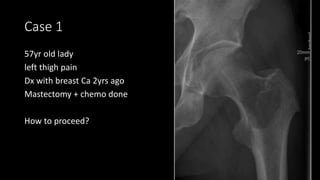
Case 1
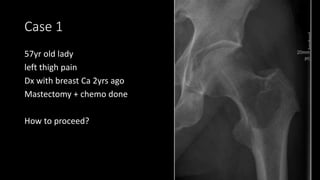
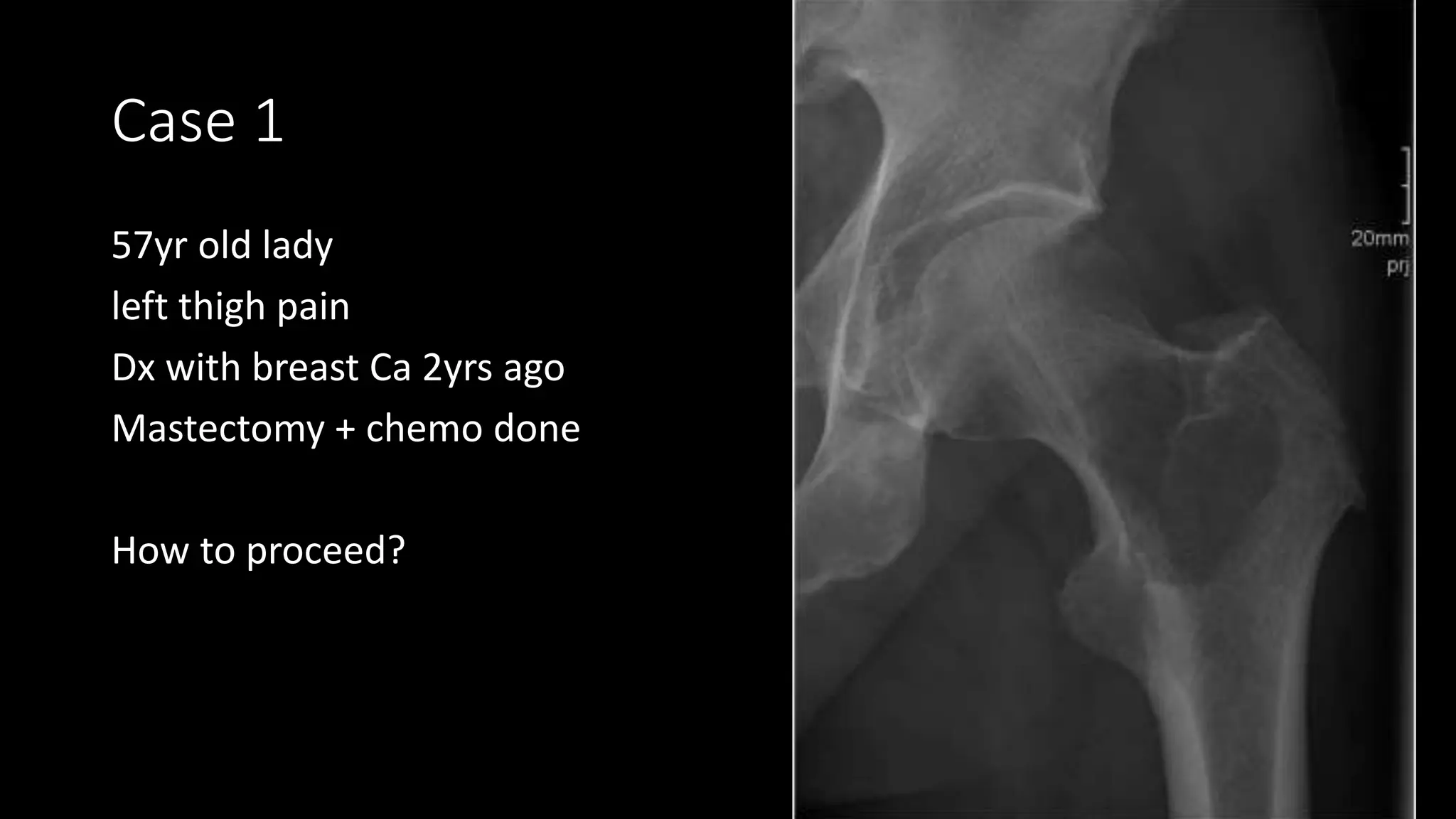
57yr old lady
left thigh pain
Dx with breast Ca 2yrs ago
Mastectomy + chemo done
How to proceed?
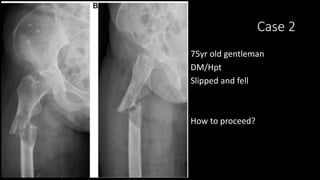
Case 2
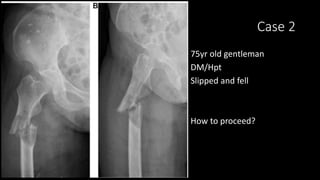
75yr old gentleman
DM/Hpt
Slipped and fell
How to proceed?
Approach to metastatic bone
disease
Outline
• Defination
• Epidemiology
• Common sites
• Pathophysiology
• Types of lesion
• Aims of Rx
• Presentation
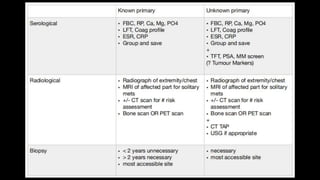
• Investigation
• Managements
Definition
• Secondary malignant neoplastic disease of the skeletal system as a
result of metastasis from a primary tumour
Epidemiology
• Aging population = increased incidence of Metastatic bone disease
• Site for mets
• Lung -> Liver -> Bone
• Lytic lesions in patients >40 yrs - MBD should be considered
Common sites
• Breast
• Lung
• Thyroid
• Kidney
• Prostate
• Hematological
• commonest site = spine > proximal femur > humerus
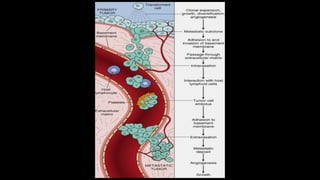
Pathophysiology
• Paget's Seed & Soil theory
• The 'seeds' (tumor cells) require appropriate 'soil' (the bone micro-
environment) to establish skeletal metastasis
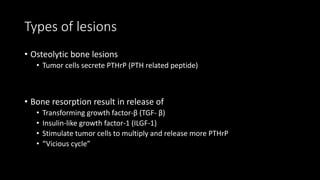
Types of lesions
• Osteolytic bone lesions
• Tumor cells secrete PTHrP (PTH related peptide)
• Bone resorption result in release of
• Transforming growth factor-β (TGF- β)
• Insulin-like growth factor-1 (ILGF-1)
• Stimulate tumor cells to multiply and release more PTHrP
• “Vicious cycle”
Types of lesions
• Osteoblastic lesion
• Due to tumor-secreted endothelin 1
Aim
• Diagnose primary
• Decide on skeletal stabalization
Presentation
• Pain
• HyperCa
• Stones, bones, abdominal groans & pshycic moans
• Pathological #
Management
• Multidisciplinary approach
• Treat life threatening conditions first!
• GOALS:
• pain relief
• preserve/restore function
• maximising quality of life
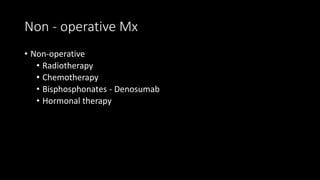
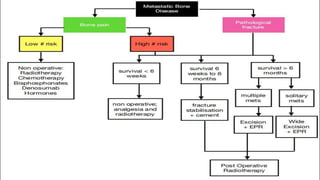
Non - operative Mx
• Non-operative
• Radiotherapy
• Chemotherapy
• Bisphosphonates - Denosumab
• Hormonal therapy
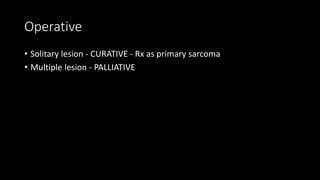
Operative
• Solitary lesion - CURATIVE - Rx as primary sarcoma
• Multiple lesion - PALLIATIVE
Indications for surgery
• pathological fracture
• prophylaxis to lesions that are high risk of fracture
• survival > 6 weeks
Risk assessment Vs Prognosis
• Risk assessment
• Harrington’s criteria
• Mirel’s score
• Prognosis
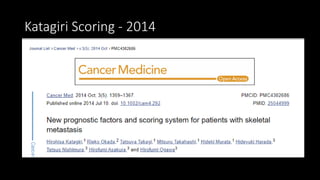
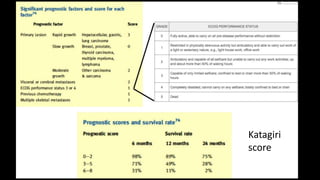
• WITHOUT spine mets : Katagiri score
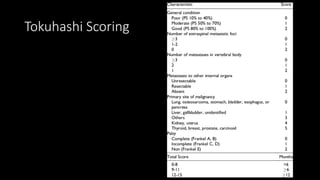
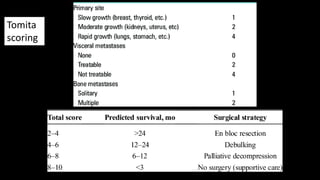
• WITH spine mets : Tomita score OR Tokuhashi score
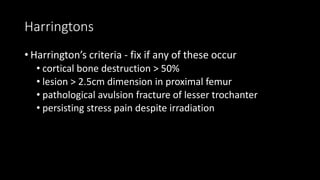
Harringtons
• Harrington’s criteria - fix if any of these occur
• cortical bone destruction > 50%
• lesion > 2.5cm dimension in proximal femur
• pathological avulsion fracture of lesser trochanter
• persisting stress pain despite irradiation
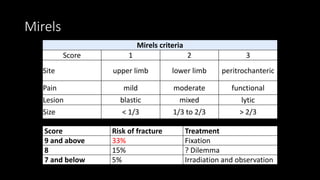
Mirels
Score Risk of fracture Treatment
9 and above 33% Fixation
8 15% ? Dilemma
7 and below 5% Irradiation and observation
Mirels criteria
Score 1 2 3
Site upper limb lower limb peritrochanteric
Pain mild moderate functional
Lesion blastic mixed lytic
Size < 1/3 1/3 to 2/3 > 2/3
Katagiri Scoring - 2014
Katagiri
score
Tokuhashi Scoring
Tomita
scoring
Take home message
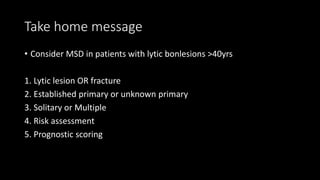
• Consider MSD in patients with lytic bonlesions >40yrs
1. Lytic lesion OR fracture
2. Established primary or unknown primary
3. Solitary or Multiple
4. Risk assessment
5. Prognostic scoring
Case 1
57yr old lady
left thigh pain
Dx with breast Ca 2yrs ago
Mastectomy + chemo done
How to proceed?
Case 2
75yr old gentleman
DM/Hpt
Slipped and fell
How to proceed?

Approach to metastatic bone disease.....

  • 1.
    Case 1 57yr oldlady left thigh pain Dx with breast Ca 2yrs ago Mastectomy + chemo done How to proceed?
  • 2.
    Case 2 75yr oldgentleman DM/Hpt Slipped and fell How to proceed?
  • 3.
  • 4.
    Outline • Defination • Epidemiology •Common sites • Pathophysiology • Types of lesion • Aims of Rx • Presentation • Investigation • Managements
  • 5.
    Definition • Secondary malignantneoplastic disease of the skeletal system as a result of metastasis from a primary tumour
  • 6.
    Epidemiology • Aging population= increased incidence of Metastatic bone disease • Site for mets • Lung -> Liver -> Bone • Lytic lesions in patients >40 yrs - MBD should be considered
  • 7.
    Common sites • Breast •Lung • Thyroid • Kidney • Prostate • Hematological • commonest site = spine > proximal femur > humerus
  • 8.
    Pathophysiology • Paget's Seed& Soil theory • The 'seeds' (tumor cells) require appropriate 'soil' (the bone micro- environment) to establish skeletal metastasis
  • 10.
    Types of lesions •Osteolytic bone lesions • Tumor cells secrete PTHrP (PTH related peptide) • Bone resorption result in release of • Transforming growth factor-β (TGF- β) • Insulin-like growth factor-1 (ILGF-1) • Stimulate tumor cells to multiply and release more PTHrP • “Vicious cycle”
  • 11.
    Types of lesions •Osteoblastic lesion • Due to tumor-secreted endothelin 1
  • 12.
    Aim • Diagnose primary •Decide on skeletal stabalization
  • 13.
    Presentation • Pain • HyperCa •Stones, bones, abdominal groans & pshycic moans • Pathological #
  • 15.
    Management • Multidisciplinary approach •Treat life threatening conditions first! • GOALS: • pain relief • preserve/restore function • maximising quality of life
  • 16.
    Non - operativeMx • Non-operative • Radiotherapy • Chemotherapy • Bisphosphonates - Denosumab • Hormonal therapy
  • 17.
    Operative • Solitary lesion- CURATIVE - Rx as primary sarcoma • Multiple lesion - PALLIATIVE
  • 18.
    Indications for surgery •pathological fracture • prophylaxis to lesions that are high risk of fracture • survival > 6 weeks
  • 19.
    Risk assessment VsPrognosis • Risk assessment • Harrington’s criteria • Mirel’s score • Prognosis • WITHOUT spine mets : Katagiri score • WITH spine mets : Tomita score OR Tokuhashi score
  • 20.
    Harringtons • Harrington’s criteria- fix if any of these occur • cortical bone destruction > 50% • lesion > 2.5cm dimension in proximal femur • pathological avulsion fracture of lesser trochanter • persisting stress pain despite irradiation
  • 21.
    Mirels Score Risk offracture Treatment 9 and above 33% Fixation 8 15% ? Dilemma 7 and below 5% Irradiation and observation Mirels criteria Score 1 2 3 Site upper limb lower limb peritrochanteric Pain mild moderate functional Lesion blastic mixed lytic Size < 1/3 1/3 to 2/3 > 2/3
  • 22.
  • 23.
  • 24.
  • 25.
  • 27.
    Take home message •Consider MSD in patients with lytic bonlesions >40yrs 1. Lytic lesion OR fracture 2. Established primary or unknown primary 3. Solitary or Multiple 4. Risk assessment 5. Prognostic scoring
  • 28.
    Case 1 57yr oldlady left thigh pain Dx with breast Ca 2yrs ago Mastectomy + chemo done How to proceed?
  • 29.
    Case 2 75yr oldgentleman DM/Hpt Slipped and fell How to proceed?

Editor's Notes

  • #10 Detachment of tumor cells Invasion of tumour cells into surrounding tissue to reach vessels Intravasation into vessels lumen Evasion ( Avoidance) of host defense mechanism Adherence to endothelium at remote location Extravasation from vessels into surrounding tissue Survival and growth within the tissue Establish own blood supply