GYNACOMASTIA
DR VIKAS BALANIA
MD MEDICINE
DEFINITION
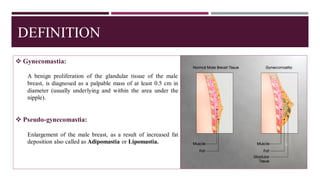
❖ Gynecomastia:
A benign proliferation of the glandular tissue of the male
breast, is diagnosed as a palpable mass of at least 0.5 cm in
diameter (usually underlying and within the area under the
nipple).
❖ Pseudo-gynecomastia:
Enlargement of the male breast, as a result of increased fat
deposition also called as Adipomastia or Lipomastia.
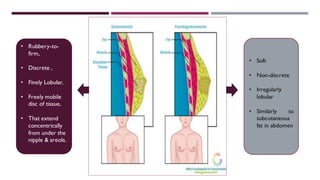
• Rubbery-to-
firm,
• Discrete ,
• Finely Lobular,
• Freely mobile
disc of tissue,
• That extend
concentrically
from under the
nipple & areola.
• Soft
• Non-discrete
• Irregularly
lobular
• Similarly to
subcutaneous
fat in abdomen
PREVALENCE
❖ Asymptomatic palpable breast tissue is common in normal males, particularly in the neonate(60%–90%),
at puberty(60%–70%), and with increasing age (20%–65%, >50 years).
❖ Because of this high prevalence, gynecomastia is considered a relatively normal finding during these
periods of life. (so called physiologic at these ages)
PATHOPHYSIOLOGY
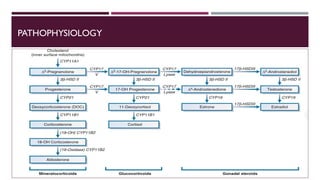
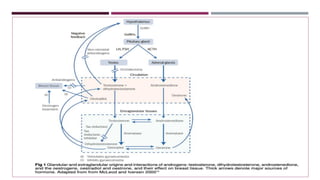
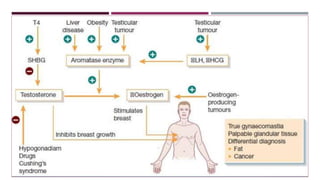
❖ Gynecomastia results from an imbalance between the stimulatory effect of estrogen and the inhibitory effect of
androgen on breast development.
❖ The imbalance is commonly caused by ;
✓Increased production of estrogen,
✓Decreased production of testosterone, or
✓Increased conversion of androgens to estrogens in peripheral tissue.
CLINICAL MANIFESTATION
❖ Gynecomastia usually manifests as a palpable, discrete button of tissue radiating from beneath the nipple and
areola.
❖ Gynecomastia feels “gritty” when the breast is pinched between the thumb and forefinger.
❖ Fatty tissue (Pseudo-gynecomastia), unlike gynecomastia, will not cause resistance until the nipple is reached.
(Difference in clinical examination).
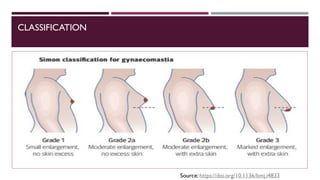
CLASSIFICATION
Source: https://doi.org/10.1136/bmj.i4833
Histopathological Classification
❖ Three histologic patternsof gynecomastia have been recognized.
• Floridpattern: consists of an increase in the number of buddingducts,
• Fibroustype: has dilated ducts, minimal duct epithelial proliferation,no periductaledema, and a
virtually acellularfibrous stroma.
• Intermediatepattern contains features of both types.
❖ Florid patternresponse well to medical treatment, while fibrous type needs surgical management.
CAUSES OF GYNECOMASTIA (FREQUENCY %)
(A) Physiological : (25%)
▪ Neonatal gynecomastia results from placental transfer of estrogen.
▪ During early puberty, production of estrogens begins earlier than testosterone production, thus causing an
imbalance in the ratio of estrogens to androgens. Its usually regresses within 1 to 2 years. (can persist in 25%
cases)
▪ With aging, testosterone production decreases, and peripheral androgen to estrogen conversion often increases
because of an age-related increase in adipose tissue.
(B) Idiopathic : (25%)
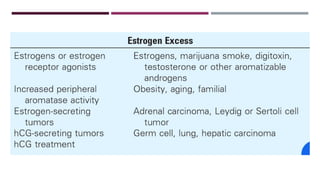
(C) ESTROGEN EXCESS :
In post-pubertal boys and adult men, the testes secrete 6-10 µg of estradiol and 2.5 µg of estrone per day. Since this only
comprises a small fraction of estrogens in the circulation (i.e. 15% of estradiol and 5% of estrone), the remainder of
estrogen in men is derived from the extraglandular aromatization of testosterone and androstenedione to estradiol and
estrone.
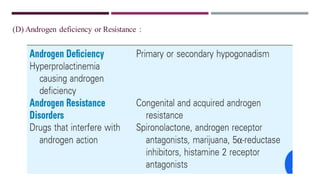
(D) Androgen deficiency or Resistance :
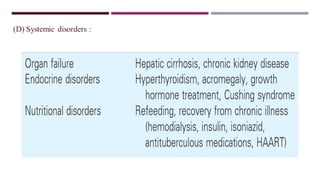
(D) Systemic disorders :
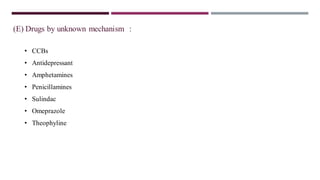
(E) Drugs by unknown mechanism :
• CCBs
• Antidepressant
• Amphetamines
• Penicillamines
• Sulindac
• Omeprazole
• Theophyline
EVALUATION
(A) HISTORY
 Age
 Duration of the gynaecomastia
 Presence of pain.
 Use of drugs including recreation drugs e.g. Alcohol
 Presence of symptoms suggestive of pathological cause.
 Symptoms of hypogonadism - reduced libido, erectile dysfunction.
 Systemic disease: Hepatic, Renal, Endocrine disease. (Thyrotoxicosis, Cushing syndrome).
 Family history of breast malignancy.
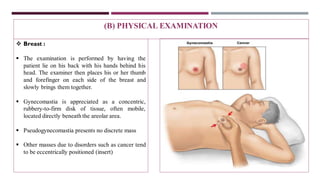
❖ Breast :
▪ The examination is performed by having the
patient lie on his back with his hands behind his
head. The examiner then places his or her thumb
and forefinger on each side of the breast and
slowly brings them together.
▪ Gynecomastia is appreciated as a concentric,
rubbery-to-firm disk of tissue, often mobile,
located directly beneath the areolar area.
▪ Pseudogynecomastia presents no discrete mass
▪ Other masses due to disorders such as cancer tend
to be eccentrically positioned (insert)
(B) PHYSICAL EXAMINATION
❖ Testicularpalpation:
• Exclude tumour.
• Assess testicular size—?atrophy
❖ 2° sex characteristics.
❖ Look for evidence of systemic disease e.g.
• Chronic liver or renal disease,
• Thyrotoxicosis ,
• Cushing's syndrome.
(C) BASELINE INVESTIGATIONS
➢ Serum Testosterone.
➢ Serum estradiol.
➢ LH and FSH.
➢ Prolactin.
➢ SHBG.
➢ Beta hCG.
➢ Liver function tests.
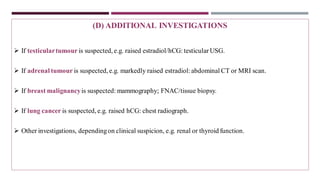
(D) ADDITIONAL INVESTIGATIONS
➢ If testiculartumour is suspected, e.g. raised estradiol/hCG: testicular USG.
➢ If adrenal tumour is suspected, e.g. markedly raised estradiol:abdominal CT or MRI scan.
➢ If breast malignancyis suspected: mammography; FNAC/tissue biopsy.
➢ If lung cancer is suspected, e.g. raised hCG: chest radiograph.
➢ Other investigations, dependingon clinical suspicion, e.g. renal or thyroid function.
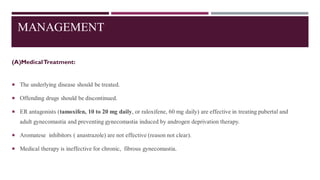
MANAGEMENT
(A)MedicalTreatment:
 The underlying disease should be treated.
 Offending drugs should be discontinued.
 ER antagonists (tamoxifen, 10 to 20 mg daily, or raloxifene, 60 mg daily) are effective in treating pubertal and
adult gynecomastia and preventing gynecomastia induced by androgen deprivation therapy.
 Aromatese inhibitors ( anastrazole) are not effective (reason not clear).
 Medical therapy is ineffective for chronic, fibrous gynecomastia.
(B) Surgery :
With long standing gynecomastia (more than 1 year): surgical reduction mammoplasty
(i.e. removal of breast tissue with or without periareolar adipose tissue) is necessary if
breast enlargement is severe, painful, socially embarrassing or disfiguring.
(C) Radiation therapy :
Low-dosage external beam radiation therapy (900 cGy or less) is effective, but less
effective than tamoxifen, for prevention of gynecomastia due to anti-androgen
monotherapyfor prostatecancer.
COURSE AND PROGNOSIS
➢ Pubertal gynecomastiausuallyregresses spontaneouslywithin 1 or 2 years.
➢ Patients who develop drug-induced gynecomastia generally have complete or near-complete
regression of the breast changes if the offending drug is discontinuedduring the early, florid stage.
➢ Once gynecomastia from any cause has reached the fibrotic stage, little or no spontaneous
regression occurs, and medical therapyis ineffective.
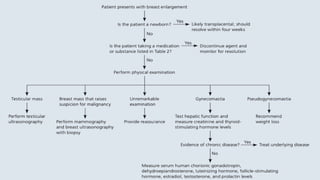
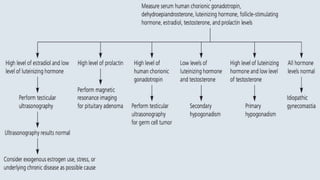
Approach to gynacomastia

Approach to gynacomastia

  • 1.
  • 2.
    DEFINITION ❖ Gynecomastia: A benignproliferation of the glandular tissue of the male breast, is diagnosed as a palpable mass of at least 0.5 cm in diameter (usually underlying and within the area under the nipple). ❖ Pseudo-gynecomastia: Enlargement of the male breast, as a result of increased fat deposition also called as Adipomastia or Lipomastia.
  • 3.
    • Rubbery-to- firm, • Discrete, • Finely Lobular, • Freely mobile disc of tissue, • That extend concentrically from under the nipple & areola. • Soft • Non-discrete • Irregularly lobular • Similarly to subcutaneous fat in abdomen
  • 4.
    PREVALENCE ❖ Asymptomatic palpablebreast tissue is common in normal males, particularly in the neonate(60%–90%), at puberty(60%–70%), and with increasing age (20%–65%, >50 years). ❖ Because of this high prevalence, gynecomastia is considered a relatively normal finding during these periods of life. (so called physiologic at these ages)
  • 5.
  • 8.
    ❖ Gynecomastia resultsfrom an imbalance between the stimulatory effect of estrogen and the inhibitory effect of androgen on breast development. ❖ The imbalance is commonly caused by ; ✓Increased production of estrogen, ✓Decreased production of testosterone, or ✓Increased conversion of androgens to estrogens in peripheral tissue.
  • 9.
    CLINICAL MANIFESTATION ❖ Gynecomastiausually manifests as a palpable, discrete button of tissue radiating from beneath the nipple and areola. ❖ Gynecomastia feels “gritty” when the breast is pinched between the thumb and forefinger. ❖ Fatty tissue (Pseudo-gynecomastia), unlike gynecomastia, will not cause resistance until the nipple is reached. (Difference in clinical examination).
  • 10.
  • 11.
    Histopathological Classification ❖ Threehistologic patternsof gynecomastia have been recognized. • Floridpattern: consists of an increase in the number of buddingducts, • Fibroustype: has dilated ducts, minimal duct epithelial proliferation,no periductaledema, and a virtually acellularfibrous stroma. • Intermediatepattern contains features of both types. ❖ Florid patternresponse well to medical treatment, while fibrous type needs surgical management.
  • 12.
    CAUSES OF GYNECOMASTIA(FREQUENCY %) (A) Physiological : (25%) ▪ Neonatal gynecomastia results from placental transfer of estrogen. ▪ During early puberty, production of estrogens begins earlier than testosterone production, thus causing an imbalance in the ratio of estrogens to androgens. Its usually regresses within 1 to 2 years. (can persist in 25% cases) ▪ With aging, testosterone production decreases, and peripheral androgen to estrogen conversion often increases because of an age-related increase in adipose tissue. (B) Idiopathic : (25%)
  • 13.
    (C) ESTROGEN EXCESS: In post-pubertal boys and adult men, the testes secrete 6-10 µg of estradiol and 2.5 µg of estrone per day. Since this only comprises a small fraction of estrogens in the circulation (i.e. 15% of estradiol and 5% of estrone), the remainder of estrogen in men is derived from the extraglandular aromatization of testosterone and androstenedione to estradiol and estrone.
  • 15.
    (D) Androgen deficiencyor Resistance :
  • 16.
  • 17.
    (E) Drugs byunknown mechanism : • CCBs • Antidepressant • Amphetamines • Penicillamines • Sulindac • Omeprazole • Theophyline
  • 18.
    EVALUATION (A) HISTORY  Age Duration of the gynaecomastia  Presence of pain.  Use of drugs including recreation drugs e.g. Alcohol  Presence of symptoms suggestive of pathological cause.  Symptoms of hypogonadism - reduced libido, erectile dysfunction.  Systemic disease: Hepatic, Renal, Endocrine disease. (Thyrotoxicosis, Cushing syndrome).  Family history of breast malignancy.
  • 19.
    ❖ Breast : ▪The examination is performed by having the patient lie on his back with his hands behind his head. The examiner then places his or her thumb and forefinger on each side of the breast and slowly brings them together. ▪ Gynecomastia is appreciated as a concentric, rubbery-to-firm disk of tissue, often mobile, located directly beneath the areolar area. ▪ Pseudogynecomastia presents no discrete mass ▪ Other masses due to disorders such as cancer tend to be eccentrically positioned (insert) (B) PHYSICAL EXAMINATION
  • 20.
    ❖ Testicularpalpation: • Excludetumour. • Assess testicular size—?atrophy ❖ 2° sex characteristics. ❖ Look for evidence of systemic disease e.g. • Chronic liver or renal disease, • Thyrotoxicosis , • Cushing's syndrome.
  • 21.
    (C) BASELINE INVESTIGATIONS ➢Serum Testosterone. ➢ Serum estradiol. ➢ LH and FSH. ➢ Prolactin. ➢ SHBG. ➢ Beta hCG. ➢ Liver function tests.
  • 22.
    (D) ADDITIONAL INVESTIGATIONS ➢If testiculartumour is suspected, e.g. raised estradiol/hCG: testicular USG. ➢ If adrenal tumour is suspected, e.g. markedly raised estradiol:abdominal CT or MRI scan. ➢ If breast malignancyis suspected: mammography; FNAC/tissue biopsy. ➢ If lung cancer is suspected, e.g. raised hCG: chest radiograph. ➢ Other investigations, dependingon clinical suspicion, e.g. renal or thyroid function.
  • 26.
    MANAGEMENT (A)MedicalTreatment:  The underlyingdisease should be treated.  Offending drugs should be discontinued.  ER antagonists (tamoxifen, 10 to 20 mg daily, or raloxifene, 60 mg daily) are effective in treating pubertal and adult gynecomastia and preventing gynecomastia induced by androgen deprivation therapy.  Aromatese inhibitors ( anastrazole) are not effective (reason not clear).  Medical therapy is ineffective for chronic, fibrous gynecomastia.
  • 27.
    (B) Surgery : Withlong standing gynecomastia (more than 1 year): surgical reduction mammoplasty (i.e. removal of breast tissue with or without periareolar adipose tissue) is necessary if breast enlargement is severe, painful, socially embarrassing or disfiguring. (C) Radiation therapy : Low-dosage external beam radiation therapy (900 cGy or less) is effective, but less effective than tamoxifen, for prevention of gynecomastia due to anti-androgen monotherapyfor prostatecancer.
  • 28.
    COURSE AND PROGNOSIS ➢Pubertal gynecomastiausuallyregresses spontaneouslywithin 1 or 2 years. ➢ Patients who develop drug-induced gynecomastia generally have complete or near-complete regression of the breast changes if the offending drug is discontinuedduring the early, florid stage. ➢ Once gynecomastia from any cause has reached the fibrotic stage, little or no spontaneous regression occurs, and medical therapyis ineffective.