PROJECT BASED
LEARNING
Applying Principles of PBL in the Classroom
Presented by Ramin Yazdanpanah, PhD
English Language Fellow
Defining Project Based Learning
Students work on a project over an extended period of time
– from a week up to a semester – that engages them in
solving a real-world problem or answering a complex
question. They demonstrate their knowledge and skills by
developing a public product or presentation for a real
audience.
As a result, students develop deep content knowledge as
well as critical thinking, creativity, and communication
skills in the context of doing an authentic, meaningful
project. Project Based Learning unleashes a contagious,
creative energy among students and teachers
(www.bie.org/about/what_pbl).
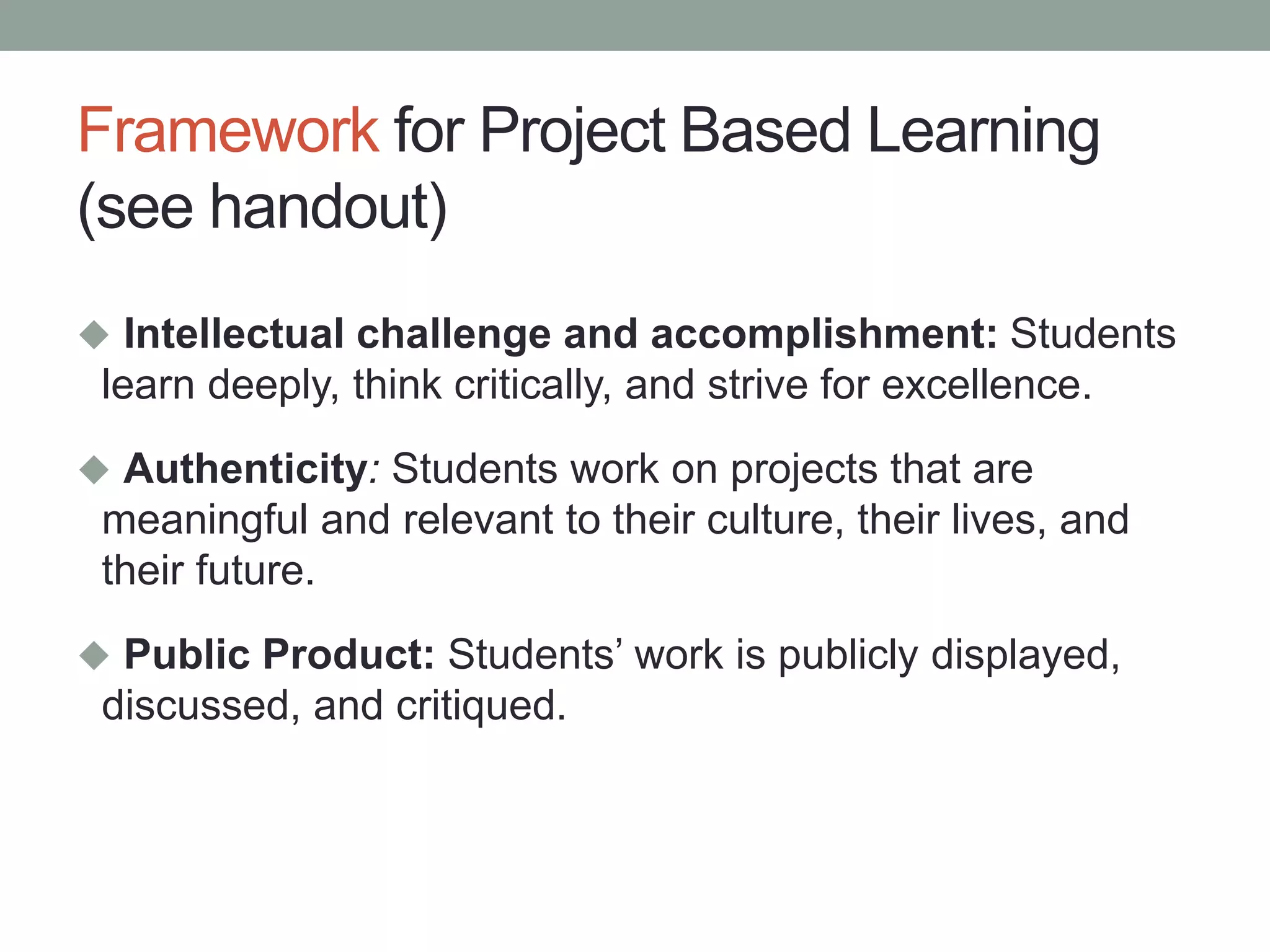
Framework for Project Based Learning
(see handout)
 Intellectual challenge and accomplishment: Students
learn deeply, think critically, and strive for excellence.
 Authenticity: Students work on projects that are
meaningful and relevant to their culture, their lives, and
their future.
 Public Product: Students’ work is publicly displayed,
discussed, and critiqued.
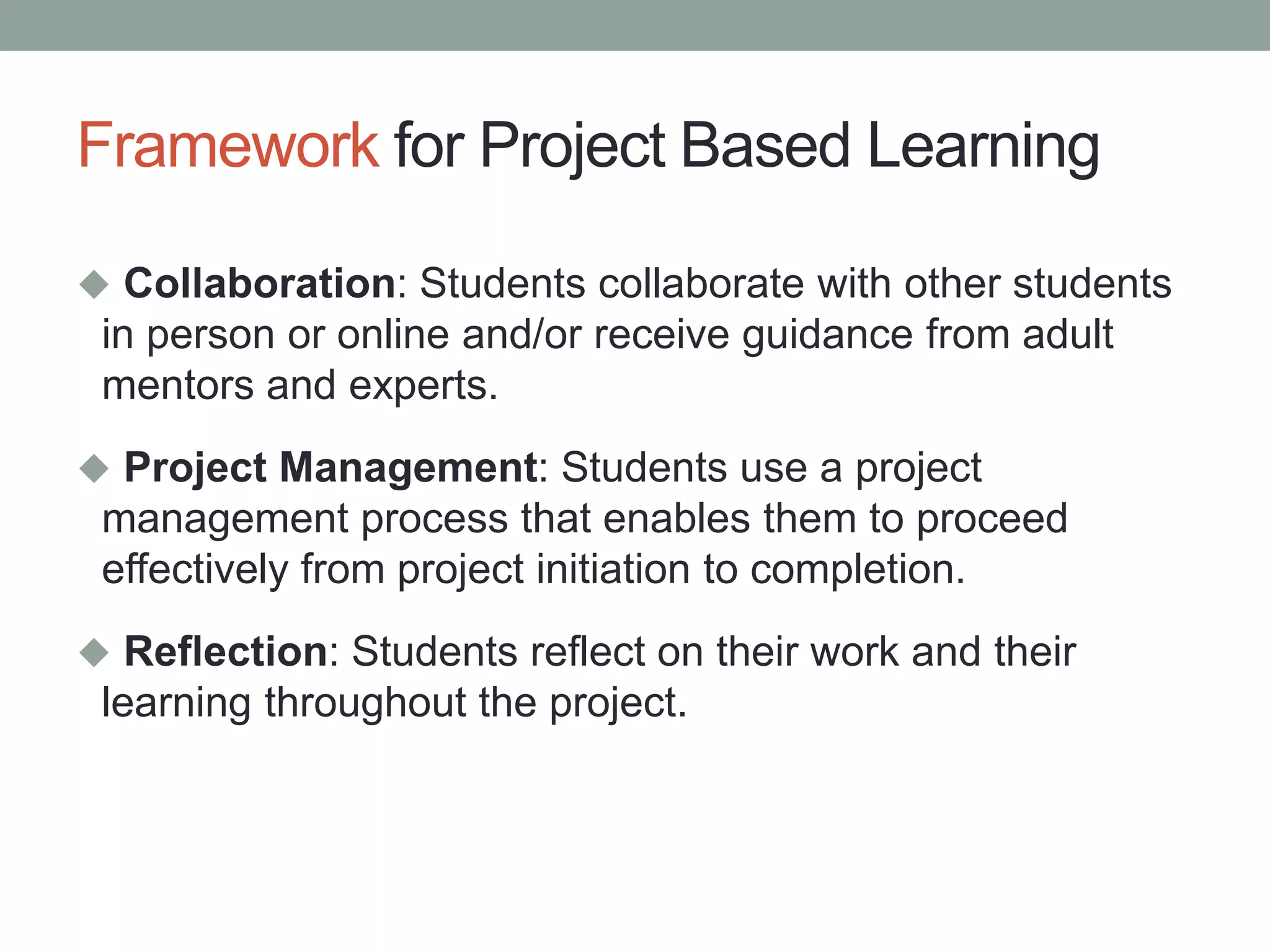
Framework for Project Based Learning
 Collaboration: Students collaborate with other students
in person or online and/or receive guidance from adult
mentors and experts.
 Project Management: Students use a project
management process that enables them to proceed
effectively from project initiation to completion.
 Reflection: Students reflect on their work and their
learning throughout the project.
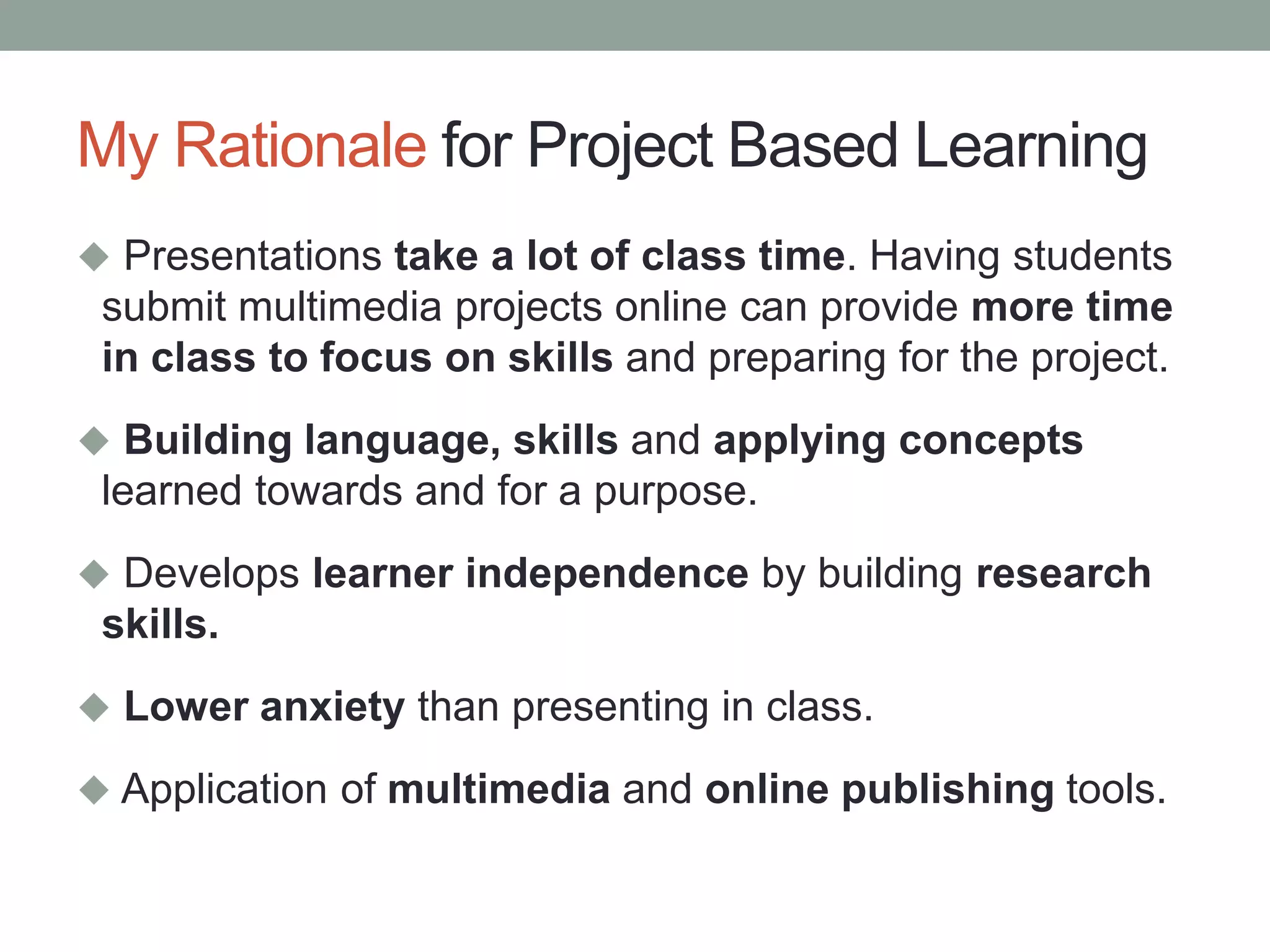
My Rationale for Project Based Learning
 Presentations take a lot of class time. Having students
submit multimedia projects online can provide more time
in class to focus on skills and preparing for the project.
 Building language, skills and applying concepts
learned towards and for a purpose.
 Develops learner independence by building research
skills.
 Lower anxiety than presenting in class.
 Application of multimedia and online publishing tools.
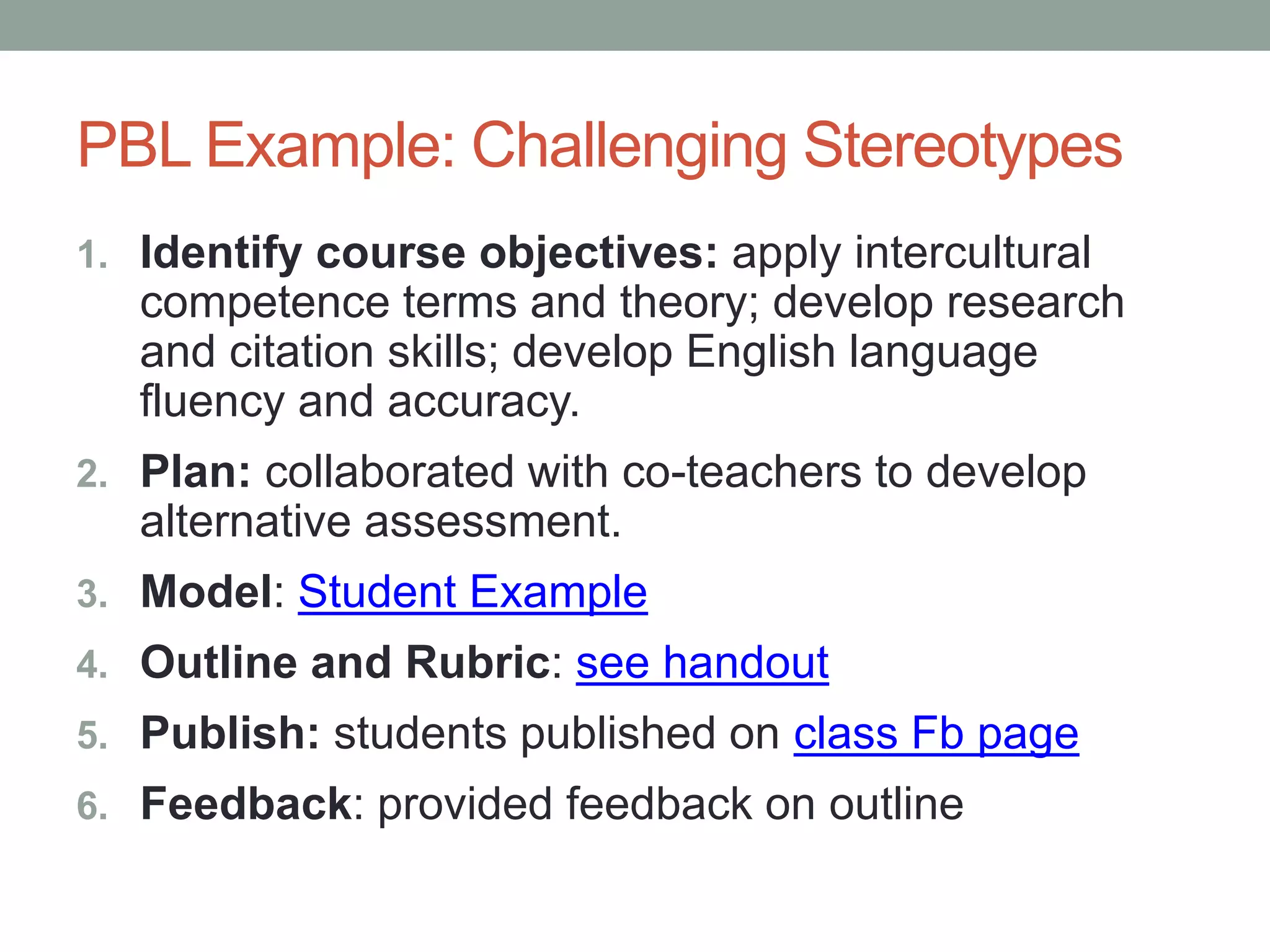
PBL Example: Challenging Stereotypes
1. Identify course objectives: apply intercultural
competence terms and theory; develop research
and citation skills; develop English language
fluency and accuracy.
2. Plan: collaborated with co-teachers to develop
alternative assessment.
3. Model: Student Example
4. Outline and Rubric: see handout
5. Publish: students published on class Fb page
6. Feedback: provided feedback on outline
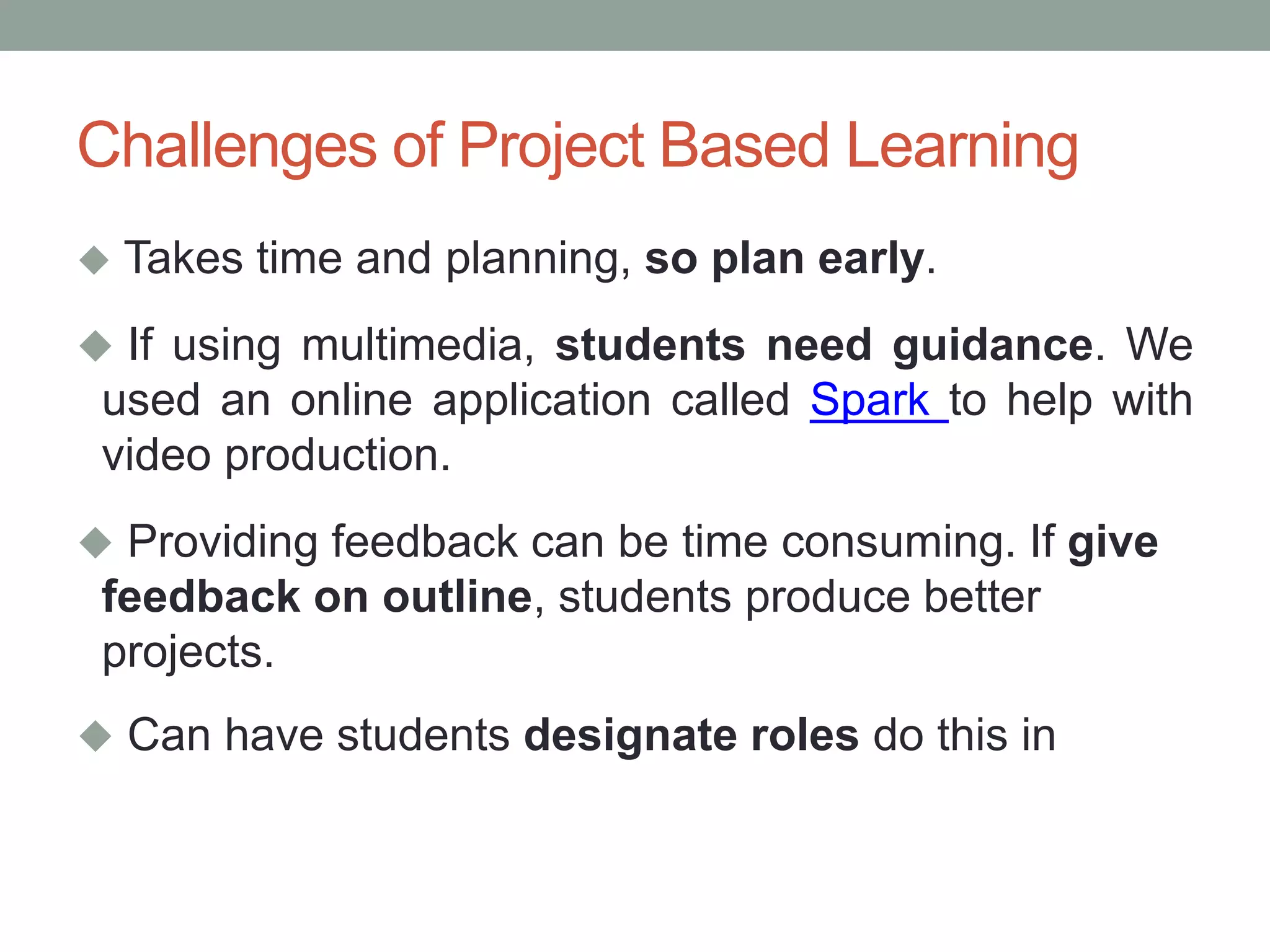
Challenges of Project Based Learning
 Takes time and planning, so plan early.
 If using multimedia, students need guidance. We
used an online application called Spark to help with
video production.
 Providing feedback can be time consuming. If give
feedback on outline, students produce better
projects.
 Can have students designate roles do this in
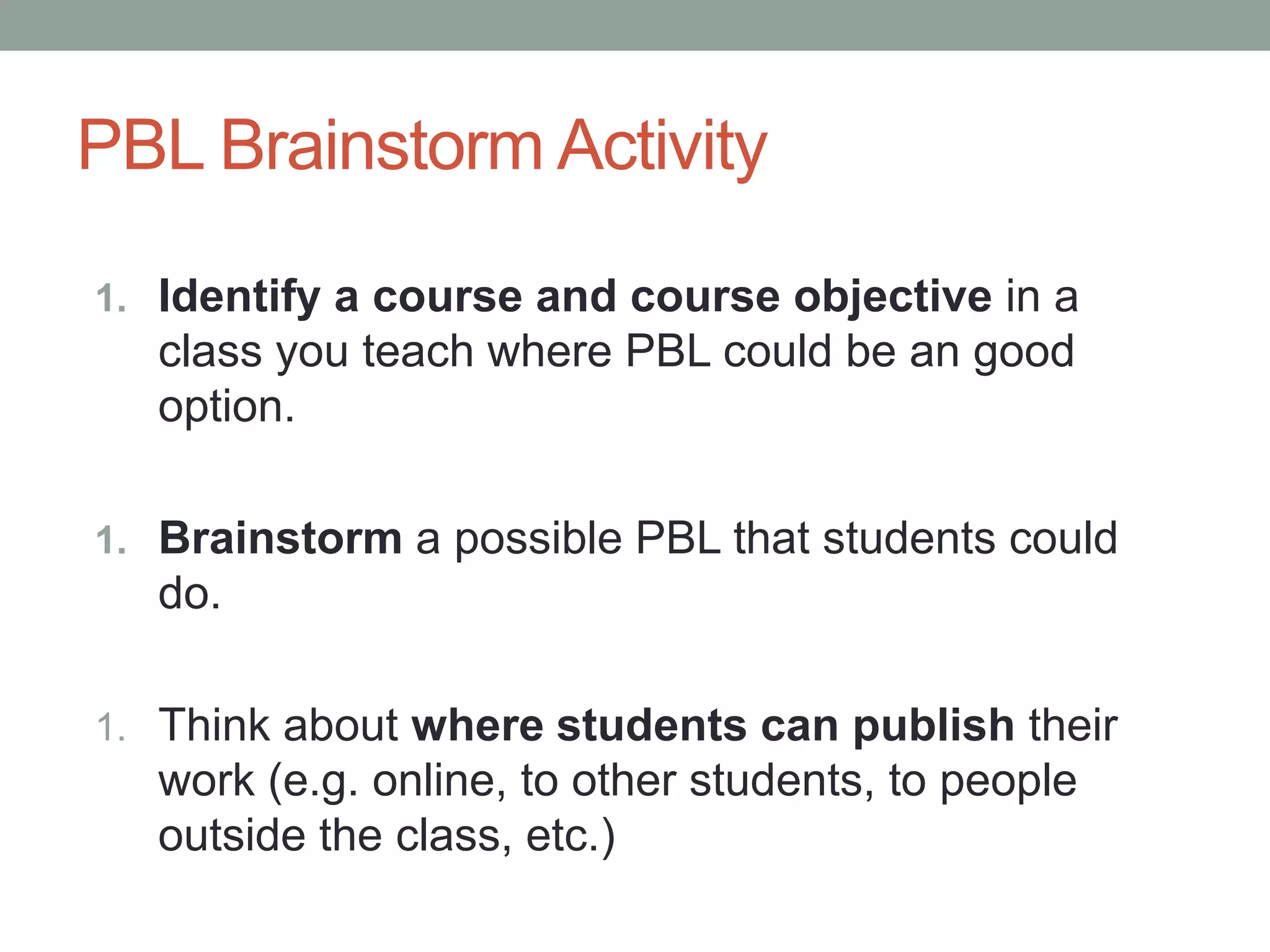
PBL Brainstorm Activity
1. Identify a course and course objective in a
class you teach where PBL could be an good
option.
1. Brainstorm a possible PBL that students could
do.
1. Think about where students can publish their
work (e.g. online, to other students, to people
outside the class, etc.)
Student Feedback
“For me, the final project is very significant and
meaningful. It is not [only] the way I and my friends in class
show what we learned from subject from my teacher, but it
also shows our knowledge about cultures around the world.
Furthermore I can practice my speaking skills and studying
myself about culture which I didn’t know before.”
Student Feedback
“It is quite difficult, but it is so interesting.”
“I got more information about a new concept: stereotypes.
Actually, I sometimes used it on unknown person. But after
I searched about stereotypes on the internet, I knew that
it's wrong when stereotyping someone. So I try not to
stereotype, not to evaluate someone too soon. Through this
assignment I found stereotypes not only in Vietnam, but
also in other countries.”
Tich Nhat Hanh

Applying principles of pbl in the classroom

  • 1.
    PROJECT BASED LEARNING Applying Principlesof PBL in the Classroom Presented by Ramin Yazdanpanah, PhD English Language Fellow
  • 3.
    Defining Project BasedLearning Students work on a project over an extended period of time – from a week up to a semester – that engages them in solving a real-world problem or answering a complex question. They demonstrate their knowledge and skills by developing a public product or presentation for a real audience. As a result, students develop deep content knowledge as well as critical thinking, creativity, and communication skills in the context of doing an authentic, meaningful project. Project Based Learning unleashes a contagious, creative energy among students and teachers (www.bie.org/about/what_pbl).
  • 4.
    Framework for ProjectBased Learning (see handout)  Intellectual challenge and accomplishment: Students learn deeply, think critically, and strive for excellence.  Authenticity: Students work on projects that are meaningful and relevant to their culture, their lives, and their future.  Public Product: Students’ work is publicly displayed, discussed, and critiqued.
  • 5.
    Framework for ProjectBased Learning  Collaboration: Students collaborate with other students in person or online and/or receive guidance from adult mentors and experts.  Project Management: Students use a project management process that enables them to proceed effectively from project initiation to completion.  Reflection: Students reflect on their work and their learning throughout the project.
  • 6.
    My Rationale forProject Based Learning  Presentations take a lot of class time. Having students submit multimedia projects online can provide more time in class to focus on skills and preparing for the project.  Building language, skills and applying concepts learned towards and for a purpose.  Develops learner independence by building research skills.  Lower anxiety than presenting in class.  Application of multimedia and online publishing tools.
  • 7.
    PBL Example: ChallengingStereotypes 1. Identify course objectives: apply intercultural competence terms and theory; develop research and citation skills; develop English language fluency and accuracy. 2. Plan: collaborated with co-teachers to develop alternative assessment. 3. Model: Student Example 4. Outline and Rubric: see handout 5. Publish: students published on class Fb page 6. Feedback: provided feedback on outline
  • 8.
    Challenges of ProjectBased Learning  Takes time and planning, so plan early.  If using multimedia, students need guidance. We used an online application called Spark to help with video production.  Providing feedback can be time consuming. If give feedback on outline, students produce better projects.  Can have students designate roles do this in
  • 9.
    PBL Brainstorm Activity 1.Identify a course and course objective in a class you teach where PBL could be an good option. 1. Brainstorm a possible PBL that students could do. 1. Think about where students can publish their work (e.g. online, to other students, to people outside the class, etc.)
  • 10.
    Student Feedback “For me,the final project is very significant and meaningful. It is not [only] the way I and my friends in class show what we learned from subject from my teacher, but it also shows our knowledge about cultures around the world. Furthermore I can practice my speaking skills and studying myself about culture which I didn’t know before.”
  • 11.
    Student Feedback “It isquite difficult, but it is so interesting.” “I got more information about a new concept: stereotypes. Actually, I sometimes used it on unknown person. But after I searched about stereotypes on the internet, I knew that it's wrong when stereotyping someone. So I try not to stereotype, not to evaluate someone too soon. Through this assignment I found stereotypes not only in Vietnam, but also in other countries.”
  • 12.