TIS PERSPECTIVES 
September 2014 
Applying Google Glass in 
Financial Institutions and 
Enterprises 
Our growth strategy at TIS is centered on leveraging 
new technology, and we have been following the 
evolution of document capture throughout the 
years. Initially, document capture occurred on 
industrial scanners, and over the years has moved 
closer and closer to the point of origination. The 
market has seen explosive growth in desktop 
scanners and most recently in mobile devices. 
Wearable technology is the next revolution of 
document capture, and TIS continues to provide 
innovative capture solutions to keep up with 
changing market demands. 
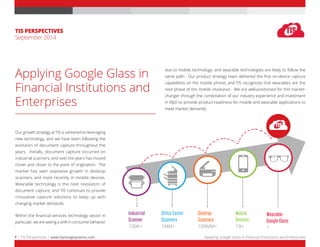
Within the financial services technology sector in 
particular, we are seeing a shift in consumer behavior 
Industrial 
Scanner 
100K+ 
due to mobile technology, and wearable technologies are likely to follow the 
same path. Our product strategy team delivered the first on-device capture 
capabilities on the mobile phone, and TIS recognizes that wearables are the 
next phase of the mobile revolution. We are well-positioned for this market-changer 
through the combination of our industry experience and investment 
in R&D to provide product-readiness for mobile and wearable applications to 
meet market demands. 
Desktop 
Scanners 
100MM+ 
Wearable- 
Google Glass 
? 
Office Center 
Scanners 
1MM+ 
Mobile 
Devices 
1B+ 
1 | TIS Perspectives | www.topimagesystems.com Applying Google Glass in Financial Institutions and Enterprises
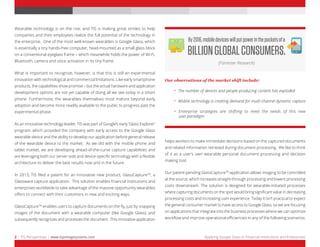
By 2016, mobile devices will put power in the pockets of a 
BILLION GLOBAL CONSUMERS. 
(Forrester Research) 
Our observations of the market shift include: 
• The number of devices and people producing content has exploded 
• Mobile technology is creating demand for multi-channel dynamic capture 
• Enterprise strategies are shifting to meet the needs of this new 
user paradigm 
helps workers to make immediate decisions based on the captured documents 
and related information retrieved during document processing. We like to think 
of it as a user’s own wearable personal document processing and decision 
making tool. 
Our patent-pending GlassCaptureTM application allows imaging to be controlled 
at the source, which increases straight-through processing and lowers processing 
costs downstream. The solution is designed for wearable-initiated processes 
where capturing documents on the spot would bring significant value in decreasing 
processing costs and increasing user experience. Today it isn’t practical to expect 
the general consumer market to have access to Google Glass, so we are focusing 
on applications that integrate into the business processes where we can optimize 
workflow and improve operational efficiencies in any of the following scenarios: 
Wearable technology is on the rise, and TIS is making great strides to help 
companies and their employees realize the full potential of the technology in 
the enterprise. One of the most well-known wearables is Google Glass, which 
is essentially a tiny hands-free computer, head-mounted as a small glass block 
on a conventional eyeglass frame – which meanwhile holds the power of Wi-Fi, 
Bluetooth, camera and voice activation in its tiny frame. 
What is important to recognize, however, is that this is still an experimental 
innovation with technological and commercial limitations. Like early smartphone 
products, the capabilities show promise – but the actual hardware and application 
development options are not yet capable of doing all we see today in a smart 
phone. Furthermore, the wearables themselves must mature beyond early 
adoption and become more readily available to the public to progress past the 
experimental phase. 
As an innovative technology leader, TIS was part of Google’s early ‘Glass Explorer’ 
program, which provided the company with early access to the Google Glass 
wearable device and the ability to develop our application before general release 
of the wearable device to the market. As we did with the mobile phone and 
tablet market, we are developing ahead-of-the-curve capture capabilities and 
are leveraging both our server-side and device-specific technology with a flexible 
architecture to deliver the best results now and in the future. 
In 2013, TIS filed a patent for an innovative new product, GlassCaptureTM, a 
Glassware capture application. This solution enables financial institutions and 
enterprises worldwide to take advantage of the massive opportunity wearables 
offers to connect with their customers in new and exciting ways. 
GlassCaptureTM enables users to capture documents on the fly, just by snapping 
images of the document with a wearable computer (like Google Glass), and 
subsequently recognizes and processes the document. This innovative application 
2 | TIS Perspectives | www.topimagesystems.com Applying Google Glass in Financial Institutions and Enterprises
The teller will immediately see details about the potential customer by scanning 
his ID card with the tablet; such as credit history, current loans and other financial 
details like suggested interest rates that available to the bank. In the future as 
technology within Google Glass improves, the teller would simply look at the 
customer’s ID and the TIS GlassCaptureTM app will perform the recognition and 
look up. 
When going over the property documents and invoking the GlassCaptureTM app, 
the teller could see the property worth, if there are any pending foreclosures 
on that property, and who the current owner is – all without reverting from the 
conversation with the customer and without typing anything on the computer. 
Corporate Accountant Processing A Paper Invoice Received In 
The Mail 
An accountant in a corporation receives an invoice, and the information is 
retrieved while she is looking at it with GlassCaptureTM - which is in turn receiving 
data validation from the corporate ERP system. The accountant is shown who 
issued the PO for that invoice, who approved it, what is the related budget for 
that invoice, and whether or not that invoice has been paid. 
The system enables the accountant to process many more invoices that she 
could have if she had to type and search for each invoice individually. This 
method also reduces the chances of error by the accountant due to a typo or 
confusion between the many invoices she needs to deal with. 
Sorting Paper Mail In A Large Enterprise 
A clerk working for a large enterprise goes though and sorts mail in the company 
mailroom. Some of the envelopes are addressed to specific people that the clerk 
does not know, nor does he know which department or building they work in. 
Completing A Life Or P&C Insurance Application With An Agent And 
An Application Transaction 
In today’s mobile-first environment, the best solutions work across devices. TIS 
has developed solutions that allow for enrollment on a mobile device, for example 
meeting with a client at their home or in the field rather than only in the office. 
A life insurance or P&C agent is sitting in-front of an applicant working from an 
iPad. Together, they are completing forms for the application. The agent simplifies 
completion of the form by taking a picture of an ID with the tablet using the 
integrated TIS MobiENROLL APMI on-device capture technology. This also 
automatically saves and archives a copy of the customer’s ID for future use. 
As they are completing the form, the agent will often need to collect supporting 
documentation associated with the application. For example, the agent receives 
information about the applicant and the proposed policy while they are conversing 
over the policy. Such information could include previous claims of the applicant, 
proposed coverage, estimated monthly fee and possible insurance plans for 
other family members. These documents are captured and processed by the 
agent’s Google Glass GlassCaptureTM app automatically as they read and review 
these documents, without interruption in the flow of the conversation. Finally, 
the agent is able to take payment on the spot by capturing an image of the check 
for immediate processing with our MobiCHECK mobile deposit capabilities on 
the tablet, thus expediting the in good order (IGO) process. 
Applying For A Mortgage At A Bank 
A customer sits in front of a loan officer at a bank for a new mortgage application. 
The person presents the banker with his identification card or driver’s license, 
documents on the property he wants to buy and documents on the property 
he currently owns. 
3 | TIS Perspectives | www.topimagesystems.com Applying Google Glass in Financial Institutions and Enterprises
Using GlassCaptureTM, the mail clerk could get precise information just by invoking 
GlassCapture™ and looking at the envelope as the system queries the company 
directory, displaying the correct department of the mail recipient. It could also 
analyze the sender of the document to ensure the documents’ priority. 
This means that the mail clerk could deduce a lot of information from the limited 
address details on the envelope. GlassCaptureTM will also help him finish his 
work faster and with far less mistakes. 
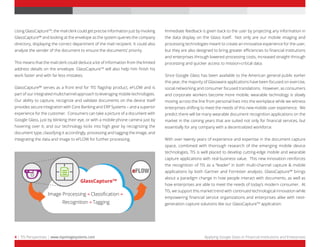
GlassCapture™ serves as a front end for TIS’ flagship product, eFLOW and is 
part of our integrated multichannel approach to leveraging mobile technologies. 
Our ability to capture, recognize and validate documents on the device itself 
provides secure integration with Core Banking and ERP Systems – and a superior 
experience for the customer. Consumers can take a picture of a document with 
Google Glass, just by blinking their eye, or with a mobile phone camera just by 
hovering over it; and our technology kicks into high gear by recognizing the 
document type, classifying it accordingly, processing and tagging the image, and 
integrating the data and image to eFLOW for further processing. 
Immediate feedback is given back to the user by projecting any information in 
the data display on the Glass itself. Not only are our mobile imaging and 
processing technologies meant to create an innovative experience for the user, 
but they are also designed to bring greater efficiencies to financial institutions 
and enterprises through lowered processing costs, increased straight through 
processing and quicker access to mission-critical data. 
Since Google Glass has been available to the American general public earlier 
this year, the majority of Glassware applications have been focused on exercise, 
social networking and consumer focused translations. However, as consumers 
and corporate workers become more mobile, wearable technology is slowly 
moving across the line from personal lives into the workplace while we witness 
enterprises shifting to meet the needs of this new mobile user experience. We 
predict there will be many wearable document recognition applications on the 
market in the coming years that are suited not only for financial services, but 
essentially for any company with a decentralized workforce. 
With over twenty years of experience and expertise in the document capture 
space, combined with thorough research of the emerging mobile device 
technologies, TIS is well placed to develop cutting-edge mobile and wearable 
capture applications with real business value. This new innovation reinforces 
the recognition of TIS as a “leader” in both multi-channel capture & mobile 
applications by both Gartner and Forrester analysts. GlassCapture™ brings 
about a paradigm change in how people interact with documents, as well as 
how enterprises are able to meet the needs of today’s modern consumer. At 
TIS, we support this market trend with continued technological innovation while 
empowering financial service organizations and enterprises alike with next-generation 
capture solutions like our GlassCaptureTM application. 
GlassCaptureTM 
Image ProcessingClassification 
RecognitionTagging 
4 | TIS Perspectives | www.topimagesystems.com Applying Google Glass in Financial Institutions and Enterprises

Applying google glass to enterprises

  • 1.
    TIS PERSPECTIVES September2014 Applying Google Glass in Financial Institutions and Enterprises Our growth strategy at TIS is centered on leveraging new technology, and we have been following the evolution of document capture throughout the years. Initially, document capture occurred on industrial scanners, and over the years has moved closer and closer to the point of origination. The market has seen explosive growth in desktop scanners and most recently in mobile devices. Wearable technology is the next revolution of document capture, and TIS continues to provide innovative capture solutions to keep up with changing market demands. Within the financial services technology sector in particular, we are seeing a shift in consumer behavior Industrial Scanner 100K+ due to mobile technology, and wearable technologies are likely to follow the same path. Our product strategy team delivered the first on-device capture capabilities on the mobile phone, and TIS recognizes that wearables are the next phase of the mobile revolution. We are well-positioned for this market-changer through the combination of our industry experience and investment in R&D to provide product-readiness for mobile and wearable applications to meet market demands. Desktop Scanners 100MM+ Wearable- Google Glass ? Office Center Scanners 1MM+ Mobile Devices 1B+ 1 | TIS Perspectives | www.topimagesystems.com Applying Google Glass in Financial Institutions and Enterprises
  • 2.
    By 2016, mobiledevices will put power in the pockets of a BILLION GLOBAL CONSUMERS. (Forrester Research) Our observations of the market shift include: • The number of devices and people producing content has exploded • Mobile technology is creating demand for multi-channel dynamic capture • Enterprise strategies are shifting to meet the needs of this new user paradigm helps workers to make immediate decisions based on the captured documents and related information retrieved during document processing. We like to think of it as a user’s own wearable personal document processing and decision making tool. Our patent-pending GlassCaptureTM application allows imaging to be controlled at the source, which increases straight-through processing and lowers processing costs downstream. The solution is designed for wearable-initiated processes where capturing documents on the spot would bring significant value in decreasing processing costs and increasing user experience. Today it isn’t practical to expect the general consumer market to have access to Google Glass, so we are focusing on applications that integrate into the business processes where we can optimize workflow and improve operational efficiencies in any of the following scenarios: Wearable technology is on the rise, and TIS is making great strides to help companies and their employees realize the full potential of the technology in the enterprise. One of the most well-known wearables is Google Glass, which is essentially a tiny hands-free computer, head-mounted as a small glass block on a conventional eyeglass frame – which meanwhile holds the power of Wi-Fi, Bluetooth, camera and voice activation in its tiny frame. What is important to recognize, however, is that this is still an experimental innovation with technological and commercial limitations. Like early smartphone products, the capabilities show promise – but the actual hardware and application development options are not yet capable of doing all we see today in a smart phone. Furthermore, the wearables themselves must mature beyond early adoption and become more readily available to the public to progress past the experimental phase. As an innovative technology leader, TIS was part of Google’s early ‘Glass Explorer’ program, which provided the company with early access to the Google Glass wearable device and the ability to develop our application before general release of the wearable device to the market. As we did with the mobile phone and tablet market, we are developing ahead-of-the-curve capture capabilities and are leveraging both our server-side and device-specific technology with a flexible architecture to deliver the best results now and in the future. In 2013, TIS filed a patent for an innovative new product, GlassCaptureTM, a Glassware capture application. This solution enables financial institutions and enterprises worldwide to take advantage of the massive opportunity wearables offers to connect with their customers in new and exciting ways. GlassCaptureTM enables users to capture documents on the fly, just by snapping images of the document with a wearable computer (like Google Glass), and subsequently recognizes and processes the document. This innovative application 2 | TIS Perspectives | www.topimagesystems.com Applying Google Glass in Financial Institutions and Enterprises
  • 3.
    The teller willimmediately see details about the potential customer by scanning his ID card with the tablet; such as credit history, current loans and other financial details like suggested interest rates that available to the bank. In the future as technology within Google Glass improves, the teller would simply look at the customer’s ID and the TIS GlassCaptureTM app will perform the recognition and look up. When going over the property documents and invoking the GlassCaptureTM app, the teller could see the property worth, if there are any pending foreclosures on that property, and who the current owner is – all without reverting from the conversation with the customer and without typing anything on the computer. Corporate Accountant Processing A Paper Invoice Received In The Mail An accountant in a corporation receives an invoice, and the information is retrieved while she is looking at it with GlassCaptureTM - which is in turn receiving data validation from the corporate ERP system. The accountant is shown who issued the PO for that invoice, who approved it, what is the related budget for that invoice, and whether or not that invoice has been paid. The system enables the accountant to process many more invoices that she could have if she had to type and search for each invoice individually. This method also reduces the chances of error by the accountant due to a typo or confusion between the many invoices she needs to deal with. Sorting Paper Mail In A Large Enterprise A clerk working for a large enterprise goes though and sorts mail in the company mailroom. Some of the envelopes are addressed to specific people that the clerk does not know, nor does he know which department or building they work in. Completing A Life Or P&C Insurance Application With An Agent And An Application Transaction In today’s mobile-first environment, the best solutions work across devices. TIS has developed solutions that allow for enrollment on a mobile device, for example meeting with a client at their home or in the field rather than only in the office. A life insurance or P&C agent is sitting in-front of an applicant working from an iPad. Together, they are completing forms for the application. The agent simplifies completion of the form by taking a picture of an ID with the tablet using the integrated TIS MobiENROLL APMI on-device capture technology. This also automatically saves and archives a copy of the customer’s ID for future use. As they are completing the form, the agent will often need to collect supporting documentation associated with the application. For example, the agent receives information about the applicant and the proposed policy while they are conversing over the policy. Such information could include previous claims of the applicant, proposed coverage, estimated monthly fee and possible insurance plans for other family members. These documents are captured and processed by the agent’s Google Glass GlassCaptureTM app automatically as they read and review these documents, without interruption in the flow of the conversation. Finally, the agent is able to take payment on the spot by capturing an image of the check for immediate processing with our MobiCHECK mobile deposit capabilities on the tablet, thus expediting the in good order (IGO) process. Applying For A Mortgage At A Bank A customer sits in front of a loan officer at a bank for a new mortgage application. The person presents the banker with his identification card or driver’s license, documents on the property he wants to buy and documents on the property he currently owns. 3 | TIS Perspectives | www.topimagesystems.com Applying Google Glass in Financial Institutions and Enterprises
  • 4.
    Using GlassCaptureTM, themail clerk could get precise information just by invoking GlassCapture™ and looking at the envelope as the system queries the company directory, displaying the correct department of the mail recipient. It could also analyze the sender of the document to ensure the documents’ priority. This means that the mail clerk could deduce a lot of information from the limited address details on the envelope. GlassCaptureTM will also help him finish his work faster and with far less mistakes. GlassCapture™ serves as a front end for TIS’ flagship product, eFLOW and is part of our integrated multichannel approach to leveraging mobile technologies. Our ability to capture, recognize and validate documents on the device itself provides secure integration with Core Banking and ERP Systems – and a superior experience for the customer. Consumers can take a picture of a document with Google Glass, just by blinking their eye, or with a mobile phone camera just by hovering over it; and our technology kicks into high gear by recognizing the document type, classifying it accordingly, processing and tagging the image, and integrating the data and image to eFLOW for further processing. Immediate feedback is given back to the user by projecting any information in the data display on the Glass itself. Not only are our mobile imaging and processing technologies meant to create an innovative experience for the user, but they are also designed to bring greater efficiencies to financial institutions and enterprises through lowered processing costs, increased straight through processing and quicker access to mission-critical data. Since Google Glass has been available to the American general public earlier this year, the majority of Glassware applications have been focused on exercise, social networking and consumer focused translations. However, as consumers and corporate workers become more mobile, wearable technology is slowly moving across the line from personal lives into the workplace while we witness enterprises shifting to meet the needs of this new mobile user experience. We predict there will be many wearable document recognition applications on the market in the coming years that are suited not only for financial services, but essentially for any company with a decentralized workforce. With over twenty years of experience and expertise in the document capture space, combined with thorough research of the emerging mobile device technologies, TIS is well placed to develop cutting-edge mobile and wearable capture applications with real business value. This new innovation reinforces the recognition of TIS as a “leader” in both multi-channel capture & mobile applications by both Gartner and Forrester analysts. GlassCapture™ brings about a paradigm change in how people interact with documents, as well as how enterprises are able to meet the needs of today’s modern consumer. At TIS, we support this market trend with continued technological innovation while empowering financial service organizations and enterprises alike with next-generation capture solutions like our GlassCaptureTM application. GlassCaptureTM Image ProcessingClassification RecognitionTagging 4 | TIS Perspectives | www.topimagesystems.com Applying Google Glass in Financial Institutions and Enterprises