EMPOWERMENT
TECHNOLOGIES
11
Gil M. Abanador
Applied
Productivity
Tools using
Word
Processor
11
Recognize potential career growth opportunities for Qualification of Data
Encoder:
1. Educational Background
 High school diploma or equivalent (minimum requirement).
 Associate’s or bachelor’s degree in business administration,
information technology, or a related field (preferred but not always
required)
2. Technical Skills
 Proficiency in typing with a high accuracy rate (at least 20-60 words
per minute is often required).
Knowledge of data entry software, Microsoft Office (Excel, Word), and
Google Workspace.
 Familiarity with database management systems and data processing
software.
3. Work Experience
 Previous experience in data entry, administrative support, or clerical
work (preferred but not always necessary for entry-level roles)
Word Processor
A word processor is a computer program or
device that provides for input, editing,
formatting and output of text often with some
additional features. Early word processors were
stand-alone devices often on its function, but
current word processors are word processor
programs running on general purpose
computers.
11
What is word processing?
The use of computer to write or
create letters, reports or
documents.
Enables you to save time and
to improve the appearance of
your documents.
11
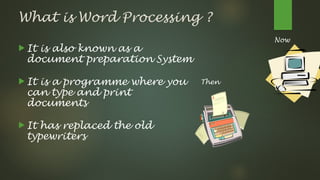
What is Word Processing ?
 It is also known as a
document preparation System
 It is a programme where you
can type and print
documents
 It has replaced the old
typewriters
Then
Now
Application areas of word processing :
Business - Legal Copies, Letterheads,
Letters, Memos, Circulars etc.
Education - To develop word processing
skills from the very beginning
Home - Dealing with assignments being
completed at home, or occasionally
recreational e.g. Maintaining diary
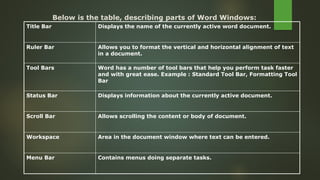
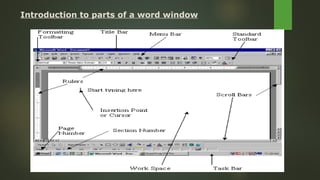
Below is the table, describing parts of Word Windows:
Title Bar Displays the name of the currently active word document.
Ruler Bar Allows you to format the vertical and horizontal alignment of text
in a document.
Tool Bars Word has a number of tool bars that help you perform task faster
and with great ease. Example : Standard Tool Bar, Formatting Tool
Bar
Status Bar Displays information about the currently active document.
Scroll Bar Allows scrolling the content or body of document.
Workspace Area in the document window where text can be entered.
Menu Bar Contains menus doing separate tasks.
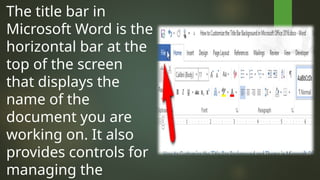
The title bar in
Microsoft Word is the
horizontal bar at the
top of the screen
that displays the
name of the
document you are
working on. It also
provides controls for
managing the
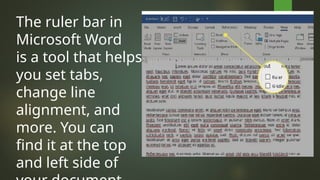
The ruler bar in
Microsoft Word
is a tool that helps
you set tabs,
change line
alignment, and
more. You can
find it at the top
and left side of
Microsoft Word
One of the most popular and
powerful word processing software
today.
You can easily create simple and
complex documents like memos
and reports.
11
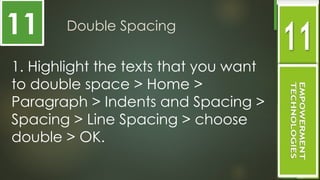
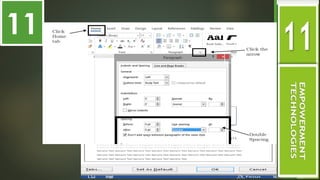
Double Spacing
1. Highlight the texts that you want
to double space > Home >
Paragraph > Indents and Spacing >
Spacing > Line Spacing > choose
double > OK.
11
11
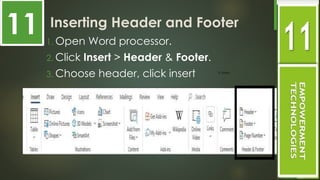
Inserting Header and Footer
1. Open Word processor.
2. Click Insert > Header & Footer.
3. Choose header, click insert & Footer
11
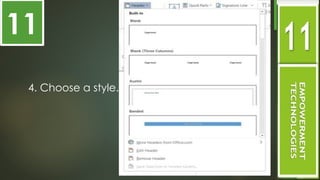
4. Choose a style.
11
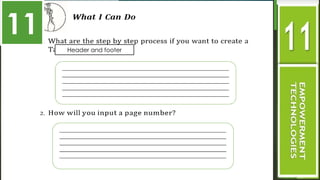
Inserting a Page Number
1. In the same area of the footer
and header, select the page
number.
2. Choose what format and style
you want to use in a page
number.
11
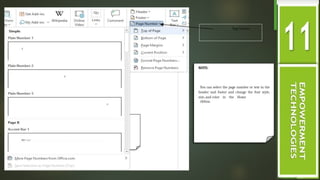
Page Number
NOTE:
You can select the page number or text in the
header and footer and change the font style,
size, and color in the Home
ribbon.
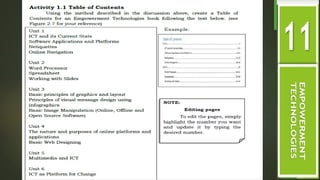
Creating a Table of Contents
 Create a new Word document, name it
“Table of Contents” and input the
following:
Unit 1
ICT and its Current State
Software Applications and Platforms Netiquettes
Online Navigation
Unit 2
Word Processor Spreadsheet Working with
Slides
11
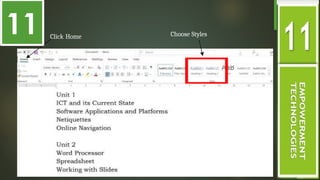
For each text, apply Heading
Style. For Unit 1 and 2, apply
Heading 1 and for the rest of
the text apply Heading 2. Click
Home > Choose Styles group >
Heading 1 or Heading 2.
11
Click Home Choose Styles
11
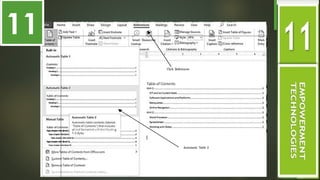
 Click in the beginning of the document to
move the insertion point.
 If you want to make it automatic in
putting label in your “Table of Contents”,
press, References > Table of Contents
group > then the click Automatic Table 2.
11
Figure 2.6 Applying Automatic Table 2 i
Automatic Table 2
Click References
11
Header and footer
11
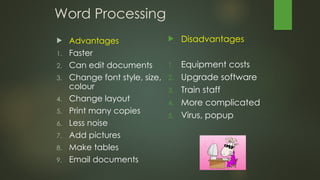
Word Processing
 Advantages
1. Faster
2. Can edit documents
3. Change font style, size,
colour
4. Change layout
5. Print many copies
6. Less noise
7. Add pictures
8. Make tables
9. Email documents
 Disadvantages
1. Equipment costs
2. Upgrade software
3. Train staff
4. More complicated
5. Virus, popup
Introduction to parts of a word window
How to enter and edit text
You can enter text by using the keyboard
Editing text may involve inserting, deleting,
or amending
Other possible methods are using a
scanner and optical character recognition
(OCR)
You can do this by speaking into a
microphone or using voice recognition
software
Word Wrap
With a word processor, when you reach
the end of a line you don’t need to use
the return key to make a new line.
Word processor will make a new line
automatically and it will move partly
completed words at the end of one line to
the start of the next line
Word Count
It is very useful if you are writing an
essay or an article containing a
certain amount of words
Instead of using spell checker to
count words use word count it saves
time.
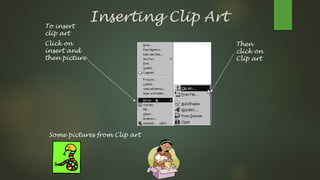
Inserting Clip Art
To insert
clip art
Click on
insert and
then picture
Then
click on
Clip art
Some pictures from Clip art
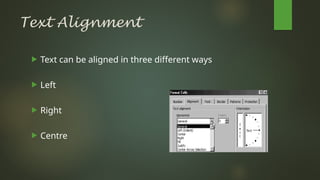
Text Alignment
 Text can be aligned in three different ways
 Left
 Right
 Centre
Features of Word Processor
 Search and Replace
We use this feature to replace a word a
number of times in a document.
 Spell Checker
The spell checker works by comparing the
typed word to words in the computer’s
internal dictionary, any word it does not
recognise it will place a red line underneath.
Features of Word Processor
 Grammar Check
 This feature works by highlighting
sentences with grammatical errors, for
example
 I seen everyone coming along
 Standard Paragraph
 A standard paragraph is a piece of
text that has been typed up, saved to
backing storage and inserted into a
document a number of times
Features of Word Processor
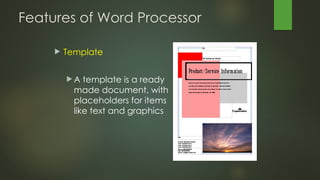
 Template
 A template is a ready
made document, with
placeholders for items
like text and graphics
WYSIWYG
 Development of higher-resolution monitors allowed
them to provide limited WYSIWYG - What You See Is
What You Get, to the extent that typographical
features like bold and italics, indentation, justification
and margins were approximated on screen.
 MacWrite, Microsoft Word and other word processing
programs for the bit-mapped Apple Macintosh
screen, introduced in 1984, were probably the first true
WYSIWYG word processors to become known to many
people until the introduction of Microsoft Windows.
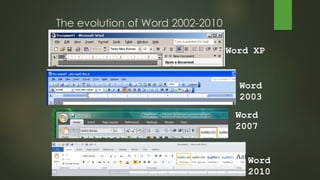
The evolution of Word 2002-2010
36
Word XP
Word
2003
Word
2007
Word
2010
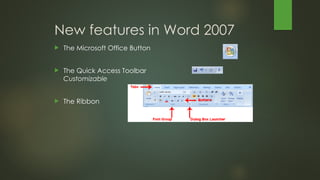
New features in Word 2007
 The Microsoft Office Button
 The Quick Access Toolbar
Customizable
 The Ribbon
THANK
YOU
11
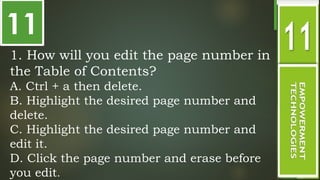
1. How will you edit the page number in
the Table of Contents?
A. Ctrl + a then delete.
B. Highlight the desired page number and
delete.
C. Highlight the desired page number and
edit it.
D. Click the page number and erase before
you edit.
11
.
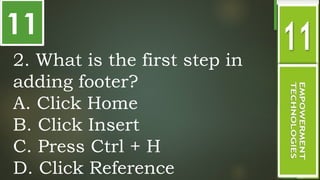
2. What is the first step in
adding footer?
A. Click Home
B. Click Insert
C. Press Ctrl + H
D. Click Reference
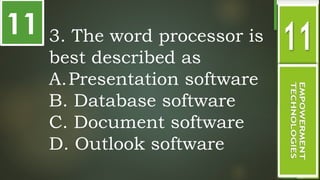
11 3. The word processor is
best described as
A.Presentation software
B. Database software
C. Document software
D. Outlook software
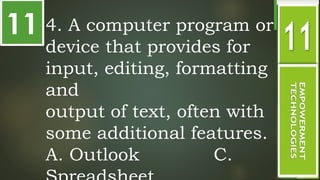
11 4. A computer program or
device that provides for
input, editing, formatting
and
output of text, often with
some additional features.
A. Outlook C.
11
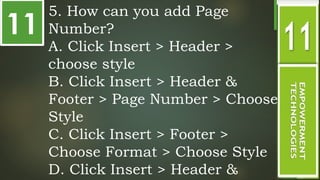
5. How can you add Page
Number?
A. Click Insert > Header >
choose style
B. Click Insert > Header &
Footer > Page Number > Choose
Style
C. Click Insert > Footer >
Choose Format > Choose Style
D. Click Insert > Header &
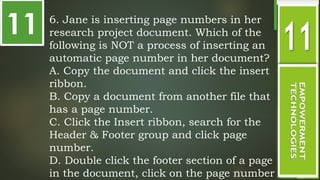
11 6. Jane is inserting page numbers in her
research project document. Which of the
following is NOT a process of inserting an
automatic page number in her document?
A. Copy the document and click the insert
ribbon.
B. Copy a document from another file that
has a page number.
C. Click the Insert ribbon, search for the
Header & Footer group and click page
number.
D. Double click the footer section of a page
in the document, click on the page number
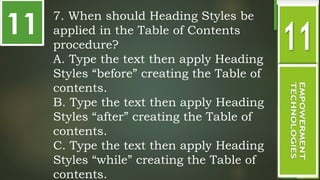
11 7. When should Heading Styles be
applied in the Table of Contents
procedure?
A. Type the text then apply Heading
Styles “before” creating the Table of
contents.
B. Type the text then apply Heading
Styles “after” creating the Table of
contents.
C. Type the text then apply Heading
Styles “while” creating the Table of
contents.


appliedproductivitytoolsusingwordprocessor.pptx

  • 1.
  • 2.
  • 3.
    Recognize potential careergrowth opportunities for Qualification of Data Encoder: 1. Educational Background  High school diploma or equivalent (minimum requirement).  Associate’s or bachelor’s degree in business administration, information technology, or a related field (preferred but not always required) 2. Technical Skills  Proficiency in typing with a high accuracy rate (at least 20-60 words per minute is often required). Knowledge of data entry software, Microsoft Office (Excel, Word), and Google Workspace.  Familiarity with database management systems and data processing software. 3. Work Experience  Previous experience in data entry, administrative support, or clerical work (preferred but not always necessary for entry-level roles)
  • 4.
    Word Processor A wordprocessor is a computer program or device that provides for input, editing, formatting and output of text often with some additional features. Early word processors were stand-alone devices often on its function, but current word processors are word processor programs running on general purpose computers. 11
  • 5.
    What is wordprocessing? The use of computer to write or create letters, reports or documents. Enables you to save time and to improve the appearance of your documents. 11
  • 6.
    What is WordProcessing ?  It is also known as a document preparation System  It is a programme where you can type and print documents  It has replaced the old typewriters Then Now
  • 7.
    Application areas ofword processing : Business - Legal Copies, Letterheads, Letters, Memos, Circulars etc. Education - To develop word processing skills from the very beginning Home - Dealing with assignments being completed at home, or occasionally recreational e.g. Maintaining diary
  • 8.
    Below is thetable, describing parts of Word Windows: Title Bar Displays the name of the currently active word document. Ruler Bar Allows you to format the vertical and horizontal alignment of text in a document. Tool Bars Word has a number of tool bars that help you perform task faster and with great ease. Example : Standard Tool Bar, Formatting Tool Bar Status Bar Displays information about the currently active document. Scroll Bar Allows scrolling the content or body of document. Workspace Area in the document window where text can be entered. Menu Bar Contains menus doing separate tasks.
  • 9.
    The title barin Microsoft Word is the horizontal bar at the top of the screen that displays the name of the document you are working on. It also provides controls for managing the
  • 10.
    The ruler barin Microsoft Word is a tool that helps you set tabs, change line alignment, and more. You can find it at the top and left side of
  • 11.
    Microsoft Word One ofthe most popular and powerful word processing software today. You can easily create simple and complex documents like memos and reports. 11
  • 12.
    Double Spacing 1. Highlightthe texts that you want to double space > Home > Paragraph > Indents and Spacing > Spacing > Line Spacing > choose double > OK. 11
  • 13.
  • 14.
    Inserting Header andFooter 1. Open Word processor. 2. Click Insert > Header & Footer. 3. Choose header, click insert & Footer 11
  • 15.
    4. Choose astyle. 11
  • 16.
    Inserting a PageNumber 1. In the same area of the footer and header, select the page number. 2. Choose what format and style you want to use in a page number. 11
  • 17.
    Page Number NOTE: You canselect the page number or text in the header and footer and change the font style, size, and color in the Home ribbon.
  • 18.
    Creating a Tableof Contents  Create a new Word document, name it “Table of Contents” and input the following: Unit 1 ICT and its Current State Software Applications and Platforms Netiquettes Online Navigation Unit 2 Word Processor Spreadsheet Working with Slides 11
  • 19.
    For each text,apply Heading Style. For Unit 1 and 2, apply Heading 1 and for the rest of the text apply Heading 2. Click Home > Choose Styles group > Heading 1 or Heading 2. 11
  • 20.
  • 21.
     Click inthe beginning of the document to move the insertion point.  If you want to make it automatic in putting label in your “Table of Contents”, press, References > Table of Contents group > then the click Automatic Table 2. 11
  • 22.
    Figure 2.6 ApplyingAutomatic Table 2 i Automatic Table 2 Click References 11
  • 23.
  • 25.
    Word Processing  Advantages 1.Faster 2. Can edit documents 3. Change font style, size, colour 4. Change layout 5. Print many copies 6. Less noise 7. Add pictures 8. Make tables 9. Email documents  Disadvantages 1. Equipment costs 2. Upgrade software 3. Train staff 4. More complicated 5. Virus, popup
  • 26.
    Introduction to partsof a word window
  • 27.
    How to enterand edit text You can enter text by using the keyboard Editing text may involve inserting, deleting, or amending Other possible methods are using a scanner and optical character recognition (OCR) You can do this by speaking into a microphone or using voice recognition software
  • 28.
    Word Wrap With aword processor, when you reach the end of a line you don’t need to use the return key to make a new line. Word processor will make a new line automatically and it will move partly completed words at the end of one line to the start of the next line
  • 29.
    Word Count It isvery useful if you are writing an essay or an article containing a certain amount of words Instead of using spell checker to count words use word count it saves time.
  • 30.
    Inserting Clip Art Toinsert clip art Click on insert and then picture Then click on Clip art Some pictures from Clip art
  • 31.
    Text Alignment  Textcan be aligned in three different ways  Left  Right  Centre
  • 32.
    Features of WordProcessor  Search and Replace We use this feature to replace a word a number of times in a document.  Spell Checker The spell checker works by comparing the typed word to words in the computer’s internal dictionary, any word it does not recognise it will place a red line underneath.
  • 33.
    Features of WordProcessor  Grammar Check  This feature works by highlighting sentences with grammatical errors, for example  I seen everyone coming along  Standard Paragraph  A standard paragraph is a piece of text that has been typed up, saved to backing storage and inserted into a document a number of times
  • 34.
    Features of WordProcessor  Template  A template is a ready made document, with placeholders for items like text and graphics
  • 35.
    WYSIWYG  Development ofhigher-resolution monitors allowed them to provide limited WYSIWYG - What You See Is What You Get, to the extent that typographical features like bold and italics, indentation, justification and margins were approximated on screen.  MacWrite, Microsoft Word and other word processing programs for the bit-mapped Apple Macintosh screen, introduced in 1984, were probably the first true WYSIWYG word processors to become known to many people until the introduction of Microsoft Windows.
  • 36.
    The evolution ofWord 2002-2010 36 Word XP Word 2003 Word 2007 Word 2010
  • 37.
    New features inWord 2007  The Microsoft Office Button  The Quick Access Toolbar Customizable  The Ribbon
  • 38.
  • 39.
    11 1. How willyou edit the page number in the Table of Contents? A. Ctrl + a then delete. B. Highlight the desired page number and delete. C. Highlight the desired page number and edit it. D. Click the page number and erase before you edit.
  • 40.
    11 . 2. What isthe first step in adding footer? A. Click Home B. Click Insert C. Press Ctrl + H D. Click Reference
  • 41.
    11 3. Theword processor is best described as A.Presentation software B. Database software C. Document software D. Outlook software
  • 42.
    11 4. Acomputer program or device that provides for input, editing, formatting and output of text, often with some additional features. A. Outlook C.
  • 43.
    11 5. How canyou add Page Number? A. Click Insert > Header > choose style B. Click Insert > Header & Footer > Page Number > Choose Style C. Click Insert > Footer > Choose Format > Choose Style D. Click Insert > Header &
  • 44.
    11 6. Janeis inserting page numbers in her research project document. Which of the following is NOT a process of inserting an automatic page number in her document? A. Copy the document and click the insert ribbon. B. Copy a document from another file that has a page number. C. Click the Insert ribbon, search for the Header & Footer group and click page number. D. Double click the footer section of a page in the document, click on the page number
  • 45.
    11 7. Whenshould Heading Styles be applied in the Table of Contents procedure? A. Type the text then apply Heading Styles “before” creating the Table of contents. B. Type the text then apply Heading Styles “after” creating the Table of contents. C. Type the text then apply Heading Styles “while” creating the Table of contents.

Editor's Notes