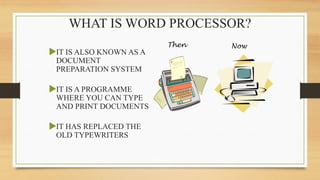
WHAT IS WORDPROCESSOR?
IT IS ALSO KNOWN AS A
DOCUMENT
PREPARATION SYSTEM
IT IS A PROGRAMME
WHERE YOU CAN TYPE
AND PRINT DOCUMENTS
IT HAS REPLACED THE
OLD TYPEWRITERS
Then Now
4.
A word processoris a computer program
or device that provides for input, editing,
formatting and output of text often with
some additional features. Early word
processors were stand-alone devices
often on its function, but current word
processors are word processor programs
running on general purpose computers.
5.
Application areas ofword processing :
• Business - Legal Copies, Letterheads,
Letters, Memos, Circulars etc.
• Education - To develop word processing
skills from the very beginning
• Home - Dealing with assignments being
completed at home, or occasionally
recreational e.g. Maintaining diary
6.
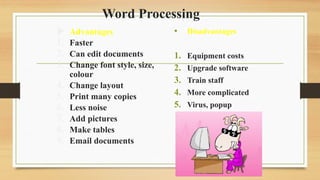
Word Processing
Advantages
1.Faster
2. Can edit documents
3. Change font style, size,
colour
4. Change layout
5. Print many copies
6. Less noise
7. Add pictures
8. Make tables
9. Email documents
• Disadvantages
1. Equipment costs
2. Upgrade software
3. Train staff
4. More complicated
5. Virus, popup
7.
Double Spacing
Highlight thetexts that you want
to double space > Home >
Paragraph > Indents and Spacing
> Spacing > Line Spacing >
choose double > OK.
8.
Inserting Header andFooter
1. Open Word processor.
2. Click Insert > Header &
Footer.
9.
Inserting a PageNumber
1. In the same area of the footer
and header, select the page
number.
2. Choose what format and style
you want to use in a page number.
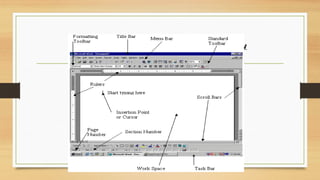
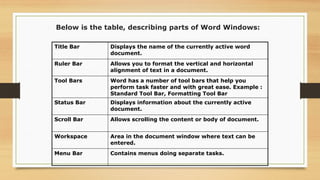
Below is thetable, describing parts of Word Windows:
Title Bar Displays the name of the currently active word
document.
Ruler Bar Allows you to format the vertical and horizontal
alignment of text in a document.
Tool Bars Word has a number of tool bars that help you
perform task faster and with great ease. Example :
Standard Tool Bar, Formatting Tool Bar
Status Bar Displays information about the currently active
document.
Scroll Bar Allows scrolling the content or body of document.
Workspace Area in the document window where text can be
entered.
Menu Bar Contains menus doing separate tasks.
15.
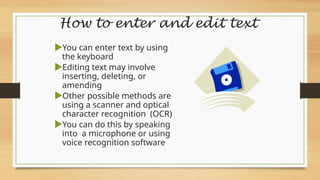
How to enterand edit text
You can enter text by using
the keyboard
Editing text may involve
inserting, deleting, or
amending
Other possible methods are
using a scanner and optical
character recognition (OCR)
You can do this by speaking
into a microphone or using
voice recognition software
16.
Word Wrap
• Witha word processor, when you reach the end
of a line you don’t need to use the return key to
make a new line.
• Word processor will make a new line
automatically and it will move partly completed
words at the end of one line to the start of the
next line
17.
Word Count
• Itis very useful if you are writing
an essay or an article containing a
certain amount of words
• Instead of using spell checker to
count words use word count it saves
time.
18.
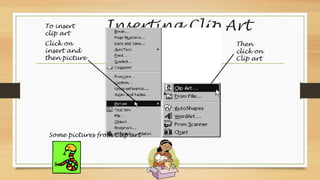
Inserting Clip Art
Toinsert
clip art
Click on
insert and
then picture
Then
click on
Clip art
Some pictures from Clip art
19.
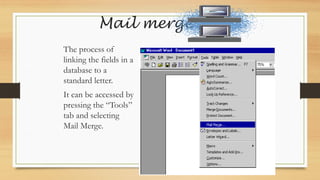
Mail merge
The processof
linking the fields in a
database to a
standard letter.
It can be accessed by
pressing the “Tools”
tab and selecting
Mail Merge.
Features of WordProcessor
• Search and Replace
We use this feature to replace a word a number
of times in a document.
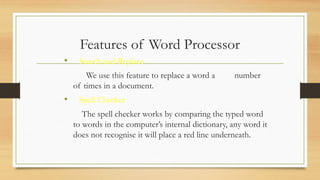
• Spell Checker
The spell checker works by comparing the typed word
to words in the computer’s internal dictionary, any word it
does not recognise it will place a red line underneath.
22.
Features of WordProcessor
• Grammar Check
• This feature works by highlighting sentences
with grammatical errors, for example
• I seen everyone coming along
• Standard Paragraph
• A standard paragraph is a piece of text that has
been typed up, saved to backing storage and
inserted into a document a number of times
23.
Features of WordProcessor
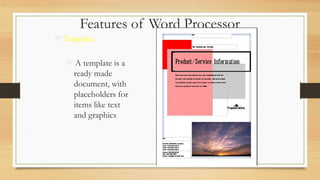
Template
A template is a
ready made
document, with
placeholders for
items like text
and graphics
24.
WYSIWYG
• Development ofhigher-resolution monitors allowed them to
provide limited WYSIWYG - What You See Is What You Get, to
the extent that typographical features like bold and italics,
indentation, justification and margins were approximated on
screen.
• MacWrite, Microsoft Word and other word processing programs
for the bit-mapped Apple Macintosh screen, introduced in 1984,
were probably the first true WYSIWYG word processors to
become known to many people until the introduction of
Microsoft Windows.
25.
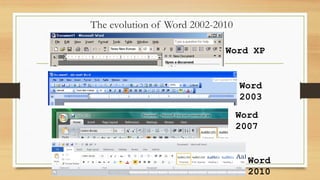
The evolution ofWord 2002-2010
25
Word XP
Word
2003
Word
2007
Word
2010
26.
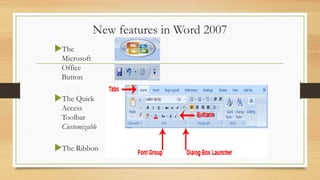
New features inWord 2007
The
Microsoft
Office
Button
The Quick
Access
Toolbar
Customizable
The Ribbon
28.
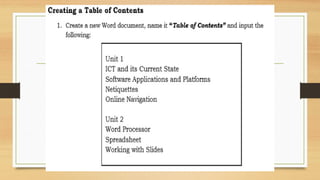
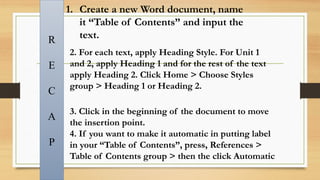
1. Create anew Word document, name
it “Table of Contents” and input the
text.
R
E
C
A
P
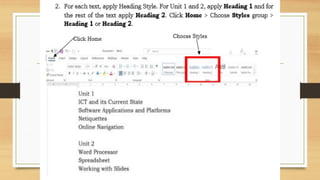
2. For each text, apply Heading Style. For Unit 1
and 2, apply Heading 1 and for the rest of the text
apply Heading 2. Click Home > Choose Styles
group > Heading 1 or Heading 2.
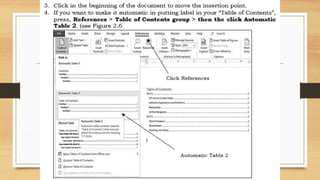
3. Click in the beginning of the document to move
the insertion point.
4. If you want to make it automatic in putting label
in your “Table of Contents”, press, References >
Table of Contents group > then the click Automatic
30.
Inserting a PageNumber
1. In the same area of the footer and
header, select the page number.
2. Choose what format and style you want to
use in a page number.






![Advanced Word [Autosaved].pptx for grade 11](https://cdn.slidesharecdn.com/ss_thumbnails/advancedwordautosaved-260116023657-79ea5d0c-thumbnail.jpg?width=640&height=640&fit=bounds)


