Dr. Aisha Al-Zuhair
General Surgery
KFHU – Khobar – Saudi Arabia
Dec 16, 2009
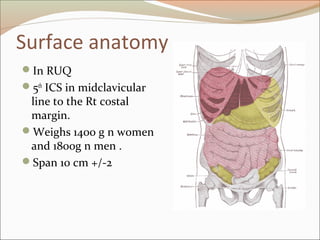
Surface anatomy
In RUQ
5th
ICS in midclavicular
line to the Rt costal
margin.
Weighs 1400 g n women
and 1800g n men .
Span 10 cm +/-2
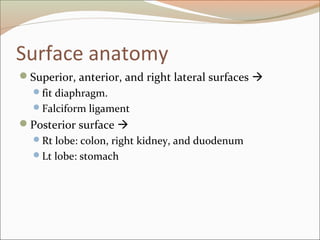
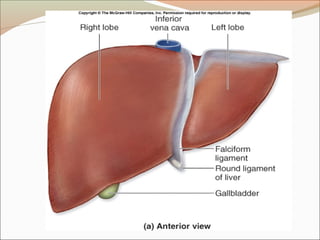
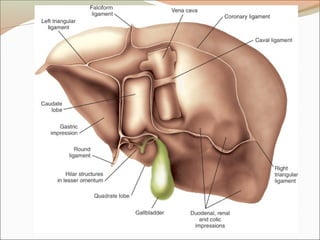
Surface anatomy
Superior, anterior, and right lateral surfaces 
fit diaphragm.
Falciform ligament
Posterior surface 
Rt lobe: colon, right kidney, and duodenum
Lt lobe: stomach
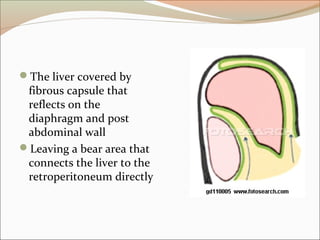
The liver covered by
fibrous capsule that
reflects on the
diaphragm and post
abdominal wall
Leaving a bear area that
connects the liver to the
retroperitoneum directly
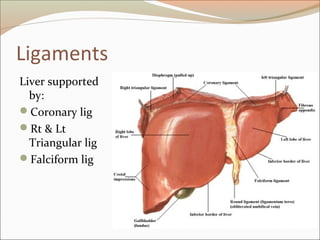
Ligaments
Liver supported
by:
Coronary lig
Rt & Lt
Triangular lig
Falciform lig
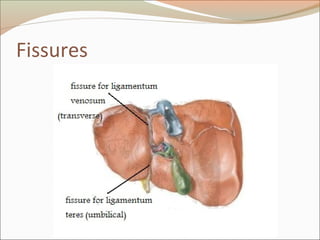
Fissures
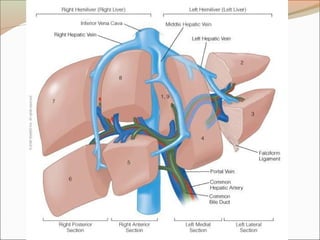
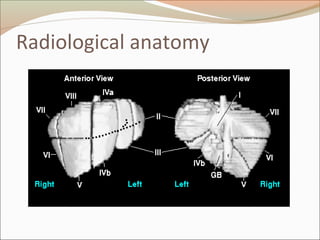
Segmental anatomy
Classically; liver divided to 4 lobes:
Right lobe
Left lobe
Caudate lobe
Quadrate lobe
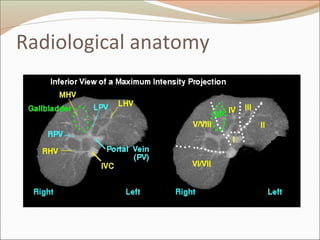
Segmental anatomy
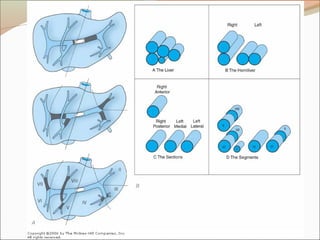
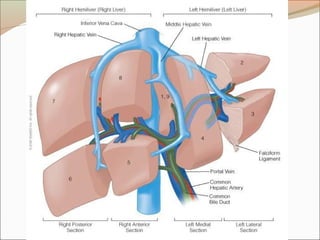
Functionally; on the basis of the distribution of
vessels and ducts within the liver  segments.
Cantlie’s line.
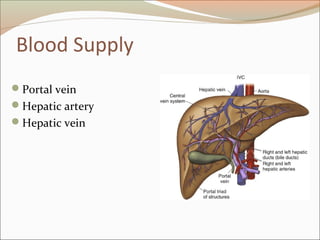
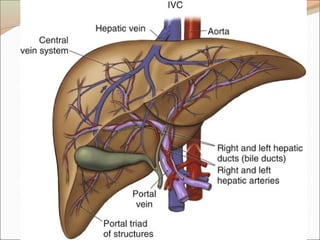
Blood Supply
Portal vein
Hepatic artery
Hepatic vein
Blood Supply – Portal Vein
 Superior Mesentric and Splenic veins
Posterior to hepatic artery and bile duct at the
hepatodudenal junction.
Valveless
75% of total blood supply the liver
Pressure 3-5 mmHg
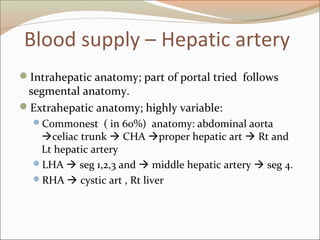
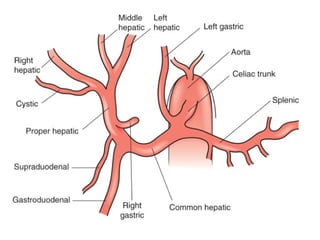
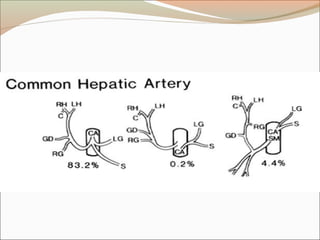
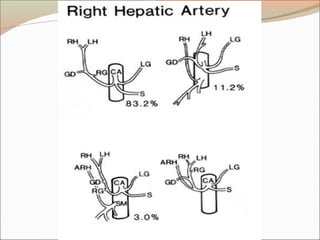
Blood supply – Hepatic artery
Intrahepatic anatomy; part of portal tried follows
segmental anatomy.
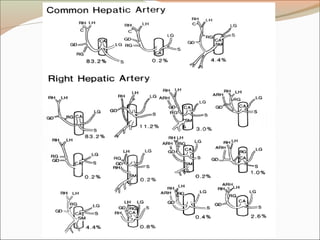
Extrahepatic anatomy; highly variable:
Commonest ( in 60%) anatomy: abdominal aorta
celiac trunk  CHA proper hepatic art  Rt and
Lt hepatic artery
LHA  seg 1,2,3 and  middle hepatic artery  seg 4.
RHA  cystic art , Rt liver
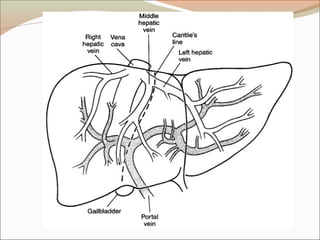
Blood supply – Hepatic vein
Rt hepatic vein  Drain seg 5,6,7,8  vena cava.
Middle hepatic vein  Drain seg 4,5,8
Lt hepatic vein  Drain seg 2,3
[ seg 1 drain by short hepatic  vena cava]
Radiological anatomy
Introduction
It is the 2nd
commonest organ injured in
blunt abdominal trauma and the
commonest injured in penetrating
trauma.
1%-8% of pt with multiple blunt trauma
sustain a liver injury.
During last 3 decades, liver injury
increased. This inc could be actual or
artificial d/t better diagnostic modalities.
Richardson JD. Ann Surg. 2000;232:324-330.
Lucas CE. Am Surg. 2000;66:337-341.
While small lacerations of the liver substance may
be, and no doubt are, recovered from without
operative interference:
If lacerations be extensive and vessels of any
magnitude are torn, hemorrhage will, owing to
the structural arrangement of the liver, go on
continously.
JH Pringle,
1908
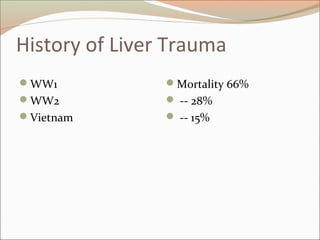
History of Liver Trauma
WW1
WW2
Vietnam
Mortality 66%
 -- 28%
 -- 15%
Factors making the liver prone to
injury:
1. The large size of the liver,
2. its friable parenchyma,
3. its thin capsule, and
4. Its relatively fixed position in relation to the
spine and ribs.
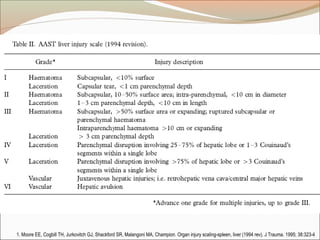
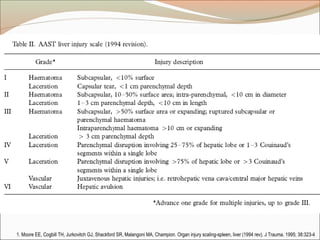
1. Moore EE, Cogbill TH, Jurkovitch GJ, Shackford SR, Malangoni MA, Champion. Organ injury scaling-spleen, liver (1994 rev). J Trauma. 1995; 38:323-4
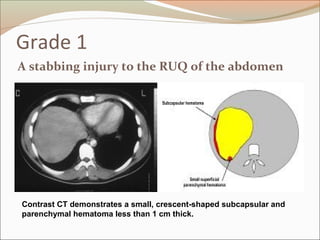
Grade 1
A stabbing injury to the RUQ of the abdomen
Contrast CT demonstrates a small, crescent-shaped subcapsular and
parenchymal hematoma less than 1 cm thick.
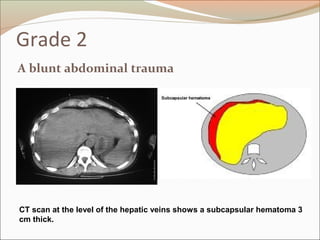
Grade 2
A blunt abdominal trauma
CT scan at the level of the hepatic veins shows a subcapsular hematoma 3
cm thick.
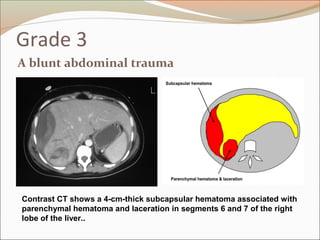
Grade 3
A blunt abdominal trauma
Contrast CT shows a 4-cm-thick subcapsular hematoma associated with
parenchymal hematoma and laceration in segments 6 and 7 of the right
lobe of the liver..
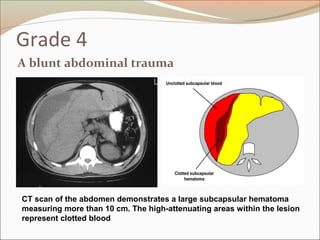
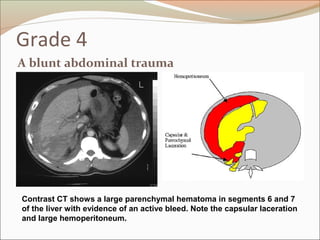
Grade 4
A blunt abdominal trauma
CT scan of the abdomen demonstrates a large subcapsular hematoma
measuring more than 10 cm. The high-attenuating areas within the lesion
represent clotted blood
Grade 4
A blunt abdominal trauma
Contrast CT shows a large parenchymal hematoma in segments 6 and 7
of the liver with evidence of an active bleed. Note the capsular laceration
and large hemoperitoneum.
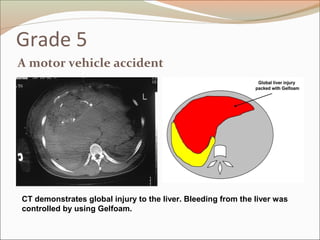
Grade 5
A motor vehicle accident
CT demonstrates global injury to the liver. Bleeding from the liver was
controlled by using Gelfoam.
Management
Operative
vs
Non-Operative
Non-Operative Management of
Liver Injury
An absolute increase in the incidenceof
nonoperatively managed liver injuries
(NOMLI) is unequivocal.
Multiple studies have shown that
NOMLI is effective
Knudson MM. Surg Clin North Am. 1999;79:1357-1371. Malhotra AK. Ann Surg. 2000;231:804-813. Maull KI. World J Surg. 2001;25:1403-1404.
Pachter HL. Am J Surg. 1995;169:442-454. Sherman HF J Trauma. 1994;37:616-621. Schweizer W. Br J Surg. 1993;80:86-88.
. Miller PR. J Trauma. 2002;53:238-242. Goan YG. J Trauma. 1998;45:360-364. Brasel KJ. Am J Surg. 1997;174:674-677.
. Ochsner MG.. World J Surg. 2001;25:1393-1396.
Criteria for NOMLI
No indications for laparotomy (physical examination
signs/symptoms or other injuries)
Hemodynamically normal after resuscitation with
crystalloid
No injuries that preclude physical examination of the
abdomen (e.g., CHI, spinal cord injury)
No transfusion requirements (PRBC)
Constant availability of surgical and critical care
resources
Liver injury score of patients is not as
important as the hemodynamic status for
determining conservative management
High Success With Non-
operative Management of
Blunt Hepatic Trauma
Arch Surg. 2003;138:475-481
Hypothesis Nonoperative management
of liver injuries (NOMLI)is highly
successful and rarely leads to adverse
events.
Setting High-volume academic level I
trauma center
Cont.
Results
78 patients
23 (29%) were operated onimmediately, but only 12
(15%) for bleeding from the liver. NOMLI failed in
8 for reasons unrelated to the liver injury.
The success rate of NOMLI was 85% (47 of 55
patients),but the liver-specific success rate was
100%.
No adverseevents were attributed to NOMLI.
Cont.
Conclusions
NOMLI is safe and effective regardless of the grade
of liver injury.
Failure of NOMLI is caused by associated abdominal
injuriesand not the liver.
Fluid and blood requirements, the degreeof injury
severity, and the presence of other abdominal
organinjuries may help predict failure.
Complications of NOMLI
Biliary (bile peritonitis, bile leak, biloma, hemobelia..)
Infection (liver abscess, necrosis, abdominal sepsis,
SIRs)
Abdominalcompartment syndrome
Hemorrhage
Hepatic necrosis &/or Acalculous Cholecystitis
Failure of NOMLI
Usually attributed to reasons unrelated to liver
injury
Other injuries can be missed in a blunt trauma
victims, such as:
Bowel
Pancreas
Diaphragm
Bladder
Which can lead to failure of NOMLI
Criteria of failure of NOMLI
Increasing fluid requirements to maintain normal
hemodynamic status
Failed angio embolization of A-V
fistulae/pseudoaneurysm
Transfusion requirements to maintain Hct/Hgb and
normal hemodynamic status
Increasing hemoperitoneum associated with
hemodynamic liability
Peritoneal signs/rebound tenderness
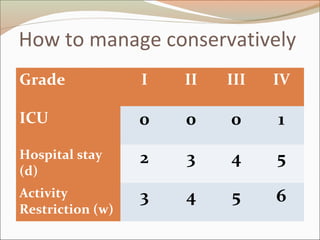
How to manage conservatively
Grade I II III IV
ICU 0 0 0 1
Hospital stay
(d)
2 3 4 5
Activity
Restriction (w)
3 4 5 6
Follow up
There is no evidence supporting routine imaging (CT or
US) of the hospitalized, clinically improving,
hemodynamically stable patient.
Nor is there evidence to support the practice of keeping
the clinically stable patient at bed rest.
2003 Eastern Association For The Surgery of Trauma
Indications
In Blunt Trauma In Penetrating Trauma
Hemodynamic
instability
Transfusion> 2 blood
volume or > 40 ml/kg
Devitalized parenchyma
Sepsis / biloma
Exploratory lapratomy
is indicated in any
penetrating trauma in
with peritoneal
penetration
Operative technique/options
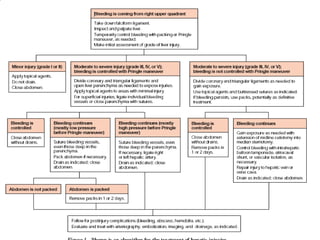
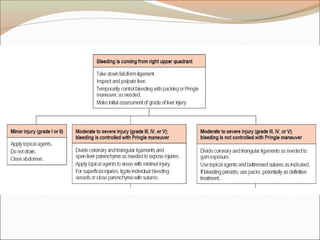
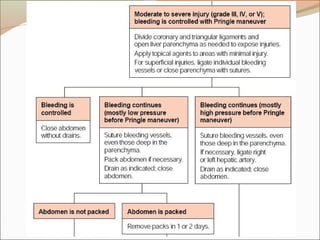
Initial   Explore Laparotomy
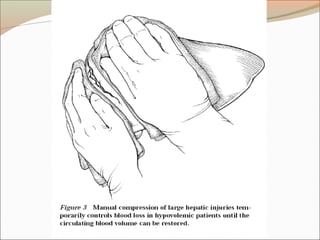
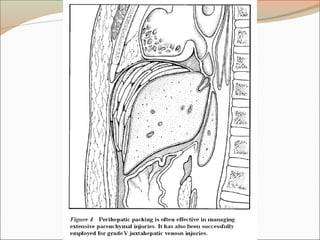
 Temporary control of hemorrhage:
Why temp?
 Ongoing hemorrhage, life threatening, no time to
restore circulatory volume.
 Liver injuries not highest priority
Operative technique/options
How?
 Manual compression
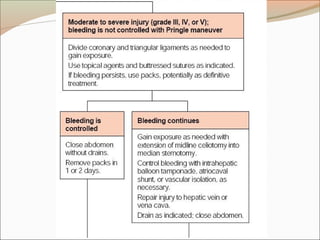
 Perihepatic packing.
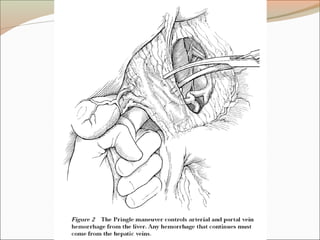
 Pringle maneuver.
 Tourniquet
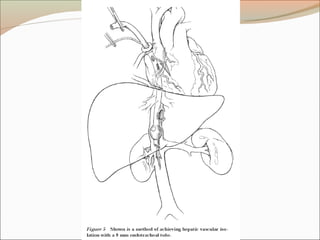
 Hepatic vascular isolation
 Placement of atriocaval shunt
 Moore-Pilcher balloon
commonest
Juxtahepatic
venous injury
Operative technique/options
Definitive management of the injuries:
1. Moore EE, Cogbill TH, Jurkovitch GJ, Shackford SR, Malangoni MA, Champion. Organ injury scaling-spleen, liver (1994 rev). J Trauma. 1995; 38:323-4
Hepatic segments Resections
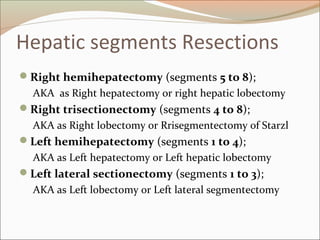
Right hemihepatectomy (segments 5 to 8);
AKA as Right hepatectomy or right hepatic lobectomy
Right trisectionectomy (segments 4 to 8);
AKA as Right lobectomy or Rrisegmentectomy of Starzl
Left hemihepatectomy (segments 1 to 4);
AKA as Left hepatectomy or Left hepatic lobectomy
Left lateral sectionectomy (segments 1 to 3);
AKA as Left lobectomy or Left lateral segmentectomy
References
Feldman: Sleisenger & Fordtran's Gastrointestinal and Liver Disease, 8th ed.
Sabiston Textbook of Surgery, 18th ed.
Khatri: Operative Surgery Manual, 1st ed.
ACS Surgery principles and Practice 2006.
Cameron; current surgical therapy, 8th
ed.
http://www.netterimages.com/
http://www.adhb.govt.nz
http://emedicine.medscape.com/article/370508-overview
http://www.east.org

Appliedliveranatomy 091219152729-phpapp01

  • 1.
    Dr. Aisha Al-Zuhair GeneralSurgery KFHU – Khobar – Saudi Arabia Dec 16, 2009
  • 3.
    Surface anatomy In RUQ 5th ICSin midclavicular line to the Rt costal margin. Weighs 1400 g n women and 1800g n men . Span 10 cm +/-2
  • 4.
    Surface anatomy Superior, anterior,and right lateral surfaces  fit diaphragm. Falciform ligament Posterior surface  Rt lobe: colon, right kidney, and duodenum Lt lobe: stomach
  • 7.
    The liver coveredby fibrous capsule that reflects on the diaphragm and post abdominal wall Leaving a bear area that connects the liver to the retroperitoneum directly
  • 8.
    Ligaments Liver supported by: Coronary lig Rt& Lt Triangular lig Falciform lig
  • 9.
  • 10.
    Segmental anatomy Classically; liverdivided to 4 lobes: Right lobe Left lobe Caudate lobe Quadrate lobe
  • 11.
    Segmental anatomy Functionally; onthe basis of the distribution of vessels and ducts within the liver  segments. Cantlie’s line.
  • 14.
  • 16.
    Blood Supply –Portal Vein  Superior Mesentric and Splenic veins Posterior to hepatic artery and bile duct at the hepatodudenal junction. Valveless 75% of total blood supply the liver Pressure 3-5 mmHg
  • 17.
    Blood supply –Hepatic artery Intrahepatic anatomy; part of portal tried follows segmental anatomy. Extrahepatic anatomy; highly variable: Commonest ( in 60%) anatomy: abdominal aorta celiac trunk  CHA proper hepatic art  Rt and Lt hepatic artery LHA  seg 1,2,3 and  middle hepatic artery  seg 4. RHA  cystic art , Rt liver
  • 23.
    Blood supply –Hepatic vein Rt hepatic vein  Drain seg 5,6,7,8  vena cava. Middle hepatic vein  Drain seg 4,5,8 Lt hepatic vein  Drain seg 2,3 [ seg 1 drain by short hepatic  vena cava]
  • 25.
  • 26.
  • 28.
    Introduction It is the2nd commonest organ injured in blunt abdominal trauma and the commonest injured in penetrating trauma. 1%-8% of pt with multiple blunt trauma sustain a liver injury. During last 3 decades, liver injury increased. This inc could be actual or artificial d/t better diagnostic modalities. Richardson JD. Ann Surg. 2000;232:324-330. Lucas CE. Am Surg. 2000;66:337-341.
  • 29.
    While small lacerationsof the liver substance may be, and no doubt are, recovered from without operative interference: If lacerations be extensive and vessels of any magnitude are torn, hemorrhage will, owing to the structural arrangement of the liver, go on continously. JH Pringle, 1908
  • 30.
    History of LiverTrauma WW1 WW2 Vietnam Mortality 66%  -- 28%  -- 15%
  • 31.
    Factors making theliver prone to injury: 1. The large size of the liver, 2. its friable parenchyma, 3. its thin capsule, and 4. Its relatively fixed position in relation to the spine and ribs.
  • 33.
    1. Moore EE,Cogbill TH, Jurkovitch GJ, Shackford SR, Malangoni MA, Champion. Organ injury scaling-spleen, liver (1994 rev). J Trauma. 1995; 38:323-4
  • 34.
    Grade 1 A stabbinginjury to the RUQ of the abdomen Contrast CT demonstrates a small, crescent-shaped subcapsular and parenchymal hematoma less than 1 cm thick.
  • 35.
    Grade 2 A bluntabdominal trauma CT scan at the level of the hepatic veins shows a subcapsular hematoma 3 cm thick.
  • 36.
    Grade 3 A bluntabdominal trauma Contrast CT shows a 4-cm-thick subcapsular hematoma associated with parenchymal hematoma and laceration in segments 6 and 7 of the right lobe of the liver..
  • 37.
    Grade 4 A bluntabdominal trauma CT scan of the abdomen demonstrates a large subcapsular hematoma measuring more than 10 cm. The high-attenuating areas within the lesion represent clotted blood
  • 38.
    Grade 4 A bluntabdominal trauma Contrast CT shows a large parenchymal hematoma in segments 6 and 7 of the liver with evidence of an active bleed. Note the capsular laceration and large hemoperitoneum.
  • 39.
    Grade 5 A motorvehicle accident CT demonstrates global injury to the liver. Bleeding from the liver was controlled by using Gelfoam.
  • 43.
  • 45.
    Non-Operative Management of LiverInjury An absolute increase in the incidenceof nonoperatively managed liver injuries (NOMLI) is unequivocal. Multiple studies have shown that NOMLI is effective Knudson MM. Surg Clin North Am. 1999;79:1357-1371. Malhotra AK. Ann Surg. 2000;231:804-813. Maull KI. World J Surg. 2001;25:1403-1404. Pachter HL. Am J Surg. 1995;169:442-454. Sherman HF J Trauma. 1994;37:616-621. Schweizer W. Br J Surg. 1993;80:86-88. . Miller PR. J Trauma. 2002;53:238-242. Goan YG. J Trauma. 1998;45:360-364. Brasel KJ. Am J Surg. 1997;174:674-677. . Ochsner MG.. World J Surg. 2001;25:1393-1396.
  • 46.
    Criteria for NOMLI Noindications for laparotomy (physical examination signs/symptoms or other injuries) Hemodynamically normal after resuscitation with crystalloid No injuries that preclude physical examination of the abdomen (e.g., CHI, spinal cord injury) No transfusion requirements (PRBC) Constant availability of surgical and critical care resources
  • 47.
    Liver injury scoreof patients is not as important as the hemodynamic status for determining conservative management
  • 48.
    High Success WithNon- operative Management of Blunt Hepatic Trauma Arch Surg. 2003;138:475-481 Hypothesis Nonoperative management of liver injuries (NOMLI)is highly successful and rarely leads to adverse events. Setting High-volume academic level I trauma center
  • 49.
    Cont. Results 78 patients 23 (29%)were operated onimmediately, but only 12 (15%) for bleeding from the liver. NOMLI failed in 8 for reasons unrelated to the liver injury. The success rate of NOMLI was 85% (47 of 55 patients),but the liver-specific success rate was 100%. No adverseevents were attributed to NOMLI.
  • 50.
    Cont. Conclusions NOMLI is safeand effective regardless of the grade of liver injury. Failure of NOMLI is caused by associated abdominal injuriesand not the liver. Fluid and blood requirements, the degreeof injury severity, and the presence of other abdominal organinjuries may help predict failure.
  • 51.
    Complications of NOMLI Biliary(bile peritonitis, bile leak, biloma, hemobelia..) Infection (liver abscess, necrosis, abdominal sepsis, SIRs) Abdominalcompartment syndrome Hemorrhage Hepatic necrosis &/or Acalculous Cholecystitis
  • 52.
    Failure of NOMLI Usuallyattributed to reasons unrelated to liver injury Other injuries can be missed in a blunt trauma victims, such as: Bowel Pancreas Diaphragm Bladder Which can lead to failure of NOMLI
  • 53.
    Criteria of failureof NOMLI Increasing fluid requirements to maintain normal hemodynamic status Failed angio embolization of A-V fistulae/pseudoaneurysm Transfusion requirements to maintain Hct/Hgb and normal hemodynamic status Increasing hemoperitoneum associated with hemodynamic liability Peritoneal signs/rebound tenderness
  • 54.
    How to manageconservatively Grade I II III IV ICU 0 0 0 1 Hospital stay (d) 2 3 4 5 Activity Restriction (w) 3 4 5 6
  • 55.
    Follow up There isno evidence supporting routine imaging (CT or US) of the hospitalized, clinically improving, hemodynamically stable patient. Nor is there evidence to support the practice of keeping the clinically stable patient at bed rest. 2003 Eastern Association For The Surgery of Trauma
  • 57.
    Indications In Blunt TraumaIn Penetrating Trauma Hemodynamic instability Transfusion> 2 blood volume or > 40 ml/kg Devitalized parenchyma Sepsis / biloma Exploratory lapratomy is indicated in any penetrating trauma in with peritoneal penetration
  • 58.
    Operative technique/options Initial  Explore Laparotomy  Temporary control of hemorrhage: Why temp?  Ongoing hemorrhage, life threatening, no time to restore circulatory volume.  Liver injuries not highest priority
  • 59.
    Operative technique/options How?  Manualcompression  Perihepatic packing.  Pringle maneuver.  Tourniquet  Hepatic vascular isolation  Placement of atriocaval shunt  Moore-Pilcher balloon commonest Juxtahepatic venous injury
  • 64.
  • 65.
    1. Moore EE,Cogbill TH, Jurkovitch GJ, Shackford SR, Malangoni MA, Champion. Organ injury scaling-spleen, liver (1994 rev). J Trauma. 1995; 38:323-4
  • 72.
    Hepatic segments Resections Righthemihepatectomy (segments 5 to 8); AKA as Right hepatectomy or right hepatic lobectomy Right trisectionectomy (segments 4 to 8); AKA as Right lobectomy or Rrisegmentectomy of Starzl Left hemihepatectomy (segments 1 to 4); AKA as Left hepatectomy or Left hepatic lobectomy Left lateral sectionectomy (segments 1 to 3); AKA as Left lobectomy or Left lateral segmentectomy
  • 75.
    References Feldman: Sleisenger &Fordtran's Gastrointestinal and Liver Disease, 8th ed. Sabiston Textbook of Surgery, 18th ed. Khatri: Operative Surgery Manual, 1st ed. ACS Surgery principles and Practice 2006. Cameron; current surgical therapy, 8th ed. http://www.netterimages.com/ http://www.adhb.govt.nz http://emedicine.medscape.com/article/370508-overview http://www.east.org

Editor's Notes

  • #5 The superior, anterior, and right lateral surfaces of the liver are smooth and convex, fitting against the diaphragm. The posterior surface has indentations from the colon, right kidney, and duodenum on the right lobe and the stomach on the left lobe
  • #11 Common resections acc to the segmants: Right hemihepatectomy (segments 5 to 8, or right hepatectomy, right hepatic lobectomy) Right trisectionectomy (segments 4 to 8, or right lobectomy, trisegmentectomy of Starzl) Left hemihepatectomy (segments 1 to 4, or left hepatectomy, left hepatic lobectomy) Left lateral sectionectomy (segments 1 to 3, or left lobectomy, left lateral segmentectomy).
  • #12 Common resections acc to the segmants: Right hemihepatectomy (segments 5 to 8, or right hepatectomy, right hepatic lobectomy) Right trisectionectomy (segments 4 to 8, or right lobectomy, trisegmentectomy of Starzl) Left hemihepatectomy (segments 1 to 4, or left hepatectomy, left hepatic lobectomy) Left lateral sectionectomy (segments 1 to 3, or left lobectomy, left lateral segmentectomy).
  • #14 The 8 liver segments (namely 1, 2, 3, 4a, 4b, 5, 6, 7, 8) are numbered clockwise on the frontal view.
  • #20 The 8 liver segments (namely 1, 2, 3, 4a, 4b, 5, 6, 7, 8) are numbered clockwise on the frontal view.