Twitter: @THATlittleJOKE
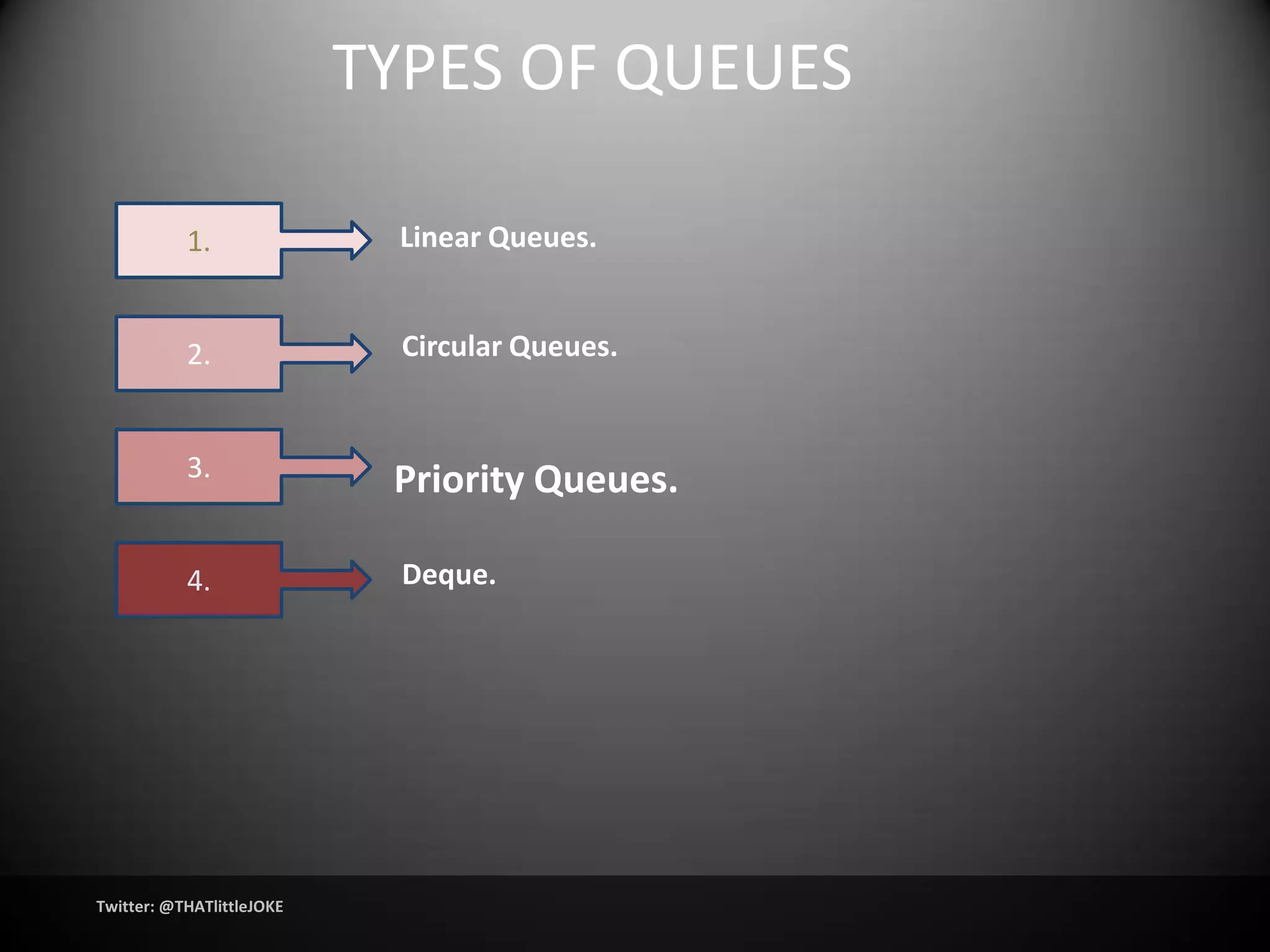
TYPES OF QUEUES

           1.               Linear Queues.


           2.                Circular Queues.


           3.               Priority Queues.

           4.                Deque.


Twitter: @THATlittleJOKE
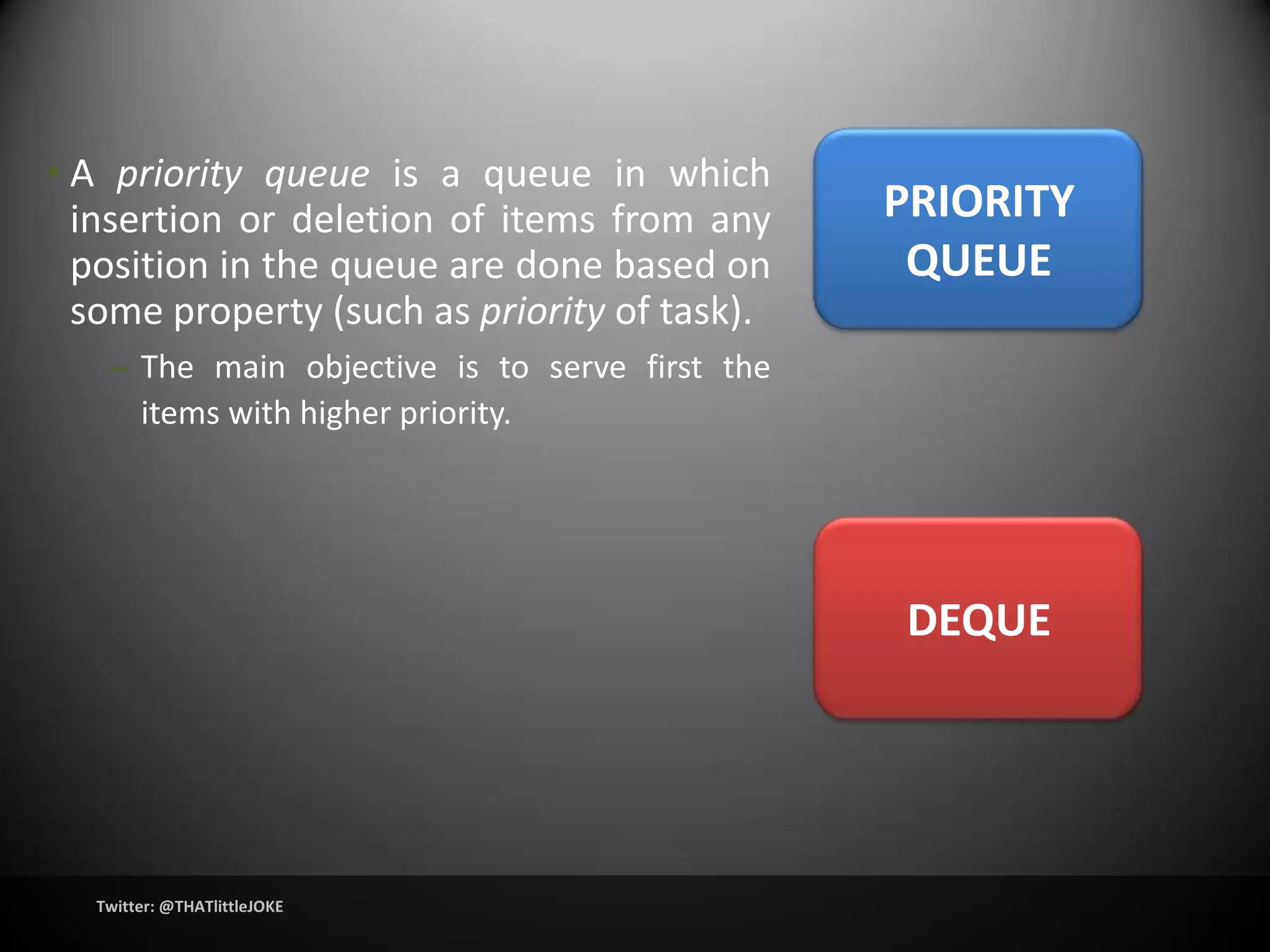
• A priority queue is a queue in which
  insertion or deletion of items from any       PRIORITY
  position in the queue are done based on        QUEUE
  some property (such as priority of task).
   – The main objective is to serve first the
     items with higher priority.


                                                DEQUE


  Twitter: @THATlittleJOKE
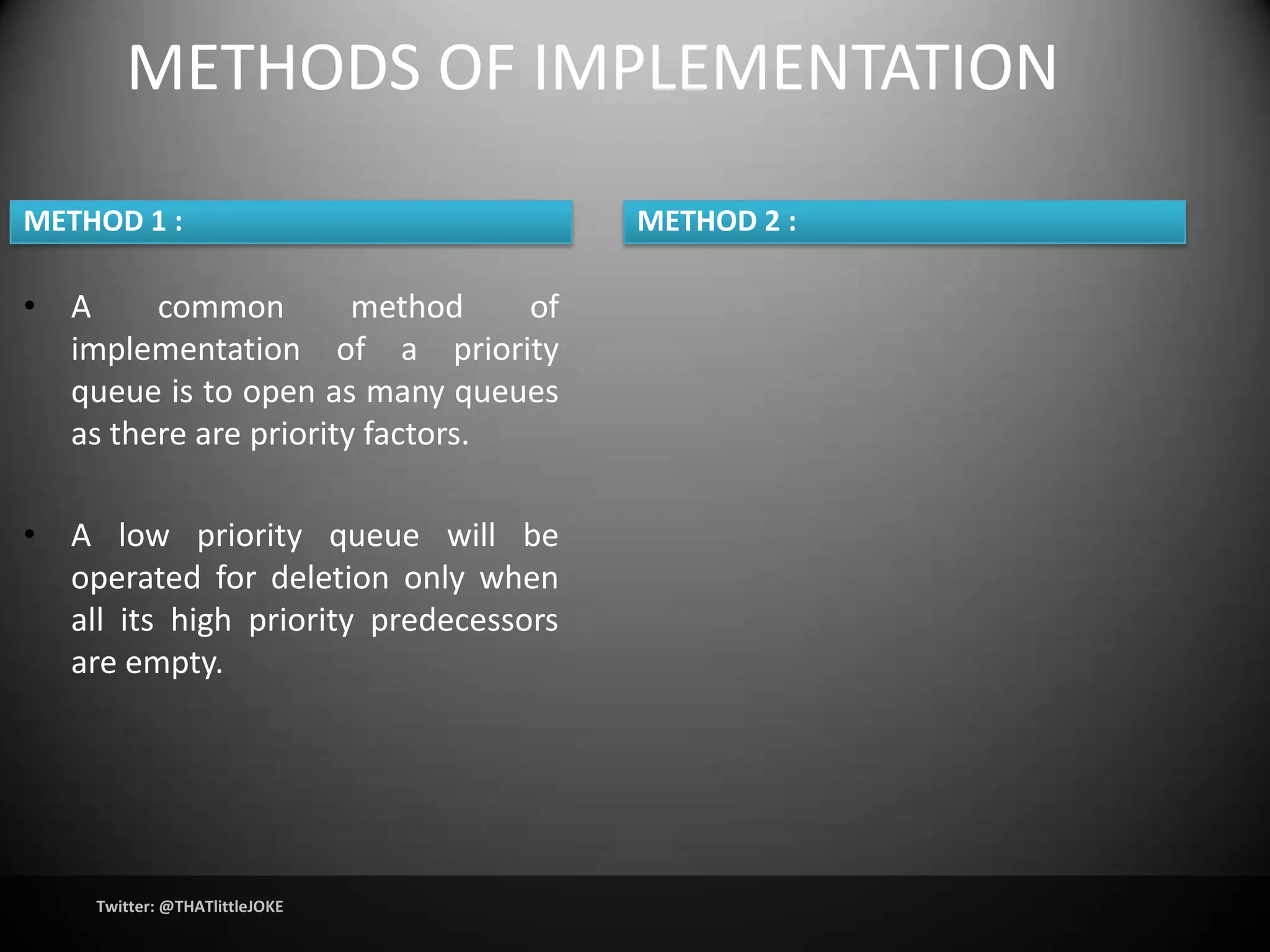
METHODS OF IMPLEMENTATION

METHOD 1 :                             METHOD 2 :

• A     common         method    of
  implementation of a priority
  queue is to open as many queues
  as there are priority factors.

• A low priority queue will be
  operated for deletion only when
  all its high priority predecessors
  are empty.


    Twitter: @THATlittleJOKE
IMPLEMENTATION
                                  METHOD 1:
• ENQUEUEING

1. Each distinct priority will have a separate
   queue to have its respective elements.

2. Thus when enqueing an item, we need
   both the item and its priority to enqueue
   it in the respective queue.

3. The items will be enqueued into the
   respective queue based on their priority.


  Twitter: @THATlittleJOKE
Cont.,
                                          METHOD 1:

• DEQUEUEING

1.A dequeue command checks for items
in the queue with the highest priority.


      2.Once it is found non-empty, the item
      from it will be dequeued based on the
      FIFO concept.


             3.If the queue is empty, it moves to the
             next non-empty queue in the order and
             performs the operation.


  Twitter: @THATlittleJOKE
Cont.,
                             METHOD 1:


• The “Queue Overflow” warning will be
  thrown only when all the queues are
  found full.

• The “Queue Underflow” warning will
  be thrown only when all the queues
  are found empty.

• The implementation depends upon the
  application (TRADE OFF)


  Twitter: @THATlittleJOKE
APPLICATIONS
METHOD 1:


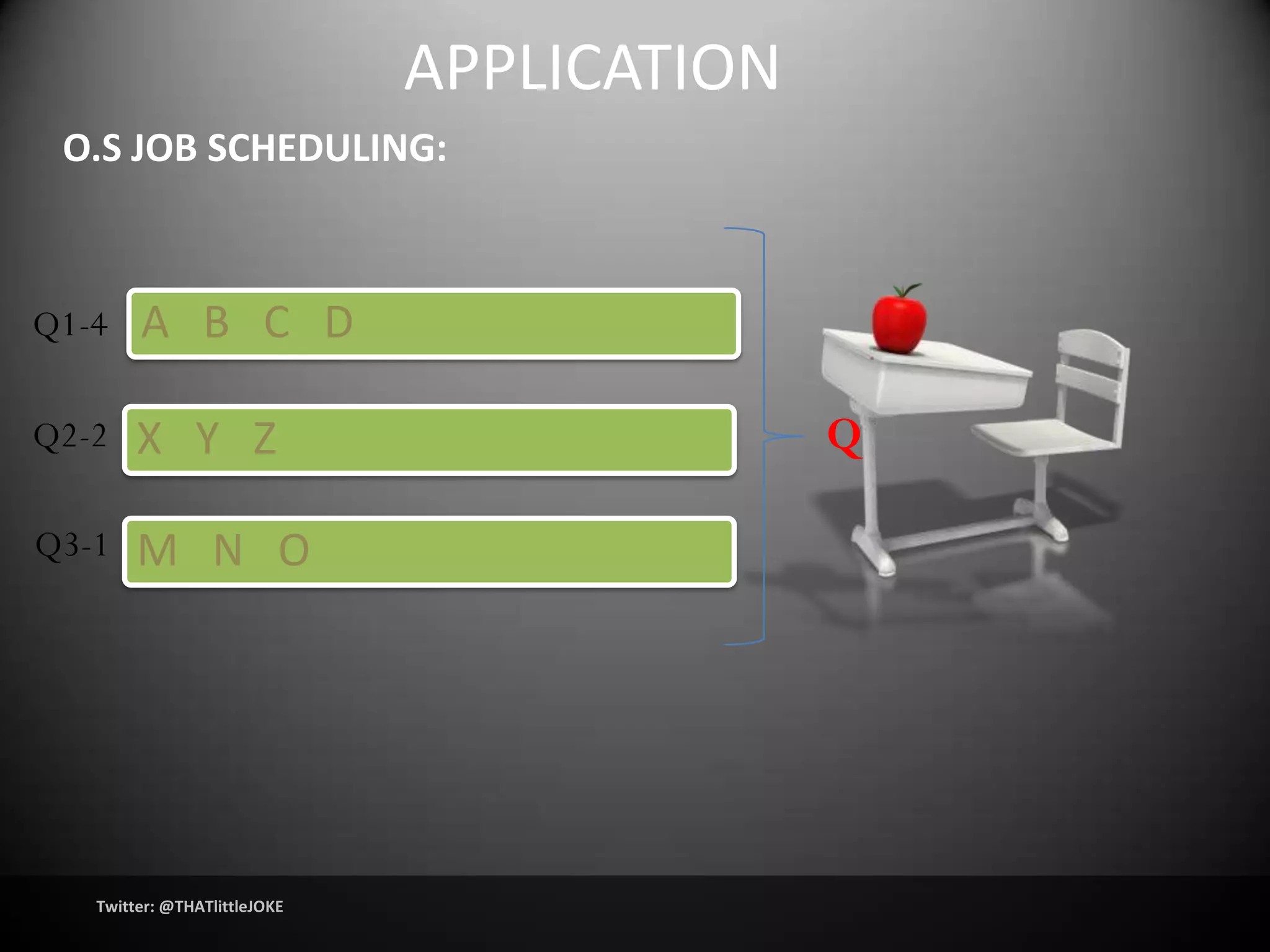
                   1. O.S Job Scheduling.


                   2.Sharing a single runway of an
                   airport for both landing and take-off
                   of flights.


 Twitter: @THATlittleJOKE
APPLICATION
 O.S JOB SCHEDULING:


Q1-4    A B C D

Q2-2    X Y Z                               Q

Q3-1    M N O


   Twitter: @THATlittleJOKE
APPLICATIONS


2.Sharing a single runway of an airport for
  both landing and take-off of flights.


 Twitter: @THATlittleJOKE
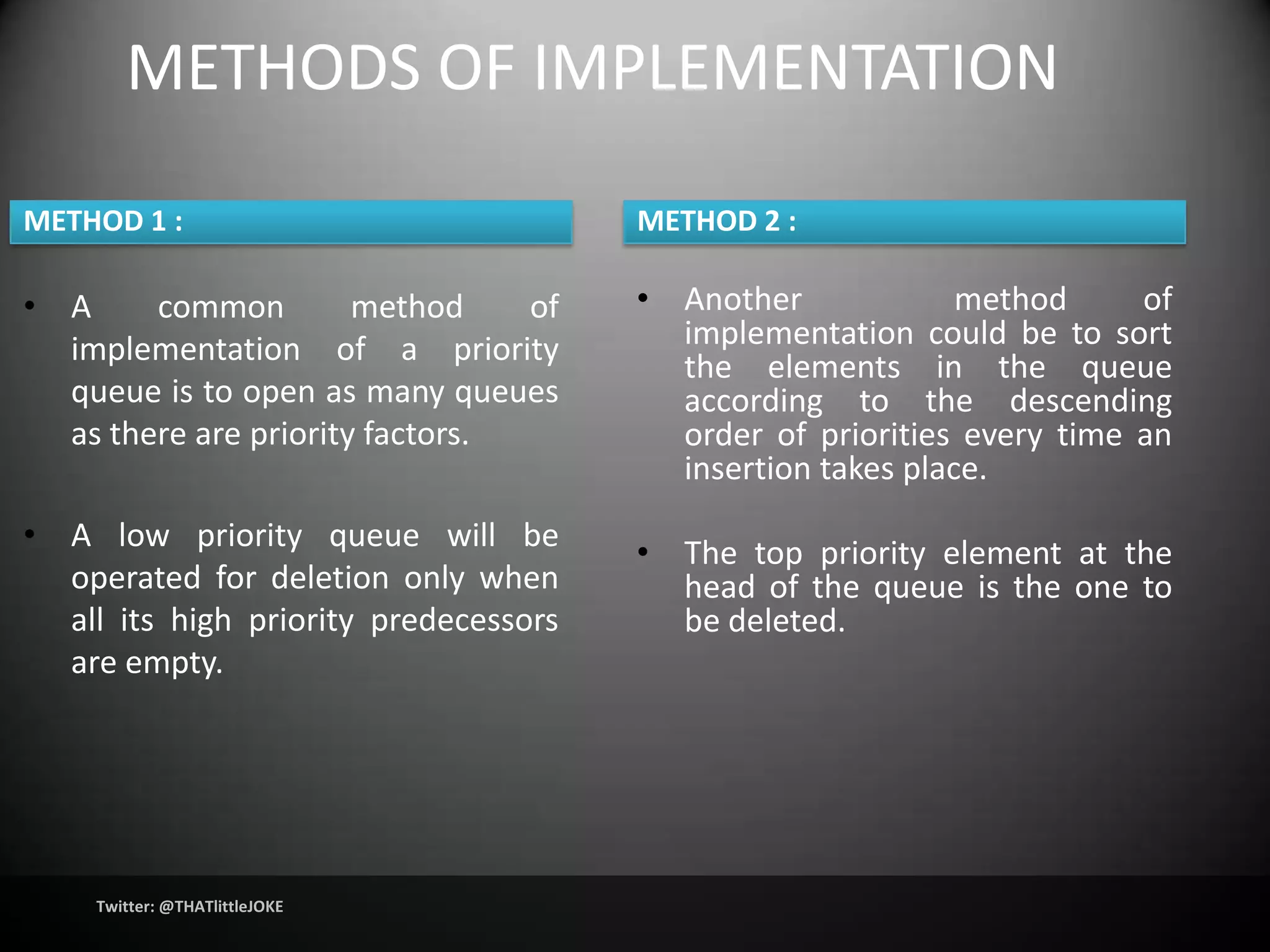
METHODS OF IMPLEMENTATION

METHOD 1 :                             METHOD 2 :

• A     common         method    of    • Another             method     of
  implementation of a priority           implementation could be to sort
                                         the elements in the queue
  queue is to open as many queues        according to the descending
  as there are priority factors.         order of priorities every time an
                                         insertion takes place.
• A low priority queue will be
                                       • The top priority element at the
  operated for deletion only when        head of the queue is the one to
  all its high priority predecessors     be deleted.
  are empty.


    Twitter: @THATlittleJOKE
IMPLEMENTATION
METHOD 2:


• Despite of having separate queues for
  every distinct priority, here we use only
  one queue.

• We store the items in the queue in the
  descending order of priority, thus
  making it possible with a single queue.


  Twitter: @THATlittleJOKE
IMPLEMENTATION
METHOD 2:
• ENQUEUE:

• Here too, the priority of the item is also
  needed to enqueue the item.

• The items are enqueued in the queue
  based on their priorities.

• The items are enqueued at the right
  place so that the queue retains its
  descending order.


  Twitter: @THATlittleJOKE
IMPLEMENTATION
METHOD 2:

• DEQUEUE:

• The dequeue operation is performed
  the same method as done in the linear
  queue.

• As it is the item with the highest
  priority which is at the front end, it is
  obviously the element with the highest
  priority that is being pushed out.


  Twitter: @THATlittleJOKE
IMPLEMENTATION
METHOD 2:


• The “Queue Overflow” warning will be
  thrown when the queue is found full
  (physically or procedurally).

• The “Queue Underflow” warning will
  be thrown only when the queue is
  empty.


  Twitter: @THATlittleJOKE
APPLICATIONS
METHOD 2:


                   1. Sorting.


                   2.O.S Job sharing .


 Twitter: @THATlittleJOKE
APPLICATION
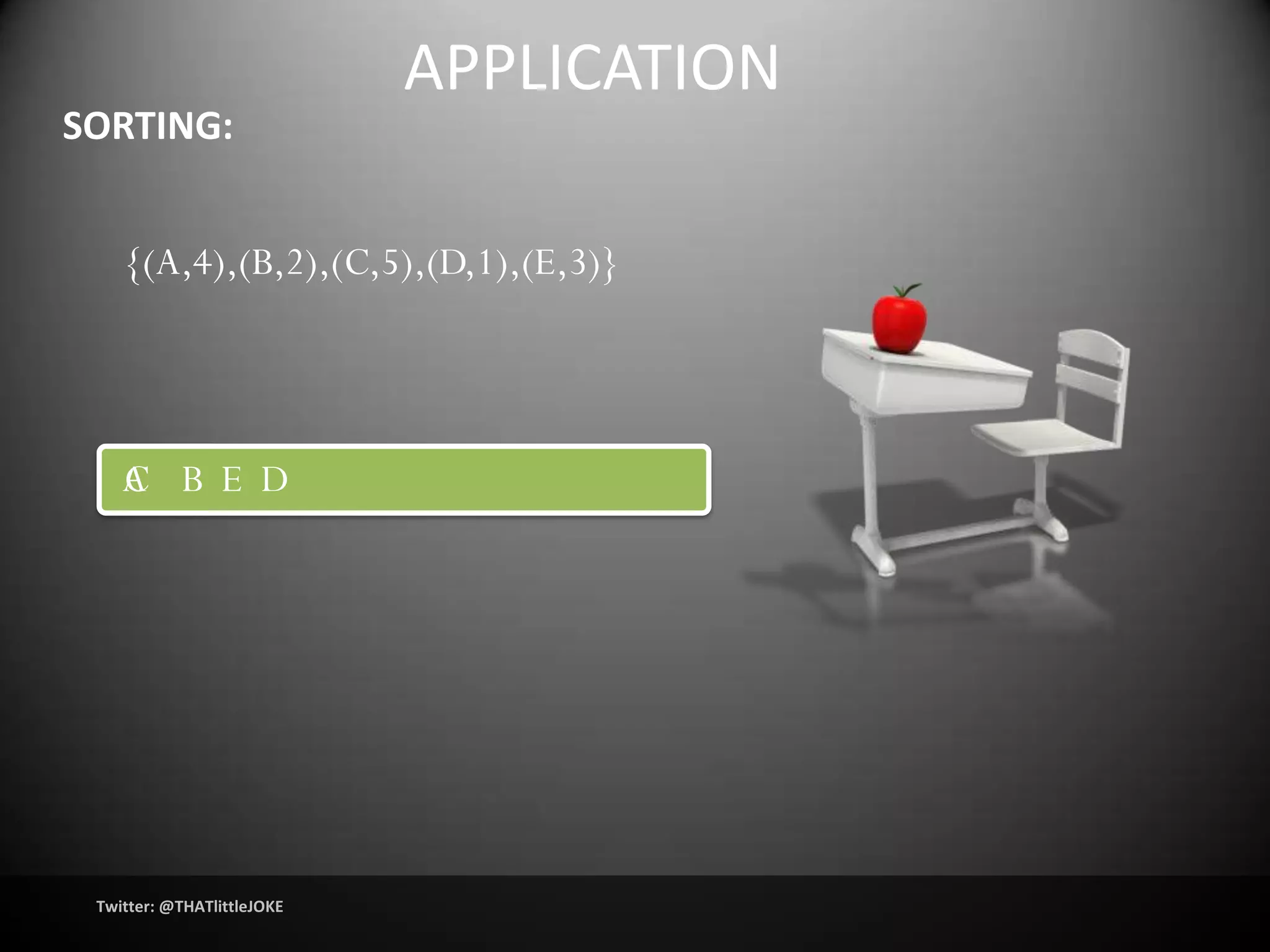
SORTING:


    {(A,4),(B,2),(C,5),(D,1),(E,3)}


    A B E D
    C


 Twitter: @THATlittleJOKE
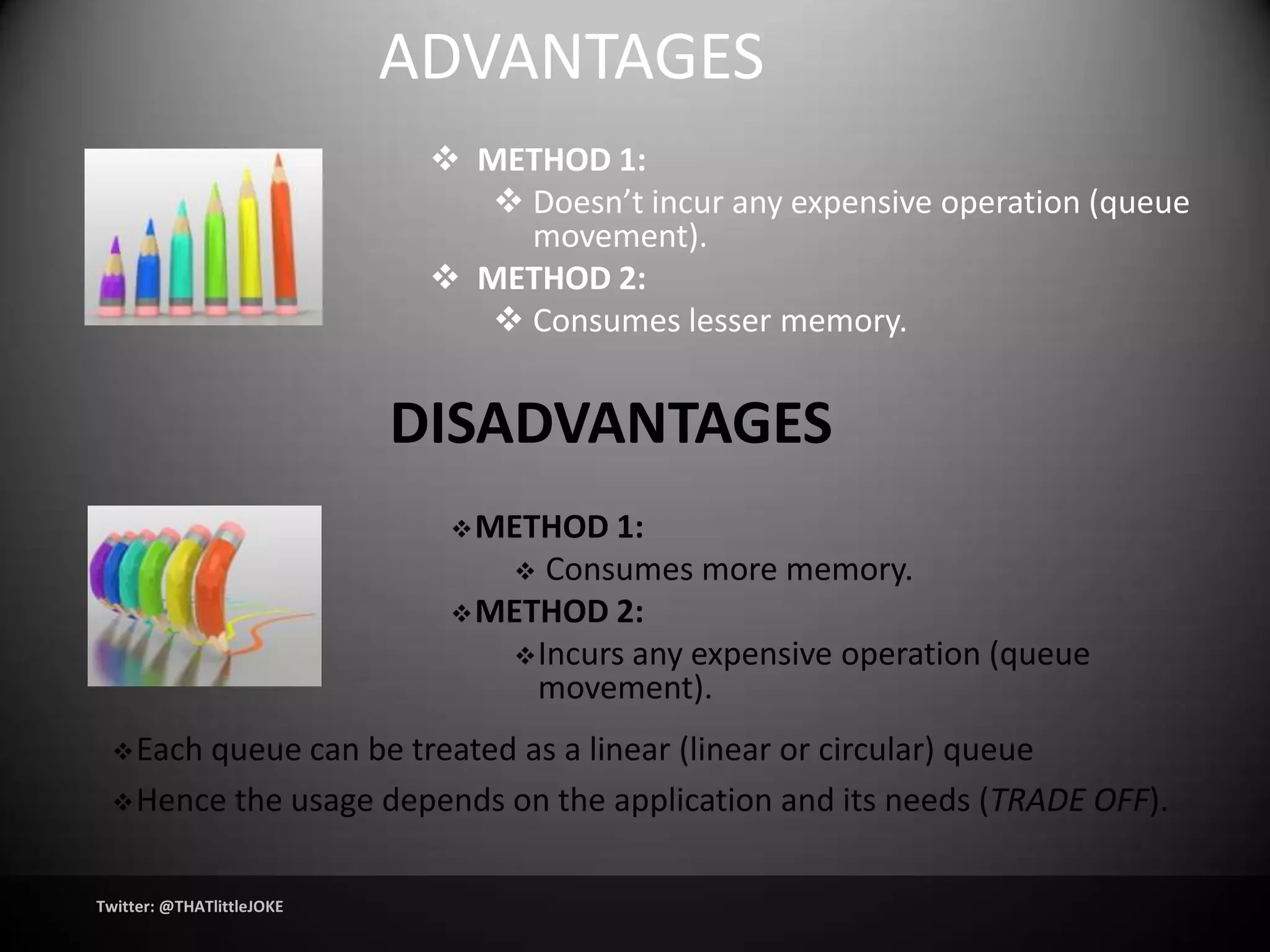
ADVANTAGES
                             METHOD 1:
                                Doesn’t incur any expensive operation (queue
                                 movement).
                             METHOD 2:
                                Consumes lesser memory.


                           DISADVANTAGES
                              METHOD  1:
                                 Consumes more memory.
                              METHOD 2:
                                 Incurs any expensive operation (queue
                                  movement).
  Eachqueue can be treated as a linear (linear or circular) queue
  Hence the usage depends on the application and its needs (TRADE OFF).


Twitter: @THATlittleJOKE
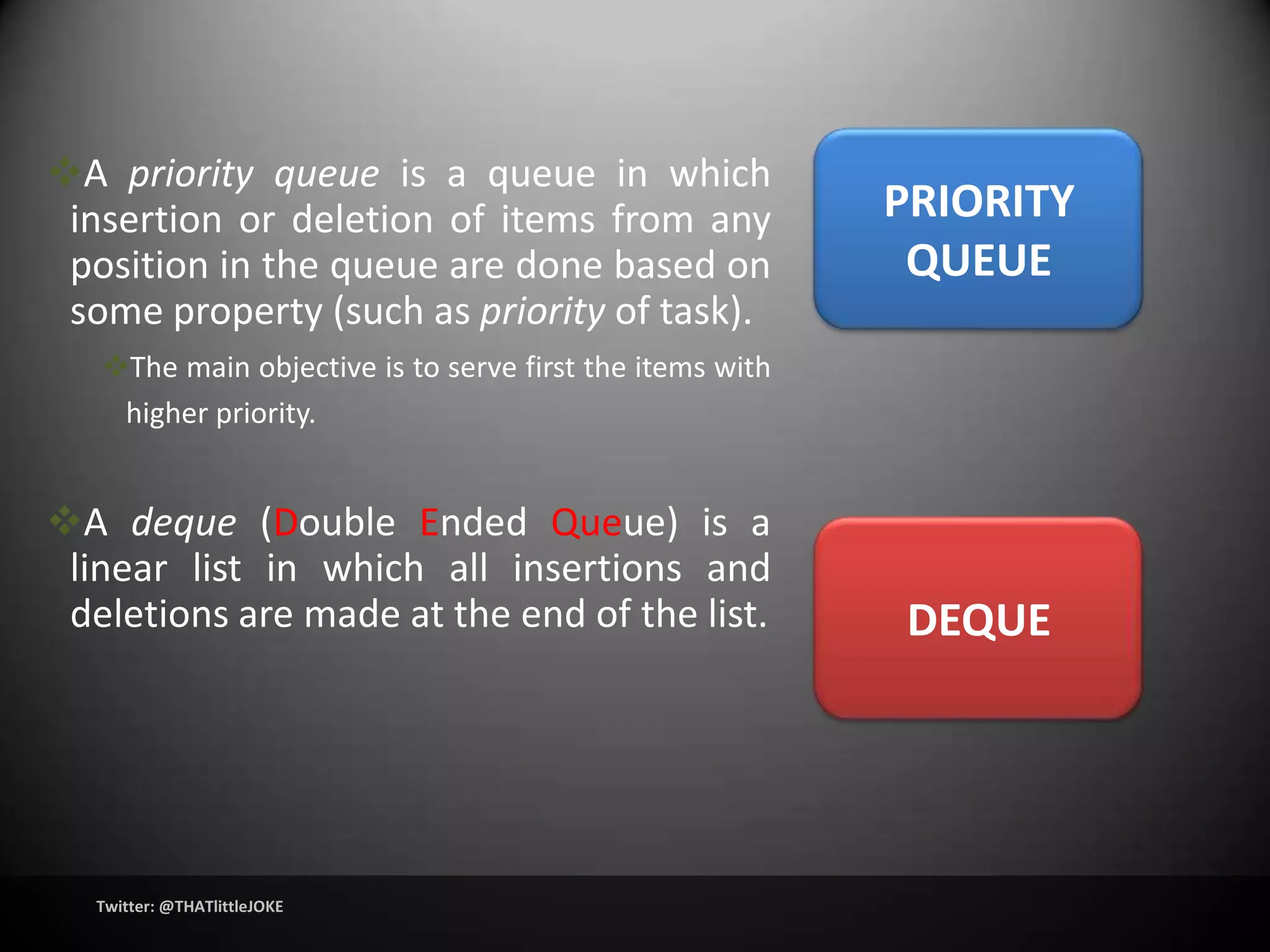
A priority queue is a queue in which
 insertion or deletion of items from any                  PRIORITY
 position in the queue are done based on                   QUEUE
 some property (such as priority of task).
   The main objective is to serve first the items with
    higher priority.


A deque (Double Ended Queue) is a
 linear list in which all insertions and
 deletions are made at the end of the list.               DEQUE


  Twitter: @THATlittleJOKE
DEQUE
 A deque is therefore more general than a
  queue and is a sort of FLIFLO (first in last in
  or first out last out). Two way insertion or
  deletion.

 Thus while one speaks of the top or
  bottom of a stack, or front or rear of a
  queue, one refers to the right end or left
  end of a deque.

 A deque has two variants: input restricted
  deque and output restricted deque.


  Twitter: @THATlittleJOKE
METHODS OF IMPLEMENTATION

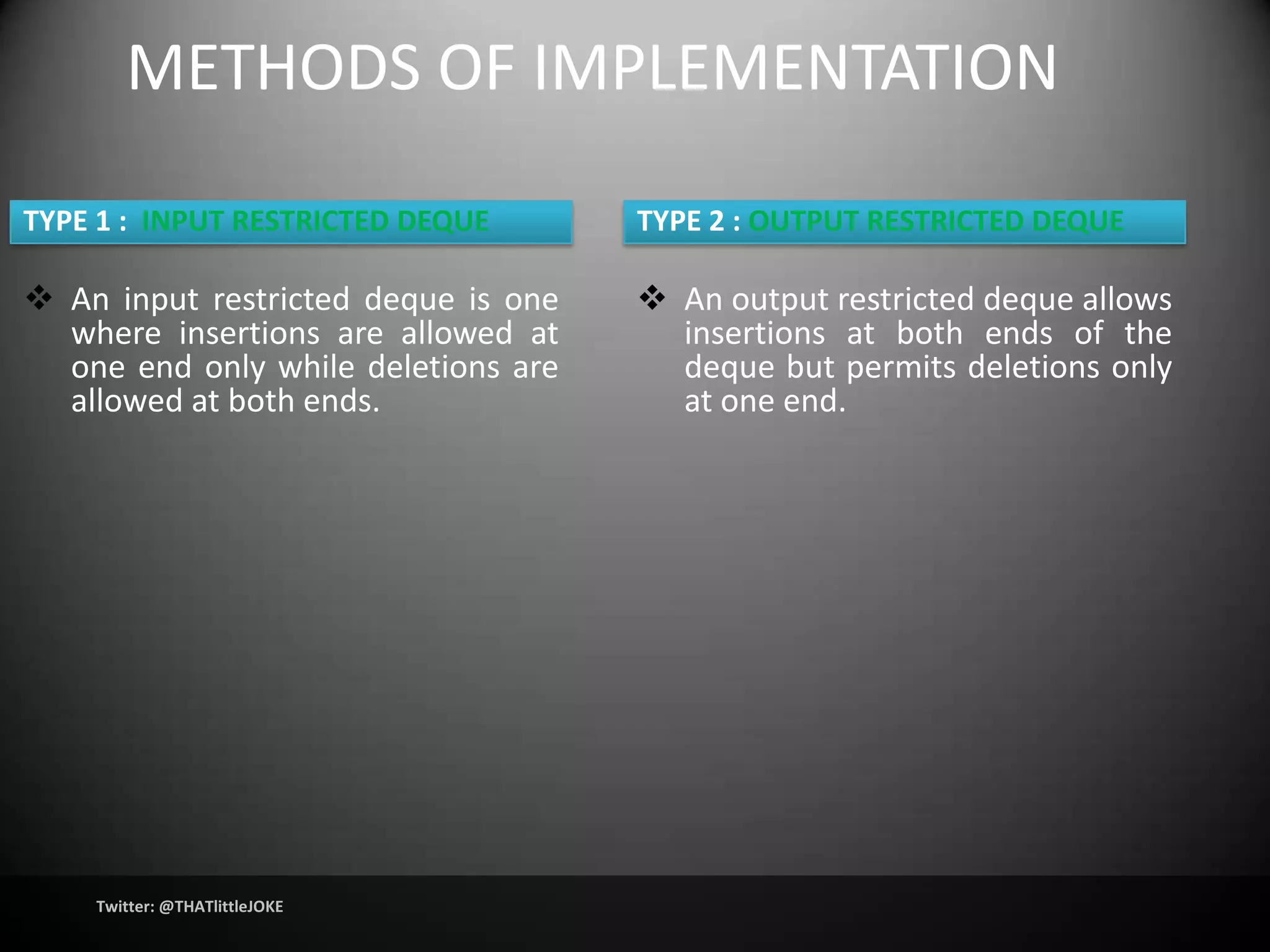
TYPE 1 : INPUT RESTRICTED DEQUE      TYPE 2 : OUTPUT RESTRICTED DEQUE

 An input restricted deque is one    An output restricted deque allows
  where insertions are allowed at      insertions at both ends of the
  one end only while deletions are     deque but permits deletions only
  allowed at both ends.                at one end.


    Twitter: @THATlittleJOKE
DEQUE


IMPLEMENTATION


Twitter: @THATlittleJOKE
DEQUE


APPLICATION


Twitter: @THATlittleJOKE
Thank You…..


                           Queries..??

Twitter: @THATlittleJOKE

Applications of queues ii

  • 1.
  • 2.
    TYPES OF QUEUES 1. Linear Queues. 2. Circular Queues. 3. Priority Queues. 4. Deque. Twitter: @THATlittleJOKE
  • 3.
    • A priorityqueue is a queue in which insertion or deletion of items from any PRIORITY position in the queue are done based on QUEUE some property (such as priority of task). – The main objective is to serve first the items with higher priority. DEQUE Twitter: @THATlittleJOKE
  • 4.
    METHODS OF IMPLEMENTATION METHOD1 : METHOD 2 : • A common method of implementation of a priority queue is to open as many queues as there are priority factors. • A low priority queue will be operated for deletion only when all its high priority predecessors are empty. Twitter: @THATlittleJOKE
  • 5.
    IMPLEMENTATION METHOD 1: • ENQUEUEING 1. Each distinct priority will have a separate queue to have its respective elements. 2. Thus when enqueing an item, we need both the item and its priority to enqueue it in the respective queue. 3. The items will be enqueued into the respective queue based on their priority. Twitter: @THATlittleJOKE
  • 6.
    Cont., METHOD 1: • DEQUEUEING 1.A dequeue command checks for items in the queue with the highest priority. 2.Once it is found non-empty, the item from it will be dequeued based on the FIFO concept. 3.If the queue is empty, it moves to the next non-empty queue in the order and performs the operation. Twitter: @THATlittleJOKE
  • 7.
    Cont., METHOD 1: • The “Queue Overflow” warning will be thrown only when all the queues are found full. • The “Queue Underflow” warning will be thrown only when all the queues are found empty. • The implementation depends upon the application (TRADE OFF) Twitter: @THATlittleJOKE
  • 8.
    APPLICATIONS METHOD 1: 1. O.S Job Scheduling. 2.Sharing a single runway of an airport for both landing and take-off of flights. Twitter: @THATlittleJOKE
  • 9.
    APPLICATION O.S JOBSCHEDULING: Q1-4 A B C D Q2-2 X Y Z Q Q3-1 M N O Twitter: @THATlittleJOKE
  • 10.
    APPLICATIONS 2.Sharing a singlerunway of an airport for both landing and take-off of flights. Twitter: @THATlittleJOKE
  • 11.
    METHODS OF IMPLEMENTATION METHOD1 : METHOD 2 : • A common method of • Another method of implementation of a priority implementation could be to sort the elements in the queue queue is to open as many queues according to the descending as there are priority factors. order of priorities every time an insertion takes place. • A low priority queue will be • The top priority element at the operated for deletion only when head of the queue is the one to all its high priority predecessors be deleted. are empty. Twitter: @THATlittleJOKE
  • 12.
    IMPLEMENTATION METHOD 2: • Despiteof having separate queues for every distinct priority, here we use only one queue. • We store the items in the queue in the descending order of priority, thus making it possible with a single queue. Twitter: @THATlittleJOKE
  • 13.
    IMPLEMENTATION METHOD 2: • ENQUEUE: •Here too, the priority of the item is also needed to enqueue the item. • The items are enqueued in the queue based on their priorities. • The items are enqueued at the right place so that the queue retains its descending order. Twitter: @THATlittleJOKE
  • 14.
    IMPLEMENTATION METHOD 2: • DEQUEUE: •The dequeue operation is performed the same method as done in the linear queue. • As it is the item with the highest priority which is at the front end, it is obviously the element with the highest priority that is being pushed out. Twitter: @THATlittleJOKE
  • 15.
    IMPLEMENTATION METHOD 2: • The“Queue Overflow” warning will be thrown when the queue is found full (physically or procedurally). • The “Queue Underflow” warning will be thrown only when the queue is empty. Twitter: @THATlittleJOKE
  • 16.
    APPLICATIONS METHOD 2: 1. Sorting. 2.O.S Job sharing . Twitter: @THATlittleJOKE
  • 17.
    APPLICATION SORTING: {(A,4),(B,2),(C,5),(D,1),(E,3)} A B E D C Twitter: @THATlittleJOKE
  • 18.
    ADVANTAGES  METHOD 1:  Doesn’t incur any expensive operation (queue movement).  METHOD 2:  Consumes lesser memory. DISADVANTAGES  METHOD 1:  Consumes more memory.  METHOD 2:  Incurs any expensive operation (queue movement).  Eachqueue can be treated as a linear (linear or circular) queue  Hence the usage depends on the application and its needs (TRADE OFF). Twitter: @THATlittleJOKE
  • 19.
    A priority queueis a queue in which insertion or deletion of items from any PRIORITY position in the queue are done based on QUEUE some property (such as priority of task). The main objective is to serve first the items with higher priority. A deque (Double Ended Queue) is a linear list in which all insertions and deletions are made at the end of the list. DEQUE Twitter: @THATlittleJOKE
  • 20.
    DEQUE  A dequeis therefore more general than a queue and is a sort of FLIFLO (first in last in or first out last out). Two way insertion or deletion.  Thus while one speaks of the top or bottom of a stack, or front or rear of a queue, one refers to the right end or left end of a deque.  A deque has two variants: input restricted deque and output restricted deque. Twitter: @THATlittleJOKE
  • 21.
    METHODS OF IMPLEMENTATION TYPE1 : INPUT RESTRICTED DEQUE TYPE 2 : OUTPUT RESTRICTED DEQUE  An input restricted deque is one  An output restricted deque allows where insertions are allowed at insertions at both ends of the one end only while deletions are deque but permits deletions only allowed at both ends. at one end. Twitter: @THATlittleJOKE
  • 22.
  • 23.
  • 24.
    Thank You….. Queries..?? Twitter: @THATlittleJOKE