Presented by
Sujata sahu
Msc Tutor
Introduction
We use pressure in different contexts
Definition
Pressure is the force on a
unit surface area
If the force F is acting a
surface of area A, the
pressure is given by
P=F/A
The pressure exerted by
fluids is called fluid pressure
Unit of pressure
 SI unit of pressure is pascal (“Pa”)
 The traditional unit for pressure in
medical community is “mmHg” which
correspond to pressure at the bottom of a
column of mercury “Hg” of certain
height “h”
 The pressure of column of liquid can be
calculated as P= hdg
Where d=density of liquid
g=acceleration due to gravity
h= height of liquid column
Typical pressure in normal human body
Hydrostatic pressure
 A very important property
of all fluids.
 When pressure is applied
on a confined fluid, it is
transmitted uniformly
throughout its volume
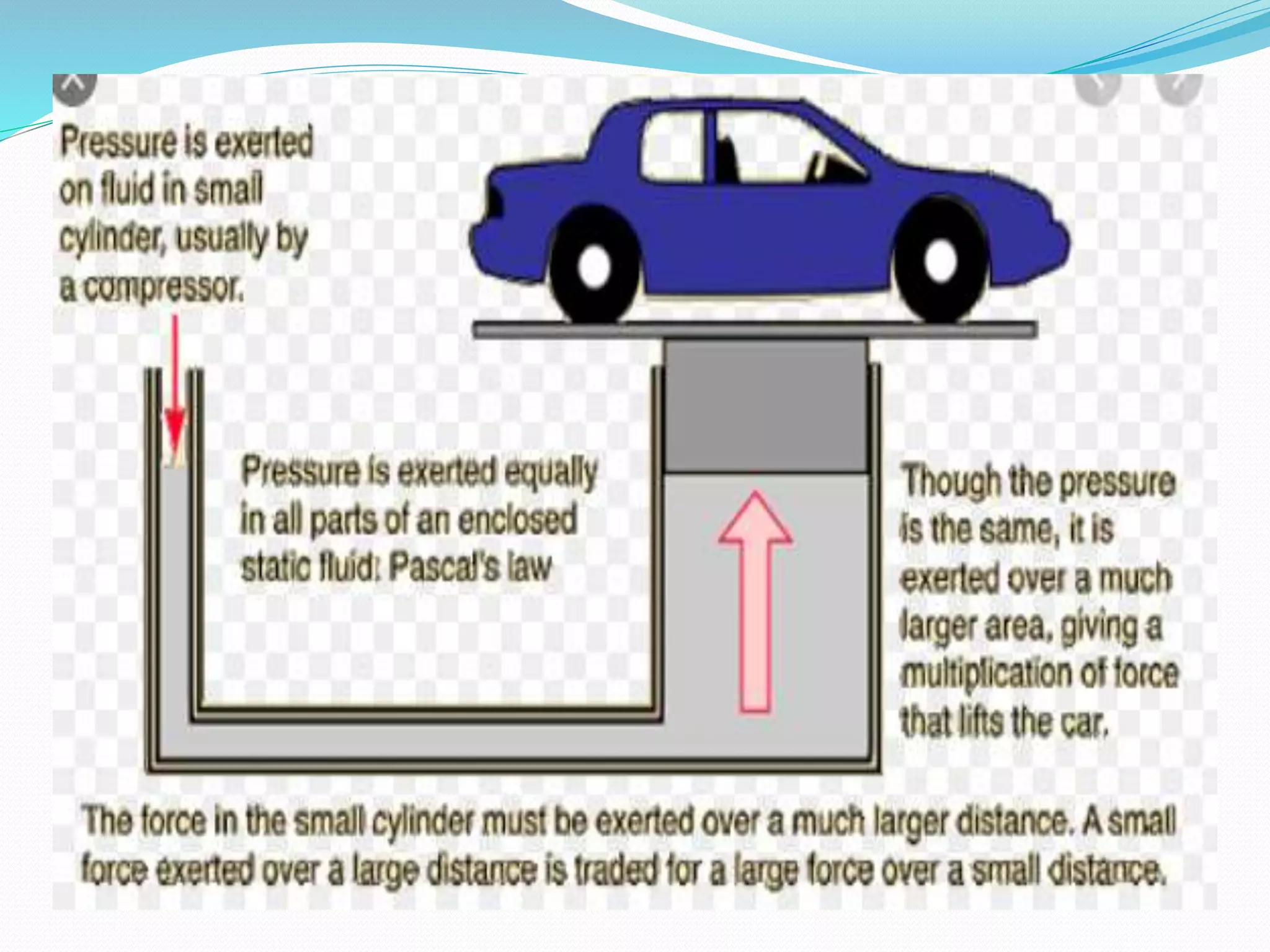
 “Any change in pressure
applied at any point in an
enclosed fluid at rest is
transmitted
undiminished &
uniformly to all its
parts.” (Pascal’s law)
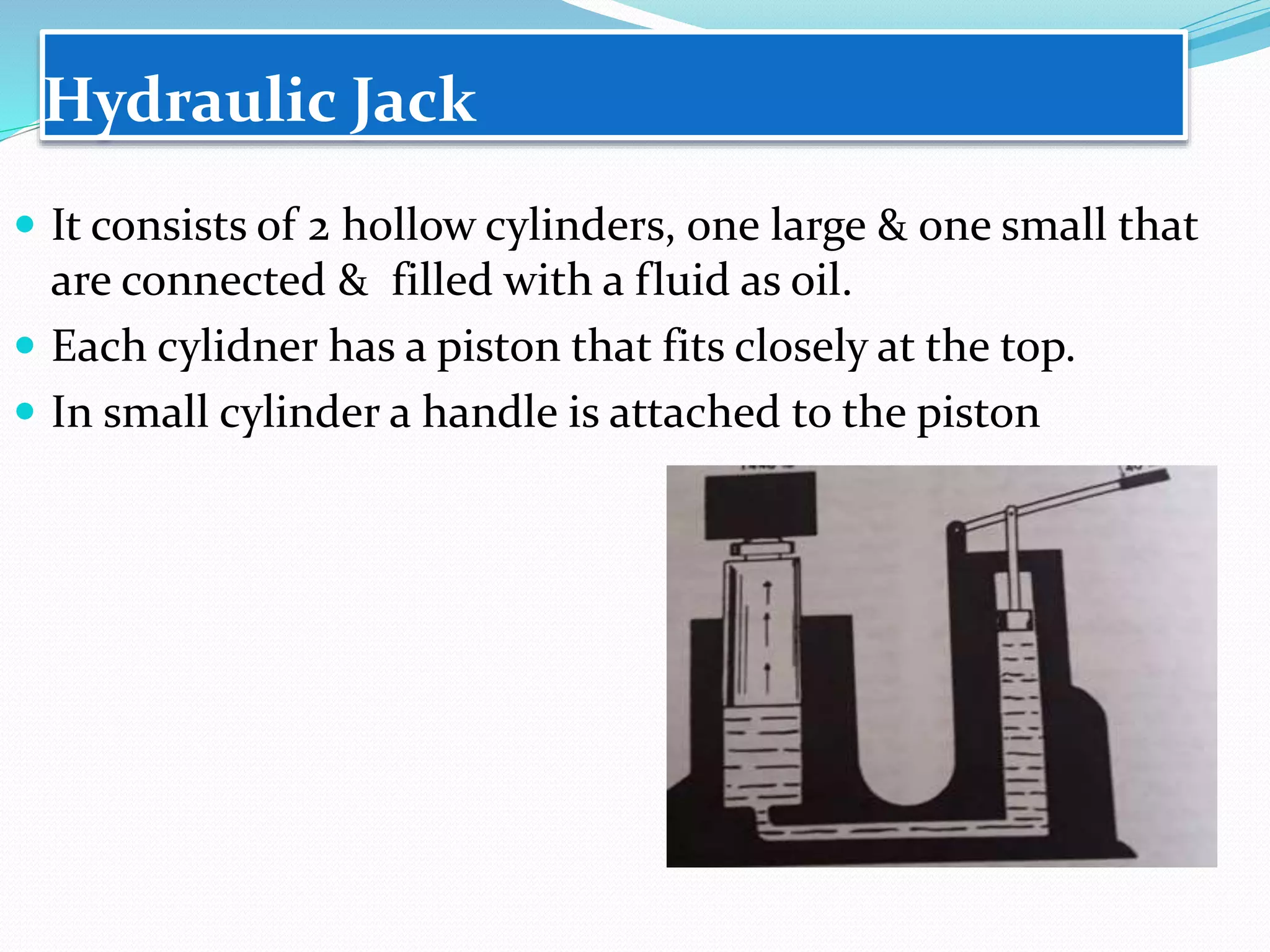
 It consists of 2 hollow cylinders, one large & one small that
are connected & filled with a fluid as oil.
 Each cylidner has a piston that fits closely at the top.
 In small cylinder a handle is attached to the piston
Hydraulic Jack
 When a force is applied to this handle ,the force is
transmitted throughout the oil to large piston
 A check valve prevents the fluid from flowing back when
handle is raised a 2nd time.
 The force is sufficient to raise a heavy object supported on
the large piston
Hydraulic Jack
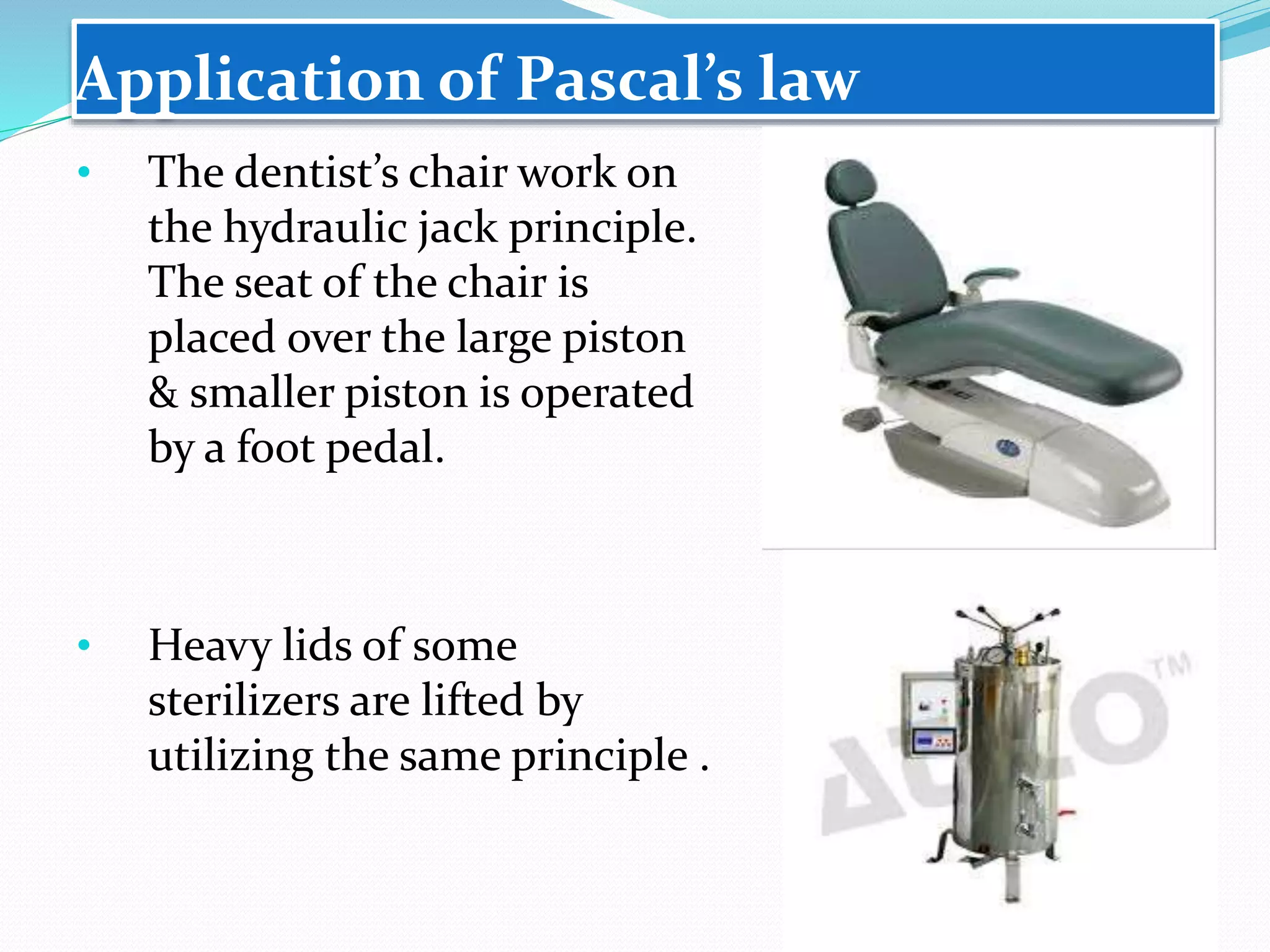
• The dentist’s chair work on
the hydraulic jack principle.
The seat of the chair is
placed over the large piston
& smaller piston is operated
by a foot pedal.
• Heavy lids of some
sterilizers are lifted by
utilizing the same principle .
Application of Pascal’s law
• Ordinary bed are having many uneven pressure points.
 The heavier part of body press against the mattress, &
the mattress in turn presses upward more firmly against
these parts of the body .
 The ch. ill pt develop ulcer at these uneven points of
pressure
A water/air mattress is ideal for patient
• Enclosed fluids provides equal pressure on all parts of
the body.
• Both wt of patient & the area that he covers influence
the pressure of the fluid within the mattress.
• Since the pressure is exerted against the surface of an
enclosed fluid , the pressure is transmitted equally
through out the fluid & therefore equally on the surface
of patient’s body.
Application of Pascal’s law
CONT…
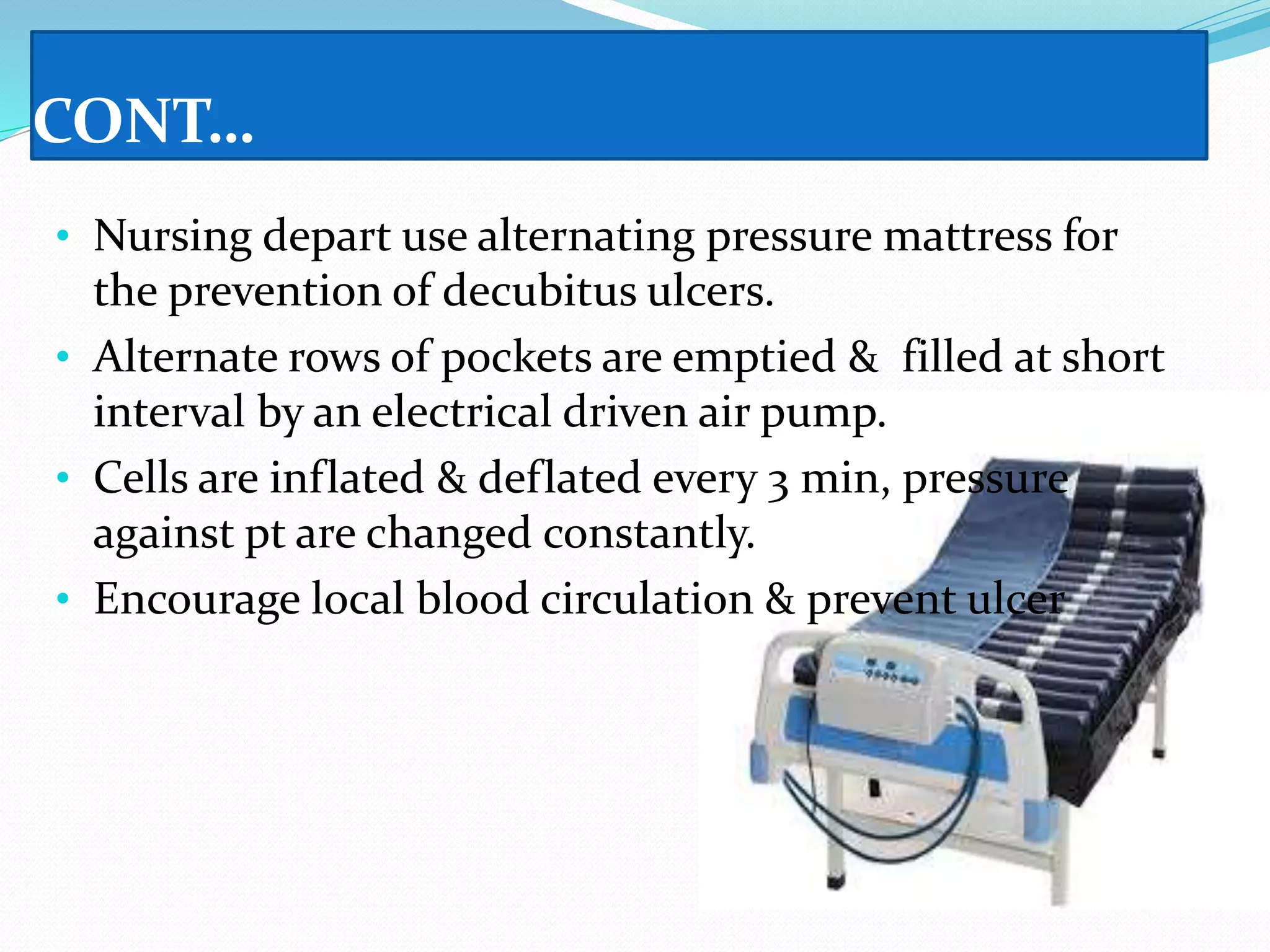
• Nursing depart use alternating pressure mattress for
the prevention of decubitus ulcers.
• Alternate rows of pockets are emptied & filled at short
interval by an electrical driven air pump.
• Cells are inflated & deflated every 3 min, pressure
against pt are changed constantly.
• Encourage local blood circulation & prevent ulcer
Cont…
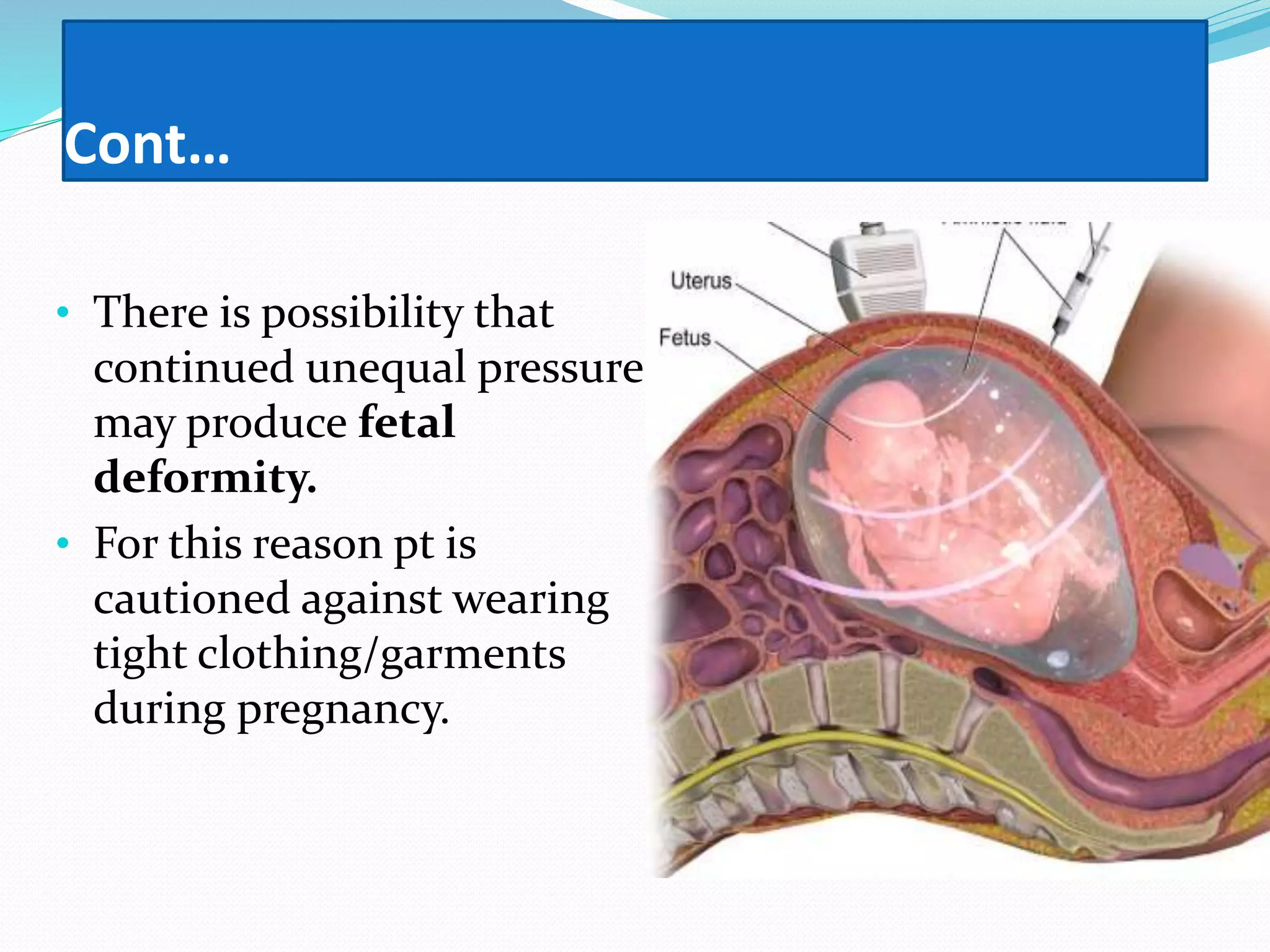
• Amniotic fluid sac enclosing
the fetus in ut is filled with
amniotic fluid.
• It is confined fluid & serves
as protection to the fetus .
• Any pressure exerted the
abdominal wall will be
transmitted to the amniotic
fluid & to all surfaces of fetus.
Cont…
• There is possibility that
continued unequal pressure
may produce fetal
deformity.
• For this reason pt is
cautioned against wearing
tight clothing/garments
during pregnancy.
Cont…
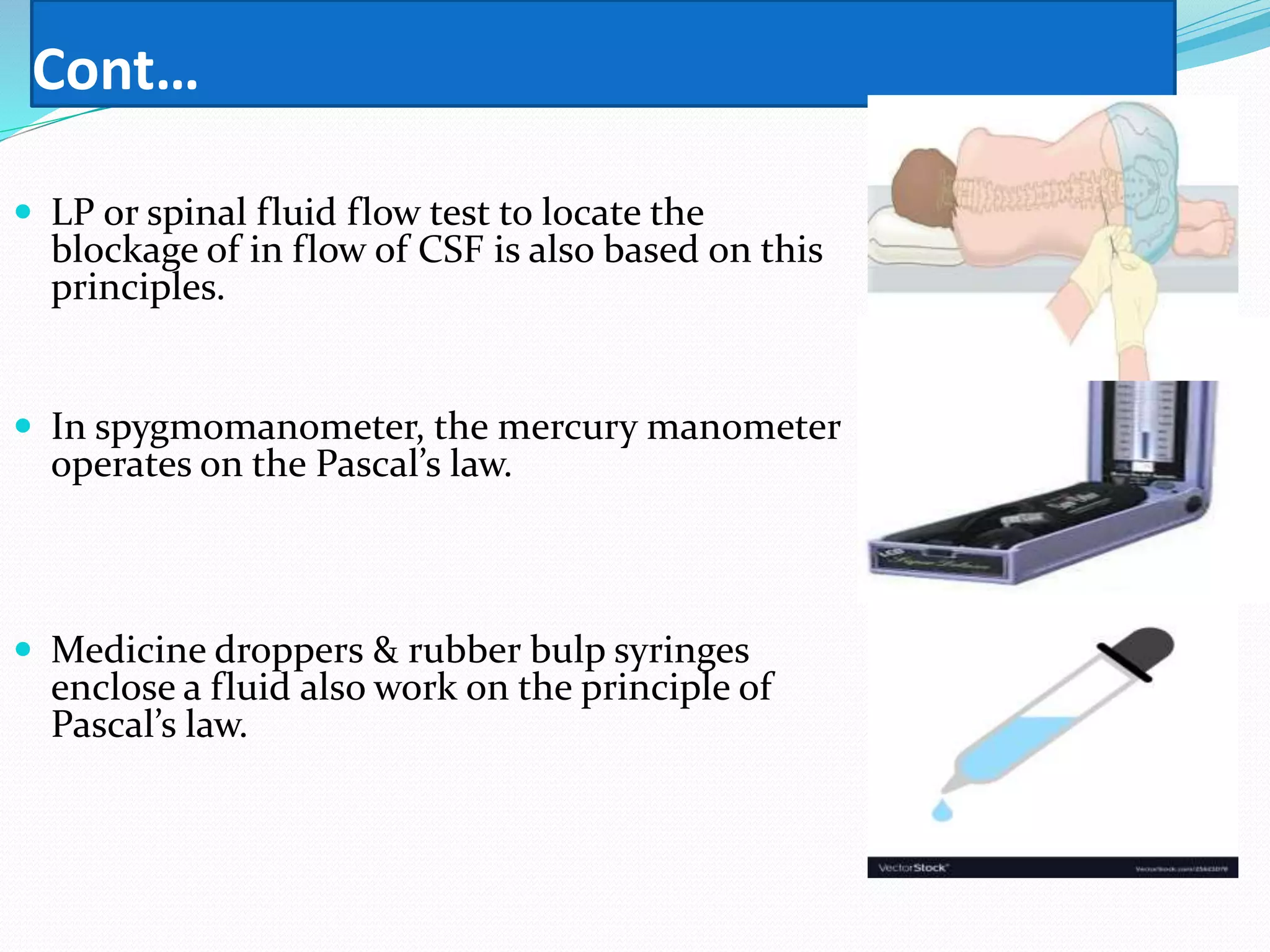
 LP or spinal fluid flow test to locate the
blockage of in flow of CSF is also based on this
principles.
 In spygmomanometer, the mercury manometer
operates on the Pascal’s law.
 Medicine droppers & rubber bulp syringes
enclose a fluid also work on the principle of
Pascal’s law.
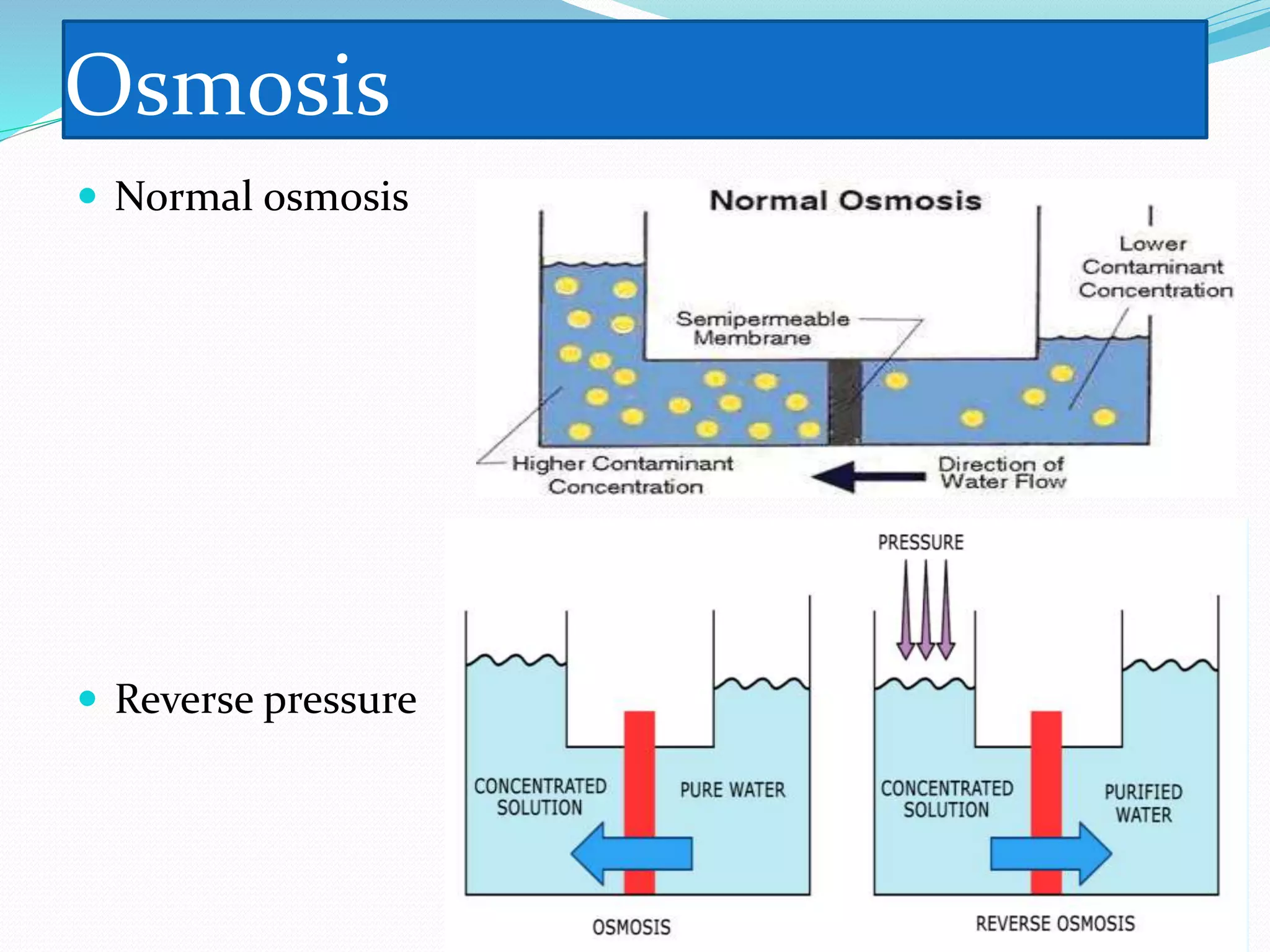
Osmosis Pressure
Osmosis
 Normal osmosis
 Reverse pressure
Osmotic pressure of a solution is proportional to the
concentration of the solute particle that can’t cross the
membrane.
Osmosis In Animal
Cell
 Any solution in which a cell,e.g-a
red cell maintains its normal
shape & volume is an isotonic
solution
 In hypotonic solution the cell will
swells
 In hypertonic solution the cell will
shrink
Application of osmotic pressure
 Blood albumin helps to maintain the colloidal pressure of
blood. If a patient loses blood albumin which may happen
in nephrosis , the colloidal osmotic pressure will drops &
fluid remains in the tissues. This results in edema .
 Sometimes infusion of a hypertonic solution is useful to
treat patient who have cerebral edema. It relives such fluid
overload by causing osmosis of water from interstitial fluid
in to blood
 hypotonic solution can be used by iv/oral,to treat
dehydration . The water in hypotonic solution moves from
blood in to interstitial fluid & then in to the body cells to
rehydrate them.
Atmospheric pressure
 The air around you has weight, and it
presses against everything it touches.
That pressure is called atmospheric
pressure, or air pressure.
 It is the force exerted on a surface by
the air above it as gravity pulls it to
Earth.
.
Measuring the atmospheric pressure
 Atmospheric pressure is commonly
measured with a barometer.
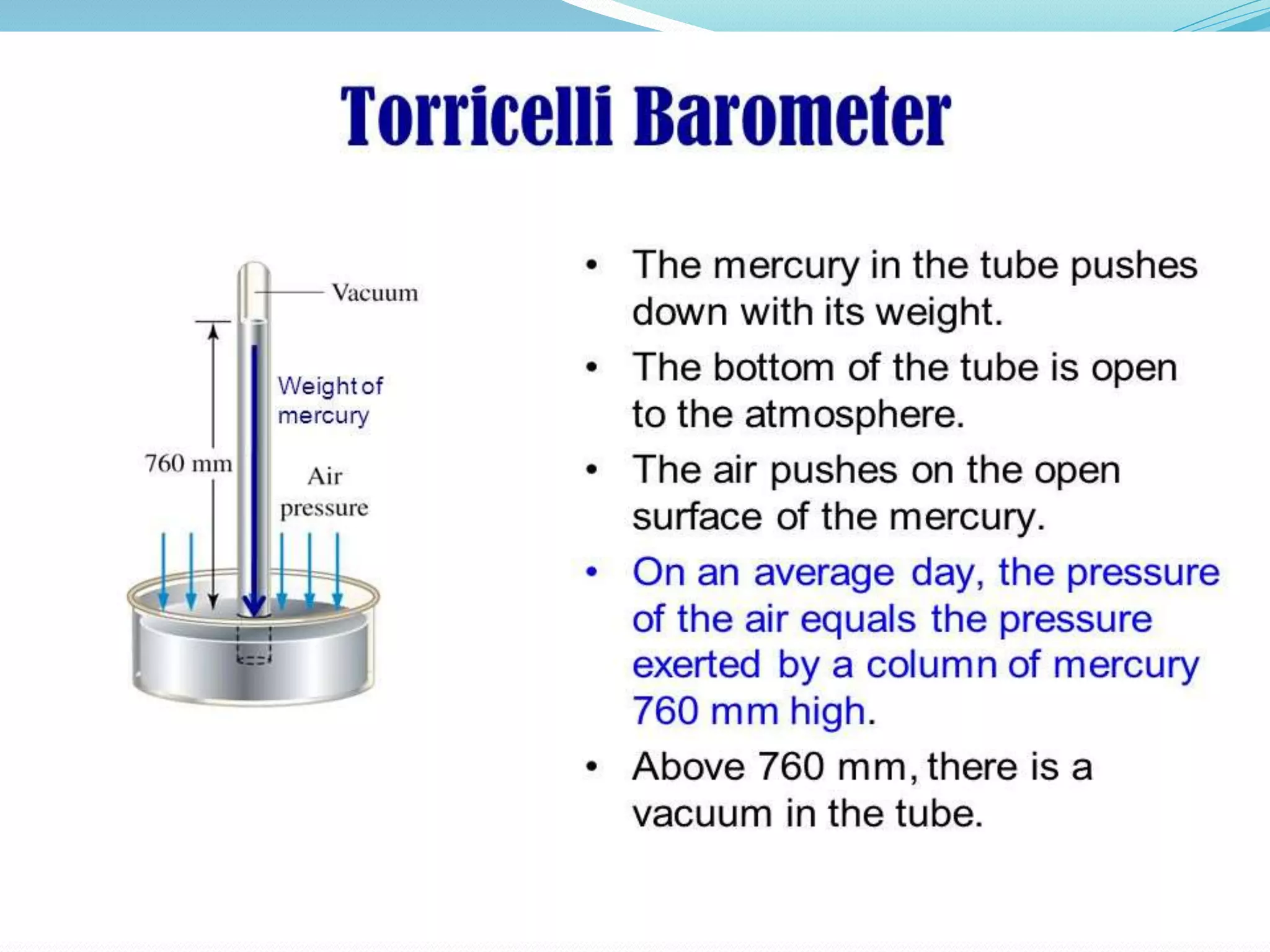
 Barometer is made up glass tube closed
at one end & it is filled up mercury &
inverted in to a bowl of mercury
 When the atmospheric pressure
increases, the level of mercury column
in tube rises, when pressure decreases
the level of mercury falls
 a column of mercury in a glass tube rises
or falls as the weight of the atmosphere
changes.
Toricelli experiment
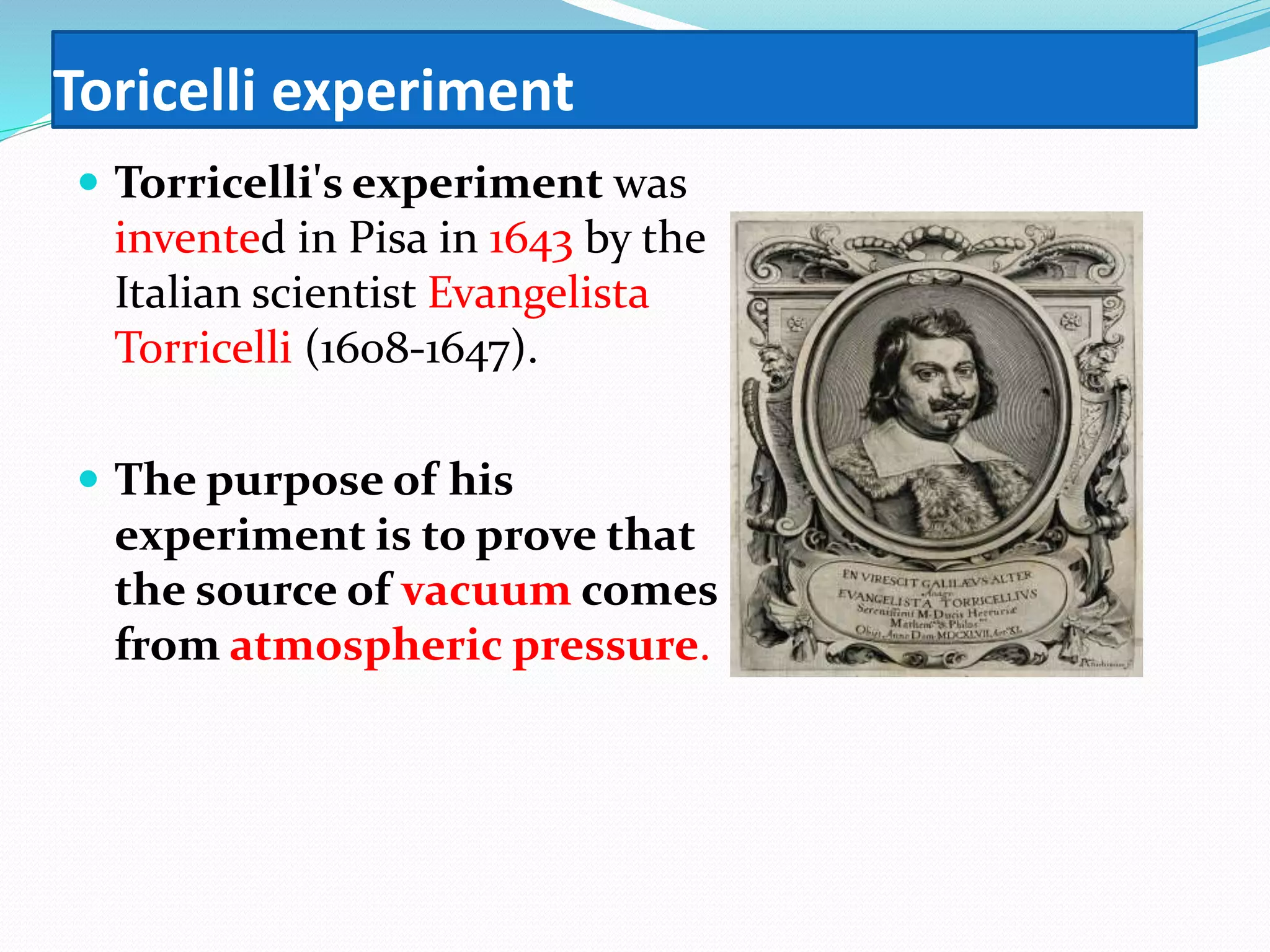
 Torricelli's experiment was
invented in Pisa in 1643 by the
Italian scientist Evangelista
Torricelli (1608-1647).
 The purpose of his
experiment is to prove that
the source of vacuum comes
from atmospheric pressure.
 He took a long glass tube open at
one end & filled it with mercury
 He closed the open end of the tube
with his finger & inverted it in a
vessel containing mercury.
 When he removed his finger , he
observed that level of mercury
dropped to certain height (76 cm
)leaving the space at the top.
Toricelli experiment
 Space at top of mercury is
vacuum
 Toricelli reasoned that
atmosphere pressed downward
on the surface of mercury in
the container & supported
mercury in the glass tube
 In other words, the rise of
mercury is due to the
atmosphere pressing down on
the mercury in the open
container
Toricelli experiment
Application of atmospheric pressure
 It is employed during surgical operation
for the removal of blood &
serosanguineous fluids from the region of
human body being operated.
 Many kinds of aspirators in hospital words
work on the application of controlled
suction.
 Water-sealed drainage used after thoracic
operation work on controlled suction &
gravity.
 Water-sealed drainage used after thoracic operation
work on controlled suction & gravity.
Application of atmospheric pressure
Cont…
MEASUREMENT
OF
PRESSURE
IN THE BODY
Measuring arterial pressure
 Arterial pressure is measured by BP cuff on upper arm
 Systolic & diastolic pressure represent the pressure
within brachial artery
 This pressure is slightly different than the pressure
found in aorta .
 The aortic pressure pulse travels down the aorta & into
distributing arteries.
 So there are characteristics changes in the systolic
pressure , diastolic pressure & in mean pressure
Measuring arterial pressure
 The systolic pressure rises & the diastolic pressure
falls,
 Therefore the pulse pressure increases, as the pulse
pressure travels away from the aorta.
 As the Arterial BP also can be measured by the placing
an intra-arterial catheter and directly attaching it to a
monitor through a transducer
Measuring central venous pressure
 CVP can be measured by either manometer or
electronically transducer.
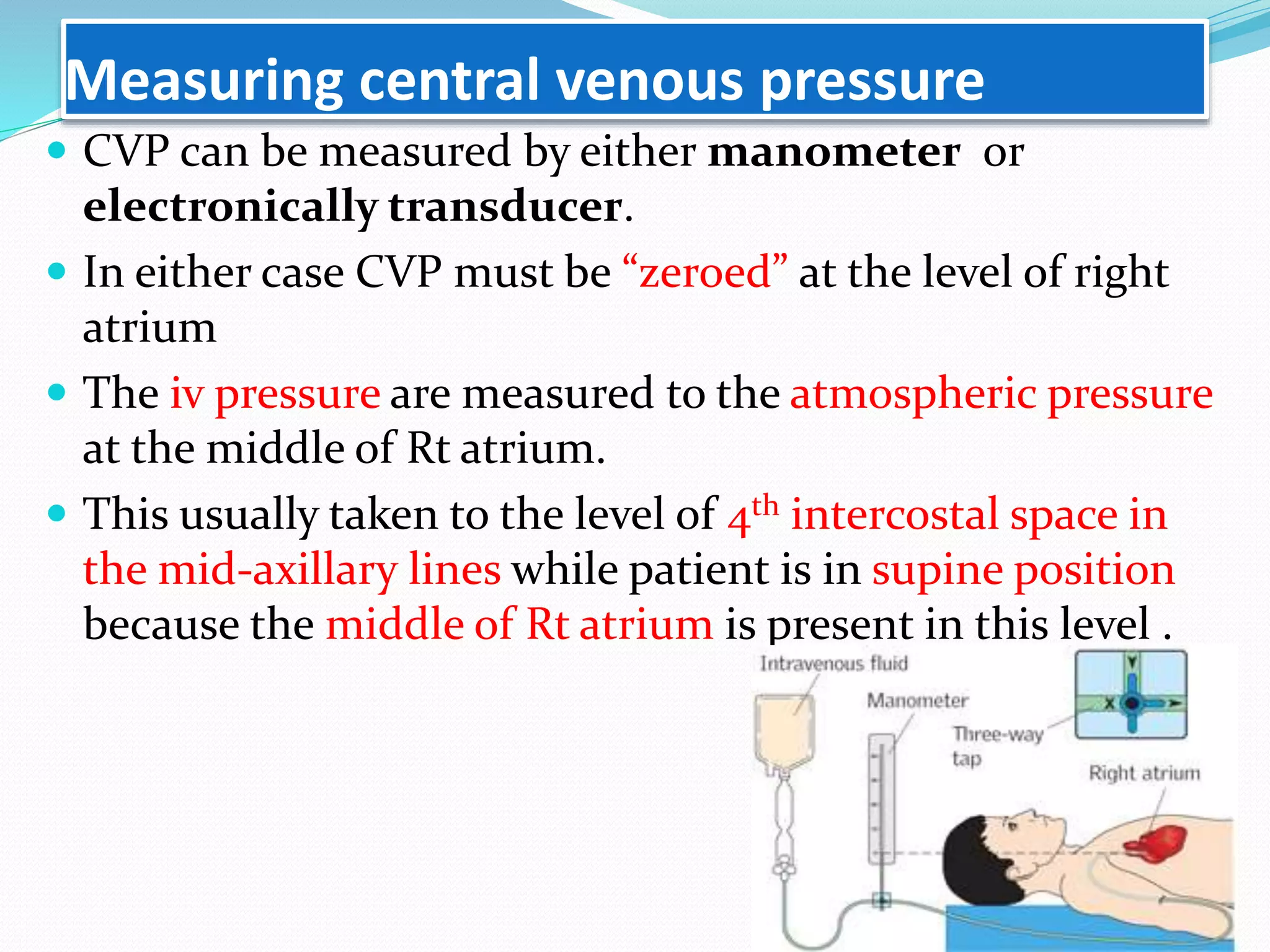
 In either case CVP must be “zeroed” at the level of right
atrium
 The iv pressure are measured to the atmospheric pressure
at the middle of Rt atrium.
 This usually taken to the level of 4th intercostal space in
the mid-axillary lines while patient is in supine position
because the middle of Rt atrium is present in this level .
Measuring central venous pressure
Using Manometer
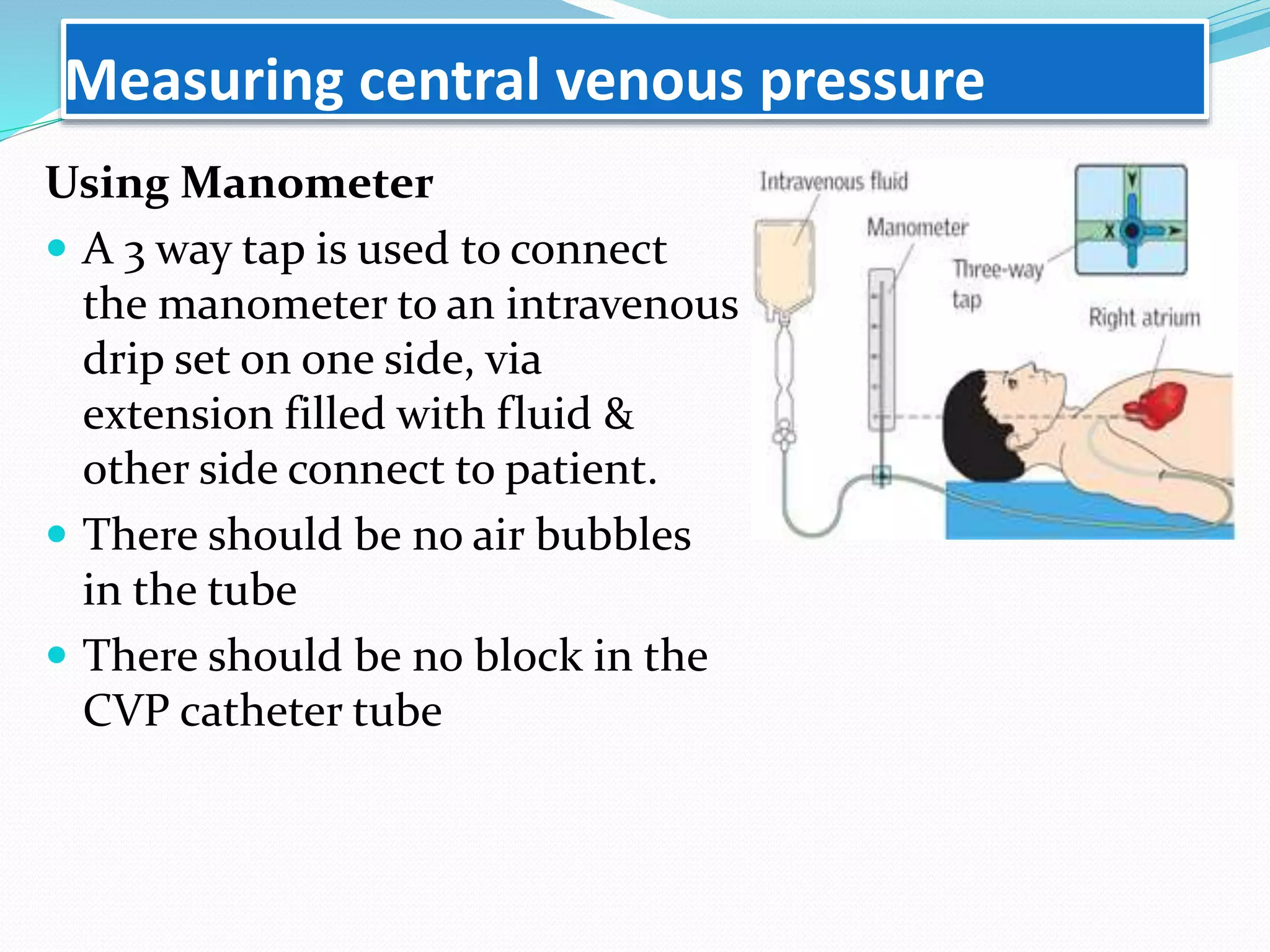
 A 3 way tap is used to connect
the manometer to an intravenous
drip set on one side, via
extension filled with fluid &
other side connect to patient.
 There should be no air bubbles
in the tube
 There should be no block in the
CVP catheter tube
Using manometer
 The 3 way tap is then turned , so that
it is open to the fluid bag &
manometer but closed to the patient,
allowing the manometer column to fill
with fluid.
 Once the manometer has filled
adequately
 The 3 way tap is turned so that it open
to patient & manometer but closed to
fluid bag.
 The fluid level within the manometer
column will fall to the level of CVP
Using manometer
 The value can be read on manometer
scale which is marked in cm.
 There fore the value for the CVP is
cm of water (cm H2O).
 The fluid level will continue to rise &
fall slightly with respiration .
 The average reading should be
recorded.
Using manometer
 The value can be read on manometer
scale which is marked in cm
 There fore the value for the CVP is
cm of water (cm H2O.
 The fluid level will continue to rise &
fall slightly with respiration
 The average reading should be
recorded
Using transducer
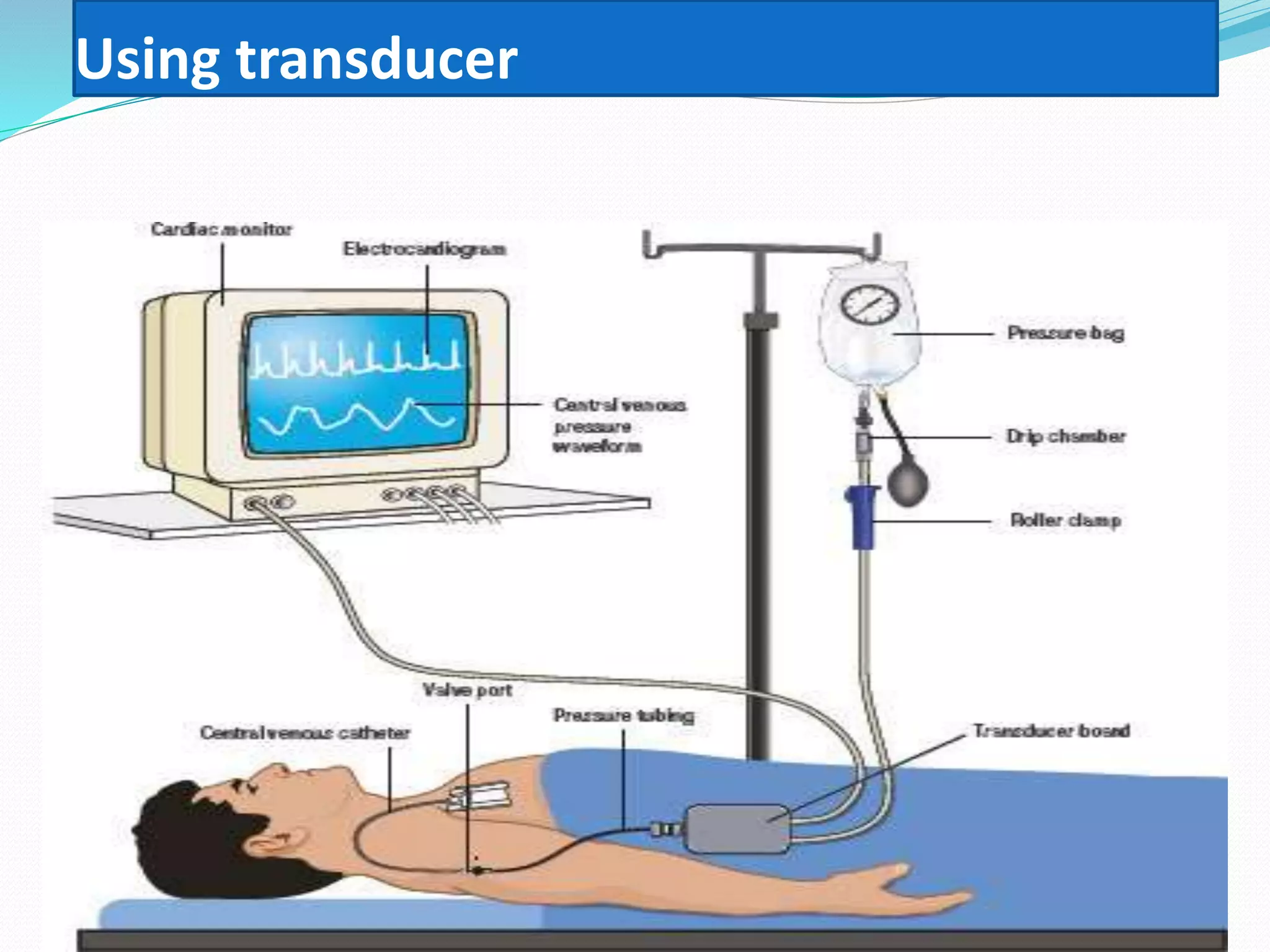
 The transducer is fixed at the level of right atrium &
connected to patient’s CVP catheter , via fluid filled
extension tubing.
 Avoid the air or kinks in the fluid tube & in the CVP
catheter tube respectively.
 The transducer is then zeroed to atmosphere pressure by
turning its 3-way tap so that it is open to the transducer
& to room air ,but closed to the patient
 Then 3 way tap is turned so that it is now closed to room
air & open between the patient & the transducer
 A continuous CVP reading, measured in mmHg rather
than cmH2O, can be obtained.
Using transducer
Intraocular Pressure
 IOP is the fluid pressure inside the eye.
 IOP is measured by tonometer
 Tonometry is the measurement of tension or pressure
within the eye
TYPES OF TONOMETRY
 Applanation Tonometry
 Pneumatonometry
Applanation Tonometry
There are many different ways to measure eye pressure.
 One such method is a painless procedure, called
“applanation tonometry.”
 The term applanate means to flatten.
 In most ophthalmologist’s offices, eye pressure is
measured using “Goldmann applanation tonometry,”
and this is considered a “gold standard” eye pressure
measurement.
 In this test, the eyes are a small amount of non-toxic
dye is placed in the eye.
 Ophthalmologist will instruct Patient to position your
head into a device called the slit lamp.
 Then, a small tip gently touches the surface of the eye
and the eye pressure is measured.
 The eye pressure is measured based on the force
required to gently flatten a fixed area of the cornea.
Applanation Tonometry
Pneumatonometry
 Alternative measurement methods include
pneumatonometry, which is particularly useful in
cases of scarred corneas.
 The pneumatonometer will also print out a tracing so
that the quality of the measurement can be assessed.
 Pneumatonometry is thought to be less influenced by
corneal thickness.
ICP monitoring
How the Test is Performed
 There are three ways to monitor ICP.
Intraventricular catheter
 The intraventricular catheter is the most accurate
monitoring method.
 To insert an intraventricular catheter, a hole is drilled
through the skull.
 The catheter is inserted through the brain into the lateral
ventricle.
 The catheter may be hard to get into place when the
intracranial pressure is high.
ICP monitoring
Subdural screw (bolt)
 This method is used if monitoring needs to be done
right away.
 A hollow screw is inserted through a hole drilled in the
skull.
 It is placed through the membrane that protects the
brain and spinal cord (dura mater).
 This allows the sensor to record from inside the
subdural space.
ICP monitoring
Epidural sensor
• An epidural sensor is inserted between the skull and
dural tissue.
• The epidural sensor is placed through a hole drilled in
the skull.
• This procedure is less invasive than other methods,
but it cannot remove excess CSF.
Application of pressure in nursing ( biophysics)

Application of pressure in nursing ( biophysics)

  • 2.
  • 3.
    Introduction We use pressurein different contexts
  • 4.
    Definition Pressure is theforce on a unit surface area If the force F is acting a surface of area A, the pressure is given by P=F/A The pressure exerted by fluids is called fluid pressure
  • 5.
    Unit of pressure SI unit of pressure is pascal (“Pa”)  The traditional unit for pressure in medical community is “mmHg” which correspond to pressure at the bottom of a column of mercury “Hg” of certain height “h”  The pressure of column of liquid can be calculated as P= hdg Where d=density of liquid g=acceleration due to gravity h= height of liquid column
  • 6.
    Typical pressure innormal human body
  • 7.
    Hydrostatic pressure  Avery important property of all fluids.  When pressure is applied on a confined fluid, it is transmitted uniformly throughout its volume  “Any change in pressure applied at any point in an enclosed fluid at rest is transmitted undiminished & uniformly to all its parts.” (Pascal’s law)
  • 8.
     It consistsof 2 hollow cylinders, one large & one small that are connected & filled with a fluid as oil.  Each cylidner has a piston that fits closely at the top.  In small cylinder a handle is attached to the piston Hydraulic Jack
  • 9.
     When aforce is applied to this handle ,the force is transmitted throughout the oil to large piston  A check valve prevents the fluid from flowing back when handle is raised a 2nd time.  The force is sufficient to raise a heavy object supported on the large piston Hydraulic Jack
  • 11.
    • The dentist’schair work on the hydraulic jack principle. The seat of the chair is placed over the large piston & smaller piston is operated by a foot pedal. • Heavy lids of some sterilizers are lifted by utilizing the same principle . Application of Pascal’s law
  • 12.
    Application of Pascal’slaw • Ordinary bed are having many uneven pressure points.  The heavier part of body press against the mattress, & the mattress in turn presses upward more firmly against these parts of the body .  The ch. ill pt develop ulcer at these uneven points of pressure
  • 13.
    A water/air mattressis ideal for patient • Enclosed fluids provides equal pressure on all parts of the body. • Both wt of patient & the area that he covers influence the pressure of the fluid within the mattress. • Since the pressure is exerted against the surface of an enclosed fluid , the pressure is transmitted equally through out the fluid & therefore equally on the surface of patient’s body. Application of Pascal’s law
  • 14.
    CONT… • Nursing departuse alternating pressure mattress for the prevention of decubitus ulcers. • Alternate rows of pockets are emptied & filled at short interval by an electrical driven air pump. • Cells are inflated & deflated every 3 min, pressure against pt are changed constantly. • Encourage local blood circulation & prevent ulcer
  • 15.
    Cont… • Amniotic fluidsac enclosing the fetus in ut is filled with amniotic fluid. • It is confined fluid & serves as protection to the fetus . • Any pressure exerted the abdominal wall will be transmitted to the amniotic fluid & to all surfaces of fetus.
  • 16.
    Cont… • There ispossibility that continued unequal pressure may produce fetal deformity. • For this reason pt is cautioned against wearing tight clothing/garments during pregnancy.
  • 17.
    Cont…  LP orspinal fluid flow test to locate the blockage of in flow of CSF is also based on this principles.  In spygmomanometer, the mercury manometer operates on the Pascal’s law.  Medicine droppers & rubber bulp syringes enclose a fluid also work on the principle of Pascal’s law.
  • 18.
  • 19.
  • 20.
    Osmotic pressure ofa solution is proportional to the concentration of the solute particle that can’t cross the membrane.
  • 21.
    Osmosis In Animal Cell Any solution in which a cell,e.g-a red cell maintains its normal shape & volume is an isotonic solution  In hypotonic solution the cell will swells  In hypertonic solution the cell will shrink
  • 22.
    Application of osmoticpressure  Blood albumin helps to maintain the colloidal pressure of blood. If a patient loses blood albumin which may happen in nephrosis , the colloidal osmotic pressure will drops & fluid remains in the tissues. This results in edema .  Sometimes infusion of a hypertonic solution is useful to treat patient who have cerebral edema. It relives such fluid overload by causing osmosis of water from interstitial fluid in to blood  hypotonic solution can be used by iv/oral,to treat dehydration . The water in hypotonic solution moves from blood in to interstitial fluid & then in to the body cells to rehydrate them.
  • 23.
    Atmospheric pressure  Theair around you has weight, and it presses against everything it touches. That pressure is called atmospheric pressure, or air pressure.  It is the force exerted on a surface by the air above it as gravity pulls it to Earth. .
  • 24.
    Measuring the atmosphericpressure  Atmospheric pressure is commonly measured with a barometer.  Barometer is made up glass tube closed at one end & it is filled up mercury & inverted in to a bowl of mercury  When the atmospheric pressure increases, the level of mercury column in tube rises, when pressure decreases the level of mercury falls  a column of mercury in a glass tube rises or falls as the weight of the atmosphere changes.
  • 25.
    Toricelli experiment  Torricelli'sexperiment was invented in Pisa in 1643 by the Italian scientist Evangelista Torricelli (1608-1647).  The purpose of his experiment is to prove that the source of vacuum comes from atmospheric pressure.
  • 26.
     He tooka long glass tube open at one end & filled it with mercury  He closed the open end of the tube with his finger & inverted it in a vessel containing mercury.  When he removed his finger , he observed that level of mercury dropped to certain height (76 cm )leaving the space at the top. Toricelli experiment
  • 27.
     Space attop of mercury is vacuum  Toricelli reasoned that atmosphere pressed downward on the surface of mercury in the container & supported mercury in the glass tube  In other words, the rise of mercury is due to the atmosphere pressing down on the mercury in the open container Toricelli experiment
  • 29.
    Application of atmosphericpressure  It is employed during surgical operation for the removal of blood & serosanguineous fluids from the region of human body being operated.  Many kinds of aspirators in hospital words work on the application of controlled suction.  Water-sealed drainage used after thoracic operation work on controlled suction & gravity.
  • 30.
     Water-sealed drainageused after thoracic operation work on controlled suction & gravity. Application of atmospheric pressure
  • 31.
  • 32.
  • 33.
    Measuring arterial pressure Arterial pressure is measured by BP cuff on upper arm  Systolic & diastolic pressure represent the pressure within brachial artery  This pressure is slightly different than the pressure found in aorta .  The aortic pressure pulse travels down the aorta & into distributing arteries.  So there are characteristics changes in the systolic pressure , diastolic pressure & in mean pressure
  • 34.
    Measuring arterial pressure The systolic pressure rises & the diastolic pressure falls,  Therefore the pulse pressure increases, as the pulse pressure travels away from the aorta.  As the Arterial BP also can be measured by the placing an intra-arterial catheter and directly attaching it to a monitor through a transducer
  • 35.
    Measuring central venouspressure  CVP can be measured by either manometer or electronically transducer.  In either case CVP must be “zeroed” at the level of right atrium  The iv pressure are measured to the atmospheric pressure at the middle of Rt atrium.  This usually taken to the level of 4th intercostal space in the mid-axillary lines while patient is in supine position because the middle of Rt atrium is present in this level .
  • 36.
    Measuring central venouspressure Using Manometer  A 3 way tap is used to connect the manometer to an intravenous drip set on one side, via extension filled with fluid & other side connect to patient.  There should be no air bubbles in the tube  There should be no block in the CVP catheter tube
  • 37.
    Using manometer  The3 way tap is then turned , so that it is open to the fluid bag & manometer but closed to the patient, allowing the manometer column to fill with fluid.  Once the manometer has filled adequately  The 3 way tap is turned so that it open to patient & manometer but closed to fluid bag.  The fluid level within the manometer column will fall to the level of CVP
  • 38.
    Using manometer  Thevalue can be read on manometer scale which is marked in cm.  There fore the value for the CVP is cm of water (cm H2O).  The fluid level will continue to rise & fall slightly with respiration .  The average reading should be recorded.
  • 39.
    Using manometer  Thevalue can be read on manometer scale which is marked in cm  There fore the value for the CVP is cm of water (cm H2O.  The fluid level will continue to rise & fall slightly with respiration  The average reading should be recorded
  • 40.
    Using transducer  Thetransducer is fixed at the level of right atrium & connected to patient’s CVP catheter , via fluid filled extension tubing.  Avoid the air or kinks in the fluid tube & in the CVP catheter tube respectively.  The transducer is then zeroed to atmosphere pressure by turning its 3-way tap so that it is open to the transducer & to room air ,but closed to the patient  Then 3 way tap is turned so that it is now closed to room air & open between the patient & the transducer  A continuous CVP reading, measured in mmHg rather than cmH2O, can be obtained.
  • 41.
  • 42.
    Intraocular Pressure  IOPis the fluid pressure inside the eye.  IOP is measured by tonometer  Tonometry is the measurement of tension or pressure within the eye TYPES OF TONOMETRY  Applanation Tonometry  Pneumatonometry
  • 43.
    Applanation Tonometry There aremany different ways to measure eye pressure.  One such method is a painless procedure, called “applanation tonometry.”  The term applanate means to flatten.  In most ophthalmologist’s offices, eye pressure is measured using “Goldmann applanation tonometry,” and this is considered a “gold standard” eye pressure measurement.
  • 44.
     In thistest, the eyes are a small amount of non-toxic dye is placed in the eye.  Ophthalmologist will instruct Patient to position your head into a device called the slit lamp.  Then, a small tip gently touches the surface of the eye and the eye pressure is measured.  The eye pressure is measured based on the force required to gently flatten a fixed area of the cornea. Applanation Tonometry
  • 45.
    Pneumatonometry  Alternative measurementmethods include pneumatonometry, which is particularly useful in cases of scarred corneas.  The pneumatonometer will also print out a tracing so that the quality of the measurement can be assessed.  Pneumatonometry is thought to be less influenced by corneal thickness.
  • 46.
    ICP monitoring How theTest is Performed  There are three ways to monitor ICP. Intraventricular catheter  The intraventricular catheter is the most accurate monitoring method.  To insert an intraventricular catheter, a hole is drilled through the skull.  The catheter is inserted through the brain into the lateral ventricle.  The catheter may be hard to get into place when the intracranial pressure is high.
  • 47.
    ICP monitoring Subdural screw(bolt)  This method is used if monitoring needs to be done right away.  A hollow screw is inserted through a hole drilled in the skull.  It is placed through the membrane that protects the brain and spinal cord (dura mater).  This allows the sensor to record from inside the subdural space.
  • 48.
    ICP monitoring Epidural sensor •An epidural sensor is inserted between the skull and dural tissue. • The epidural sensor is placed through a hole drilled in the skull. • This procedure is less invasive than other methods, but it cannot remove excess CSF.