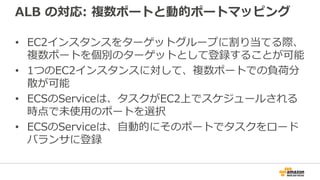
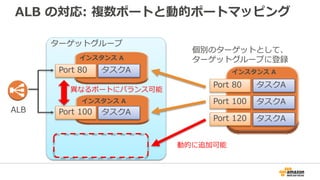
ALB の対応: 複数ポートと動的ポートマッピング
タスクA
タスクA
Port80
Port 100
インスタンス A
タスクA
タスクA
Port 80
Port 100
インスタンス A
インスタンス A
個別のターゲットとして、
ターゲットグループに登録
ターゲットグループ
タスクAPort 120
異なるポートにバランス可能
動的に追加可能
ALB
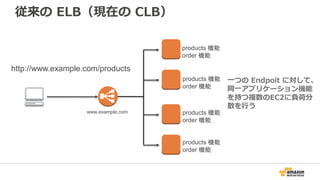
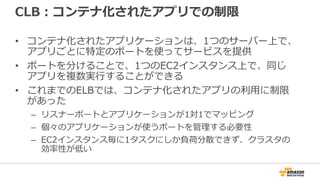
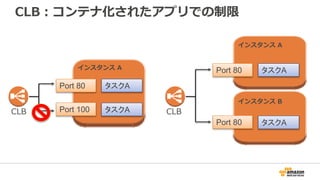
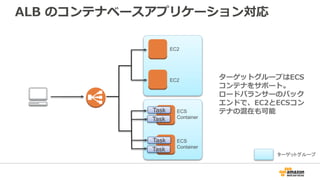
#4 Given that Containerized applications can send traffic to specific ports on a sever customer can then run many copies of an application on a single instance,
However for the Standard LoadBalancer we are unable to take advantage of this due to the 1:1 Mapping of the Listener port to the Instance port Application.
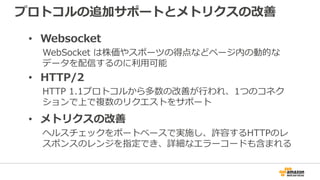
#8 So at launch we will provide Path Based Routing . We will then release new features incrementally throughout the year.
Future features will include:
Websockets
SNI
CBR with Hostnames, cookies
Custom error messages
Custom headers.
We are also working with other services, integrating with the likes of :
Auto Scaling, Cloud formation, Elastic Beanstalk, ECS,
AWS Config, AWS Certificate Manager and IAM
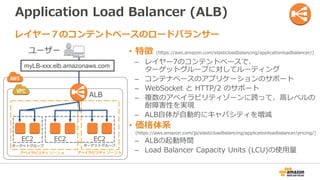
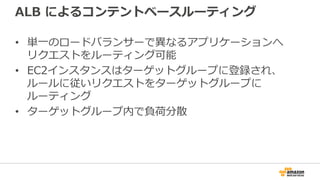
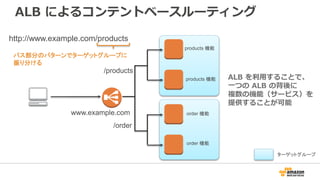
#10 So in the new Application LoadBalancer, you can have :
one URL path that goes to one set of BE instances
and another URL path the goes to another set of BE instances
You can also set up the Application Loadbalancer to have one single Front end port (e.g. port 80),
But now route traffic to 80:81 on the BE, or you can route traffic to 80:80 on the other BE.
* So this gives us true multiple Port support on the BE!
#11 So at launch we will provide Path Based Routing . We will then release new features incrementally throughout the year.
Future features will include:
Websockets
SNI
CBR with Hostnames, cookies
Custom error messages
Custom headers.
We are also working with other services, integrating with the likes of :
Auto Scaling, Cloud formation, Elastic Beanstalk, ECS,
AWS Config, AWS Certificate Manager and IAM
#12 So in the new Application LoadBalancer, you can have :
one URL path that goes to one set of BE instances
and another URL path the goes to another set of BE instances
You can also set up the Application Loadbalancer to have one single Front end port (e.g. port 80),
But now route traffic to 80:81 on the BE, or you can route traffic to 80:80 on the other BE.
* So this gives us true multiple Port support on the BE!
#13 So in the new Application LoadBalancer, you can have :
one URL path that goes to one set of BE instances
and another URL path the goes to another set of BE instances
You can also set up the Application Loadbalancer to have one single Front end port (e.g. port 80),
But now route traffic to 80:81 on the BE, or you can route traffic to 80:80 on the other BE.
* So this gives us true multiple Port support on the BE!
#14 So at launch we will provide Path Based Routing . We will then release new features incrementally throughout the year.
Future features will include:
Websockets
SNI
CBR with Hostnames, cookies
Custom error messages
Custom headers.
We are also working with other services, integrating with the likes of :
Auto Scaling, Cloud formation, Elastic Beanstalk, ECS,
AWS Config, AWS Certificate Manager and IAM
#15 So in the new Application LoadBalancer, you can have :
one URL path that goes to one set of BE instances
and another URL path the goes to another set of BE instances
You can also set up the Application Loadbalancer to have one single Front end port (e.g. port 80),
But now route traffic to 80:81 on the BE, or you can route traffic to 80:80 on the other BE.
* So this gives us true multiple Port support on the BE!
#17 Given that Containerized applications can send traffic to specific ports on a sever customer can then run many copies of an application on a single instance,
However for the Standard LoadBalancer we are unable to take advantage of this due to the 1:1 Mapping of the Listener port to the Instance port Application.
#18 So in the new Application LoadBalancer, you can have :
one URL path that goes to one set of BE instances
and another URL path the goes to another set of BE instances
You can also set up the Application Loadbalancer to have one single Front end port (e.g. port 80),
But now route traffic to 80:81 on the BE, or you can route traffic to 80:80 on the other BE.
* So this gives us true multiple Port support on the BE!
#20 So in the new Application LoadBalancer, you can have :
one URL path that goes to one set of BE instances
and another URL path the goes to another set of BE instances
You can also set up the Application Loadbalancer to have one single Front end port (e.g. port 80),
But now route traffic to 80:81 on the BE, or you can route traffic to 80:80 on the other BE.
* So this gives us true multiple Port support on the BE!
#21 So in the new Application LoadBalancer, you can have :
one URL path that goes to one set of BE instances
and another URL path the goes to another set of BE instances
You can also set up the Application Loadbalancer to have one single Front end port (e.g. port 80),
But now route traffic to 80:81 on the BE, or you can route traffic to 80:80 on the other BE.
* So this gives us true multiple Port support on the BE!
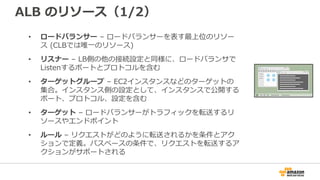
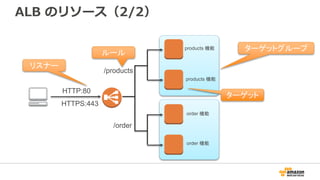
#23 And here are the definitions of the new resources we have just specified .
We’ve talked about LBs
We’ve talked about Listeners
We’ve talked about TGs and Targets and how to register them.
And we’ve introduced Rules – being made up of conditions and actions.
#24 And here are the definitions of the new resources we have just specified .
We’ve talked about LBs
We’ve talked about Listeners
We’ve talked about TGs and Targets and how to register them.
And we’ve introduced Rules – being made up of conditions and actions.
#25 So in the new Application LoadBalancer, you can have :
one URL path that goes to one set of BE instances
and another URL path the goes to another set of BE instances
You can also set up the Application Loadbalancer to have one single Front end port (e.g. port 80),
But now route traffic to 80:81 on the BE, or you can route traffic to 80:80 on the other BE.
* So this gives us true multiple Port support on the BE!







![[Black Belt Online Seminar] AWS上でのログ管理](https://cdn.slidesharecdn.com/ss_thumbnails/aws-log-mgmt-161201043056-thumbnail.jpg?width=640&height=640&fit=bounds)


![[Aurora事例祭り]AWS Database Migration Service と Schema Conversion Tool の使いドコロ](https://cdn.slidesharecdn.com/ss_thumbnails/aurorafestival-dms-170307140305-thumbnail.jpg?width=640&height=640&fit=bounds)


![[AWSマイスターシリーズ]Amazon Elastic Load Balancing (ELB)](https://cdn.slidesharecdn.com/ss_thumbnails/20130612aws-meister-regenerate-elb-public-130612232128-phpapp01-thumbnail.jpg?width=640&height=640&fit=bounds)


![[AWSマイスターシリーズ] AWS Elastic Beanstalk](https://cdn.slidesharecdn.com/ss_thumbnails/20131009aws-meister-regenerate-elasticbeanstalk-public-131014212455-phpapp02-thumbnail.jpg?width=640&height=640&fit=bounds)


![[20220126] JAWS-UG 2022初頭までに葬ったAWSアンチパターン大紹介](https://cdn.slidesharecdn.com/ss_thumbnails/20220126-anti-220126190603-thumbnail.jpg?width=640&height=640&fit=bounds)


