APPLICATION AND
IMPLEMENTATION OF
DIFFERENT DEEP
LEARNING
Jacky Chow (Jie Zou)
AGENDA
2
Part I. Background in Big Data and AI
Part II. Case Study – Coronavirus
Part III. Major Applications:
- digital and personalized health
- new drug discovery and drug development
- genomics
- radiology
- population health and disease management
- medical insurance
Part IV. Discussion Panel
AGENDA
• Part I. What?
• Part II. Why?
• Part III. How?
• Part IV. Conclusion
PART 1. WHAT?
3
This Photo by Unknown Author is licensed under CC BY-SA
What is Deep Learning?
4
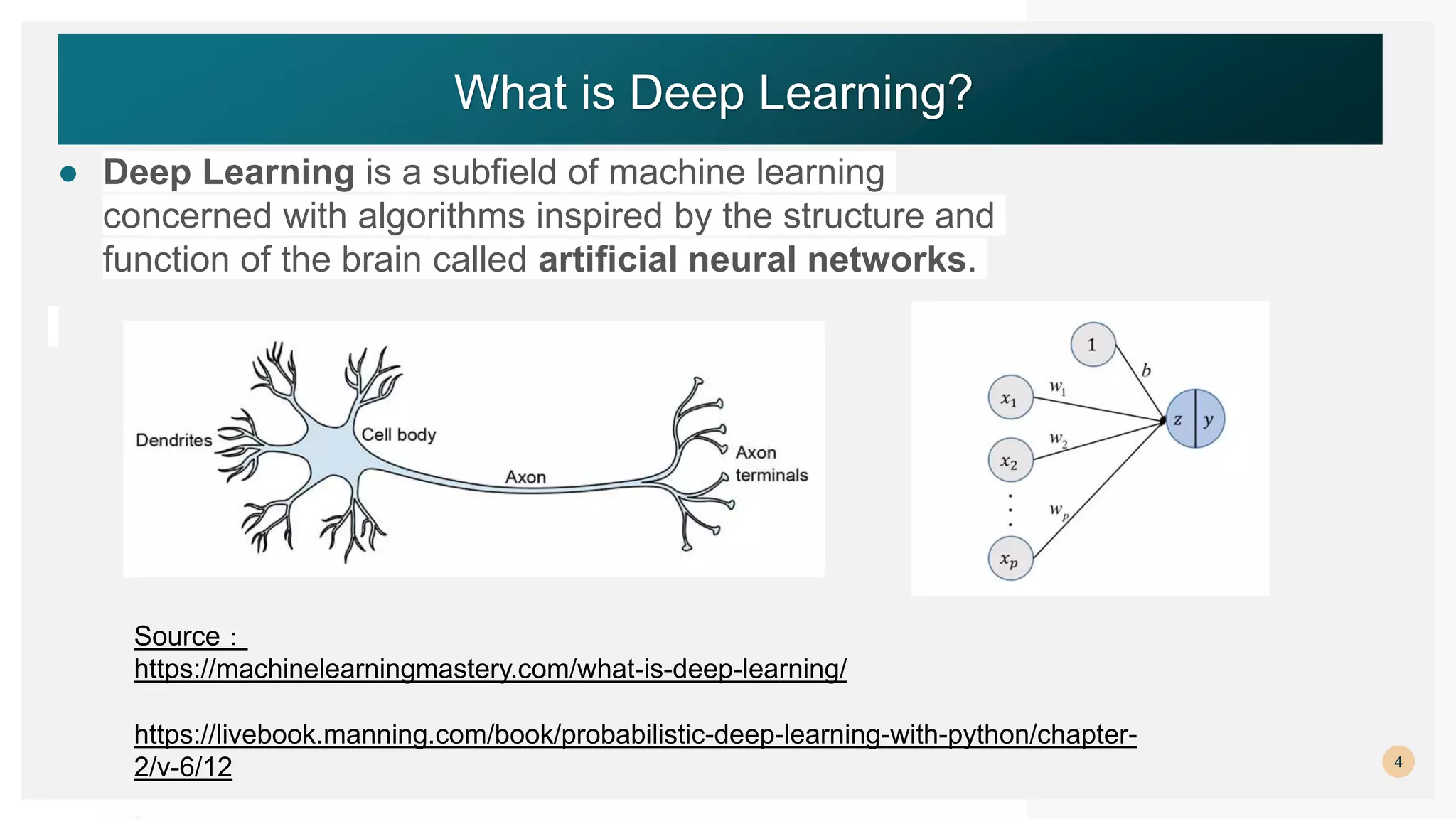
● Deep Learning is a subfield of machine learning
concerned with algorithms inspired by the structure and
function of the brain called artificial neural networks.
Source:
https://machinelearningmastery.com/what-is-deep-learning/
https://livebook.manning.com/book/probabilistic-deep-learning-with-python/chapter-
2/v-6/12
5
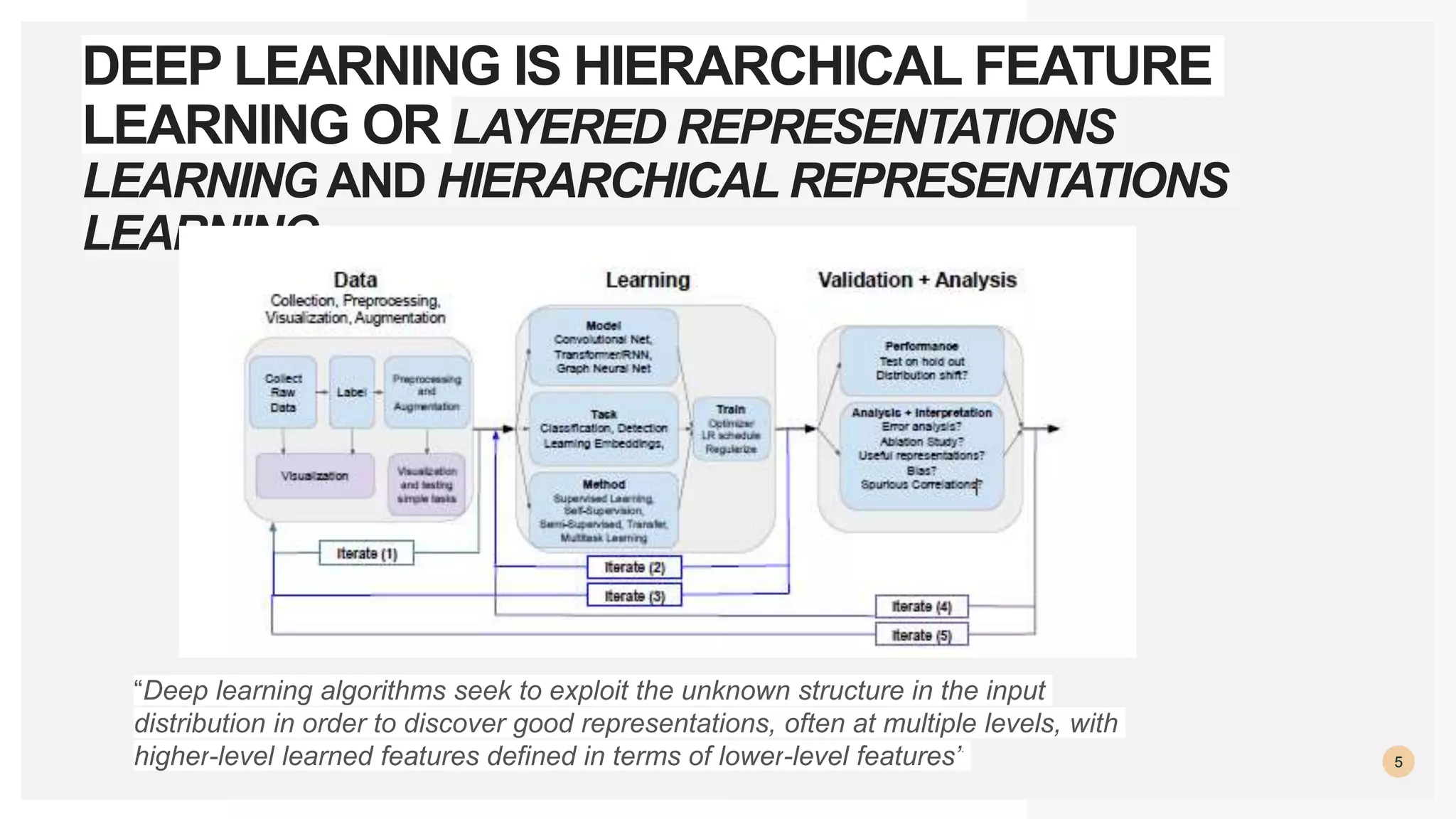
DEEP LEARNING IS HIERARCHICAL FEATURE
LEARNING OR LAYERED REPRESENTATIONS
LEARNINGAND HIERARCHICAL REPRESENTATIONS
LEARNING
“Deep learning algorithms seek to exploit the unknown structure in the input
distribution in order to discover good representations, often at multiple levels, with
higher-level learned features defined in terms of lower-level features”
6
This Photo by Unknown Author is licensed under CC BY-SA
6
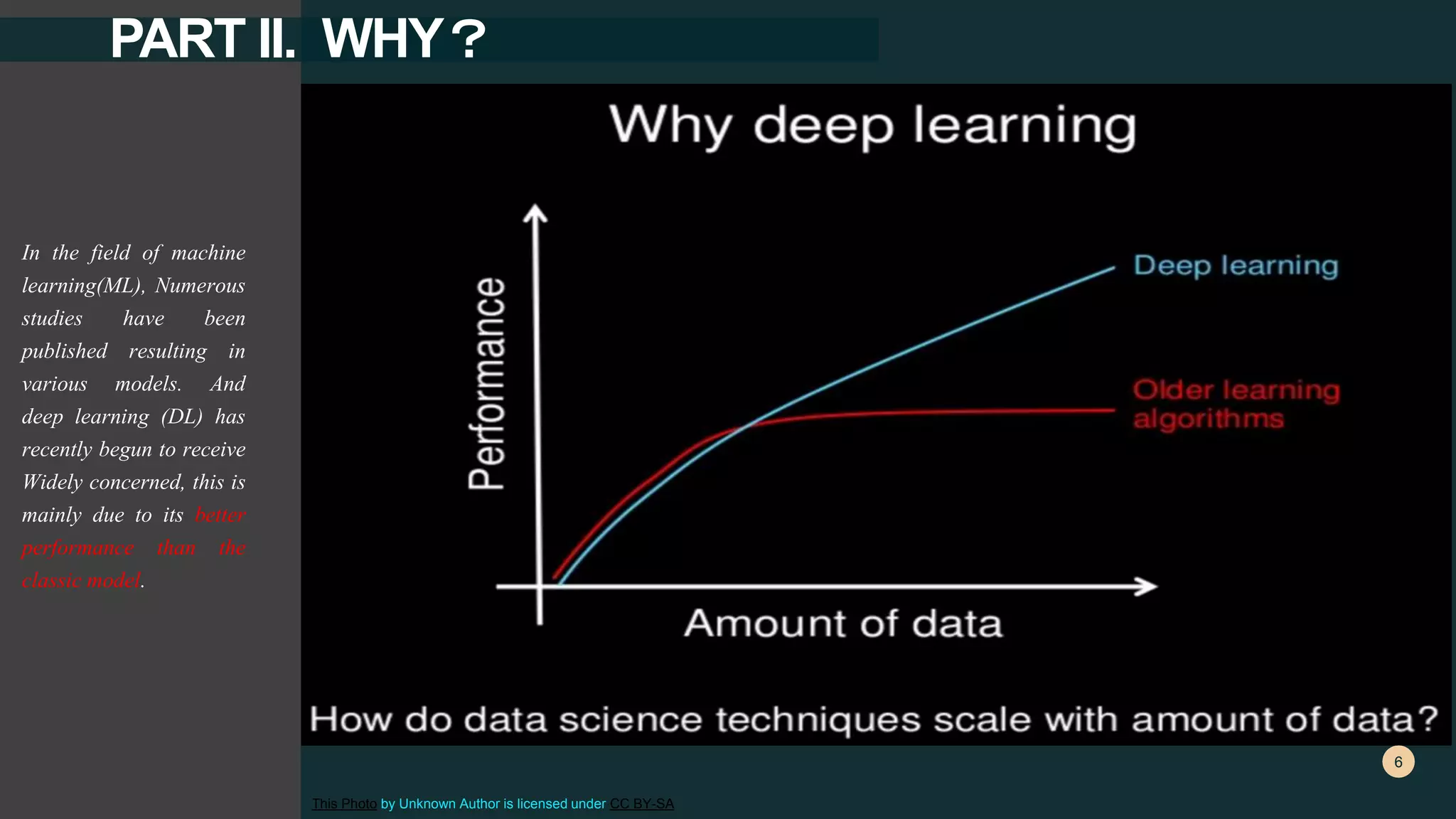
PART II. WHY?
In the field of machine
learning(ML), Numerous
studies have been
published resulting in
various models. And
deep learning (DL) has
recently begun to receive
Widely concerned, this is
mainly due to its better
performance than the
classic model.
PART II. WHY?
7
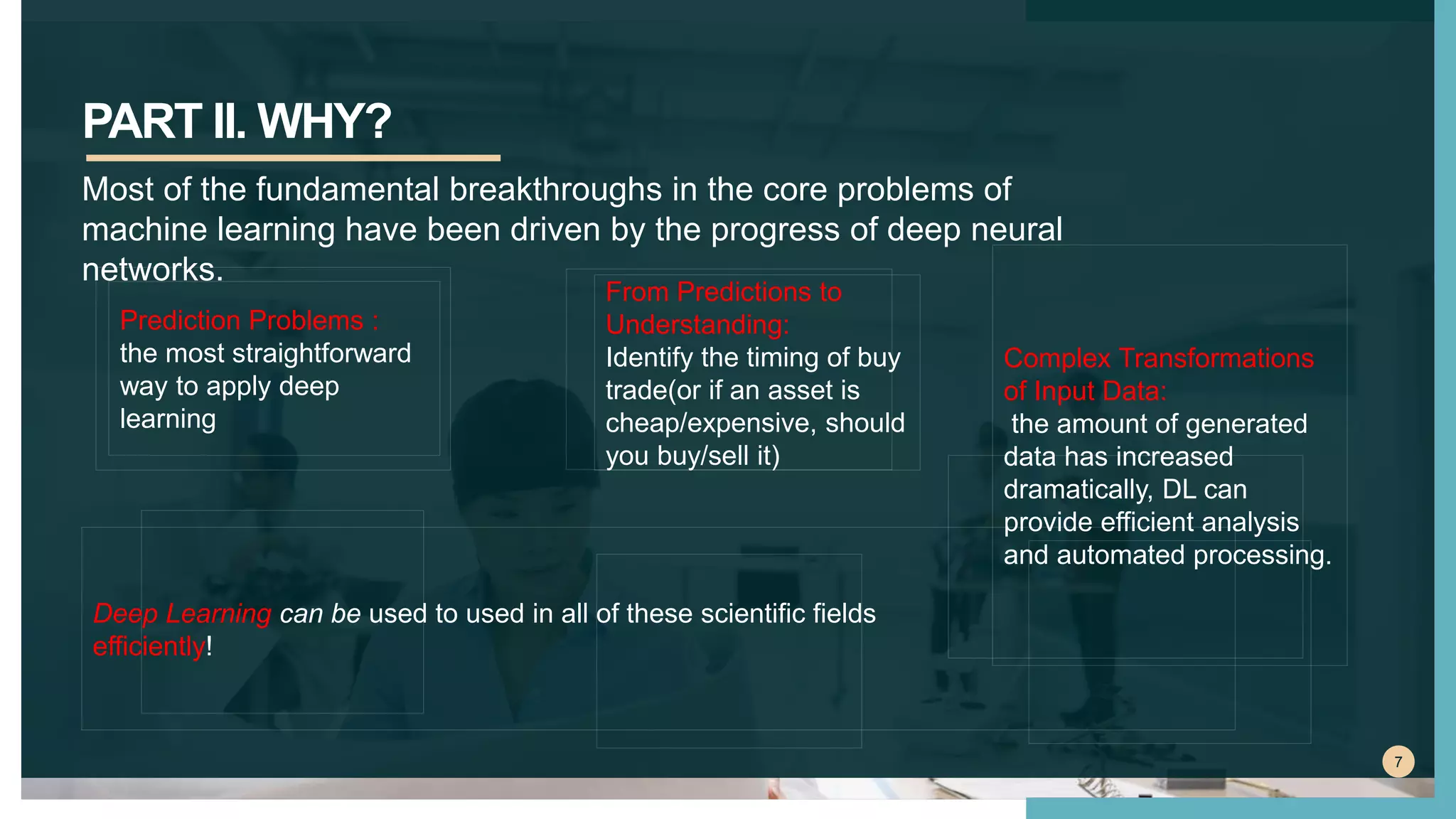
Most of the fundamental breakthroughs in the core problems of
machine learning have been driven by the progress of deep neural
networks.
From Predictions to
Understanding:
Identify the timing of buy
trade(or if an asset is
cheap/expensive, should
you buy/sell it)
Prediction Problems :
the most straightforward
way to apply deep
learning
Complex Transformations
of Input Data:
the amount of generated
data has increased
dramatically, DL can
provide efficient analysis
and automated processing.
Deep Learning can be used to used in all of these scientific fields
efficiently!
PART II:WHY?
Data is the life of Deep Learning
8
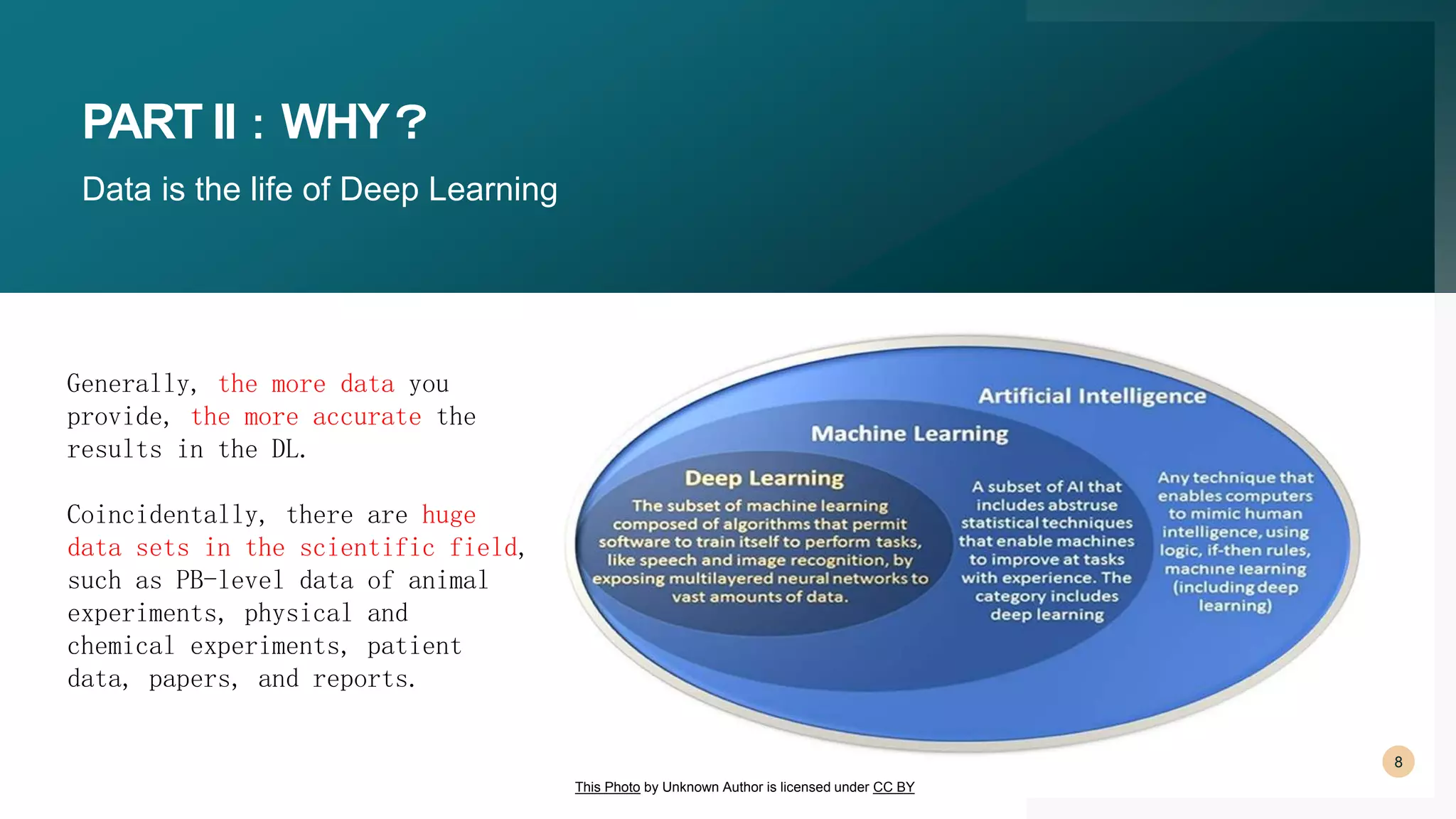
Generally, the more data you
provide, the more accurate the
results in the DL.
Coincidentally, there are huge
data sets in the scientific field,
such as PB-level data of animal
experiments, physical and
chemical experiments, patient
data, papers, and reports.
This Photo by Unknown Author is licensed under CC BY
PART III: HOW?
Our focus was on DL implementations for scientific
applications
9
And I will introduce other studies of the applications of DL in the
scientific discovery field on similar topics, such as:
 Deep learning applications in biological research
 The application of deep learning in medicine
 Set up structured data, such as organic compounds
 Model different invariances-apply the invariance of specific
Lie groups to molecular property prediction
Main:
From Survey
"A Survey of Deep
Learning for Scientific
Discovery "
PART III. HOW ?
How to use DL in Scientific Discovery?
10
Bayers’ theorem
1
Deep learning models
2
Deep Learning Libraries
and Resources
3
• Doing More with Less Data;
• Interpretability, Model Inspection and
Representation Analysis
4
Key Methods (Supervised Learning)
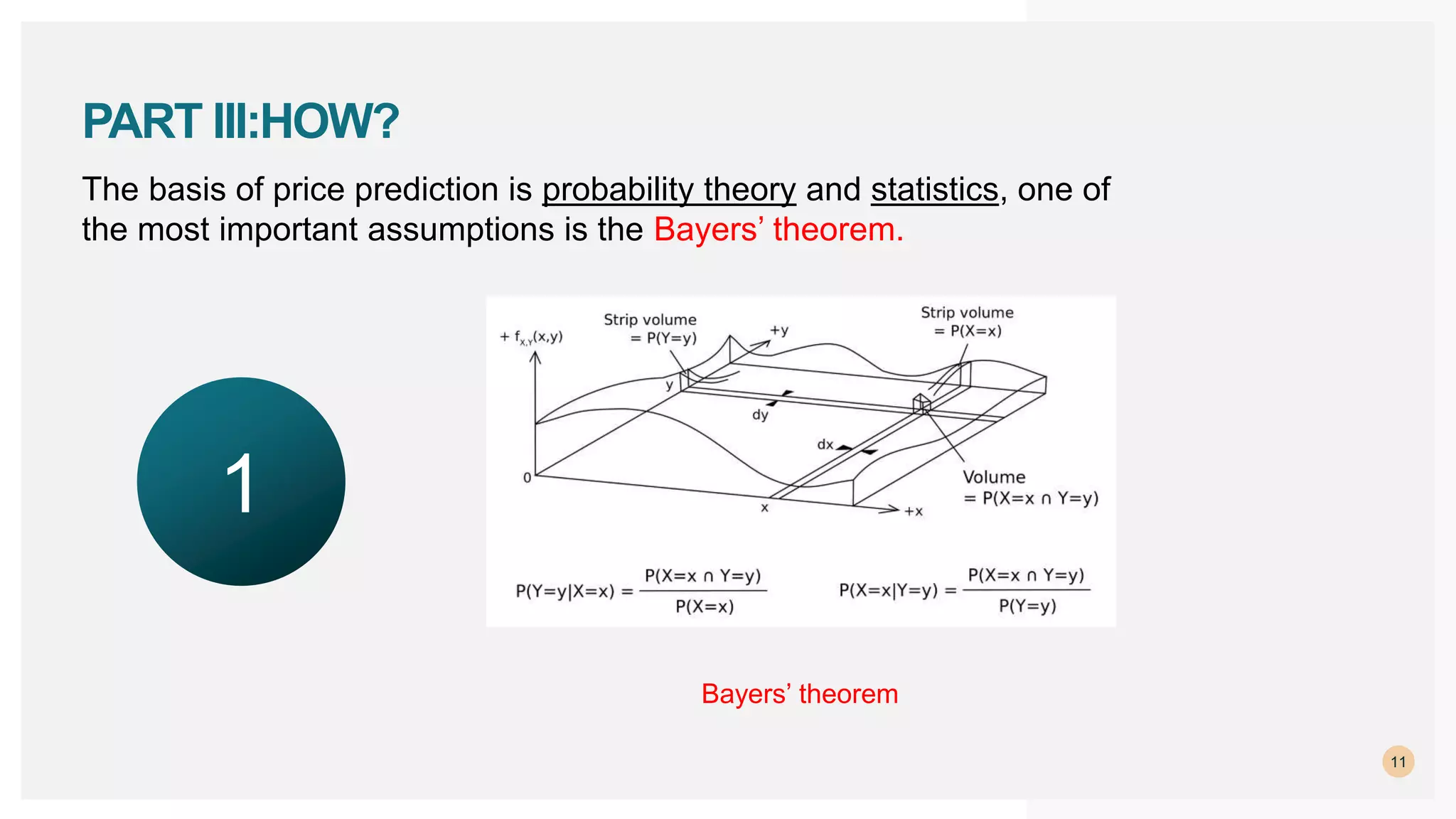
The basis of price prediction is probability theory and statistics, one of
the most important assumptions is the Bayers’ theorem.
11
PART III:HOW?
1
Bayers’ theorem
12
PART III:HOW?
The proposed deep learning models that the source
papers have used for their research.
• Convolutional neural network(CNN)
• Recurrent Neural Networks(RNN)
• Long Short Term Memory (LSTM)
• Deep Belief Networks (DBNs)
2
13
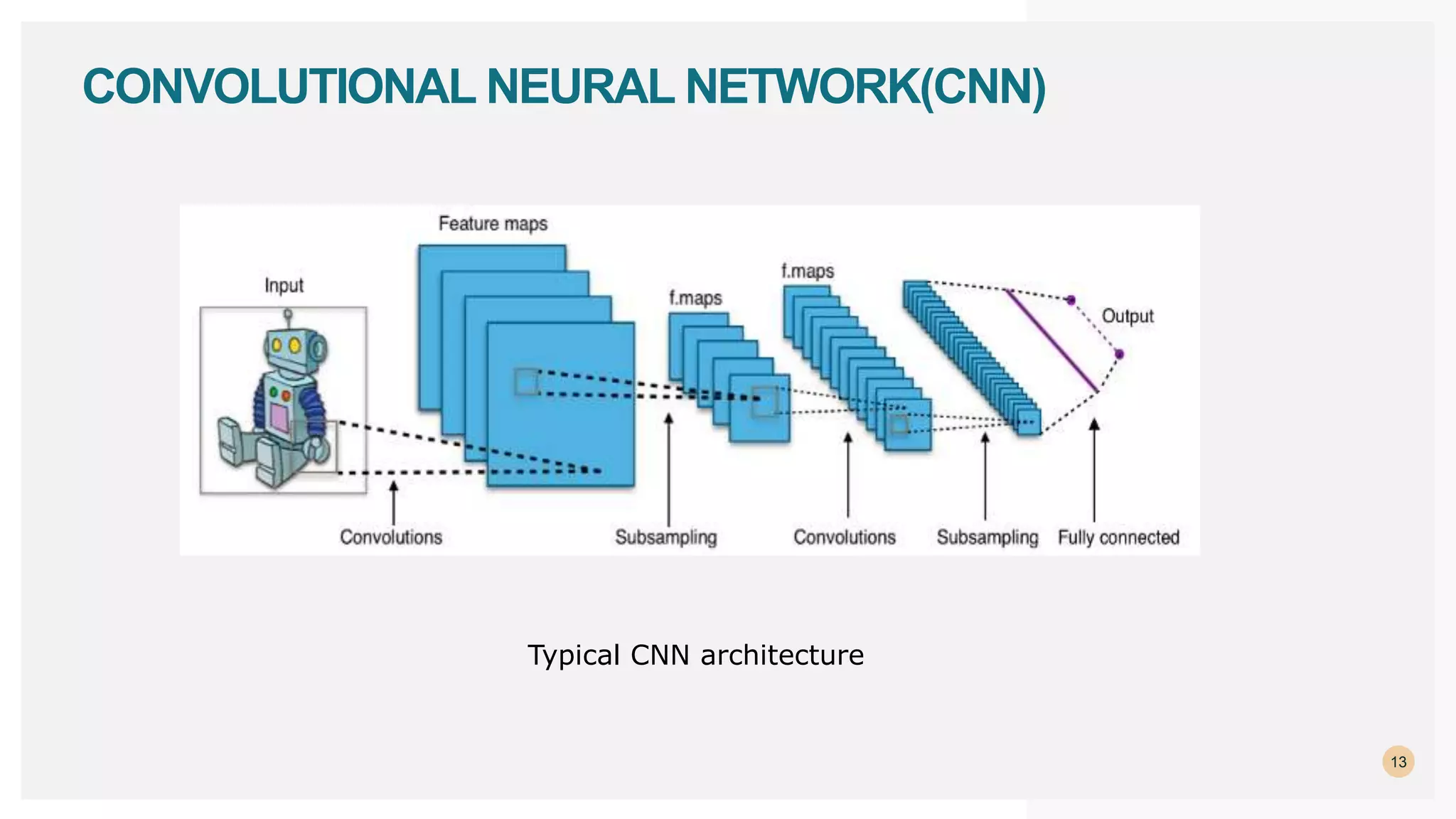
CONVOLUTIONAL NEURAL NETWORK(CNN)
Typical CNN architecture
14
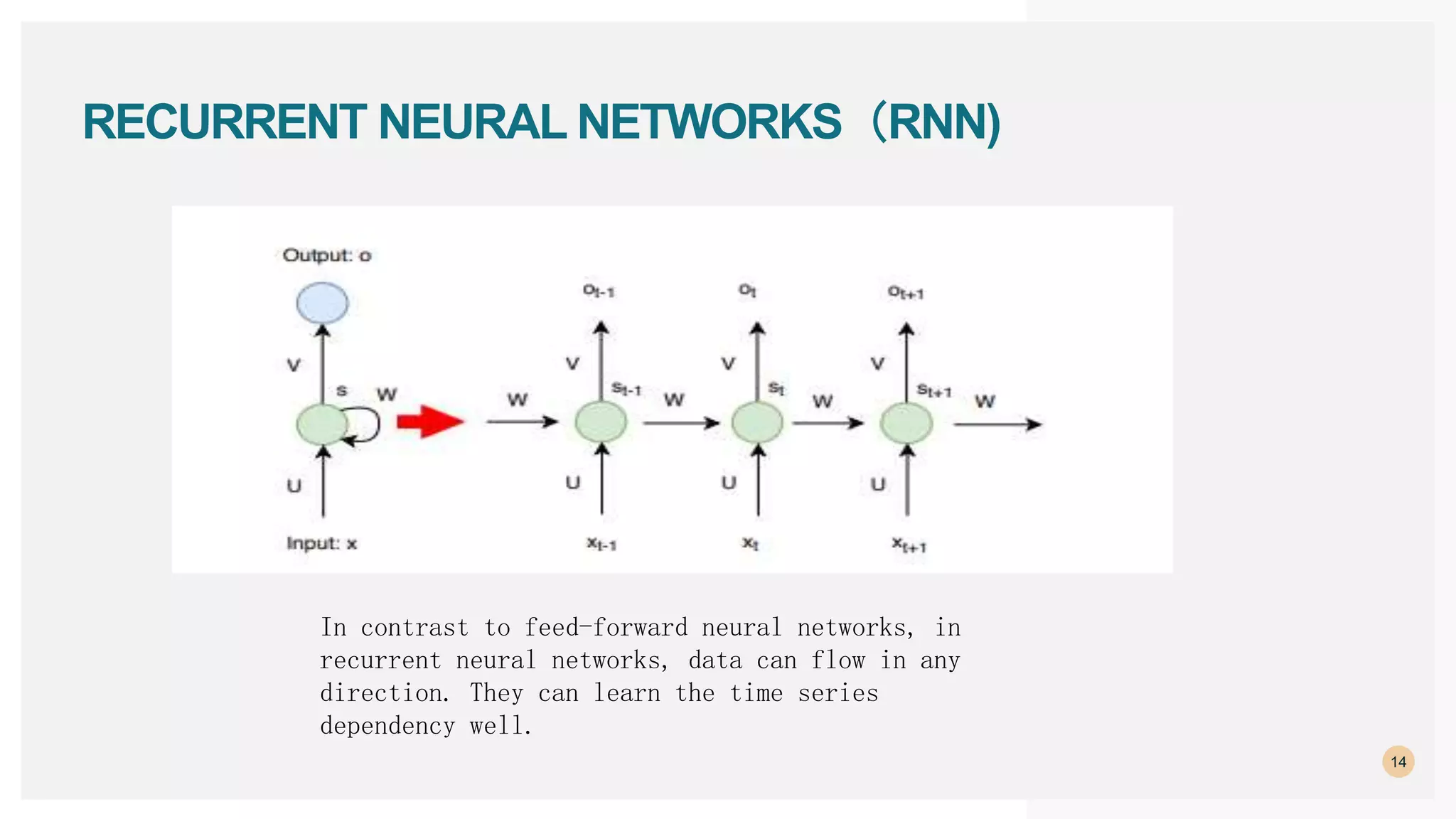
RECURRENT NEURAL NETWORKS(RNN)
In contrast to feed-forward neural networks, in
recurrent neural networks, data can flow in any
direction. They can learn the time series
dependency well.
15
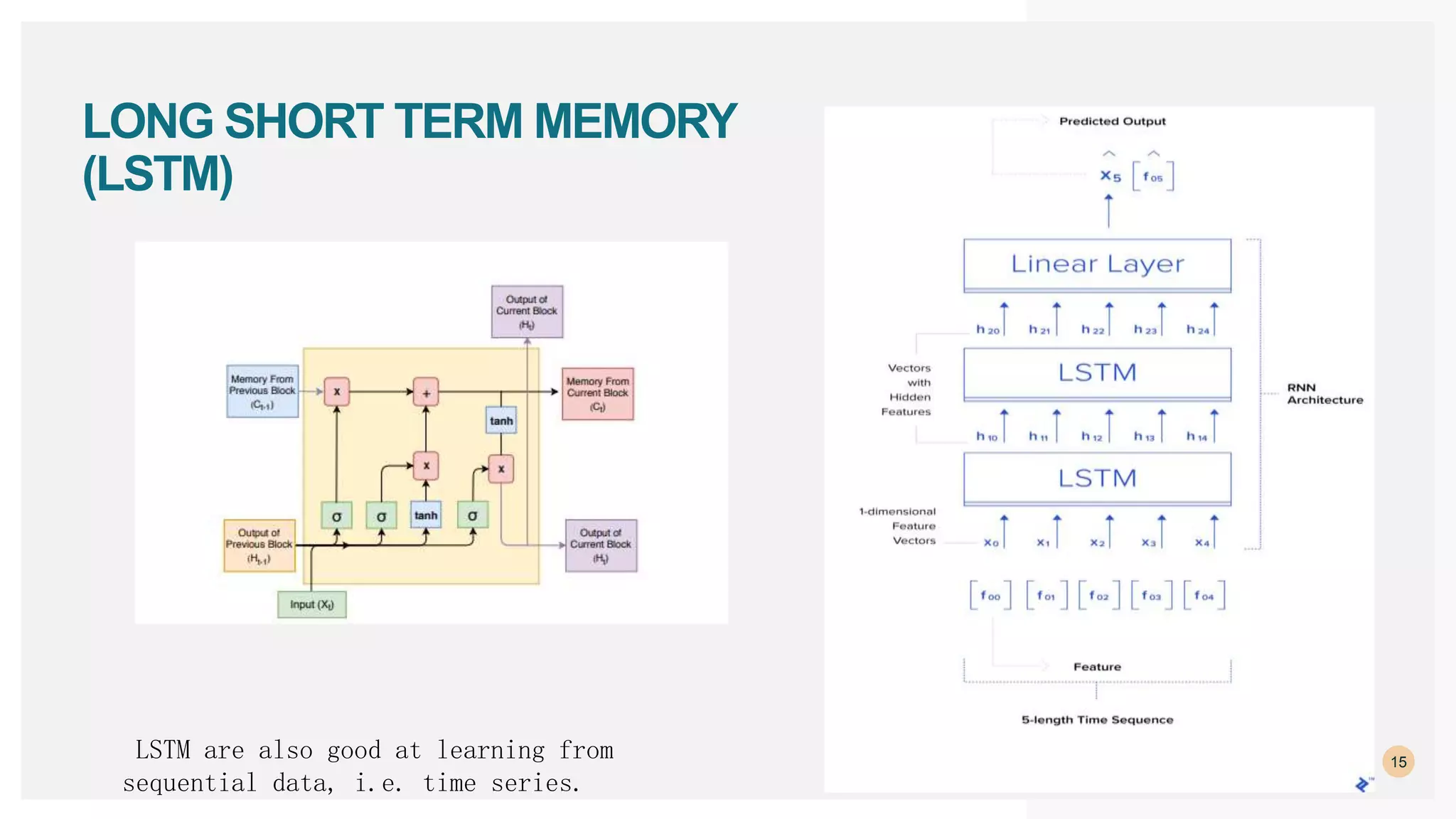
LONG SHORT TERM MEMORY
(LSTM)
LSTM are also good at learning from
sequential data, i.e. time series.
16
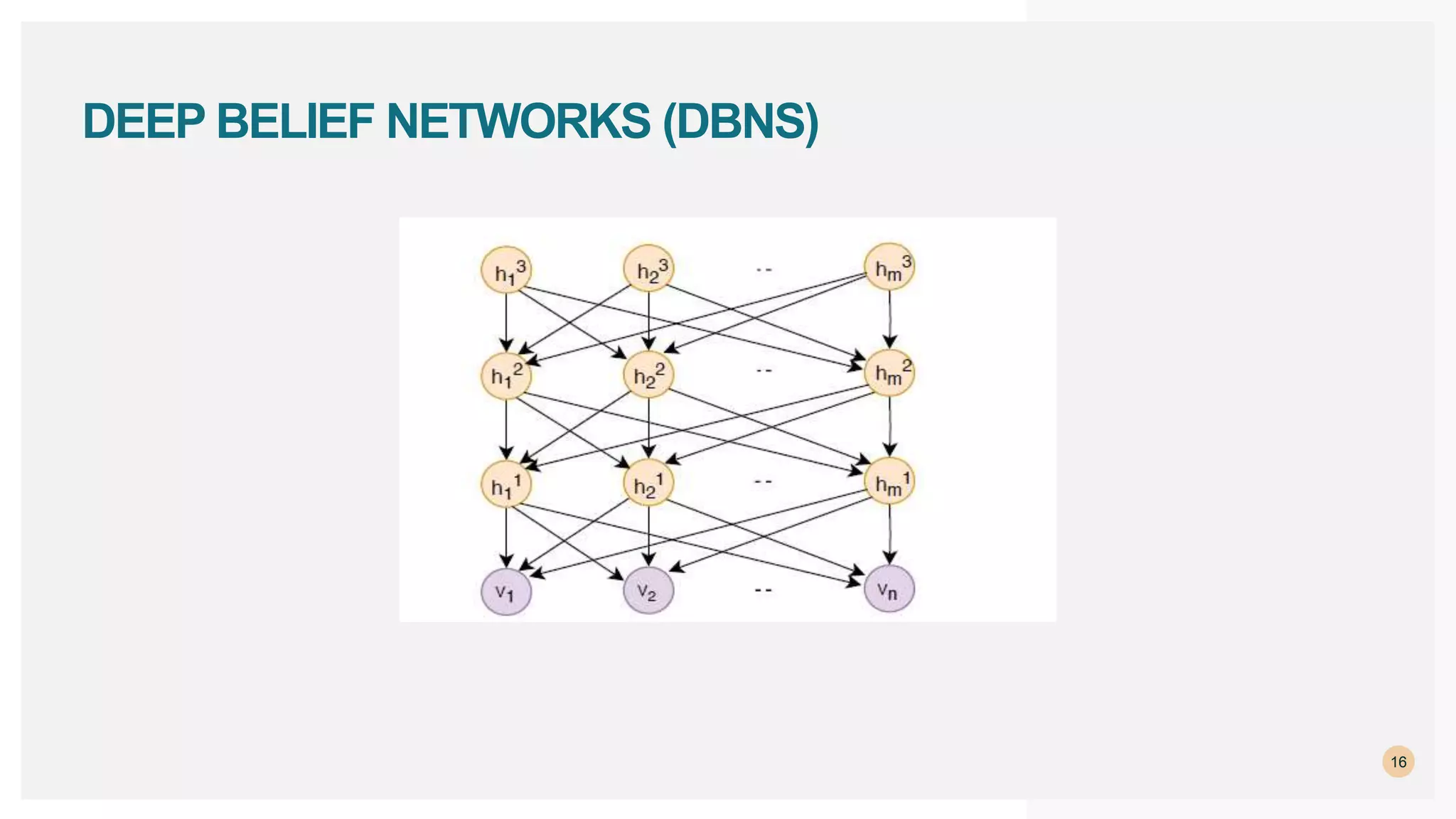
DEEP BELIEF NETWORKS (DBNS)
17
PART III:HOW?
Deep Learning Libraries and Resources that the source
papers have used for their research.
• Software Libraries for Deep Learning
• Research Overviews, Code, Discussion
• Models, Training Code and Pretrained Models:
• Data Collection, Curation and Labelling Resources
• Visualization, Analysis and Compute Resources
2
Application in Scientific
18
PART III. HOW?
• Key Methods (Supervised Learning)
Transfer Learning
Domain Adaptation
Multitask Learning
Weak Supervision (Distant Supervision)
3
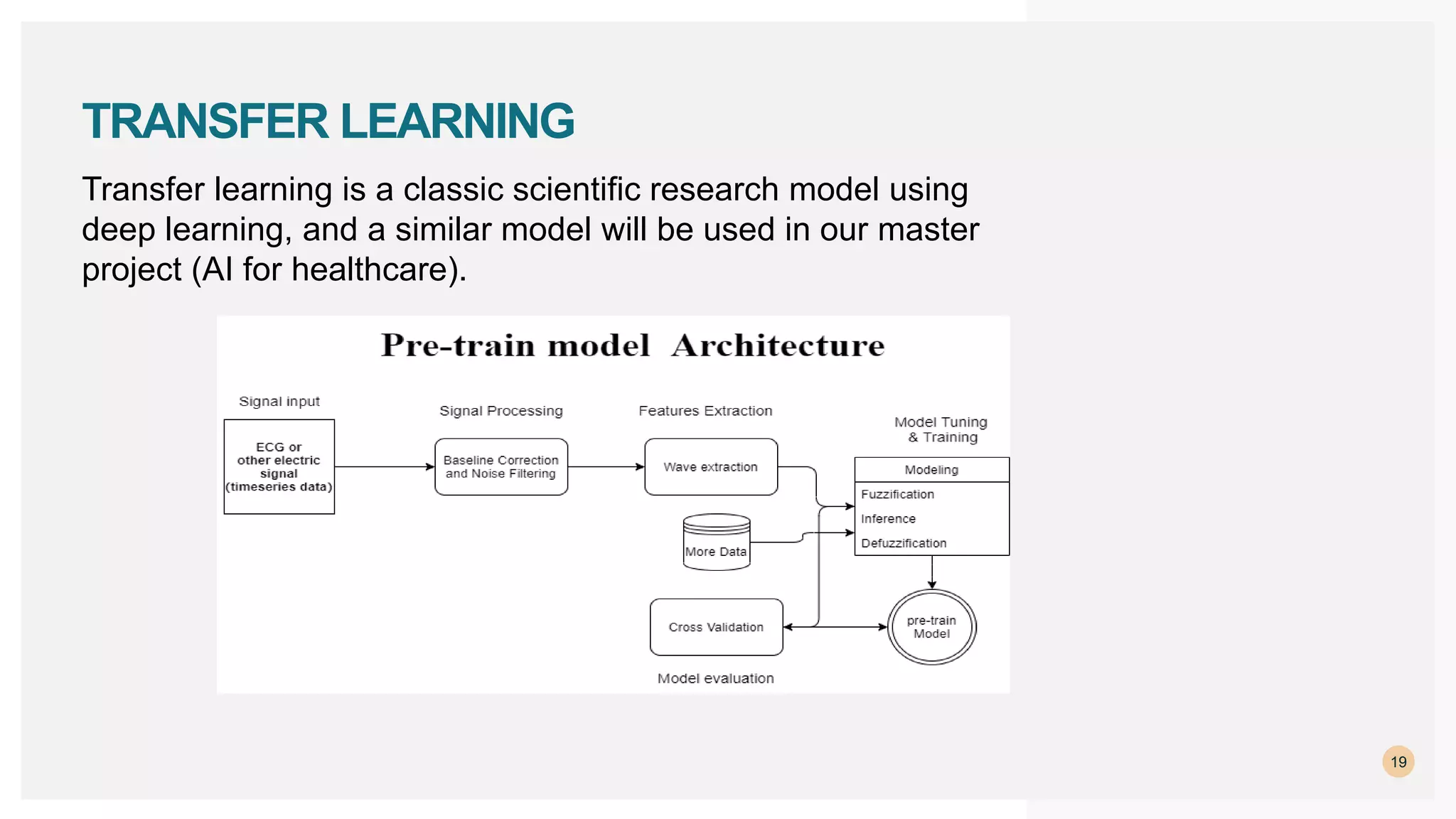
Transfer learning is a classic scientific research model using
deep learning, and a similar model will be used in our master
project (AI for healthcare).
19
TRANSFER LEARNING
Application in Scientific
20
PART III. HOW? • Doing More with Less Data
 Self-Supervised Learning
 Semi-Supervised Learning
 Co-training
 Data Augmentation
 MIL
 GAN
 Meta-learning
• Interpretability, Model Inspection and Representation
Analysis
 Feature Attribution and Per Example Interpretability
 Model Inspection and Representational Analysis
open-sourced book:Interpretable Machine Learning
• Other studies
4
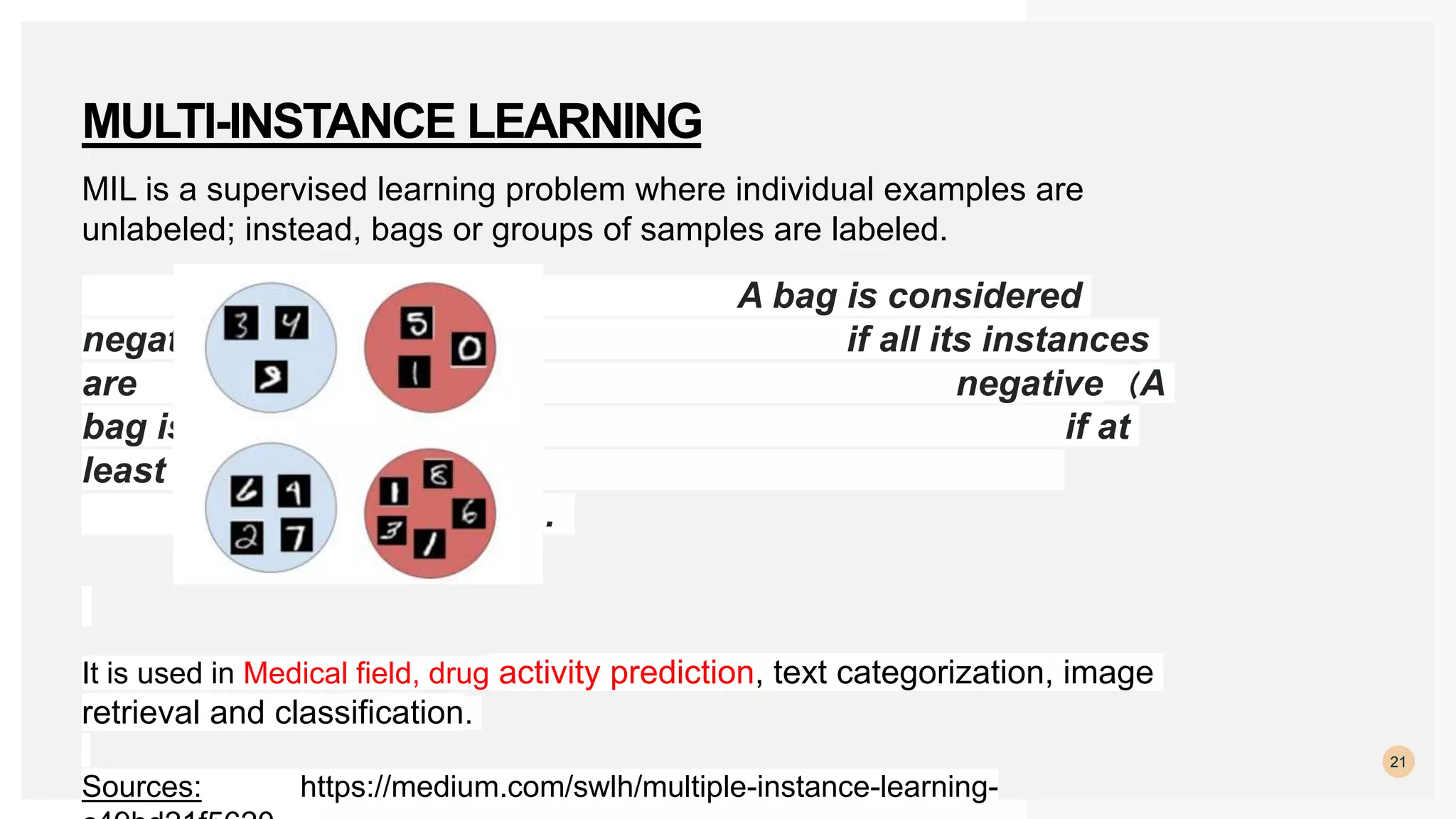
MIL is a supervised learning problem where individual examples are
unlabeled; instead, bags or groups of samples are labeled.
A bag is considered
negative if all its instances
are negative(A
bag is positive, if at
least one instance in
the bag is positive).
It is used in Medical field, drug activity prediction, text categorization, image
retrieval and classification.
Sources: https://medium.com/swlh/multiple-instance-learning-
21
MULTI-INSTANCE LEARNING
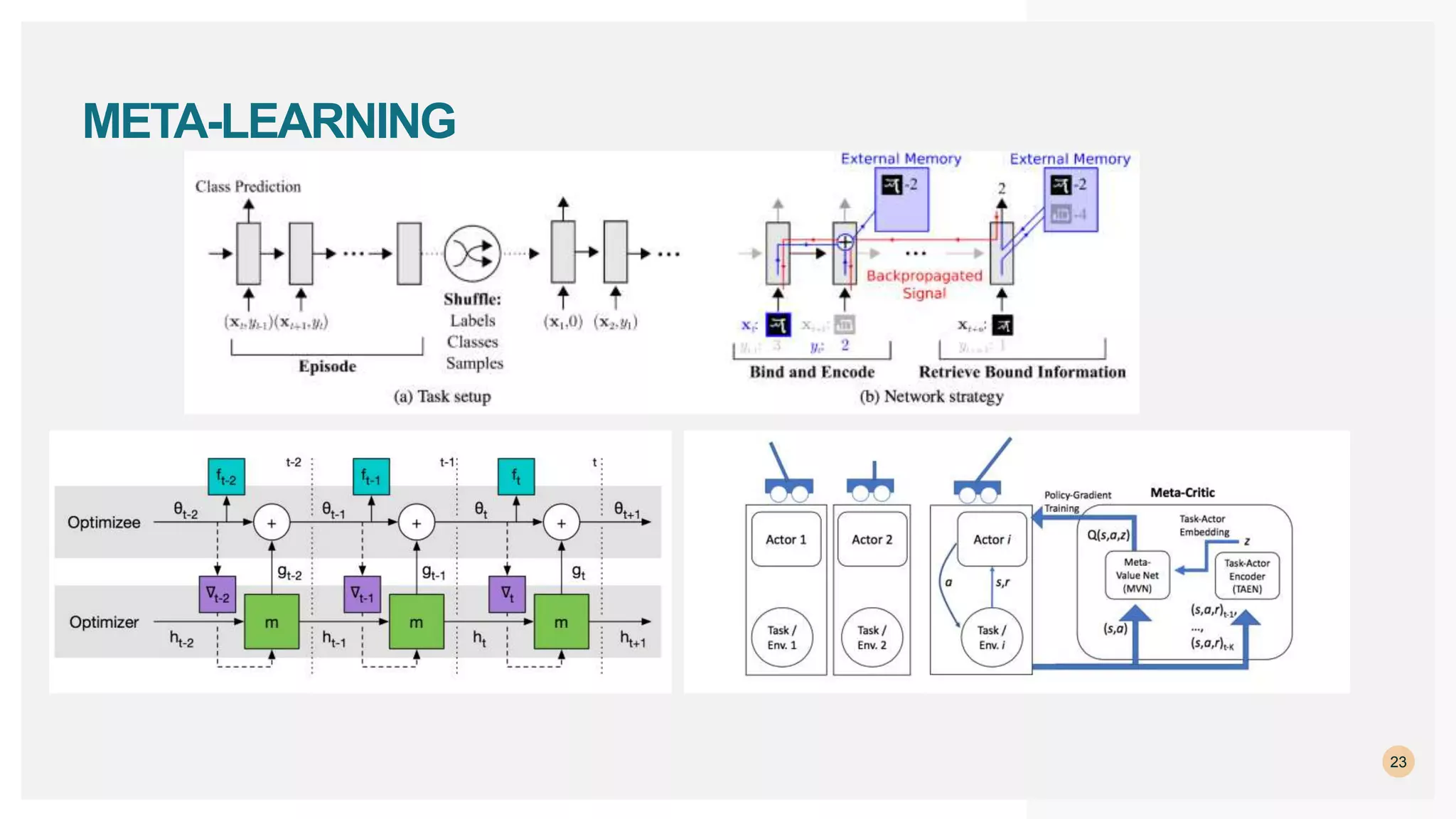
 Memory-based approach
 Method based on predicted gradient
 Method of using Attention attention mechanism
 Learn from the LSTM method
 Meta Learning Method for RL
 Through the method of training a good base
model, and simultaneously applying to
supervised learning and reinforcement learning
 Ways to use WaveNet
 Ways to predict Loss
22
META-LEARNING
23
META-LEARNING
24
— OTHER STUDIES:
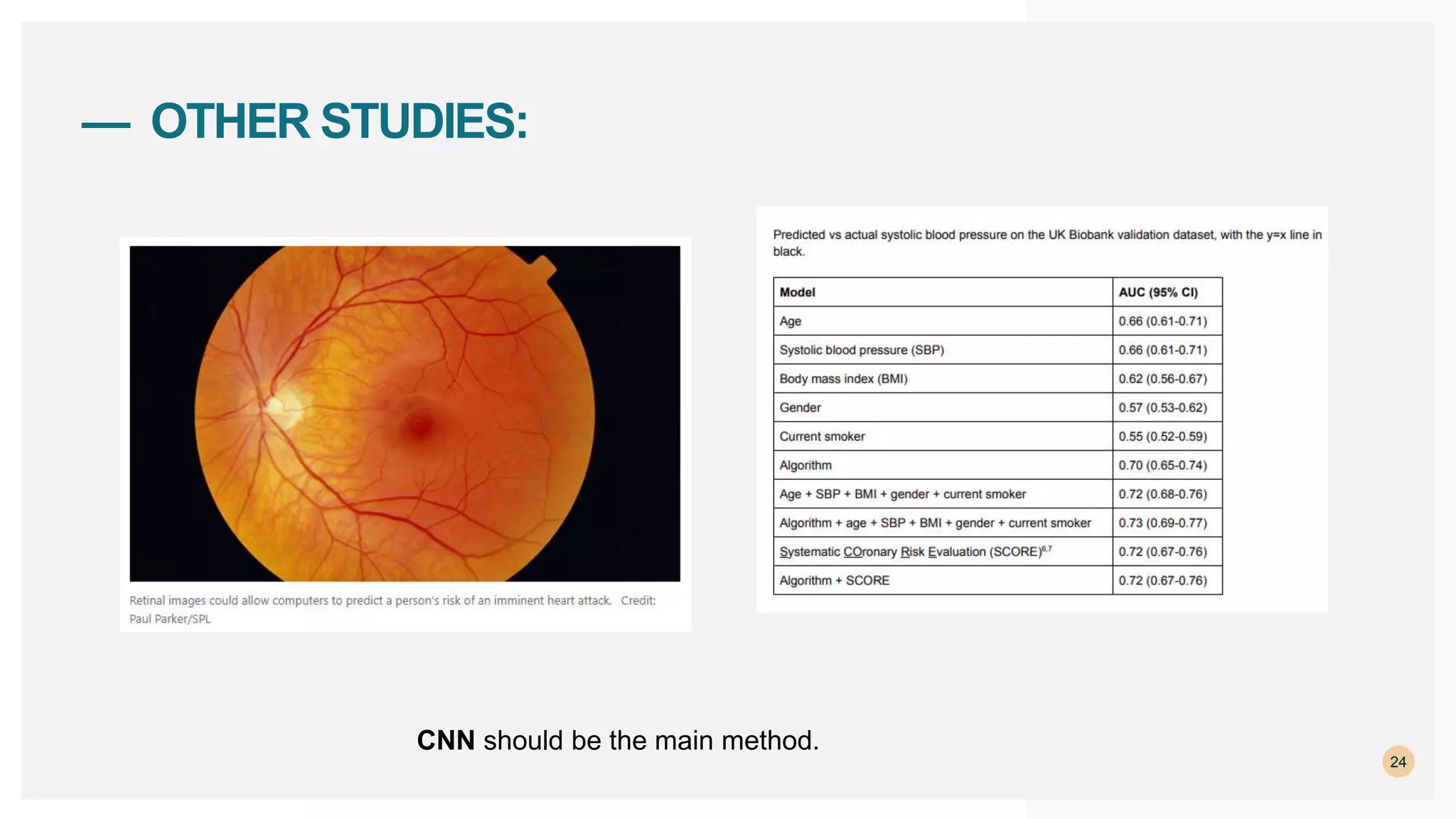
CNN should be the main method.
CONCLUSION
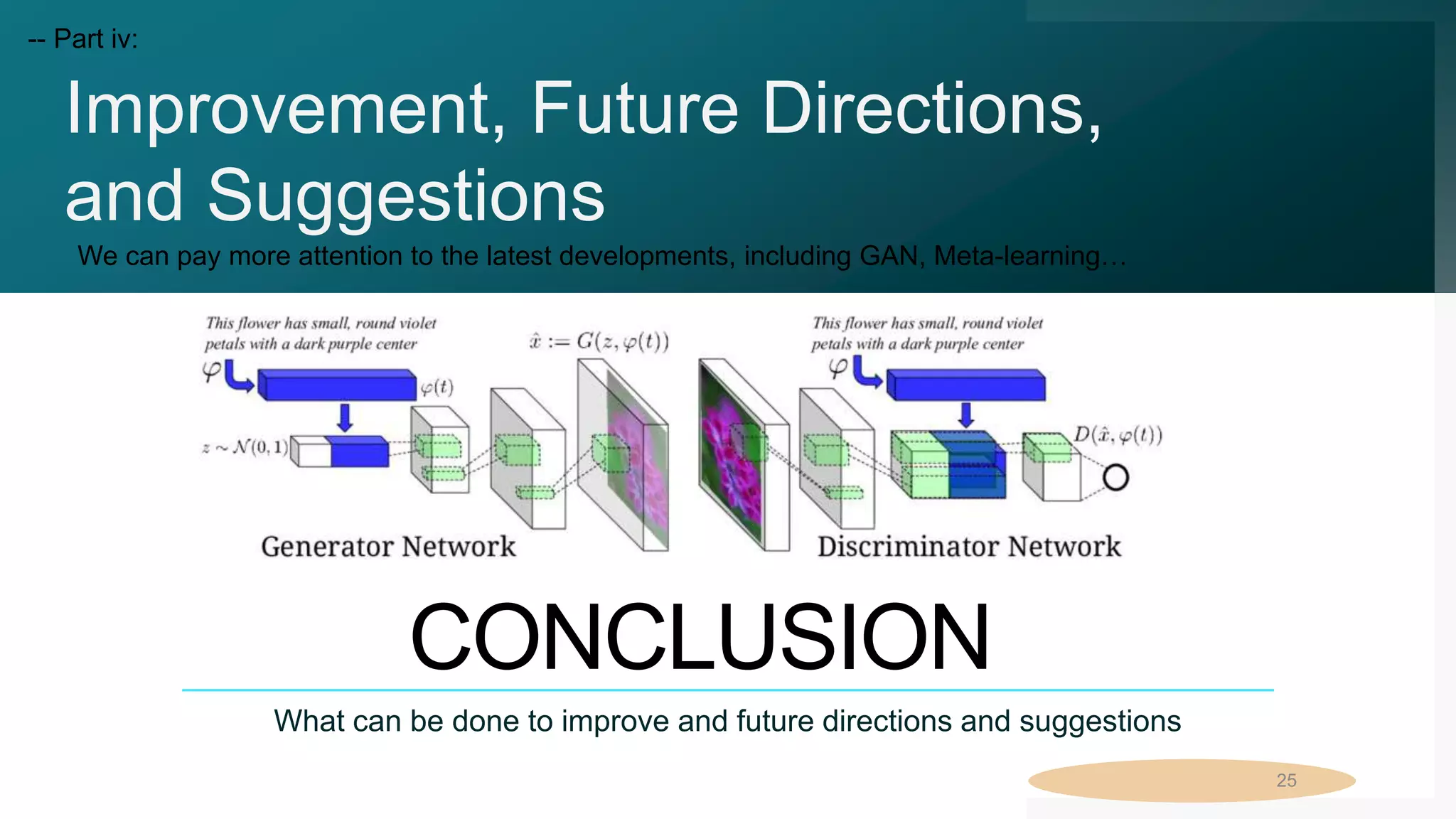
What can be done to improve and future directions and suggestions
25
Improvement, Future Directions,
and Suggestions
We can pay more attention to the latest developments, including GAN, Meta-learning…
-- Part iv:
26
REFERENCES:
[1] A Survey of Deep Learning for Scientific Discovery
[2] Deep learning sharpens views of cells and genes
[3] Recent Advances of Deep Learning in Bioinformatics and Computational Biology
[4] Deep learning for biology
[5] Multiple Instance Learning with MNIST dataset using Pytorch
[6] Review of Multi-Instance Learning and Its applications
[7] Santoro, Adam, Bartunov, Sergey, Botvinick, Matthew, Wierstra, Daan, and Lillicrap, Timothy. Meta-
learning with memory-augmented neural networks. In Proceedings of The 33rd International Conference on
Machine Learning, pp. 1842–1850, 2016.
[8] Munkhdalai T, Yu H. Meta Networks. arXiv preprint arXiv:1703.00837, 2017.
[9] Ravi, Sachin and Larochelle, Hugo. Optimization as a model for few-shot learning. In International
Conference on Learning Representations (ICLR), 2017.
[10] Flood Sung, Zhang L, Xiang T, Hospedales T, et al. Learning to Learn: Meta-Critic Networks for
Sample Efficient Learning. arXiv preprint arXiv:1706.09529, 2017.https://arxiv.org/pdf/1706.09529.pdf
[11] Ravi, Sachin and Larochelle, Hugo. Optimization as a model for few-shot learning. In International
Conference on Learning Representations (ICLR), 2017.
THANK
YOU
Jacky Chow
jie.zou@sjsu.edu
SJSU MSSE-Data Science

Application and Implementation of different deep learning

  • 1.
    APPLICATION AND IMPLEMENTATION OF DIFFERENTDEEP LEARNING Jacky Chow (Jie Zou)
  • 2.
    AGENDA 2 Part I. Backgroundin Big Data and AI Part II. Case Study – Coronavirus Part III. Major Applications: - digital and personalized health - new drug discovery and drug development - genomics - radiology - population health and disease management - medical insurance Part IV. Discussion Panel AGENDA • Part I. What? • Part II. Why? • Part III. How? • Part IV. Conclusion
  • 3.
    PART 1. WHAT? 3 ThisPhoto by Unknown Author is licensed under CC BY-SA
  • 4.
    What is DeepLearning? 4 ● Deep Learning is a subfield of machine learning concerned with algorithms inspired by the structure and function of the brain called artificial neural networks. Source: https://machinelearningmastery.com/what-is-deep-learning/ https://livebook.manning.com/book/probabilistic-deep-learning-with-python/chapter- 2/v-6/12
  • 5.
    5 DEEP LEARNING ISHIERARCHICAL FEATURE LEARNING OR LAYERED REPRESENTATIONS LEARNINGAND HIERARCHICAL REPRESENTATIONS LEARNING “Deep learning algorithms seek to exploit the unknown structure in the input distribution in order to discover good representations, often at multiple levels, with higher-level learned features defined in terms of lower-level features”
  • 6.
    6 This Photo byUnknown Author is licensed under CC BY-SA 6 PART II. WHY? In the field of machine learning(ML), Numerous studies have been published resulting in various models. And deep learning (DL) has recently begun to receive Widely concerned, this is mainly due to its better performance than the classic model.
  • 7.
    PART II. WHY? 7 Mostof the fundamental breakthroughs in the core problems of machine learning have been driven by the progress of deep neural networks. From Predictions to Understanding: Identify the timing of buy trade(or if an asset is cheap/expensive, should you buy/sell it) Prediction Problems : the most straightforward way to apply deep learning Complex Transformations of Input Data: the amount of generated data has increased dramatically, DL can provide efficient analysis and automated processing. Deep Learning can be used to used in all of these scientific fields efficiently!
  • 8.
    PART II:WHY? Data isthe life of Deep Learning 8 Generally, the more data you provide, the more accurate the results in the DL. Coincidentally, there are huge data sets in the scientific field, such as PB-level data of animal experiments, physical and chemical experiments, patient data, papers, and reports. This Photo by Unknown Author is licensed under CC BY
  • 9.
    PART III: HOW? Ourfocus was on DL implementations for scientific applications 9 And I will introduce other studies of the applications of DL in the scientific discovery field on similar topics, such as:  Deep learning applications in biological research  The application of deep learning in medicine  Set up structured data, such as organic compounds  Model different invariances-apply the invariance of specific Lie groups to molecular property prediction Main: From Survey "A Survey of Deep Learning for Scientific Discovery "
  • 10.
    PART III. HOW? How to use DL in Scientific Discovery? 10 Bayers’ theorem 1 Deep learning models 2 Deep Learning Libraries and Resources 3 • Doing More with Less Data; • Interpretability, Model Inspection and Representation Analysis 4 Key Methods (Supervised Learning)
  • 11.
    The basis ofprice prediction is probability theory and statistics, one of the most important assumptions is the Bayers’ theorem. 11 PART III:HOW? 1 Bayers’ theorem
  • 12.
    12 PART III:HOW? The proposeddeep learning models that the source papers have used for their research. • Convolutional neural network(CNN) • Recurrent Neural Networks(RNN) • Long Short Term Memory (LSTM) • Deep Belief Networks (DBNs) 2
  • 13.
  • 14.
    14 RECURRENT NEURAL NETWORKS(RNN) Incontrast to feed-forward neural networks, in recurrent neural networks, data can flow in any direction. They can learn the time series dependency well.
  • 15.
    15 LONG SHORT TERMMEMORY (LSTM) LSTM are also good at learning from sequential data, i.e. time series.
  • 16.
  • 17.
    17 PART III:HOW? Deep LearningLibraries and Resources that the source papers have used for their research. • Software Libraries for Deep Learning • Research Overviews, Code, Discussion • Models, Training Code and Pretrained Models: • Data Collection, Curation and Labelling Resources • Visualization, Analysis and Compute Resources 2
  • 18.
    Application in Scientific 18 PARTIII. HOW? • Key Methods (Supervised Learning) Transfer Learning Domain Adaptation Multitask Learning Weak Supervision (Distant Supervision) 3
  • 19.
    Transfer learning isa classic scientific research model using deep learning, and a similar model will be used in our master project (AI for healthcare). 19 TRANSFER LEARNING
  • 20.
    Application in Scientific 20 PARTIII. HOW? • Doing More with Less Data  Self-Supervised Learning  Semi-Supervised Learning  Co-training  Data Augmentation  MIL  GAN  Meta-learning • Interpretability, Model Inspection and Representation Analysis  Feature Attribution and Per Example Interpretability  Model Inspection and Representational Analysis open-sourced book:Interpretable Machine Learning • Other studies 4
  • 21.
    MIL is asupervised learning problem where individual examples are unlabeled; instead, bags or groups of samples are labeled. A bag is considered negative if all its instances are negative(A bag is positive, if at least one instance in the bag is positive). It is used in Medical field, drug activity prediction, text categorization, image retrieval and classification. Sources: https://medium.com/swlh/multiple-instance-learning- 21 MULTI-INSTANCE LEARNING
  • 22.
     Memory-based approach Method based on predicted gradient  Method of using Attention attention mechanism  Learn from the LSTM method  Meta Learning Method for RL  Through the method of training a good base model, and simultaneously applying to supervised learning and reinforcement learning  Ways to use WaveNet  Ways to predict Loss 22 META-LEARNING
  • 23.
  • 24.
    24 — OTHER STUDIES: CNNshould be the main method.
  • 25.
    CONCLUSION What can bedone to improve and future directions and suggestions 25 Improvement, Future Directions, and Suggestions We can pay more attention to the latest developments, including GAN, Meta-learning… -- Part iv:
  • 26.
    26 REFERENCES: [1] A Surveyof Deep Learning for Scientific Discovery [2] Deep learning sharpens views of cells and genes [3] Recent Advances of Deep Learning in Bioinformatics and Computational Biology [4] Deep learning for biology [5] Multiple Instance Learning with MNIST dataset using Pytorch [6] Review of Multi-Instance Learning and Its applications [7] Santoro, Adam, Bartunov, Sergey, Botvinick, Matthew, Wierstra, Daan, and Lillicrap, Timothy. Meta- learning with memory-augmented neural networks. In Proceedings of The 33rd International Conference on Machine Learning, pp. 1842–1850, 2016. [8] Munkhdalai T, Yu H. Meta Networks. arXiv preprint arXiv:1703.00837, 2017. [9] Ravi, Sachin and Larochelle, Hugo. Optimization as a model for few-shot learning. In International Conference on Learning Representations (ICLR), 2017. [10] Flood Sung, Zhang L, Xiang T, Hospedales T, et al. Learning to Learn: Meta-Critic Networks for Sample Efficient Learning. arXiv preprint arXiv:1706.09529, 2017.https://arxiv.org/pdf/1706.09529.pdf [11] Ravi, Sachin and Larochelle, Hugo. Optimization as a model for few-shot learning. In International Conference on Learning Representations (ICLR), 2017.
  • 27.

Editor's Notes

  • #5 The design of NNs is inspired by the way the brain works. You shouldn’t overstretch this point; it's just a loose inspiration. The brain is a network of neurons. The human brain has about 100 billion neurons, and each neuron is, on average, connected with 10 thousand other neurons. So let’s take a look at the brain’s basic unit—a neuron. neuron: It receives signals from other neurons via its dendrites. Some inputs have an activating impact, and some inputs have an inhibiting impact. The received signal is accumulated and processed within the cell body of the neuron. If the signal is strong enough, the neuron fires. That means it produces a signal that’s transported to the axon terminals. Each axon terminal connects to another neuron. Some connections can be stronger than others, which makes it easier to transduce the signal to the next neuron. The strength of these connections can be changed by experiences and learning.
  • #6 https://machinelearningmastery.com/what-is-deep-learning/ Yoshua Bengio is another leader in deep learning although began with a strong interest in the automatic feature learning that large neural networks are capable of achieving. He describes deep learning in terms of the algorithms ability to discover and learn good representations using feature learning. In his 2012 paper titled “Deep Learning of Representations for Unsupervised and Transfer Learning” he commented:
  • #18 https://paperswithcode:com/ http://www:arxiv-sanity:com/top https://www:reddit:com/r/MachineLearning/ https://www:paperdigest:org/ https://www:ipam:ucla:edu/programs/workshops/deep-learning-and-medical-applications/?tab=schedule (i) Pytorch and TensorFlow have a collection of pretrained models, found at https://github:com/tensorflow/models and https://pytorch:org/docs/stable/torchvision/models:html. (ii) https://github:com/huggingface Hugging Face (yes, that really is the name), offers a huge collection of both pretrained neural networks and the code used to train them. Particularly impressive is their library of Transformer models, a one-stop-shop for sequential or language applications. (iii) https://github:com/rasbt/deeplearning-models offers many standard neural network architectures,including multilayer perceptrons, convolutional neural networks, GANs and Recurrent Neural Networks. (iv) https://github:com/hysts/pytorch_image_classification does a deep dive into image classification architectures, with training code, highly popular data augmentation techniques such as cutout, and careful speed and accuracy benchmarking. See their page for some object detection architectures also. (v) https://github:com/openai/baselines provides implementations of many popular RL algorithms. (vi) https://modelzoo:co/ is a little like paperswithcode, but for models, linking to implementations of neural network architectures for many different standard problems. (vii) https://github:com/rusty1s/pytorch_geometric. Implementations and paper links for many graph neural network architectures.
  • #20 Instead of randomly initializing parameters and directly training the target task, we first perform pre-training steps on some diversified general tasks. This leads to the neural network parameters converges to a set of values, called pre-training weights. If the pre-training tasks are sufficiently diverse, these pre-training weights will contain useful functions, which can be used to learn the target task more effectively. Starting with the pre-trained weights, we then train the network on the target task (called fine-tuning), which provides us with the final model.
  • #21 But sometimes we need ‘Doing More with Less Data’
  • #24 [1] Santoro, Adam, Bartunov, Sergey, Botvinick, Matthew, Wierstra, Daan, and Lillicrap, Timothy. Meta-learning with memory-augmented neural networks. In Proceedings of The 33rd International Conference on Machine Learning, pp. 1842–1850, 2016. [2] Munkhdalai T, Yu H. Meta Networks. arXiv preprint arXiv:1703.00837, 2017. [3] Andrychowicz, Marcin, Denil, Misha, Gomez, Sergio, Hoffman, Matthew W, Pfau, David, Schaul, Tom, and de Freitas, Nando. Learning to learn by gradient descent by gradient descent. In Advances in Neural Information Processing Systems, pp. 3981–3989, 2016 [4] Learning to Learn: Meta-Critic Networks for Sample Efficient Learning
  • #26 Source:Reed, Scott & Akata, Zeynep & Yan, Xinchen & Logeswaran, Lajanugen & Schiele, Bernt & Lee, Honglak. (2016). Generative Adversarial Text to Image Synthesis. We can pay more attention to the latest developments, including GAN, Meta-learning and other related content, which will play a huge role in scientific research.