APPENDICITIS
INTRODUCTION
Appendicitis is an inflammation of the appendix which result from
bacterial invasion usually distal to an obstruction of the lumen.
The obstruction is caused by faecaliths, seeds or worms in the lumen or
by invasion of the appendix wall by parasites, such as amoeba,
schistosomes.s’
It is a finger-shaped pouch that projects from your colon on the lower
right side of your abdomen.
CAUSES OF APPENDICITIS
• Appendicitis occurs when the appendix becomes blocked, often by
stool, a foreign body, or cancer.
• Blockage may also occur from infection, since the appendix inflame
in response to any infection in the body.
CLINICAL FEATURES
A. SIGNS AND SMPTOMS OF APPENDICITIS
• Sudden pain that begins on the right side of the lower abdomen and progressively
worsening
• painful coughing or sneezing, walk or make other jarring movements
• nausea
• vomiting
• inability to pass gas (break wind)
• fever: Low-grade fever that may worsen as the illness progresses
• constipation
• loss of appetite
• Sudden pain that begins around your navel and often shifts to your lower right abdomen
• Abdominal bloating
CLINICAL FEATURES
B. PHYSICAL FINDINGS INCLUDES:
• Mc Burney’s point: Tenderness with localized rigidity in the right
lower quadrant 1/3 distance between the umbilicus and the right
anterior superior iliac spine.
• Rovsing Sign: Right lower quadrant pain with deep palpation on the
left lower quadrant is a sign of referred pain from appendicitis as the
innervation of the intestine does not localize
CLINICAL FEATURES
• Psoas sign: Right lower quadrant pain with external rotation of the
right thigh indicates appendicitis or psoas abscess and may indicate
that the appendix is rectoceacal in location as the ilio psoas muscle is
retroperitoneal
• Obturator sign: Right lower quadrant pain with internal rotation of
the flexed right thigh indicates irritation of the obturator internus
muscle which is another indicator of appendicitis.
• Right side tenderness on rectal examination
•
CAUSES OF APPENDICITIS
• Appendicitis occurs when the appendix becomes blocked, often by
stool, a foreign body, or cancer. Blockage may also occur from
infection.
INVESTIGATION
• Ultra sound scanning
• CT Scan
DIFFERENTIAL DIAGNOSIS
• Gastroenteritis
• Ascariasis
• Amoebiasis
• Urinary tract infection
• Ruptured ectopic pregnancy
• Pelvic inflammatory disease (salpingitis)
• Twisted ovarian follicle
• Mesenteric adenitis
DIAGNOSIS
• It can be diagnosed based on clinical/physical assessment
Complications
• Ruptured appendix. A rupture spreads infection throughout your
abdomen (peritonitis). Possibly life-threatening, this condition
requires immediate surgery to remove the appendix and clean your
abdominal cavity.
• pocket of pus that forms in the abdomen. If your appendix bursts,
you may develop a pocket of infection (abscess). In most cases, a
surgeon drains the abscess by placing a tube through your abdominal
wall into the abscess. The tube is left in place for about two weeks,
and you're given antibiotics to clear the infection. Once the infection
is clear, you'll have surgery to remove the appendix. In some cases,
the abscess is drained, and the appendix is removed immediately.
Complication continue
• Peritonitis:If the appendix ruptures and releases the infection into the
abdomen, the patient may develop peritonitis, which is an infection and
inflammation of the peritoneum. The peritoneum is the membrane that
lines the abdominal cavity and covers most of the abdominal organs.
Peritonitis may lead to the shutdown bowel movements, and the bowel
will become blocked. The patient will develop a fever and could go into
shock. Peritonitis requires urgent treatment.
• Abscess: If the infection seeps out of the appendix and mixes with
intestinal contents, it may form an abscess. If the abscess is not treated, it
can cause peritonitis. Sometimes, abscesses are treated with antibiotics.
Often, they are surgically drained with the aid of a tube, which is placed
into the abdomen. The complications of appendicitis can be life-
threatening. It is important to seek medical help for anyone who may have
appendicitis.
LOCATION OR POSITION OF THE APPENDIX
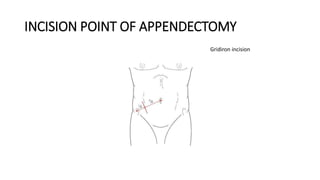
INCISION POINT OF APPENDECTOMY
Gridiron incision
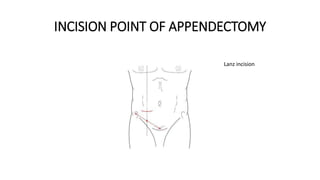
INCISION POINT OF APPENDECTOMY
Lanz incision

APPENDICITIS power point presentations.pptx

  • 1.
    APPENDICITIS INTRODUCTION Appendicitis is aninflammation of the appendix which result from bacterial invasion usually distal to an obstruction of the lumen. The obstruction is caused by faecaliths, seeds or worms in the lumen or by invasion of the appendix wall by parasites, such as amoeba, schistosomes.s’ It is a finger-shaped pouch that projects from your colon on the lower right side of your abdomen.
  • 2.
    CAUSES OF APPENDICITIS •Appendicitis occurs when the appendix becomes blocked, often by stool, a foreign body, or cancer. • Blockage may also occur from infection, since the appendix inflame in response to any infection in the body.
  • 3.
    CLINICAL FEATURES A. SIGNSAND SMPTOMS OF APPENDICITIS • Sudden pain that begins on the right side of the lower abdomen and progressively worsening • painful coughing or sneezing, walk or make other jarring movements • nausea • vomiting • inability to pass gas (break wind) • fever: Low-grade fever that may worsen as the illness progresses • constipation • loss of appetite • Sudden pain that begins around your navel and often shifts to your lower right abdomen • Abdominal bloating
  • 4.
    CLINICAL FEATURES B. PHYSICALFINDINGS INCLUDES: • Mc Burney’s point: Tenderness with localized rigidity in the right lower quadrant 1/3 distance between the umbilicus and the right anterior superior iliac spine. • Rovsing Sign: Right lower quadrant pain with deep palpation on the left lower quadrant is a sign of referred pain from appendicitis as the innervation of the intestine does not localize
  • 5.
    CLINICAL FEATURES • Psoassign: Right lower quadrant pain with external rotation of the right thigh indicates appendicitis or psoas abscess and may indicate that the appendix is rectoceacal in location as the ilio psoas muscle is retroperitoneal • Obturator sign: Right lower quadrant pain with internal rotation of the flexed right thigh indicates irritation of the obturator internus muscle which is another indicator of appendicitis. • Right side tenderness on rectal examination •
  • 6.
    CAUSES OF APPENDICITIS •Appendicitis occurs when the appendix becomes blocked, often by stool, a foreign body, or cancer. Blockage may also occur from infection.
  • 7.
    INVESTIGATION • Ultra soundscanning • CT Scan
  • 8.
    DIFFERENTIAL DIAGNOSIS • Gastroenteritis •Ascariasis • Amoebiasis • Urinary tract infection • Ruptured ectopic pregnancy • Pelvic inflammatory disease (salpingitis) • Twisted ovarian follicle • Mesenteric adenitis
  • 9.
    DIAGNOSIS • It canbe diagnosed based on clinical/physical assessment
  • 10.
    Complications • Ruptured appendix.A rupture spreads infection throughout your abdomen (peritonitis). Possibly life-threatening, this condition requires immediate surgery to remove the appendix and clean your abdominal cavity. • pocket of pus that forms in the abdomen. If your appendix bursts, you may develop a pocket of infection (abscess). In most cases, a surgeon drains the abscess by placing a tube through your abdominal wall into the abscess. The tube is left in place for about two weeks, and you're given antibiotics to clear the infection. Once the infection is clear, you'll have surgery to remove the appendix. In some cases, the abscess is drained, and the appendix is removed immediately.
  • 11.
    Complication continue • Peritonitis:Ifthe appendix ruptures and releases the infection into the abdomen, the patient may develop peritonitis, which is an infection and inflammation of the peritoneum. The peritoneum is the membrane that lines the abdominal cavity and covers most of the abdominal organs. Peritonitis may lead to the shutdown bowel movements, and the bowel will become blocked. The patient will develop a fever and could go into shock. Peritonitis requires urgent treatment. • Abscess: If the infection seeps out of the appendix and mixes with intestinal contents, it may form an abscess. If the abscess is not treated, it can cause peritonitis. Sometimes, abscesses are treated with antibiotics. Often, they are surgically drained with the aid of a tube, which is placed into the abdomen. The complications of appendicitis can be life- threatening. It is important to seek medical help for anyone who may have appendicitis.
  • 12.
    LOCATION OR POSITIONOF THE APPENDIX
  • 13.
    INCISION POINT OFAPPENDECTOMY Gridiron incision
  • 14.
    INCISION POINT OFAPPENDECTOMY Lanz incision