APOLLO TYRES 
LEARNING FROM ENVIRONMENTAL 
SCANNING
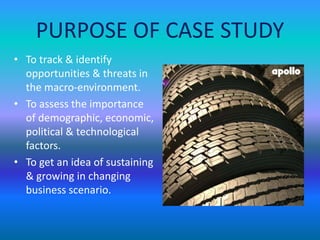
PURPOSE OF CASE STUDY 
• To track & identify 
opportunities & threats in 
the macro-environment. 
• To assess the importance 
of demographic, economic, 
political & technological 
factors. 
• To get an idea of sustaining 
& growing in changing 
business scenario.
THE INDIAN TYRE INDUSTRY 
*TYRE INDUSTRY SIZE - Rs 13,000 CRORE 
*THE FORTUNE DEPENDS ON – 
1. Agricultural and industrial performance 
2. Transportation needs 
3. The production of vehicles
MAJOR KEY PLAYERS 
• MRF 
• APOLLO TYRES 
• CEAT 
• JK RUBBER 
• MODI RUBBER 
• KESORAM INDUSTRIES 
• GOODYEAR INDIA 
• DUNLOP 
• FALCON 
• TCIL 
• METRO TYRES
SEGMENT-WISE TYRE DEMAND 
Three segments of tyre demand- 
1. ORIGINAL EQUIPMENT MAKERS(OE)- 
* MAJOR SOURCE OF DEMAND in passenger car 
market, two wheeler and tractor segments. 
*60% of the total demand formed by OE segment in 
passenger car market. 
*50% contribution of OE in two wheeler and tractor 
segments.
2. REPLACEMENT- 
*PRIMARY driver of demand. 
*Demand hinges on the automobile output in 
recent past. 
3. EXPORTS- 
*Accounts for less than 10 percent of total demand.
ECONOMY AND TYRE DEMAND 
RELATION 
• ECONOMIC GROWTH- INCREASE IN GOODS TRANSPORT 
AND MORE MOBILITY resulting in increasing public 
transport. 
• Transport is A MAJOR CONTRIBUTOR TO THE ECONOMY in 
its own right. 
• Good transportation- vital to the movement of goods & 
services, direct impact on economic growth & productivity. 
• CONCLUSION: THE ECONOMIC GROWTH INCREASES 
TRANSPORT REQUIREMENT WHICH ULTIMATELY IMPACTS 
AND INCREASES THE DEMAND OF TYRES
EFFECT OF MACRO ECONOMIC 
ANALYSIS ON MARKETING STRATEGY 
• Economic growth has a cascading effect on macro environment & impacts 
consumers resulting in increased disposable income, purchasing power & 
other cultural changes. 
• Development of ECONOMETRIC MODEL to determine the demand of tyres 
based on the changes in macro & economic environment. 
• Tyres generally have low elasticity of demand. 
• During BOOM PERIOD the Company has to ensure the production is 
enough to keep in pace with demand in OE segment. 
• In RECESSION PERIOD the company has to ensure that it diversify into 
other geographical areas as export account only for 10% of demand.
TWEAK & ADJUSTMENT STRATEGY 
• IMPORTS FROM FOREIGN 
COUNTRIES- Lower costs 
for the tyre industry as 
export import policy allows 
free import of all types of 
new tyres & tubes. 
• TIE UP’S WITH SUPPLIER : 
Since raw material costs 
accounts for 70% of price of 
product, company can 
engage into long term 
contacts with natural 
rubber traders.
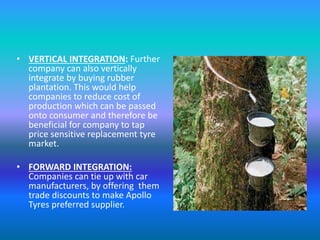
• VERTICAL INTEGRATION: Further 
company can also vertically 
integrate by buying rubber 
plantation. This would help 
companies to reduce cost of 
production which can be passed 
onto consumer and therefore be 
beneficial for company to tap 
price sensitive replacement tyre 
market. 
• FORWARD INTEGRATION: 
Companies can tie up with car 
manufacturers, by offering them 
trade discounts to make Apollo 
Tyres preferred supplier.
FUTURE DIRECTION FOR APOLLO TYRE 
• Regarding future direction, taking initiative in NEW RURAL MARKET would 
be a good option. 
• Presence of rivals like JK TYRES would encourage healthy competition and 
better value delivery . 
• Tractor & two wheeler segment contributes to 50% of the total demand. 
• Increase in agricultural production would lead to more demand of 
tractors. 
• May introduce colored tyres – green or tornado green to gain 
differentiation. 
• Increment in sales could be achieved by consumer education program – 
*To Spread awareness about need for care & maintenance to receive 
maximum returns from tractor tyres. 
* Adhering to the customer centric approach, informing & educating the 
new rural segment, given the kind of soil & weather , so that they can 
arrive at the right choice of tyres.
MADE BY 
• AMREEN SHAHID 
• RAMA SANGAL 
• MEGHA MAHESHWARI 
• POOJA CHOUDHARY 
• NEHA JINDAL 
• YAMINI SONI

Apollo tyres

  • 1.
    APOLLO TYRES LEARNINGFROM ENVIRONMENTAL SCANNING
  • 2.
    PURPOSE OF CASESTUDY • To track & identify opportunities & threats in the macro-environment. • To assess the importance of demographic, economic, political & technological factors. • To get an idea of sustaining & growing in changing business scenario.
  • 3.
    THE INDIAN TYREINDUSTRY *TYRE INDUSTRY SIZE - Rs 13,000 CRORE *THE FORTUNE DEPENDS ON – 1. Agricultural and industrial performance 2. Transportation needs 3. The production of vehicles
  • 4.
    MAJOR KEY PLAYERS • MRF • APOLLO TYRES • CEAT • JK RUBBER • MODI RUBBER • KESORAM INDUSTRIES • GOODYEAR INDIA • DUNLOP • FALCON • TCIL • METRO TYRES
  • 5.
    SEGMENT-WISE TYRE DEMAND Three segments of tyre demand- 1. ORIGINAL EQUIPMENT MAKERS(OE)- * MAJOR SOURCE OF DEMAND in passenger car market, two wheeler and tractor segments. *60% of the total demand formed by OE segment in passenger car market. *50% contribution of OE in two wheeler and tractor segments.
  • 6.
    2. REPLACEMENT- *PRIMARYdriver of demand. *Demand hinges on the automobile output in recent past. 3. EXPORTS- *Accounts for less than 10 percent of total demand.
  • 7.
    ECONOMY AND TYREDEMAND RELATION • ECONOMIC GROWTH- INCREASE IN GOODS TRANSPORT AND MORE MOBILITY resulting in increasing public transport. • Transport is A MAJOR CONTRIBUTOR TO THE ECONOMY in its own right. • Good transportation- vital to the movement of goods & services, direct impact on economic growth & productivity. • CONCLUSION: THE ECONOMIC GROWTH INCREASES TRANSPORT REQUIREMENT WHICH ULTIMATELY IMPACTS AND INCREASES THE DEMAND OF TYRES
  • 8.
    EFFECT OF MACROECONOMIC ANALYSIS ON MARKETING STRATEGY • Economic growth has a cascading effect on macro environment & impacts consumers resulting in increased disposable income, purchasing power & other cultural changes. • Development of ECONOMETRIC MODEL to determine the demand of tyres based on the changes in macro & economic environment. • Tyres generally have low elasticity of demand. • During BOOM PERIOD the Company has to ensure the production is enough to keep in pace with demand in OE segment. • In RECESSION PERIOD the company has to ensure that it diversify into other geographical areas as export account only for 10% of demand.
  • 9.
    TWEAK & ADJUSTMENTSTRATEGY • IMPORTS FROM FOREIGN COUNTRIES- Lower costs for the tyre industry as export import policy allows free import of all types of new tyres & tubes. • TIE UP’S WITH SUPPLIER : Since raw material costs accounts for 70% of price of product, company can engage into long term contacts with natural rubber traders.
  • 10.
    • VERTICAL INTEGRATION:Further company can also vertically integrate by buying rubber plantation. This would help companies to reduce cost of production which can be passed onto consumer and therefore be beneficial for company to tap price sensitive replacement tyre market. • FORWARD INTEGRATION: Companies can tie up with car manufacturers, by offering them trade discounts to make Apollo Tyres preferred supplier.
  • 11.
    FUTURE DIRECTION FORAPOLLO TYRE • Regarding future direction, taking initiative in NEW RURAL MARKET would be a good option. • Presence of rivals like JK TYRES would encourage healthy competition and better value delivery . • Tractor & two wheeler segment contributes to 50% of the total demand. • Increase in agricultural production would lead to more demand of tractors. • May introduce colored tyres – green or tornado green to gain differentiation. • Increment in sales could be achieved by consumer education program – *To Spread awareness about need for care & maintenance to receive maximum returns from tractor tyres. * Adhering to the customer centric approach, informing & educating the new rural segment, given the kind of soil & weather , so that they can arrive at the right choice of tyres.
  • 13.
    MADE BY •AMREEN SHAHID • RAMA SANGAL • MEGHA MAHESHWARI • POOJA CHOUDHARY • NEHA JINDAL • YAMINI SONI