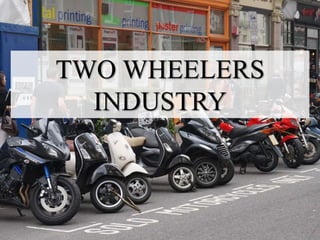
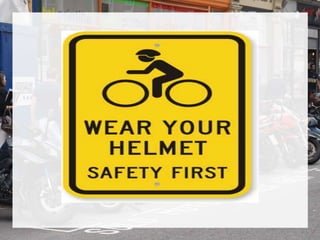
TWO WHEELERS
INDUSTRY
Presenting by:
S.no NAMES HALL TICKET NO
1 Dachepally Keerthi 21564C1018
2 Bhukya kalyani 21564C1050
3 Bandi Kavya 21564C1102
4 Bairi Vishnu Prasad 21564C1027
5 G. Abhinav 21564C1035
6 Anumula Archyuth Kumar 21564C1120
7 Balabadra Yamini 21564C1131
8 Ambala Somashekar 21564C1150
9 Shaik Wasim Ahmed 21564C1052
10 Podichetti Manish 21564C1129
11 Kola Manashwini 21564C1037
12 Bakkathatla Chandrashekar 21564C1031
PLAN OF PRESENTATION
• Introduction
• Origin & Growth
• 4P’s of the Industry
• Leading Organizations
• SWOT Analysis
• PEST Analysis
• National Policies
• Growth prospects and Challenges
• Business Strategies
• Contribution to Economy
• Conclusion
INTRODUCTION
• Indian two wheeler contributes the largest volume amongst all
the segments in automobile industry
• India is the second largest producer and manufacturer of two
wheelers in the world
• India stands next to China and japan
• Indian two wheeler industry made beginnings in early 50's
when API started manufacturing scooters un the country
• Two wheeler industry can broadly categorized into 3 sub
segments -Scooters, motorcycle and mopeds
• Two wheeler industry are mostly preferable
• Two wheeler industry are most popular and highly sough out
medium of transport in India
• Trend of owning 2 wheelers is due to its – economical prices,
safety, fuel efficient, comfort level
ORIGIN AND GROWTH
ORIGIN:
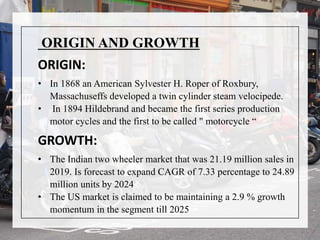
• In 1868 an American Sylvester H. Roper of Roxbury,
Massachuseffs developed a twin cylinder steam velocipede.
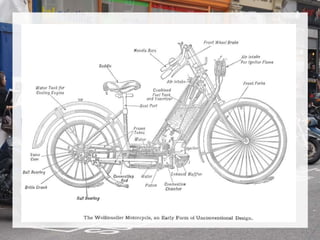
• In 1894 Hildebrand and became the first series production
motor cycles and the first to be called " motorcycle “
GROWTH:
• The Indian two wheeler market that was 21.19 million sales in
2019. Is forecast to expand CAGR of 7.33 percentage to 24.89
million units by 2024
• The US market is claimed to be maintaining a 2.9 % growth
momentum in the segment till 2025
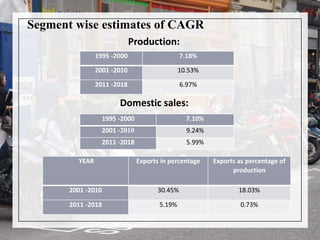
Segment wise estimates of CAGR
Production:
Domestic sales:
1995 -2000 7.10%
2001 -2010 9.24%
2011 -2018 5.99%
YEAR Exports in percentage Exports as percentage of
production
2001 -2010 30.45% 18.03%
2011 -2018 5.19% 0.73%
1995 -2000 7.18%
2001 -2010 10.53%
2011 -2018 6.97%
4 P’S OF TWO WHEELER
INDUSTRY
• PRODUCT STRATEGY
• PRICE STRATEGY
• PROMOTION STRATEGY
• PLACE STRATEGY
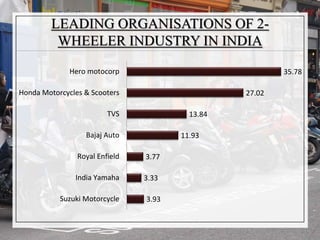
LEADING ORGANISATIONS OF 2-
WHEELER INDUSTRY IN INDIA
3.93
3.33
3.77
11.93
13.84
27.02
35.78
Suzuki Motorcycle
India Yamaha
Royal Enfield
Bajaj Auto
TVS
Honda Motorcycles & Scooters
Hero motocorp
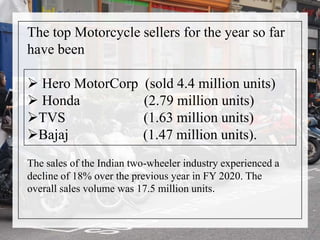
The top Motorcycle sellers for the year so far
have been
 Hero MotorCorp (sold 4.4 million units)
 Honda (2.79 million units)
TVS (1.63 million units)
Bajaj (1.47 million units).
The sales of the Indian two-wheeler industry experienced a
decline of 18% over the previous year in FY 2020. The
overall sales volume was 17.5 million units.
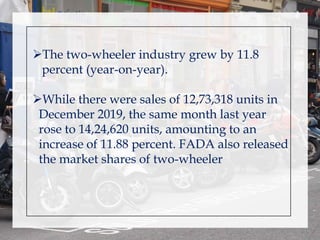
The two-wheeler industry grew by 11.8
percent (year-on-year).
While there were sales of 12,73,318 units in
December 2019, the same month last year
rose to 14,24,620 units, amounting to an
increase of 11.88 percent. FADA also released
the market shares of two-wheeler
6 FACTORS THAT WILL DRIVE DEMAND
FOR TWO-WHEELERS IN POST-
LOCKDOWN TIMES
1. Social distancing and personal mobility
2. Shifting towards low- budget transport vehicle
3. Vehicle financing will be the mantra
4. Leasing is better than owning
5. Limited and lower commitments
6. Technology will be the key
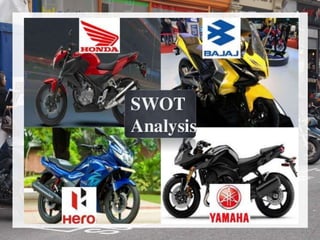
SWOT ANALYSIS
• Significant contribution to Indian economy
• A Favorable industry to Asian economic
condition
• Most helpful for a developing country like
India In terms of Transport Feasibility
• Government provides monetary assistance
for manufacturing units
• Reduced Labor Cost
STRENGTHS
WEAKNESS
• Rise in raw material cost
• Due to Competition, Pricing reduces and
affects to raw quality of Products and
Services
• Low Labor Productivity
• Low Investments in R & D
OPPORTUNITIES
• Reduction in excise duty
• Rural Demand raising
• Changing Demographics
• Income Levels is at a Constant Increase
• Strategic Alliances
THREATS
• Economic Slowdown
• Unskilled Labor
• Volatility in Fuel Prices
• Due to heavy of four Wheeler, Low
priced Cars have emerged in market which
causes threat to two wheeler on the basis
of price
PEST ANALYSIS
• POLITICAL
• ECONOMIC
• SOCIAL
• TECHNOLOGY
GOVERNMENT SCHEMES & POLICIES
›Department of Heavy Industry Ministry of Heavy
Industries and Public Enterprises(Government of
India)
›National GDP – 2.77% (1992-93) to 7.1% now
›Foreign Investment
›Initiatives
›Amma Two Wheeler Scheme
›Electric Two Wheelers as Taxi’s
›Demands of Industries after COVID-19 Lockdown
CHALLENGES FACING BY INDUSTRY:
• Rising Customer Expectations
• Creation of distribution Infrastructure
• Environmental and Safety Concerns
GROWTH PROSPECTS AND KEY DRIVERS
OF TWO WHEELER INDUSTRY:
• Rise in India’s Young Working Population
• Rise of India’s Rural Economy and Growth in Middle
Income Households
• Greater Affordability of Vehicles
• Rapid Product Introduction and Shorter Product Life
Cycle
BUSINESS STRATEGIES
•In any business, the key to surviving is a steady stream of
revenue. To get that, customer have to know about your
business
•Awareness depends upon the ability of businessman to market
his business properly
• For making of awareness about the business, businessman
using various marketing strategies
•The aim of the marketing strategy is to use advertising as well
other tools to maximize sales and maintain the long term
relationship with their consumers
•Advertising is a tool which can attract the customers to a
product or service
CONTRIBUTION TO ECONOMY
Scooter:
• Fastest growing segments in Indian market at 15% CAGR from
2012-2019. share of scooter is increased from 19% to 32% from
2012 -2019.
• High concentrated market with 86% shares with top 3 players
Motorcycle:
• Market for motorcycle is concentrated, the top 3 players
accounted for 83% share in the market in 2018.
Mopeds:
• Tamilnadu and Andhra Pradesh is only two states accounting for
lion share of the overall moped market in India.
CONCLUSION
• Globalization has affected the sector in all
segments.
• Significant contribution to the Indian
Economy.
• Challenges posed by global market to be
tackled by
– Technological advancement
– Customer care feedback system
– Appropriate Marketing Strategies.
Two Wheeler Industry

Two Wheeler Industry

  • 1.
  • 2.
    Presenting by: S.no NAMESHALL TICKET NO 1 Dachepally Keerthi 21564C1018 2 Bhukya kalyani 21564C1050 3 Bandi Kavya 21564C1102 4 Bairi Vishnu Prasad 21564C1027 5 G. Abhinav 21564C1035 6 Anumula Archyuth Kumar 21564C1120 7 Balabadra Yamini 21564C1131 8 Ambala Somashekar 21564C1150 9 Shaik Wasim Ahmed 21564C1052 10 Podichetti Manish 21564C1129 11 Kola Manashwini 21564C1037 12 Bakkathatla Chandrashekar 21564C1031
  • 3.
    PLAN OF PRESENTATION •Introduction • Origin & Growth • 4P’s of the Industry • Leading Organizations • SWOT Analysis • PEST Analysis • National Policies • Growth prospects and Challenges • Business Strategies • Contribution to Economy • Conclusion
  • 4.
    INTRODUCTION • Indian twowheeler contributes the largest volume amongst all the segments in automobile industry • India is the second largest producer and manufacturer of two wheelers in the world • India stands next to China and japan • Indian two wheeler industry made beginnings in early 50's when API started manufacturing scooters un the country • Two wheeler industry can broadly categorized into 3 sub segments -Scooters, motorcycle and mopeds • Two wheeler industry are mostly preferable • Two wheeler industry are most popular and highly sough out medium of transport in India • Trend of owning 2 wheelers is due to its – economical prices, safety, fuel efficient, comfort level
  • 6.
    ORIGIN AND GROWTH ORIGIN: •In 1868 an American Sylvester H. Roper of Roxbury, Massachuseffs developed a twin cylinder steam velocipede. • In 1894 Hildebrand and became the first series production motor cycles and the first to be called " motorcycle “ GROWTH: • The Indian two wheeler market that was 21.19 million sales in 2019. Is forecast to expand CAGR of 7.33 percentage to 24.89 million units by 2024 • The US market is claimed to be maintaining a 2.9 % growth momentum in the segment till 2025
  • 7.
    Segment wise estimatesof CAGR Production: Domestic sales: 1995 -2000 7.10% 2001 -2010 9.24% 2011 -2018 5.99% YEAR Exports in percentage Exports as percentage of production 2001 -2010 30.45% 18.03% 2011 -2018 5.19% 0.73% 1995 -2000 7.18% 2001 -2010 10.53% 2011 -2018 6.97%
  • 8.
    4 P’S OFTWO WHEELER INDUSTRY • PRODUCT STRATEGY • PRICE STRATEGY • PROMOTION STRATEGY • PLACE STRATEGY
  • 10.
    LEADING ORGANISATIONS OF2- WHEELER INDUSTRY IN INDIA 3.93 3.33 3.77 11.93 13.84 27.02 35.78 Suzuki Motorcycle India Yamaha Royal Enfield Bajaj Auto TVS Honda Motorcycles & Scooters Hero motocorp
  • 11.
    The top Motorcyclesellers for the year so far have been  Hero MotorCorp (sold 4.4 million units)  Honda (2.79 million units) TVS (1.63 million units) Bajaj (1.47 million units). The sales of the Indian two-wheeler industry experienced a decline of 18% over the previous year in FY 2020. The overall sales volume was 17.5 million units.
  • 12.
    The two-wheeler industrygrew by 11.8 percent (year-on-year). While there were sales of 12,73,318 units in December 2019, the same month last year rose to 14,24,620 units, amounting to an increase of 11.88 percent. FADA also released the market shares of two-wheeler
  • 13.
    6 FACTORS THATWILL DRIVE DEMAND FOR TWO-WHEELERS IN POST- LOCKDOWN TIMES 1. Social distancing and personal mobility 2. Shifting towards low- budget transport vehicle 3. Vehicle financing will be the mantra 4. Leasing is better than owning 5. Limited and lower commitments 6. Technology will be the key
  • 15.
    SWOT ANALYSIS • Significantcontribution to Indian economy • A Favorable industry to Asian economic condition • Most helpful for a developing country like India In terms of Transport Feasibility • Government provides monetary assistance for manufacturing units • Reduced Labor Cost STRENGTHS
  • 16.
    WEAKNESS • Rise inraw material cost • Due to Competition, Pricing reduces and affects to raw quality of Products and Services • Low Labor Productivity • Low Investments in R & D
  • 17.
    OPPORTUNITIES • Reduction inexcise duty • Rural Demand raising • Changing Demographics • Income Levels is at a Constant Increase • Strategic Alliances
  • 18.
    THREATS • Economic Slowdown •Unskilled Labor • Volatility in Fuel Prices • Due to heavy of four Wheeler, Low priced Cars have emerged in market which causes threat to two wheeler on the basis of price
  • 19.
    PEST ANALYSIS • POLITICAL •ECONOMIC • SOCIAL • TECHNOLOGY
  • 20.
    GOVERNMENT SCHEMES &POLICIES ›Department of Heavy Industry Ministry of Heavy Industries and Public Enterprises(Government of India) ›National GDP – 2.77% (1992-93) to 7.1% now ›Foreign Investment ›Initiatives ›Amma Two Wheeler Scheme ›Electric Two Wheelers as Taxi’s ›Demands of Industries after COVID-19 Lockdown
  • 21.
    CHALLENGES FACING BYINDUSTRY: • Rising Customer Expectations • Creation of distribution Infrastructure • Environmental and Safety Concerns GROWTH PROSPECTS AND KEY DRIVERS OF TWO WHEELER INDUSTRY: • Rise in India’s Young Working Population • Rise of India’s Rural Economy and Growth in Middle Income Households • Greater Affordability of Vehicles • Rapid Product Introduction and Shorter Product Life Cycle
  • 22.
    BUSINESS STRATEGIES •In anybusiness, the key to surviving is a steady stream of revenue. To get that, customer have to know about your business •Awareness depends upon the ability of businessman to market his business properly • For making of awareness about the business, businessman using various marketing strategies •The aim of the marketing strategy is to use advertising as well other tools to maximize sales and maintain the long term relationship with their consumers •Advertising is a tool which can attract the customers to a product or service
  • 23.
    CONTRIBUTION TO ECONOMY Scooter: •Fastest growing segments in Indian market at 15% CAGR from 2012-2019. share of scooter is increased from 19% to 32% from 2012 -2019. • High concentrated market with 86% shares with top 3 players Motorcycle: • Market for motorcycle is concentrated, the top 3 players accounted for 83% share in the market in 2018. Mopeds: • Tamilnadu and Andhra Pradesh is only two states accounting for lion share of the overall moped market in India.
  • 24.
    CONCLUSION • Globalization hasaffected the sector in all segments. • Significant contribution to the Indian Economy. • Challenges posed by global market to be tackled by – Technological advancement – Customer care feedback system – Appropriate Marketing Strategies.