Apertures-R-Us
Customer
Service
Presentation
Michelle Peters
Rick Morrison
Jessie Hillard
Christopher Dilley
Customer Service and Communication
 Communication     is an essential element to
  all customer service.
 In order to be effective in customer
  service, one must have excellent listening
  skills.
 Communication is essential in building
  rapport and trust
 Many businesses have discovered that
  quality customer service, and good
  communication skills are imperative tools
  to have in maintaining and empowering
  the success of a business.
Communication
 Your  communication style can make the
  difference between a happy customer who
  recommends your business to family and friends,
  and a disgruntled one who shares his
  dissatisfaction with hundreds of potential
  customers through a blog or other means.
 There are three different styles of
  communication; aggressive, passive, and
  assertive:
Communication
   Aggressive communication is normally not the best form of
    communication to use when providing customer service. Aggressive
    communication can be found to be rude, irresponsible, and a
    disrespectful form of communication. However, knowing how to deal
    with customers who have an aggressive communication style is a good
    skill to have. When a customer is displaying aggressive communication, it
    is best to remember to remain clam and listen/analyze why or what it is
    that had put the customer in an aggressive state.
    Passive communication is an excellent form of communication to
    understand and concentrate on when searching for signs that a
    customer might need service/assistance. Customers that are confused or
    unsure of what they want often display passive communication styles.
    When dealing with passive type customers it’s important to understand
    that the customer most likely can use help with something, but doesn’t
    always want to ask for it. For example, a customer who is shopping and
    constantly picks up items and then puts them back is a good sign that
    passive communication is being displayed. Addressing these types of
    customers can help not only in the sale of an item, but can also build a
    bond/friendship or turn an OK experience into a great one.
Communication
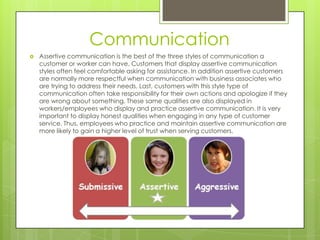
   Assertive communication is the best of the three styles of communication a
    customer or worker can have. Customers that display assertive communication
    styles often feel comfortable asking for assistance. In addition assertive customers
    are normally more respectful when communication with business associates who
    are trying to address their needs. Last, customers with this style type of
    communication often take responsibility for their own actions and apologize if they
    are wrong about something. These same qualities are also displayed in
    workers/employees who display and practice assertive communication. It is very
    important to display honest qualities when engaging in any type of customer
    service. Thus, employees who practice and maintain assertive communication are
    more likely to gain a higher level of trust when serving customers.
Verbal and Non-verbal Communication
   Verbal communication is more than just speaking words. There is more to verbal
    communication than just literally speaking words. Verbal communication is the
    choice of words you say, the tone of voice you say them in, and the timing or when
    something is said. “Experts agree that only 20 percent of your message is
    communicated face-to-face through words; 45 percent is communicated by the
    quality of your voice tone and inflection.

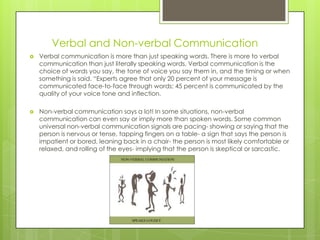
   Non-verbal communication says a lot! In some situations, non-verbal
    communication can even say or imply more than spoken words. Some common
    universal non-verbal communication signals are pacing- showing or saying that the
    person is nervous or tense, tapping fingers on a table- a sign that says the person is
    impatient or bored, leaning back in a chair- the person is most likely comfortable or
    relaxed, and rolling of the eyes- implying that the person is skeptical or sarcastic.
Customer Feedback
   Three hundred and sixty degree feed back is
    essential to proper communication. This type of
    communication is a full circle of events that helps
    individuals performing customer services ensure,
    support, and reinforce individual and organizational
    development objectives, like creating customers
    satisfaction goals.
   Communication is one of the biggest, and if not the
    number one it’s right at the top of the most important
    tools that should be used when providing any type of
    customer service. The degree of customer service
    and communication can really sway the difference
    in weather a customer feel satisfied or becomes loyal
    to a business.
Various Sources of Feedback
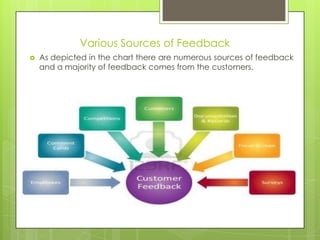
   As depicted in the chart there are numerous sources of feedback
    and a majority of feedback comes from the customers.
7 Steps to Identify Loyal Customers vs. Satisfied
                     Customers
1. Pricing. You negotiate prices with satisfied customers. You negotiate costs
with loyal customers.
2. Payment. Satisfied customer pay at their discretion; loyal customers pay
on time.
3. Referrals. Satisfied customers become referrals of your competitors. Loyal
customers willingly provide referrals to you.
4. Turnover. Generally, you will experience turnover rates of 15% or higher of
satisfied customers. The turnover rate of loyal customers will be less than 5%
and will be for reasons out of your control.
5. Competitive data. Your satisfied customers are seeking competitive data.
Your loyal customers are sharing competitive data.
6. Perception. Satisfied customers perceive you as a commodity provider.
Loyal customers perceive you as a partner.
7. Contract. You will need a contract to keep many satisfied customers in
place. You have a virtual lifetime contract with your loyal customers.
References
•Davis, A. , & Shannon, J.R. (2011) The Definitive Guide to HR
Communication: Engaging Employees in Benefits, Pay, and Performance.
Upper     Saddle River, NJ: Person Education Inc.
•LepsingerGriffth, R. , & Lucia, A.D. (2009) The Art and Science of 360 Degree
Feedback.San Francisco, CA: John Wiley & Sons, Inc.
•Lucas, R. W. (2012) Customer Service Skills for Success (5th ed.). New York,
NY: McGraw-Hill.
•Noe, R.A. (2011) Fundamentals of Human Resource Management (4th ed.)
New York, NY: McGraw-Hill.
•Mueller, M. (2012, January 6). Are Your Messages Being Heard. The New
York Times. Retrieved from http://boss.blogs.nytimes.com/2011/01/06/are-
your-messages-being-heard/
•Retrieved from:
 http://smallbusiness.chron.com/impact-communication-styles-customer-
service-49587.html
•Retrieved from: http://www.tmcnet.com/channels/customer-experience-
management/articles/936-customer-experience-customer-satisfaction-vs-
customer-loyalty.htm
•Retrieved from: http://www.icontraining.com/training_tips/cservetip/

Apertures r-us customer ppt

  • 1.
  • 2.
    Customer Service andCommunication  Communication is an essential element to all customer service.  In order to be effective in customer service, one must have excellent listening skills.  Communication is essential in building rapport and trust  Many businesses have discovered that quality customer service, and good communication skills are imperative tools to have in maintaining and empowering the success of a business.
  • 3.
    Communication  Your communication style can make the difference between a happy customer who recommends your business to family and friends, and a disgruntled one who shares his dissatisfaction with hundreds of potential customers through a blog or other means.  There are three different styles of communication; aggressive, passive, and assertive:
  • 4.
    Communication  Aggressive communication is normally not the best form of communication to use when providing customer service. Aggressive communication can be found to be rude, irresponsible, and a disrespectful form of communication. However, knowing how to deal with customers who have an aggressive communication style is a good skill to have. When a customer is displaying aggressive communication, it is best to remember to remain clam and listen/analyze why or what it is that had put the customer in an aggressive state.  Passive communication is an excellent form of communication to understand and concentrate on when searching for signs that a customer might need service/assistance. Customers that are confused or unsure of what they want often display passive communication styles. When dealing with passive type customers it’s important to understand that the customer most likely can use help with something, but doesn’t always want to ask for it. For example, a customer who is shopping and constantly picks up items and then puts them back is a good sign that passive communication is being displayed. Addressing these types of customers can help not only in the sale of an item, but can also build a bond/friendship or turn an OK experience into a great one.
  • 5.
    Communication  Assertive communication is the best of the three styles of communication a customer or worker can have. Customers that display assertive communication styles often feel comfortable asking for assistance. In addition assertive customers are normally more respectful when communication with business associates who are trying to address their needs. Last, customers with this style type of communication often take responsibility for their own actions and apologize if they are wrong about something. These same qualities are also displayed in workers/employees who display and practice assertive communication. It is very important to display honest qualities when engaging in any type of customer service. Thus, employees who practice and maintain assertive communication are more likely to gain a higher level of trust when serving customers.
  • 6.
    Verbal and Non-verbalCommunication  Verbal communication is more than just speaking words. There is more to verbal communication than just literally speaking words. Verbal communication is the choice of words you say, the tone of voice you say them in, and the timing or when something is said. “Experts agree that only 20 percent of your message is communicated face-to-face through words; 45 percent is communicated by the quality of your voice tone and inflection.  Non-verbal communication says a lot! In some situations, non-verbal communication can even say or imply more than spoken words. Some common universal non-verbal communication signals are pacing- showing or saying that the person is nervous or tense, tapping fingers on a table- a sign that says the person is impatient or bored, leaning back in a chair- the person is most likely comfortable or relaxed, and rolling of the eyes- implying that the person is skeptical or sarcastic.
  • 7.
    Customer Feedback  Three hundred and sixty degree feed back is essential to proper communication. This type of communication is a full circle of events that helps individuals performing customer services ensure, support, and reinforce individual and organizational development objectives, like creating customers satisfaction goals.  Communication is one of the biggest, and if not the number one it’s right at the top of the most important tools that should be used when providing any type of customer service. The degree of customer service and communication can really sway the difference in weather a customer feel satisfied or becomes loyal to a business.
  • 8.
    Various Sources ofFeedback  As depicted in the chart there are numerous sources of feedback and a majority of feedback comes from the customers.
  • 9.
    7 Steps toIdentify Loyal Customers vs. Satisfied Customers 1. Pricing. You negotiate prices with satisfied customers. You negotiate costs with loyal customers. 2. Payment. Satisfied customer pay at their discretion; loyal customers pay on time. 3. Referrals. Satisfied customers become referrals of your competitors. Loyal customers willingly provide referrals to you. 4. Turnover. Generally, you will experience turnover rates of 15% or higher of satisfied customers. The turnover rate of loyal customers will be less than 5% and will be for reasons out of your control. 5. Competitive data. Your satisfied customers are seeking competitive data. Your loyal customers are sharing competitive data. 6. Perception. Satisfied customers perceive you as a commodity provider. Loyal customers perceive you as a partner. 7. Contract. You will need a contract to keep many satisfied customers in place. You have a virtual lifetime contract with your loyal customers.
  • 10.
    References •Davis, A. ,& Shannon, J.R. (2011) The Definitive Guide to HR Communication: Engaging Employees in Benefits, Pay, and Performance. Upper Saddle River, NJ: Person Education Inc. •LepsingerGriffth, R. , & Lucia, A.D. (2009) The Art and Science of 360 Degree Feedback.San Francisco, CA: John Wiley & Sons, Inc. •Lucas, R. W. (2012) Customer Service Skills for Success (5th ed.). New York, NY: McGraw-Hill. •Noe, R.A. (2011) Fundamentals of Human Resource Management (4th ed.) New York, NY: McGraw-Hill. •Mueller, M. (2012, January 6). Are Your Messages Being Heard. The New York Times. Retrieved from http://boss.blogs.nytimes.com/2011/01/06/are- your-messages-being-heard/ •Retrieved from: http://smallbusiness.chron.com/impact-communication-styles-customer- service-49587.html •Retrieved from: http://www.tmcnet.com/channels/customer-experience- management/articles/936-customer-experience-customer-satisfaction-vs- customer-loyalty.htm •Retrieved from: http://www.icontraining.com/training_tips/cservetip/

Editor's Notes

  • #2 Customer service presentation for CAPSTONE PROJECT: Apertures-R-Us
  • #3 Customer service and communication go hand-in-hand. You cannot have good customer service with bad communication.
  • #7 So, mastering an audience’s attention by making them want to listen to you is essential in good business communication. Selling yourself can be done by mastering your body language. So, again pay attention to the non-verbal messages in addition to verbal messages.
  • #8 A ground-breaking research study, “Effects of Multisource Feedback and a Feedback Facilitator on the Influence Behavior of Managers Toward Subordinates,” (Journal of Applied Psychology, 2003, 88, 3, 561-569) by Dr. Gary Yukl, Charles F. Seifert, and Robert A. McDonald, demonstrates that OnPoint’s Influence Skills feedback instrument increases managers’ use of effective influence tactics and results in a positive change in their leadership behavior.
  • #9 A ground-breaking research study, “Effects of Multisource Feedback and a Feedback Facilitator on the Influence Behavior of Managers Toward Subordinates,” (Journal of Applied Psychology, 2003, 88, 3, 561-569) by Dr. Gary Yukl, Charles F. Seifert, and Robert A. McDonald, demonstrates that OnPoint’s Influence Skills feedback instrument increases managers’ use of effective influence tactics and results in a positive change in their leadership behavior.