International Journal of Modern Engineering Research (IJMER)
              www.ijmer.com              Vol.3, Issue.2, March-April. 2013 pp-692-697      ISSN: 2249-6645


            Strategies for Reinvigorating the Urban Heart of Mysore

                                       Dr. B. Shankar, 1 M.C.Shashikumar2
   1
    Associate Professor in Urban and Regional Planning, Institute of Development Studies, University of Mysore Mysore,
                  2
                    Joint Director of Town Planning, Government of Karnataka, Mysore Division, Mysore

Abstract: Reinvigoration of urban heart is an increasingly important for planning of large cities. Cities work better when
they are diverse and livable, with a mix of land uses, high population densities and lively streets with magnificent urban built
form, architectural buildings and urban design elements. Therefore, it is necessary to conserve the central area for
regaining the past glory. Reinvigoration is a deliberate, planned and overall effort to change the urban built environment by
adopting comprehensive approach and large scale modification of existing city central area for serving the present and
future generations. Mysore is an historical, cultural and planned city in India and it has a strong urban heart with well
defined boundaries. The paper presents the structure and issues of urban heart of Mysore and proposes strategies for
reinvigoration.

Keywords: Reinvigoration, Urban Heart, Strategy, Heritage City

                                                      I. Introduction
          The core areas of Indian cities are experiencing rapid changes in land use, high density of developments, traffic
congestion, haphazard developments, land speculation, urban decay, dilapidated buildings, insanitary conditions, over
loading on the existing infrastructure and many more. Cities’ effort enhanced when they are rejuvenated their built and urban
forms. It is commonly accepted that reinvigoration of urban heart is an important component of urban renewal for planning
of cities. Reinvigoration is a deliberate, planned and overall effort to change the urban built environment by adopting
comprehensive urban renewal programmes. Conservation, rehabilitation and redevelopment are the three components of
urban reinvigoration, which are interrelated. In this paper an attempt has been made to highlight the significance of city core
and propose strategies for reinvigoration of urban heart of Mysore.

                                                II. Background of Mysore
          Mysore is the second largest city in Karnataka State. The city had a population of 887,446 as per 2011 provisional
census figures and increased from 7, 85, 800 in 2001. It is situated at 140 km from Bengaluru. Mysore has many
architectural buildings, which were built in the beginning of twentieth century during Maharaja’s regime. Mysore is an
educational, commercial and administrative heritage and tourist centre. The city is famous for if cultural festival namely
Dasara. The city has more concentrated wealth of beauty spots and is rich in picturesque and historic and other kinds of
interest. The streets in the city have been laid out on broad and generous lanes with pedestrian walks on either side. The
skyline of the city with the clock tower, statues, vista and the palace domes against the background of Chamundi hills
presents a beautiful townscape.


                         SATELLITE   IMAGE
                         OF THE C.B.D AREA


                             LAND USE PLAN OF                  LAND USE PLAN OF
                                MYSORE CITY                    STUDY AREA (C.B.D)

                                                 Fig.1 Urban Heart of Mysore
                                                         www.ijmer.com                                               692 | Page
International Journal of Modern Engineering Research (IJMER)
              www.ijmer.com              Vol.3, Issue.2, March-April. 2013 pp-692-697      ISSN: 2249-6645

                                                  III. Urban Heart of Mysore
          The present structure of Mysore city is a product of history, early directive planning of Mysore City Improvement
Trust Board (MCITB) in 1903, and recently the dominant market forces and ineffective planning. Now, central area of the
city is more than 100 years old, but the city had the charm of princely capital. In addition, because of the slow growth rate
and rigid land market controlled solely by the state agency, it could until recently hold together a coherent and comfortably
compact form and structure. Recent developments however, are trying to rupture as it the seams. The essential elements
which define Mysore central area are Palace, business, commercial and administrative centre. The central area is also the
cultural center with art gallery etc. The respect and reverence they inspire in the people of Mysore are so deep-rooted that
any development which will lessen the physical and visual importance of these elements will not be accepted. The central
area covers an area of 281.70 hectares and comprises of all types of land use. The height and form of the buildings are
different in the areas of commercial, residential and varies from public buildings. The inner parts of the city especially the
older areas are in greater demand for commercial use. Until recently, the business and commercial activity of the city was
conducted in old low-rise buildings. This was a beginning to change, and old buildings got pulled down and new structures
which have come up have a little regard to the bulk density regulations, setbacks, lung spaces or even the character or
architectural quality of the buildings. The city is beginning to loose the sense of the place. The blending of the manmade
structures with the natural features of balanced treatment of architectural composition has given the city a rare and
captivating beauty. The statues, clock towers and fountains have been beautifully designed in different styles and erected
within carefully planned open space.
          There are quite a number of beautiful houses built in the old traditional styles rising up to three floors with
sufficient open space all around. The streets in the city have been laid out on broad and generous lanes with pedestrian walks
on either side. This presents to the visitors, some of the most attractive vistas. The Albert-Victor Road, which has a parkway
beautifully laid within the Curzon Park and hugging the palace gate and the Fort, is worth visiting to appreciate the beauty of
Mysore city. The skyline of the city with the clock tower, statues and the palace domes against the background of Chamundi
Hills present a beautiful townscape. Public buildings have maintained beautiful gardens within their premises enhance the
appearance of the city. Trees planted on either side of some roads form an avenue. Mysore thus has the distinction of being
developed on a grand scale into a planned city and a centre of tourism. The junction like K.R.Circle, Nehru Circle, and
Vishweshvaraiah Circle form the good rotaries in the circulation pattern. The buildings around these circles are also designed
with circular façade brings harmony and feeling of the place.
          Mysore Urban Development authority has identified planning district number one as intensively populated area in
master plan and Mysore City Corporation has considered this road as inner-ring road which forms the boundary for urban
heart. The boundary of the urban heart is follows: east by Bangalore Nilagiri road; west by JLB road; north by Sawday road
and south by Chamaraja double road. The city centre is having more heritage building, recreation centres, public buildings,
market places, educational institutions, commercial streets and buildings, hotels and lodging, bus terminals and railway
stations. The people’s movement is towards heart of city for their daily needs. At present the city is losing its past glory
owning to absence of any comprehensive vision for safeguarding its built heritage. Also, the city centre is losing its charm as
the roads are narrow and congested due to increase in vehicles. The urban heart of Mysore is changing rapidly in land use
and in appearance as well as. As the city grows in size, the importance of the heart of the city assumes more and more the
function of shopping and style. The limited space, narrow streets, old houses and traffic of all types of vehicles are in striking
contrast to the environment of the heart of city.

                                                        IV. Land Use Pattern
         Urban areas contain a complex interaction of land uses and activities. Newer cities with strong planning controls
may have fairly well defined residential, shopping or industrial areas. Elsewhere a great mix of land uses may be existed
side-by-side, sometimes in conditions of extreme conflict. Different land uses place differing demands upon the city
network.
                                             Table 1: Land Use of Mysore City
                                                           1976(ODP)               1986 (CDP)           1997( RCDP)
                           Land use                        Area in                 Area in      % to    Area     in   %     to
                                                                      % to total
                                                           hectares                hectares     total   hectares      total
                           Residential                     81.07      28.78        74.25        26.36   67.14         23.83
                           Commercial                      31.55      11.2         40.87        14.51   48.59         17.24
                           Industrial                      4.65       1.65         6.79         2.41    6.00          2.21
                           Parks and open space            21.94      7.79         17.01        6.04    17.05         6.12
                           public and semi public          48.76      17.31        67.58        23.99   67.58         23.99
                           Traffic and transportation      68.42      24.29        75.13        26.67   75.14         26.67
                           Total                           281.7      100          281.7        100     281.70        100


                          Source: Mysore Urban Development Authority, Mysore.


                                                              www.ijmer.com                                                      693 | Page
International Journal of Modern Engineering Research (IJMER)
              www.ijmer.com             Vol.3, Issue.2, March-April. 2013 pp-692-697      ISSN: 2249-6645

                                               Table 2: Existing land Use- 2009
                                                                      Area in
                                Land use                                           %
                                                                      hectares
                                Residential                           62.25        22.09
                                Commercial                            52.88        18.77
                                Industrial                            6.6          2.34
                                Parks and open space                  17.25        6.15
                                Public and semi public                67.58        23.98
                                Traffic and transportation            75.14        26.67
                                Total                              281.7       100.00
                                    Source: Primary survey conducted by researchers
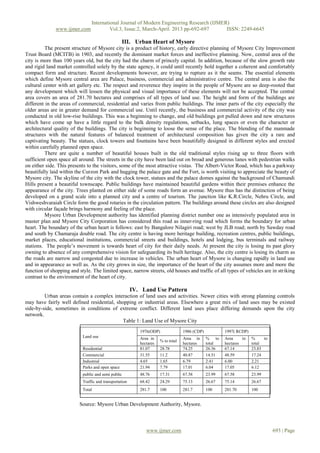
          Residential land use in the central area is 62.25 hectares which constitute about 22.09% of total area. The residential
areas are older and most of the residences are found to be older than 100 to 150 years. At present, commercial land use in
this district is about 52.88 hectares which constitutes 18.77% of the total area. The district has more commercial activities
compared to any other district in the city. The area occupied by palace is about 8% of the total area. Administrative and
government offices, educational institutions have been classified as public and semipublic land use in the planning district
one. The total area under public and semipublic is 67.58 hectares and constitutes about 23.98% of the urban heart. In the
central area, parks and open spaces constitute about 6.15% covering an area of 17.25 hectares. Parks are much concentrated
around the palace, moat around the fort are being later maintained as parks. Parks like Curzon Park and People’s parks are
located in the central part of the city where large numbers of people spend their leisure. These parks serve as a place for
relaxing the visitors in the central area and it is observed that often, vendors and hawkers occupy these areas. A portion of
open space in front of Town hall has given a magnificent look to the building. Industries in the central area occupy 6.0
hectares and they constitute 2.21% of the total area.


                                              V. Architectural Characters
        The heritage buildings of Mysore can be classified as Indo – Sarcenic, traditional Hindu, Greco-Roman, Gothic and
the European classical styles based on their architectural features,

A. Indo Sarcenic.
        Amba Vilas Palace is an Indo-saracenic building and its styling was an occasional departure from the long-lasting
vogue of the European, they yet have a compelling presence in the city’s remarkable heritage of architecture.


                                                    Fig.2 Ambavilas Palace

         Mixtures of Hindu and Muslim characteristics of architecture are found in the building and some of the Islamic
architectural influences found namely Islamic pointed and cup shaped arch opening found in the verandahs, projecting
minarets near the entrance porticos, big bulbous domes in the centre and in the corners of the building on their roof level.
Also, architectural features are found in curvilinear chatris, banana and lotus stem brackets attached to the column capitals
including motifs of the Hindu gods and goddess in studiously created niches. The interiors of the some of the buildings have
colonnaded court yards with Hindu style architectural motifs on the column brackets and doors of the palaces are carved
with figures of Hindu gods and goddesses.
B. European Classical Architecture
         Lalitha Mahal Palace is the best example of European Classical style of architecture. The buildings of this style can
be seen with extensive use of Lonic and Corinthian columns supporting their structures. The elevations of these buildings are
treated with thick bands of cornices, finaled parapets and rediments containing Hindu gods and goddesses.

                                                         www.ijmer.com                                                694 | Page
International Journal of Modern Engineering Research (IJMER)
              www.ijmer.com            Vol.3, Issue.2, March-April. 2013 pp-692-697      ISSN: 2249-6645


                                                Fig.3. Lalitha Mahal Palace

         Other buildings which have influenced this style of architecture are the Wesley and the Philomenas church,
University Educational buildings like the Uvaraja’s and Maharaja’s degree colleges and many more buildings.
C. Traditional Hindu Style
          The Jaganmohan Palace is example of predominantly Hindu traditional style. All temples in Mysore exhibit the
traditional Hindu style of architecture. Each temple has a Garbhagruha, Sukanasi, Navaranga and Mukhamantapa. The
agrahara houses are examples of traditional style with a simple but functional structure placed shoulder to shoulder with
shared masonry walls.


                                                Fig. 4 Jagan Mohan Palace

D. Greco-Roman Architecture.
          In these structures a Vatican dome rising on a drum (Circular, Octagonal etc.) dominates the elevation. The column
styles could be Tuscan, Ionic and Corinthian; arched and plastered colonnades form the two wings. Greek deities define the
tier and the balustraded parapet bends are an agreeable addition to a rich composition. The Deputy Commissioner’s Office
(Dewan’s Kacheri) Chaluvamba Park and the Krishna raja Hospital are classic examples.


                                                    Fig.5 K.R. Hospital

   Gothic architecture
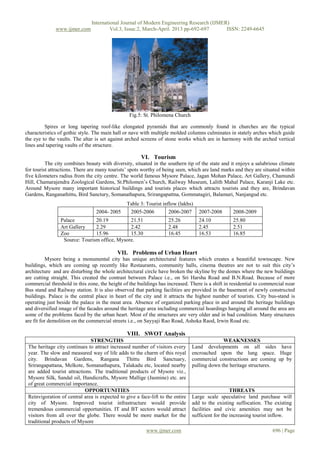
         The Philomena Church is a best example for its gothic architectural influence and tall towers or spheres at the
entrance of this church; all the openings are supported by gothic arches.

                                                       www.ijmer.com                                             695 | Page
International Journal of Modern Engineering Research (IJMER)
              www.ijmer.com             Vol.3, Issue.2, March-April. 2013 pp-692-697      ISSN: 2249-6645


                                                 Fig.5: St. Philomena Church

         Spires or long tapering roof-like elongated pyramids that are commonly found in churches are the typical
characteristics of gothic style. The main hall or nave with multiple molded columns culminates in stately arches which guide
the eye to the vaults. The altar is set against arched screens of stone works which are in harmony with the arched vertical
lines and tapering vaults of the structure.

                                                       VI. Tourism
          The city combines beauty with diversity, situated in the southern tip of the state and it enjoys a salubrious climate
for tourist attractions. There are many tourists’ spots worthy of being seen, which are land marks and they are situated within
five kilometers radius from the city centre. The world famous Mysore Palace, Jagan Mohan Palace, Art Gallery, Chamundi
Hill, Chamarajendra Zoological Gardens, St.Philomen’s Church, Railway Museum, Lalith Mahal Palace, Karanji Lake etc.
Around Mysore many important historical buildings and tourists places which attracts tourists and they are, Brindavan
Gardens, Ranganathittu, Bird Sanctury, Somanathapura, Srirangapattna, Gommatagiri, Balamuri, Nanjangud etc.
                                                Table 3: Tourist inflow (lakhs)
                                 2004- 2005      2005-2006          2006-2007      2007-2008      2008-2009
                Palace         20.19          21.51                 25.26          24.10          25.80
                Art Gallery    2.29           2.42                  2.48           2.45           2.51
                Zoo            15.96          15.30                 16.45          16.53          16.85
                 Source: Tourism office, Mysore.

                                           VII. Problems of Urban Heart
           Mysore being a monumental city has unique architectural features which creates a beautiful townscape. New
buildings, which are coming up recently like Restaurants, community halls, cinema theatres are not to suit this city’s
architecture and are disturbing the whole architectural circle have broken the skyline by the domes where the new buildings
are cutting straight. This created the contrast between Palace i.e., on Sri Harsha Road and B.N.Road. Because of more
commercial threshold in this zone, the height of the buildings has increased. There is a shift in residential to commercial near
Bus stand and Railway station. It is also observed that parking facilities are provided in the basement of newly constructed
buildings. Palace is the central place in heart of the city and it attracts the highest number of tourists. City bus-stand is
operating just beside the palace in the moat area. Absence of organized parking place in and around the heritage buildings
and diversified image of the facades around the heritage area including commercial hoardings hanging all around the area are
some of the problems faced by the urban heart. Most of the structures are very older and in bad condition. Many structures
are fit for demolition on the commercial streets i.e., on Sayyaji Rao Road, Ashoka Raod, Irwin Road etc.

                                                VIII. SWOT Analysis
                              STRENGTHS                                                       WEAKNESSES
 The heritage city continues to attract increased number of visitors every      Land developments on all sides have
 year. The slow and measured way of life adds to the charm of this royal        encroached upon the lung space. Huge
 city. Brindavan Gardens, Rangana Thittu Bird Sanctuary,                        commercial constructions are coming up by
 Srirangapattana, Melkote, Somanathapura, Talakadu etc, located nearby          pulling down the heritage structures.
 are added tourist attractions. The traditional products of Mysore viz.,
 Mysore Silk, Sandal oil, Handicrafts, Mysore Mallige (Jasmine) etc. are
 of great commercial importance.
                            OPPORTUNITIES                                                          THREATS
 Reinvigoration of central area is expected to give a face-lift to the entire   Large scale speculative land purchase will
 city of Mysore. Improved tourist infrastructure would provide                  add to the existing suffocation. The existing
 tremendous commercial opportunities. IT and BT sectors would attract           facilities and civic amenities may not be
 visitors from all over the globe. There would be more market for the           sufficient for the increasing tourist inflow.
 traditional products of Mysore
                                                         www.ijmer.com                                               696 | Page
International Journal of Modern Engineering Research (IJMER)
               www.ijmer.com              Vol.3, Issue.2, March-April. 2013 pp-692-697      ISSN: 2249-6645

                                      IX. Planning Strategies for Reinvigoration
          Mysore has a strong historical core and neither it has scope to expand horizontally; nor it can expand vertically
because of height of the building cannot be higher than the Palace’s height. Central area of the city needs to be developed
promoting actively as a viable place to live, work, shop and visit. It should be the business, financial and cultural centre. It
also needs to offer a strong local and regional presence and be a place that local people are proud of and visitors can enjoy
and it is to be made environmentally attractive, economically viable, and attractive and liveliness. It is high time to take up
conserve measures in the central area to regain the past glory through reinvigorating the urban heart of Mysore and is as
follows:
a) All the monuments should be identified, graded and taken for conservation.
b) The precincts have to be identified and they have to be developed within their envelops
c) A separate regulations to be developed for inner city core or urban heart
d) The projects should be initiated which would therefore aim at decongesting the old city areas, like Santepet, Gandhi
     square, Devaraja Market.
e) Action may be taken to introduce rapid transit and efficient public transport systems. One way to keep city centre alive
     is good planning.
f) Discourage new large constructions in the core city area, and force all new development in dedicated zones around the
     periphery.
g) Floor Space Index (FSI) in the core city could be pegged at a suitably low level, while higher FSI permitted in the
     periphery.
h) Larger development fees or betterment charges could be levied in the central area.
i) Pro-actively develop fully self-sustained enclaves (industrial, commercial, or residential) on the periphery, so that there
     is no incentive for development to move to the core.
j) Providing basic facilities, street beautification and proper maintenance around heritage buildings has to be taken up by
     planning authority and incorporate these suggestions while preparing land use plan and also forecasting the future need.
k) Residential should is not be allowed for change of land use to avoid mixed land use, where the occupants are free from
     traffic disturbance.
l) Architectural control to be imposed around Palace on the Sayyaji Rao Road, K.R.Circle, Ashoka Road.
m) Public and semi public places are retained and are regulated not to grow further.
n) Strict enforcement of zoning regulation and building Bye-law to congestion.

                                                        X. Conclusions
         Reinvigoration of urban heart is an increasingly important component of city planning system. The Mysore is
known as cultural and historical capital and its central area is known for its heritage religious and architectural buildings. It is
losing harmony among buildings, streets and open spaces visual apparent. The central area is over crowded with all the
economic and administrative activities coupled by environmental degradation and pressure on existing infrastructure.
Therefore, it is high time to conserve the central area to regain the past glory through reinvigorating the urban heart of
Mysore.

                                                            References
[1]  Niamh Moore (1999), Rejuvenating docklands: the Irish context, Irish Geography, vol. 32 (2).
[2]  ITPI New Delhi, Journal volume-6, number 1 (January- March, 2009) article “Revitalizing Chitar Oli: A Street with Tradition.
[3]  Ashotosh Joshi. (2007), “Regeneration of Indian Historic Cities”, The Journal of the Indian institute of Architecture, volume 72,
     issue 12, pp.20-22.
[4] Kevin lynch (1994), “The Image of the City”, MIT Press, Cambridge.
[5] Johan Rannels (1956), “The core of the city” Columbia University press, New York.
[6] Regeneration of Brevery site in http://www.vaux Co.uk
[7] Regenerating Derby, in www.qaresearch.co.uk
[8] Ian Bond Conservation (2003) urban landscape character Analysis.
[9] City centre master plan Bellingham, Washington August-2002.
[10] Conservation Area Review Background paper, www.nort-herts.gov.uk.
[11] Conservation Area Review Appraisals English heritage 2005, www.helm.org.uk.
[12] A Guide to planning in conservation areas (2004) Stroud District Council, www.stroud.gov.uk.

BIOGRAPHIES
      Dr. B. Shankar received the B.E. degree in Civil Engineering in 1984, M.U.R.P degree in Urban and Regional Planning
      in 1989 and Ph.D degree in Urban and Regional Planning in 1997 from the University of Mysore, Mysore. He is
      working as Associate Professor in Urban and Regional Planning at the Institute of Development Studies, University of
      Mysore, Mysore. His research interests to include Urban Planning, Land Use Planning, Heritage Conservation, and
      Planning Legislation.
      M. C. Shashi Kumar received B.E. degree in Civil Engineering and M.Tech in Urban and Regional Planning from the
      University of Mysore, Mysore in 2010. Presently, he is working as Joint Director of Town Planning, Department of
      Town Planning, Mysore Division, Government of Karnataka. His research interests to include Heritage Conservation.

                                                            www.ijmer.com                                                 697 | Page

Ap32692697

  • 1.
    International Journal ofModern Engineering Research (IJMER) www.ijmer.com Vol.3, Issue.2, March-April. 2013 pp-692-697 ISSN: 2249-6645 Strategies for Reinvigorating the Urban Heart of Mysore Dr. B. Shankar, 1 M.C.Shashikumar2 1 Associate Professor in Urban and Regional Planning, Institute of Development Studies, University of Mysore Mysore, 2 Joint Director of Town Planning, Government of Karnataka, Mysore Division, Mysore Abstract: Reinvigoration of urban heart is an increasingly important for planning of large cities. Cities work better when they are diverse and livable, with a mix of land uses, high population densities and lively streets with magnificent urban built form, architectural buildings and urban design elements. Therefore, it is necessary to conserve the central area for regaining the past glory. Reinvigoration is a deliberate, planned and overall effort to change the urban built environment by adopting comprehensive approach and large scale modification of existing city central area for serving the present and future generations. Mysore is an historical, cultural and planned city in India and it has a strong urban heart with well defined boundaries. The paper presents the structure and issues of urban heart of Mysore and proposes strategies for reinvigoration. Keywords: Reinvigoration, Urban Heart, Strategy, Heritage City I. Introduction The core areas of Indian cities are experiencing rapid changes in land use, high density of developments, traffic congestion, haphazard developments, land speculation, urban decay, dilapidated buildings, insanitary conditions, over loading on the existing infrastructure and many more. Cities’ effort enhanced when they are rejuvenated their built and urban forms. It is commonly accepted that reinvigoration of urban heart is an important component of urban renewal for planning of cities. Reinvigoration is a deliberate, planned and overall effort to change the urban built environment by adopting comprehensive urban renewal programmes. Conservation, rehabilitation and redevelopment are the three components of urban reinvigoration, which are interrelated. In this paper an attempt has been made to highlight the significance of city core and propose strategies for reinvigoration of urban heart of Mysore. II. Background of Mysore Mysore is the second largest city in Karnataka State. The city had a population of 887,446 as per 2011 provisional census figures and increased from 7, 85, 800 in 2001. It is situated at 140 km from Bengaluru. Mysore has many architectural buildings, which were built in the beginning of twentieth century during Maharaja’s regime. Mysore is an educational, commercial and administrative heritage and tourist centre. The city is famous for if cultural festival namely Dasara. The city has more concentrated wealth of beauty spots and is rich in picturesque and historic and other kinds of interest. The streets in the city have been laid out on broad and generous lanes with pedestrian walks on either side. The skyline of the city with the clock tower, statues, vista and the palace domes against the background of Chamundi hills presents a beautiful townscape. SATELLITE IMAGE OF THE C.B.D AREA LAND USE PLAN OF LAND USE PLAN OF MYSORE CITY STUDY AREA (C.B.D) Fig.1 Urban Heart of Mysore www.ijmer.com 692 | Page
  • 2.
    International Journal ofModern Engineering Research (IJMER) www.ijmer.com Vol.3, Issue.2, March-April. 2013 pp-692-697 ISSN: 2249-6645 III. Urban Heart of Mysore The present structure of Mysore city is a product of history, early directive planning of Mysore City Improvement Trust Board (MCITB) in 1903, and recently the dominant market forces and ineffective planning. Now, central area of the city is more than 100 years old, but the city had the charm of princely capital. In addition, because of the slow growth rate and rigid land market controlled solely by the state agency, it could until recently hold together a coherent and comfortably compact form and structure. Recent developments however, are trying to rupture as it the seams. The essential elements which define Mysore central area are Palace, business, commercial and administrative centre. The central area is also the cultural center with art gallery etc. The respect and reverence they inspire in the people of Mysore are so deep-rooted that any development which will lessen the physical and visual importance of these elements will not be accepted. The central area covers an area of 281.70 hectares and comprises of all types of land use. The height and form of the buildings are different in the areas of commercial, residential and varies from public buildings. The inner parts of the city especially the older areas are in greater demand for commercial use. Until recently, the business and commercial activity of the city was conducted in old low-rise buildings. This was a beginning to change, and old buildings got pulled down and new structures which have come up have a little regard to the bulk density regulations, setbacks, lung spaces or even the character or architectural quality of the buildings. The city is beginning to loose the sense of the place. The blending of the manmade structures with the natural features of balanced treatment of architectural composition has given the city a rare and captivating beauty. The statues, clock towers and fountains have been beautifully designed in different styles and erected within carefully planned open space. There are quite a number of beautiful houses built in the old traditional styles rising up to three floors with sufficient open space all around. The streets in the city have been laid out on broad and generous lanes with pedestrian walks on either side. This presents to the visitors, some of the most attractive vistas. The Albert-Victor Road, which has a parkway beautifully laid within the Curzon Park and hugging the palace gate and the Fort, is worth visiting to appreciate the beauty of Mysore city. The skyline of the city with the clock tower, statues and the palace domes against the background of Chamundi Hills present a beautiful townscape. Public buildings have maintained beautiful gardens within their premises enhance the appearance of the city. Trees planted on either side of some roads form an avenue. Mysore thus has the distinction of being developed on a grand scale into a planned city and a centre of tourism. The junction like K.R.Circle, Nehru Circle, and Vishweshvaraiah Circle form the good rotaries in the circulation pattern. The buildings around these circles are also designed with circular façade brings harmony and feeling of the place. Mysore Urban Development authority has identified planning district number one as intensively populated area in master plan and Mysore City Corporation has considered this road as inner-ring road which forms the boundary for urban heart. The boundary of the urban heart is follows: east by Bangalore Nilagiri road; west by JLB road; north by Sawday road and south by Chamaraja double road. The city centre is having more heritage building, recreation centres, public buildings, market places, educational institutions, commercial streets and buildings, hotels and lodging, bus terminals and railway stations. The people’s movement is towards heart of city for their daily needs. At present the city is losing its past glory owning to absence of any comprehensive vision for safeguarding its built heritage. Also, the city centre is losing its charm as the roads are narrow and congested due to increase in vehicles. The urban heart of Mysore is changing rapidly in land use and in appearance as well as. As the city grows in size, the importance of the heart of the city assumes more and more the function of shopping and style. The limited space, narrow streets, old houses and traffic of all types of vehicles are in striking contrast to the environment of the heart of city. IV. Land Use Pattern Urban areas contain a complex interaction of land uses and activities. Newer cities with strong planning controls may have fairly well defined residential, shopping or industrial areas. Elsewhere a great mix of land uses may be existed side-by-side, sometimes in conditions of extreme conflict. Different land uses place differing demands upon the city network. Table 1: Land Use of Mysore City 1976(ODP) 1986 (CDP) 1997( RCDP) Land use Area in Area in % to Area in % to % to total hectares hectares total hectares total Residential 81.07 28.78 74.25 26.36 67.14 23.83 Commercial 31.55 11.2 40.87 14.51 48.59 17.24 Industrial 4.65 1.65 6.79 2.41 6.00 2.21 Parks and open space 21.94 7.79 17.01 6.04 17.05 6.12 public and semi public 48.76 17.31 67.58 23.99 67.58 23.99 Traffic and transportation 68.42 24.29 75.13 26.67 75.14 26.67 Total 281.7 100 281.7 100 281.70 100 Source: Mysore Urban Development Authority, Mysore. www.ijmer.com 693 | Page
  • 3.
    International Journal ofModern Engineering Research (IJMER) www.ijmer.com Vol.3, Issue.2, March-April. 2013 pp-692-697 ISSN: 2249-6645 Table 2: Existing land Use- 2009 Area in Land use % hectares Residential 62.25 22.09 Commercial 52.88 18.77 Industrial 6.6 2.34 Parks and open space 17.25 6.15 Public and semi public 67.58 23.98 Traffic and transportation 75.14 26.67 Total 281.7 100.00 Source: Primary survey conducted by researchers Residential land use in the central area is 62.25 hectares which constitute about 22.09% of total area. The residential areas are older and most of the residences are found to be older than 100 to 150 years. At present, commercial land use in this district is about 52.88 hectares which constitutes 18.77% of the total area. The district has more commercial activities compared to any other district in the city. The area occupied by palace is about 8% of the total area. Administrative and government offices, educational institutions have been classified as public and semipublic land use in the planning district one. The total area under public and semipublic is 67.58 hectares and constitutes about 23.98% of the urban heart. In the central area, parks and open spaces constitute about 6.15% covering an area of 17.25 hectares. Parks are much concentrated around the palace, moat around the fort are being later maintained as parks. Parks like Curzon Park and People’s parks are located in the central part of the city where large numbers of people spend their leisure. These parks serve as a place for relaxing the visitors in the central area and it is observed that often, vendors and hawkers occupy these areas. A portion of open space in front of Town hall has given a magnificent look to the building. Industries in the central area occupy 6.0 hectares and they constitute 2.21% of the total area. V. Architectural Characters The heritage buildings of Mysore can be classified as Indo – Sarcenic, traditional Hindu, Greco-Roman, Gothic and the European classical styles based on their architectural features, A. Indo Sarcenic. Amba Vilas Palace is an Indo-saracenic building and its styling was an occasional departure from the long-lasting vogue of the European, they yet have a compelling presence in the city’s remarkable heritage of architecture. Fig.2 Ambavilas Palace Mixtures of Hindu and Muslim characteristics of architecture are found in the building and some of the Islamic architectural influences found namely Islamic pointed and cup shaped arch opening found in the verandahs, projecting minarets near the entrance porticos, big bulbous domes in the centre and in the corners of the building on their roof level. Also, architectural features are found in curvilinear chatris, banana and lotus stem brackets attached to the column capitals including motifs of the Hindu gods and goddess in studiously created niches. The interiors of the some of the buildings have colonnaded court yards with Hindu style architectural motifs on the column brackets and doors of the palaces are carved with figures of Hindu gods and goddesses. B. European Classical Architecture Lalitha Mahal Palace is the best example of European Classical style of architecture. The buildings of this style can be seen with extensive use of Lonic and Corinthian columns supporting their structures. The elevations of these buildings are treated with thick bands of cornices, finaled parapets and rediments containing Hindu gods and goddesses. www.ijmer.com 694 | Page
  • 4.
    International Journal ofModern Engineering Research (IJMER) www.ijmer.com Vol.3, Issue.2, March-April. 2013 pp-692-697 ISSN: 2249-6645 Fig.3. Lalitha Mahal Palace Other buildings which have influenced this style of architecture are the Wesley and the Philomenas church, University Educational buildings like the Uvaraja’s and Maharaja’s degree colleges and many more buildings. C. Traditional Hindu Style The Jaganmohan Palace is example of predominantly Hindu traditional style. All temples in Mysore exhibit the traditional Hindu style of architecture. Each temple has a Garbhagruha, Sukanasi, Navaranga and Mukhamantapa. The agrahara houses are examples of traditional style with a simple but functional structure placed shoulder to shoulder with shared masonry walls. Fig. 4 Jagan Mohan Palace D. Greco-Roman Architecture. In these structures a Vatican dome rising on a drum (Circular, Octagonal etc.) dominates the elevation. The column styles could be Tuscan, Ionic and Corinthian; arched and plastered colonnades form the two wings. Greek deities define the tier and the balustraded parapet bends are an agreeable addition to a rich composition. The Deputy Commissioner’s Office (Dewan’s Kacheri) Chaluvamba Park and the Krishna raja Hospital are classic examples. Fig.5 K.R. Hospital Gothic architecture The Philomena Church is a best example for its gothic architectural influence and tall towers or spheres at the entrance of this church; all the openings are supported by gothic arches. www.ijmer.com 695 | Page
  • 5.
    International Journal ofModern Engineering Research (IJMER) www.ijmer.com Vol.3, Issue.2, March-April. 2013 pp-692-697 ISSN: 2249-6645 Fig.5: St. Philomena Church Spires or long tapering roof-like elongated pyramids that are commonly found in churches are the typical characteristics of gothic style. The main hall or nave with multiple molded columns culminates in stately arches which guide the eye to the vaults. The altar is set against arched screens of stone works which are in harmony with the arched vertical lines and tapering vaults of the structure. VI. Tourism The city combines beauty with diversity, situated in the southern tip of the state and it enjoys a salubrious climate for tourist attractions. There are many tourists’ spots worthy of being seen, which are land marks and they are situated within five kilometers radius from the city centre. The world famous Mysore Palace, Jagan Mohan Palace, Art Gallery, Chamundi Hill, Chamarajendra Zoological Gardens, St.Philomen’s Church, Railway Museum, Lalith Mahal Palace, Karanji Lake etc. Around Mysore many important historical buildings and tourists places which attracts tourists and they are, Brindavan Gardens, Ranganathittu, Bird Sanctury, Somanathapura, Srirangapattna, Gommatagiri, Balamuri, Nanjangud etc. Table 3: Tourist inflow (lakhs) 2004- 2005 2005-2006 2006-2007 2007-2008 2008-2009 Palace 20.19 21.51 25.26 24.10 25.80 Art Gallery 2.29 2.42 2.48 2.45 2.51 Zoo 15.96 15.30 16.45 16.53 16.85 Source: Tourism office, Mysore. VII. Problems of Urban Heart Mysore being a monumental city has unique architectural features which creates a beautiful townscape. New buildings, which are coming up recently like Restaurants, community halls, cinema theatres are not to suit this city’s architecture and are disturbing the whole architectural circle have broken the skyline by the domes where the new buildings are cutting straight. This created the contrast between Palace i.e., on Sri Harsha Road and B.N.Road. Because of more commercial threshold in this zone, the height of the buildings has increased. There is a shift in residential to commercial near Bus stand and Railway station. It is also observed that parking facilities are provided in the basement of newly constructed buildings. Palace is the central place in heart of the city and it attracts the highest number of tourists. City bus-stand is operating just beside the palace in the moat area. Absence of organized parking place in and around the heritage buildings and diversified image of the facades around the heritage area including commercial hoardings hanging all around the area are some of the problems faced by the urban heart. Most of the structures are very older and in bad condition. Many structures are fit for demolition on the commercial streets i.e., on Sayyaji Rao Road, Ashoka Raod, Irwin Road etc. VIII. SWOT Analysis STRENGTHS WEAKNESSES The heritage city continues to attract increased number of visitors every Land developments on all sides have year. The slow and measured way of life adds to the charm of this royal encroached upon the lung space. Huge city. Brindavan Gardens, Rangana Thittu Bird Sanctuary, commercial constructions are coming up by Srirangapattana, Melkote, Somanathapura, Talakadu etc, located nearby pulling down the heritage structures. are added tourist attractions. The traditional products of Mysore viz., Mysore Silk, Sandal oil, Handicrafts, Mysore Mallige (Jasmine) etc. are of great commercial importance. OPPORTUNITIES THREATS Reinvigoration of central area is expected to give a face-lift to the entire Large scale speculative land purchase will city of Mysore. Improved tourist infrastructure would provide add to the existing suffocation. The existing tremendous commercial opportunities. IT and BT sectors would attract facilities and civic amenities may not be visitors from all over the globe. There would be more market for the sufficient for the increasing tourist inflow. traditional products of Mysore www.ijmer.com 696 | Page
  • 6.
    International Journal ofModern Engineering Research (IJMER) www.ijmer.com Vol.3, Issue.2, March-April. 2013 pp-692-697 ISSN: 2249-6645 IX. Planning Strategies for Reinvigoration Mysore has a strong historical core and neither it has scope to expand horizontally; nor it can expand vertically because of height of the building cannot be higher than the Palace’s height. Central area of the city needs to be developed promoting actively as a viable place to live, work, shop and visit. It should be the business, financial and cultural centre. It also needs to offer a strong local and regional presence and be a place that local people are proud of and visitors can enjoy and it is to be made environmentally attractive, economically viable, and attractive and liveliness. It is high time to take up conserve measures in the central area to regain the past glory through reinvigorating the urban heart of Mysore and is as follows: a) All the monuments should be identified, graded and taken for conservation. b) The precincts have to be identified and they have to be developed within their envelops c) A separate regulations to be developed for inner city core or urban heart d) The projects should be initiated which would therefore aim at decongesting the old city areas, like Santepet, Gandhi square, Devaraja Market. e) Action may be taken to introduce rapid transit and efficient public transport systems. One way to keep city centre alive is good planning. f) Discourage new large constructions in the core city area, and force all new development in dedicated zones around the periphery. g) Floor Space Index (FSI) in the core city could be pegged at a suitably low level, while higher FSI permitted in the periphery. h) Larger development fees or betterment charges could be levied in the central area. i) Pro-actively develop fully self-sustained enclaves (industrial, commercial, or residential) on the periphery, so that there is no incentive for development to move to the core. j) Providing basic facilities, street beautification and proper maintenance around heritage buildings has to be taken up by planning authority and incorporate these suggestions while preparing land use plan and also forecasting the future need. k) Residential should is not be allowed for change of land use to avoid mixed land use, where the occupants are free from traffic disturbance. l) Architectural control to be imposed around Palace on the Sayyaji Rao Road, K.R.Circle, Ashoka Road. m) Public and semi public places are retained and are regulated not to grow further. n) Strict enforcement of zoning regulation and building Bye-law to congestion. X. Conclusions Reinvigoration of urban heart is an increasingly important component of city planning system. The Mysore is known as cultural and historical capital and its central area is known for its heritage religious and architectural buildings. It is losing harmony among buildings, streets and open spaces visual apparent. The central area is over crowded with all the economic and administrative activities coupled by environmental degradation and pressure on existing infrastructure. Therefore, it is high time to conserve the central area to regain the past glory through reinvigorating the urban heart of Mysore. References [1] Niamh Moore (1999), Rejuvenating docklands: the Irish context, Irish Geography, vol. 32 (2). [2] ITPI New Delhi, Journal volume-6, number 1 (January- March, 2009) article “Revitalizing Chitar Oli: A Street with Tradition. [3] Ashotosh Joshi. (2007), “Regeneration of Indian Historic Cities”, The Journal of the Indian institute of Architecture, volume 72, issue 12, pp.20-22. [4] Kevin lynch (1994), “The Image of the City”, MIT Press, Cambridge. [5] Johan Rannels (1956), “The core of the city” Columbia University press, New York. [6] Regeneration of Brevery site in http://www.vaux Co.uk [7] Regenerating Derby, in www.qaresearch.co.uk [8] Ian Bond Conservation (2003) urban landscape character Analysis. [9] City centre master plan Bellingham, Washington August-2002. [10] Conservation Area Review Background paper, www.nort-herts.gov.uk. [11] Conservation Area Review Appraisals English heritage 2005, www.helm.org.uk. [12] A Guide to planning in conservation areas (2004) Stroud District Council, www.stroud.gov.uk. BIOGRAPHIES Dr. B. Shankar received the B.E. degree in Civil Engineering in 1984, M.U.R.P degree in Urban and Regional Planning in 1989 and Ph.D degree in Urban and Regional Planning in 1997 from the University of Mysore, Mysore. He is working as Associate Professor in Urban and Regional Planning at the Institute of Development Studies, University of Mysore, Mysore. His research interests to include Urban Planning, Land Use Planning, Heritage Conservation, and Planning Legislation. M. C. Shashi Kumar received B.E. degree in Civil Engineering and M.Tech in Urban and Regional Planning from the University of Mysore, Mysore in 2010. Presently, he is working as Joint Director of Town Planning, Department of Town Planning, Mysore Division, Government of Karnataka. His research interests to include Heritage Conservation. www.ijmer.com 697 | Page