Collections A  collection  is an object that serves as a repository for other objects A collection usually provides services such as adding, removing, and otherwise managing the elements it contains Sometimes the elements in a collection are ordered, sometimes they are not Sometimes collections are  homogeneous , sometimes the are  heterogeneous
Abstract Data Types Collections can be implemented in many different ways  An  abstract data type  (ADT) is an organized collection of information and a set of operations used to manage that information The set of operations defines the  interface  to the ADT As long as the ADT fulfills the promises of the interface, it doesn't really matter how the ADT is implemented Objects are a perfect programming mechanism to create ADTs because their internal details are  encapsulated
Abstraction Our data structures should be abstractions That is, they should hide unneeded details We want to separate the interface of the structure from its underlying implementation This helps manage complexity and makes it possible to change the implementation without changing the interface
Collection Classes The Java standard library contains several classes that represent collections, often referred to as the  Java Collections API Their underlying implementation is implied in the class names such as  ArrayList  and  LinkedList Several interfaces are used to define operations on the collections, such as  List ,  Set , and  Map
Static vs. Dynamic Structures A  static  data structure has a fixed size This meaning is different from the meaning of the  static  modifier Arrays are static;  once you define the number of elements it can hold, the number doesn’t change A  dynamic   data structure  grows and shrinks at execution time as required by its contents A dynamic data structure is implemented using  links
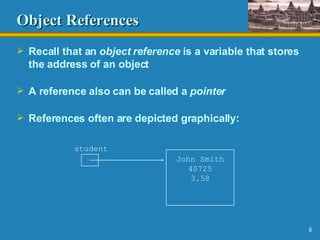
Object References Recall that an  object reference  is a variable that stores the address of an object A reference also can be called a  pointer References often are depicted graphically: student John Smith 40725 3.58
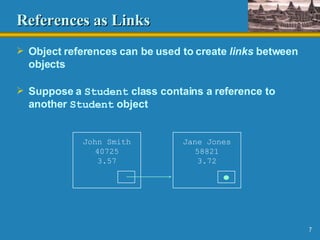
References as Links Object references can be used to create  links  between objects Suppose a  Student  class contains a reference to another  Student  object John Smith 40725 3.57 Jane Jones 58821 3.72
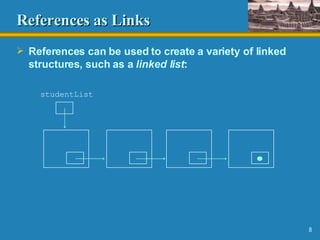
References as Links References can be used to create a variety of linked structures, such as a  linked list : studentList
Intermediate Nodes The objects being stored should not be concerned with the details of the data structure in which they may be stored For example, the  Student  class should not have to store a link to the next  Student  object in the list Instead, we can use a separate node class with two parts: 1) a reference to an independent object and 2) a link to the next node in the list The internal representation becomes a linked list of nodes See  ListNode .java   (pg 516)
Magazine Collection Let’s explore an example of a collection of  Magazine  objects The collection is managed by the  MagazineList  class, which contains a linked list of  ListNode  objects The data portion of each  ListNode  is a  Magazine  object See  ListNode .java   (page 516) See  MagazineRack .java   (page 521) See  MagazineList .java   (page 522) See  Magazine.java   (page 523)
Inserting a Node A method called  insert  could be defined to add a node anywhere in the list, to keep it sorted, for example See Figures 9.2 and 9.3
Deleting a Node A method called  delete  could be defined to remove a node from the list See Figures 9.4 and 9.5
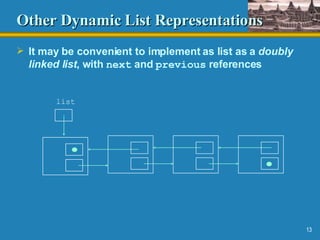
Other Dynamic List Representations It may be convenient to implement as list as a  doubly linked list , with  next  and  previous  references list
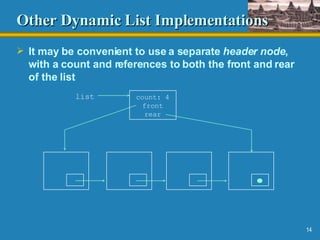
Other Dynamic List Implementations It may be convenient to use a separate  header node , with a count and references to both the front and rear of the list count: 4 front rear list
Other Dynamic List Implementations A linked list can be  circularly linked  in which case the last node in the list points to the first node in the list If the linked list is doubly linked, the first node in the list also points to the last node in the list The representation should facilitate the intended operations and should make them easy to implement
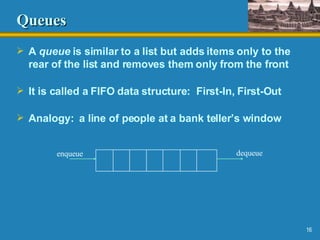
Queues A  queue  is similar to a list but adds items only to the rear of the list and removes them only from the front It is called a FIFO data structure:  First-In, First-Out Analogy:  a line of people at a bank teller’s window enqueue dequeue
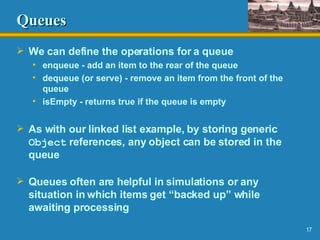
Queues We can define the operations for a queue enqueue - add an item to the rear of the queue dequeue (or serve) - remove an item from the front of the queue isEmpty - returns true if the queue is empty As with our linked list example, by storing generic  Object  references, any object can be stored in the queue Queues often are helpful in simulations or any situation in which items get “backed up” while awaiting processing
Priority Queues In a priority queue, some elements get to “cut in line” The enqueue and isEmpty operations behave the same as with normal queues The dequeue operation removes the element with the highest priority
Stacks A  stack  ADT is also linear, like a list or a queue Items are added and removed from only one end of a stack It is therefore LIFO:  Last-In, First-Out Analogies:  a stack of plates in a cupboard, a stack of bills to be paid, or a stack of hay bales in a barn
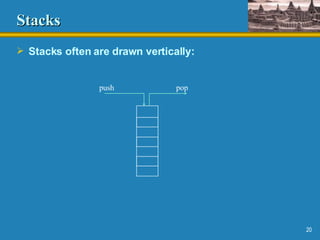
Stacks Stacks often are drawn vertically: pop push
Stacks Some stack operations: push - add an item to the top of the stack pop - remove an item from the top of the stack peekTop - retrieves the top item without removing it isEmpty - returns true if the stack is empty A stack can be represented by a singly-linked list; it doesn’t matter whether the references point from the top toward the bottom or vice versa A stack can be represented by an array, but the new item should be placed in the next available place in the array rather than at the end of the array
Stacks Like  ArrayList  operations, the  Stack  operations operate on  Object  references See  Decode.java   (page 531) See  ArrayStack .java   (page 532)
Summary Chapter 9 has focused on: collections Abstract Data Types (ADTs) dynamic structures and linked lists queues and stacks

Ap Power Point Chpt9

  • 1.
    Collections A collection is an object that serves as a repository for other objects A collection usually provides services such as adding, removing, and otherwise managing the elements it contains Sometimes the elements in a collection are ordered, sometimes they are not Sometimes collections are homogeneous , sometimes the are heterogeneous
  • 2.
    Abstract Data TypesCollections can be implemented in many different ways An abstract data type (ADT) is an organized collection of information and a set of operations used to manage that information The set of operations defines the interface to the ADT As long as the ADT fulfills the promises of the interface, it doesn't really matter how the ADT is implemented Objects are a perfect programming mechanism to create ADTs because their internal details are encapsulated
  • 3.
    Abstraction Our datastructures should be abstractions That is, they should hide unneeded details We want to separate the interface of the structure from its underlying implementation This helps manage complexity and makes it possible to change the implementation without changing the interface
  • 4.
    Collection Classes TheJava standard library contains several classes that represent collections, often referred to as the Java Collections API Their underlying implementation is implied in the class names such as ArrayList and LinkedList Several interfaces are used to define operations on the collections, such as List , Set , and Map
  • 5.
    Static vs. DynamicStructures A static data structure has a fixed size This meaning is different from the meaning of the static modifier Arrays are static; once you define the number of elements it can hold, the number doesn’t change A dynamic data structure grows and shrinks at execution time as required by its contents A dynamic data structure is implemented using links
  • 6.
    Object References Recallthat an object reference is a variable that stores the address of an object A reference also can be called a pointer References often are depicted graphically: student John Smith 40725 3.58
  • 7.
    References as LinksObject references can be used to create links between objects Suppose a Student class contains a reference to another Student object John Smith 40725 3.57 Jane Jones 58821 3.72
  • 8.
    References as LinksReferences can be used to create a variety of linked structures, such as a linked list : studentList
  • 9.
    Intermediate Nodes Theobjects being stored should not be concerned with the details of the data structure in which they may be stored For example, the Student class should not have to store a link to the next Student object in the list Instead, we can use a separate node class with two parts: 1) a reference to an independent object and 2) a link to the next node in the list The internal representation becomes a linked list of nodes See ListNode .java (pg 516)
  • 10.
    Magazine Collection Let’sexplore an example of a collection of Magazine objects The collection is managed by the MagazineList class, which contains a linked list of ListNode objects The data portion of each ListNode is a Magazine object See ListNode .java (page 516) See MagazineRack .java (page 521) See MagazineList .java (page 522) See Magazine.java (page 523)
  • 11.
    Inserting a NodeA method called insert could be defined to add a node anywhere in the list, to keep it sorted, for example See Figures 9.2 and 9.3
  • 12.
    Deleting a NodeA method called delete could be defined to remove a node from the list See Figures 9.4 and 9.5
  • 13.
    Other Dynamic ListRepresentations It may be convenient to implement as list as a doubly linked list , with next and previous references list
  • 14.
    Other Dynamic ListImplementations It may be convenient to use a separate header node , with a count and references to both the front and rear of the list count: 4 front rear list
  • 15.
    Other Dynamic ListImplementations A linked list can be circularly linked in which case the last node in the list points to the first node in the list If the linked list is doubly linked, the first node in the list also points to the last node in the list The representation should facilitate the intended operations and should make them easy to implement
  • 16.
    Queues A queue is similar to a list but adds items only to the rear of the list and removes them only from the front It is called a FIFO data structure: First-In, First-Out Analogy: a line of people at a bank teller’s window enqueue dequeue
  • 17.
    Queues We candefine the operations for a queue enqueue - add an item to the rear of the queue dequeue (or serve) - remove an item from the front of the queue isEmpty - returns true if the queue is empty As with our linked list example, by storing generic Object references, any object can be stored in the queue Queues often are helpful in simulations or any situation in which items get “backed up” while awaiting processing
  • 18.
    Priority Queues Ina priority queue, some elements get to “cut in line” The enqueue and isEmpty operations behave the same as with normal queues The dequeue operation removes the element with the highest priority
  • 19.
    Stacks A stack ADT is also linear, like a list or a queue Items are added and removed from only one end of a stack It is therefore LIFO: Last-In, First-Out Analogies: a stack of plates in a cupboard, a stack of bills to be paid, or a stack of hay bales in a barn
  • 20.
    Stacks Stacks oftenare drawn vertically: pop push
  • 21.
    Stacks Some stackoperations: push - add an item to the top of the stack pop - remove an item from the top of the stack peekTop - retrieves the top item without removing it isEmpty - returns true if the stack is empty A stack can be represented by a singly-linked list; it doesn’t matter whether the references point from the top toward the bottom or vice versa A stack can be represented by an array, but the new item should be placed in the next available place in the array rather than at the end of the array
  • 22.
    Stacks Like ArrayList operations, the Stack operations operate on Object references See Decode.java (page 531) See ArrayStack .java (page 532)
  • 23.
    Summary Chapter 9has focused on: collections Abstract Data Types (ADTs) dynamic structures and linked lists queues and stacks