Hamilton Anxiety Rating Scale
State-Trait Anxiety Inventory
Hospital Anxiety Depression Scale
Dr. Amit Chail
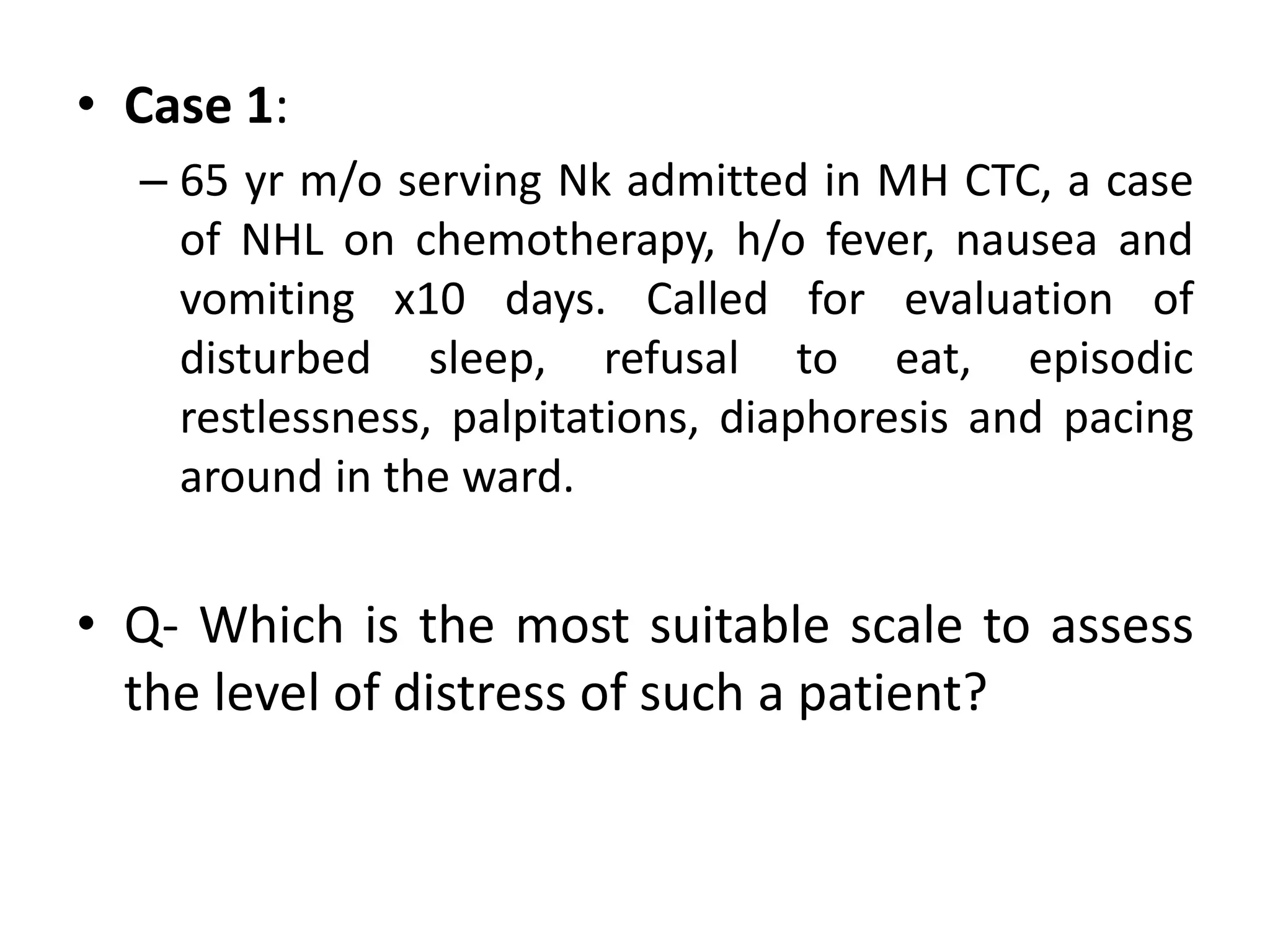
• Case 1:
– 65 yr m/o serving Nk admitted in MH CTC, a case
of NHL on chemotherapy, h/o fever, nausea and
vomiting x10 days. Called for evaluation of
disturbed sleep, refusal to eat, episodic
restlessness, palpitations, diaphoresis and pacing
around in the ward.
• Q- Which is the most suitable scale to assess
the level of distress of such a patient?
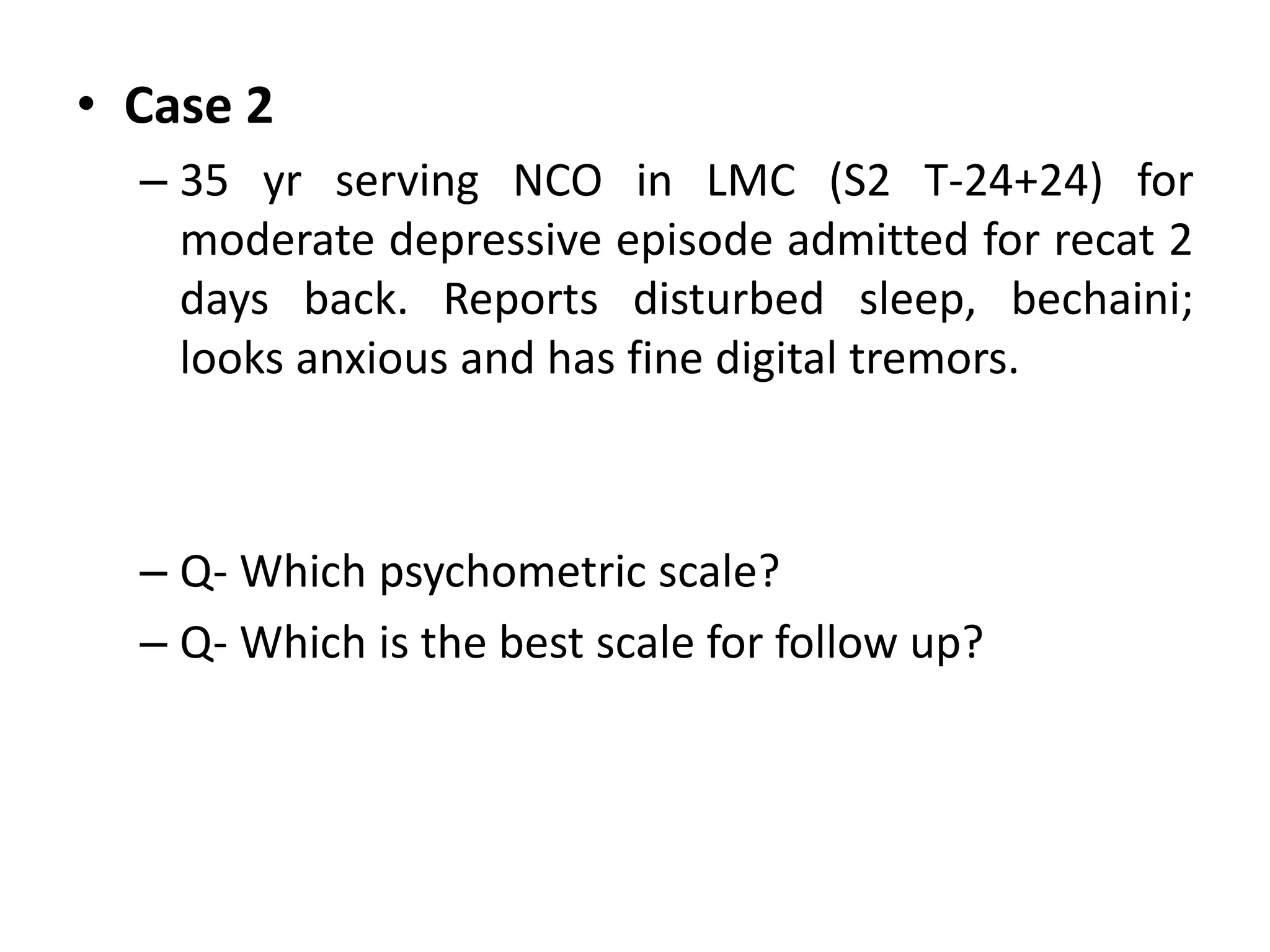
• Case 2
– 35 yr serving NCO in LMC (S2 T-24+24) for
moderate depressive episode admitted for recat 2
days back. Reports disturbed sleep, bechaini;
looks anxious and has fine digital tremors.
– Q- Which psychometric scale?
– Q- Which is the best scale for follow up?
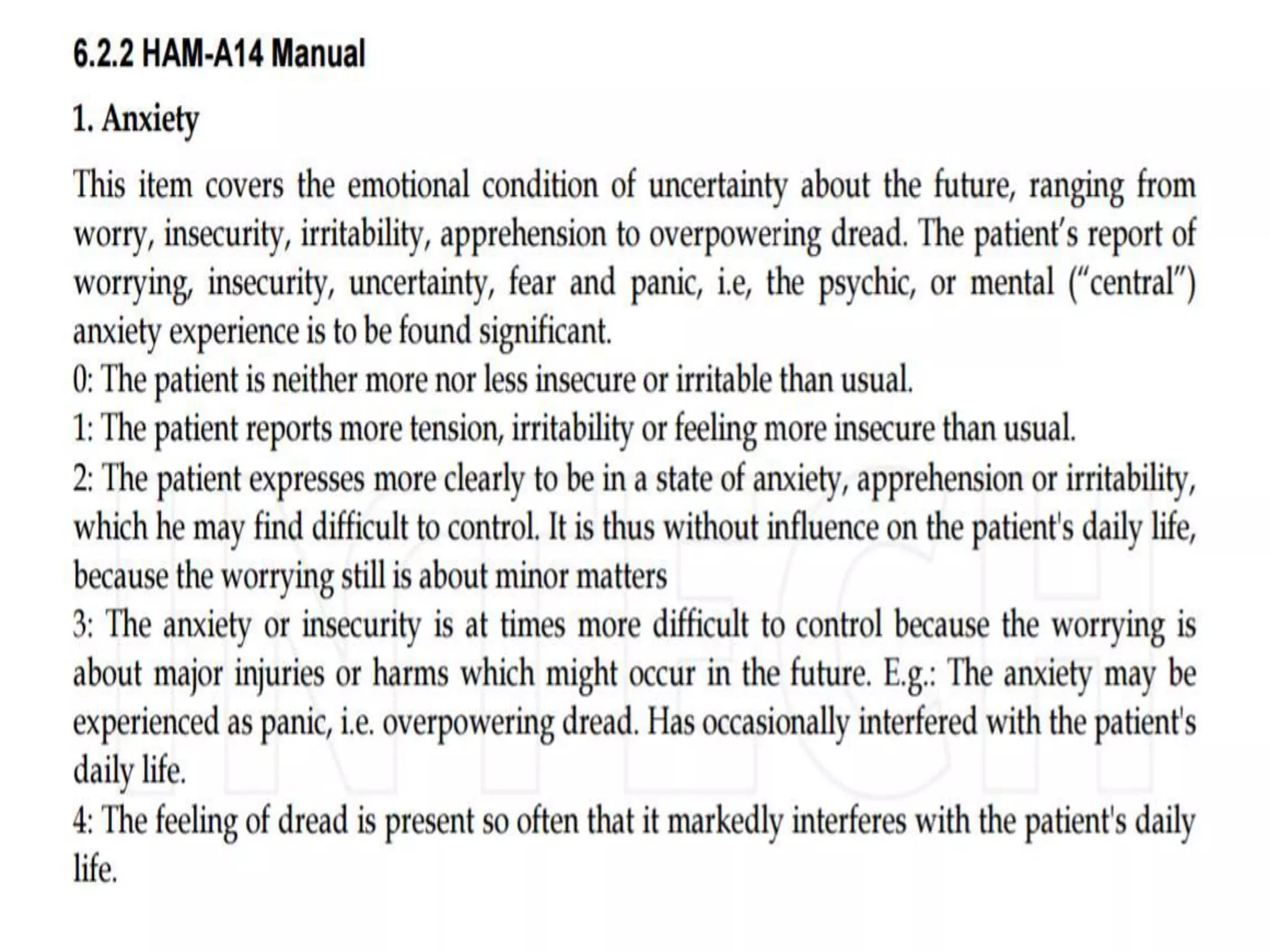
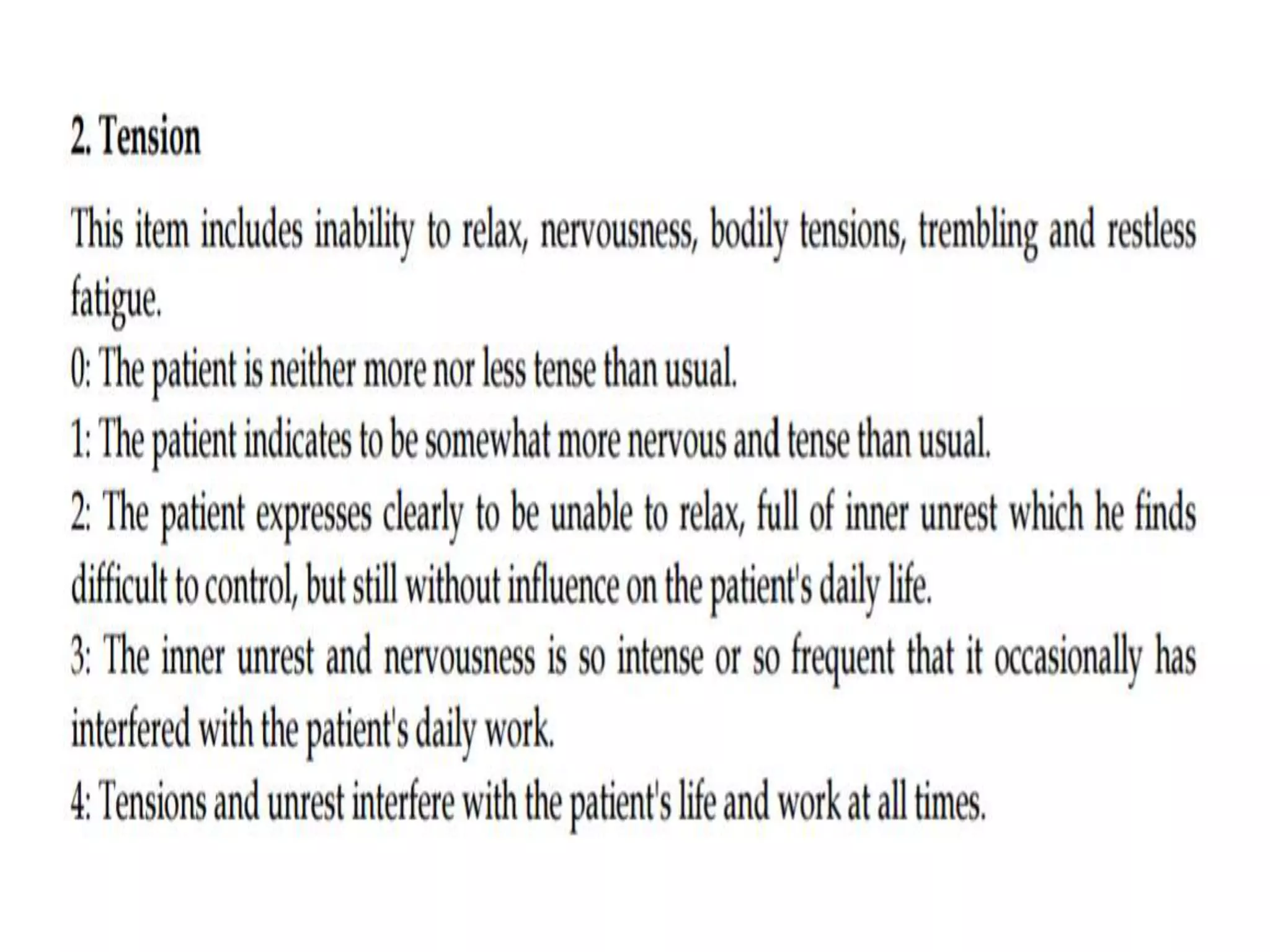
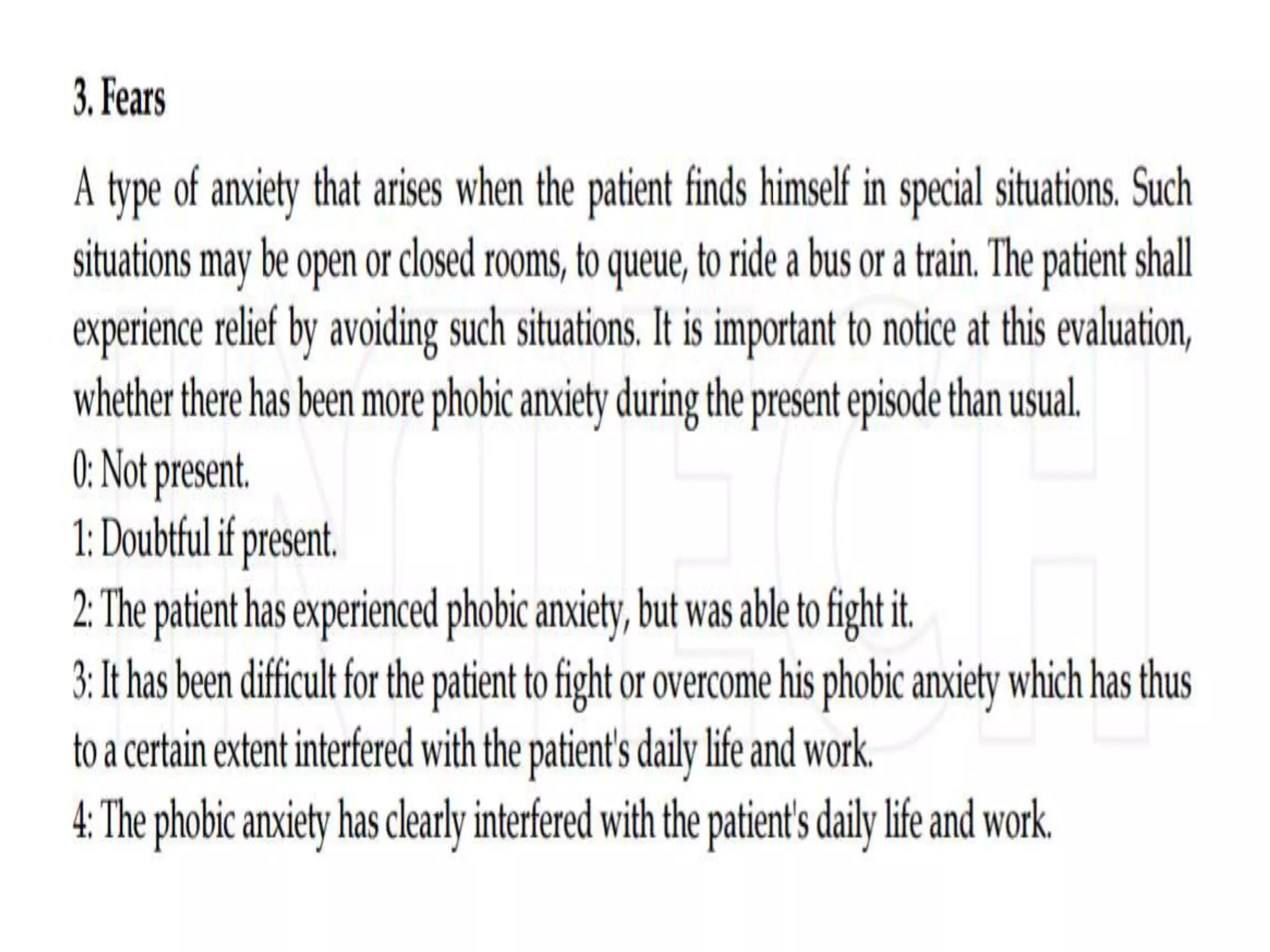
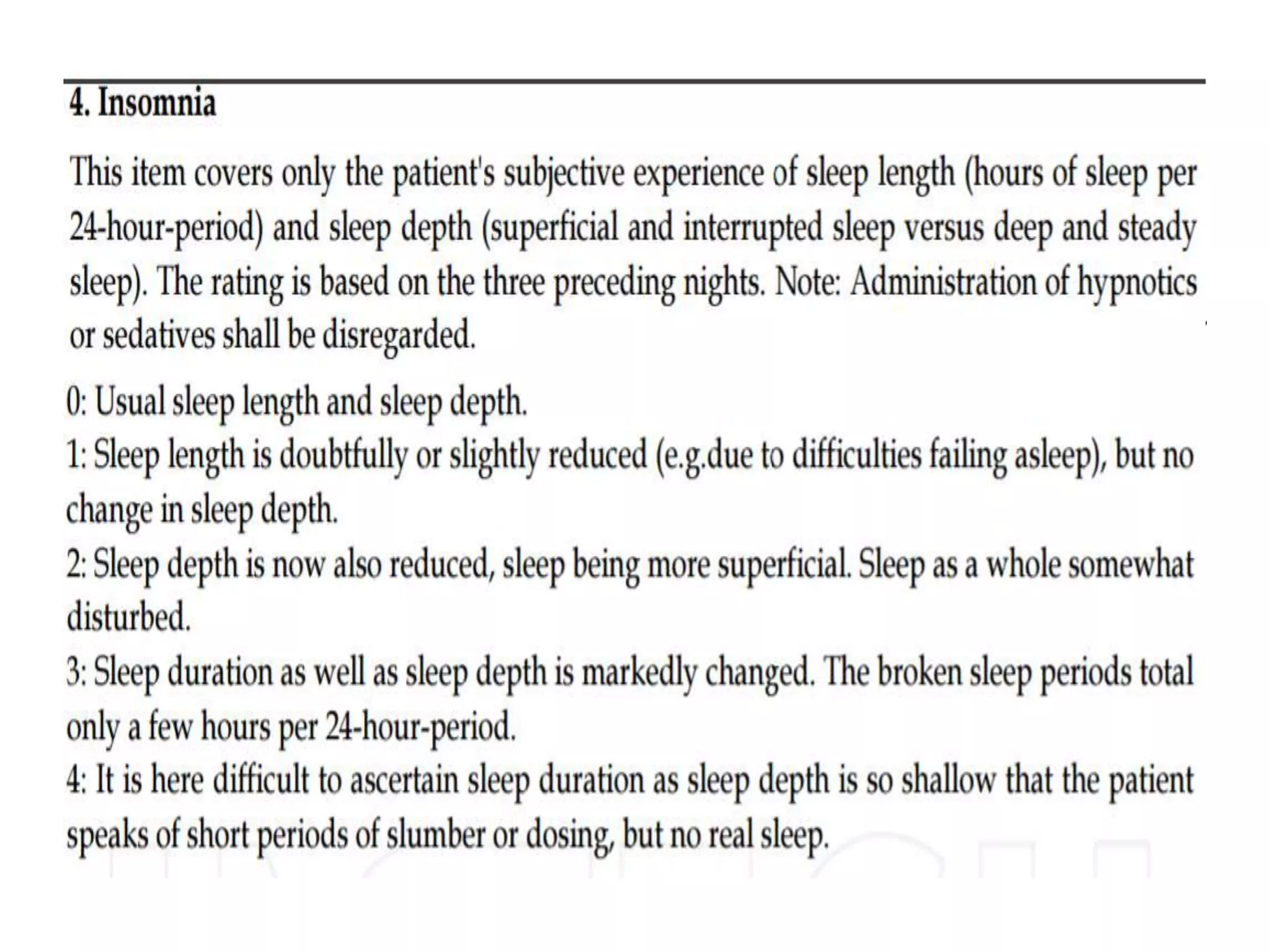
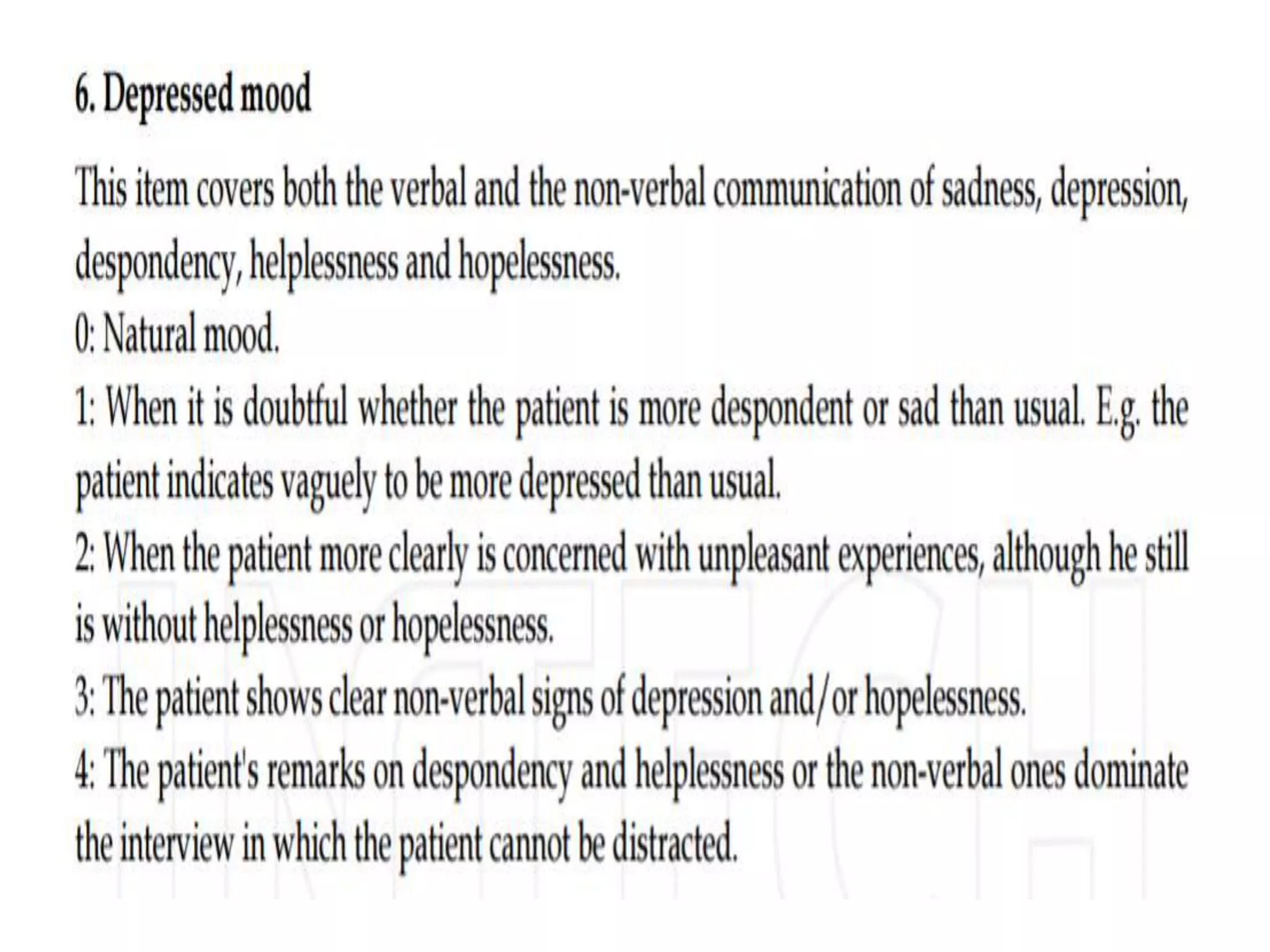
The Hamilton Anxiety Rating Scale
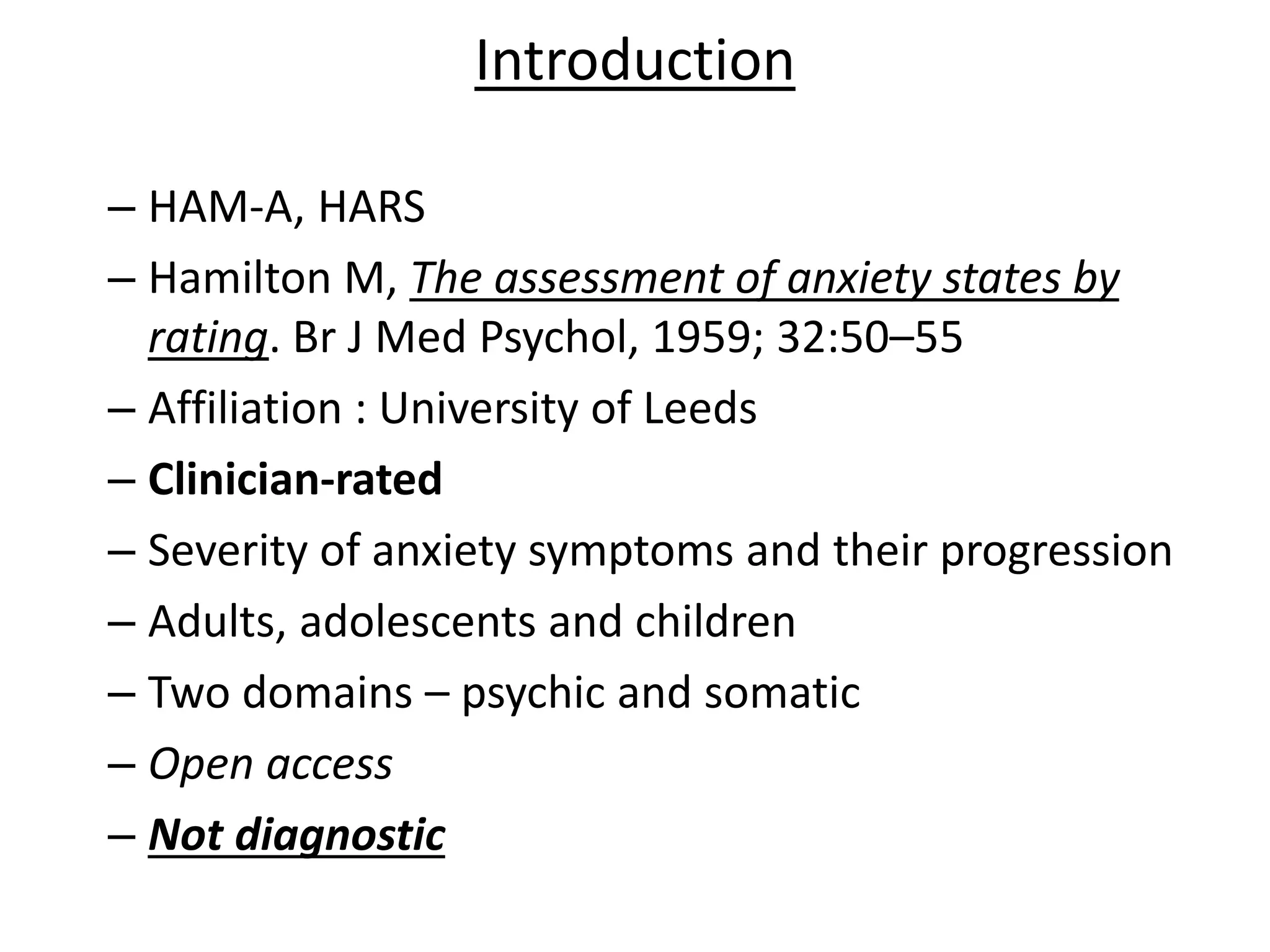
Introduction
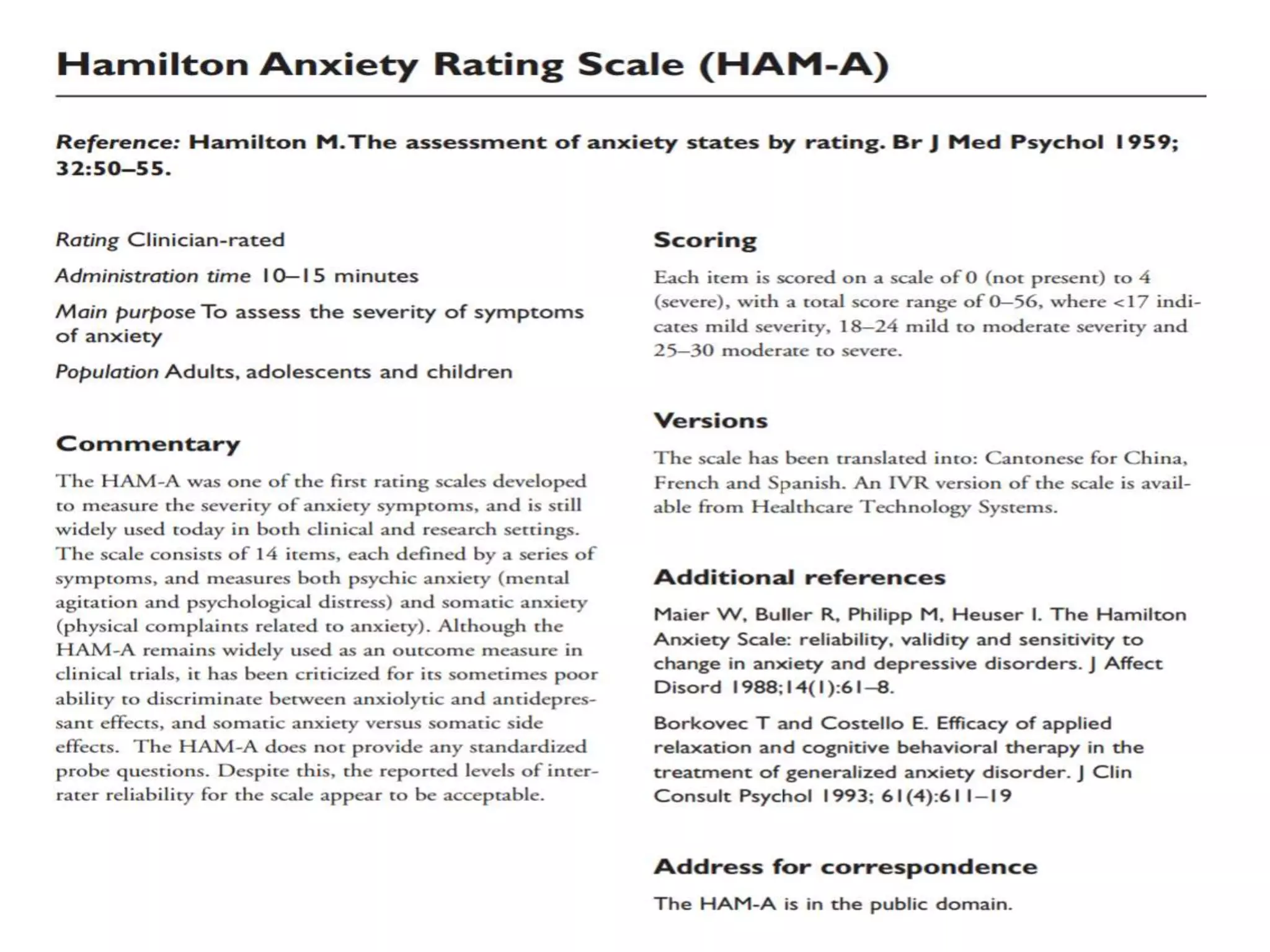
– HAM-A, HARS
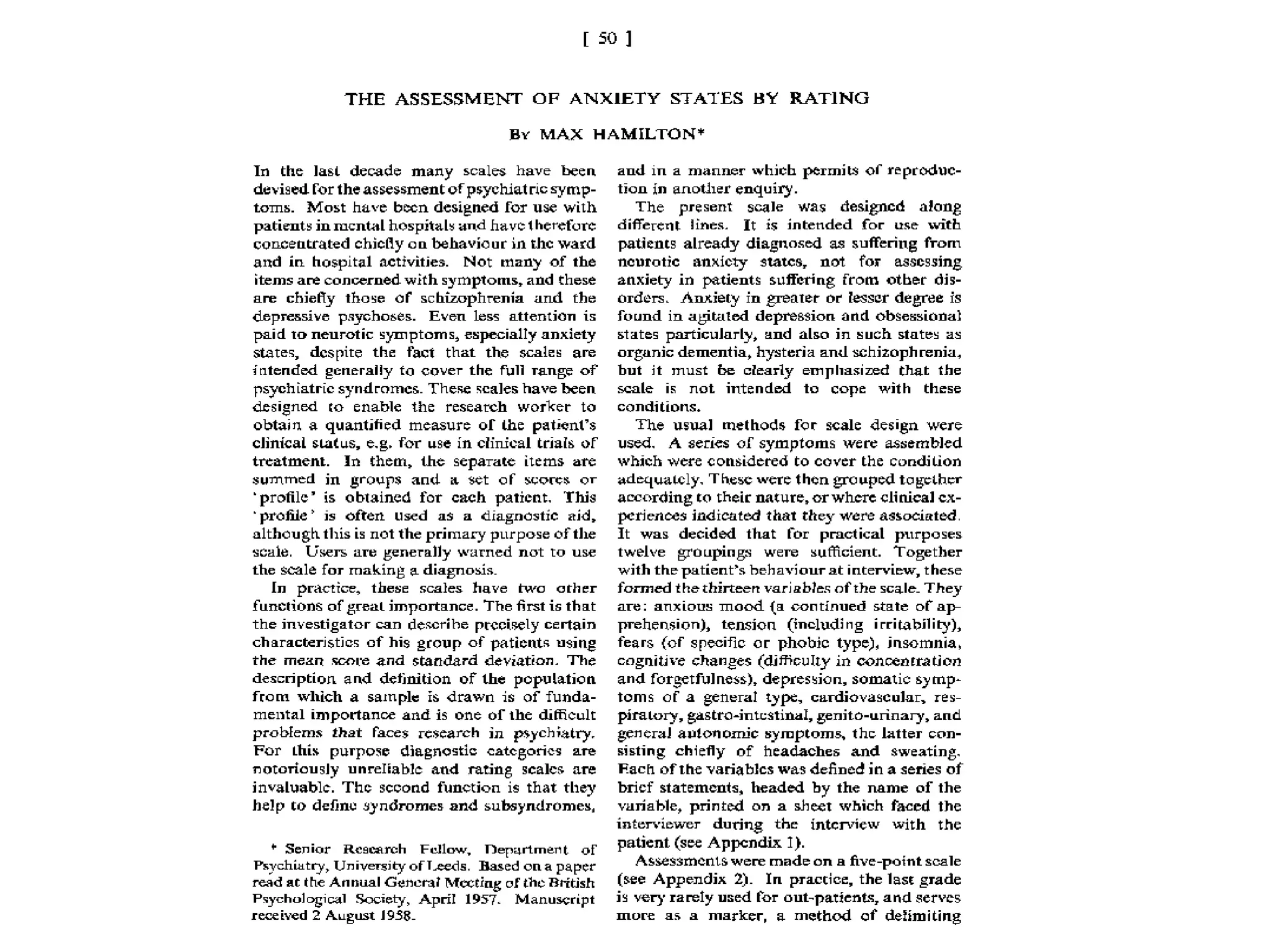
– Hamilton M, The assessment of anxiety states by
rating. Br J Med Psychol, 1959; 32:50–55
– Affiliation : University of Leeds
– Clinician-rated
– Severity of anxiety symptoms and their progression
– Adults, adolescents and children
– Two domains – psychic and somatic
– Open access
– Not diagnostic
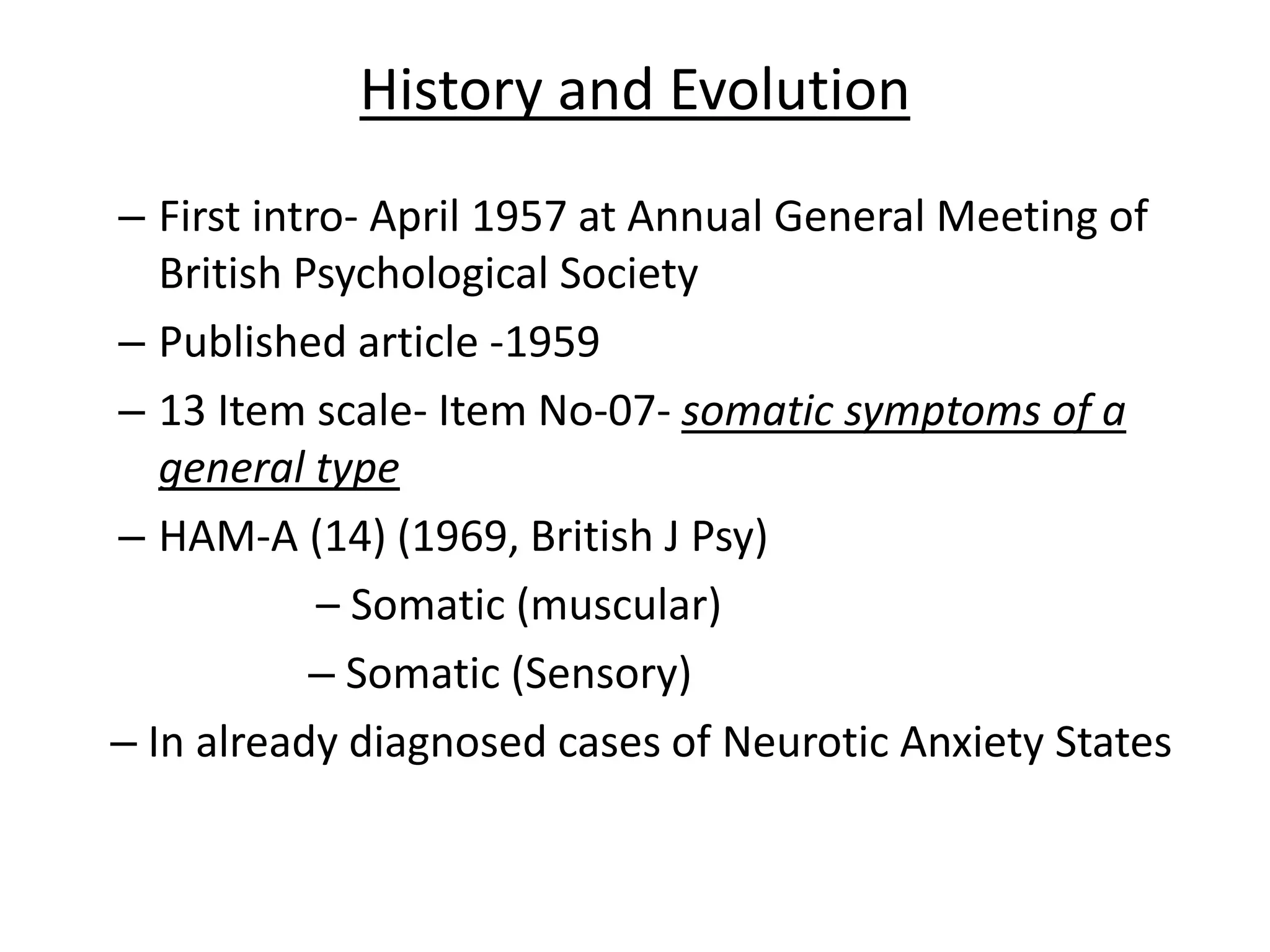
History and Evolution
– First intro- April 1957 at Annual General Meeting of
British Psychological Society
– Published article -1959
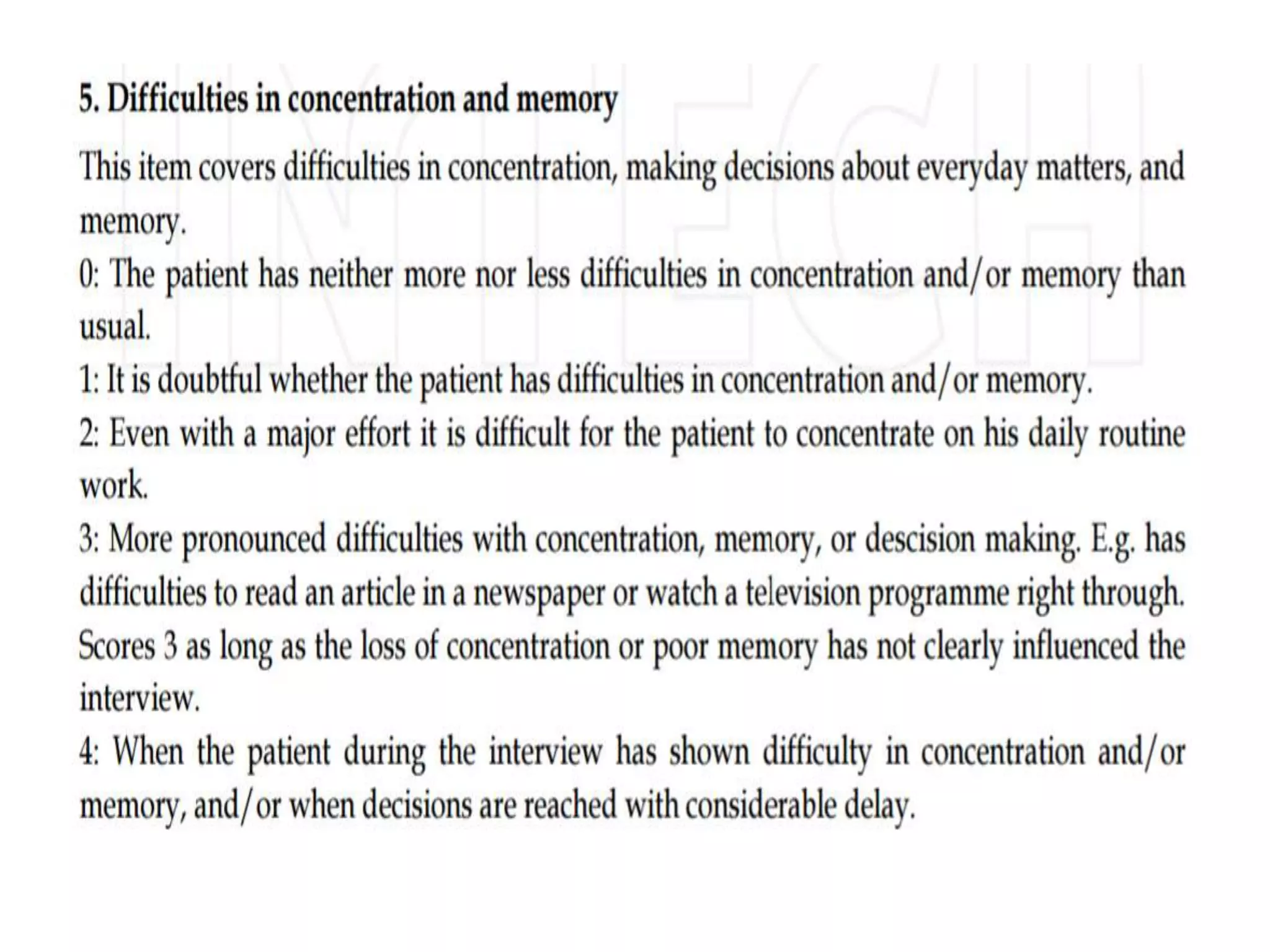
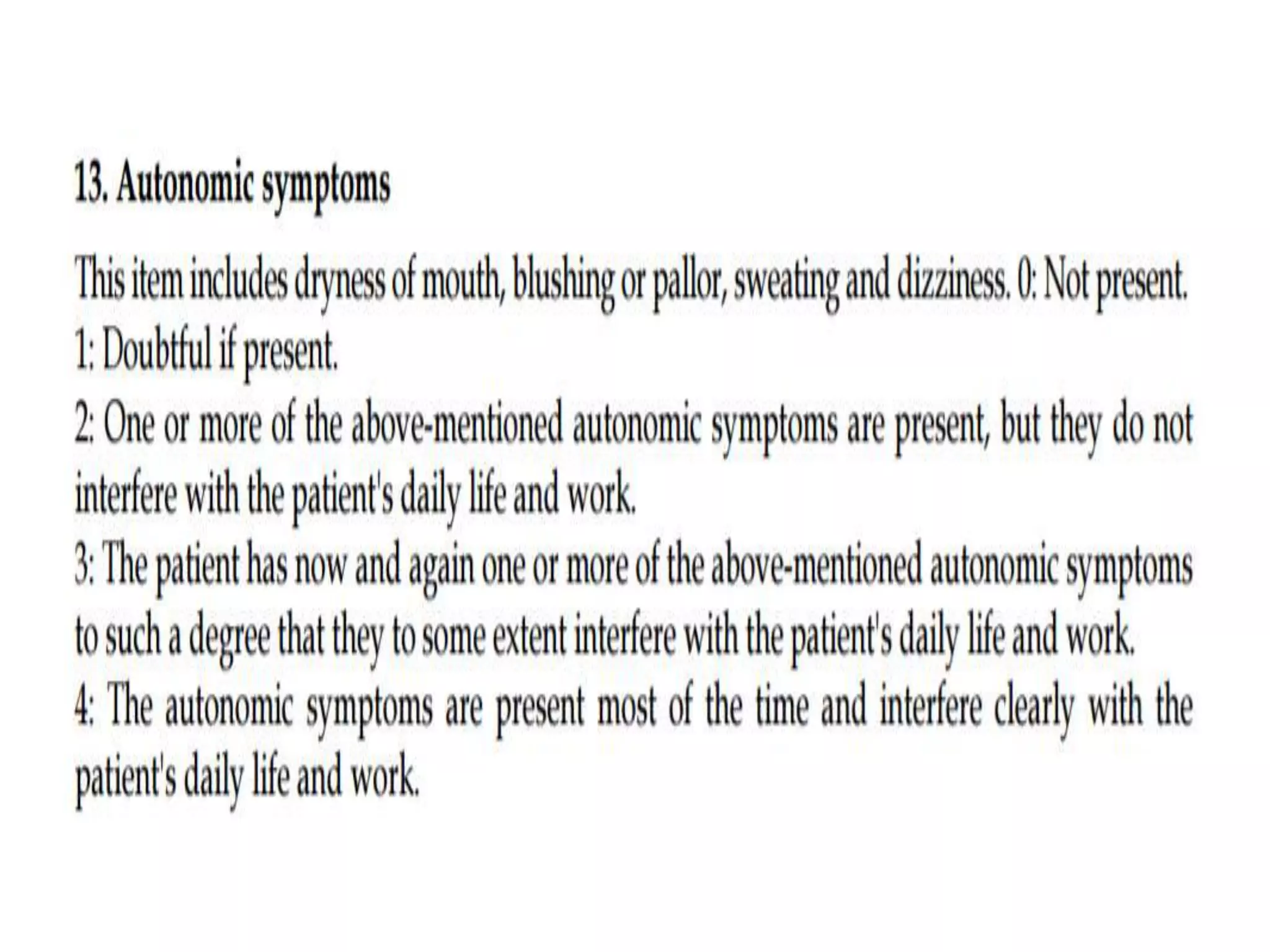
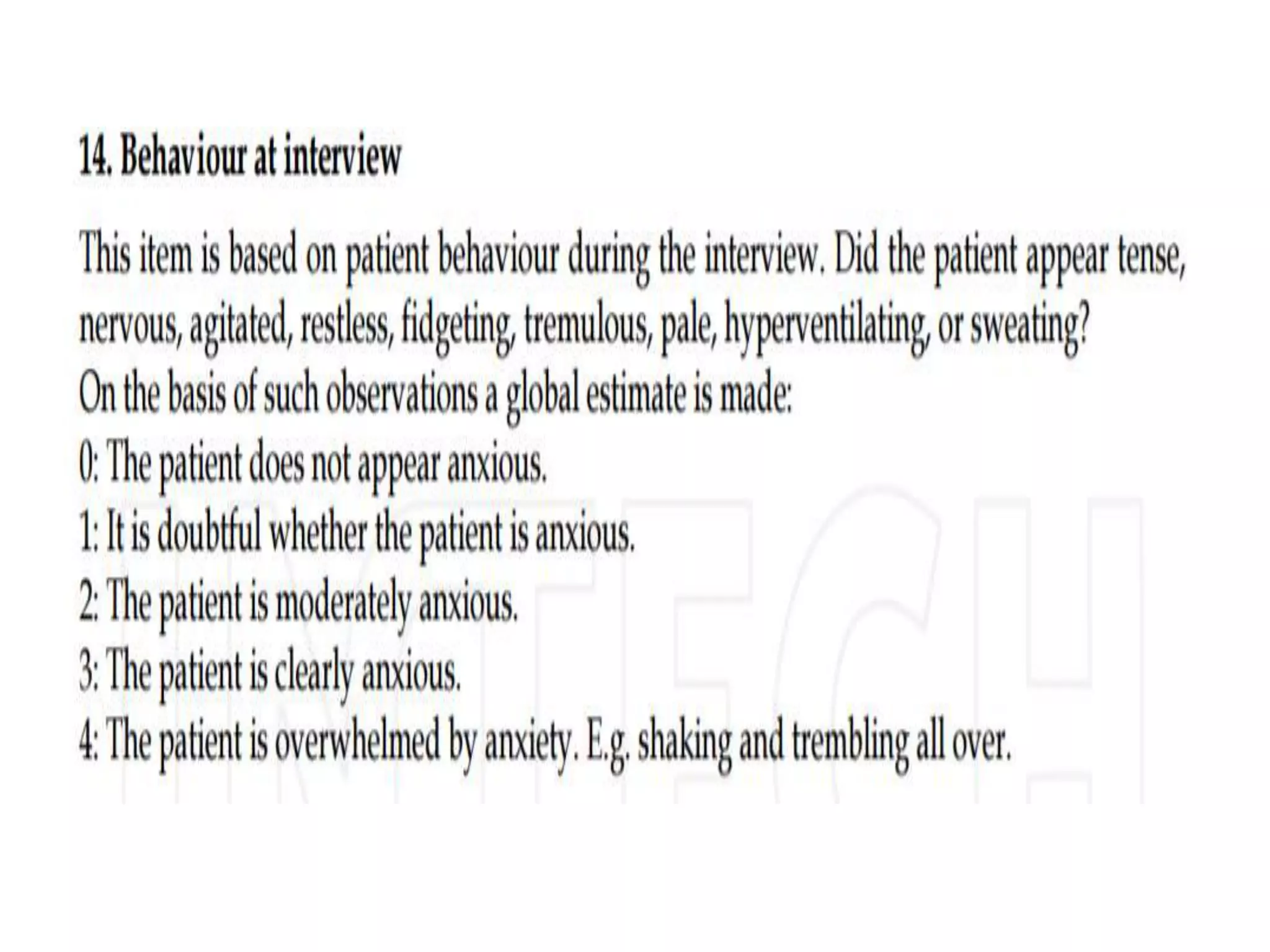
– 13 Item scale- Item No-07- somatic symptoms of a
general type
– HAM-A (14) (1969, British J Psy)
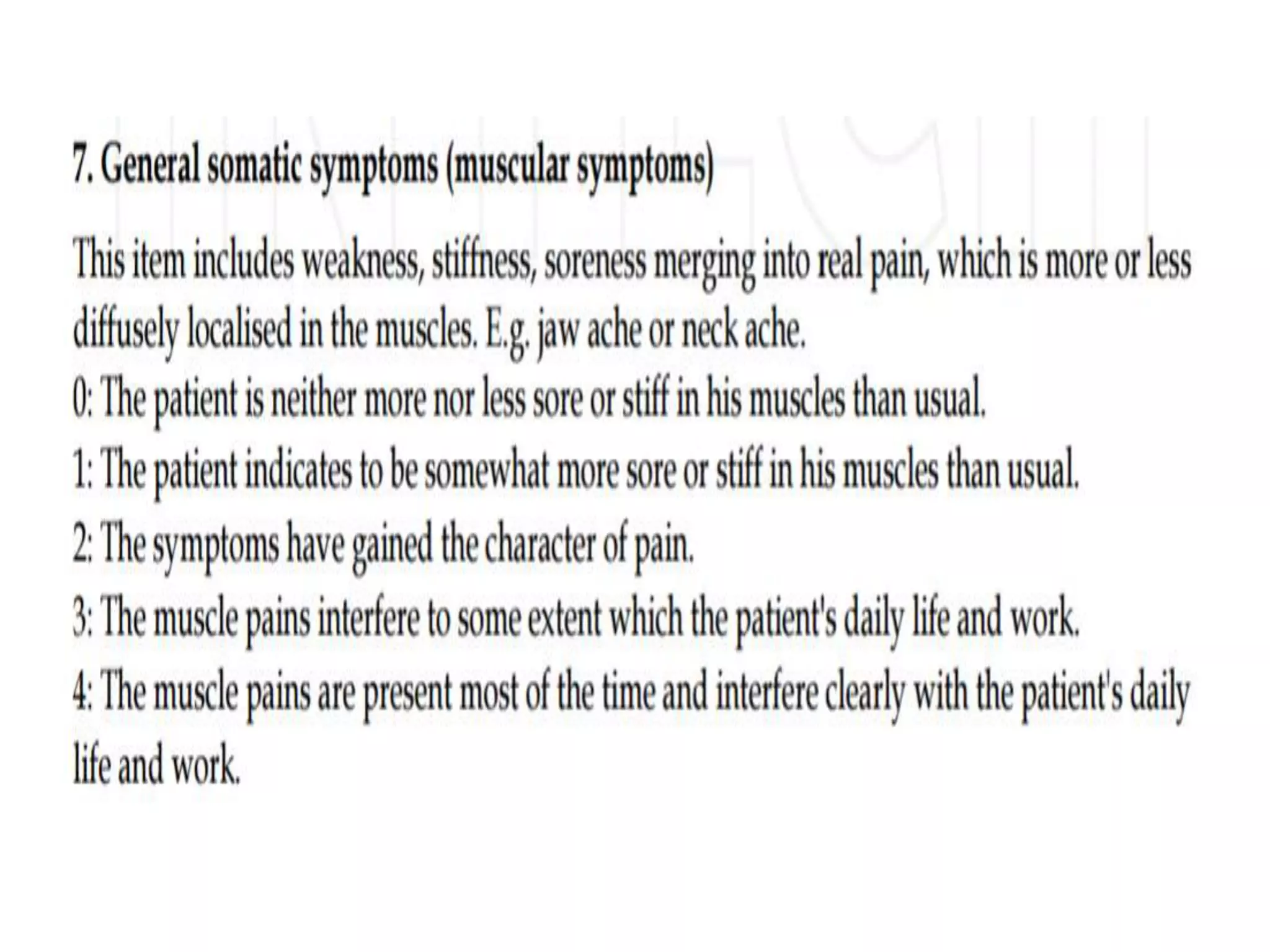
– Somatic (muscular)
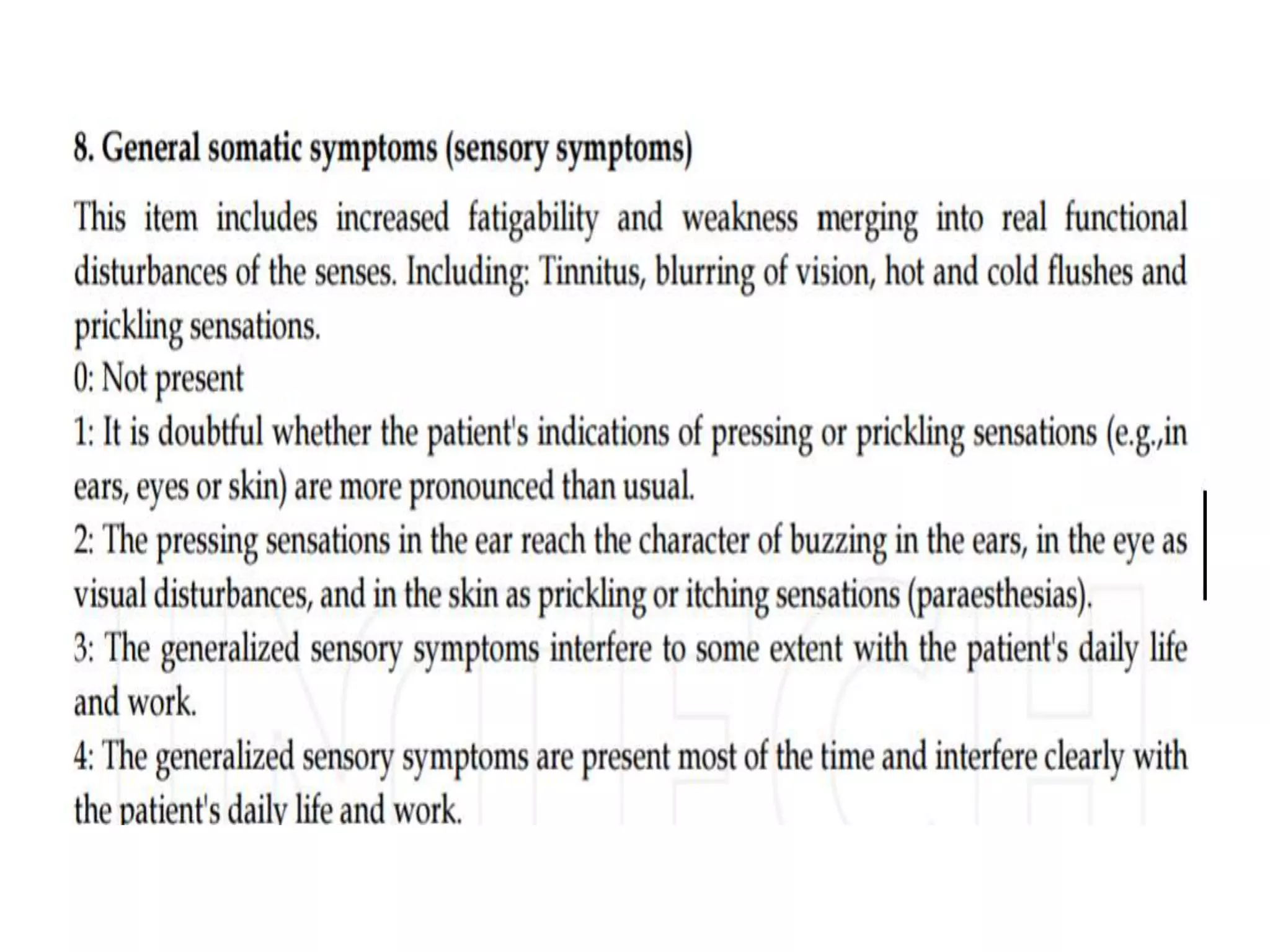
– Somatic (Sensory)
– In already diagnosed cases of Neurotic Anxiety States
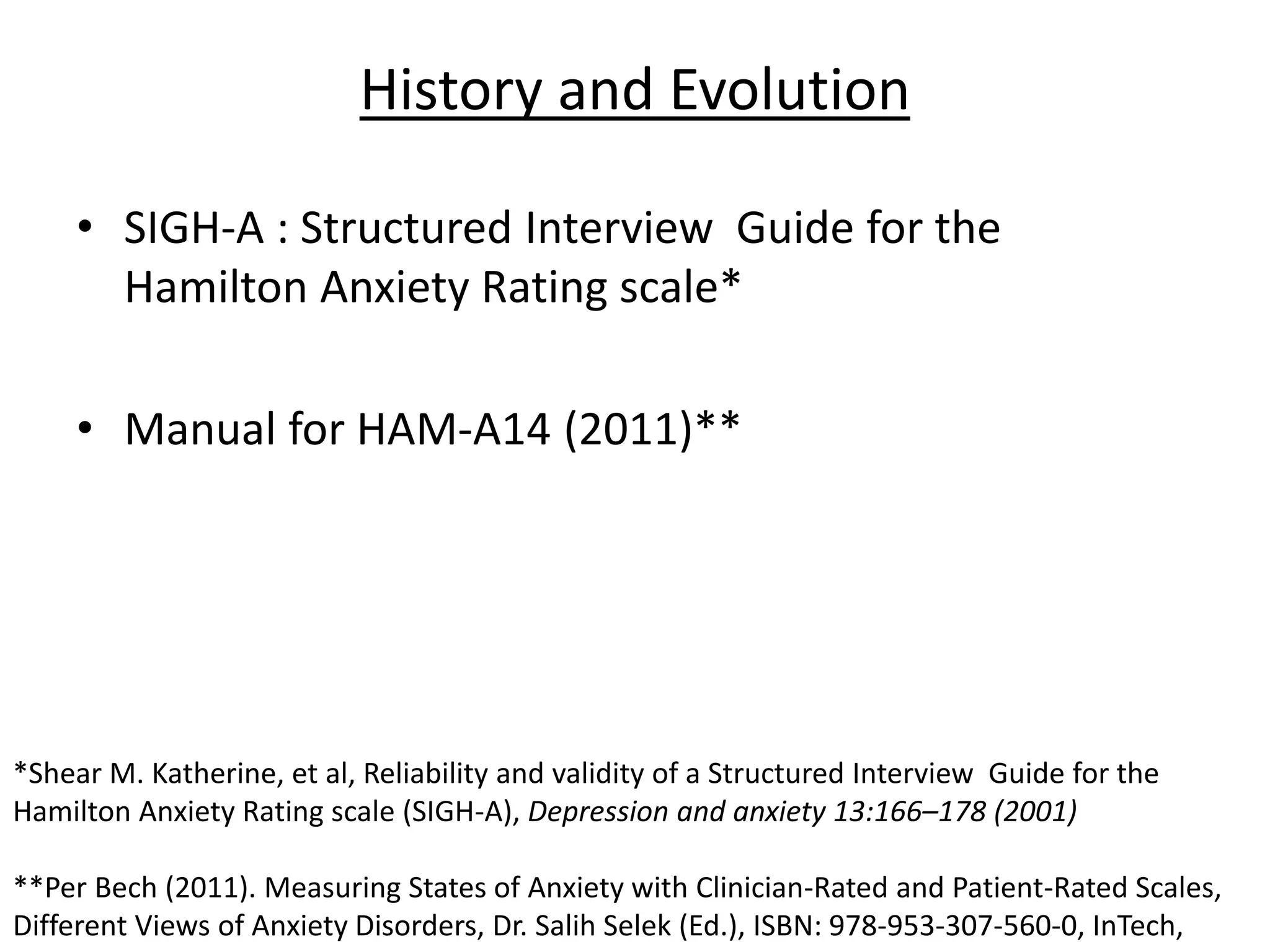
History and Evolution
• SIGH-A : Structured Interview Guide for the
Hamilton Anxiety Rating scale*
• Manual for HAM-A14 (2011)**
*Shear M. Katherine, et al, Reliability and validity of a Structured Interview Guide for the
Hamilton Anxiety Rating scale (SIGH-A), Depression and anxiety 13:166–178 (2001)
**Per Bech (2011). Measuring States of Anxiety with Clinician-Rated and Patient-Rated Scales,
Different Views of Anxiety Disorders, Dr. Salih Selek (Ed.), ISBN: 978-953-307-560-0, InTech,
The Hamilton Anxiety Rating Scale
• Components:
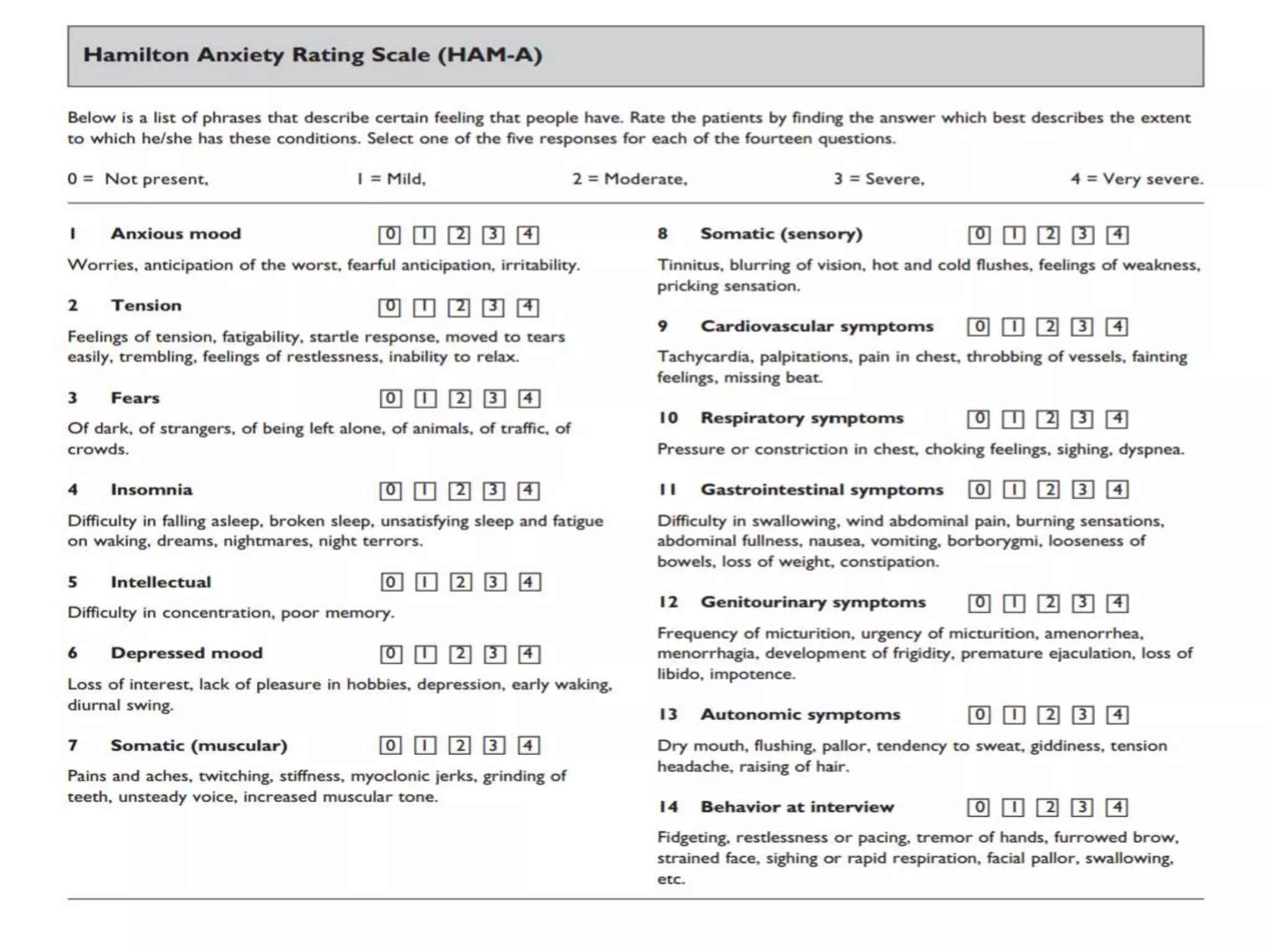
– 14 Items
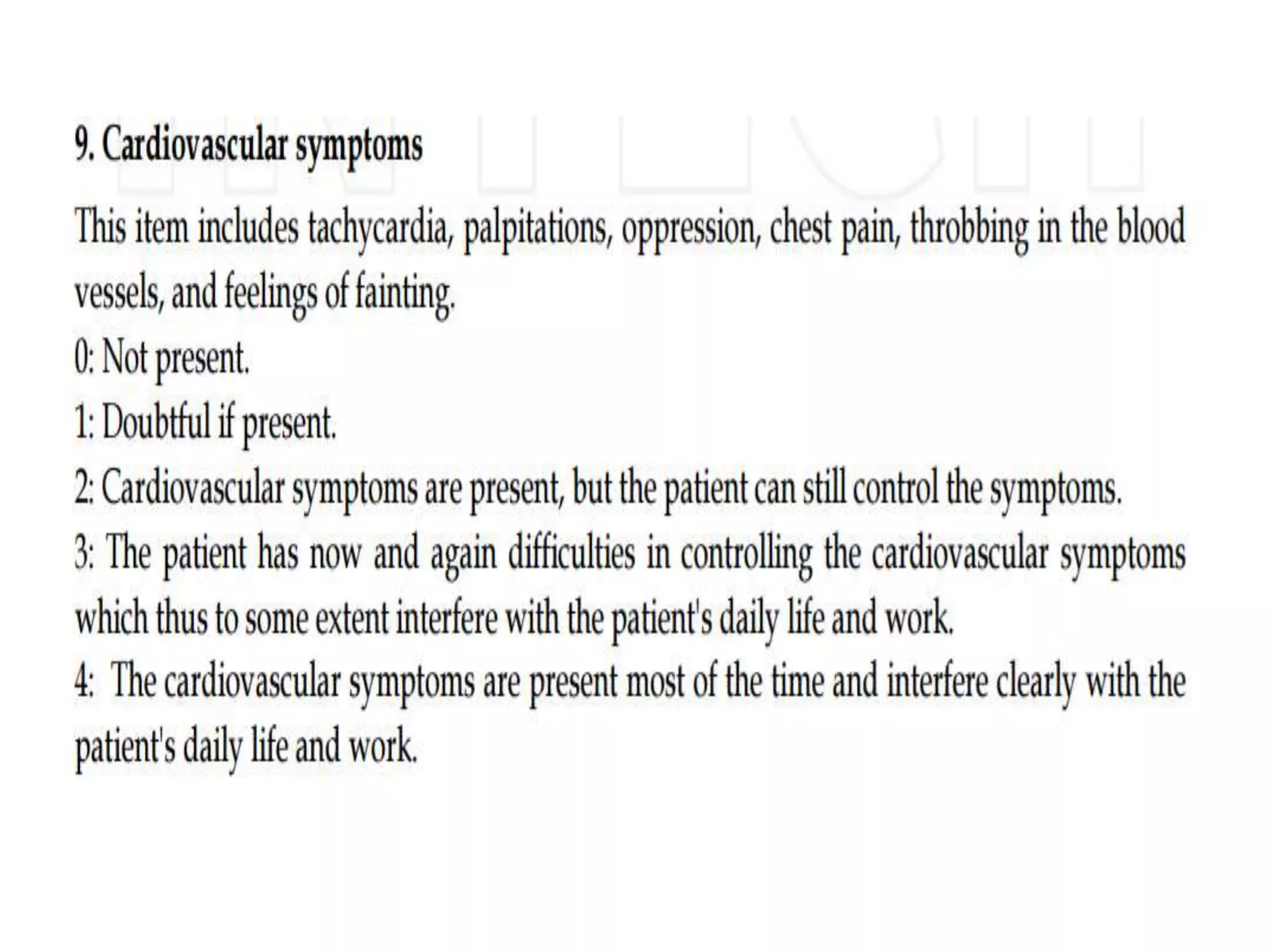
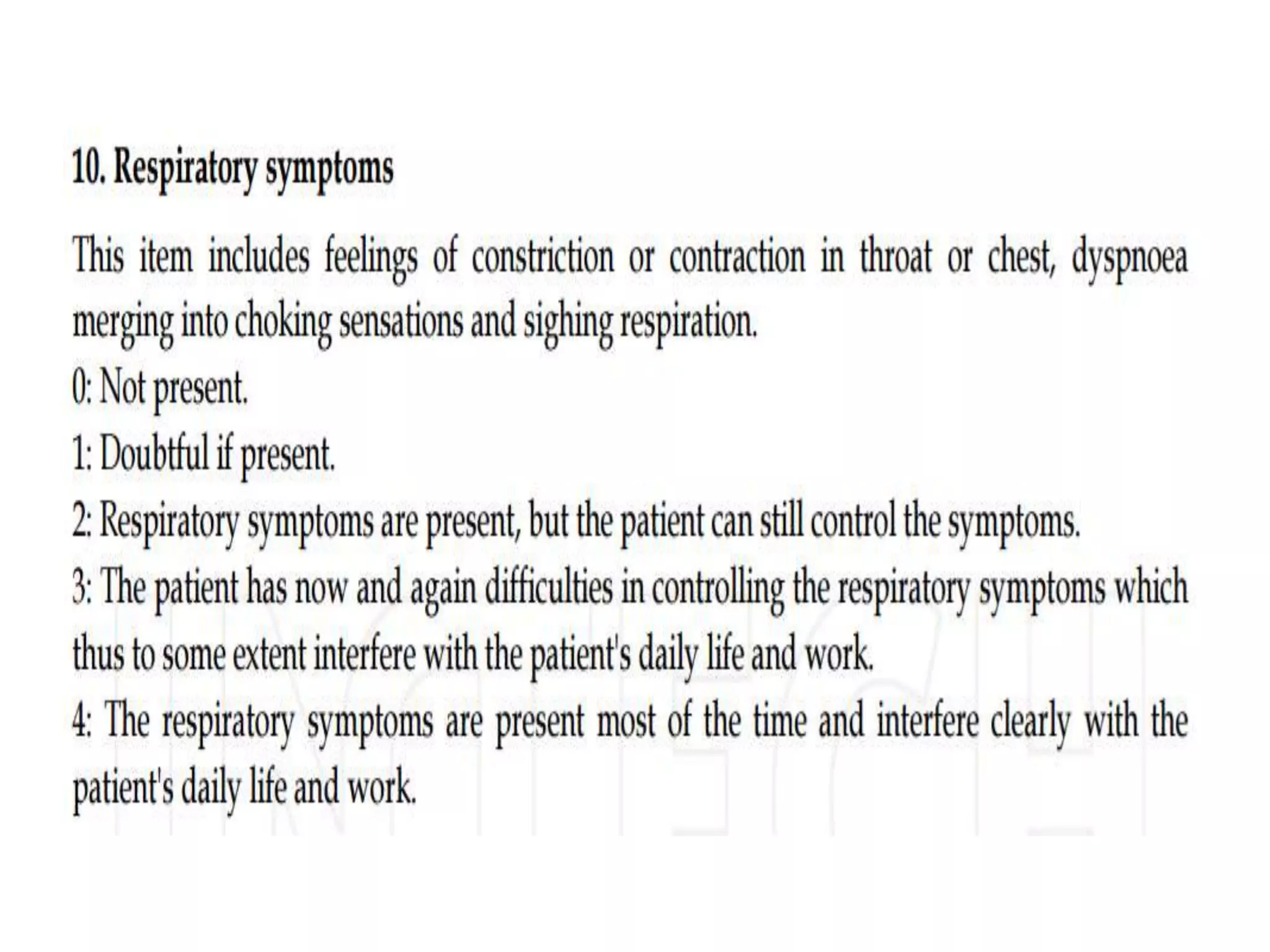
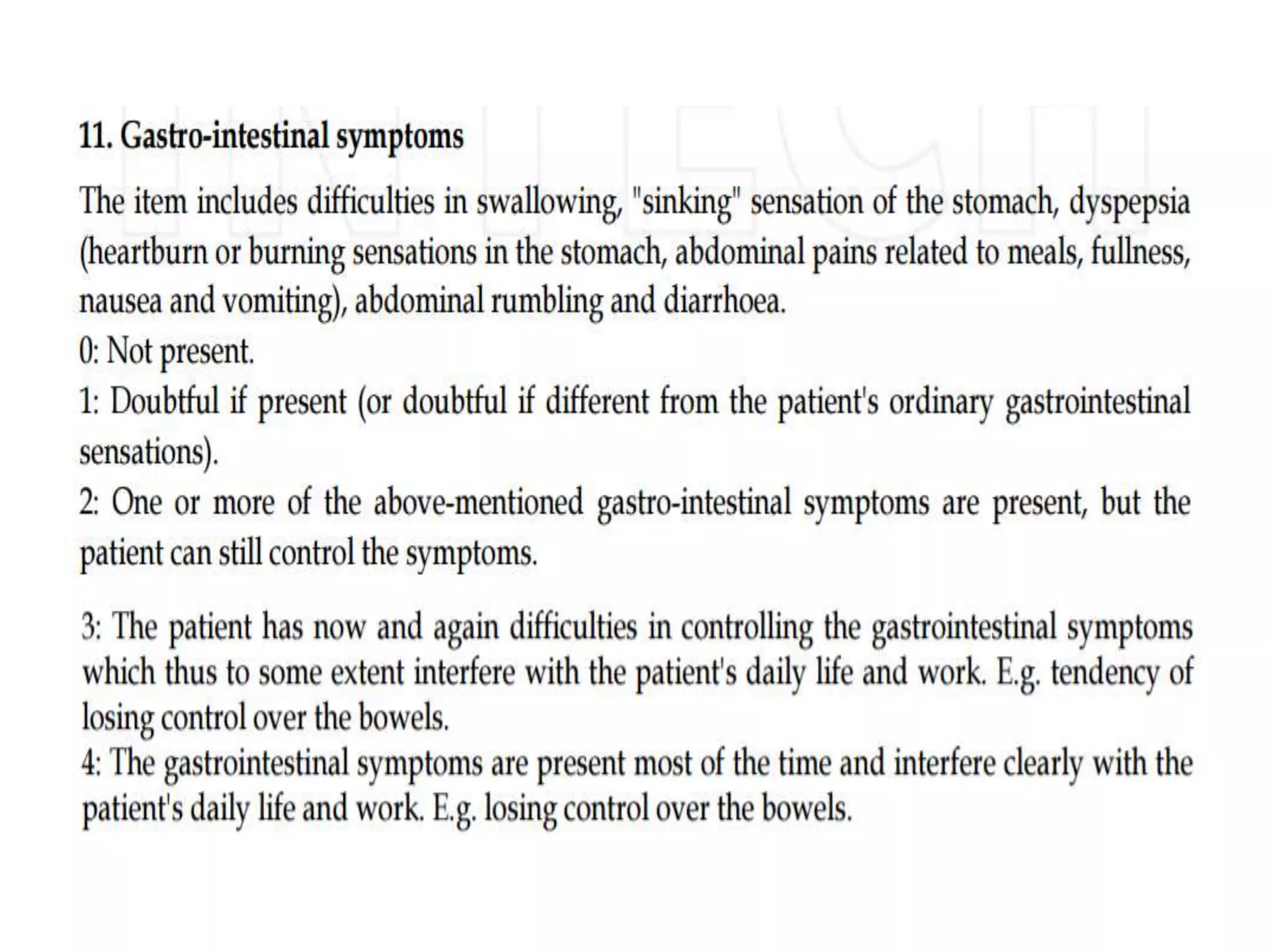
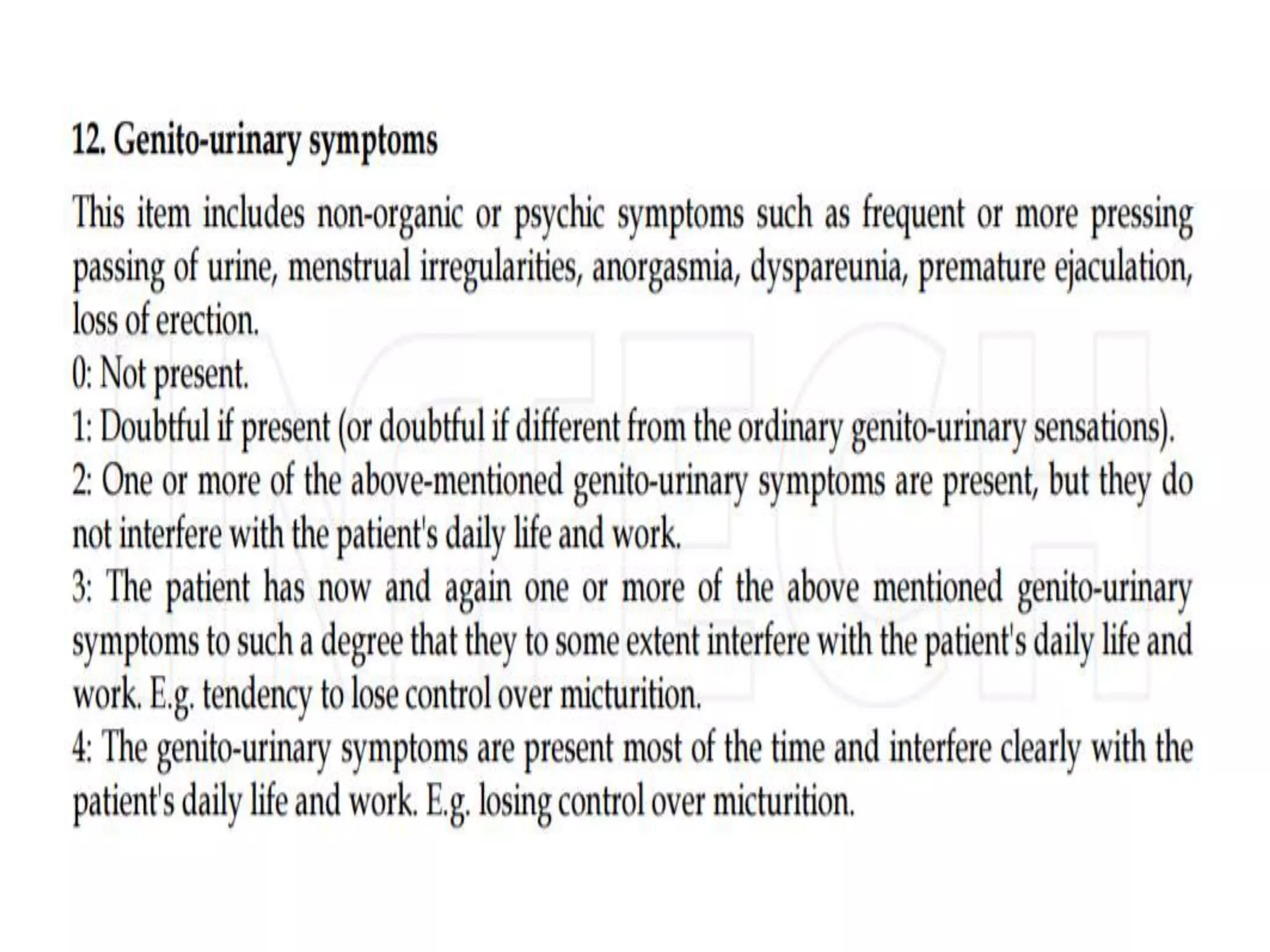
– 1-6 - psychic components
– 7-14 - Somatic
– To assess the severity of these symptoms
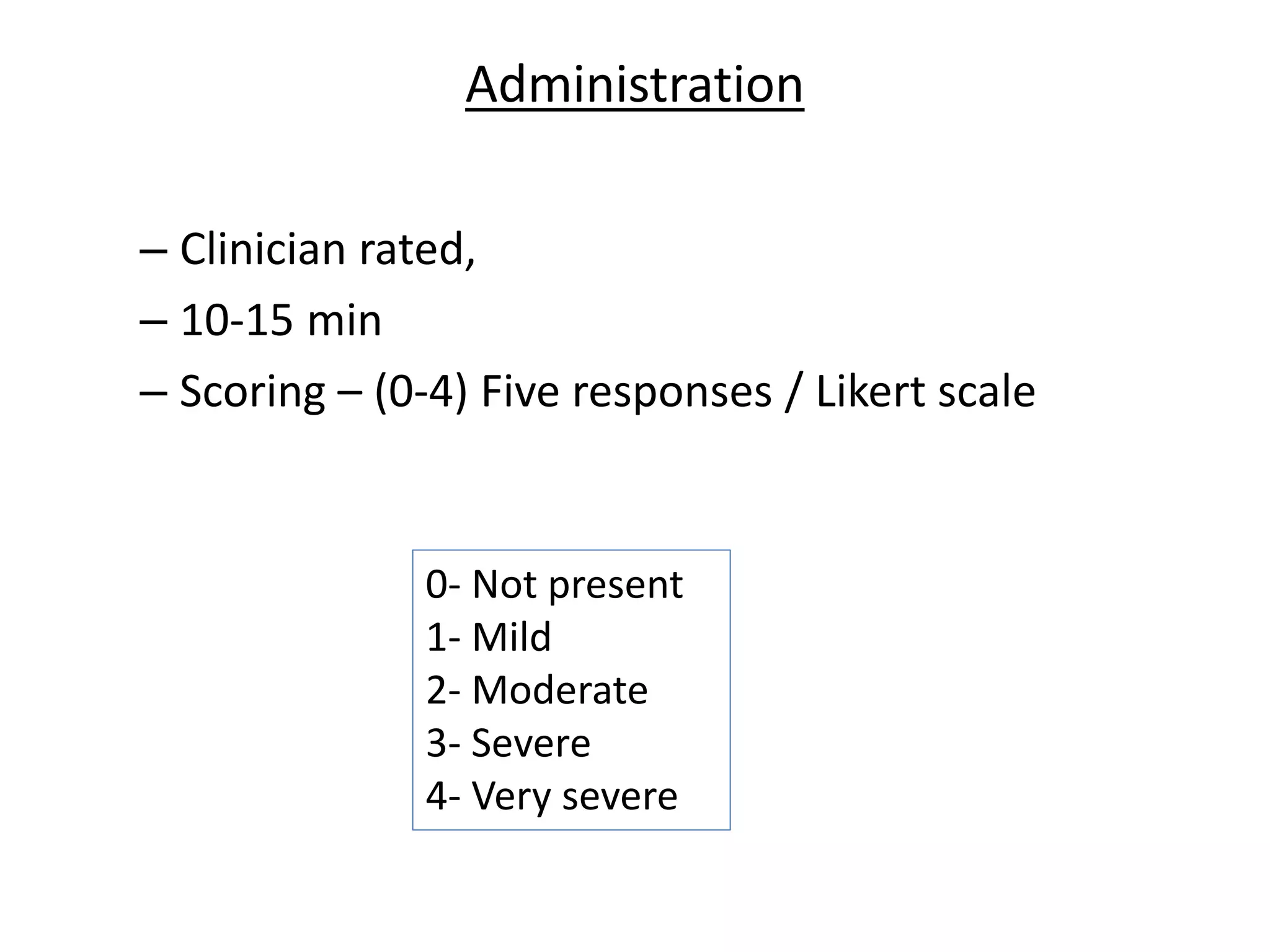
Administration
– Clinician rated,
– 10-15 min
– Scoring – (0-4) Five responses / Likert scale
0- Not present
1- Mild
2- Moderate
3- Severe
4- Very severe
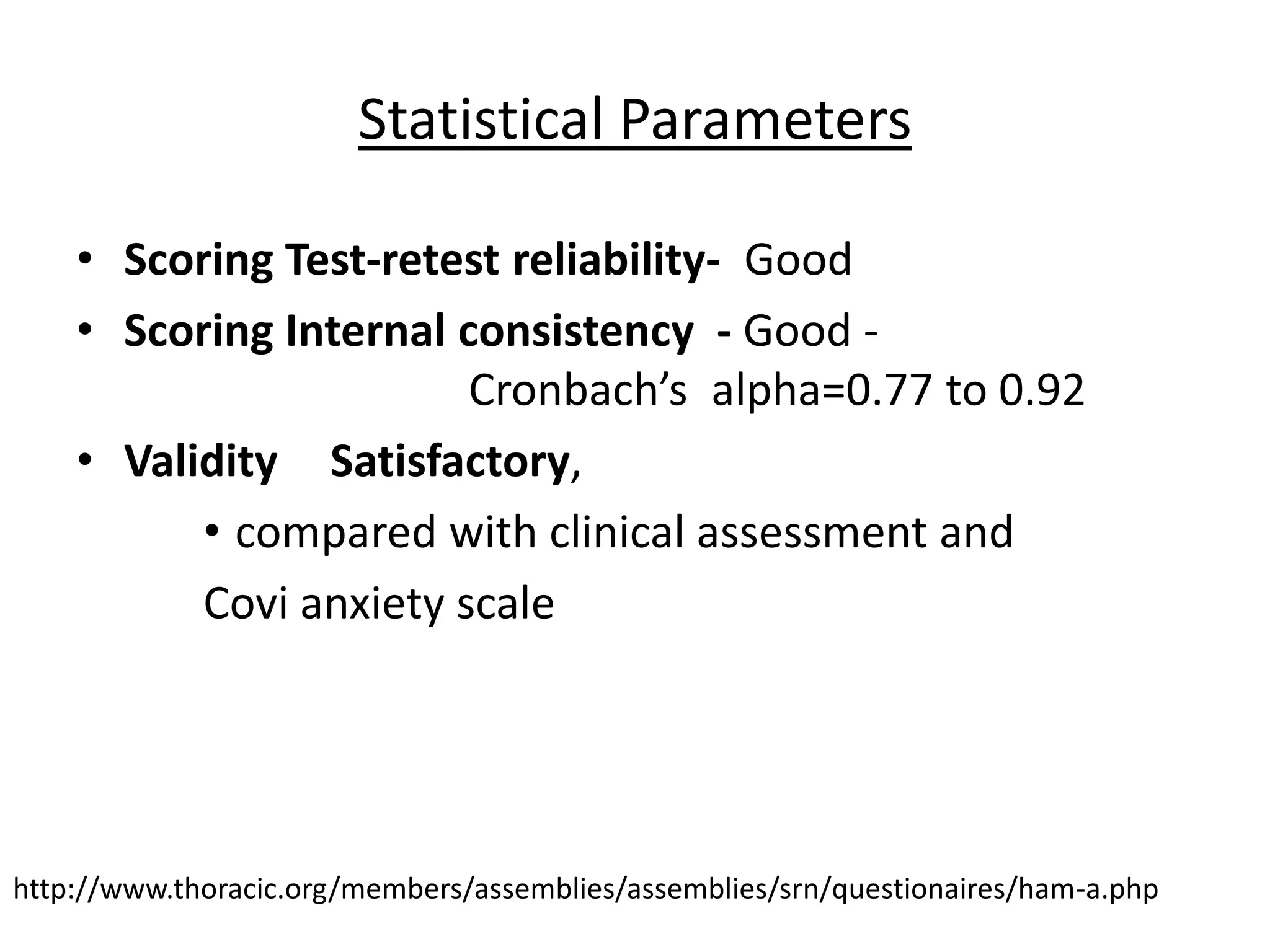
Statistical Parameters
• Scoring Test-retest reliability- Good
• Scoring Internal consistency - Good -
Cronbach’s alpha=0.77 to 0.92
• Validity Satisfactory,
• compared with clinical assessment and
Covi anxiety scale
http://www.thoracic.org/members/assemblies/assemblies/srn/questionaires/ham-a.php
Interpretation of scores
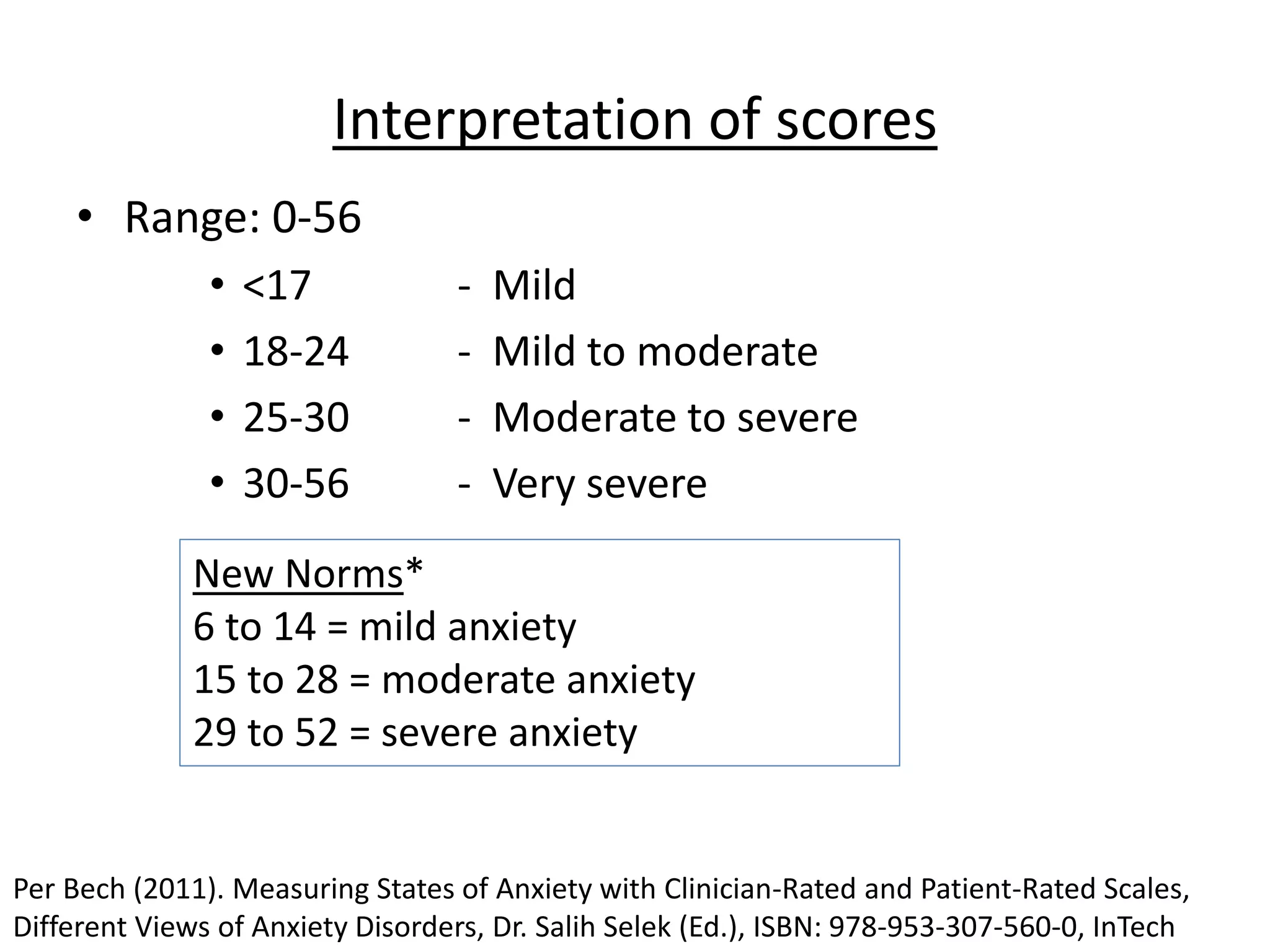
• Range: 0-56
• <17 - Mild
• 18-24 - Mild to moderate
• 25-30 - Moderate to severe
• 30-56 - Very severe
New Norms*
6 to 14 = mild anxiety
15 to 28 = moderate anxiety
29 to 52 = severe anxiety
Per Bech (2011). Measuring States of Anxiety with Clinician-Rated and Patient-Rated Scales,
Different Views of Anxiety Disorders, Dr. Salih Selek (Ed.), ISBN: 978-953-307-560-0, InTech
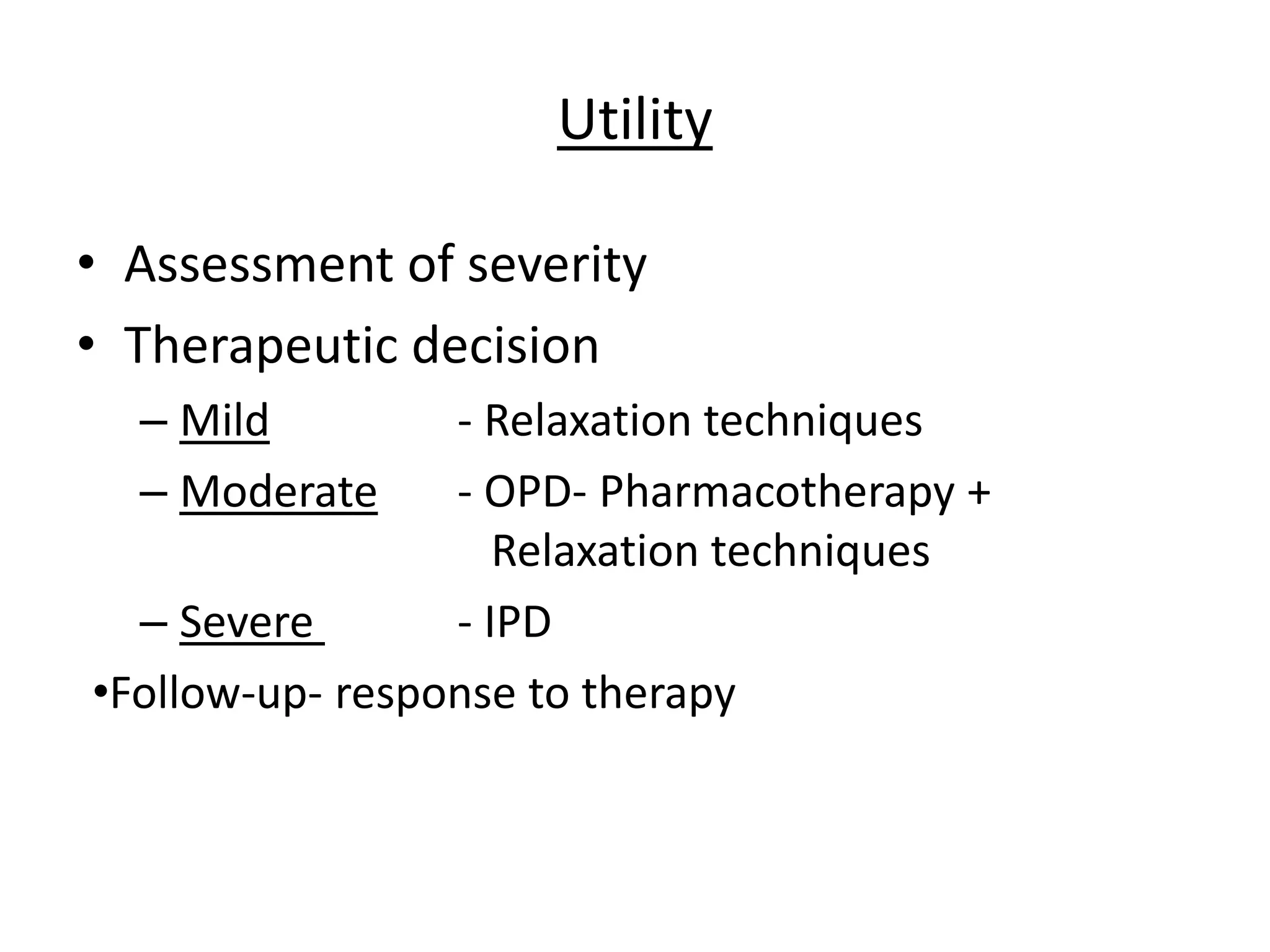
Utility
• Assessment of severity
• Therapeutic decision
– Mild - Relaxation techniques
– Moderate - OPD- Pharmacotherapy +
Relaxation techniques
– Severe - IPD
•Follow-up- response to therapy
Limitations
• Skewed towards physical manifestations
• Does not differentiate between anxiety co-morbid
with depressive episode or an independent anxiety
disorder
• Research for therapeutic efficacy of a drug
– anxiolytic or anti-depressant??
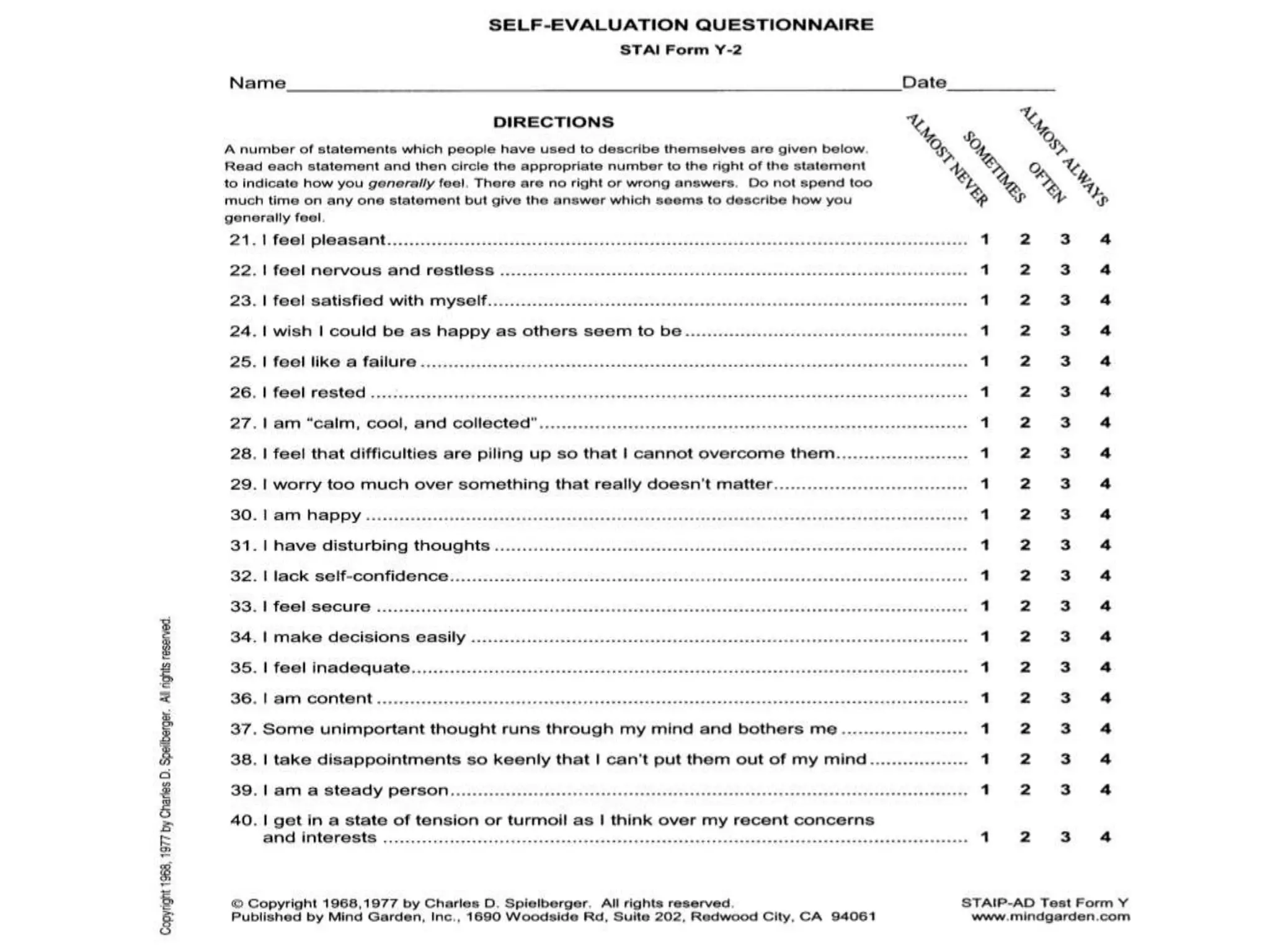
STATE TRAIT ANXIETY INVENTORY
Introduction
– Charles Spielberger, 1968(X), 1977, 1983 (Y)
– Affiliation: Dept of Psychology, University of South
Florida
– Introspective psychological inventory
– 40 self-report items pertaining to anxiety affect.
– Not Open access
Applications
• Psychological and health research
• Clinical diagnosis
• Differentiating anxiety from depression
• Assessment of clinical anxiety in medical, surgical,
psychosomatic and psychiatric patients
• Intensity of feelings of anxiety
• Normal adults
• Screen for anxiety disorders
• Follow-up
Concept
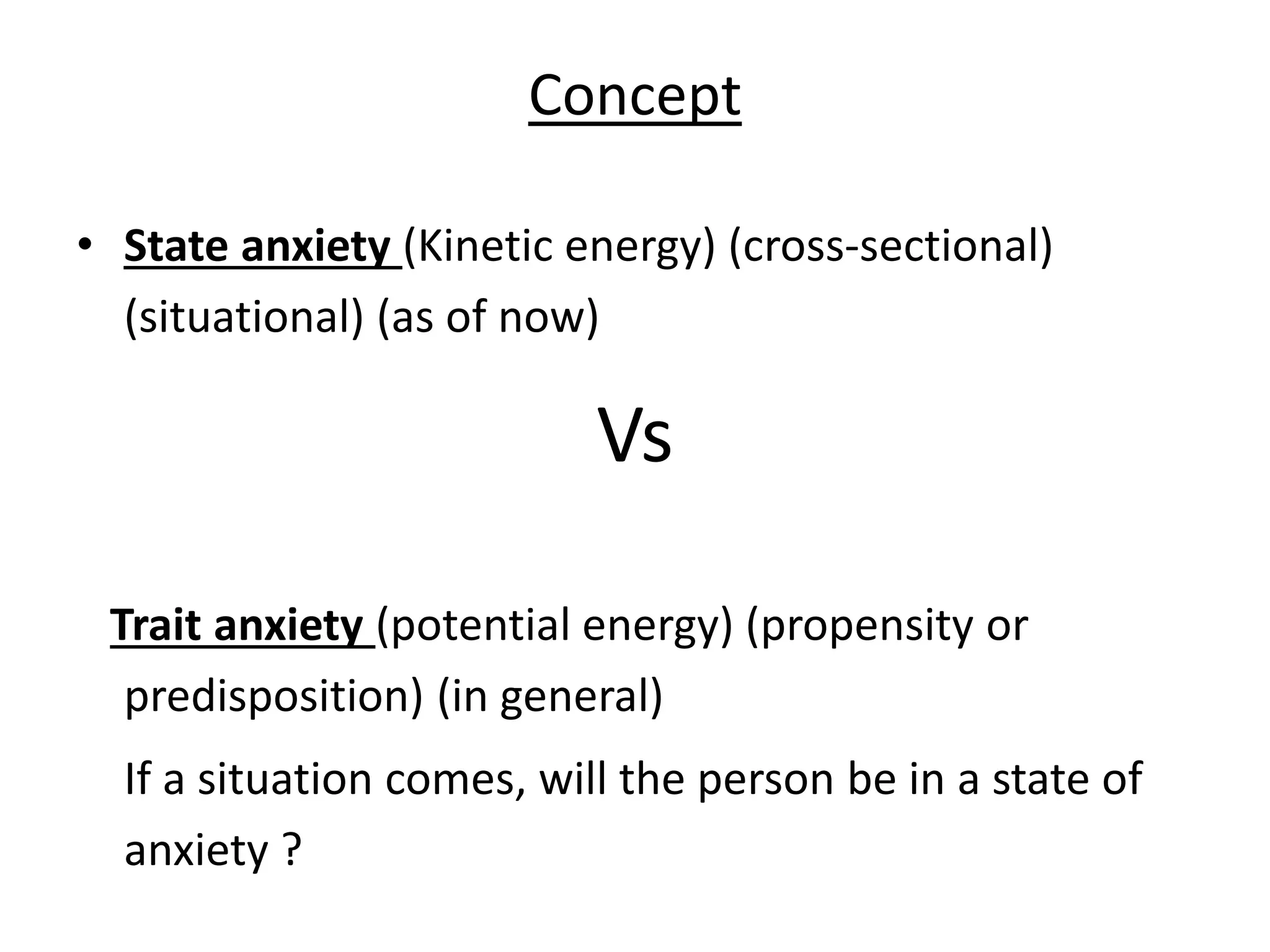
• State anxiety (Kinetic energy) (cross-sectional)
(situational) (as of now)
Vs
Trait anxiety (potential energy) (propensity or
predisposition) (in general)
If a situation comes, will the person be in a state of
anxiety ?
Concept
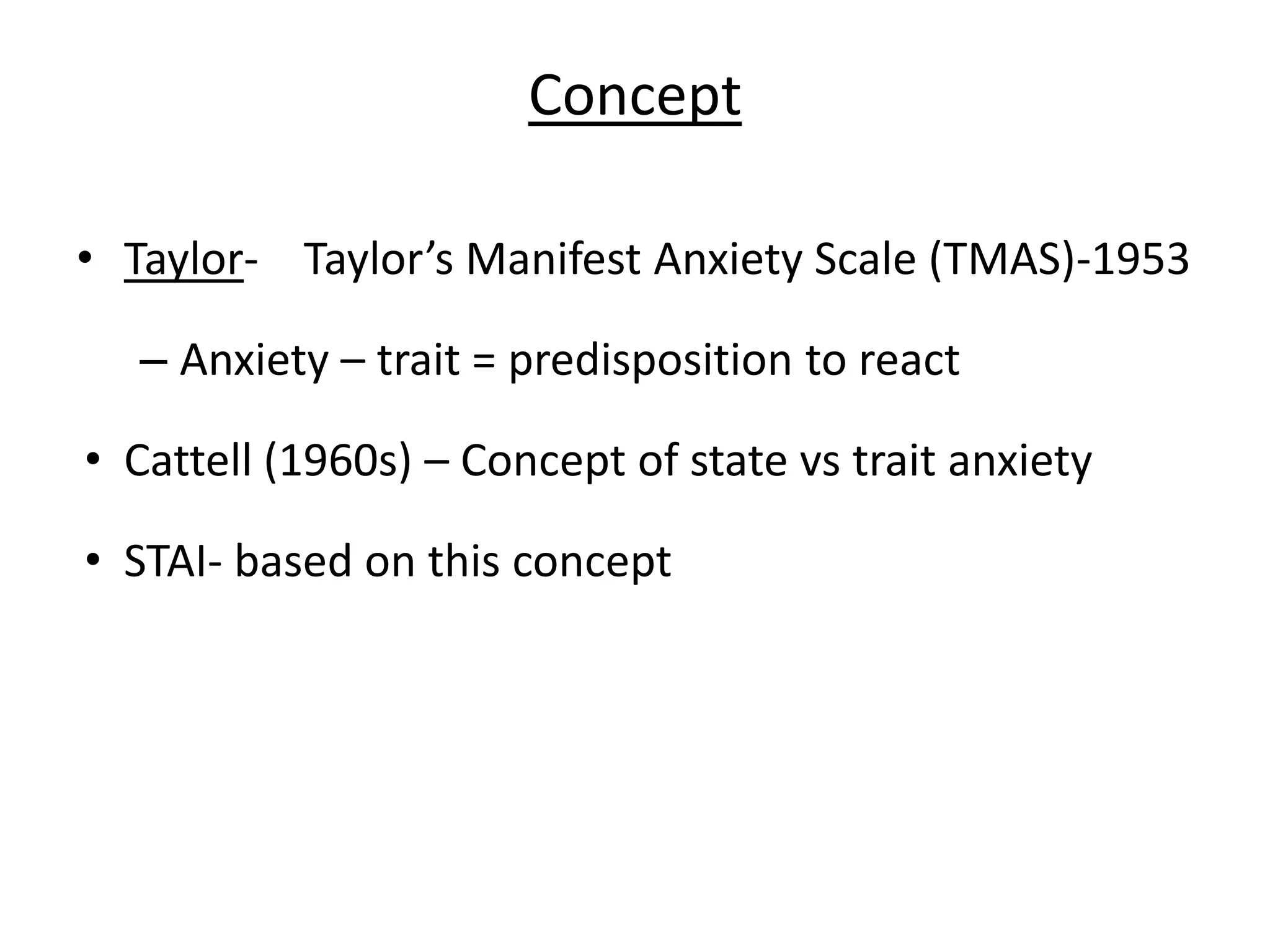
• Taylor- Taylor’s Manifest Anxiety Scale (TMAS)-1953
– Anxiety – trait = predisposition to react
• Cattell (1960s) – Concept of state vs trait anxiety
• STAI- based on this concept
Administration
• Self report
• 10 min
• >16 yrs, with at least a 6th grade level comprehension
Description/ Components
• Two categories-
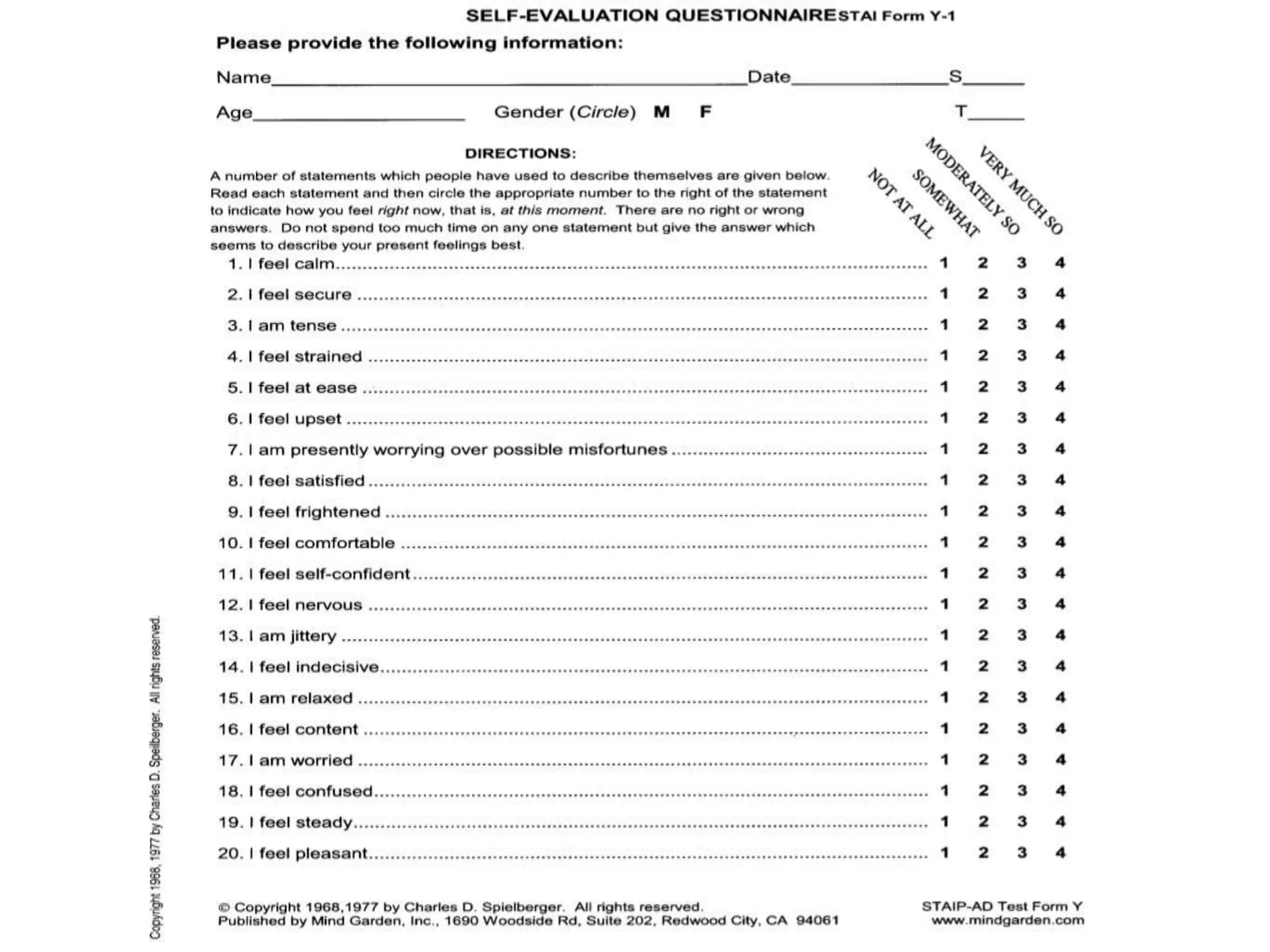
– State Anxiety (A-State)- 1-20 (Y-1)
• “How you feel right now, that is, at this
moment.”
– Trait Anxiety (A- Trait) – 21-40 (Y-2)
• “how you generally feel”
–Likert Scale- 1-4
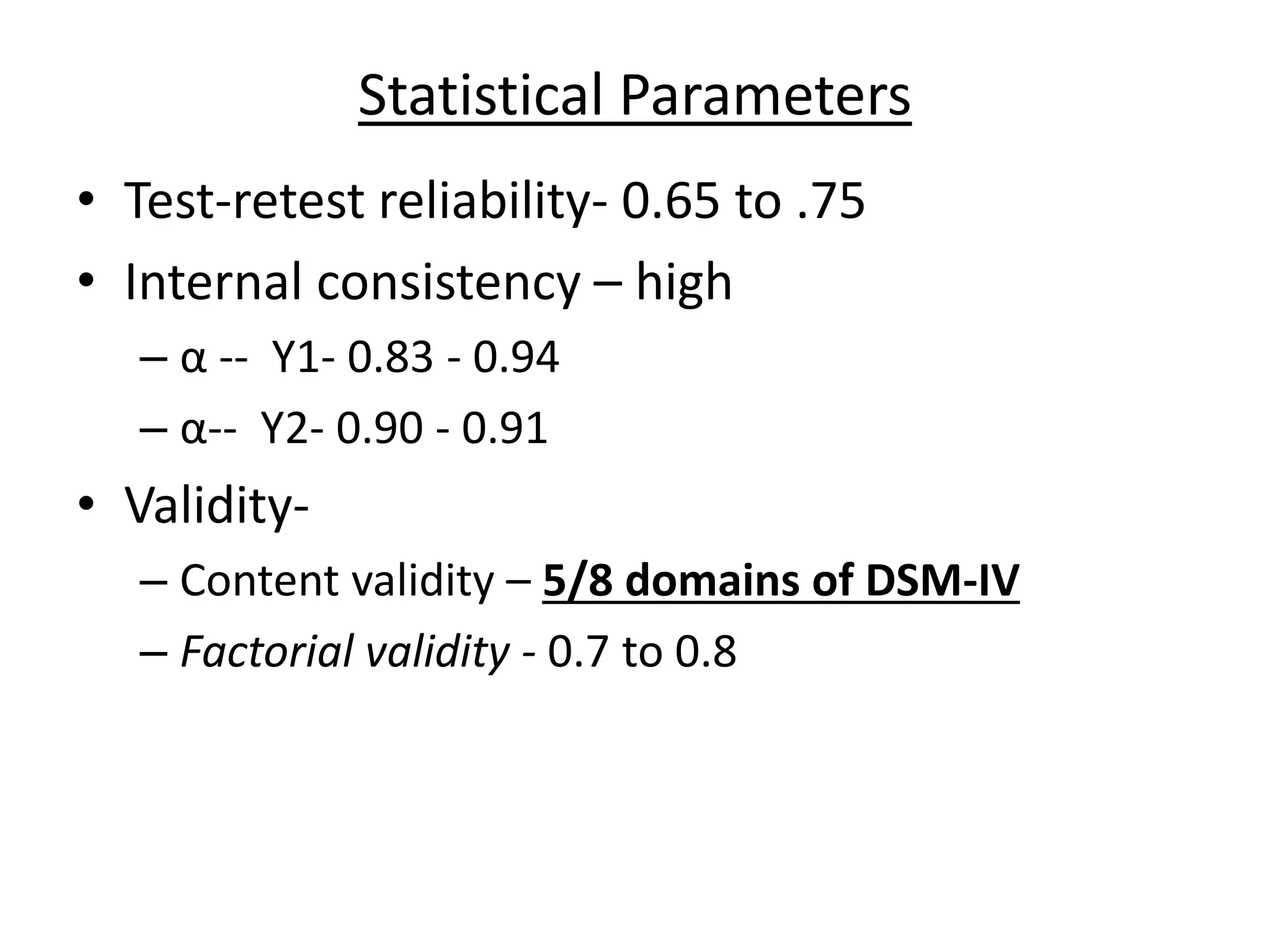
Statistical Parameters
• Test-retest reliability- 0.65 to .75
• Internal consistency – high
– α -- Y1- 0.83 - 0.94
– α-- Y2- 0.90 - 0.91
• Validity-
– Content validity – 5/8 domains of DSM-IV
– Factorial validity - 0.7 to 0.8
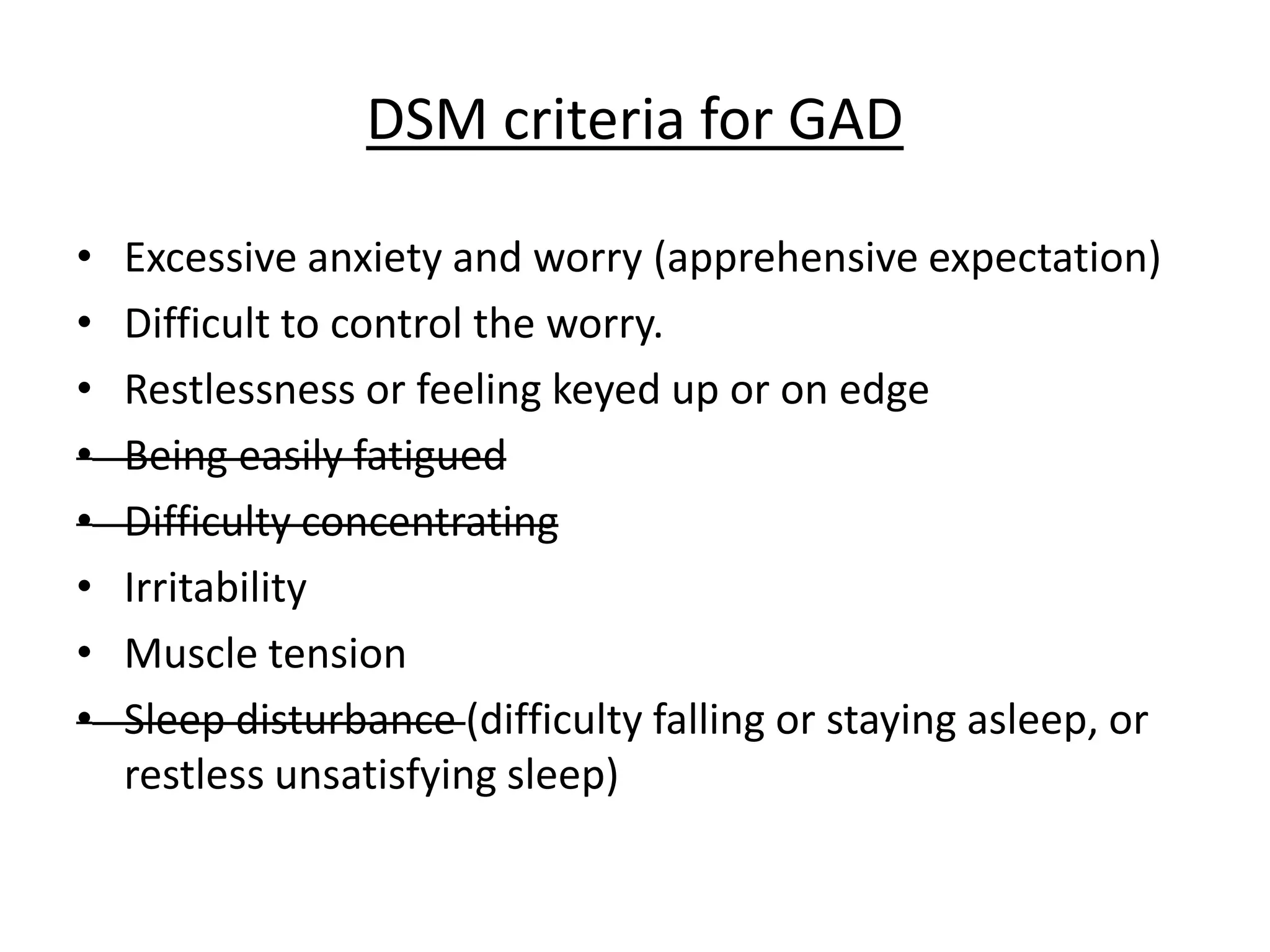
DSM criteria for GAD
• Excessive anxiety and worry (apprehensive expectation)
• Difficult to control the worry.
• Restlessness or feeling keyed up or on edge
• Being easily fatigued
• Difficulty concentrating
• Irritability
• Muscle tension
• Sleep disturbance (difficulty falling or staying asleep, or
restless unsatisfying sleep)
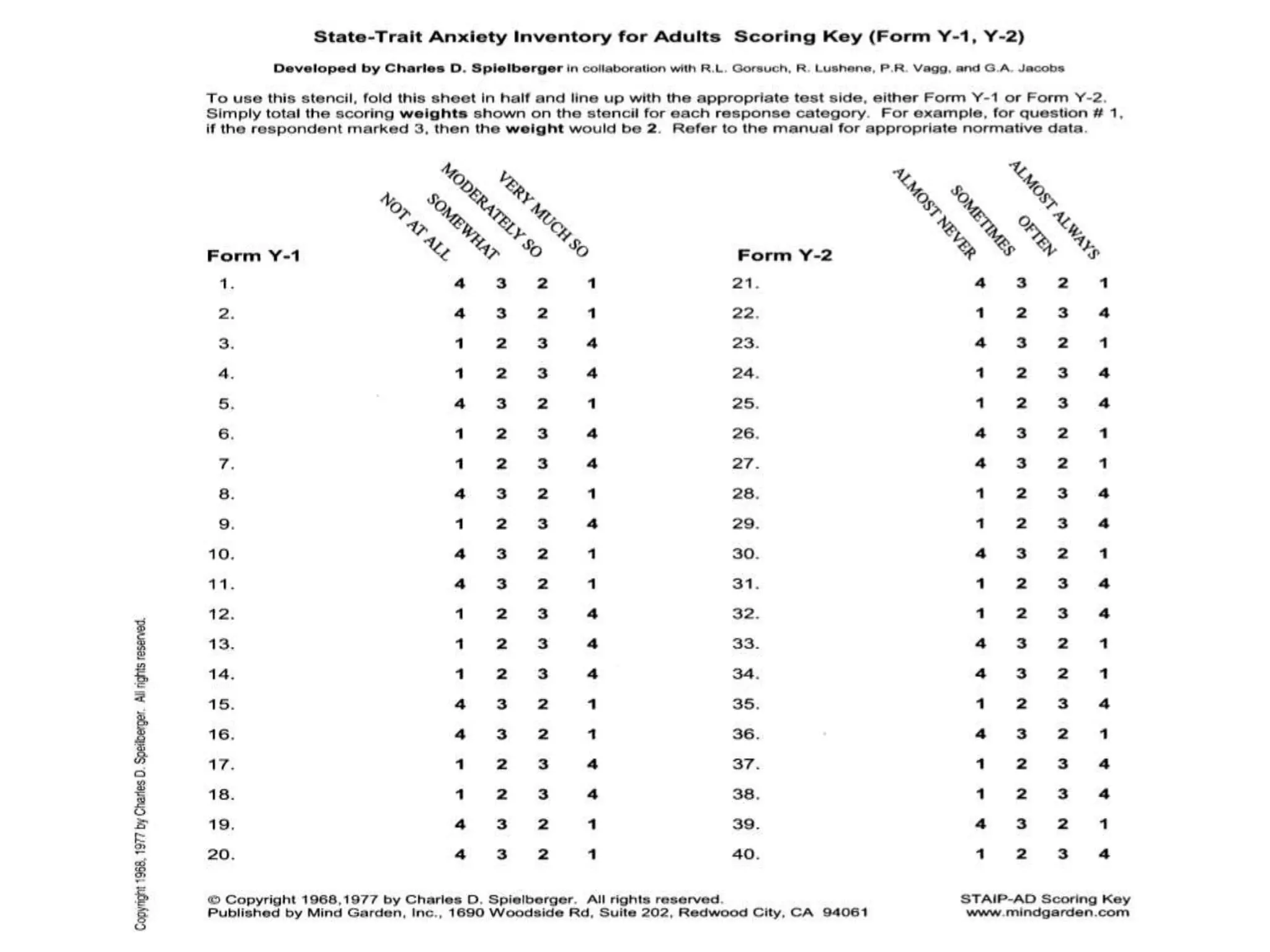
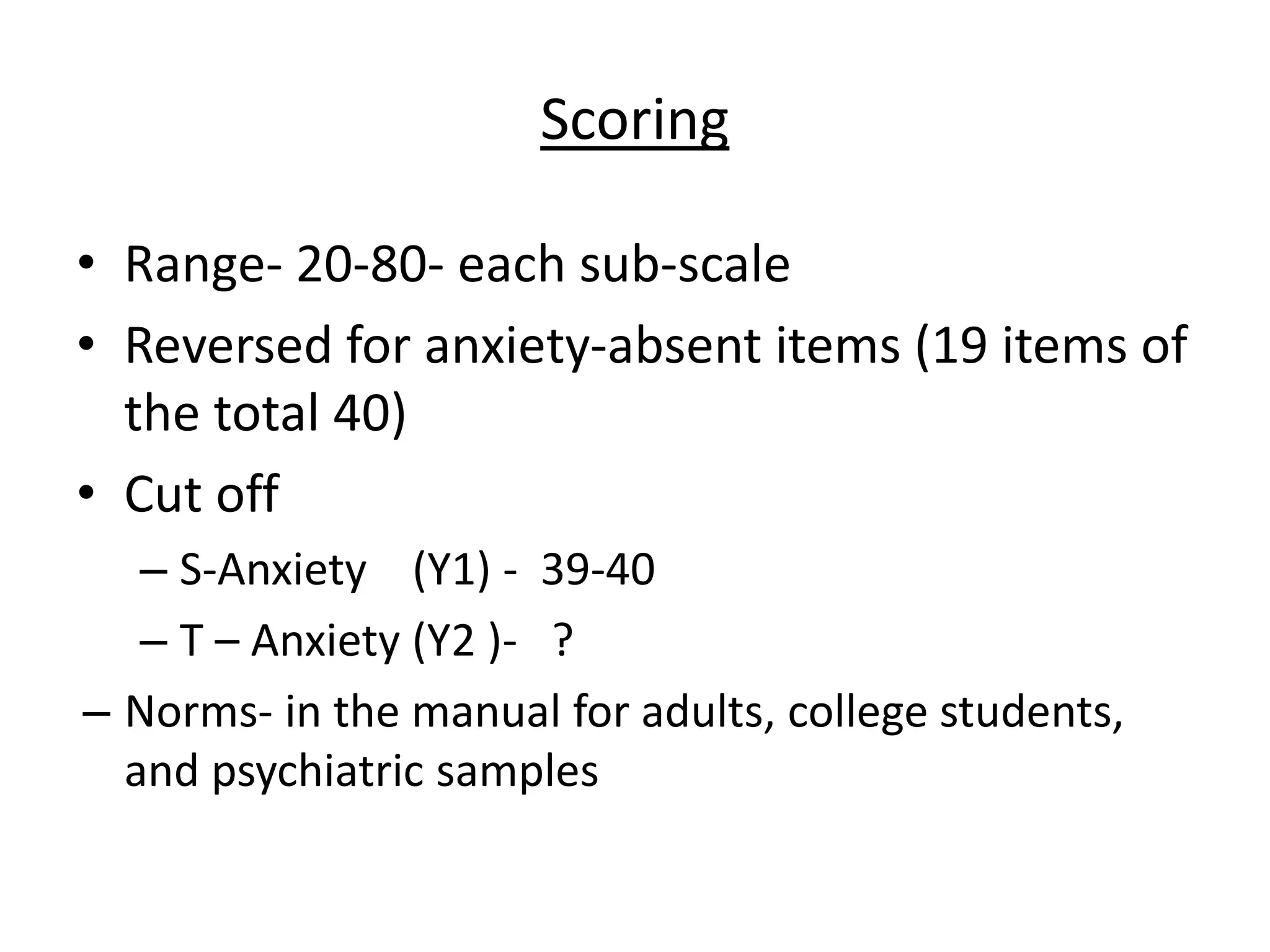
Scoring
• Range- 20-80- each sub-scale
• Reversed for anxiety-absent items (19 items of
the total 40)
• Cut off
– S-Anxiety (Y1) - 39-40
– T – Anxiety (Y2 )- ?
– Norms- in the manual for adults, college students,
and psychiatric samples
Limitations
• Indian Adaptations?
• Education ?
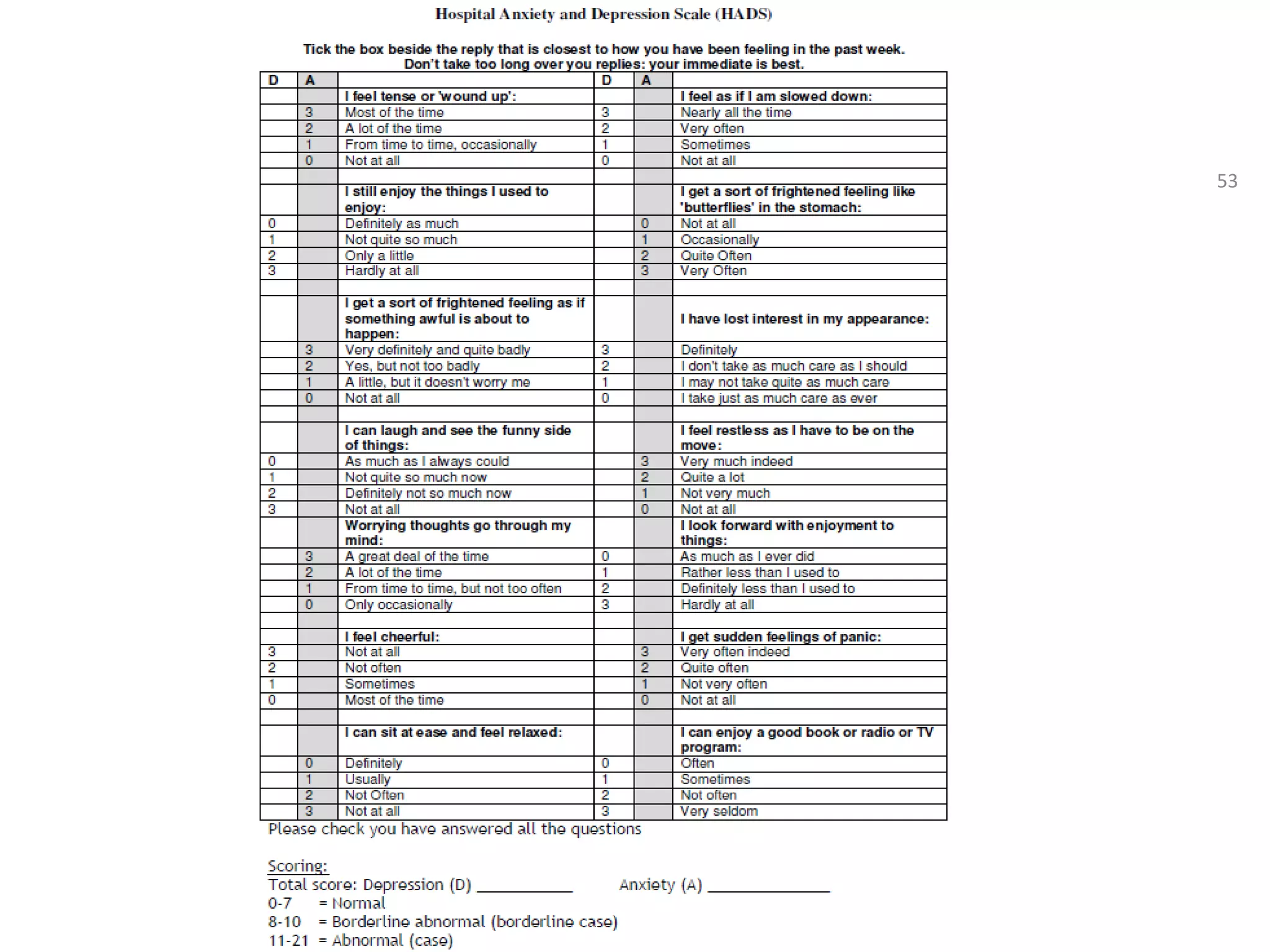
• Hospital Anxiety and Depression Scale
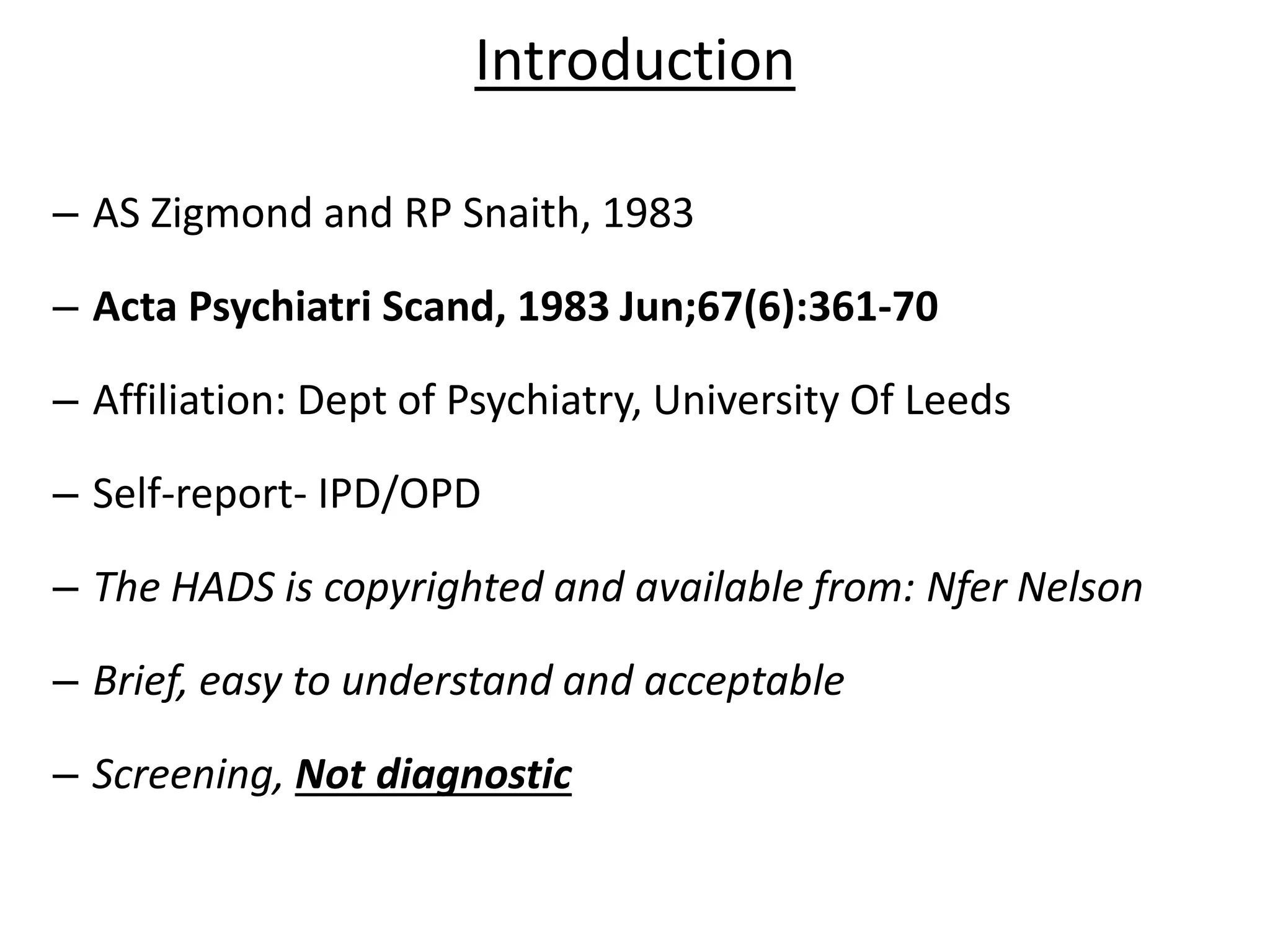
Introduction
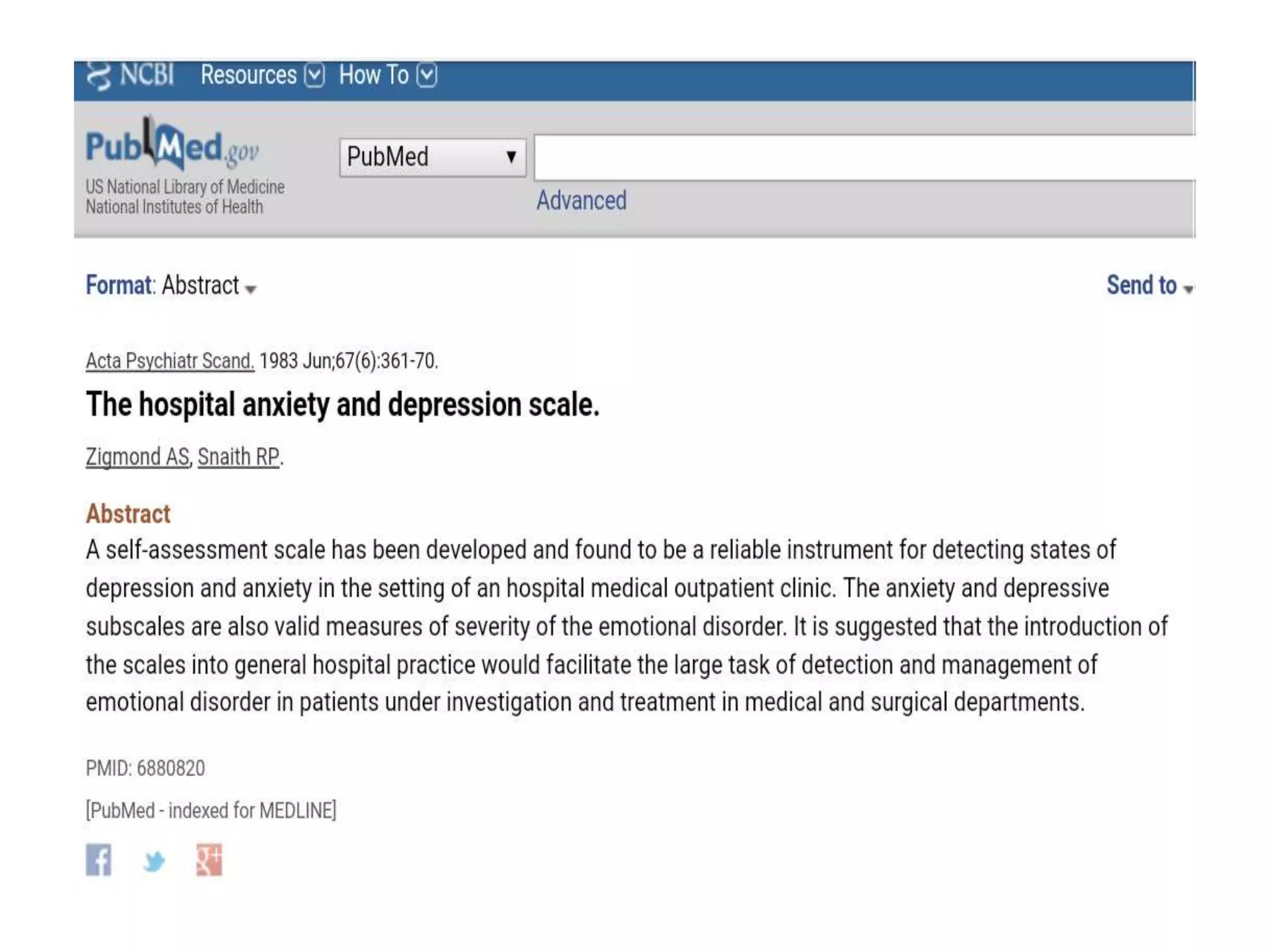
– AS Zigmond and RP Snaith, 1983
– Acta Psychiatri Scand, 1983 Jun;67(6):361-70
– Affiliation: Dept of Psychiatry, University Of Leeds
– Self-report- IPD/OPD
– The HADS is copyrighted and available from: Nfer Nelson
– Brief, easy to understand and acceptable
– Screening, Not diagnostic
Why a separate scale?
• Emotional component of physical illness – sadness/worry
• Anxiety and depression
– somatic symptoms like pain, fatigue, insomnia,
disturbed appetite, weight loss, palpitations, sweating
and GI symptoms
– Increase the distress of physical illness
– Can even confuse the diagnosis
• If diagnosed- respond well to anti-depressant or anxiolytic
treatment
History and Evolution
• 1983- Published – 8 items in each sub-scale
• Aim- To avoid effect of somatic complaints of
illnesses like insomnia/fatigue
• 2-factor model-ie -2 diff emotional conditions
– More acceptable
• One factor model (?)- MDD incl Adjustment
disorder with co-morbid anxiety
Administration
• Self report
• 2-5 min
• “Fill the form to reflect how you have been
feeling over the last one week”
• Literate
• Verbally by examiner for illiterate
53
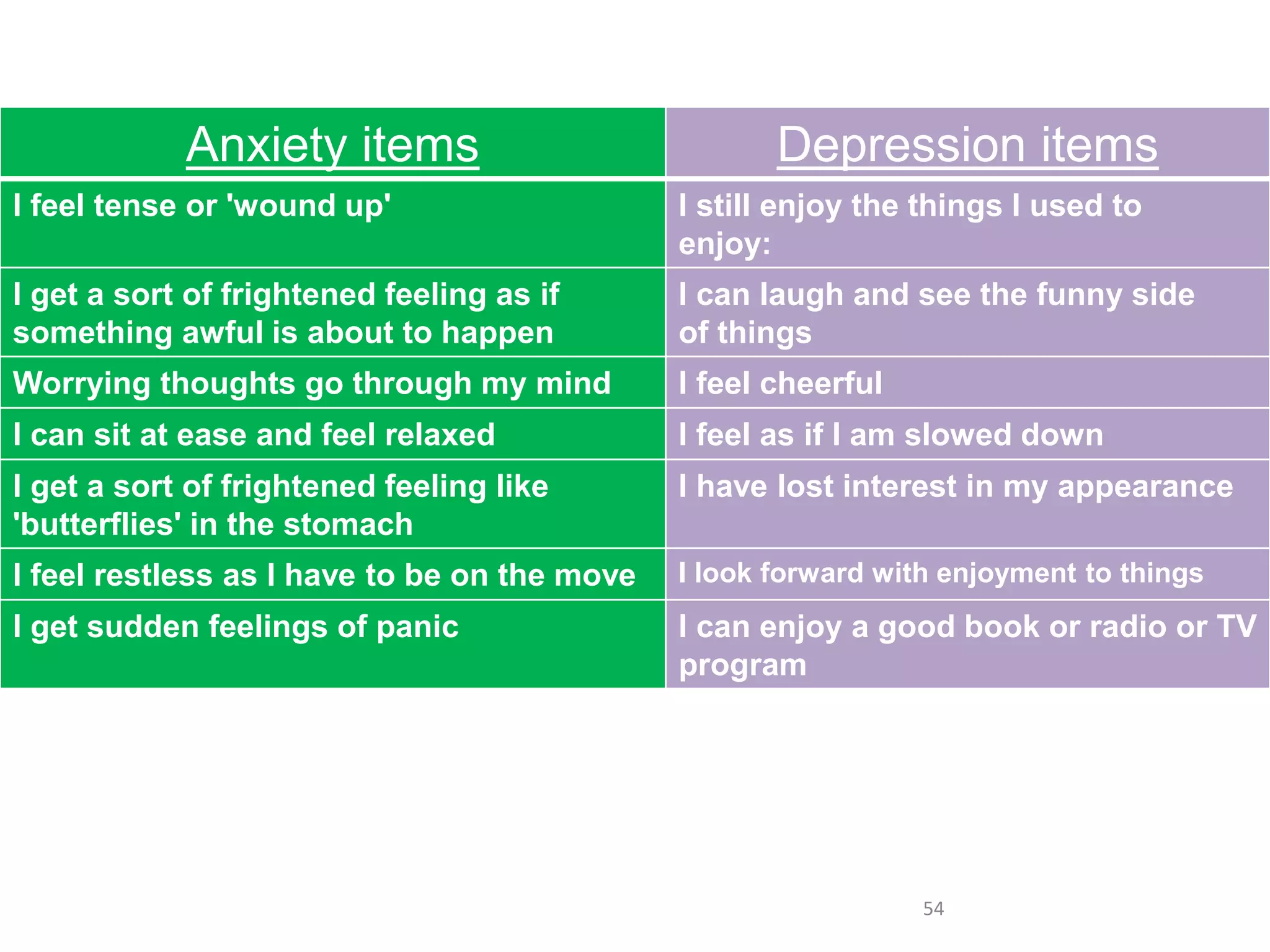
Anxiety items Depression items
I feel tense or 'wound up' I still enjoy the things I used to
enjoy:
I get a sort of frightened feeling as if
something awful is about to happen
I can laugh and see the funny side
of things
Worrying thoughts go through my mind I feel cheerful
I can sit at ease and feel relaxed I feel as if I am slowed down
I get a sort of frightened feeling like
'butterflies' in the stomach
I have lost interest in my appearance
I feel restless as I have to be on the move I look forward with enjoyment to things
I get sudden feelings of panic I can enjoy a good book or radio or TV
program
54
Scoring:
Total score: Depression (D) ___________ Anxiety (A) ______________
0-7 = Normal
8-10 = Borderline abnormal (borderline case)
11-21 = Abnormal (case)
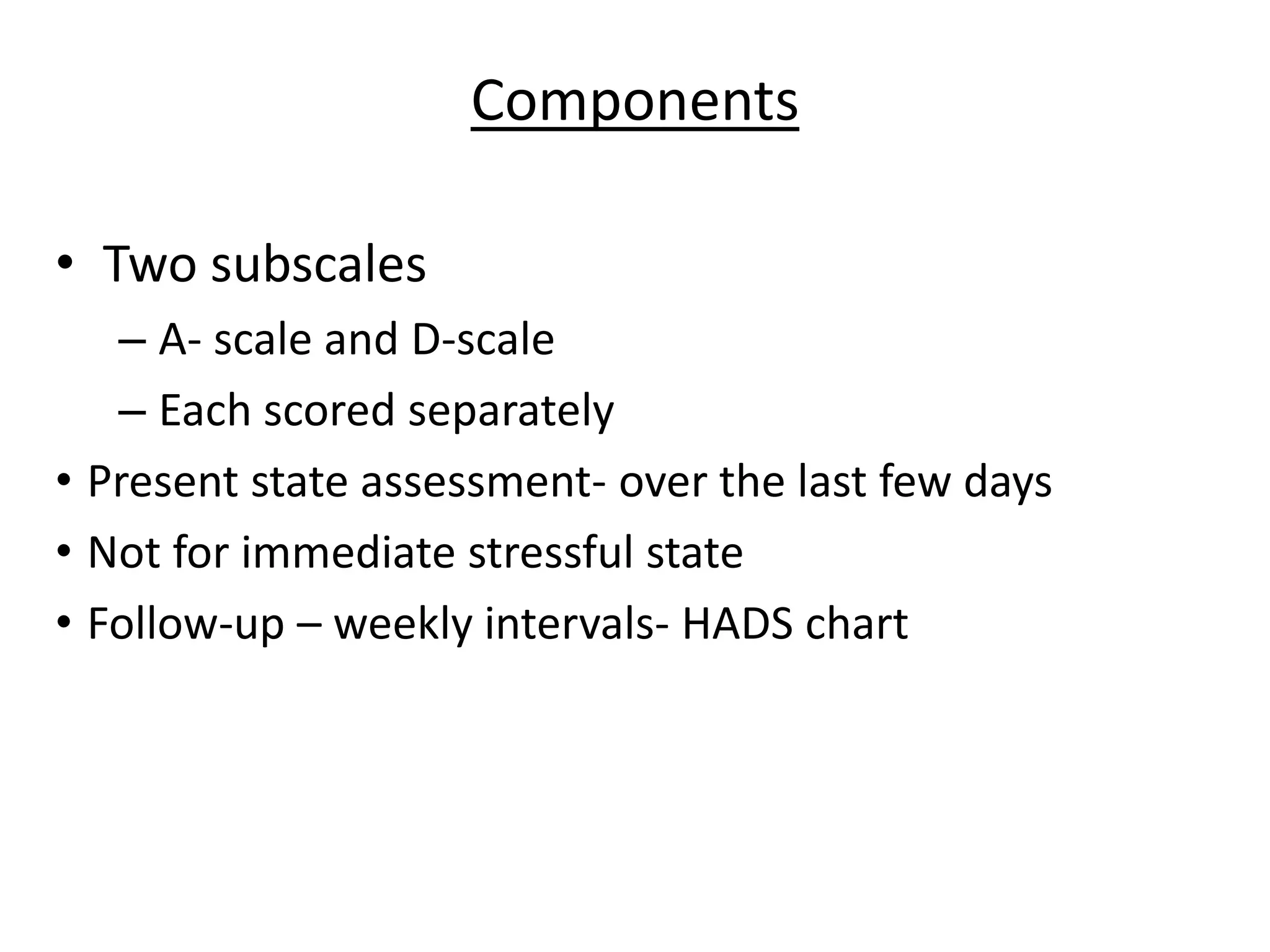
Components
• Two subscales
– A- scale and D-scale
– Each scored separately
• Present state assessment- over the last few days
• Not for immediate stressful state
• Follow-up – weekly intervals- HADS chart
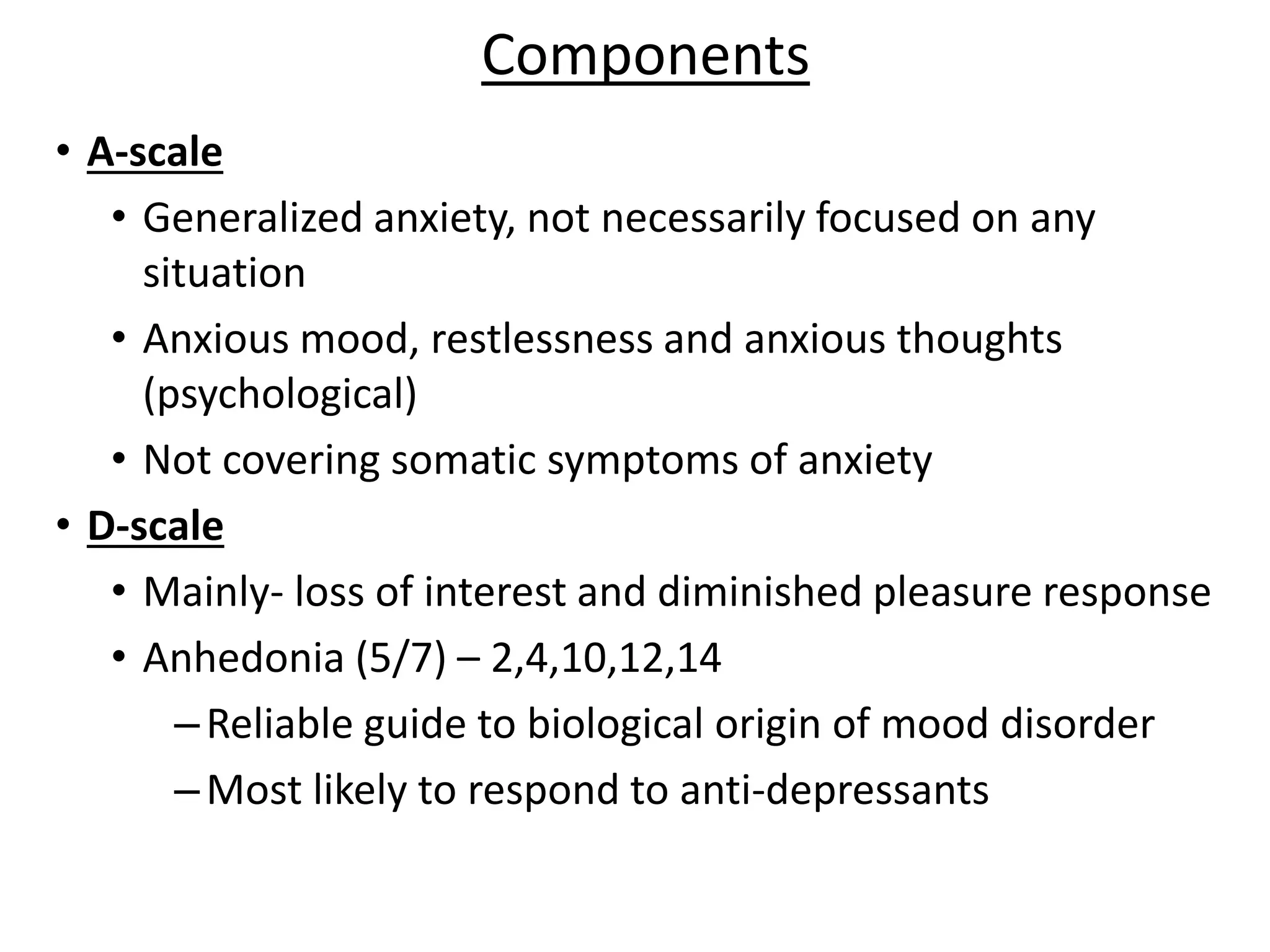
Components
• A-scale
• Generalized anxiety, not necessarily focused on any
situation
• Anxious mood, restlessness and anxious thoughts
(psychological)
• Not covering somatic symptoms of anxiety
• D-scale
• Mainly- loss of interest and diminished pleasure response
• Anhedonia (5/7) – 2,4,10,12,14
–Reliable guide to biological origin of mood disorder
–Most likely to respond to anti-depressants
Scoring
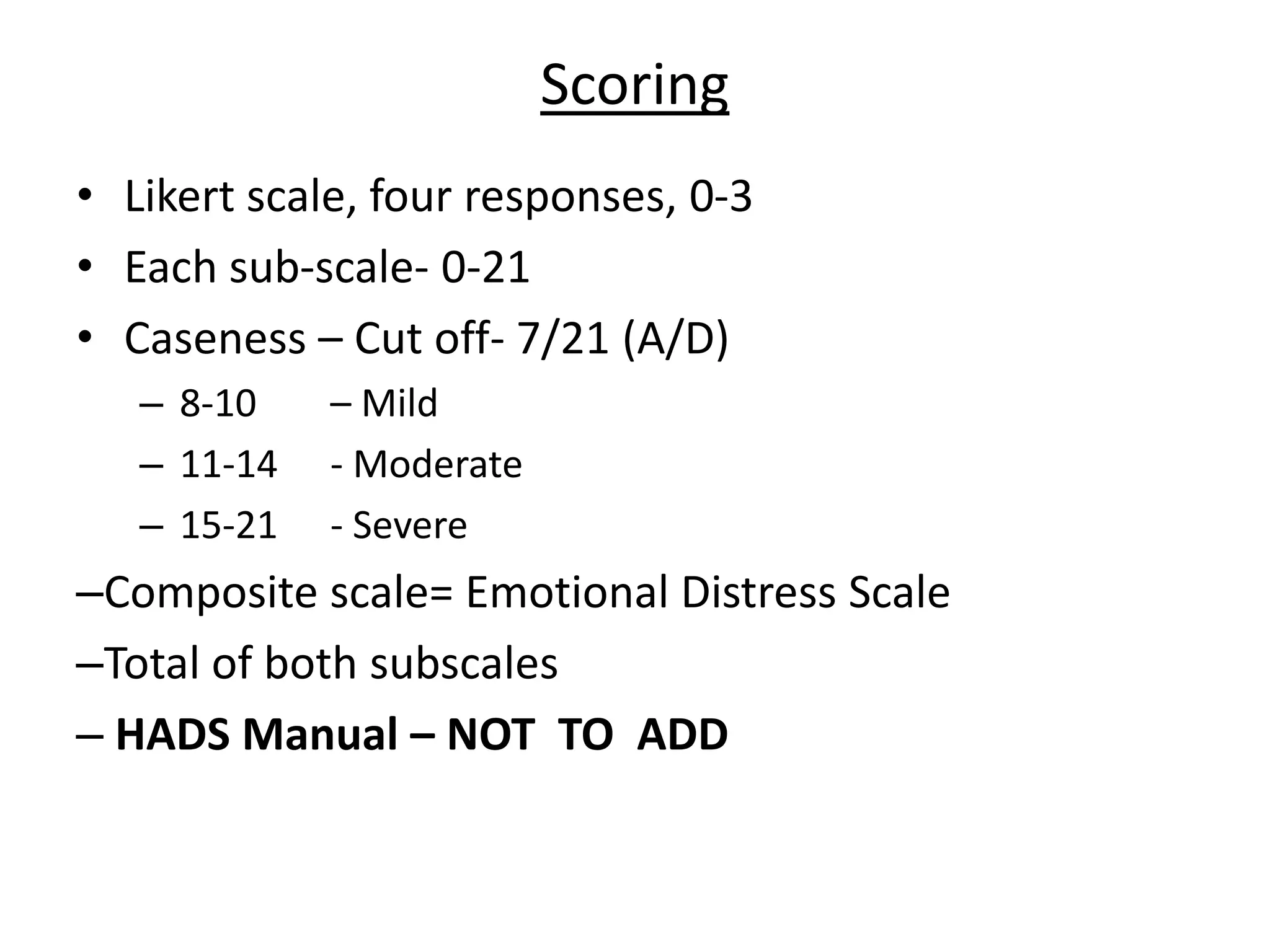
• Likert scale, four responses, 0-3
• Each sub-scale- 0-21
• Caseness – Cut off- 7/21 (A/D)
– 8-10 – Mild
– 11-14 - Moderate
– 15-21 - Severe
–Composite scale= Emotional Distress Scale
–Total of both subscales
– HADS Manual – NOT TO ADD
Statistical Parameters
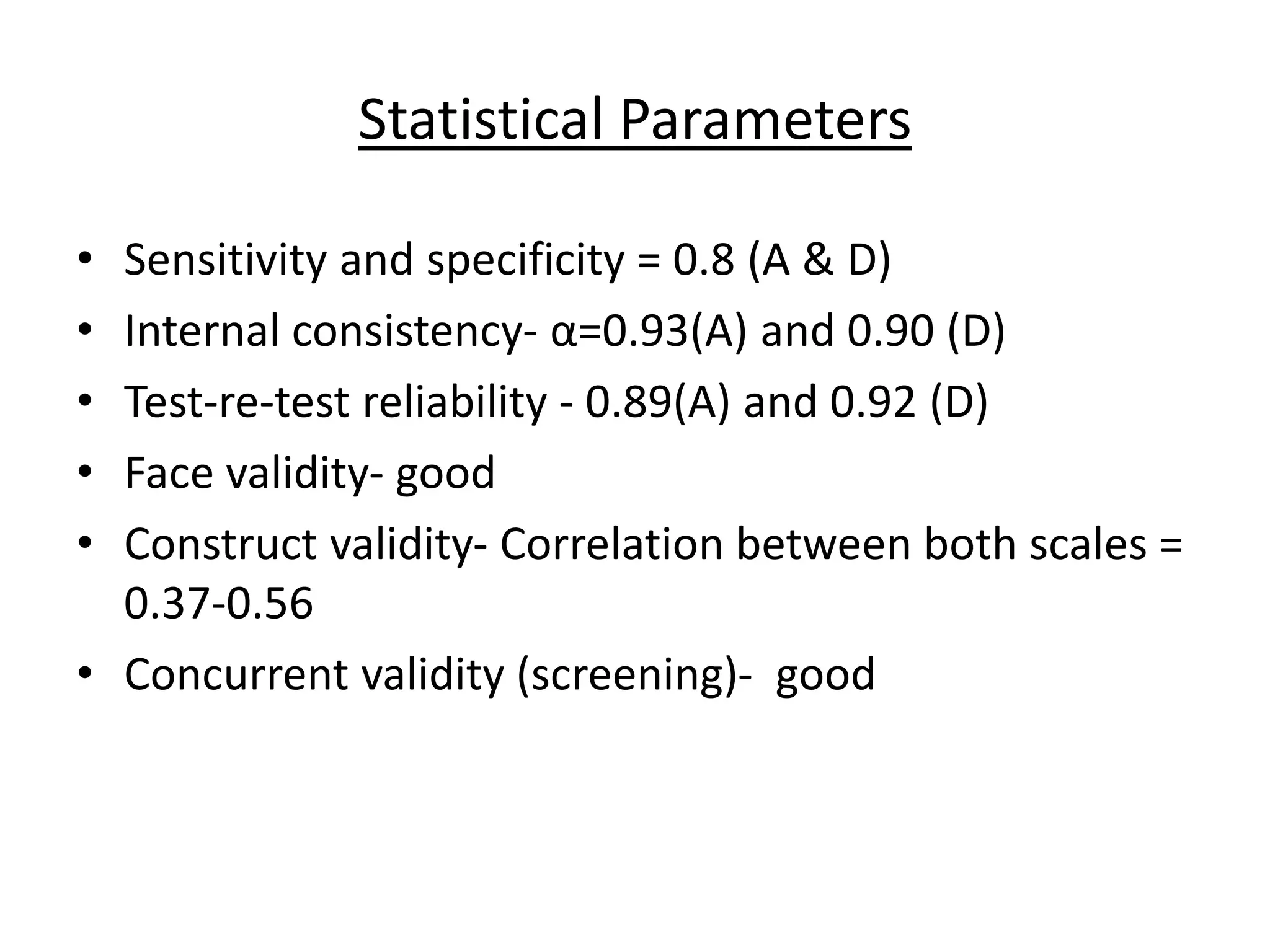
• Sensitivity and specificity = 0.8 (A & D)
• Internal consistency- α=0.93(A) and 0.90 (D)
• Test-re-test reliability - 0.89(A) and 0.92 (D)
• Face validity- good
• Construct validity- Correlation between both scales =
0.37-0.56
• Concurrent validity (screening)- good
Thank you

Anxiety scales tutorial

  • 1.
    Hamilton Anxiety RatingScale State-Trait Anxiety Inventory Hospital Anxiety Depression Scale Dr. Amit Chail
  • 2.
    • Case 1: –65 yr m/o serving Nk admitted in MH CTC, a case of NHL on chemotherapy, h/o fever, nausea and vomiting x10 days. Called for evaluation of disturbed sleep, refusal to eat, episodic restlessness, palpitations, diaphoresis and pacing around in the ward. • Q- Which is the most suitable scale to assess the level of distress of such a patient?
  • 3.
    • Case 2 –35 yr serving NCO in LMC (S2 T-24+24) for moderate depressive episode admitted for recat 2 days back. Reports disturbed sleep, bechaini; looks anxious and has fine digital tremors. – Q- Which psychometric scale? – Q- Which is the best scale for follow up?
  • 4.
  • 5.
    Introduction – HAM-A, HARS –Hamilton M, The assessment of anxiety states by rating. Br J Med Psychol, 1959; 32:50–55 – Affiliation : University of Leeds – Clinician-rated – Severity of anxiety symptoms and their progression – Adults, adolescents and children – Two domains – psychic and somatic – Open access – Not diagnostic
  • 7.
    History and Evolution –First intro- April 1957 at Annual General Meeting of British Psychological Society – Published article -1959 – 13 Item scale- Item No-07- somatic symptoms of a general type – HAM-A (14) (1969, British J Psy) – Somatic (muscular) – Somatic (Sensory) – In already diagnosed cases of Neurotic Anxiety States
  • 8.
    History and Evolution •SIGH-A : Structured Interview Guide for the Hamilton Anxiety Rating scale* • Manual for HAM-A14 (2011)** *Shear M. Katherine, et al, Reliability and validity of a Structured Interview Guide for the Hamilton Anxiety Rating scale (SIGH-A), Depression and anxiety 13:166–178 (2001) **Per Bech (2011). Measuring States of Anxiety with Clinician-Rated and Patient-Rated Scales, Different Views of Anxiety Disorders, Dr. Salih Selek (Ed.), ISBN: 978-953-307-560-0, InTech,
  • 9.
    The Hamilton AnxietyRating Scale • Components: – 14 Items – 1-6 - psychic components – 7-14 - Somatic – To assess the severity of these symptoms
  • 10.
    Administration – Clinician rated, –10-15 min – Scoring – (0-4) Five responses / Likert scale 0- Not present 1- Mild 2- Moderate 3- Severe 4- Very severe
  • 28.
    Statistical Parameters • ScoringTest-retest reliability- Good • Scoring Internal consistency - Good - Cronbach’s alpha=0.77 to 0.92 • Validity Satisfactory, • compared with clinical assessment and Covi anxiety scale http://www.thoracic.org/members/assemblies/assemblies/srn/questionaires/ham-a.php
  • 29.
    Interpretation of scores •Range: 0-56 • <17 - Mild • 18-24 - Mild to moderate • 25-30 - Moderate to severe • 30-56 - Very severe New Norms* 6 to 14 = mild anxiety 15 to 28 = moderate anxiety 29 to 52 = severe anxiety Per Bech (2011). Measuring States of Anxiety with Clinician-Rated and Patient-Rated Scales, Different Views of Anxiety Disorders, Dr. Salih Selek (Ed.), ISBN: 978-953-307-560-0, InTech
  • 30.
    Utility • Assessment ofseverity • Therapeutic decision – Mild - Relaxation techniques – Moderate - OPD- Pharmacotherapy + Relaxation techniques – Severe - IPD •Follow-up- response to therapy
  • 31.
    Limitations • Skewed towardsphysical manifestations • Does not differentiate between anxiety co-morbid with depressive episode or an independent anxiety disorder • Research for therapeutic efficacy of a drug – anxiolytic or anti-depressant??
  • 32.
  • 33.
    Introduction – Charles Spielberger,1968(X), 1977, 1983 (Y) – Affiliation: Dept of Psychology, University of South Florida – Introspective psychological inventory – 40 self-report items pertaining to anxiety affect. – Not Open access
  • 35.
    Applications • Psychological andhealth research • Clinical diagnosis • Differentiating anxiety from depression • Assessment of clinical anxiety in medical, surgical, psychosomatic and psychiatric patients • Intensity of feelings of anxiety • Normal adults • Screen for anxiety disorders • Follow-up
  • 36.
    Concept • State anxiety(Kinetic energy) (cross-sectional) (situational) (as of now) Vs Trait anxiety (potential energy) (propensity or predisposition) (in general) If a situation comes, will the person be in a state of anxiety ?
  • 37.
    Concept • Taylor- Taylor’sManifest Anxiety Scale (TMAS)-1953 – Anxiety – trait = predisposition to react • Cattell (1960s) – Concept of state vs trait anxiety • STAI- based on this concept
  • 38.
    Administration • Self report •10 min • >16 yrs, with at least a 6th grade level comprehension
  • 39.
    Description/ Components • Twocategories- – State Anxiety (A-State)- 1-20 (Y-1) • “How you feel right now, that is, at this moment.” – Trait Anxiety (A- Trait) – 21-40 (Y-2) • “how you generally feel” –Likert Scale- 1-4
  • 43.
    Statistical Parameters • Test-retestreliability- 0.65 to .75 • Internal consistency – high – α -- Y1- 0.83 - 0.94 – α-- Y2- 0.90 - 0.91 • Validity- – Content validity – 5/8 domains of DSM-IV – Factorial validity - 0.7 to 0.8
  • 44.
    DSM criteria forGAD • Excessive anxiety and worry (apprehensive expectation) • Difficult to control the worry. • Restlessness or feeling keyed up or on edge • Being easily fatigued • Difficulty concentrating • Irritability • Muscle tension • Sleep disturbance (difficulty falling or staying asleep, or restless unsatisfying sleep)
  • 45.
    Scoring • Range- 20-80-each sub-scale • Reversed for anxiety-absent items (19 items of the total 40) • Cut off – S-Anxiety (Y1) - 39-40 – T – Anxiety (Y2 )- ? – Norms- in the manual for adults, college students, and psychiatric samples
  • 46.
  • 47.
    • Hospital Anxietyand Depression Scale
  • 48.
    Introduction – AS Zigmondand RP Snaith, 1983 – Acta Psychiatri Scand, 1983 Jun;67(6):361-70 – Affiliation: Dept of Psychiatry, University Of Leeds – Self-report- IPD/OPD – The HADS is copyrighted and available from: Nfer Nelson – Brief, easy to understand and acceptable – Screening, Not diagnostic
  • 50.
    Why a separatescale? • Emotional component of physical illness – sadness/worry • Anxiety and depression – somatic symptoms like pain, fatigue, insomnia, disturbed appetite, weight loss, palpitations, sweating and GI symptoms – Increase the distress of physical illness – Can even confuse the diagnosis • If diagnosed- respond well to anti-depressant or anxiolytic treatment
  • 51.
    History and Evolution •1983- Published – 8 items in each sub-scale • Aim- To avoid effect of somatic complaints of illnesses like insomnia/fatigue • 2-factor model-ie -2 diff emotional conditions – More acceptable • One factor model (?)- MDD incl Adjustment disorder with co-morbid anxiety
  • 52.
    Administration • Self report •2-5 min • “Fill the form to reflect how you have been feeling over the last one week” • Literate • Verbally by examiner for illiterate
  • 53.
  • 54.
    Anxiety items Depressionitems I feel tense or 'wound up' I still enjoy the things I used to enjoy: I get a sort of frightened feeling as if something awful is about to happen I can laugh and see the funny side of things Worrying thoughts go through my mind I feel cheerful I can sit at ease and feel relaxed I feel as if I am slowed down I get a sort of frightened feeling like 'butterflies' in the stomach I have lost interest in my appearance I feel restless as I have to be on the move I look forward with enjoyment to things I get sudden feelings of panic I can enjoy a good book or radio or TV program 54 Scoring: Total score: Depression (D) ___________ Anxiety (A) ______________ 0-7 = Normal 8-10 = Borderline abnormal (borderline case) 11-21 = Abnormal (case)
  • 55.
    Components • Two subscales –A- scale and D-scale – Each scored separately • Present state assessment- over the last few days • Not for immediate stressful state • Follow-up – weekly intervals- HADS chart
  • 56.
    Components • A-scale • Generalizedanxiety, not necessarily focused on any situation • Anxious mood, restlessness and anxious thoughts (psychological) • Not covering somatic symptoms of anxiety • D-scale • Mainly- loss of interest and diminished pleasure response • Anhedonia (5/7) – 2,4,10,12,14 –Reliable guide to biological origin of mood disorder –Most likely to respond to anti-depressants
  • 57.
    Scoring • Likert scale,four responses, 0-3 • Each sub-scale- 0-21 • Caseness – Cut off- 7/21 (A/D) – 8-10 – Mild – 11-14 - Moderate – 15-21 - Severe –Composite scale= Emotional Distress Scale –Total of both subscales – HADS Manual – NOT TO ADD
  • 58.
    Statistical Parameters • Sensitivityand specificity = 0.8 (A & D) • Internal consistency- α=0.93(A) and 0.90 (D) • Test-re-test reliability - 0.89(A) and 0.92 (D) • Face validity- good • Construct validity- Correlation between both scales = 0.37-0.56 • Concurrent validity (screening)- good
  • 59.

Editor's Notes

  • #6 Senior research fellow, Dept of Psy, Based on a paper that Max hamilton presented in April 1957 at Annual General Meeting of British Psychological Society
  • #32 The major problems with the HAM-A are that (1) anxiolytic and antidepressant effects cannot be clearly distinguished; (2) the subscale of somatic anxiety is strongly related to somatic side effects. The applicability of the HAM-A in anxiolytic treatment studies is therefore limited.
  • #34 Spielberger was founding Editor (1973–76) of the American Journal of Community Psychology,[2] official journal of Division 27 (Community Psychology) of the American Psychological Association Cattell used multivariate analyses to examine the structure of questionnaire items deemed to measure anxiety, and empirically distinguished between trait and state components
  • #36 distinguishes between state anxiety (a temporary condition experienced in specific situations) and trait anxiety (a general tendency to perceive situations as threatening). Spielberger drew an analogy with energy: trait anxiety would be equivalent to potential energy, and state to kinetic energy It was originally developed as a research instrument to study anxiety in normal adult population samples, but it can also be used to screen for anxiety disorders and can be used with patient samples
  • #37 Potential energy refers to differences in the amount of kinetic energy associated with a particular physical object, which may be released if triggered by an appropriate force. Trait Anxiety implies differences between people in the disposition to respond to stressful situations with varying amounts of S-Anxiety. But whether or not people who differ in T-Anxiety will show corresponding differences in S-Anxiety depends on the extent to which each of them perceives a speciific situation as psychologically dangerous or threatening, and this is greatly influenced by each individual’s past experience
  • #38 Early measures of anxiety such as Taylor’s 1953 Manifest Anxiety Scale (TMAS) characterized anxiety as a trait or personality predisposition to react in a particular way to stressful situations . During the 1960s, Cattell used multivariate analyses to examine the structure of questionnaire items deemed to measure anxiety, and empirically distinguished between trait and state components
  • #39 distinguishes between state anxiety (a temporary condition experienced in specific situations) and trait anxiety (a general tendency to perceive situations as threatening). Spielberger drew an analogy with energy: trait anxiety would be equivalent to potential energy, and state to kinetic energy It was originally developed as a research instrument to study anxiety in normal adult population samples, but it can also be used to screen for anxiety disorders and can be used with patient samples
  • #40 The State-Trait Anxiety Inventory Form Y is the definitive instrument for measuring anxiety in adults. The STAI clearly differentiates between the temporary condition of "state anxiety" and the moregeneral and long-standing quality of "trait anxiety." Scale: State Anxiety (S-Anxiety) The essential qualities evaluated by the STAI S-Anxiety scale are feelings of apprehension, tension, nervousness, and worry. Scores on the STAI S-Anxiety scale increase in response to physical danger and psychological stress, and decrease as a result of relaxation training. Scale: Trait Anxiety (T-Anxiety) On the STAI T-Anxiety scale, consistent with the trait anxiety construct, psychoneurotic and depressed patients generally have high scores. More information about S-Anxiety: Evaluates how respondents felt at a particular time in the recent past and how they anticipate they will feel either in a specific situation that is likely to be encountered in the future or in a variety of hypothetical situations. Is found to be a sensitive indicator of changes in transitory anxiety experienced by clients and patients in counseling, psychotherapy, and behavior-modification programs. Assesses the level induced by stressful experimental procedures and by unavoidable real-life stressors such as imminent surgery, dental treatment, job interviews, or important school tests. For screening high school and college students and military recruits for anxiety problems, and for evaluating the immediate and long-term outcome of psychotherapy, counseling, behavior modification, and drug-treatment programs.
  • #44 Internal consistency coefficients for the scale have ranged from .86 to .95; test-retest reliability coefficients have ranged from .65 to .75 over a 2month interval (Spielberger et al., 1983). Test-retest coefficients for this measure in the present study ranged from .69 to .89. Considerable evidence attests to the construct and concurrent validity of the scale (Spielberger, 1989) Validity Content validity was assessed by Okun et al., who noted that the STAI covered five of eight domains for generalized anxiety disorder in the DSM-IV Factorial validity. As state and trait are considered conceptually distinct but related constructs, numerous studies have commented on the empirical relationship between the two facets of the STAI. Correlations between state and trait scales typically fall in the range of 0.7 to 0.8
  • #46 Score interpretation—Range of scores for each subtest is 20–80, the higher score indicating greater anxiety. A cut point of 39–40 has been suggested to detect clinically significant symptoms for the S-Anxiety scale (9,10); however, other studies have suggested a higher cut score of 54–55 for older adults (11). Normative values are available in the manual (12) for adults, college students, and psychiatric samples.
  • #49 The Hospital Anxiety And Depression Scale, Zigmond and Snaith*, In dept of Psychiatry, University Of Leeds The initial study – OPD patients Health and Quality of Life Outcomes 2003, 1:29
  • #51 Physical illnesses may result in emotional manifestations like distress or sadness of mood due to pain and anxiety due to chronic illness Also states of anxiety and depression may present with somatic symptoms like pain, fatigue, insomnia, disturbed appetite, palpitaions, sweating and GI symptoms Also states of anxiety and depression – increase the distress of physical illness Can even confuse the diagnosis If diagnosed- responds well to anti-depressant or anxiolytic treatment
  • #52 Aim- To avoid effect of somatic complaints of illnesses like insomnia/fatigue which may be mistaken as depression or anxiety
  • #55 HADS was originally developed by Zigmond and Snaith (1983) . The HADS is a fourteen item scale . Seven of the items relate to anxiety and seven relate to depression. Zigmond and Snaith created this specifically to avoid reliance on aspects of depression and anxiety ,which are also common a part of physical illness, for example fatigue and insomnia or hypersomnia. Thus this tool was uswed for the detection of anxiety and depression in people with physical health problems