Anxiety
and its effect on performance
Aims and Objectives
Understand what anxiety is and what form it can
take
Explain how anxiety may affect performance
Describe how levels of anxiety can be measured
Explain the different ways in which performers
may try to control anxiety
Evaluate the benefits of goal setting methods
used to set goals
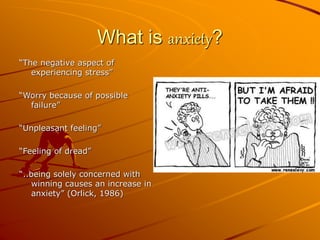
What is anxiety?
“The negative aspect of
experiencing stress”
“Worry because of possible
failure”
“Unpleasant feeling”
“Feeling of dread”
“..being solely concerned with
winning causes an increase in
anxiety” (Orlick, 1986)
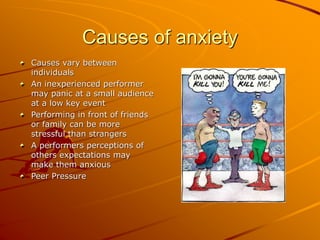
Causes of anxiety
Causes vary between
individuals
An inexperienced performer
may panic at a small audience
at a low key event
Performing in front of friends
or family can be more
stressful than strangers
A performers perceptions of
others expectations may
make them anxious
Peer Pressure
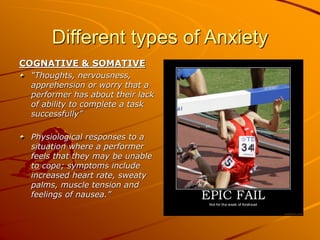
Different types of Anxiety
COGNATIVE & SOMATIVE
“Thoughts, nervousness,
apprehension or worry that a
performer has about their lack
of ability to complete a task
successfully”
Physiological responses to a
situation where a performer
feels that they may be unable
to cope; symptoms include
increased heart rate, sweaty
palms, muscle tension and
feelings of nausea.”
State & Trait
State Anxiety
Emotional state
“Characterised by subjective,
consciously perceived feelings of
apprehension and tension
accompanied by or associated with
activation or arousal of the autonomic
nervous system” (Speilberger, 1966)
Level of state anxiety would
change during an
activity/performance
Eg. Basketball – higher level
of SA before tip off - lower
level as settle into game –
very high in closing seconds
of a 2 point game
“Anxiety felt in a particular
situation”
Trait Anxiety
As a personality trait
E.g. two kickers in a rugby
match, one has high trait
anxiety, the other has low
trait anxiety – How would
they react to a last second
penalty kick to win a
match??
Low trait = “laid back”
High trait = “finds all
situations threatening”
Winners or losers?
Measuring Anxiety
Both state and trait anxiety can affect performance and so
need to be studied and measured
Examples:
– Somatic anxiety = heart rate, muscle tension, sweating
– Cognitive = Observations, questionnaires
What problems can you see with these?
Questionnaires
3 questionnaires are used
1. The State-Trait Anxiety Inventory (STAI)
2. The Sport Competition Anxiety Test (SCAT)
3. The Competitive State Anxiety Inventory-2
(CSAI-2)
http://www.brianmac.co.uk/scat.htm

ANXIETY.ppt

  • 1.
    Anxiety and its effecton performance
  • 2.
    Aims and Objectives Understandwhat anxiety is and what form it can take Explain how anxiety may affect performance Describe how levels of anxiety can be measured Explain the different ways in which performers may try to control anxiety Evaluate the benefits of goal setting methods used to set goals
  • 3.
    What is anxiety? “Thenegative aspect of experiencing stress” “Worry because of possible failure” “Unpleasant feeling” “Feeling of dread” “..being solely concerned with winning causes an increase in anxiety” (Orlick, 1986)
  • 6.
    Causes of anxiety Causesvary between individuals An inexperienced performer may panic at a small audience at a low key event Performing in front of friends or family can be more stressful than strangers A performers perceptions of others expectations may make them anxious Peer Pressure
  • 7.
    Different types ofAnxiety COGNATIVE & SOMATIVE “Thoughts, nervousness, apprehension or worry that a performer has about their lack of ability to complete a task successfully” Physiological responses to a situation where a performer feels that they may be unable to cope; symptoms include increased heart rate, sweaty palms, muscle tension and feelings of nausea.”
  • 8.
    State & Trait StateAnxiety Emotional state “Characterised by subjective, consciously perceived feelings of apprehension and tension accompanied by or associated with activation or arousal of the autonomic nervous system” (Speilberger, 1966) Level of state anxiety would change during an activity/performance Eg. Basketball – higher level of SA before tip off - lower level as settle into game – very high in closing seconds of a 2 point game “Anxiety felt in a particular situation” Trait Anxiety As a personality trait E.g. two kickers in a rugby match, one has high trait anxiety, the other has low trait anxiety – How would they react to a last second penalty kick to win a match?? Low trait = “laid back” High trait = “finds all situations threatening”
  • 9.
  • 10.
    Measuring Anxiety Both stateand trait anxiety can affect performance and so need to be studied and measured Examples: – Somatic anxiety = heart rate, muscle tension, sweating – Cognitive = Observations, questionnaires What problems can you see with these?
  • 11.
    Questionnaires 3 questionnaires areused 1. The State-Trait Anxiety Inventory (STAI) 2. The Sport Competition Anxiety Test (SCAT) 3. The Competitive State Anxiety Inventory-2 (CSAI-2) http://www.brianmac.co.uk/scat.htm