ARCHITECT
ANTONIO GAUDI


BY: SRISHTI SHUBH
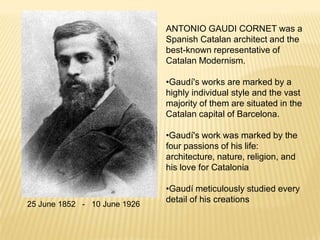
ANTONIO GAUDI CORNET was a
                              Spanish Catalan architect and the
                              best-known representative of
                              Catalan Modernism.

                              •Gaudí's works are marked by a
                              highly individual style and the vast
                              majority of them are situated in the
                              Catalan capital of Barcelona.

                              •Gaudí's work was marked by the
                              four passions of his life:
                              architecture, nature, religion, and
                              his love for Catalonia

                              •Gaudí meticulously studied every
                              detail of his creations
25 June 1852 - 10 June 1926
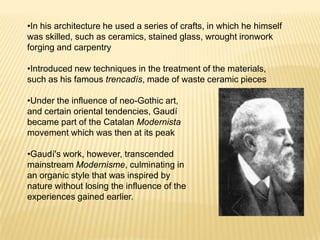
•In his architecture he used a series of crafts, in which he himself
was skilled, such as ceramics, stained glass, wrought ironwork
forging and carpentry

•Introduced new techniques in the treatment of the materials,
such as his famous trencadís, made of waste ceramic pieces

•Under the influence of neo-Gothic art,
and certain oriental tendencies, Gaudí
became part of the Catalan Modernista
movement which was then at its peak

•Gaudí's work, however, transcended
mainstream Modernisme, culminating in
an organic style that was inspired by
nature without losing the influence of the
experiences gained earlier.
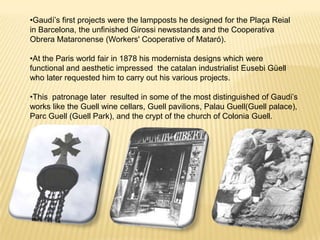
•Gaudí’s first projects were the lampposts he designed for the Plaça Reial
in Barcelona, the unfinished Girossi newsstands and the Cooperativa
Obrera Mataronense (Workers' Cooperative of Mataró).

•At the Paris world fair in 1878 his modernista designs which were
functional and aesthetic impressed the catalan industrialist Eusebi Güell
who later requested him to carry out his various projects.

•This patronage later resulted in some of the most distinguished of Gaudi’s
works like the Guell wine cellars, Guell pavilions, Palau Guell(Guell palace),
Parc Guell (Guell Park), and the crypt of the church of Colonia Guell.
HIS WORKS
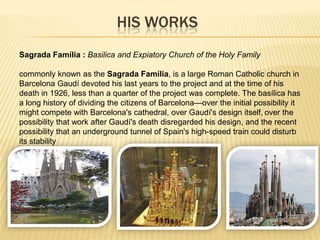
Sagrada Família : Basilica and Expiatory Church of the Holy Family

commonly known as the Sagrada Família, is a large Roman Catholic church in
Barcelona Gaudí devoted his last years to the project and at the time of his
death in 1926, less than a quarter of the project was complete. The basílica has
a long history of dividing the citizens of Barcelona—over the initial possibility it
might compete with Barcelona's cathedral, over Gaudí's design itself, over the
possibility that work after Gaudí's death disregarded his design, and the recent
possibility that an underground tunnel of Spain's high-speed train could disturb
its stability
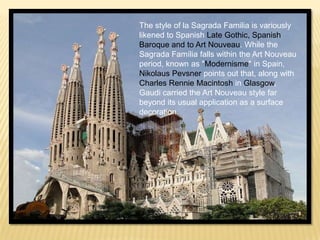
The style of la Sagrada Familia is variously
likened to Spanish Late Gothic, Spanish
Baroque and to Art Nouveau. While the
Sagrada Família falls within the Art Nouveau
period, known as "Modernisme" in Spain,
Nikolaus Pevsner points out that, along with
Charles Rennie Macintosh in Glasgow,
Gaudi carried the Art Nouveau style far
beyond its usual application as a surface
decoration.
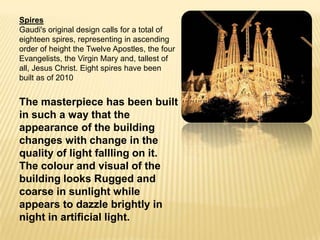
Spires
Gaudi's original design calls for a total of
eighteen spires, representing in ascending
order of height the Twelve Apostles, the four
Evangelists, the Virgin Mary and, tallest of
all, Jesus Christ. Eight spires have been
built as of 2010


The masterpiece has been built
in such a way that the
appearance of the building
changes with change in the
quality of light fallling on it.
The colour and visual of the
building looks Rugged and
coarse in sunlight while
appears to dazzle brightly in
night in artificial light.
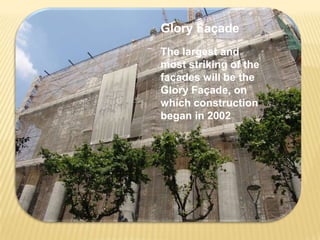
Glory Façade
The largest and
most striking of the
facades will be the
Glory Façade, on
which construction
began in 2002
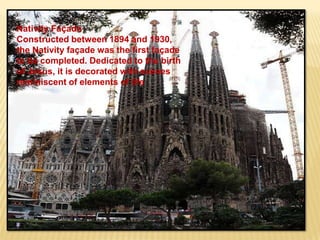
Nativity Façade
Constructed between 1894 and 1930,
the Nativity façade was the first façade
to be completed. Dedicated to the birth
of Jesus, it is decorated with scenes
reminiscent of elements of life
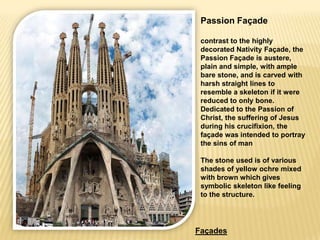
Passion Façade

 contrast to the highly
 decorated Nativity Façade, the
 Passion Façade is austere,
 plain and simple, with ample
 bare stone, and is carved with
 harsh straight lines to
 resemble a skeleton if it were
 reduced to only bone.
 Dedicated to the Passion of
 Christ, the suffering of Jesus
 during his crucifixion, the
 façade was intended to portray
 the sins of man

 The stone used is of various
 shades of yellow ochre mixed
 with brown which gives
 symbolic skeleton like feeling
 to the structure.


Façades
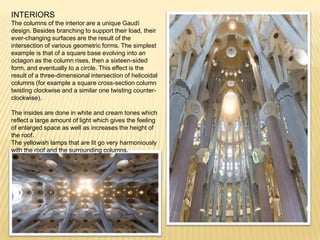
INTERIORS
The columns of the interior are a unique Gaudí
design. Besides branching to support their load, their
ever-changing surfaces are the result of the
intersection of various geometric forms. The simplest
example is that of a square base evolving into an
octagon as the column rises, then a sixteen-sided
form, and eventually to a circle. This effect is the
result of a three-dimensional intersection of helicoidal
columns (for example a square cross-section column
twisting clockwise and a similar one twisting counter-
clockwise).

The insides are done in white and cream tones which
reflect a large amount of light which gives the feeling
of enlarged space as well as increases the height of
the roof.
The yellowish lamps that are lit go very harmoniously
with the roof and the surrounding columns.
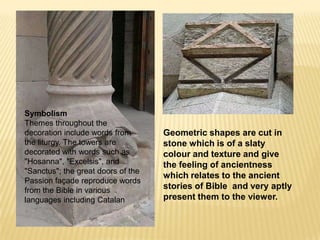
Symbolism
Themes throughout the
decoration include words from       Geometric shapes are cut in
the liturgy. The towers are         stone which is of a slaty
decorated with words such as        colour and texture and give
"Hosanna", "Excelsis", and          the feeling of ancientness
"Sanctus"; the great doors of the
                                    which relates to the ancient
Passion façade reproduce words
from the Bible in various           stories of Bible and very aptly
languages including Catalan         present them to the viewer.
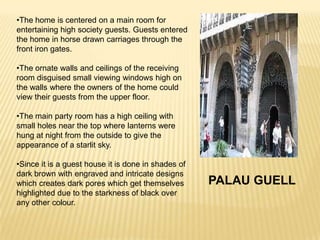
•The home is centered on a main room for
entertaining high society guests. Guests entered
the home in horse drawn carriages through the
front iron gates.

•The ornate walls and ceilings of the receiving
room disguised small viewing windows high on
the walls where the owners of the home could
view their guests from the upper floor.

•The main party room has a high ceiling with
small holes near the top where lanterns were
hung at night from the outside to give the
appearance of a starlit sky.

•Since it is a guest house it is done in shades of
dark brown with engraved and intricate designs
which creates dark pores which get themselves        PALAU GUELL
highlighted due to the starkness of black over
any other colour.
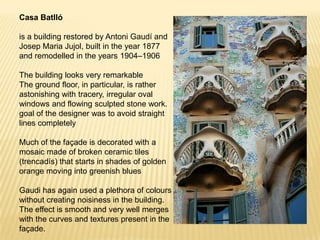
Casa Batlló

is a building restored by Antoni Gaudí and
Josep Maria Jujol, built in the year 1877
and remodelled in the years 1904–1906

The building looks very remarkable
The ground floor, in particular, is rather
astonishing with tracery, irregular oval
windows and flowing sculpted stone work.
goal of the designer was to avoid straight
lines completely

Much of the façade is decorated with a
mosaic made of broken ceramic tiles
(trencadís) that starts in shades of golden
orange moving into greenish blues

Gaudi has again used a plethora of colours
without creating noisiness in the building.
The effect is smooth and very well merges
with the curves and textures present in the
façade.
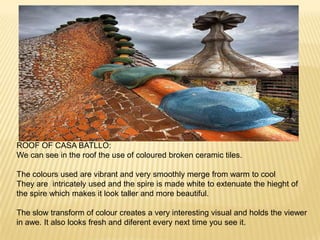
ROOF OF CASA BATLLO:
We can see in the roof the use of coloured broken ceramic tiles.

The colours used are vibrant and very smoothly merge from warm to cool
They are intricately used and the spire is made white to extenuate the hieght of
the spire which makes it look taller and more beautiful.

The slow transform of colour creates a very interesting visual and holds the viewer
in awe. It also looks fresh and diferent every next time you see it.
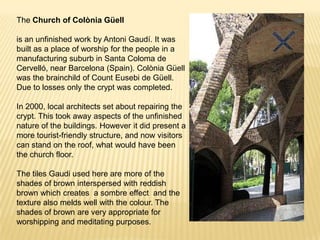
The Church of Colònia Güell

is an unfinished work by Antoni Gaudí. It was
built as a place of worship for the people in a
manufacturing suburb in Santa Coloma de
Cervelló, near Barcelona (Spain). Colònia Güell
was the brainchild of Count Eusebi de Güell.
Due to losses only the crypt was completed.

In 2000, local architects set about repairing the
crypt. This took away aspects of the unfinished
nature of the buildings. However it did present a
more tourist-friendly structure, and now visitors
can stand on the roof, what would have been
the church floor.

The tiles Gaudi used here are more of the
shades of brown interspersed with reddish
brown which creates a sombre effect and the
texture also melds well with the colour. The
shades of brown are very appropriate for
worshipping and meditating purposes.
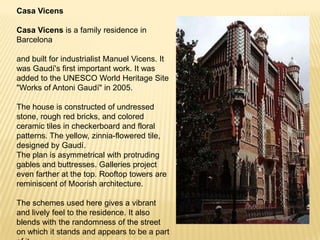
Casa Vicens

Casa Vicens is a family residence in
Barcelona

and built for industrialist Manuel Vicens. It
was Gaudí's first important work. It was
added to the UNESCO World Heritage Site
"Works of Antoni Gaudí" in 2005.

The house is constructed of undressed
stone, rough red bricks, and colored
ceramic tiles in checkerboard and floral
patterns. The yellow, zinnia-flowered tile,
designed by Gaudí.
The plan is asymmetrical with protruding
gables and buttresses. Galleries project
even farther at the top. Rooftop towers are
reminiscent of Moorish architecture.

The schemes used here gives a vibrant
and lively feel to the residence. It also
blends with the randomness of the street
on which it stands and appears to be a part
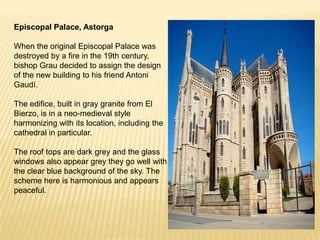
Episcopal Palace, Astorga

When the original Episcopal Palace was
destroyed by a fire in the 19th century,
bishop Grau decided to assign the design
of the new building to his friend Antoni
Gaudí.

The edifice, built in gray granite from El
Bierzo, is in a neo-medieval style
harmonizing with its location, including the
cathedral in particular.

The roof tops are dark grey and the glass
windows also appear grey they go well with
the clear blue background of the sky. The
scheme here is harmonious and appears
peaceful.
Architect

Architect

  • 1.
  • 2.
    ANTONIO GAUDI CORNETwas a Spanish Catalan architect and the best-known representative of Catalan Modernism. •Gaudí's works are marked by a highly individual style and the vast majority of them are situated in the Catalan capital of Barcelona. •Gaudí's work was marked by the four passions of his life: architecture, nature, religion, and his love for Catalonia •Gaudí meticulously studied every detail of his creations 25 June 1852 - 10 June 1926
  • 3.
    •In his architecturehe used a series of crafts, in which he himself was skilled, such as ceramics, stained glass, wrought ironwork forging and carpentry •Introduced new techniques in the treatment of the materials, such as his famous trencadís, made of waste ceramic pieces •Under the influence of neo-Gothic art, and certain oriental tendencies, Gaudí became part of the Catalan Modernista movement which was then at its peak •Gaudí's work, however, transcended mainstream Modernisme, culminating in an organic style that was inspired by nature without losing the influence of the experiences gained earlier.
  • 4.
    •Gaudí’s first projectswere the lampposts he designed for the Plaça Reial in Barcelona, the unfinished Girossi newsstands and the Cooperativa Obrera Mataronense (Workers' Cooperative of Mataró). •At the Paris world fair in 1878 his modernista designs which were functional and aesthetic impressed the catalan industrialist Eusebi Güell who later requested him to carry out his various projects. •This patronage later resulted in some of the most distinguished of Gaudi’s works like the Guell wine cellars, Guell pavilions, Palau Guell(Guell palace), Parc Guell (Guell Park), and the crypt of the church of Colonia Guell.
  • 5.
    HIS WORKS Sagrada Família: Basilica and Expiatory Church of the Holy Family commonly known as the Sagrada Família, is a large Roman Catholic church in Barcelona Gaudí devoted his last years to the project and at the time of his death in 1926, less than a quarter of the project was complete. The basílica has a long history of dividing the citizens of Barcelona—over the initial possibility it might compete with Barcelona's cathedral, over Gaudí's design itself, over the possibility that work after Gaudí's death disregarded his design, and the recent possibility that an underground tunnel of Spain's high-speed train could disturb its stability
  • 6.
    The style ofla Sagrada Familia is variously likened to Spanish Late Gothic, Spanish Baroque and to Art Nouveau. While the Sagrada Família falls within the Art Nouveau period, known as "Modernisme" in Spain, Nikolaus Pevsner points out that, along with Charles Rennie Macintosh in Glasgow, Gaudi carried the Art Nouveau style far beyond its usual application as a surface decoration.
  • 7.
    Spires Gaudi's original designcalls for a total of eighteen spires, representing in ascending order of height the Twelve Apostles, the four Evangelists, the Virgin Mary and, tallest of all, Jesus Christ. Eight spires have been built as of 2010 The masterpiece has been built in such a way that the appearance of the building changes with change in the quality of light fallling on it. The colour and visual of the building looks Rugged and coarse in sunlight while appears to dazzle brightly in night in artificial light.
  • 8.
    Glory Façade The largestand most striking of the facades will be the Glory Façade, on which construction began in 2002
  • 9.
    Nativity Façade Constructed between1894 and 1930, the Nativity façade was the first façade to be completed. Dedicated to the birth of Jesus, it is decorated with scenes reminiscent of elements of life
  • 10.
    Passion Façade contrastto the highly decorated Nativity Façade, the Passion Façade is austere, plain and simple, with ample bare stone, and is carved with harsh straight lines to resemble a skeleton if it were reduced to only bone. Dedicated to the Passion of Christ, the suffering of Jesus during his crucifixion, the façade was intended to portray the sins of man The stone used is of various shades of yellow ochre mixed with brown which gives symbolic skeleton like feeling to the structure. Façades
  • 11.
    INTERIORS The columns ofthe interior are a unique Gaudí design. Besides branching to support their load, their ever-changing surfaces are the result of the intersection of various geometric forms. The simplest example is that of a square base evolving into an octagon as the column rises, then a sixteen-sided form, and eventually to a circle. This effect is the result of a three-dimensional intersection of helicoidal columns (for example a square cross-section column twisting clockwise and a similar one twisting counter- clockwise). The insides are done in white and cream tones which reflect a large amount of light which gives the feeling of enlarged space as well as increases the height of the roof. The yellowish lamps that are lit go very harmoniously with the roof and the surrounding columns.
  • 12.
    Symbolism Themes throughout the decorationinclude words from Geometric shapes are cut in the liturgy. The towers are stone which is of a slaty decorated with words such as colour and texture and give "Hosanna", "Excelsis", and the feeling of ancientness "Sanctus"; the great doors of the which relates to the ancient Passion façade reproduce words from the Bible in various stories of Bible and very aptly languages including Catalan present them to the viewer.
  • 13.
    •The home iscentered on a main room for entertaining high society guests. Guests entered the home in horse drawn carriages through the front iron gates. •The ornate walls and ceilings of the receiving room disguised small viewing windows high on the walls where the owners of the home could view their guests from the upper floor. •The main party room has a high ceiling with small holes near the top where lanterns were hung at night from the outside to give the appearance of a starlit sky. •Since it is a guest house it is done in shades of dark brown with engraved and intricate designs which creates dark pores which get themselves PALAU GUELL highlighted due to the starkness of black over any other colour.
  • 14.
    Casa Batlló is abuilding restored by Antoni Gaudí and Josep Maria Jujol, built in the year 1877 and remodelled in the years 1904–1906 The building looks very remarkable The ground floor, in particular, is rather astonishing with tracery, irregular oval windows and flowing sculpted stone work. goal of the designer was to avoid straight lines completely Much of the façade is decorated with a mosaic made of broken ceramic tiles (trencadís) that starts in shades of golden orange moving into greenish blues Gaudi has again used a plethora of colours without creating noisiness in the building. The effect is smooth and very well merges with the curves and textures present in the façade.
  • 15.
    ROOF OF CASABATLLO: We can see in the roof the use of coloured broken ceramic tiles. The colours used are vibrant and very smoothly merge from warm to cool They are intricately used and the spire is made white to extenuate the hieght of the spire which makes it look taller and more beautiful. The slow transform of colour creates a very interesting visual and holds the viewer in awe. It also looks fresh and diferent every next time you see it.
  • 16.
    The Church ofColònia Güell is an unfinished work by Antoni Gaudí. It was built as a place of worship for the people in a manufacturing suburb in Santa Coloma de Cervelló, near Barcelona (Spain). Colònia Güell was the brainchild of Count Eusebi de Güell. Due to losses only the crypt was completed. In 2000, local architects set about repairing the crypt. This took away aspects of the unfinished nature of the buildings. However it did present a more tourist-friendly structure, and now visitors can stand on the roof, what would have been the church floor. The tiles Gaudi used here are more of the shades of brown interspersed with reddish brown which creates a sombre effect and the texture also melds well with the colour. The shades of brown are very appropriate for worshipping and meditating purposes.
  • 17.
    Casa Vicens Casa Vicensis a family residence in Barcelona and built for industrialist Manuel Vicens. It was Gaudí's first important work. It was added to the UNESCO World Heritage Site "Works of Antoni Gaudí" in 2005. The house is constructed of undressed stone, rough red bricks, and colored ceramic tiles in checkerboard and floral patterns. The yellow, zinnia-flowered tile, designed by Gaudí. The plan is asymmetrical with protruding gables and buttresses. Galleries project even farther at the top. Rooftop towers are reminiscent of Moorish architecture. The schemes used here gives a vibrant and lively feel to the residence. It also blends with the randomness of the street on which it stands and appears to be a part
  • 18.
    Episcopal Palace, Astorga Whenthe original Episcopal Palace was destroyed by a fire in the 19th century, bishop Grau decided to assign the design of the new building to his friend Antoni Gaudí. The edifice, built in gray granite from El Bierzo, is in a neo-medieval style harmonizing with its location, including the cathedral in particular. The roof tops are dark grey and the glass windows also appear grey they go well with the clear blue background of the sky. The scheme here is harmonious and appears peaceful.