Antimicrobial resistance for clinicians
Course content
Courseroadmap
Basic concepts
Common infections
1
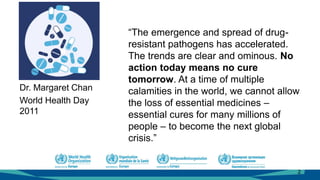
“The emergence and spread of drug-
resistant pathogens has accelerated.
The trends are clear and ominous. No
action today means no cure
tomorrow. At a time of multiple
calamities in the world, we cannot allow
the loss of essential medicines –
essential cures for many millions of
people – to become the next global
crisis.”
Dr. Margaret Chan
World Health Day
2011
2
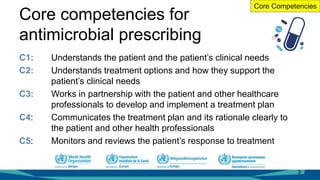
Core competencies for
antimicrobial prescribing
C1: Understands the patient and the patient’s clinical needs
C2: Understands treatment options and how they support the
patient’s clinical needs
C3: Works in partnership with the patient and other healthcare
professionals to develop and implement a treatment plan
C4: Communicates the treatment plan and its rationale clearly to
the patient and other health professionals
C5: Monitors and reviews the patient’s response to treatment
3
Core Competencies
Objectives
• Highlight mechanisms by which microorganisms develop
antimicrobial resistance
• Illustrate the emergence and global spread of drug resistant
organisms
• Demonstrate the use of clinical guidelines in choosing empiric
antimicrobial therapy – one tool clinicians can use to combat
antimicrobial resistance
4
5
Antimicrobial resistance (AMR)
6
7
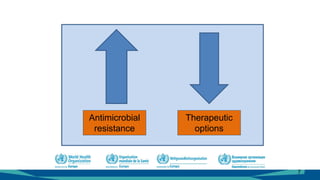
Antimicrobial
resistance
Therapeutic
options
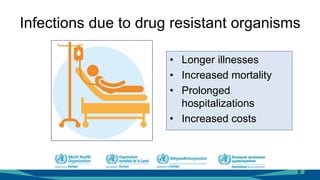
Infections due to drug resistant organisms
• Longer illnesses
• Increased mortality
• Prolonged
hospitalizations
• Increased costs
8
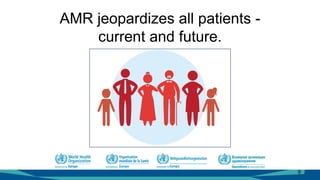
AMR jeopardizes all patients -
current and future.
9
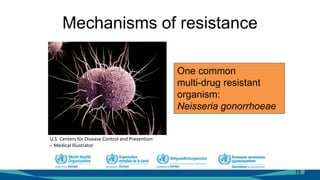
Mechanisms of resistance
10
One common
multi-drug resistant
organism:
Neisseria gonorrhoeae
U.S. Centers for Disease Control and Prevention
– Medical Illustrator
Inappropriate use of antimicrobials can
have dire consequences.
11
WHO/A. Kristensen
12
ANTIMICROBIAL RESISTANCE:
THE BASICS
Core Competencies 1 & 2
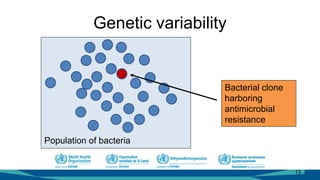
Genetic variability
13
Bacterial clone
harboring
antimicrobial
resistance
Population of bacteria
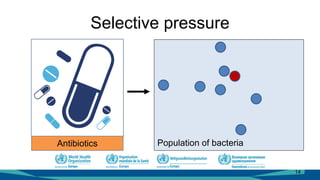
Selective pressure
14
Population of bacteriaAntibiotics
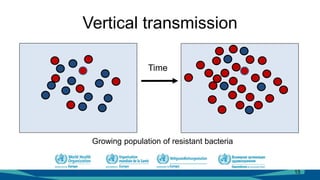
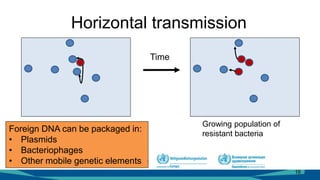
Vertical transmission
15
Time
Growing population of resistant bacteria
Horizontal transmission
16
Foreign DNA can be packaged in:
• Plasmids
• Bacteriophages
• Other mobile genetic elements
Growing population of
resistant bacteria
Time
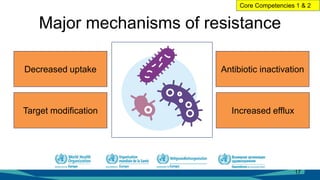
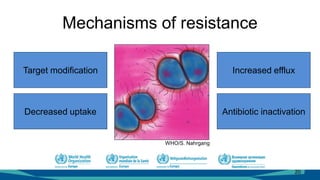
Major mechanisms of resistance
17
Target modification
Decreased uptake Antibiotic inactivation
Increased efflux
Core Competencies 1 & 2
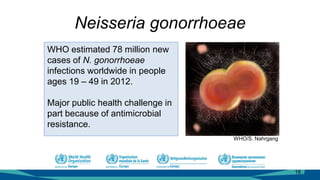
Neisseria gonorrhoeae
18
WHO/S. Nahrgang
WHO estimated 78 million new
cases of N. gonorrhoeae
infections worldwide in people
ages 19 – 49 in 2012.
Major public health challenge in
part because of antimicrobial
resistance.
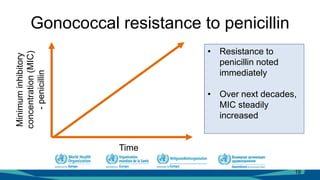
Gonococcal resistance to penicillin
19
Time
Minimuminhibitory
concentration(MIC)
-penicillin
• Resistance to
penicillin noted
immediately
• Over next decades,
MIC steadily
increased
Mechanisms of resistance
20
Antibiotic inactivation
Increased efflux
Decreased uptake
Target modification
WHO/S. Nahrgang
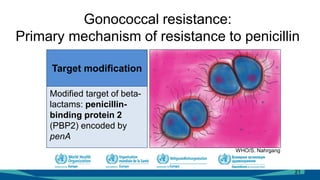
21
Target modification
Modified target of beta-
lactams: penicillin-
binding protein 2
(PBP2) encoded by
penA
Gonococcal resistance:
Primary mechanism of resistance to penicillin
WHO/S. Nahrgang
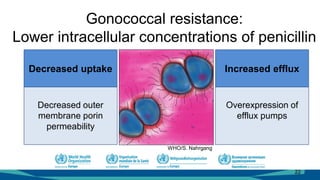
22
Decreased uptake
Decreased outer
membrane porin
permeability
Increased efflux
Overexpression of
efflux pumps
Gonococcal resistance:
Lower intracellular concentrations of penicillin
WHO/S. Nahrgang
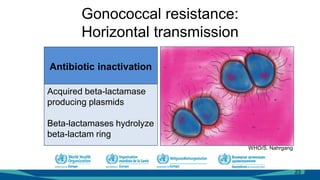
Gonococcal resistance:
Horizontal transmission
23
Antibiotic inactivation
Acquired beta-lactamase
producing plasmids
Beta-lactamases hydrolyze
beta-lactam ring
WHO/S. Nahrgang
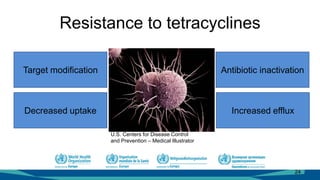
Resistance to tetracyclines
24
Antibiotic inactivation
Increased effluxDecreased uptake
Target modification
U.S. Centers for Disease Control
and Prevention – Medical Illustrator
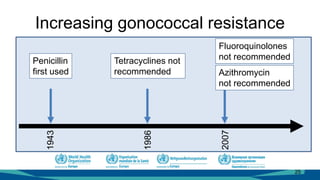
Increasing gonococcal resistance
25
1943
Penicillin
first used
1986
Tetracyclines not
recommended
2007
Fluoroquinolones
not recommended
Azithromycin
not recommended
26
PART 2:
A CLINICAL CASE
WHO/A. Kristensen
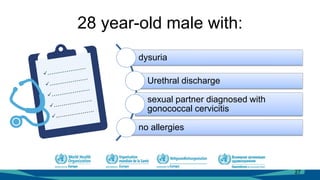
28 year-old male with:
dysuria
Urethral discharge
sexual partner diagnosed with
gonococcal cervicitis
no allergies
27
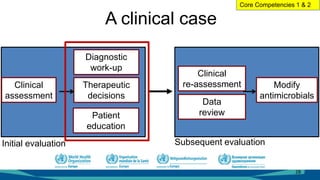
A clinical case
Subsequent evaluationInitial evaluation
Clinical
assessment
Diagnostic
work-up
Patient
education
Therapeutic
decisions
Modify
antimicrobials
Data
review
Clinical
re-assessment
28
Core Competencies 1 & 2
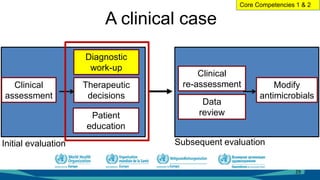
A clinical case
Subsequent evaluationInitial evaluation
Clinical
assessment
Diagnostic
work-up
Patient
education
Therapeutic
decisions
Modify
antimicrobials
Data
review
Clinical
re-assessment
29
Core Competencies 1 & 2
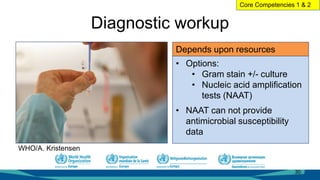
Diagnostic workup
30
Depends upon resources
• Options:
• Gram stain +/- culture
• Nucleic acid amplification
tests (NAAT)
• NAAT can not provide
antimicrobial susceptibility
data
WHO/A. Kristensen
Core Competencies 1 & 2
Subsequent evaluationInitial evaluation
Clinical
assessment
Diagnostic
work-up
Patient
education
Therapeutic
decisions
Modify
antimicrobials
Data
review
Clinical
re-assessment
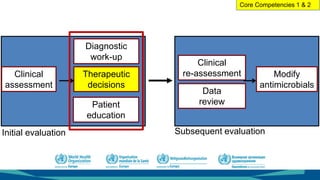
Core Competencies 1 & 2
Subsequent evaluationInitial evaluation
Clinical
assessment
Diagnostic
work-up
Patient
education
Therapeutic
decisions
Modify
antimicrobials
Data
review
Clinical
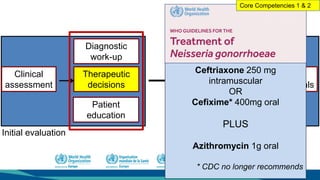
re-assessmentCeftriaxone 250 mg
intramuscular
OR
Cefixime* 400mg oral
PLUS
Azithromycin 1g oral
* CDC no longer recommends
Core Competencies 1 & 2
Subsequent evaluationInitial evaluation
Clinical
assessment
Diagnostic
work-up
Patient
education
Therapeutic
decisions
Modify
antimicrobials
Data
review
Clinical
re-assessment
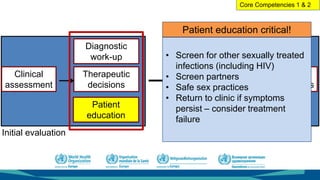
Patient education critical!
• Screen for other sexually treated
infections (including HIV)
• Screen partners
• Safe sex practices
• Return to clinic if symptoms
persist – consider treatment
failure
Core Competencies 1 & 2
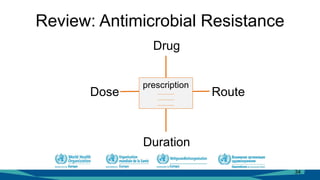
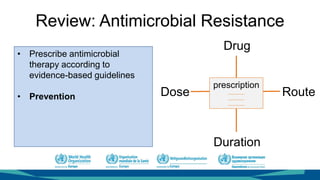
Review: Antimicrobial Resistance
Drug
Dose
Duration
Route
prescription
.............
.............
.............
34
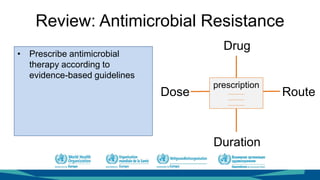
Review: Antimicrobial Resistance
Drug
Dose
Duration
Route
prescription
.............
.............
.............
• Prescribe antimicrobial
therapy according to
evidence-based guidelines
Review: Antimicrobial ResistanceReview: Antimicrobial Resistance
Drug
Dose
Duration
Route
prescription
.............
.............
.............
• Prescribe antimicrobial
therapy according to
evidence-based guidelines
• Prevention
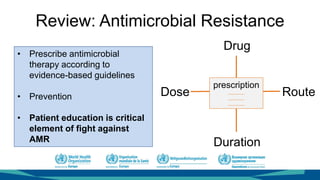
Review: Antimicrobial Resistance
Drug
Dose
Duration
Route
prescription
.............
.............
.............
• Prescribe antimicrobial
therapy according to
evidence-based guidelines
• Prevention
• Patient education is critical
element of fight against
AMR
38
Quiz time!
Please click
“Next” to
proceed.

Antimicrobial resistance for clinicians