ANTIMICROBIAL
RESISTANCE
BY
HEBA ISMAIL SAAD
ASSOCIATE PROFESSOR OF TROPICAL MEDICINE
AIN SHAMS UNIVERSITY
AGENDA
• Introduction
• What Is Antimicrobial Resistance
• Is It an Important Concern?
• The current situation of the drug resistance
• Factors contributing to Antimicrobial resistance
• Mechanism of antimicrobial resistance
• AwaRe classification of WHO
INTRODUCTION
• Antibiotic resistance (AMR) is a naturally occurring process
• In December 1945, Sir Alexander Fleming himself warned of the danger of
resistance saying that “It is not difficult to make microbes resistant to penicillin in
the lab by exposing them to concentrations not sufficient to kill them”
• Nowadays the WHO has declared that AMR is one of the top 10 global public
health threats facing humanity.
WHAT IS ANTIMICROBIAL RESISTANCE
• AMR is defined as microorganisms that are not inhibited by usually achievable
systemic concentrations of an antimicrobial agent with normal dosage schedule.
• AMR occurs when bacteria, viruses, fungi and parasites change over time and no
longer respond to medicines making infections harder to treat leading to higher
risk of disease spread, severe illness and death.
WHY IS ANTIMICROBIAL RESISTANCE A GLOBAL
CONCERN?
• The emergence and spread of drug-resistant pathogens continues to threaten our
ability to treat common infections. Especially with the rapid global spread of
multi- and pan-resistant bacteria (also known as “superbugs”) that cause
infections that are not treatable with any of the existing antimicrobial medicines.
• The cost of AMR to national economies and their health systems is significant as
it affects productivity of patients and their caretakers through prolonged hospital
stays and the need for more expensive and intensive care.
• Antimicrobial resistant organisms are found in people, animals, food, plants and
the environment (in water, soil and air). They can spread from person to person or
between people and animals, including from food of animal origin.
• Although new antimicrobials are urgently needed, However, if people do not
change the way antibiotics are used now, these new antibiotics will suffer the
same fate as the current ones and become ineffective.
THE CURRENT SITUATION
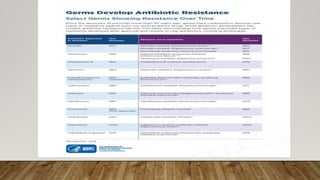
• More than 2.8 million antibiotic-resistant infections occur in the U.S. each year. More
than 35,000 people die as a result, according to CDC’s 2019 Antibiotic Resistance (AR)
Threats Report
• The estimated national cost to treat infections caused by multidrug-resistant germs
frequently found in health care can be substantial more than $4.6 billion annually,
according to a collaborative CDC study published in 2021.
• In 2019 WHO identified 32 antibiotics in clinical development that address the WHO
list of priority pathogens. Furthermore, a lack of access to quality antimicrobials
remains a major issue.
• Now the clinical pipeline of new antimicrobials is dry.
THE CURRENT SITUATION
A- DRUG RESISTANCE IN BACTERIA
• The rate of resistance to ciprofloxacin varied from 8.4% to 93% for Escherichia coli
and from 4 % to 79 % for Klebsiella pneumoniae in countries reporting to the
Global Antimicrobial Resistance and Use Surveillance System.
• Resistance in K. pneumoniae to last resort treatment has spreaded worldwide. K.
pneumoniae is a major cause of hospital-acquired infections such as pneumonia,
bloodstream infections, and infections in newborns and intensive-care unit
patients. In some countries, carbapenem antibiotics do not work in more than half
of the patients treated for K. pneumoniae infections due to resistance.
• Colistin is the only last resort treatment for life-threatening infections caused by carbapenem
resistant Enterobacteriaceae (i.e. E.coli, Klebsiella, etc). Bacteria resistant to colistin have also
been detected in several countries causing infections for which there is no effective antibiotic
treatment at present.
• Regarding Staphylococcus aureus, People with methicillin-resistant Staphylococcus aureus
(MRSA) infections are 64% more likely to die than people with drug-sensitive infections.
• Also, the widespread resistance in highly variable strains of N. gonorrhoeae has compromised
the control of gonorrhoea. Resistance has rapidly emerged to sulphonamides, penicillins,
tetracyclines, macrolides, fluoroquinolones, and early generation cephalosporins. Currently, in
most countries, the injectable extended-spectrum cephalosporin (ESC) ceftriaxone is the only
remaining empiric monotherapy for gonorrhoea.
B-DRUG RESISTANCE IN MYCOBACTERIUM
TUBERCULOSIS
• WHO estimates that, in 2018, there were about half a million new cases of
rifampicin-resistant TB (RR-TB) identified globally, of which the vast majority have
multi-drug resistant TB (MDR-TB), a form of tuberculosis that is resistant to the
two most powerful anti-TB drugs. MDR-TB requires treatment courses that are
longer, less effective and far more expensive than those for non-resistant TB. Less
than 60% of those treated for MDR/RR-TB are successfully cured.
C-DRUG RESISTANCE IN VIRUSES
• All antiretroviral (ARV) drugs, including newer classes, are at risk of becoming partly
or fully inactive because of the emergence of drug-resistant HIV (HIVDR). People
receiving antiretroviral therapy can acquire HIVDR, and people can also be infected
with HIV that is already drug resistant.
• Levels of pretreatment HIVDR (PDR) to non-nucleoside reverse-transcriptase inhibitors
(NNRTIs) among adults initiating first-line therapy exceeded 10% in the majority of
the monitored countries in Africa, Asia and Latin America. The prevalence of PDR
among infants is alarmingly high. In sub-Saharan Africa, over 50% of the infants newly
diagnosed with HIV carry a virus that is resistant to NNRTI. Informed by these
findings, latest WHO ARV guidelines now recommend the adoption of a new drug,
dolutegravir, as the preferred first-line treatment for adults and children.
D- DRUG RESISTANCE IN MALARIA
• Artemisinin-based combination therapies (ACTs) are the recommended first-line
treatment for uncomplicated P. falciparum malaria and are used by most malaria
endemic countries.
• In the WHO Western Pacific Region and in the WHO South-East Asia Region, partial
resistance to artemisinin and resistance to a number of the other combination drugs
has been confirmed through studies conducted between 2001 and 2019. This makes
selecting the right treatment more challenging and requires close monitoring.
• In the WHO Eastern Mediterranean Region, P. falciparum resistance to sulfadoxine-
pyrimethamine led to artesunate-sulfadoxine-pyrimethamine failures in some
countries, necessitating a change to another ACT.
E- DRUG RESISTANCE IN FUNGI
• Drug-resistant Candida auris, one of the most common invasive fungal infections,
is already widespread with increasing resistance reported to fluconazole,
amphotericin B and voriconazole as well as emerging caspofungin resistance.
• This is leading to more difficult to treat fungal infections, treatment failures,
longer hospital stays and much more expensive treatment options.
TYPES OF ANTIMICROBIAL RESISTANCE
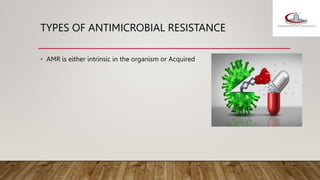
• AMR is either intrinsic in the organism or Acquired
INTRINSIC RESISTANCE
• It occurs naturally due to:
• Lack of the target (No cell wall innately resistant to penicillins)
• Innate efflux pump (Drugs are blocked from entrance e.g Ecoli )
• Drug inactivation (chephalosporines in klebsiella)
FACTORS CONTRIBUTING TO ACQUIRED
ANTIMICROBIAL RESISTANCE
• Environmental Factors
• Drug related factors
• Patient related factors
• Physician related factors
ENVIRONMENTAL FACTORS
• Overcrowding
• Increased national and international travelling
• Poor sanitation
• Ineffective infection control programs
• Widespread use of antibiotics in animals and agriculture
DRUG RELATED FACTORS
• Over the counter availability of antimicrobials
• Poor quality of the drugs
• Irrational fixed dose combination of antimicrobials
PATIENT RELATED FACTORS
• Poor adherence of dosage regimens
• Poverty
• Lack of education and sanitation concepts
• Self medications
PHYSICIAN RELATED FACTORS
• Inappropriate use of the available drugs
• Increased empiric poly-antimicrobial use
• Inadequate dosing
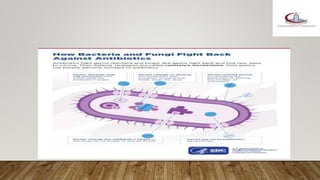
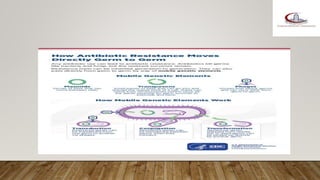
MECHANISMS OF ANTIBIOTIC RESISTANCE
Restrict access of the antibiotic
Microbe restrict access by changing the entryways
or limiting the number of entryways. Example:
Gram-negative bacteria have an outer layer
(membrane) that protects them from their
environment. These bacteria can use this
membrane to selectively keep antibiotic drugs
from entering.
Get rid of the antibiotic
Germs get rid of antibiotics using pumps in their
cell walls to remove antibiotic drugs that enter the
cell. Example: Some Pseudomonas
aeruginosa bacteria can produce pumps to get rid
of several different important antibiotic drugs,
including fluoroquinolones, beta-lactams,
chloramphenicol, and trimethoprim.
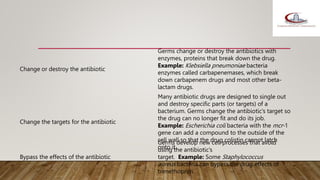
Change or destroy the antibiotic
Germs change or destroy the antibiotics with
enzymes, proteins that break down the drug.
Example: Klebsiella pneumoniae bacteria
enzymes called carbapenemases, which break
down carbapenem drugs and most other beta-

lactam drugs.
Change the targets for the antibiotic
Many antibiotic drugs are designed to single out
and destroy specific parts (or targets) of a
bacterium. Germs change the antibiotic’s target so
the drug can no longer fit and do its job.
Example: Escherichia coli bacteria with the mcr-1
gene can add a compound to the outside of the
cell wall so that the drug colistin cannot latch
onto it.
Bypass the effects of the antibiotic
Germs develop new cell processes that avoid
using the antibiotic’s
target. Example: Some Staphylococcus
aureus bacteria can bypass the drug effects of
trimethoprim.
ACTIONS TO FIGHT ANTIBIOTIC RESISTANCE
• Prevent infections in the first place
• Improve antibiotic use to slow the development of resistance
• Stop the spread of resistance when it does develop
WHO AWARE CLASSIFICATION OF ANTIBIOTICS
• The AWaRe Classification of antibiotics was developed in 2017 by the WHO Expert
Committee on Selection and Use of Essential Medicines
• Antibiotics are classified into three groups, Access, Watch and Reserve,
considering the impact of different antibiotics and antibiotic classes on
antimicrobial resistance, to emphasize the importance of their appropriate use.
• The 2021 update of the AWaRe classification includes an additional 78 antibiotics
not previously classified, bringing the total to 258.
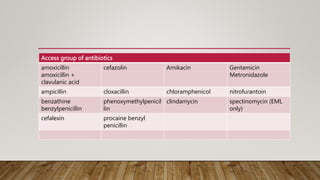
ACCESS GROUP ANTIBIOTICS
• This group includes antibiotics that have activity against a wide range of
commonly encountered susceptible pathogens while also showing lower
resistance potential than antibiotics in the other groups. The Access group
includes 48 antibiotics, 19 of which are included individually on the WHO Model
List of Essential Medicines as first- or second -choice empiric treatment options
for specified infectious syndromes.
• The WHO Model List of Essential Medicines ( Essential Medicines List or EML),
published by the (WHO) since 1977, contains the medications considered to be
most effective and safe to meet the most important needs in a health system
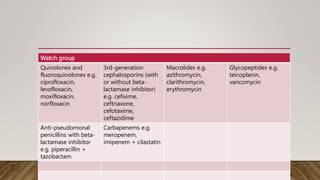
WATCH GROUP ANTIBIOTICS
• This group includes antibiotics that have higher resistance potential. Antibiotics
in Watch group should be prioritized as key targets of stewardship programs and
monitoring. The Watch group includes 110 antibiotics, 11 of which are included
individually on the WHO Model List of Essential Medicines as first- or second -
choice empiric treatment options for specified infectious syndromes.
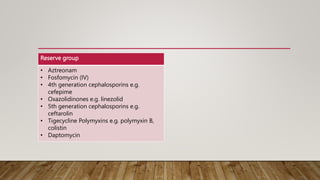
RESERVE GROUP ANTIBIOTICS
• This group includes antibiotic classes that should be reserved for treatment of
confirmed or suspected infections due to multi-drug-resistant organisms.
Antibiotics in Reserve group should be treated as “last resort” options, and their
use should be tailored to highly specific patients and settings, when all
alternatives have failed or are not suitable. These medicines should be protected
from the misuse to preserve their effectiveness. 22 antibiotics have been classified
as Reserve group. Seven Reserve group antibiotics are listed individually on the
WHO Model List of Essential Medicines.
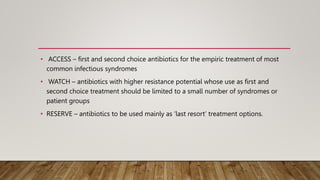
• ACCESS – first and second choice antibiotics for the empiric treatment of most
common infectious syndromes
• WATCH – antibiotics with higher resistance potential whose use as first and
second choice treatment should be limited to a small number of syndromes or
patient groups
• RESERVE – antibiotics to be used mainly as ‘last resort’ treatment options.
Access group of antibiotics
amoxicillin
amoxicillin +
clavulanic acid
cefazolin Amikacin Gentamicin
Metronidazole
ampicillin cloxacillin chloramphenicol nitrofurantoin
benzathine
benzylpenicillin
phenoxymethylpenicil
lin
clindamycin spectinomycin (EML
only)
cefalexin procaine benzyl
penicillin
Watch group
Quinolones and
fluoroquinolones e.g.
ciprofloxacin,
levofloxacin,
moxifloxacin,
norfloxacin
3rd-generation
cephalosporins (with
or without beta-
lactamase inhibitor)
e.g. cefixime,
ceftriaxone,
cefotaxime,
ceftazidime
Macrolides e.g.
azithromycin,
clarithromycin,
erythromycin
Glycopeptides e.g.
teicoplanin,
vancomycin
Anti-pseudomonal
penicillins with beta-
lactamase inhibitor
e.g. piperacillin +
tazobactam
Carbapenems e.g.
meropenem,
imipenem + cilastatin
Reserve group
• Aztreonam
• Fosfomycin (IV)
• 4th generation cephalosporins e.g.
cefepime
• Oxazolidinones e.g. linezolid
• 5th generation cephalosporins e.g.
ceftarolin
• Tigecycline Polymyxins e.g. polymyxin B,
colistin
• Daptomycin
• https://www.who.int/publications/i/item/2021-AWaRe-classification
Antimicrobial resistance .pptx

Antimicrobial resistance .pptx

  • 1.
    ANTIMICROBIAL RESISTANCE BY HEBA ISMAIL SAAD ASSOCIATEPROFESSOR OF TROPICAL MEDICINE AIN SHAMS UNIVERSITY
  • 2.
    AGENDA • Introduction • WhatIs Antimicrobial Resistance • Is It an Important Concern? • The current situation of the drug resistance • Factors contributing to Antimicrobial resistance • Mechanism of antimicrobial resistance • AwaRe classification of WHO
  • 3.
    INTRODUCTION • Antibiotic resistance(AMR) is a naturally occurring process • In December 1945, Sir Alexander Fleming himself warned of the danger of resistance saying that “It is not difficult to make microbes resistant to penicillin in the lab by exposing them to concentrations not sufficient to kill them” • Nowadays the WHO has declared that AMR is one of the top 10 global public health threats facing humanity.
  • 5.
    WHAT IS ANTIMICROBIALRESISTANCE • AMR is defined as microorganisms that are not inhibited by usually achievable systemic concentrations of an antimicrobial agent with normal dosage schedule. • AMR occurs when bacteria, viruses, fungi and parasites change over time and no longer respond to medicines making infections harder to treat leading to higher risk of disease spread, severe illness and death.
  • 6.
    WHY IS ANTIMICROBIALRESISTANCE A GLOBAL CONCERN? • The emergence and spread of drug-resistant pathogens continues to threaten our ability to treat common infections. Especially with the rapid global spread of multi- and pan-resistant bacteria (also known as “superbugs”) that cause infections that are not treatable with any of the existing antimicrobial medicines. • The cost of AMR to national economies and their health systems is significant as it affects productivity of patients and their caretakers through prolonged hospital stays and the need for more expensive and intensive care.
  • 7.
    • Antimicrobial resistantorganisms are found in people, animals, food, plants and the environment (in water, soil and air). They can spread from person to person or between people and animals, including from food of animal origin. • Although new antimicrobials are urgently needed, However, if people do not change the way antibiotics are used now, these new antibiotics will suffer the same fate as the current ones and become ineffective.
  • 8.
    THE CURRENT SITUATION •More than 2.8 million antibiotic-resistant infections occur in the U.S. each year. More than 35,000 people die as a result, according to CDC’s 2019 Antibiotic Resistance (AR) Threats Report • The estimated national cost to treat infections caused by multidrug-resistant germs frequently found in health care can be substantial more than $4.6 billion annually, according to a collaborative CDC study published in 2021. • In 2019 WHO identified 32 antibiotics in clinical development that address the WHO list of priority pathogens. Furthermore, a lack of access to quality antimicrobials remains a major issue. • Now the clinical pipeline of new antimicrobials is dry.
  • 10.
    THE CURRENT SITUATION A-DRUG RESISTANCE IN BACTERIA • The rate of resistance to ciprofloxacin varied from 8.4% to 93% for Escherichia coli and from 4 % to 79 % for Klebsiella pneumoniae in countries reporting to the Global Antimicrobial Resistance and Use Surveillance System. • Resistance in K. pneumoniae to last resort treatment has spreaded worldwide. K. pneumoniae is a major cause of hospital-acquired infections such as pneumonia, bloodstream infections, and infections in newborns and intensive-care unit patients. In some countries, carbapenem antibiotics do not work in more than half of the patients treated for K. pneumoniae infections due to resistance.
  • 11.
    • Colistin isthe only last resort treatment for life-threatening infections caused by carbapenem resistant Enterobacteriaceae (i.e. E.coli, Klebsiella, etc). Bacteria resistant to colistin have also been detected in several countries causing infections for which there is no effective antibiotic treatment at present. • Regarding Staphylococcus aureus, People with methicillin-resistant Staphylococcus aureus (MRSA) infections are 64% more likely to die than people with drug-sensitive infections. • Also, the widespread resistance in highly variable strains of N. gonorrhoeae has compromised the control of gonorrhoea. Resistance has rapidly emerged to sulphonamides, penicillins, tetracyclines, macrolides, fluoroquinolones, and early generation cephalosporins. Currently, in most countries, the injectable extended-spectrum cephalosporin (ESC) ceftriaxone is the only remaining empiric monotherapy for gonorrhoea.
  • 12.
    B-DRUG RESISTANCE INMYCOBACTERIUM TUBERCULOSIS • WHO estimates that, in 2018, there were about half a million new cases of rifampicin-resistant TB (RR-TB) identified globally, of which the vast majority have multi-drug resistant TB (MDR-TB), a form of tuberculosis that is resistant to the two most powerful anti-TB drugs. MDR-TB requires treatment courses that are longer, less effective and far more expensive than those for non-resistant TB. Less than 60% of those treated for MDR/RR-TB are successfully cured.
  • 13.
    C-DRUG RESISTANCE INVIRUSES • All antiretroviral (ARV) drugs, including newer classes, are at risk of becoming partly or fully inactive because of the emergence of drug-resistant HIV (HIVDR). People receiving antiretroviral therapy can acquire HIVDR, and people can also be infected with HIV that is already drug resistant. • Levels of pretreatment HIVDR (PDR) to non-nucleoside reverse-transcriptase inhibitors (NNRTIs) among adults initiating first-line therapy exceeded 10% in the majority of the monitored countries in Africa, Asia and Latin America. The prevalence of PDR among infants is alarmingly high. In sub-Saharan Africa, over 50% of the infants newly diagnosed with HIV carry a virus that is resistant to NNRTI. Informed by these findings, latest WHO ARV guidelines now recommend the adoption of a new drug, dolutegravir, as the preferred first-line treatment for adults and children.
  • 14.
    D- DRUG RESISTANCEIN MALARIA • Artemisinin-based combination therapies (ACTs) are the recommended first-line treatment for uncomplicated P. falciparum malaria and are used by most malaria endemic countries. • In the WHO Western Pacific Region and in the WHO South-East Asia Region, partial resistance to artemisinin and resistance to a number of the other combination drugs has been confirmed through studies conducted between 2001 and 2019. This makes selecting the right treatment more challenging and requires close monitoring. • In the WHO Eastern Mediterranean Region, P. falciparum resistance to sulfadoxine- pyrimethamine led to artesunate-sulfadoxine-pyrimethamine failures in some countries, necessitating a change to another ACT.
  • 15.
    E- DRUG RESISTANCEIN FUNGI • Drug-resistant Candida auris, one of the most common invasive fungal infections, is already widespread with increasing resistance reported to fluconazole, amphotericin B and voriconazole as well as emerging caspofungin resistance. • This is leading to more difficult to treat fungal infections, treatment failures, longer hospital stays and much more expensive treatment options.
  • 16.
    TYPES OF ANTIMICROBIALRESISTANCE • AMR is either intrinsic in the organism or Acquired
  • 17.
    INTRINSIC RESISTANCE • Itoccurs naturally due to: • Lack of the target (No cell wall innately resistant to penicillins) • Innate efflux pump (Drugs are blocked from entrance e.g Ecoli ) • Drug inactivation (chephalosporines in klebsiella)
  • 18.
    FACTORS CONTRIBUTING TOACQUIRED ANTIMICROBIAL RESISTANCE • Environmental Factors • Drug related factors • Patient related factors • Physician related factors
  • 19.
    ENVIRONMENTAL FACTORS • Overcrowding •Increased national and international travelling • Poor sanitation • Ineffective infection control programs • Widespread use of antibiotics in animals and agriculture
  • 20.
    DRUG RELATED FACTORS •Over the counter availability of antimicrobials • Poor quality of the drugs • Irrational fixed dose combination of antimicrobials
  • 21.
    PATIENT RELATED FACTORS •Poor adherence of dosage regimens • Poverty • Lack of education and sanitation concepts • Self medications
  • 22.
    PHYSICIAN RELATED FACTORS •Inappropriate use of the available drugs • Increased empiric poly-antimicrobial use • Inadequate dosing
  • 24.
    MECHANISMS OF ANTIBIOTICRESISTANCE Restrict access of the antibiotic Microbe restrict access by changing the entryways or limiting the number of entryways. Example: Gram-negative bacteria have an outer layer (membrane) that protects them from their environment. These bacteria can use this membrane to selectively keep antibiotic drugs from entering. Get rid of the antibiotic Germs get rid of antibiotics using pumps in their cell walls to remove antibiotic drugs that enter the cell. Example: Some Pseudomonas aeruginosa bacteria can produce pumps to get rid of several different important antibiotic drugs, including fluoroquinolones, beta-lactams, chloramphenicol, and trimethoprim.
  • 25.
    Change or destroythe antibiotic Germs change or destroy the antibiotics with enzymes, proteins that break down the drug. Example: Klebsiella pneumoniae bacteria enzymes called carbapenemases, which break down carbapenem drugs and most other beta- lactam drugs. Change the targets for the antibiotic Many antibiotic drugs are designed to single out and destroy specific parts (or targets) of a bacterium. Germs change the antibiotic’s target so the drug can no longer fit and do its job. Example: Escherichia coli bacteria with the mcr-1 gene can add a compound to the outside of the cell wall so that the drug colistin cannot latch onto it. Bypass the effects of the antibiotic Germs develop new cell processes that avoid using the antibiotic’s target. Example: Some Staphylococcus aureus bacteria can bypass the drug effects of trimethoprim.
  • 28.
    ACTIONS TO FIGHTANTIBIOTIC RESISTANCE • Prevent infections in the first place • Improve antibiotic use to slow the development of resistance • Stop the spread of resistance when it does develop
  • 30.
    WHO AWARE CLASSIFICATIONOF ANTIBIOTICS • The AWaRe Classification of antibiotics was developed in 2017 by the WHO Expert Committee on Selection and Use of Essential Medicines • Antibiotics are classified into three groups, Access, Watch and Reserve, considering the impact of different antibiotics and antibiotic classes on antimicrobial resistance, to emphasize the importance of their appropriate use. • The 2021 update of the AWaRe classification includes an additional 78 antibiotics not previously classified, bringing the total to 258.
  • 31.
    ACCESS GROUP ANTIBIOTICS •This group includes antibiotics that have activity against a wide range of commonly encountered susceptible pathogens while also showing lower resistance potential than antibiotics in the other groups. The Access group includes 48 antibiotics, 19 of which are included individually on the WHO Model List of Essential Medicines as first- or second -choice empiric treatment options for specified infectious syndromes. • The WHO Model List of Essential Medicines ( Essential Medicines List or EML), published by the (WHO) since 1977, contains the medications considered to be most effective and safe to meet the most important needs in a health system
  • 32.
    WATCH GROUP ANTIBIOTICS •This group includes antibiotics that have higher resistance potential. Antibiotics in Watch group should be prioritized as key targets of stewardship programs and monitoring. The Watch group includes 110 antibiotics, 11 of which are included individually on the WHO Model List of Essential Medicines as first- or second - choice empiric treatment options for specified infectious syndromes.
  • 33.
    RESERVE GROUP ANTIBIOTICS •This group includes antibiotic classes that should be reserved for treatment of confirmed or suspected infections due to multi-drug-resistant organisms. Antibiotics in Reserve group should be treated as “last resort” options, and their use should be tailored to highly specific patients and settings, when all alternatives have failed or are not suitable. These medicines should be protected from the misuse to preserve their effectiveness. 22 antibiotics have been classified as Reserve group. Seven Reserve group antibiotics are listed individually on the WHO Model List of Essential Medicines.
  • 34.
    • ACCESS –first and second choice antibiotics for the empiric treatment of most common infectious syndromes • WATCH – antibiotics with higher resistance potential whose use as first and second choice treatment should be limited to a small number of syndromes or patient groups • RESERVE – antibiotics to be used mainly as ‘last resort’ treatment options.
  • 35.
    Access group ofantibiotics amoxicillin amoxicillin + clavulanic acid cefazolin Amikacin Gentamicin Metronidazole ampicillin cloxacillin chloramphenicol nitrofurantoin benzathine benzylpenicillin phenoxymethylpenicil lin clindamycin spectinomycin (EML only) cefalexin procaine benzyl penicillin
  • 36.
    Watch group Quinolones and fluoroquinolonese.g. ciprofloxacin, levofloxacin, moxifloxacin, norfloxacin 3rd-generation cephalosporins (with or without beta- lactamase inhibitor) e.g. cefixime, ceftriaxone, cefotaxime, ceftazidime Macrolides e.g. azithromycin, clarithromycin, erythromycin Glycopeptides e.g. teicoplanin, vancomycin Anti-pseudomonal penicillins with beta- lactamase inhibitor e.g. piperacillin + tazobactam Carbapenems e.g. meropenem, imipenem + cilastatin
  • 37.
    Reserve group • Aztreonam •Fosfomycin (IV) • 4th generation cephalosporins e.g. cefepime • Oxazolidinones e.g. linezolid • 5th generation cephalosporins e.g. ceftarolin • Tigecycline Polymyxins e.g. polymyxin B, colistin • Daptomycin
  • 38.