1
Right Choice of Antibiotics to
Combat Against Antibiotic
Resistance.
2
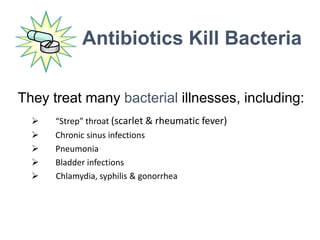
 “Strep” throat (scarlet & rheumatic fever)
 Chronic sinus infections
 Pneumonia
 Bladder infections
 Chlamydia, syphilis & gonorrhea
They treat many bacterial illnesses, including:
Antibiotics Kill Bacteria
3
(Adapted from Levin BR, Clin Infect Dis 2001)
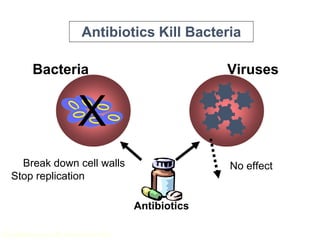
Antibiotics Kill Bacteria
Viruses
Bacteria
No effect
Antibiotics
X
Break down cell walls
Stop replication
4
(Adapted from Levin BR, Clin Infect Dis 2001)
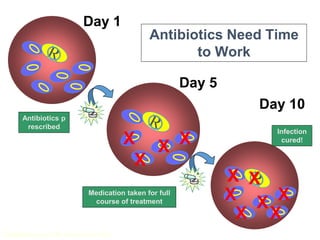
Antibiotics Need Time
to Work
Antibiotics p
rescribed
Day 5
X X
X
X
Medication taken for full
course of treatment
X
X
X
X
X X
X
Infection
cured!
Day 1
Day 10
5
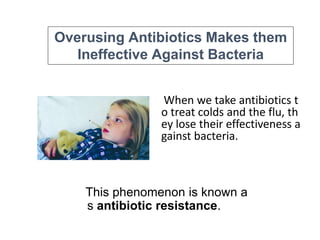
When we take antibiotics t
o treat colds and the flu, th
ey lose their effectiveness a
gainst bacteria.
This phenomenon is known a
s antibiotic resistance.
Overusing Antibiotics Makes them
Ineffective Against Bacteria
6
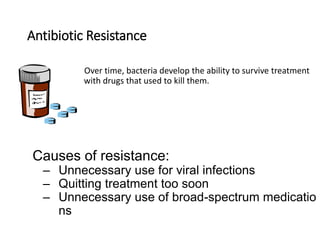
Antibiotic Resistance
Over time, bacteria develop the ability to survive treatment
with drugs that used to kill them.
Causes of resistance:
– Unnecessary use for viral infections
– Quitting treatment too soon
– Unnecessary use of broad-spectrum medicatio
ns
7
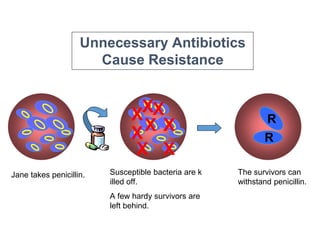
Unnecessary Antibiotics
Cause Resistance
Susceptible bacteria are k
illed off.
A few hardy survivors are
left behind.
X
X
X
X
X
XX
X
The survivors can
withstand penicillin.
R
R
Jane takes penicillin.
8
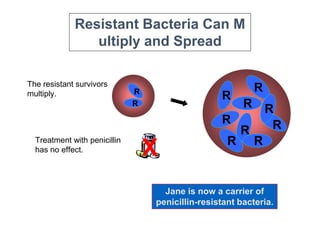
The resistant survivors
multiply. R
R
R
R
R
R
R
R
R
R
R
Treatment with penicillin
has no effect. X
Resistant Bacteria Can M
ultiply and Spread
Jane is now a carrier of
penicillin-resistant bacteria.
9
(Adapted from Levin BR, Clin Infect Dis 2001)
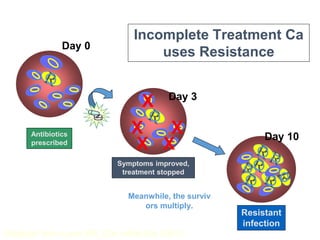
Incomplete Treatment Ca
uses Resistance
X
X
X
X
X Day 3
Symptoms improved,
treatment stopped
Day 0
Antibiotics
prescribed
Day 10
Resistant
infection
Meanwhile, the surviv
ors multiply.
10
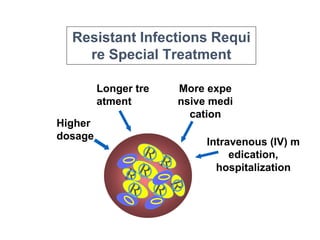
Resistant Infections Requi
re Special Treatment
Longer tre
atment
Higher
dosage
More expe
nsive medi
cation
Intravenous (IV) m
edication,
hospitalization
11
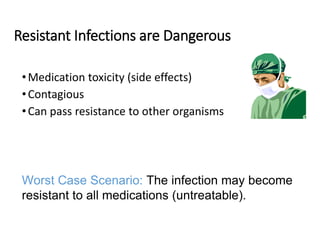
Resistant Infections are Dangerous
•Medication toxicity (side effects)
•Contagious
•Can pass resistance to other organisms
Worst Case Scenario: The infection may become
resistant to all medications (untreatable).
12
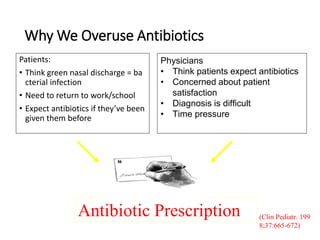
Why We Overuse Antibiotics
Patients:
• Think green nasal discharge = ba
cterial infection
• Need to return to work/school
• Expect antibiotics if they’ve been
given them before
Physicians
• Think patients expect antibiotics
• Concerned about patient
satisfaction
• Diagnosis is difficult
• Time pressure
(Clin Pediatr. 199
8;37:665-672)
Antibiotic Prescription
13
What is antibiotic resistance?
• Antibiotic resistance occurs when an antibiotic has lost its ability to ef
fectively control or kill bacterial growth; in other words, the bacteria
are "resistant" and continue to multiply in the presence of therapeuti
c levels of an antibiotic.
14
Why do bacteria become resistant to antibiotic
s?
• When antibiotics are used to kill the bacterial microorganisms, a few
microorganisms are able to still survive, because microbes are always
mutating, eventually leading to a mutation protecting itself against th
e antibiotic
15
• Antibiotics that are used correctly overwhelm the harmful b
acteria
• Overuse of antibiotics or unnecessary use creates a selective
environment
• Resistant bacteria has better fitness in this context
• Resistant strains survive and multiply.
• After reproducing, the resistant bacteria move to another ho
st.
16
Resistance
• It took less than 20 years for, bacteria to show signs of resistance
• Staphylococcus aureus, which causes blood poisoning and pneumoni
a, started to show resistance in the 1950s
• Today there are different strains of S. aureus resistant to every form o
f antibiotic in use
17
Multiple resistance
• It seems that some resistance was already naturally present in bacterial
populations
• The presence of antibiotics in their environment in higher concentration
s increased the pressure by natural selection
• Resistant bacteria that survived, rapidly multiplied
• They passed their resistant genes on to other bacteria (both disease cau
sing pathogens and non-pathogens)
18
Transposons & Integrons
• Resistance genes are often associated with transposons, genes that easil
y move from one bacterium to another
• Many bacteria also possess integrons, pieces of DNA that accumulate ne
w genes
• Gradually a strain of a bacterium can build up a whole range of resistanc
e genes
• This is multiple resistance
• These may then be passed on in a group to other strains or other species
19
Antibiotics promote resistance
• If a patient taking a course of antibiotic treatment does not co
mplete it
• Or forgets to take the doses regularly,
• Then resistant strains get a chance to build up
• The antibiotics also kill innocent bystanders bacteria which are
non-pathogens
• This reduces the competition for the resistant pathogens
• The use of antibiotics also promotes antibiotic resistance in non
-pathogens too
• These non-pathogens may later pass their resistance genes on t
o pathogens
20
How humans have created the upsurge of bacteri
al diseases:
• International travel
• Inadequate sanitation
• “antibiotic paradox”
21
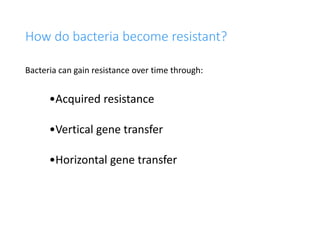
How do bacteria become resistant?
Bacteria can gain resistance over time through:
•Acquired resistance
•Vertical gene transfer
•Horizontal gene transfer
22
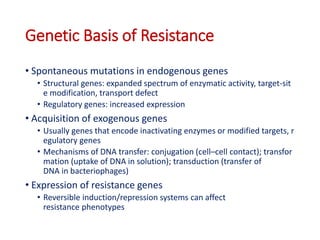
Genetic Basis of Resistance
• Spontaneous mutations in endogenous genes
• Structural genes: expanded spectrum of enzymatic activity, target-sit
e modification, transport defect
• Regulatory genes: increased expression
• Acquisition of exogenous genes
• Usually genes that encode inactivating enzymes or modified targets, r
egulatory genes
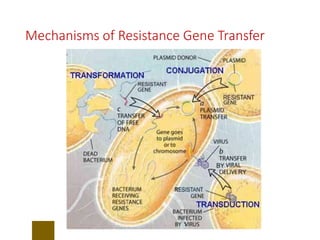
• Mechanisms of DNA transfer: conjugation (cell–cell contact); transfor
mation (uptake of DNA in solution); transduction (transfer of
DNA in bacteriophages)
• Expression of resistance genes
• Reversible induction/repression systems can affect
resistance phenotypes
23
Mechanisms of Resistance Gene Transfer
24
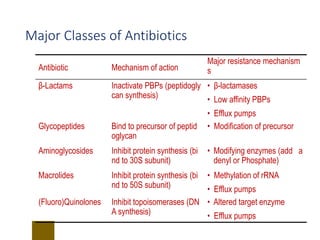
Major Classes of Antibiotics
Antibiotic Mechanism of action
Major resistance mechanism
s
β-Lactams Inactivate PBPs (peptidogly
can synthesis)
• β-lactamases
• Low affinity PBPs
• Efflux pumps
Glycopeptides Bind to precursor of peptid
oglycan
• Modification of precursor
Aminoglycosides Inhibit protein synthesis (bi
nd to 30S subunit)
• Modifying enzymes (add a
denyl or Phosphate)
Macrolides Inhibit protein synthesis (bi
nd to 50S subunit)
• Methylation of rRNA
• Efflux pumps
(Fluoro)Quinolones Inhibit topoisomerases (DN
A synthesis)
• Altered target enzyme
• Efflux pumps
25
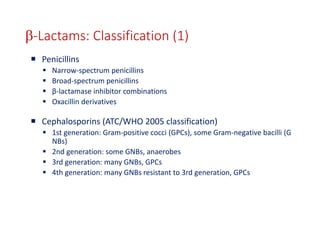
b-Lactams: Classification (1)
 Penicillins
 Narrow-spectrum penicillins
 Broad-spectrum penicillins
 β-lactamase inhibitor combinations
 Oxacillin derivatives
 Cephalosporins (ATC/WHO 2005 classification)
 1st generation: Gram-positive cocci (GPCs), some Gram-negative bacilli (G
NBs)
 2nd generation: some GNBs, anaerobes
 3rd generation: many GNBs, GPCs
 4th generation: many GNBs resistant to 3rd generation, GPCs
26
b-Lactams: Classification (2)
• Carbapenems
• Imipenem, meropenem, Doripenem, ertapenem
• Monobactams
• Aztreonam
27
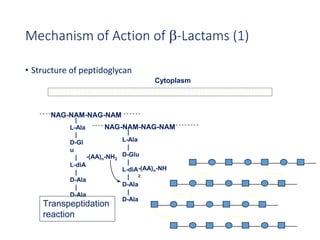
Mechanism of Action of b-Lactams (1)
• Structure of peptidoglycan
|
L-Ala
|
D-Gl
u
|
L-diA
|
D-Ala
|
D-Ala
NAG-NAM-NAG-NAM
-(AA)n-NH2
|
L-Ala
|
D-Glu
|
L-diA
|
D-Ala
|
D-Ala
NAG-NAM-NAG-NAM
-(AA)n-NH
2
Cytoplasm
Transpeptidation
reaction
28
Mechanism of Action of b-Lactams (2)
• Penicillin-binding proteins (PBPs)
• Membrane-bound enzymes
• Catalyse final steps of peptidoglycan synthesis (transglycosylation and transp
eptidation)
• b-lactams
• Act on PBPs, inhibit transpeptidation
• Substrate analogues of D-Ala-D-Ala
29
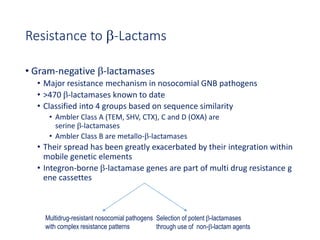
Resistance to b-Lactams
• Gram-negative b-lactamases
• Major resistance mechanism in nosocomial GNB pathogens
• >470 b-lactamases known to date
• Classified into 4 groups based on sequence similarity
• Ambler Class A (TEM, SHV, CTX), C and D (OXA) are
serine b-lactamases
• Ambler Class B are metallo-b-lactamases
• Their spread has been greatly exacerbated by their integration within
mobile genetic elements
• Integron-borne b-lactamase genes are part of multi drug resistance g
ene cassettes
Multidrug-resistant nosocomial pathogens
with complex resistance patterns
Selection of potent b-lactamases
through use of non-b-lactam agents
30
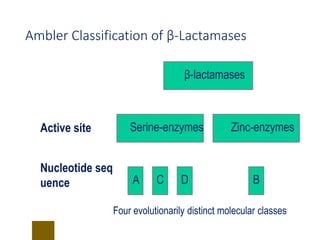
Ambler Classification of β-Lactamases
Active site
Nucleotide seq
uence
Four evolutionarily distinct molecular classes
A C D
Serine-enzymes
B
Zinc-enzymes
β-lactamases
31
Resistance to b-Lactams
• Chromosomal AmpC b-lactamases
• Several Enterobacteriaceae, including Enterobacter, Citrobacter, and
Serratia contain an inducible, chromosomal gene coding for a b-lacta
mase
• Resistant to cephalosporins and monobactams; not inhibited by clavu
lanate; Class C b-lactamases
• Plasmid-mediated AmpC b-lactamases
• Arose through transfer of AmpC chromosomal genes into plasmids
• Not inducible, with substrate profile (usually) same as parental enzy
me
• Highly prevalent in the naturally AmpC-deficient K. pneumoniae
• Emergence predominantly in community-acquired infections
(Salmonella spp., E. coli)
• Co-resistance to aminoglycosides, SXT, quinolones
• Wide dissemination worldwide (SE Asia, N Africa, South Europe, USA)
32
Resistance to b-Lactams
 Extended-spectrum b-lactamases (ESBL)
 No consensus of the precise definition of ESBLs
 In general: β-lactamases conferring resistance to the penicillins, 1st , 2nd, 3
rd, and even 4th generation cephalosporins, and monobactams, not to car
bapenems and cephamycins
 Inhibited by b-lactamase inhibitor clavulanic acid
 Derived from Class A b-lactamases (exceptions are Class D, OXA): TEM, SHV
, CTX-M, OXA, VEB, PER,...
 Differ from their progenitors by 1–5 amino acids
 Marked and unexplained predilection for Klebsiella pneumoniae
 Therapeutic options: carbapenems
33
Resistance to b-Lactams
• Carbapenemases
• Defined as b-lactamases, hydrolyzing at least imipenem or/and meropenem
or/and ertapenem
• Belong to Ambler Class A, B, and D, of which Class B are the most clinically sig
nificant:
• Class A: KPC, SME & NMC/IMI
• Class B: IMP, VIM & SPM metallo b-lactamases
• Class D: OXA-23, -40 & -58 related
34
Class B (Metallo)-Carbapenemases
• Hydrolyzing virtually all b-lactams
• Mediate broad spectrum b-lactam resistance
• No clinical inhibitor available
• Present on large plasmids and integrons
• Genes are continuously spreading
• Associated (80%) with aminoglycoside resistance
35
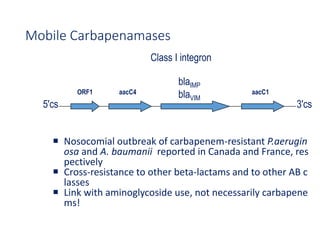
ORF1 aacC4 aacC1
blaIMP
blaVIM
Class I integron
5'cs 3'cs
Mobile Carbapenamases
 Nosocomial outbreak of carbapenem-resistant P.aerugin
osa and A. baumanii reported in Canada and France, res
pectively
 Cross-resistance to other beta-lactams and to other AB c
lasses
 Link with aminoglycoside use, not necessarily carbapene
ms!
36
Class D Oxacillinase — Carbapenemases
 Class D enzymes
 OXA-23, -24, -25, -26, -27, -28, -40, -49, -58, ….
 Highly mobile (integron, plasmid)
 Found in South America, South-East Asia, Europe (Greece, Spain, P
ortugal, France, Belgium)
 Multi-drug resistance (penicillins and 3rd & 4th generation cephalo
sporins, BL/BL-inhibitors, aminoglycosides, SXT,…)
 Variable resistance levels to imipenem and meropenem (4–>256 m
g/mL)
37
Rapidly Increasing Antibiotic Resist
ance Constitutes One of the Most I
mportant Clinical, Epidemiological a
nd Microbiological Problems of Tod
ay

Antibiotic Resistance speaker.pptx

  • 1.
    1 Right Choice ofAntibiotics to Combat Against Antibiotic Resistance.
  • 2.
    2  “Strep” throat(scarlet & rheumatic fever)  Chronic sinus infections  Pneumonia  Bladder infections  Chlamydia, syphilis & gonorrhea They treat many bacterial illnesses, including: Antibiotics Kill Bacteria
  • 3.
    3 (Adapted from LevinBR, Clin Infect Dis 2001) Antibiotics Kill Bacteria Viruses Bacteria No effect Antibiotics X Break down cell walls Stop replication
  • 4.
    4 (Adapted from LevinBR, Clin Infect Dis 2001) Antibiotics Need Time to Work Antibiotics p rescribed Day 5 X X X X Medication taken for full course of treatment X X X X X X X Infection cured! Day 1 Day 10
  • 5.
    5 When we takeantibiotics t o treat colds and the flu, th ey lose their effectiveness a gainst bacteria. This phenomenon is known a s antibiotic resistance. Overusing Antibiotics Makes them Ineffective Against Bacteria
  • 6.
    6 Antibiotic Resistance Over time,bacteria develop the ability to survive treatment with drugs that used to kill them. Causes of resistance: – Unnecessary use for viral infections – Quitting treatment too soon – Unnecessary use of broad-spectrum medicatio ns
  • 7.
    7 Unnecessary Antibiotics Cause Resistance Susceptiblebacteria are k illed off. A few hardy survivors are left behind. X X X X X XX X The survivors can withstand penicillin. R R Jane takes penicillin.
  • 8.
    8 The resistant survivors multiply.R R R R R R R R R R R Treatment with penicillin has no effect. X Resistant Bacteria Can M ultiply and Spread Jane is now a carrier of penicillin-resistant bacteria.
  • 9.
    9 (Adapted from LevinBR, Clin Infect Dis 2001) Incomplete Treatment Ca uses Resistance X X X X X Day 3 Symptoms improved, treatment stopped Day 0 Antibiotics prescribed Day 10 Resistant infection Meanwhile, the surviv ors multiply.
  • 10.
    10 Resistant Infections Requi reSpecial Treatment Longer tre atment Higher dosage More expe nsive medi cation Intravenous (IV) m edication, hospitalization
  • 11.
    11 Resistant Infections areDangerous •Medication toxicity (side effects) •Contagious •Can pass resistance to other organisms Worst Case Scenario: The infection may become resistant to all medications (untreatable).
  • 12.
    12 Why We OveruseAntibiotics Patients: • Think green nasal discharge = ba cterial infection • Need to return to work/school • Expect antibiotics if they’ve been given them before Physicians • Think patients expect antibiotics • Concerned about patient satisfaction • Diagnosis is difficult • Time pressure (Clin Pediatr. 199 8;37:665-672) Antibiotic Prescription
  • 13.
    13 What is antibioticresistance? • Antibiotic resistance occurs when an antibiotic has lost its ability to ef fectively control or kill bacterial growth; in other words, the bacteria are "resistant" and continue to multiply in the presence of therapeuti c levels of an antibiotic.
  • 14.
    14 Why do bacteriabecome resistant to antibiotic s? • When antibiotics are used to kill the bacterial microorganisms, a few microorganisms are able to still survive, because microbes are always mutating, eventually leading to a mutation protecting itself against th e antibiotic
  • 15.
    15 • Antibiotics thatare used correctly overwhelm the harmful b acteria • Overuse of antibiotics or unnecessary use creates a selective environment • Resistant bacteria has better fitness in this context • Resistant strains survive and multiply. • After reproducing, the resistant bacteria move to another ho st.
  • 16.
    16 Resistance • It tookless than 20 years for, bacteria to show signs of resistance • Staphylococcus aureus, which causes blood poisoning and pneumoni a, started to show resistance in the 1950s • Today there are different strains of S. aureus resistant to every form o f antibiotic in use
  • 17.
    17 Multiple resistance • Itseems that some resistance was already naturally present in bacterial populations • The presence of antibiotics in their environment in higher concentration s increased the pressure by natural selection • Resistant bacteria that survived, rapidly multiplied • They passed their resistant genes on to other bacteria (both disease cau sing pathogens and non-pathogens)
  • 18.
    18 Transposons & Integrons •Resistance genes are often associated with transposons, genes that easil y move from one bacterium to another • Many bacteria also possess integrons, pieces of DNA that accumulate ne w genes • Gradually a strain of a bacterium can build up a whole range of resistanc e genes • This is multiple resistance • These may then be passed on in a group to other strains or other species
  • 19.
    19 Antibiotics promote resistance •If a patient taking a course of antibiotic treatment does not co mplete it • Or forgets to take the doses regularly, • Then resistant strains get a chance to build up • The antibiotics also kill innocent bystanders bacteria which are non-pathogens • This reduces the competition for the resistant pathogens • The use of antibiotics also promotes antibiotic resistance in non -pathogens too • These non-pathogens may later pass their resistance genes on t o pathogens
  • 20.
    20 How humans havecreated the upsurge of bacteri al diseases: • International travel • Inadequate sanitation • “antibiotic paradox”
  • 21.
    21 How do bacteriabecome resistant? Bacteria can gain resistance over time through: •Acquired resistance •Vertical gene transfer •Horizontal gene transfer
  • 22.
    22 Genetic Basis ofResistance • Spontaneous mutations in endogenous genes • Structural genes: expanded spectrum of enzymatic activity, target-sit e modification, transport defect • Regulatory genes: increased expression • Acquisition of exogenous genes • Usually genes that encode inactivating enzymes or modified targets, r egulatory genes • Mechanisms of DNA transfer: conjugation (cell–cell contact); transfor mation (uptake of DNA in solution); transduction (transfer of DNA in bacteriophages) • Expression of resistance genes • Reversible induction/repression systems can affect resistance phenotypes
  • 23.
  • 24.
    24 Major Classes ofAntibiotics Antibiotic Mechanism of action Major resistance mechanism s β-Lactams Inactivate PBPs (peptidogly can synthesis) • β-lactamases • Low affinity PBPs • Efflux pumps Glycopeptides Bind to precursor of peptid oglycan • Modification of precursor Aminoglycosides Inhibit protein synthesis (bi nd to 30S subunit) • Modifying enzymes (add a denyl or Phosphate) Macrolides Inhibit protein synthesis (bi nd to 50S subunit) • Methylation of rRNA • Efflux pumps (Fluoro)Quinolones Inhibit topoisomerases (DN A synthesis) • Altered target enzyme • Efflux pumps
  • 25.
    25 b-Lactams: Classification (1) Penicillins  Narrow-spectrum penicillins  Broad-spectrum penicillins  β-lactamase inhibitor combinations  Oxacillin derivatives  Cephalosporins (ATC/WHO 2005 classification)  1st generation: Gram-positive cocci (GPCs), some Gram-negative bacilli (G NBs)  2nd generation: some GNBs, anaerobes  3rd generation: many GNBs, GPCs  4th generation: many GNBs resistant to 3rd generation, GPCs
  • 26.
    26 b-Lactams: Classification (2) •Carbapenems • Imipenem, meropenem, Doripenem, ertapenem • Monobactams • Aztreonam
  • 27.
    27 Mechanism of Actionof b-Lactams (1) • Structure of peptidoglycan | L-Ala | D-Gl u | L-diA | D-Ala | D-Ala NAG-NAM-NAG-NAM -(AA)n-NH2 | L-Ala | D-Glu | L-diA | D-Ala | D-Ala NAG-NAM-NAG-NAM -(AA)n-NH 2 Cytoplasm Transpeptidation reaction
  • 28.
    28 Mechanism of Actionof b-Lactams (2) • Penicillin-binding proteins (PBPs) • Membrane-bound enzymes • Catalyse final steps of peptidoglycan synthesis (transglycosylation and transp eptidation) • b-lactams • Act on PBPs, inhibit transpeptidation • Substrate analogues of D-Ala-D-Ala
  • 29.
    29 Resistance to b-Lactams •Gram-negative b-lactamases • Major resistance mechanism in nosocomial GNB pathogens • >470 b-lactamases known to date • Classified into 4 groups based on sequence similarity • Ambler Class A (TEM, SHV, CTX), C and D (OXA) are serine b-lactamases • Ambler Class B are metallo-b-lactamases • Their spread has been greatly exacerbated by their integration within mobile genetic elements • Integron-borne b-lactamase genes are part of multi drug resistance g ene cassettes Multidrug-resistant nosocomial pathogens with complex resistance patterns Selection of potent b-lactamases through use of non-b-lactam agents
  • 30.
    30 Ambler Classification ofβ-Lactamases Active site Nucleotide seq uence Four evolutionarily distinct molecular classes A C D Serine-enzymes B Zinc-enzymes β-lactamases
  • 31.
    31 Resistance to b-Lactams •Chromosomal AmpC b-lactamases • Several Enterobacteriaceae, including Enterobacter, Citrobacter, and Serratia contain an inducible, chromosomal gene coding for a b-lacta mase • Resistant to cephalosporins and monobactams; not inhibited by clavu lanate; Class C b-lactamases • Plasmid-mediated AmpC b-lactamases • Arose through transfer of AmpC chromosomal genes into plasmids • Not inducible, with substrate profile (usually) same as parental enzy me • Highly prevalent in the naturally AmpC-deficient K. pneumoniae • Emergence predominantly in community-acquired infections (Salmonella spp., E. coli) • Co-resistance to aminoglycosides, SXT, quinolones • Wide dissemination worldwide (SE Asia, N Africa, South Europe, USA)
  • 32.
    32 Resistance to b-Lactams Extended-spectrum b-lactamases (ESBL)  No consensus of the precise definition of ESBLs  In general: β-lactamases conferring resistance to the penicillins, 1st , 2nd, 3 rd, and even 4th generation cephalosporins, and monobactams, not to car bapenems and cephamycins  Inhibited by b-lactamase inhibitor clavulanic acid  Derived from Class A b-lactamases (exceptions are Class D, OXA): TEM, SHV , CTX-M, OXA, VEB, PER,...  Differ from their progenitors by 1–5 amino acids  Marked and unexplained predilection for Klebsiella pneumoniae  Therapeutic options: carbapenems
  • 33.
    33 Resistance to b-Lactams •Carbapenemases • Defined as b-lactamases, hydrolyzing at least imipenem or/and meropenem or/and ertapenem • Belong to Ambler Class A, B, and D, of which Class B are the most clinically sig nificant: • Class A: KPC, SME & NMC/IMI • Class B: IMP, VIM & SPM metallo b-lactamases • Class D: OXA-23, -40 & -58 related
  • 34.
    34 Class B (Metallo)-Carbapenemases •Hydrolyzing virtually all b-lactams • Mediate broad spectrum b-lactam resistance • No clinical inhibitor available • Present on large plasmids and integrons • Genes are continuously spreading • Associated (80%) with aminoglycoside resistance
  • 35.
    35 ORF1 aacC4 aacC1 blaIMP blaVIM ClassI integron 5'cs 3'cs Mobile Carbapenamases  Nosocomial outbreak of carbapenem-resistant P.aerugin osa and A. baumanii reported in Canada and France, res pectively  Cross-resistance to other beta-lactams and to other AB c lasses  Link with aminoglycoside use, not necessarily carbapene ms!
  • 36.
    36 Class D Oxacillinase— Carbapenemases  Class D enzymes  OXA-23, -24, -25, -26, -27, -28, -40, -49, -58, ….  Highly mobile (integron, plasmid)  Found in South America, South-East Asia, Europe (Greece, Spain, P ortugal, France, Belgium)  Multi-drug resistance (penicillins and 3rd & 4th generation cephalo sporins, BL/BL-inhibitors, aminoglycosides, SXT,…)  Variable resistance levels to imipenem and meropenem (4–>256 m g/mL)
  • 37.
    37 Rapidly Increasing AntibioticResist ance Constitutes One of the Most I mportant Clinical, Epidemiological a nd Microbiological Problems of Tod ay