Dr. Vikram Sharma, MD
MAMC
Eukaryote
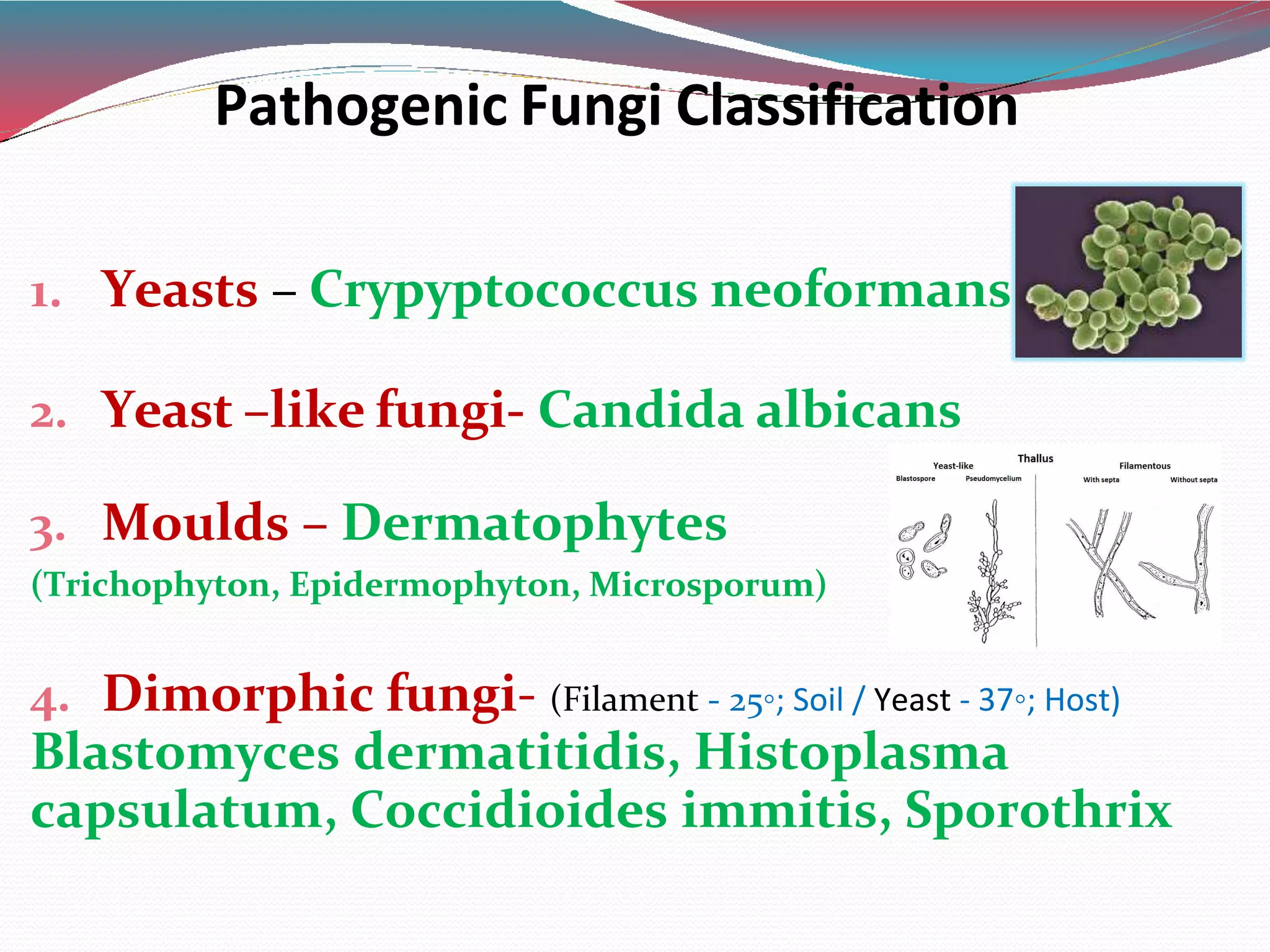
1. Yeasts – Crypyptococcus neoformans
2. Yeast –like fungi- Candida albicans
3. Moulds – Dermatophytes
(Trichophyton, Epidermophyton, Microsporum)
4. Dimorphic fungi- (Filament - 25◦; Soil / Yeast - 37◦; Host)
Blastomyces dermatitidis, Histoplasma
capsulatum, Coccidioides immitis, Sporothrix
Pathogenic Fungi Classification
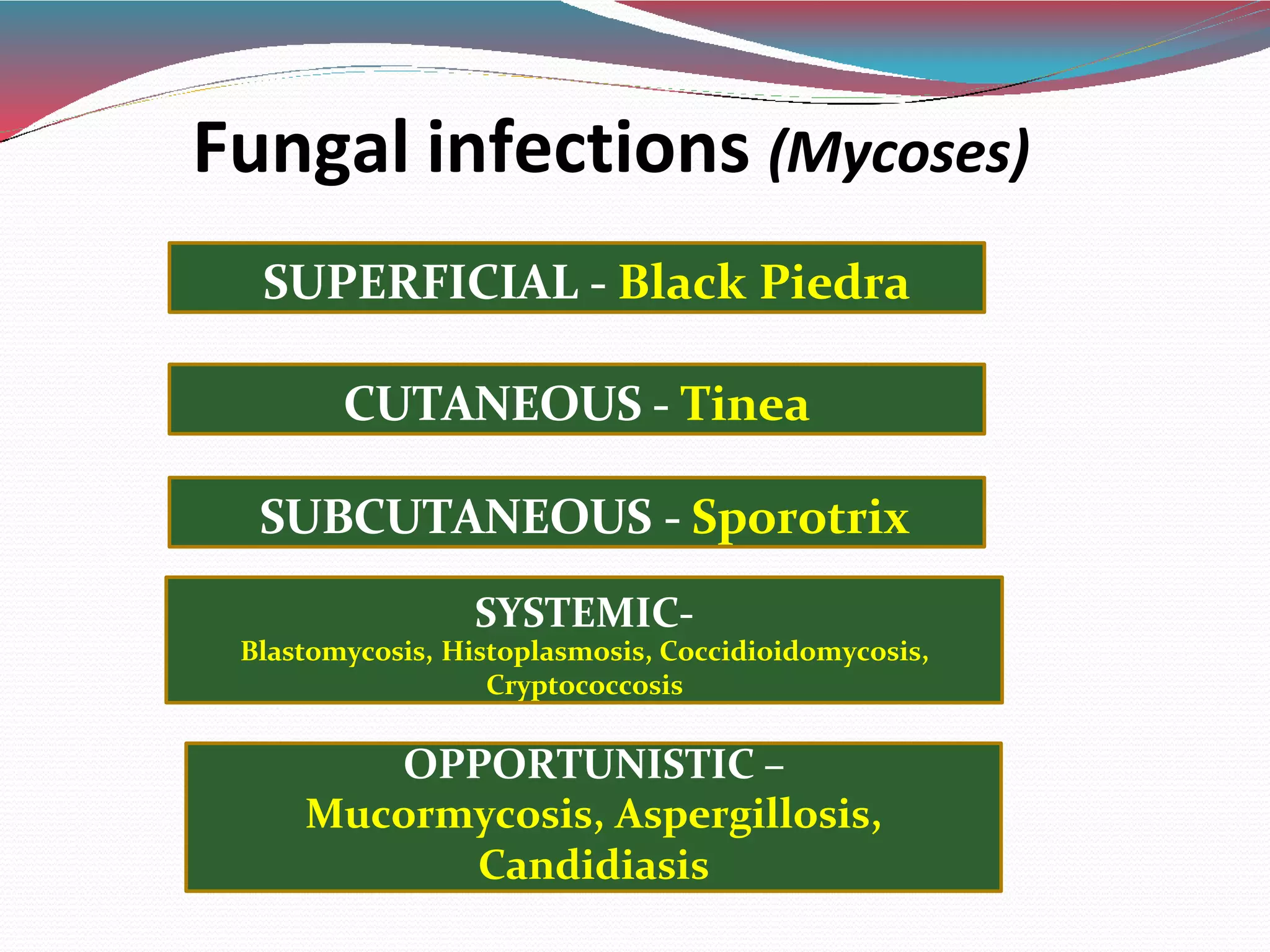
Fungal infections (Mycoses)
SUPERFICIAL - Black Piedra
CUTANEOUS - Tinea
SUBCUTANEOUS - Sporotrix
SYSTEMIC-
Blastomycosis, Histoplasmosis, Coccidioidomycosis,
Cryptococcosis
OPPORTUNISTIC –
Mucormycosis, Aspergillosis,
Candidiasis
Classification based on MOA
1. Acting on fungal cell wall :
Echinocandins
2. Acting on fungal cell membrane : Polyenes,
Azoles & Allylamine
3. Inhibition of nucleic acid synthesis: 5-Flucytosine.
4. Acting on mitotic spindle: Griseofulvin
5. Topical: Cicloprix, Tolnaftate,
Haloprogin,Butenafine, Undecylenic acid, Topical
Azoles, Clotrimazole, Nystatin
DRUGS
i)Polyenes: Amphotericin, Nystatin, Natamycin
ii)Azoles:
A) Imidazoles - Ketoconazole, Butaxonazole,
Clotrimazole, Econazole, Miconazole
Oxiconazole, Sulconazole
B) Triazoles – Fluconazole Itraconazole Tioconazole
DRUGS
iii) Allyamines: Terbinafine, Naftifine, Butenafine
(iv) Echinocandins: Caspofungin, Micafungin,
Anidulafungin
Mechanism of Action
Echinocandins
Polyenes
Amphotericin B
Binds ergosterol in fungal cell membrane
Form pores in cell membrane
Cell contents leak out
Cell death
Squalene
Ergosterol
14--demethylase
Squalene Epoxidase
Lanosterol
Fungal cell membrane
Azoles & Allylamines
Allylamines
Azoles
5-Flucytosine
Griseofulvin
Binds to polymerised microtubules
Disrupt Mitotic Spindles
Inhibit Mitosis
ECHINOCANDINS
Echinocandins
 Spectrum: Candida (Broad -spectrum activity against all
Candida species); Aspergillus
(NOT active againt Cryptococcus)
 High PPB
 Metabolites are eliminated by kidneys & GIT
 Available only as i/v formulations
 Adv.- Relatively low toxicity among the safest
Caspofungin
o FDA approved in 2001
o Dose – Single loading dose 70mg followed by
daily dose of 50mg iv over 1 hr
o Use -
 Invasive forms of candidiasis
 Invasive aspergillosis
Micafungin
FDA approved in 2005
 Candida esophagitis (150 mg/day)
 Candidemia (100mg/day)
 Prophylaxis of fungal infections in those
receiving stem cell transplant (50mg/day)
 D/I: Micafungin -↑ the levels of
nifedipine,cyclosporine and sirolimus
Anidulafungin
FDA approved in 2006
 Candida esophagitis (100mg 1st day followed by 50mg/day)
 Candidemia (200mg 1st day followed by 100mg/day)
Adverse Effects
 Flushing , phlebitis (Anidulafungin)
 Increase in liver enz, GI disturbances
(Caspofungin)
Lactone ring
Lipophilic part
 Amphotericin B:
 Streptomyces Nodosus
 Amphoteric
Hydrophilic part
Mechanism Of Resistance
 Replacement of ergosterol by other
sterols in fungal plasma membrane.
Pharmacokinetics
 Poorly absorbed orally
 Insoluble in water so colloidal
suspension prepared with sodium
deoxycholate(1:1 complex)
 t ½ = 15 days
Lipid formulations of AMB
Amphotericin B Lipid Complex(ABLC)
(ABLC; Abelcet®)
Amphotericin B Colloidal Dispersion(ABCD)
® ®)
Liposomal Amphotericin B
(L-AMB; Ambisome®)
part l
r ipi DMPC, PG
J Liposome Res 1993; 3:
451
AMB Lipid
complex
(ABLC)
AMB
Colloidal
Dispersion
(ABCD)
Hospital Practice 1992; 30: 53
Liposomal AMB
(Small unilamellar vesicles)
Antifungal spectrum
- Aspergillus
Broadest
spectrum
- Blastomyces
- Candida albicans
- Cryptococcus neoformans
- Coccidioides immitis
- Histoplasma capsulatum
- Mucor
 Systemic mycotic infections
• Invasive aspergillosis
• Rapidly progressive Blastomycosis &
Coccidiomycosis
• Mucormycosis
• Disseminated rapidly progressing
Histoplasmosis
• Cryptococcus neoformans (intra-
thecal)
Uses
Liposomes in the therapy of infectious
diseases and cancer 1989: 105
Antiprotozoal spectrum
• Mucocutaneous Leishmania
• Naegleria fowleri
Liposomes in the therapy of infectious
diseases and cancer 1989: 105
Release from
macrophage
Macrophage
Endocytosis
Liposome Lysosome
Fusion
Liposome
degradation
Endocytic
vesicle
Release in blood
compartment
Reserve drugs
for resistant
kala azar
Adverse events (Amphoterrible !!!)
o Acute reaction (infusion related)
o Long term toxicity
 Nephrotoxicity (Renal Tubular
necrosis, ↓ K+/Mg2+,Azotaemia; Irreversible)
 CNS toxicity (Arachanoiditis, Seizures)
 Anaemia (Hypochromic Microcytic)
o Hepatotoxicity (Jaundice,rarely)
Measures to Avoid Nephrotoxicity
 Prior hydration with 1L N.S.
 Avoid Concomitant Diuretics
 Liposomal AMB
Topical Uses
 Intestinal Monoliasis (Orally)
 Vaginitis
 Otomycosis (3 % drops)
 Mycotic infections of the bladder (bladder irrigation)
 Mycotic corneal ulcers & keratitis
Nystatin
 S. noursei
 Toxic; Locally
Uses:
 Intestinal moniliasis
 Vaginitis
 Prevention of oral candidiasis
 Oral, cutaneous, conjunctival candidiasis
Hamycin
 S. Pimprina
Topical use
 Thrush, cutaneous candidiasis,
trichomonas & monilial vaginitis,
otomycosis by aspergillus
Natamycin
Broad spectrum
Used topically
Fusarium solani keratitis, Trichomonas
& Monilial vaginitis
AZOLES
Azoles
 Synthetic (Imidazoles; Triazoles)
 Broad spectrum
 Fungistatic or fungicidal depending on conc.
of drug
 Also block fungal respiratory chain?
Imidazoles:
 Two nitrogen in structure
 Topical: Econazole, Miconazole,
Clotrimazole, Butaconazole, Oxiconazole,
Sulconazole
 Systemic: Ketoconazole
Triazoles
o Three nitrogen in structure
o Topical: Terconazole
o Systemic: Fluconazole, Itraconazole, Voriconazole
SYSTEMIC TOPICAL
 Ketoconazole
 Fluconazole
 Itraconazole
 Voriconazole
 Clotrimazole
 Miconazole
 Econazole
 Oxiconazole
 Sertaconazole
 Terconazole
 Sulconazole
 Tioconazole
 Butaconazole
Imidazoles
Miconazole & Clotrimazole
 Topical use:
 Miconazole - 2% ; Clotrimazole - 1%
 Uses:
 Dermatophyte infections
 Candida: oral pharyngeal, vaginal,
cutaneous
 Adverse events:
 Local irritation
 First orally effective broad spectrum antifungal
 Acidic environment favours absorption
Antacids, H2 blocker ↓ absorption
 CSF penetration is less Ineffective for fungal
meningitis
 Elimination thru Bile Ineffective for fungal
cystitis
Ketoconazole
Ketoconazole and Steroid hormone
synthesis
o Inhibit cholesterol side-chain cleavage
enzyme
 17α-hydroxylase - which converts cholesterol
to pregnenolone
 17,20-lyase ,which convert pregnenolone into
androgens
 11β-hydoxylase, which converts 11- deoxycortisol
to cortisol.
Ketoconazole
 ADRs:
 ↓ Steroid, Testosterone & Estrogen synthesis
o Males: Gynaecomastia, oligospermia ,
loss of libido & impotence
o Females: Menstrual irregularities
& amenorrhoea
Drug Interactions
Dangerous interaction with
terfenadine, astemizole and
cisapridePolymorphic ventricular
tachycardia (Torsades De Pointes)
Drug Interactions
Uses
Monilial vaginitis
Systemic mycosis
Topical: T.pedis/cruris/corporis/
versicolor
Non-antifungal Uses of Ketoconazole
 Prostate cancer
 Precocious puberty
 Cushing syndrome
 Hirsuitism
Triazoles
Fluconazole
 Broad spectrum:
 Candida, Cryptococcosis,
Coccidiodomycosis
 Dermatophytosis
 Blastomycosis
 Histoplasmosis
 Sporotrichosis
 Oral; IV;Topical
 Not effective against Aspergillosis & Mucormycosis
Pharmacokinetic Advantages of Fluconazole
 Notaffected by food or gastric pH
 Crosses BBB → Fungal meningitis
 Least effect on heaptic microsomal enzyme
Fewer D/I
 Noanti-androgenic & other endocrine effects
Uses of Fluconazole
 Candida:
 Vaginal candidiasis (150 mg oral dose)
 Oral candidiasis (2 weeks treatment required)
 Tinea infections & Cutaneous candidiasis:
o 150 mg weekly for 4 weeks
o Tinea unguim : 12 months[
 Systemic fungal infections
 Meningitis: preferred drug
 Fungal keratitis (eye drops)
Itraconazole
Broad spectrum of activity
including Aspergillus.
Does not inhibit steroid hormone
synthesis and no serious
hepatoxicity.
Pharmacokinetics of Itraconazole
 Absorption enhanced by food & gastric acidity
(D/I: Oral absorption ↓ by Antacids, H2 blockers)
 Accumulates in vaginal mucosa, skin, nails
 CNS penetration is poor
Uses of Itraconazole
 (DOC)Paracoccidomycosis,Chromoblastomycosis,
Histoplasmosis & Blastomycosis.
 Candidiasis - Oesophageal, Oropharyngeal, Vaginal
 Dermatophytosis
 Onychomycosis
 Aspergillosis
Adverse events of Itraconazole
 Hypokalaemia
 Increase plasma transaminase
 Hypertension, Edema
 Headache, nausea, epigastric distress
Voriconazole
o High Oral Bioavailability
o Good CSF penetration
o Doesn’trequire gastric acidity for absorption
o Extensive Hepatic Metabolism (2C19)
o Enzyme Inhibitor
Uses of Voriconazole
 DOC for Invasive Aspergillosis
 Most useful for Esophageal Candidiasis
 First line for moulds like Fusarium
 Resistant Candida infections
ADRs of Voriconazole
 Transient visual changes like blurred vision ,
altered color perception & photophobia
 QT Prolongation
 Rashes (5-6%)
Posaconazole
 Broadest spectrum azole
 Liquid oral formulation
 Fatty meal ↑ absorption
 Dose : 800 mg/day
 Potent Inhibitor of CYP3A4
Uses of Posaconazole
Prophylaxis of invasive candidiasis
Salvage therapy for invasive
aspergillosis
Mucormycosis & Zygomycosis
(only activeazole !!!)
Ravuconazole
Phase II clinical trial
Spectrum: Candida, Aspergillus,
Dermatophytes
Oral
Water
solubility
Absorption Halflife (hr) Elimination ROA
Ketoconazole low variable 7-10 Hepatic Oral
Itraconazole low variable 24-42 Hepatic Oral/IV
Fluconazole high high 22-31 Renal Oral/IV
Voriconazole high high 6 Hepatic Oral/IV
Posaconazole low high 25 Hepatic Oral
Allyamines
Terbinafine
 Orally & topically effective
 Fungicidal
 Pharmacokinetics:
 Well absorbed orally
 Highly keratophilic & lipophilic (very slow release
of drug from skin, nails & adipose tissue)
 Poor BBB permeability
 t1/2 - 15 days
Terbinafine
 Adverse events:
 Taste disturbances
 Rarely hepatic dysfunction (symptomatic
hepatobiliary dysfunction)
 Uses:
 Dermatophytosis
 Onychomycosis
 Candidiasis
5-Flucytosine
 Narrow spectrum
 Prodrug; pyrimidine analog
 Adverse events: (Fluotoxin)
 Bone marrow toxicity, alopecia, reversible
hepatomegaly
 Uses: In combination with AMB for cryptococcal
meningitis
Advantages of
combination:
 Entry of 5 FC
 Reduced toxicity
 Rapid culture
conversion
 Reduced duration of
therapy
 Decreased
resistance
Griseofulvin
 Penicillium griseofulvum
 Fungistatic
 Systemic drug for superficial fungal
infections (topically binds to newly synthesized keratin in stratum
corneum of skin, hair & nails)
 Active against dermatophytes
(Dermatophytes concentrate it actively hence selective toxicity)
Pharmacokinetics
o Increased absorption by fatty food &
Micronisation
o Accumulates in keratinized tissue
o t1/2 - 24 hrs
o CytP450 INDUCER !!!
 Adverse events:
 Headache most common
 CNS symptoms: confusion, fatigue, vertigo
 Peripheral neuritis
 Photoallergy
 Transient leukopenia, albuminuria
Griseofulvin
 Uses:
o Systemically only for dermatophytosis, ineffective
topically.
o Duration of treatment depends on site, thickness
of keratin & turnover of keratin.
o Treatment must be continued till infected
tissue is completely replaced by normal
skin,hair, nail.
o Dose: 125-250 mg QID
Duration of treatment
•
•
•
•
Body skin -- 3 weeks
Palm, soles -- 4-6 weeks
Finger nails -- 4-6months
Toe nails -- 8-12 months
 Interactions:
 Warfarin, OCP Failure
 Phenobarbitone
 Disulfiram-like reaction
Griseofulvin
Topical Agents
for Dermatophytes
 Ciclopirox olamine:
 Tinea infections, pitryasis versicolor
, dermal candidiasis, vaginal
candidiasis
 Penetrates superficial layers
 Tolnaftate:
 Tinea infections
 Not effective in hyperkeratinized lesions
 Salicylic acid aids its effect by keratolysis
 Undecylenic acid: 5% (Tineafax)
 Generally combined with zinc (20%)
 Used in Tinea cruris & nappy rash
 Sodium thiosulfate: (Karpin lotion)
 Reducing agent known as hypo
 Effective in Pitryasis versicolor only 20%
solution for 3-4 weeks
 Benzoic acid:
 Used in combination with salicylic acid
 Whitfields ointment: (benzoic acid 6% + salicyclic acid 3%)
 Salicyclic acid due to its keratolytic action helps to
remove infected tissue & promotes penetration of
benzoic acid in fungal infected lesion
 Adverse events: irritation & burning
sensation
(Ring cutter ointment)
 Haloprogin
 Dermatophytosis (Mainly T. pedis)
 Quinidiochlor
 Luminal amoebicide
 Weak antifungal & antibacterial
 External application: dermatophytosis, mycosis
barbae, pitryasis versicolor
 Selenium sulfide: T. versicolor
 Potassium iodide
THANK YOU
ALL
vikramsharma161@gmail.com
8826012309
;
;

Anti-Fungal drugs.pptx

  • 1.
  • 2.
  • 4.
    1. Yeasts –Crypyptococcus neoformans 2. Yeast –like fungi- Candida albicans 3. Moulds – Dermatophytes (Trichophyton, Epidermophyton, Microsporum) 4. Dimorphic fungi- (Filament - 25◦; Soil / Yeast - 37◦; Host) Blastomyces dermatitidis, Histoplasma capsulatum, Coccidioides immitis, Sporothrix Pathogenic Fungi Classification
  • 6.
    Fungal infections (Mycoses) SUPERFICIAL- Black Piedra CUTANEOUS - Tinea SUBCUTANEOUS - Sporotrix SYSTEMIC- Blastomycosis, Histoplasmosis, Coccidioidomycosis, Cryptococcosis OPPORTUNISTIC – Mucormycosis, Aspergillosis, Candidiasis
  • 7.
    Classification based onMOA 1. Acting on fungal cell wall : Echinocandins 2. Acting on fungal cell membrane : Polyenes, Azoles & Allylamine 3. Inhibition of nucleic acid synthesis: 5-Flucytosine.
  • 8.
    4. Acting onmitotic spindle: Griseofulvin 5. Topical: Cicloprix, Tolnaftate, Haloprogin,Butenafine, Undecylenic acid, Topical Azoles, Clotrimazole, Nystatin
  • 9.
    DRUGS i)Polyenes: Amphotericin, Nystatin,Natamycin ii)Azoles: A) Imidazoles - Ketoconazole, Butaxonazole, Clotrimazole, Econazole, Miconazole Oxiconazole, Sulconazole B) Triazoles – Fluconazole Itraconazole Tioconazole
  • 10.
    DRUGS iii) Allyamines: Terbinafine,Naftifine, Butenafine (iv) Echinocandins: Caspofungin, Micafungin, Anidulafungin
  • 11.
  • 12.
  • 13.
  • 14.
    Amphotericin B Binds ergosterolin fungal cell membrane Form pores in cell membrane Cell contents leak out Cell death
  • 15.
  • 16.
  • 17.
    Griseofulvin Binds to polymerisedmicrotubules Disrupt Mitotic Spindles Inhibit Mitosis
  • 19.
  • 20.
    Echinocandins  Spectrum: Candida(Broad -spectrum activity against all Candida species); Aspergillus (NOT active againt Cryptococcus)  High PPB  Metabolites are eliminated by kidneys & GIT  Available only as i/v formulations  Adv.- Relatively low toxicity among the safest
  • 21.
    Caspofungin o FDA approvedin 2001 o Dose – Single loading dose 70mg followed by daily dose of 50mg iv over 1 hr o Use -  Invasive forms of candidiasis  Invasive aspergillosis
  • 22.
    Micafungin FDA approved in2005  Candida esophagitis (150 mg/day)  Candidemia (100mg/day)  Prophylaxis of fungal infections in those receiving stem cell transplant (50mg/day)  D/I: Micafungin -↑ the levels of nifedipine,cyclosporine and sirolimus
  • 23.
    Anidulafungin FDA approved in2006  Candida esophagitis (100mg 1st day followed by 50mg/day)  Candidemia (200mg 1st day followed by 100mg/day)
  • 24.
    Adverse Effects  Flushing, phlebitis (Anidulafungin)  Increase in liver enz, GI disturbances (Caspofungin)
  • 25.
    Lactone ring Lipophilic part Amphotericin B:  Streptomyces Nodosus  Amphoteric Hydrophilic part
  • 26.
    Mechanism Of Resistance Replacement of ergosterol by other sterols in fungal plasma membrane.
  • 27.
    Pharmacokinetics  Poorly absorbedorally  Insoluble in water so colloidal suspension prepared with sodium deoxycholate(1:1 complex)  t ½ = 15 days
  • 28.
    Lipid formulations ofAMB Amphotericin B Lipid Complex(ABLC) (ABLC; Abelcet®) Amphotericin B Colloidal Dispersion(ABCD) ® ®) Liposomal Amphotericin B (L-AMB; Ambisome®)
  • 29.
    part l r ipiDMPC, PG J Liposome Res 1993; 3: 451 AMB Lipid complex (ABLC)
  • 30.
  • 31.
    Hospital Practice 1992;30: 53 Liposomal AMB (Small unilamellar vesicles)
  • 32.
    Antifungal spectrum - Aspergillus Broadest spectrum -Blastomyces - Candida albicans - Cryptococcus neoformans - Coccidioides immitis - Histoplasma capsulatum - Mucor
  • 33.
     Systemic mycoticinfections • Invasive aspergillosis • Rapidly progressive Blastomycosis & Coccidiomycosis • Mucormycosis • Disseminated rapidly progressing Histoplasmosis • Cryptococcus neoformans (intra- thecal) Uses
  • 34.
    Liposomes in thetherapy of infectious diseases and cancer 1989: 105 Antiprotozoal spectrum • Mucocutaneous Leishmania • Naegleria fowleri
  • 35.
    Liposomes in thetherapy of infectious diseases and cancer 1989: 105 Release from macrophage Macrophage Endocytosis Liposome Lysosome Fusion Liposome degradation Endocytic vesicle Release in blood compartment Reserve drugs for resistant kala azar
  • 36.
    Adverse events (Amphoterrible!!!) o Acute reaction (infusion related) o Long term toxicity  Nephrotoxicity (Renal Tubular necrosis, ↓ K+/Mg2+,Azotaemia; Irreversible)  CNS toxicity (Arachanoiditis, Seizures)  Anaemia (Hypochromic Microcytic) o Hepatotoxicity (Jaundice,rarely)
  • 37.
    Measures to AvoidNephrotoxicity  Prior hydration with 1L N.S.  Avoid Concomitant Diuretics  Liposomal AMB
  • 38.
    Topical Uses  IntestinalMonoliasis (Orally)  Vaginitis  Otomycosis (3 % drops)  Mycotic infections of the bladder (bladder irrigation)  Mycotic corneal ulcers & keratitis
  • 39.
    Nystatin  S. noursei Toxic; Locally Uses:  Intestinal moniliasis  Vaginitis  Prevention of oral candidiasis  Oral, cutaneous, conjunctival candidiasis
  • 40.
    Hamycin  S. Pimprina Topicaluse  Thrush, cutaneous candidiasis, trichomonas & monilial vaginitis, otomycosis by aspergillus
  • 41.
    Natamycin Broad spectrum Used topically Fusariumsolani keratitis, Trichomonas & Monilial vaginitis
  • 42.
  • 43.
    Azoles  Synthetic (Imidazoles;Triazoles)  Broad spectrum  Fungistatic or fungicidal depending on conc. of drug  Also block fungal respiratory chain?
  • 44.
    Imidazoles:  Two nitrogenin structure  Topical: Econazole, Miconazole, Clotrimazole, Butaconazole, Oxiconazole, Sulconazole  Systemic: Ketoconazole
  • 45.
    Triazoles o Three nitrogenin structure o Topical: Terconazole o Systemic: Fluconazole, Itraconazole, Voriconazole
  • 46.
    SYSTEMIC TOPICAL  Ketoconazole Fluconazole  Itraconazole  Voriconazole  Clotrimazole  Miconazole  Econazole  Oxiconazole  Sertaconazole  Terconazole  Sulconazole  Tioconazole  Butaconazole
  • 47.
  • 48.
    Miconazole & Clotrimazole Topical use:  Miconazole - 2% ; Clotrimazole - 1%  Uses:  Dermatophyte infections  Candida: oral pharyngeal, vaginal, cutaneous  Adverse events:  Local irritation
  • 49.
     First orallyeffective broad spectrum antifungal  Acidic environment favours absorption Antacids, H2 blocker ↓ absorption  CSF penetration is less Ineffective for fungal meningitis  Elimination thru Bile Ineffective for fungal cystitis Ketoconazole
  • 50.
    Ketoconazole and Steroidhormone synthesis o Inhibit cholesterol side-chain cleavage enzyme  17α-hydroxylase - which converts cholesterol to pregnenolone  17,20-lyase ,which convert pregnenolone into androgens  11β-hydoxylase, which converts 11- deoxycortisol to cortisol.
  • 51.
    Ketoconazole  ADRs:  ↓Steroid, Testosterone & Estrogen synthesis o Males: Gynaecomastia, oligospermia , loss of libido & impotence o Females: Menstrual irregularities & amenorrhoea
  • 52.
  • 53.
    Dangerous interaction with terfenadine,astemizole and cisapridePolymorphic ventricular tachycardia (Torsades De Pointes) Drug Interactions
  • 54.
  • 55.
    Non-antifungal Uses ofKetoconazole  Prostate cancer  Precocious puberty  Cushing syndrome  Hirsuitism
  • 56.
  • 57.
    Fluconazole  Broad spectrum: Candida, Cryptococcosis, Coccidiodomycosis  Dermatophytosis  Blastomycosis  Histoplasmosis  Sporotrichosis  Oral; IV;Topical  Not effective against Aspergillosis & Mucormycosis
  • 58.
    Pharmacokinetic Advantages ofFluconazole  Notaffected by food or gastric pH  Crosses BBB → Fungal meningitis  Least effect on heaptic microsomal enzyme Fewer D/I  Noanti-androgenic & other endocrine effects
  • 59.
    Uses of Fluconazole Candida:  Vaginal candidiasis (150 mg oral dose)  Oral candidiasis (2 weeks treatment required)  Tinea infections & Cutaneous candidiasis: o 150 mg weekly for 4 weeks o Tinea unguim : 12 months[  Systemic fungal infections  Meningitis: preferred drug  Fungal keratitis (eye drops)
  • 60.
    Itraconazole Broad spectrum ofactivity including Aspergillus. Does not inhibit steroid hormone synthesis and no serious hepatoxicity.
  • 61.
    Pharmacokinetics of Itraconazole Absorption enhanced by food & gastric acidity (D/I: Oral absorption ↓ by Antacids, H2 blockers)  Accumulates in vaginal mucosa, skin, nails  CNS penetration is poor
  • 62.
    Uses of Itraconazole (DOC)Paracoccidomycosis,Chromoblastomycosis, Histoplasmosis & Blastomycosis.  Candidiasis - Oesophageal, Oropharyngeal, Vaginal  Dermatophytosis  Onychomycosis  Aspergillosis
  • 63.
    Adverse events ofItraconazole  Hypokalaemia  Increase plasma transaminase  Hypertension, Edema  Headache, nausea, epigastric distress
  • 65.
    Voriconazole o High OralBioavailability o Good CSF penetration o Doesn’trequire gastric acidity for absorption o Extensive Hepatic Metabolism (2C19) o Enzyme Inhibitor
  • 66.
    Uses of Voriconazole DOC for Invasive Aspergillosis  Most useful for Esophageal Candidiasis  First line for moulds like Fusarium  Resistant Candida infections
  • 67.
    ADRs of Voriconazole Transient visual changes like blurred vision , altered color perception & photophobia  QT Prolongation  Rashes (5-6%)
  • 68.
    Posaconazole  Broadest spectrumazole  Liquid oral formulation  Fatty meal ↑ absorption  Dose : 800 mg/day  Potent Inhibitor of CYP3A4
  • 69.
    Uses of Posaconazole Prophylaxisof invasive candidiasis Salvage therapy for invasive aspergillosis Mucormycosis & Zygomycosis (only activeazole !!!)
  • 70.
    Ravuconazole Phase II clinicaltrial Spectrum: Candida, Aspergillus, Dermatophytes Oral
  • 71.
    Water solubility Absorption Halflife (hr)Elimination ROA Ketoconazole low variable 7-10 Hepatic Oral Itraconazole low variable 24-42 Hepatic Oral/IV Fluconazole high high 22-31 Renal Oral/IV Voriconazole high high 6 Hepatic Oral/IV Posaconazole low high 25 Hepatic Oral
  • 72.
  • 73.
    Terbinafine  Orally &topically effective  Fungicidal  Pharmacokinetics:  Well absorbed orally  Highly keratophilic & lipophilic (very slow release of drug from skin, nails & adipose tissue)  Poor BBB permeability  t1/2 - 15 days
  • 74.
    Terbinafine  Adverse events: Taste disturbances  Rarely hepatic dysfunction (symptomatic hepatobiliary dysfunction)  Uses:  Dermatophytosis  Onychomycosis  Candidiasis
  • 75.
    5-Flucytosine  Narrow spectrum Prodrug; pyrimidine analog  Adverse events: (Fluotoxin)  Bone marrow toxicity, alopecia, reversible hepatomegaly  Uses: In combination with AMB for cryptococcal meningitis
  • 76.
    Advantages of combination:  Entryof 5 FC  Reduced toxicity  Rapid culture conversion  Reduced duration of therapy  Decreased resistance
  • 77.
    Griseofulvin  Penicillium griseofulvum Fungistatic  Systemic drug for superficial fungal infections (topically binds to newly synthesized keratin in stratum corneum of skin, hair & nails)  Active against dermatophytes (Dermatophytes concentrate it actively hence selective toxicity)
  • 78.
    Pharmacokinetics o Increased absorptionby fatty food & Micronisation o Accumulates in keratinized tissue o t1/2 - 24 hrs o CytP450 INDUCER !!!
  • 79.
     Adverse events: Headache most common  CNS symptoms: confusion, fatigue, vertigo  Peripheral neuritis  Photoallergy  Transient leukopenia, albuminuria Griseofulvin
  • 80.
     Uses: o Systemicallyonly for dermatophytosis, ineffective topically. o Duration of treatment depends on site, thickness of keratin & turnover of keratin. o Treatment must be continued till infected tissue is completely replaced by normal skin,hair, nail. o Dose: 125-250 mg QID
  • 81.
    Duration of treatment • • • • Bodyskin -- 3 weeks Palm, soles -- 4-6 weeks Finger nails -- 4-6months Toe nails -- 8-12 months
  • 82.
     Interactions:  Warfarin,OCP Failure  Phenobarbitone  Disulfiram-like reaction Griseofulvin
  • 83.
  • 84.
     Ciclopirox olamine: Tinea infections, pitryasis versicolor , dermal candidiasis, vaginal candidiasis  Penetrates superficial layers  Tolnaftate:  Tinea infections  Not effective in hyperkeratinized lesions  Salicylic acid aids its effect by keratolysis
  • 85.
     Undecylenic acid:5% (Tineafax)  Generally combined with zinc (20%)  Used in Tinea cruris & nappy rash  Sodium thiosulfate: (Karpin lotion)  Reducing agent known as hypo  Effective in Pitryasis versicolor only 20% solution for 3-4 weeks
  • 86.
     Benzoic acid: Used in combination with salicylic acid  Whitfields ointment: (benzoic acid 6% + salicyclic acid 3%)  Salicyclic acid due to its keratolytic action helps to remove infected tissue & promotes penetration of benzoic acid in fungal infected lesion  Adverse events: irritation & burning sensation (Ring cutter ointment)
  • 87.
     Haloprogin  Dermatophytosis(Mainly T. pedis)  Quinidiochlor  Luminal amoebicide  Weak antifungal & antibacterial  External application: dermatophytosis, mycosis barbae, pitryasis versicolor
  • 88.
     Selenium sulfide:T. versicolor  Potassium iodide
  • 89.

Editor's Notes

  • #34 Given as IV Available as 50mg vial – suspended in 10 ml water and then diluted with 500 ml glucose