Coagulants and anticoagulants
Dr. Kiran Vakade
Professor and Head
Department of Pharmacology
DVVPF’s Medical College, Ahmednagar
Introduction
• Haemostasis is the spontaneous arrest of bleeding from
the damaged blood vessels.
• In the process of haemostasis, complex interactions take place
between the injured vessel wall, platelets and clotting factors.
• Following injury, there is local vasoconstriction and platelet
adhesion—forming a plug which temporarily stops bleeding. This is
reinforced by fibrin for long-term haemostasis.
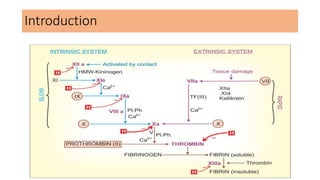
• Clotting factors are proteins synthesized by the liver.
Two systems—the extrinsic and the intrinsic system are involved in
the process of coagulation. Several proteins interact in a cascading
series to form the clot.
Introduction
Role of thrombin in coagulation:
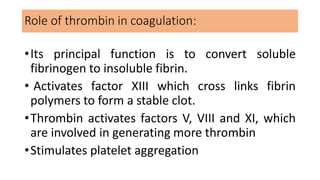
•Its principal function is to convert soluble
fibrinogen to insoluble fibrin.
• Activates factor XIII which cross links fibrin
polymers to form a stable clot.
•Thrombin activates factors V, VIII and XI, which
are involved in generating more thrombin
•Stimulates platelet aggregation
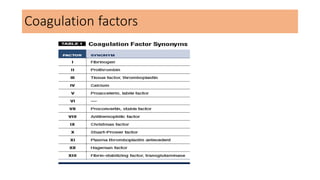
Coagulation factors
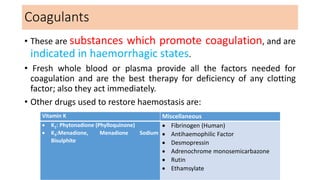
Coagulants
• These are substances which promote coagulation, and are
indicated in haemorrhagic states.
• Fresh whole blood or plasma provide all the factors needed for
coagulation and are the best therapy for deficiency of any clotting
factor; also they act immediately.
• Other drugs used to restore haemostasis are:
Vitamin K Miscellaneous
 K1: Phytonadione (Phylloquinone)
 K3:Menadione, Menadione Sodium
Bisulphite
 Fibrinogen (Human)
 Antihaemophilic Factor
 Desmopressin
 Adrenochrome monosemicarbazone
 Rutin
 Ethamsylate
Vitamin K
•Natural vitamin K or Phytonadione
 It is obtained from leafy vegetables.
It can be given orally or by IV injection. It has a rapid
onset and prolonged effect.
 When given orally it requires bile salts for
absorption.
 Hence deficiency can occur in obstructive jaundice
and in any disease involving malabsorption syndrome.
Vitamin K
•Vitamin K2 or Menaquinone
It is synthesized by intestinal bacterial flora.
Hence, inhibition of the growth of intestinal bacteria
due to prolonged antibiotic therapy leads to vitamin K
deficiency.
Vitamin K
•Vitamin K3 or Menadione is a synthetic (water soluble)
analogue.
Bile salts are not needed for its absorption,
hence it can be given orally in case of obstructive
jaundice.
However it has slow onset of action.
Uses of vitamin K
•The only use of vit K is in prophylaxis and
treatment of bleeding due to deficiency of
clotting factors in the following situations
1. Dietary deficiency: of vit K is very rare in
adults. However, when it occurs 5–10
mg/day oral or parenteral vit K rapidly
corrects the defects.
2. Prolonged antimicrobial therapy: treat in
the same way as dietary deficiency of vit K.
3. Obstructive jaundice or malabsorption syndromes
(sprue, regional ileitis, steatorrhoea, etc.): vit K 10
mg i.m./day, or orally along with bile salts.
4. Liver disease (cirrhosis, viral hepatitis): associated
bleeding responds poorly to vit K. Because of
hepatocellular damage, synthesis of clotting factors
is inadequate despite the presence of vit K.
However, vit K may be of some use if its absorption
had been affected due to lack of bile salts.
5.Newborns:
 All newborns have low levels of prothrombin and other
clotting factors. Further decrease occurs in the next few days.
The cause is both lower capacity to synthesize clotting
factors as well as deficiency of vit K. The defect is exaggerated
in the premature infant.
Vit K 1 mg i.m. soon after birth has been recommended
routinely.
Some prefer administering 5–10 mg i.m. to the mother 4–12
hours before delivery.
Haemorrhagic disease of the newborn can be effectively
prevented/treated by such medication.
Menadione (K3) should not be used for this purpose
Uses of vitamin K
6. Overdose of oral anticoagulants: This is the most
important indication of vit K. Phytonadione (K1) is
the preparation of choice, because it acts most
rapidly; dose depends on the severity of
hypoprothrombinemia (measured INR) and
bleeding.
7. Prolonged high dose salicylate therapy causes
hypoprothrombinemia: vit K should be given
prophylactically.
Adverse effects of Vitamin K
• Phytonadione injected im or given orally hardly produces any adverse
effects. allergic reactions are rare.
• Severe Anaphylactoid reactions can occur on i.v. injection of emulsified
formulation; this route should not be used.
• Menadione and its water-soluble derivatives can cause haemolysis in a
dose-dependent manner.
• Patients with G-6-PD deficiency and neonates are especially susceptible
for hemolysis.
• In the newborn Menadione or its salts can precipitate kernicterus:
(a) by inducing haemolysis and increasing bilirubin load.
(b) by competitively inhibiting glucuronidation of bilirubin.
Other coagulants
2. Fibrinogen: The fibrinogen fraction of human plasma, used to control
bleeding in haemophilia, Antihaemophilic globulin (AHG) deficiency and
acute afrinogenemic states. 0.5 g infused iv.
3. Antihaemophilic factor It is concentrated AHG (factor VIII) prepared
from polled human plasma. It is indicated (along with human
fibrinogen) in haemophilia which due to AHG deficiency.
4. Desmopressin: It acts by releasing Factor VIII and von Willebrand’s
factor from vascular endothelium.
5. Adrenochrome monosemicarbazone: It is believed to reduce capillary
fragility, control oozing from raw surfaces and prevent microvessel
bleeding eg. Epistaxis, Haematuria, Secondary hemorrhage from
wounds etc.
Other coagulants
5. Rutin: It is a plant glycoside claimed to reduce capillary
bleeding. It has been used in a dose of 60 mg oral BD-TDS
along with vitamin C.
6. Ethamsylate: It reduces capillary bleeding when platelets are
adequate; probably corrects abnormalities of platelet
adhesion, but does not stabilize fibrin. It has been used in the
prevention and treatment of capillary bleeding in
menorrhagia, after abortion, epistaxis, Malena, hematuria and
after tooth extraction, However efficacy is doubtful.
Local haemostatics (Styptics)
• After injury to arterioles and other smaller blood vessels, normal
haemostasis occurs successively by contraction of injured vessel wall
(lasting few minutes), adhesion and aggregation of platelets to form a
plug (primary haemostasis), activation of the coagulation cascade and
formation of a blood clot (secondary haemostasis).
• External bleeding is usually stopped by manual pressure, cotton-
gauze pressure pack or by suturing.
• Control of bleeding may be aided by local haemostatics (styptics)
that are substances used to stop bleeding from a local and
approachable site.
Local haemostatics (Styptics)
• They are particularly effective on oozing surfaces, e.g. tooth socket,
abrasions, etc.
• Examples of styptics:
• Absorbable materials like fibrin(prepared from human plasma and
dryed as sheet or foam), gelatin foam, oxidized cellulose(as strips
which can be cut and placed in the wound)  Left in situ these
materials are absorbed in 1–4 weeks and generally cause no
foreign body reaction.
• Thrombin obtained from bovine plasma may be applied as dry
powder or freshly prepared solution to the bleeding surface in
haemophiliacs.
Local haemostatics (Styptics)
•Vasoconstrictors like 0.1% Adrenaline solution
may be soaked in sterile cotton-gauze and packed
in the bleeding tooth socket or nose in case of
epistaxis.
•Astringents such as tannic acid or metallic salts
are occasionally applied for bleeding gums,
bleeding piles,
Anticoagulants
• Used in vivo
A. Parenteral anticoagulants
1. Indirect thrombin inhibitors: Heparin, Low molecular weight heparins
(enoxaparin, dalteparin, reviparin, nadroparin, parnaparin, adreparin),
Fondaparinux, Danaparoid
2. Direct thrombin inhibitors: Lepirudin, Desirudin, Bivalirudin, Argatroban
B. Oral anticoagulants
1. Vitamin K antagonists:
Coumarin derivatives: Bishydroxycoumarin (dicumarol), Warfarin
sod, Acenocoumarol (Nicoumalone), Ethylbiscoumacetate
Indandione derivative: Phenindione.
2. Direct factor Xa inhibitors: Rivaroxaban, Apixaban
3. Oral direct thrombin inhibitor: Dabigatran etexilate
Anticoagulants
• Used in vitro
• Heparin: 150 U to prevent clotting of 100 ml blood.
• Calcium complexing agents:
Sodium citrate: 1.65 g for 350 ml of blood; used to keep blood in the
fluid state for transfusion;
Sodium oxalate: 10 mg for 1 ml blood and Sodium edetate:2 mg for 1
ml blood (used in blood taken for investigation).
Introduction
• Heparin was discovered by McLean, a medical student in
1916.
• It was named 'heparin' as it was first extracted from the liver.
• It is a mucopolysaccharide with molecular weight
10000-20000 found in the mast cells of the liver, lungs and
intestinal mucosa.
• Heparin carries strong electronegative charges
and is the strongest acid in the body.
•Commercially unfractionated heparin is produced
from ox lung and pig intestinal mucosa.
Chemistry and occurrence
•It contains polymers of two sulfated
disaccharide units
D-glucosamine-L-iduronic acid and
D-glucosamine-D- glucuronicacid
Antithrombin III
•Antithrombin-III is itself a substrate for
the protease clotting factors; binds with
the protease to form a stable complex
(suicide inhibitor).
•However, in the absence of heparin, the
two interact very slowly.
Mechanism of action
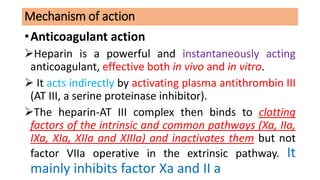
•Anticoagulant action
Heparin is a powerful and instantaneously acting
anticoagulant, effective both in vivo and in vitro.
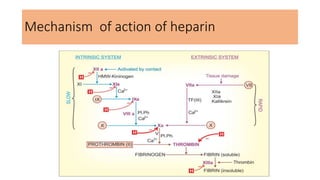
 It acts indirectly by activating plasma antithrombin III
(AT III, a serine proteinase inhibitor).
The heparin-AT III complex then binds to clotting
factors of the intrinsic and common pathways (Xa, IIa,
IXa, XIa, XIIa and XIIIa) and inactivates them but not
factor VIIa operative in the extrinsic pathway. It
mainly inhibits factor Xa and II a
Mechanism of action of heparin
Mechanism of action
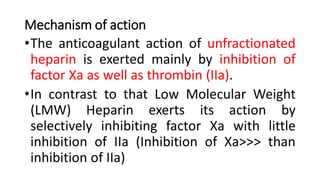
•The anticoagulant action of unfractionated
heparin is exerted mainly by inhibition of
factor Xa as well as thrombin (IIa).
•In contrast to that Low Molecular Weight
(LMW) Heparin exerts its action by
selectively inhibiting factor Xa with little
inhibition of IIa (Inhibition of Xa>>> than
inhibition of IIa)
Mechanism of action
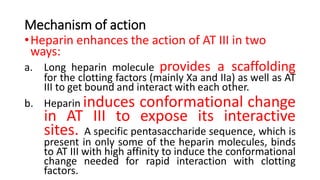
•Heparin enhances the action of AT III in two
ways:
a. Long heparin molecule provides a scaffolding
for the clotting factors (mainly Xa and IIa) as well as AT
III to get bound and interact with each other.
b. Heparin induces conformational change
in AT III to expose its interactive
sites. A specific pentasaccharide sequence, which is
present in only some of the heparin molecules, binds
to AT III with high affinity to induce the conformational
change needed for rapid interaction with clotting
factors.
Mechanism of action
•Inhibition of IIa requires both the
mechanisms, but Xa inhibition can occur
by mechanism ‘b’ alone. This probably
explains why low molecular weight
heparin, which is insufficient to provide
a long scaffolding, selectively inhibits
factor Xa
Mechanism of action
•Antiplatelet Action: Heparin in higher doses inhibits
platelet aggregation and prolongs bleeding time.
•Lipaemia clearing Action: Injection of heparin clears
turbid post-prandial lipaemic plasma by releasing a
lipoprotein lipase from the vessel wall and tissues,
which hydrolyses triglycerides of chylomicra and very
low density lipoproteins to free fatty acids. These then
pass into tissues and the plasma looks clear. This
action requires lower concentration of heparin than
that needed for anticoagulation.
Pharmacokinetics of heparin:
• Large, highly ionised molecule not effective orally.
• It is given IV or SC.
•After giving IV  instantaneous effect, after Sc
injection  anticoagulant action seen in 60 min
•Bioavailability of heparin used by sc route is
inconsistent
•Given intravenously the onset of action is immediate,
reaches peak in 5-10 minutes and clotting time returns
to normal in 2-4 hours.
• It should not be given IM because it may cause haematomas
at the site of injection due to local bleeding.
Pharmacokinetics of heparin:
• Because of its large molecular size, heparin does not cross the BBB
or placental barrier. Therefore, heparin can be used in pregnancy,
if an anticoagulant is needed.
• It is metabolized in liver by heparinase and fragments are excreted
in urine.
• Plasma half life is 1 hr at doses < 100 U/kg, t1/2 increases at higher
dose.
• t1/2 is longer in cirrhotic and renal failure patients and shorter in
patients of pulmonary embolism.
• Treatment is monitored by the aPTT (preferable) or clotting time.
• Heparin released from mast cells is degraded by tissue
macrophages—it is not a physiologically circulating anticoagulant.
•UFH is safer than LMW heparins or fondaparinux
in kidney failure patients.
•Heparin should not be mixed with penicillin,
tetracyclines, hydrocortisone or NA in the same
syringe or infusion bottle.
• Heparinized blood is not suitable for blood
counts (alters the shape of RBCs and WBCs),
fragility testing and complement fixation tests.
Dosage
•Heparin is conventionally given i.v. in a bolus dose of
5,000–10,000 U (children 50–100 U/kg), followed by
continuous infusion of 750–1000 U/hr.
• Intermittent i.v. bolus doses of UFH are no longer
recommended.
•The rate of infusion is controlled by aPTT
measurement which is kept at 50–80 sec. or 1.5–2.5
times the patient’s pretreatment value.
•If these tests are not available, whole blood clotting
time should be measured and kept at ~2 times the
normal value.
Dosage
• Low dose (s.c.) regimen: 5000 U of UFH is injected s.c. every
8–12 hours, started before surgery and continued for 7–10
days or till the patient starts moving about.
• This regimen has been found to prevent postoperative deep
vein thrombosis without increasing surgical bleeding.
• It also does not prolong aPTT or clotting time.
• However, it should not be used in case of neurosurgery or
when spinal anaesthesia is to be given.
• The patients should not be receiving aspirin or oral
anticoagulants.
• This regimen is ineffective in high-risk situations, e.g. hip
joint or pelvic surgery.
Adverse effects of heparin :
•Bleeding
It is due to overdose of the drug.
It is the most serious complication of heparin
therapy.
Haematuria is generally the first sign. other sites are
g.i. tract, brain, joints, muscles, etc.
With proper monitoring, serious bleeding occurs only
in 1–3% patients
Adverse effects of heparin :
•Heparin Induced Thrombocytopenia (HIT)
Generally it is mild and transient;
 Occurs due to aggregation of platelets.
Occasionally serious thromboembolic events result.
In some patients antibodies are formed to the heparin platelet
complex and marked depletion of platelets occursheparin should
be discontinued in such cases.
 Even low molecular weight (LMW) heparins are not safe in such
patients.
Such patients should be treated with direct
thrombin inhibitors
Adverse effects of heparin :
•Transient and reversible alopecia is infrequent.
•Serum transaminase levels may rise.
•Osteoporosis may develop on long-term use of
relatively high doses.
•Hypersensitivity reactions are rare;
manifestations are urticaria, rigor, fever and
anaphylaxis. Patients with allergic diathesis are
more liable.
Contraindications
• Bleeding disorders, history of heparin induced thrombocytopenia.
• Severe hypertension (risk of cerebral haemorrhage), threatened
abortion, piles, g.i. ulcers (risk of aggravated bleeding).
• Subacute bacterial endocarditis (risk of embolism), large
malignancies (risk of bleeding in the central necrosed area of the
tumour), tuberculosis (risk of hemoptysis).
• Ocular and neurosurgery, lumbar puncture.
• Chronic alcoholics, cirrhosis, renal failure.
• Aspirin and other antiplatelet drugs should be used very cautiously
during heparin therapy.
Low Molecular Weight Heparin (LMWH)
•Examples: enoxaparin, dalteparin, reviparin,
nadroparin, parnaparin, adreparin etc.
•Heparin has been fractionated into LMW
forms (MW 3000–7000) by different
techniques.
•LMW heparins have a different anticoagulant
profile; i.e. selectively inhibit factor Xa with
little effect on IIa.
LMWH
• They act only by inducing conformational
change in AT III and not by providing a scaffolding
for interaction of AT III with thrombin.
•As a result, LMW heparins have smaller effect on
aPTT and whole blood clotting time than
unfractionated heparin (UFH)
•They have lesser antiplatelet action
Advantages of LMWH over UFH
1. Better bioavailability (70-90%) than UFH (20-30%)
following SC injection. Variability in response is
minimized.
2. Longer and more consistent monoexponential t½
(4–6 hours); making possible once daily s.c.
administration.
3. Since aPTT/clotting times are not prolonged,
laboratory monitoring is not needed; dose is
calculated on body weight basis.
Advantages of LMWH over UFH
4. Risk of osteoporosis after long term use is
much less with LMW heparin compared with
UFH.
5. Lower incidence of thrombocytopenia and
thrombosis.
6. Major bleeding is less frequent
•Most studies have found LMW heparins to be
equally efficacious to UFH except during
cardiopulmonary bypass surgery, in which high
dose UFH is still the preferred anticoagulant,
because LMW heparin and fondaparinux are less
effective in preventing catheter thrombosis.
•Moreover, their effects are not fully reversed by
protamine.
• Indications of LMW heparins are:
Prophylaxis of deep vein thrombosis and pulmonary
embolism in high-risk patients undergoing surgery; stroke or
other immobilized patients.
Treatment of established deep vein thrombosis.
Unstable angina and MI: they have largely replaced
continuous infusion of UFH.
To maintain patency of cannulae and shunts in dialysis
patients.
Fondaparinux:
•It is pentasaccharide which selectively inhibits
factor Xa without affecting factor IIa (thrombin).
•The bioavailability of fondaparinux injected s.c. is
100% and it is longer acting (t½ 17 hours).
•Metabolism is minimal, and it is largely excreted
unchanged by the kidney. As such, it is not to be
used in renal failure patients.
Fondaparinux:
•Advantages of Fondaparinux
1. less likely to cause thrombocytopenia compared to even
LMW heparins.
2. Risk of osteoporosis after prolonged use is also minimal.
Fondaparinux
3. does not require laboratory monitoring of aPTT
4. longer acting alternative to LMW heparins with the above
advantages.
•Dose: 5–10 mg s.c. once daily
Danaparoid
•It is a preparation containing mainly heparan
sulfate which is a heparin-like substance found in
many tissues, having less potent anticoagulant
action than heparin.
•Danaparoid is obtained from pig gut mucosa, and
is used in cases with heparin induced
thrombocytopenia.
Heparin Antagonist: Protamine Sulphate
•It is a strongly basic, low molecular weight
protein obtained from the sperm of certain
fish.
•Given i.v. it neutralises heparin weight for
weight, i.e. 1 mg is needed for every 100 U
of heparin.
•Protamine does not neutralize
fondaparinux, and it only partially reverses
the anticoagulant effect of LMW heparins.
•In the absence of heparin, protamine itself acts as a
weak anticoagulant by interacting with platelets and
fibrinogen.
•Being basic in nature it can release histamine in the
body. Hypersensitivity reactions have occurred.
•Protamine should be injected slowly (5 mg/min i.v.).
Rapid i.v. injection causes flushing and breathing
difficulty
Oral anticoagulants
• A Haemorrhagic disease described in cattle in 1924  due
to feeding them on spoiled sweet clover hay.
• This disorder was found to be due to prothrombin deficiency
and toxic principle was identified as Bishydroxycoumarin in
1939.
• It was cured by feeding alfalfa grass.
• First clinical use of Bishydroxycoumarin was made in
1941and many congener were added later.
• Warfarin was initially used as rat poison it was found safe
in clinical trial and now it is the principal coumarin oral
anticoagulant.
Oral anticoagulants
• Coumarin Derivatives: Bishydroxycoumarin (dicumarol), Warfarin
sod, Acenocoumarol (Nicoumalone), Ethylbiscoumacetntiate
Warfarin:
• It is the most popular oral anticoagulant.
• The commercial preparation of warfarin is a mixture of R
(dextrorotatory) and S (levorotatory) enantiomers.
• Warfarin and its congeners act as anticoagulants only in vivo
because they act by interfering with the synthesis of vitamin K
dependent clotting factors (II, VII, IX and X) in the liver.
Oral anticoagulants
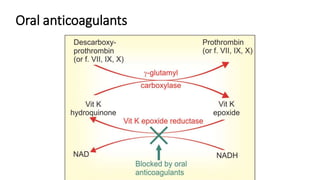
Warfarin Mechanism of action
• Warfarin ant its congeners acts as anticoagulants in vivo ,
not in in vitro.
• Warfarin acts by inhibiting synthesis of vitamin K
dependent clotting factors  factor II, VII, IX and
X
•γ carboxylation is glutamate residue is important last
step in the synthesis of factor II, VII, IX and X. γ
glutamyl carboxylase enzyme is required for γ
carboxylation reaction.
Warfarin Mechanism of action
•Vitamin K hydroquinone ( active form/ reduced form
of vitamin K) acts as cofactor of enzyme glutamyl
carboxylase.
•Vitamin K epoxide reductase (VKOR)
enzyme is required for formation of a vitamin K
hydroquinone (reduced form of vitamin K, its active
form of vitamin K ) from vitamin K epoxide (Oxidised
form, it is inactive form of vitamin K)
Warfarin Mechanism of action
•Warfarin and its congeners block the gamma-
carboxylation of glutamate residues in II, VII, IX and X
by inhibiting Vitamin K Epoxide
Reductase (VKOR) enzyme.
• By inhibiting VKOR enzyme, coumarin derivatives
interfere with formation of active hydroquinone form
of vitamin K.
• (Note: Active hydroquinone form is required for
gamma carboxylation of factor II, VII, IX and X)
Warfarin Mechanism of action
•The onset of action is slow; it develops over
1-3 days because oral anticoagulants do not
destroy the already circulating clotting
factors.  there is always a delay between
administration of coumarin drugs and the
anticoagulant effect
Pharmacokinetics:
• Warfarin is completely absorbed orally and is 99% bound to plasma
proteins.
• They are metabolized by glucuronide conjugation and are excreted in
the urine.
• Warfarin is also metabolized by microsomal enzymes CYP2C9.
• People inheriting a genetic variant of CYP2C9 metabolise warfarin at a
slow rate and, therefore, the risk of bleeding is higher in such people.
• It crosses placenta and is secreted in milk; however, quantity of active
form is generally insufficient to affect the suckling infant it is
contraindicated in pregnancy.
Adverse effects
• Bleeding:
Bleeding as a result of extension of the desired
pharmacological action is the most important problem
causing ecchymosis, epistaxis, hematuria, bleeding in the
g.i.t.
Intracranial or other internal haemorrhages may even be
fatal.
Bleeding is more likely if therapy is not properly monitored,
or when INR exceeds 4, or interacting
drugs/contraindications are present.
Adverse effects
Treatment: of bleeding due to oral anticoagulants
consists of:
Withhold the anticoagulant.
Give fresh blood transfusion; this supplies clotting factors
and replenishes lost blood. Alternatively fresh frozen
plasma may be used as a source of clotting factors.
Give vit K1 which is the specific antidote , but it takes 6–
24 hours for the clotting factors to be resynthesized and
released in blood after vit K administration.
Adverse effects
•GIT disturbances, oral ulceration, Alopecia ,
dermatitis, diarrhoea.
•Cutaneous necrosis is a rare complication that can
occur with any coumarin anticoagulant.
•Note: when warfarin is administered, the plasma
levels of vitamin K depending anticlotting factors
(Protein C and protein S) fall much earlier than the
fall in plasma levels of vitamin K dependent clotting
factors. The decrease level of anticlotting factors
leads to an initial prothrombotic state for a brief
period after warfarin administration which leads to
skin necrosis in some patient
•Warfarin and acenocoumarol are
considered to be the most suitable
and better tolerated coumarin
anticoagulants
Dose Adjustment
• The dose of oral anticoagulant must be individualized by repeated
measurement of prothrombin time or INR.
• INR: International normalized ratio (INR) is the preferred test of
choice for patients taking vitamin K antagonists (VKA). It can also be
used to assess the risk of bleeding or the coagulation status of the
patients.
• Patients taking oral anticoagulants are required to monitor INR to
adjust the VKA doses because these vary between patients.
• The INR is derived from prothrombin time (PT) which is calculated as
a ratio of the patient’s PT to a control PT standardized for the potency
of the thromboplastin reagent.
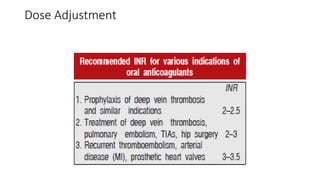
Dose Adjustment
Contraindications
• All contraindications to heparin apply to these drugs as well.
• Oral anticoagulants should not be used during pregnancy. Warfarin
given in early pregnancy increases birth defects, especially skeletal
abnormalities. It can produce foetal warfarin syndrome—hypoplasia
of nose, eye socket, hand bones, and growth retardation.
• Given later in pregnancy, it can cause CNS defects, foetal
haemorrhage, foetal death and accentuates neonatal
hypoprothrombinemia.
Drug interactions with oral anticoagulants
•Enhanced anticoagulant action:
Broad-spectrum antibiotics: inhibit gut flora and reduce vit K
production.
Newer cephalosporins (ceftriaxone, cefoperazone) cause
hypoprothrombinemia by the same mechanism as warfarin —additive
action.
Aspirin increases risk of bleeding in patient who is on warfarin due to
antiplatelet action (additive effect – pharmacodynamic type) and due
to displacement of warfarin from binding site.
Long acting sulfonamides, indomethacin, phenytoin and Probenecid:
displace warfarin from plasma protein binding.
Chloramphenicol, erythromycin, Celecoxib, cimetidine, allopurinol,
amiodarone and metronidazole: inhibit warfarin metabolism.
Liquid paraffin (habitual use): reduces vit K absorption.
Drug interactions with oral anticoagulants
• Reduced anticoagulant action:
Barbiturates (but not benzodiazepines), carbamazepine, rifampin and
Griseofulvin induce the metabolism of oral anticoagulants. The dose
of anticoagulant determined during therapy with these drugs would
be higher: if the same is continued after withdrawing the inducer—
marked hypoprothrombinemia can occur—fatal bleeding is on record.
Oral contraceptives: increase blood levels of clotting factors.
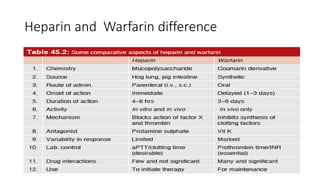
Heparin and Warfarin difference
•Warfarin was developed at University of Wiscosin by
Wiscosin Alumini Research Foundation:
WARFarin (arin came from word
Coumarin )
•Rodenticides like Bromadiolone act by a
machanism similar to that of warfarin  inhibiting
vitamin K dependent clotting factors  risk of
excessive bleeding
•Vitamin K is used for the treatment of rrodenticide
poisoning
Direct thrombin inhibitors
Role of thrombin
•Principal function of Thrombin is to convert soluble
fibrinogen to insoluble fibrin.
• Activates factor XIII which cross links fibrin polymers
to form a stable clot.
•Thrombin activates factors V, VIII and XI, which are
involved in generating more thrombin
•Stimulates platelet aggregation
Direct thrombin inhibitors
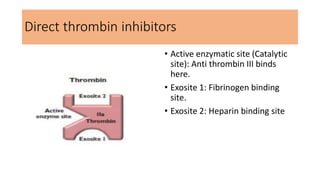
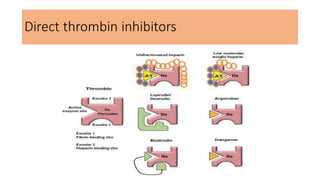
• Active enzymatic site (Catalytic
site): Anti thrombin III binds
here.
• Exosite 1: Fibrinogen binding
site.
• Exosite 2: Heparin binding site
Direct thrombin inhibitors
• Direct thrombin inhibitors (DTIs) bind directly to thrombin
and do not require a cofactor such as antithrombin to exert
their effect.
• Bivalent DTIs (hirudin and analogs) bind both to the active
site and exosite 1, while univalent DTIs bind only to the
active site to inhibit the thrombin.
• Examples of Bivalent DTIs are hirudin, lepirudin, bivalirudin,
desirudin
• Examples of Univalent DTIs are Argatroban, Melagatran,
ximelagatran, Dabigatran
Direct thrombin inhibitors
• Lepirudin, desirudin, bivalirudin and argatroban are
approved for parenteral route while dabigatran etexilate is
approved for oral route
• Hirudin : obtained from salivary gland of leech
• Lepirudin and Desirudin are the recombinant form of hirudin
derived from yeast cell. Used by subcutaneous or IV route.
• Bivalirudin is synthetic hirudin analogue. Used by IV route
• Argatroban is considered safer in patients with renal failure
because its clearance is through hepatic system. It is used by
IV route
Direct thrombin inhibitors
Limitations of Heparin:
1. It is not able to neutralise fibrin bound thrombin/clot
bound thrombin.
2. Unpredictable dose-dependent anticoagulant response
because of its binding with various plasma proteins.
3. Routine dose-adjustments and anticoagulant monitoring is
required
4. Risk of Heparin Induced Thrombocytopenia (HIT).
Direct thrombin inhibitors
Advantages of Direct Thrombin Inhibitors:
1. Better suppression of thrombus growth inhibits fibrin
bound as well as unbound thrombin.
2. Retain activity in presence of platelet rich thrombi.
3. Predictable anticoagulant action because they do not bind
with other plasma proteins.
4. No risk of Heparin Induced Thrombocytopenia
Oral Direct Factor Xa inhibitors
• Limitations of Warfarin:
Delayed onset of action,
Slow recovery on stoppage,
Narrow therapeutic range,
Need for repeated laboratory monitoring dose adjustment
Numerous drug interactions.
• To overcome limitations of Warfarin, some oral direct factor Xa
inhibitors and oral direct thrombin inhibitor (ODTI) have been lately
introduced.
• Oral direct Xa inhibitors act rapidly without a lag time, and have
short-lasting action.
Oral Direct Factor Xa inhibitors
Rivaroxaban
• Oral direct Factor Xa inhibitor.
• Action develops rapidly within 3–4 hours of ingestion and lasts for
~24 hours.
• It requires no laboratory monitoring of PT or aPTT
• It is recommended in a fixed dose of 10 mg once daily starting 6–10
hours after surgery for prophylaxis of venous thromboembolism
following total knee/hip replacement. Duration of prophylaxis is 12-
14 days after knee replacement and 35 days after hip replacement.
• For treatment of DVT and PE, it is recommended in the dose of 15 mg
twice daily for 3 weeks followed by 20 mg/day
Oral Direct Factor Xa inhibitors
• Rivaroxaban has also been found equally effective as
warfarin for preventing stroke in patients with atrial
fibrillation.
• It is now also approved in a dose of 2.5 mg/day for
coadministration with aspirin and clopidogrel for prophylaxis
of ACS.
• Side effects reported are bleeding, nausea, hypotension,
tachycardia and edema
Oral Direct Factor Xa inhibitors
Apixaban:
•Indications similar to Rivaroxaban.
•Bioavailability 85% and peak after 3 hours.
•Metabolised by CYP 3A4, elimination through urine
and faeces
•Chances of drug interactions with CYP 3A4 inducers or
inhibitors.
Oral Direct Factor Xa inhibitors
•Apixaban is approved for
1. Prophylaxis of VTE following knee/ hip replacement
(2.5 mg BD)
2. Prophylaxis of stroke in AF patients (Dose 5 mg BD)
3. Treatment of DVT and PE (Dose 10 mg BD for 7 days
followed by 5 mg BD)
Oral Direct Factor Xa inhibitors
•Andexanet Alpha is antidote
of oral direct factor Xa
inhibitors
Oral Direct thrombin inhibitor
•Dabigatran Etexilate
Prodrug which after oral administration is rapidly
hydrolysed to dabigatran
 Direct thrombin inhibitor which reversibly blocks the
catalytic site of thrombin and produces a rapid (within
2 hours) anticoagulant action.
oral bioavailability is low
The plasma t½ is 12–14 hours and duration of action
24 hours
Oral Direct thrombin inhibitor
• No laboratory monitoring is required.
• No interactions with CYP 3A4 inducers/inhibitors
• It is approved for prevention of VTE following hip/knee joint
replacement surgery. (dose 110 mg daily and in patients > 75
years dose is 75 mg daily)
• It is also approved for prevention of embolism and stroke in
patients of atrial fibrillation.
• Side effects: Bleeding (less as compare to warfarin, however
most important adverse effect), dyspepsia, hepatobiliary
syndrome
Oral Direct thrombin inhibitor
•A monoclonal antibody
idarucizumab has been
developed as a reversal agent
for dabigatran.
Uses of anticoaulants
•Use of anticoagulant can be life
saving
•Prophylactic value, but can be risky
(may provoke fetal bleeding).
•use requires great caution and
expertise
Uses of anticoaulants
•The aim of using anticoagulants is to prevent
thrombus extension and embolic complications by
reducing the rate of fibrin formation. They. do not
dissolve already formed clot, but prevent recurrences.
•Parenteral anticoagulants (UFH, LMW heparins,
Fondaparinux, DTIs) are utilized for rapid and short
term action, while oral anticoagulants (warfarin, oral
factor Xa inhibitors, oral DTIs) are suitable for
maintenance purpose.
Uses of anticoaulants
• Anticoagulants are more effective for prevention and
treatment of VTE, because venous thrombi are mainly fibrin
thrombi.
• Anticoagulants have limited and inconsistent role in arterial
thrombosis, because arterial thrombi are mainly composed
of platelets. Their role in MI and UA is short term and
secondary to that of antiplatelet drugs.
• Oral factor Xa inhibitors and DTIs have surpassed low dose
s.c. heparin and LMW heparins for prevention of VTE in post
knee/ hip replacement surgery.
Uses of anticoaulants
•LMW heparins and fondaparinux have almost
replaced UFH, except in kidney disease patients,
because clearance of UFH is affected to a lesser
extent by renal failure. UFH is also preferred in
major surgery and high risk cases, because its
action can be rapidly reversed by protamine,
which neutralizes LMW heparins to lower extent,
and does not neutralise fondaparinux.
Uses of anticoaulants
•Oral anticoagulants (warfarin, factor Xa inhibitors,
DTIs) are more effective than antiplatelet drugs for the
prevention of stroke in nonvalvular AF cases.
•Anticoagulants have little value in thrombotic stroke.
Neurological sequelae are similar whether they are
given or not. However, they may be given in cerebral
emboli, because showers of emboli are recurrent, and
can be prevented by anticoagulants. Antiplatelet
drugs are superior to anticoagulants in transient
ischemic attacks (TIAs).
Uses of anticoaulants
•The parenteral DTI bivalirudin is
specifically indicated in patients with
HIT, or those with high risk of HIT.
Uses of anticoagulant Drugs:
•Deep vein thrombosis (DVT) and
pulmonary embolism (PE):
Prophylaxis is recommended for all high risk
patients including bedridden, elderly,
postoperative, postpartum, post stroke and leg
fracture patients.
When deep vein thrombosis/ pulmonary
embolism has occurred, immediate
heparin/LMW heparin followed by warfarin
therapy should be instituted.
Uses of anticoagulant Drugs:
•Myocardial infarction (MI):
Arterial thrombi are mainly platelet thrombi;
anticoagulants are of questionable value.
For secondary prophylaxis against a subsequent
attack— anticoagulants are inferior to antiplatelet
drugs.
Heparin (i.v.) or preferably LMW heparin/
fondaparinux s.c. once or twice daily for 2–8 days
followed by oral anticoagulants for 3 months or
continuation of LMW heparin for 2–3 months are
generally given after recanalization of coronary artery
by fibrinolytic therapy.
Uses of anticoagulant Drugs:
•Unstable angina:
•Short-term use of heparin has reduced the occurrence
of MI in unstable angina patients; aspirin is equally
effective.
• Current recommendation is to use aspirin +
heparin/LMW heparin followed by warfarin.
Uses
•Rheumatic heart disease; Atrial fibrillation (AF):
All atrial fibrillation patients should be protected against
thromboembolism from fibrillating atria and the resulting stroke.
For this purpose, the effective options are warfarin/low dose
heparin/low dose aspirin.
The ‘Stroke prevention in Atrial Fibrillation’ trial and a metaanalysis
have shown warfarin to be more effective than aspirin.
Current guideline is to give warfarin to a target INR of 2–3 in AF
patients with high risk for stroke (elderly, heart failure, etc.), and to
reserve aspirin for low risk patients or for those unable to take
warfarin.
Anticoagulants are given for 3–4 weeks before and after attempting
conversion of AF to sinus rhythm
Uses
•Cerebrovascular disease:
Anticoagulants are of little value in cerebral thrombosis.
They may be used in cerebral embolism, because showers of
emboli are often recurrent and can be prevented by
anticoagulants.
Oral anticoagulants may be beneficial in transient ischaemic
attacks (TIAs), but antiplatelet drugs are simpler to use and
probably better.
Uses
• Vascular surgery, prosthetic heart valves, retinal vessel
thrombosis, extracorporeal circulation, and haemodialysis:
Anticoagulants are indicated along with antiplatelet drugs for
prevention of thromboembolism.
• Heparin flushes (200 U in 2 ml) every 4–8 hr are used to
keep patent long-term intravascular cannulae/catheters.
Uses
Defibrination syndrome or ‘disseminated intravascular coagulation’
 occurs in Abruptio placentae and other obstetric conditions, certain
malignancies and infections.
The coagulation factors get consumed for the formation of
intravascular microclots and blood is incoagulable.
Heparin paradoxically checks bleeding in such patients by preserving
the clotting factors.
However, in some cases heparin may aggravate bleeding
Uses of anticoagulants
1. Deep vein thrombosis (DVT) and pulmonary embolism (PE):
2. Myocardial infarction (MI):
3. Unstable Angina
4. Rheumatic heart disease; Atrial fibrillation (AF):
5. Cerebrovascular disease:
6. Vascular surgery, prosthetic heart valves, retinal vessel
thrombosis, extracorporeal circulation, and haemodialysis:
7. to keep patent long-term intravascular cannulae/catheters.
8. Defibrination syndrome or ‘disseminated intravascular
coagulation’