
MEDIDAS
FARMACOLÓGICAS
PARA AHORRO DE
HEMODERIVADOS
JOSÉ A. PARAMO
SERVICIO DE HEMATOLOGÍA
CLÍNICA UNIVERSIDAD DE NAVARRA
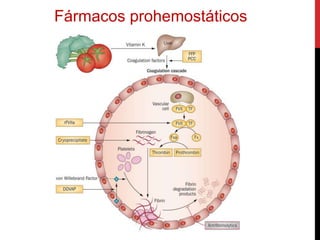
Fármacos prohemostáticos
3
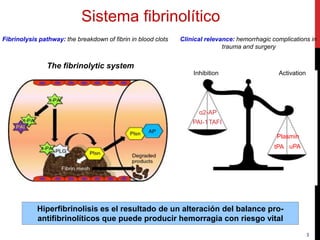
uPA
PAI-1
tPA
Plasmin
α2-AP
Sistema fibrinolítico
Inhibition Activation
Fibrinolysis pathway: the breakdown of fibrin in blood clots Clinical relevance: hemorrhagic complications in
trauma and surgery
Hiperfibrinolisis es el resultado de un alteración del balance pro-
antifibrinolíticos que puede producir hemorragia con riesgo vital
TAFI
The fibrinolytic system
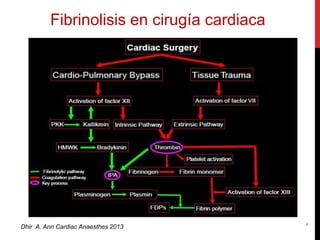
Dhir A. Ann Cardiac Anaesthes 2013
Fibrinolisis en cirugía cardiaca
4
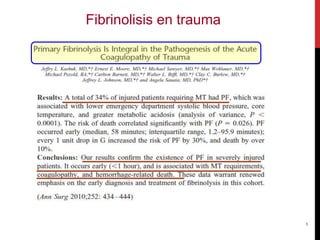
Fibrinolisis en trauma
5
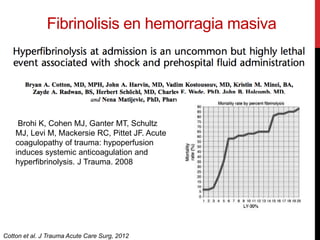
Fibrinolisis en hemorragia masiva
Brohi K, Cohen MJ, Ganter MT, Schultz
MJ, Levi M, Mackersie RC, Pittet JF. Acute
coagulopathy of trauma: hypoperfusion
induces systemic anticoagulation and
hyperfibrinolysis. J Trauma. 2008
Cotton et al. J Trauma Acute Care Surg, 2012
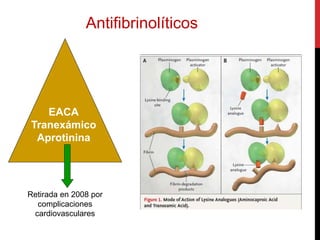
Antifibrinolíticos
EACA
Tranexámico
Aprotinina
Retirada en 2008 por
complicaciones
cardiovasculares
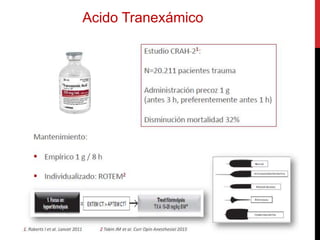
Acido Tranexámico
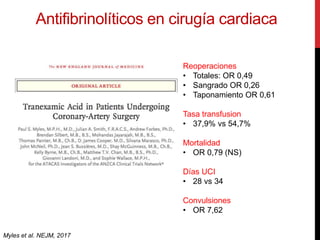
Reoperaciones
• Totales: OR 0,49
• Sangrado OR 0,26
• Taponamiento OR 0,61
Tasa transfusion
• 37,9% vs 54,7%
Mortalidad
• OR 0,79 (NS)
Días UCI
• 28 vs 34
Convulsiones
• OR 7,62
Myles et al. NEJM, 2017
Antifibrinolíticos en cirugía cardiaca
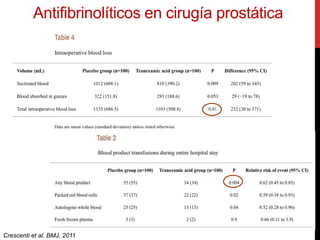
Crescenti et al. BMJ, 2011
Antifibrinolíticos en cirugía prostática
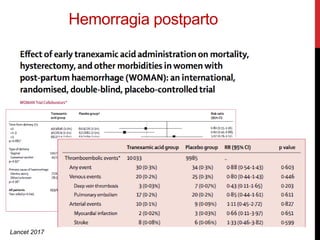
Hemorragia postparto
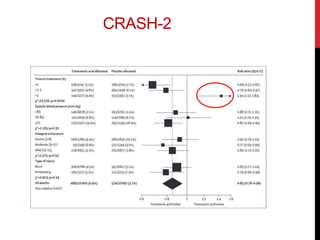
Lancet 2017
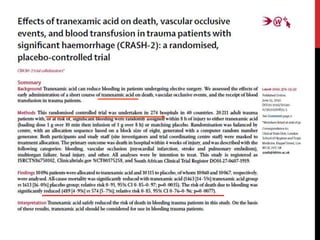
CRASH-2
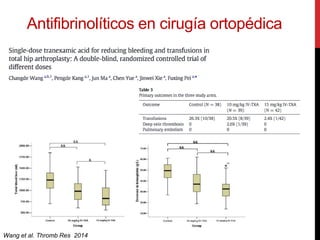
Wang et al. Thromb Res 2014
Antifibrinolíticos en cirugía ortopédica
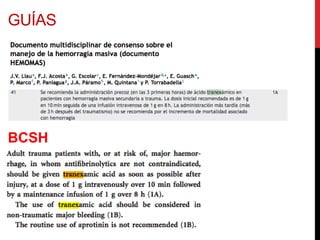
GUÍAS
BCSH
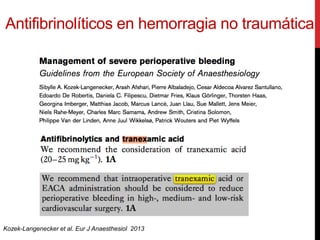
Kozek-Langenecker et al. Eur J Anaesthesiol 2013
Antifibrinolíticos en hemorragia no traumática
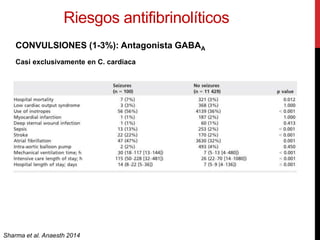
CONVULSIONES (1-3%): Antagonista GABAA
Casi exclusivamente en C. cardiaca
Sharma et al. Anaesth 2014
Riesgos antifibrinolíticos
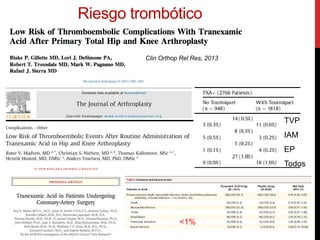
Clin Orthop Rel Res, 2013
Riesgo trombótico
TVP
IAM
EP
Todos
<1%
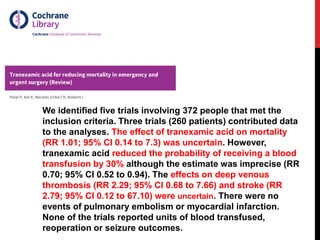
We identified five trials involving 372 people that met the
inclusion criteria. Three trials (260 patients) contributed data
to the analyses. The effect of tranexamic acid on mortality
(RR 1.01; 95% CI 0.14 to 7.3) was uncertain. However,
tranexamic acid reduced the probability of receiving a blood
transfusion by 30% although the estimate was imprecise (RR
0.70; 95% CI 0.52 to 0.94). The effects on deep venous
thrombosis (RR 2.29; 95% CI 0.68 to 7.66) and stroke (RR
2.79; 95% CI 0.12 to 67.10) were uncertain. There were no
events of pulmonary embolism or myocardial infarction.
None of the trials reported units of blood transfused,
reoperation or seizure outcomes.
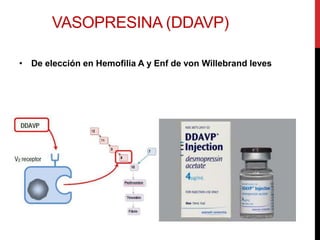
VASOPRESINA (DDAVP)
• De elección en Hemofilia A y Enf de von Willebrand leves
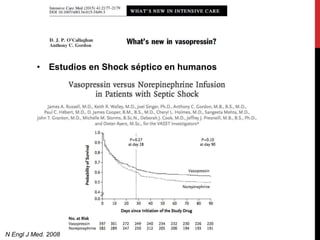
• Estudios en Shock séptico en humanos
N Engl J Med. 2008
VASOPRESINA
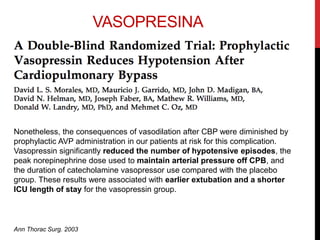
Nonetheless, the consequences of vasodilation after CBP were diminished by
prophylactic AVP administration in our patients at risk for this complication.
Vasopressin significantly reduced the number of hypotensive episodes, the
peak norepinephrine dose used to maintain arterial pressure off CPB, and
the duration of catecholamine vasopressor use compared with the placebo
group. These results were associated with earlier extubation and a shorter
ICU length of stay for the vasopressin group.
Ann Thorac Surg. 2003
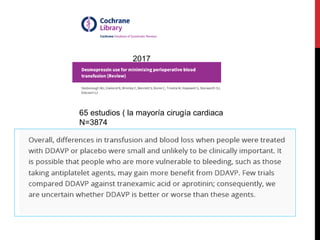
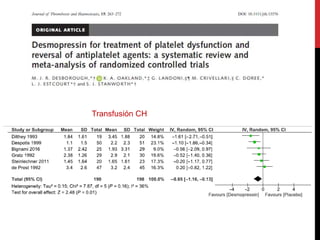
65 estudios ( la mayoría cirugía cardiaca
N=3874
2017
Transfusión CH
26
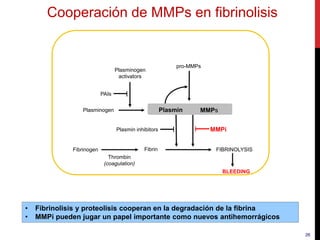
Cooperación de MMPs en fibrinolisis
Plasminogen
activators
Plasminogen
Fibrinogen Fibrin
Thrombin
(coagulation)
FIBRINOLYSIS
PAIs
Plasmin inhibitors
pro-MMPs
MMPsPlasmin
BLEEDING
MMPi
• Fibrinolisis y proteolisis cooperan en la degradación de la fibrina
• MMPi pueden jugar un papel importante como nuevos antihemorrágicos
27
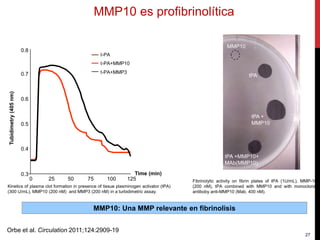
Orbe et al. Circulation 2011;124:2909-19
MMP10
tPA +
MMP10
tPA
tPA +MMP10+
MAb(MMP10)
MMP10 es profibrinolítica
t-PA+MMP10
Time (min)
Tubidimetry(405nm)
0.3
0.4
0.5
0.6
0.7
0.8
0 25 50 75 100 125
t-PA
t-PA+MMP3
Kinetics of plasma clot formation in presence of tissue plasminogen activator (tPA)
(300 U/mL), MMP10 (200 nM) and MMP3 (200 nM) in a turbidimetric assay.
Fibrinolytic activity on fibrin plates of tPA (1U/mL), MMP-10
(200 nM), tPA combined with MMP10 and with monoclonal
antiboby anti-MMP10 (Mab, 400 nM).
MMP10: Una MMP relevante en fibrinolisis
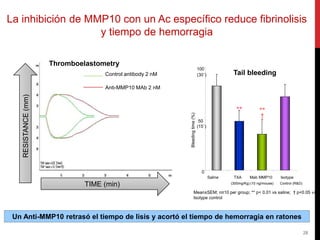
La inhibición de MMP10 con un Ac específico reduce fibrinolisis
y tiempo de hemorragia
28
Thromboelastometry
Anti-MMP10 MAb 2 nM
Control antibody 2 nM
Saline TXA
(300mg/Kg)
Mab MMP10
(10 ng/mouse)
Isotype
Control (R&D)
Bleedingtime(%)
0
(15´)
50
100
(30´)
** **
†
Mean±SEM; n≥10 per group; ** p< 0.01 vs saline; † p<0.05 vs
Isotype control
Tail bleeding
TIME (min)
RESISTANCE(mm)
Un Anti-MMP10 retrasó el tiempo de lisis y acortó el tiempo de hemorragia en ratones
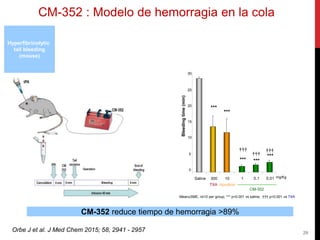
CM-352 reduce tiempo de hemorragia >89%
Mean±SME; n≥10 per group; *** p<0.001 vs saline; ††† p<0.001 vs TXA
Bleedingtime(min)
Saline 300 10 1 0.1 0.01 mg/Kg
CM-352
TXA Aprotinin
***
†††
***
*** ***
***†††
†††
0
5
10
15
20
25
30
35
CM-352 : Modelo de hemorragia en la cola
Orbe J et al. J Med Chem 2015; 58, 2941 - 2957
Hyperfibrinolytic
tail bleeding
(mouse)
29
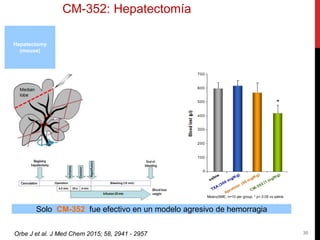
30
Mean±SME; n=10 per group; * p< 0.05 vs saline
Solo CM-352 fue efectivo en un modelo agresivo de hemorragia
CM-352: Hepatectomía
Orbe J et al. J Med Chem 2015; 58, 2941 - 2957
Hepatectomy
(mouse)
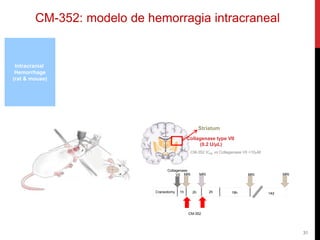
31
Intracranial
Hemorrhage
(rat & mouse)
Collagenase type VII
(0.2 U/µL)
Striatum
CM-352 IC50 vs Collagenase VII >10mM
Collagenase
VII
Craneotomy 1h
MRI MRI
2h
CM-352
2h 19h 14d
MRI MRI
CM-352: modelo de hemorragia intracraneal
(1 mg/Kg)
n=6 n=6
Bedersonscale
0
1
2
3
4
5
6
7
8
Baseline 24 h day 14
** p<0.01Control CM 352
** **
Neurological deficit
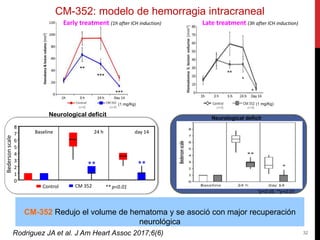
32
Early treatment (1h after ICH induction)
Rodriguez JA et al. J Am Heart Assoc 2017;6(6)
(1 mg/Kg)
n=6 n=6
Late treatment (3h after ICH induction)
Neurological deficit
*p<0.05, **p<0.01
CM-352 Redujo el volume de hematoma y se asoció con major recuperación
neurológica
CM-352: modelo de hemorragia intracraneal
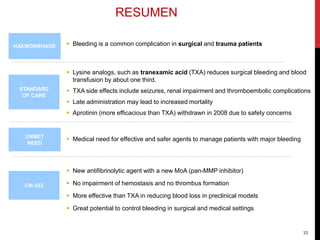
RESUMEN
HAEMORRHAGE  Bleeding is a common complication in surgical and trauma patients
STANDARD
OF CARE
CM-352
 New antifibrinolytic agent with a new MoA (pan-MMP inhibitor)
 No impairment of hemostasis and no thrombus formation
 More effective than TXA in reducing blood loss in preclinical models
 Great potential to control bleeding in surgical and medical settings
 Lysine analogs, such as tranexamic acid (TXA) reduces surgical bleeding and blood
transfusion by about one third.
 TXA side effects include seizures, renal impairment and thromboembolic complications
 Late administration may lead to increased mortality
 Aprotinin (more efficacious than TXA) withdrawn in 2008 due to safety concerns
UNMET
NEED
 Medical need for effective and safer agents to manage patients with major bleeding
33
Antibibrinoliticos ddavp-jaca

Antibibrinoliticos ddavp-jaca

  • 1.
    MEDIDAS FARMACOLÓGICAS PARA AHORRO DE HEMODERIVADOS JOSÉA. PARAMO SERVICIO DE HEMATOLOGÍA CLÍNICA UNIVERSIDAD DE NAVARRA
  • 2.
  • 3.
    3 uPA PAI-1 tPA Plasmin α2-AP Sistema fibrinolítico Inhibition Activation Fibrinolysispathway: the breakdown of fibrin in blood clots Clinical relevance: hemorrhagic complications in trauma and surgery Hiperfibrinolisis es el resultado de un alteración del balance pro- antifibrinolíticos que puede producir hemorragia con riesgo vital TAFI The fibrinolytic system
  • 4.
    Dhir A. AnnCardiac Anaesthes 2013 Fibrinolisis en cirugía cardiaca 4
  • 5.
  • 6.
    Fibrinolisis en hemorragiamasiva Brohi K, Cohen MJ, Ganter MT, Schultz MJ, Levi M, Mackersie RC, Pittet JF. Acute coagulopathy of trauma: hypoperfusion induces systemic anticoagulation and hyperfibrinolysis. J Trauma. 2008 Cotton et al. J Trauma Acute Care Surg, 2012
  • 7.
  • 8.
  • 9.
    Reoperaciones • Totales: OR0,49 • Sangrado OR 0,26 • Taponamiento OR 0,61 Tasa transfusion • 37,9% vs 54,7% Mortalidad • OR 0,79 (NS) Días UCI • 28 vs 34 Convulsiones • OR 7,62 Myles et al. NEJM, 2017 Antifibrinolíticos en cirugía cardiaca
  • 10.
    Crescenti et al.BMJ, 2011 Antifibrinolíticos en cirugía prostática
  • 11.
  • 13.
  • 14.
    Wang et al.Thromb Res 2014 Antifibrinolíticos en cirugía ortopédica
  • 15.
  • 16.
    Kozek-Langenecker et al.Eur J Anaesthesiol 2013 Antifibrinolíticos en hemorragia no traumática
  • 17.
    CONVULSIONES (1-3%): AntagonistaGABAA Casi exclusivamente en C. cardiaca Sharma et al. Anaesth 2014 Riesgos antifibrinolíticos
  • 18.
    Clin Orthop RelRes, 2013 Riesgo trombótico TVP IAM EP Todos <1%
  • 19.
    We identified fivetrials involving 372 people that met the inclusion criteria. Three trials (260 patients) contributed data to the analyses. The effect of tranexamic acid on mortality (RR 1.01; 95% CI 0.14 to 7.3) was uncertain. However, tranexamic acid reduced the probability of receiving a blood transfusion by 30% although the estimate was imprecise (RR 0.70; 95% CI 0.52 to 0.94). The effects on deep venous thrombosis (RR 2.29; 95% CI 0.68 to 7.66) and stroke (RR 2.79; 95% CI 0.12 to 67.10) were uncertain. There were no events of pulmonary embolism or myocardial infarction. None of the trials reported units of blood transfused, reoperation or seizure outcomes.
  • 20.
    VASOPRESINA (DDAVP) • Deelección en Hemofilia A y Enf de von Willebrand leves
  • 22.
    • Estudios enShock séptico en humanos N Engl J Med. 2008
  • 23.
    VASOPRESINA Nonetheless, the consequencesof vasodilation after CBP were diminished by prophylactic AVP administration in our patients at risk for this complication. Vasopressin significantly reduced the number of hypotensive episodes, the peak norepinephrine dose used to maintain arterial pressure off CPB, and the duration of catecholamine vasopressor use compared with the placebo group. These results were associated with earlier extubation and a shorter ICU length of stay for the vasopressin group. Ann Thorac Surg. 2003
  • 24.
    65 estudios (la mayoría cirugía cardiaca N=3874 2017
  • 25.
  • 26.
    26 Cooperación de MMPsen fibrinolisis Plasminogen activators Plasminogen Fibrinogen Fibrin Thrombin (coagulation) FIBRINOLYSIS PAIs Plasmin inhibitors pro-MMPs MMPsPlasmin BLEEDING MMPi • Fibrinolisis y proteolisis cooperan en la degradación de la fibrina • MMPi pueden jugar un papel importante como nuevos antihemorrágicos
  • 27.
    27 Orbe et al.Circulation 2011;124:2909-19 MMP10 tPA + MMP10 tPA tPA +MMP10+ MAb(MMP10) MMP10 es profibrinolítica t-PA+MMP10 Time (min) Tubidimetry(405nm) 0.3 0.4 0.5 0.6 0.7 0.8 0 25 50 75 100 125 t-PA t-PA+MMP3 Kinetics of plasma clot formation in presence of tissue plasminogen activator (tPA) (300 U/mL), MMP10 (200 nM) and MMP3 (200 nM) in a turbidimetric assay. Fibrinolytic activity on fibrin plates of tPA (1U/mL), MMP-10 (200 nM), tPA combined with MMP10 and with monoclonal antiboby anti-MMP10 (Mab, 400 nM). MMP10: Una MMP relevante en fibrinolisis
  • 28.
    La inhibición deMMP10 con un Ac específico reduce fibrinolisis y tiempo de hemorragia 28 Thromboelastometry Anti-MMP10 MAb 2 nM Control antibody 2 nM Saline TXA (300mg/Kg) Mab MMP10 (10 ng/mouse) Isotype Control (R&D) Bleedingtime(%) 0 (15´) 50 100 (30´) ** ** † Mean±SEM; n≥10 per group; ** p< 0.01 vs saline; † p<0.05 vs Isotype control Tail bleeding TIME (min) RESISTANCE(mm) Un Anti-MMP10 retrasó el tiempo de lisis y acortó el tiempo de hemorragia en ratones
  • 29.
    CM-352 reduce tiempode hemorragia >89% Mean±SME; n≥10 per group; *** p<0.001 vs saline; ††† p<0.001 vs TXA Bleedingtime(min) Saline 300 10 1 0.1 0.01 mg/Kg CM-352 TXA Aprotinin *** ††† *** *** *** ***††† ††† 0 5 10 15 20 25 30 35 CM-352 : Modelo de hemorragia en la cola Orbe J et al. J Med Chem 2015; 58, 2941 - 2957 Hyperfibrinolytic tail bleeding (mouse) 29
  • 30.
    30 Mean±SME; n=10 pergroup; * p< 0.05 vs saline Solo CM-352 fue efectivo en un modelo agresivo de hemorragia CM-352: Hepatectomía Orbe J et al. J Med Chem 2015; 58, 2941 - 2957 Hepatectomy (mouse)
  • 31.
    31 Intracranial Hemorrhage (rat & mouse) Collagenasetype VII (0.2 U/µL) Striatum CM-352 IC50 vs Collagenase VII >10mM Collagenase VII Craneotomy 1h MRI MRI 2h CM-352 2h 19h 14d MRI MRI CM-352: modelo de hemorragia intracraneal
  • 32.
    (1 mg/Kg) n=6 n=6 Bedersonscale 0 1 2 3 4 5 6 7 8 Baseline24 h day 14 ** p<0.01Control CM 352 ** ** Neurological deficit 32 Early treatment (1h after ICH induction) Rodriguez JA et al. J Am Heart Assoc 2017;6(6) (1 mg/Kg) n=6 n=6 Late treatment (3h after ICH induction) Neurological deficit *p<0.05, **p<0.01 CM-352 Redujo el volume de hematoma y se asoció con major recuperación neurológica CM-352: modelo de hemorragia intracraneal
  • 33.
    RESUMEN HAEMORRHAGE  Bleedingis a common complication in surgical and trauma patients STANDARD OF CARE CM-352  New antifibrinolytic agent with a new MoA (pan-MMP inhibitor)  No impairment of hemostasis and no thrombus formation  More effective than TXA in reducing blood loss in preclinical models  Great potential to control bleeding in surgical and medical settings  Lysine analogs, such as tranexamic acid (TXA) reduces surgical bleeding and blood transfusion by about one third.  TXA side effects include seizures, renal impairment and thromboembolic complications  Late administration may lead to increased mortality  Aprotinin (more efficacious than TXA) withdrawn in 2008 due to safety concerns UNMET NEED  Medical need for effective and safer agents to manage patients with major bleeding 33

Editor's Notes

  • #33 neurological assessment that was developed to measure neurological impairments following stroke